Explanation
Tells us how something works or gives
us information about something.
Purpose
Structure
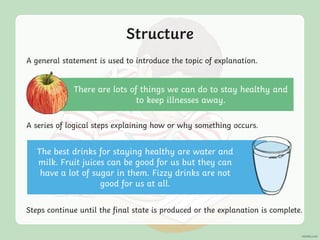
A general statement is used to introduce the topic of explanation.
A series of logical steps explaining how or why something occurs.
Steps continue until the final state is produced or the explanation is complete.
There are lots of things we can do to stay healthy and
to keep illnesses away.
The best drinks for staying healthy are water and
milk. Fruit juices can be good for us but they can
have a lot of sugar in them. Fizzy drinks are not
good for us at all.
Features
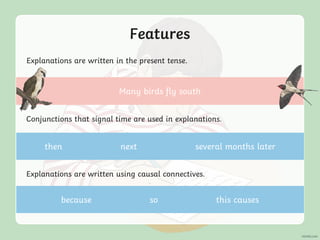
Explanations are written in the present tense.
Conjunctions that signal time are used in explanations.
then next several months later
Explanations are written using causal connectives.
because so this causes
Many birds fly south
Features
• Title – explains what the text is for
• Opening Statement – about the subject
• Clear, simple points about why or how something occurs
• Technical words – where appropriate
• Conjunctions – e.g. because, resulting in
• Present tense
• Summary Paragraph
Using how
or why in a
title helps.
Use a clear title
that indicates
what you are
writing about.
Title and
Introduction
Use the first
paragraph to
introduce the
subject to the
reader.
Try to make the
title intrigue
the reader.
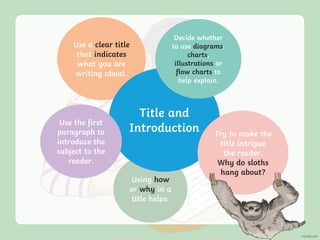
Why do sloths
hang about?
Decide whether
to use diagrams,
charts,
illustrations or
flow charts to
help explain.
Organise the writing and illustrations to explain:
• What you need.
• How it works.
• Why it works.
• When and where it works.
• What it is used for.
• Add in extra, interesting information.
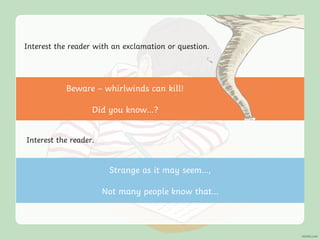
Interest the reader with an exclamation or question.
Interest the reader.
Strange as it may seem…,
Not many people know that…
Beware – whirlwinds can kill!
Did you know...?
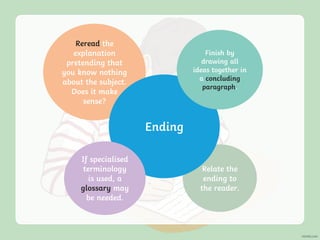
Relate the
ending to
the reader.
Reread the
explanation
pretending that
you know nothing
about the subject.
Does it make
sense?
Ending
If specialised
terminology
is used, a
glossary may
be needed.
Finish by
drawing all
ideas together in
a concluding
paragraph.
T2-E-199-Tips-for-Writing-Explanation-Powerpoint_ver_2.pptx

T2-E-199-Tips-for-Writing-Explanation-Powerpoint_ver_2.pptx

  • 2.
    Explanation Tells us howsomething works or gives us information about something. Purpose
  • 3.
    Structure A general statementis used to introduce the topic of explanation. A series of logical steps explaining how or why something occurs. Steps continue until the final state is produced or the explanation is complete. There are lots of things we can do to stay healthy and to keep illnesses away. The best drinks for staying healthy are water and milk. Fruit juices can be good for us but they can have a lot of sugar in them. Fizzy drinks are not good for us at all.
  • 4.
    Features Explanations are writtenin the present tense. Conjunctions that signal time are used in explanations. then next several months later Explanations are written using causal connectives. because so this causes Many birds fly south
  • 5.
    Features • Title –explains what the text is for • Opening Statement – about the subject • Clear, simple points about why or how something occurs • Technical words – where appropriate • Conjunctions – e.g. because, resulting in • Present tense • Summary Paragraph
  • 6.
    Using how or whyin a title helps. Use a clear title that indicates what you are writing about. Title and Introduction Use the first paragraph to introduce the subject to the reader. Try to make the title intrigue the reader. Why do sloths hang about? Decide whether to use diagrams, charts, illustrations or flow charts to help explain.
  • 7.
    Organise the writingand illustrations to explain: • What you need. • How it works. • Why it works. • When and where it works. • What it is used for. • Add in extra, interesting information.
  • 8.
    Interest the readerwith an exclamation or question. Interest the reader. Strange as it may seem…, Not many people know that… Beware – whirlwinds can kill! Did you know...?
  • 9.
    Relate the ending to thereader. Reread the explanation pretending that you know nothing about the subject. Does it make sense? Ending If specialised terminology is used, a glossary may be needed. Finish by drawing all ideas together in a concluding paragraph.