SYSTEMATICALLY IMPROVING
SALES FORECAST ACCURACY
Bob Apollo | Inflexion-Point | 12-May-2016
50+ PROJECTS
SALES
FORECAST
ACCURACY
NO BETTER THAN A COIN FLIP?
Average win rate of
forecasted deals
remains stubbornly
stuck below 50%
CSO Insights
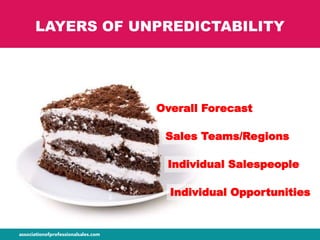
LAYERS OF UNPREDICTABILITY
Overall Forecast
Sales Teams/Regions
Individual Opportunities
Individual Salespeople
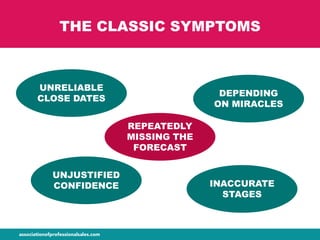
THE CLASSIC SYMPTOMS
UNRELIABLE
CLOSE DATES
DEPENDING
ON MIRACLES
UNJUSTIFIED
CONFIDENCE INACCURATE
STAGES
REPEATEDLY
MISSING THE
FORECAST
DISCIPLINE
PROCESS
RIGOUR
DISCIPLINE
PROCESS
RIGOUR
“If you can't describe what you
are doing as a process, you
don't know what you're doing.”
W Edwards Deming
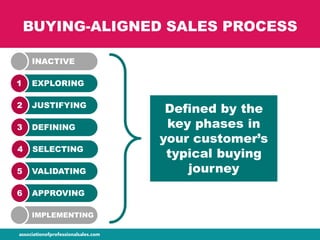
BUYING-ALIGNED SALES PROCESS
EXPLORING1
JUSTIFYING2
DEFINING3
SELECTING4
VALIDATING5
APPROVING6
INACTIVE
IMPLEMENTING
Defined by the
key phases in
your customer’s
typical buying
journey
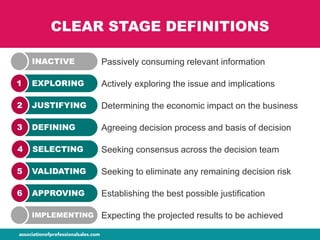
CLEAR STAGE DEFINITIONS
EXPLORING1
JUSTIFYING2
DEFINING3
SELECTING4
VALIDATING5
APPROVING6
INACTIVE
IMPLEMENTING
Actively exploring the issue and implications
Passively consuming relevant information
Determining the economic impact on the business
Agreeing decision process and basis of decision
Seeking consensus across the decision team
Seeking to eliminate any remaining decision risk
Establishing the best possible justification
Expecting the projected results to be achieved
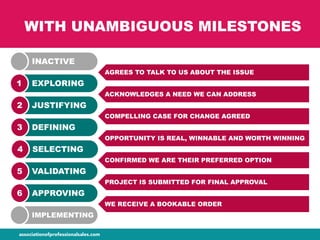
WITH UNAMBIGUOUS MILESTONES
EXPLORING1
JUSTIFYING2
DEFINING3
SELECTING4
VALIDATING5
APPROVING6
INACTIVE
IMPLEMENTING
AGREES TO TALK TO US ABOUT THE ISSUE
ACKNOWLEDGES A NEED WE CAN ADDRESS
COMPELLING CASE FOR CHANGE AGREED
OPPORTUNITY IS REAL, WINNABLE AND WORTH WINNING
CONFIRMED WE ARE THEIR PREFERRED OPTION
PROJECT IS SUBMITTED FOR FINAL APPROVAL
WE RECEIVE A BOOKABLE ORDER
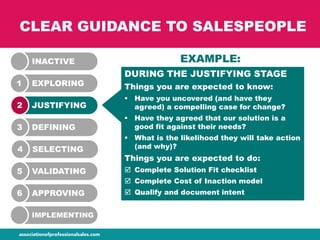
CLEAR GUIDANCE TO SALESPEOPLE
EXPLORING1
JUSTIFYING2
DEFINING3
SELECTING4
VALIDATING5
APPROVING6
INACTIVE
IMPLEMENTING
DURING THE JUSTIFYING STAGE
Things you are expected to know:
 Have you uncovered (and have they
agreed) a compelling case for change?
 Have they agreed that our solution is a
good fit against their needs?
 What is the likelihood they will take action
(and why)?
Things you are expected to do:
 Complete Solution Fit checklist
 Complete Cost of Inaction model
 Qualify and document intent
EXAMPLE:
We need to identify our
most valuable prospects,
educate them on critical
issues and establish a
reputation as experts
NEED TO KNOW
 How do we identify our
ideal prospects?
 What critical issues
should we focus on?
 How can we detect
indications of interest?
NEED TO DO
 Research the market
 Build target database
 Targeted marketing
CRITICAL MILESTONE
The prospect agrees to
talk to us about the issue
We need to learn more
about the prospect’s
situation, shape their
thinking and start the
qualification process
NEED TO KNOW
 How did they become
aware of the issue?
 What impact is the
issue having on them?
 Who else is likely to be
affected by the issue?
NEED TO DO
 Problem fit checklist
 Identify stakeholders
 Qualify interest
CRITICAL MILESTONE
They acknowledge a
need we can address
We need to confirm
technical and
commercial fit and
decide whether
opportunity is real and
winnable
NEED TO KNOW
 Is there a compelling
case for change?
 How good is our
solution fit?
 What is the likelihood
they will take action?
NEED TO DO
 Solution fit checklist
 Complete COI model
 Qualify intent
CRITICAL MILESTONE
We conclude they are
likely to take action
We need to shape their
requirements, influence
their decision criteria,
identify our competition
and get on their shortlist
NEED TO KNOW
 What other options are
they considering?
 Who is on the decision
making team?
 How will they decide
which one to adopt?
NEED TO DO
 Create buying vision
 Influence criteria
 Qualify process
CRITICAL MILESTONE
We conclude deal is real
and winnable
We need to develop a
compelling proposal,
become their preferred
solution, and eliminate all
other available options
NEED TO KNOW
 What do we need to do
to get selected?
 Have we established
clear differentiation?
 How can we eliminate
all other options?
NEED TO DO
 Position for success
 Establish superiority
 Confirm selection
CRITICAL MILESTONE
We are informed that we
are their preferred option
We need to eliminate all
remaining issues, agree
mutually acceptable
terms, and get ready for
final formal approval
NEED TO KNOW
 What do we need to do
to agree terms?
 How can we eliminate
any reservations?
 How can we optimise
business case?
NEED TO DO
 Finalise contract terms
 Eliminate reservations
 Finalise business case
CRITICAL MILESTONE
The project is submitted
for final approval
We need to fully support
our sponsor(s) in their
submission of the project
to the final formal
approval process
NEED TO KNOW
 What determines if the
project is approved?
 How can we support
the approval process?
 How can we maximise
our chances of
success?
NEED TO DO
 Support sponsor
 Prepare for order
 Get approved
CRITICAL MILESTONE
We receive a bookable
order
We need to ensure that
the project delivers the
expected benefits and
that the customer will
recommend us to others
NEED TO KNOW
 Are expected benefits
being achieved?
 Is customer prepared
to recommend us?
 Are there any
prospects they could
refer us to?
NEED TO DO
 Support project rollout
 Deliver benefits
 Get recommended
CRITICAL MILESTONE
We receive a bookable
order
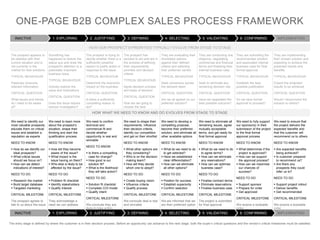
ONE-PAGE B2B COMPLEX SALES PROCESS FRAMEWORK
The entry stage is defined by where the customer is in their decision process. Before an opportunity can advance to the next stage, both the buyer’s critical questions and the vendor’s critical milestones must be satisfied.
The prospect appears to
be satisfied with their
current situation and is
not currently in the
market for new solutions
TYPICAL BEHAVIOUR
Passively consume
relevant information
CRITICAL QUESTION
What issues and trends
do I need to be aware
of?
Something has
happened to disturb the
status quo and draw the
prospect's attention to a
potentially important
business issue
TYPICAL BEHAVIOUR
Actively explore the
issue and implications
CRITICAL QUESTION
Does this issue require
serious investigation?
The prospect is trying to
decide whether there is a
sufficiently powerful
reason to justify action in
response to the issue
TYPICAL BEHAVIOUR
Determine the economic
impact on the business
CRITICAL QUESTION
Is there a sufficiently
compelling reason to
act?
The prospect has
decided to act and are in
the process of defining
their requirements,
priorities and decision
criteria
TYPICAL BEHAVIOUR
Agree decision process
and basis of decision
CRITICAL QUESTION
How are we going to
choose the best
solution?
They are evaluating their
shortlisted options
against their defined
criteria and selecting
their preferred vendor
TYPICAL BEHAVIOUR
Seek consensus across
the decision team
CRITICAL QUESTION
Are we all agreed on our
preferred solution?
They are conducting due
diligence, negotiating
commercial and financial
terms and finalising their
internal business case
TYPICAL BEHAVIOUR
Seek to eliminate any
remaining decision risk
CRITICAL QUESTION
Have we negotiated the
best possible outcome?
They are submitting the
recommended solution
and associated internal
business case for final
formal approval
TYPICAL BEHAVIOUR
Establish the best
possible justification
CRITICAL QUESTION
Do we have formal
approval to proceed?
They are implementing
their chosen solution and
expecting to achieve the
predicted results and
benefits
TYPICAL BEHAVIOUR
Expect the projected
results to be achieved
CRITICAL QUESTION
Would I recommend the
solution to others?
IMPLEMENTING6: CONFIRMING5: VALIDATING4: SELECTING3: DEFINING2: JUSTIFYING1: EXPLORINGINACTIVE
HOW OUR PROSPECT’S PRIORITIES TYPICALLY EVOLVE FROM STAGE TO STAGE
HOW WHAT WE NEED TO KNOW AND DO EVOLVES FROM STAGE TO STAGE
IMPLEMENTING6: CONFIRMING5: VALIDATING4: SELECTING3: DEFINING2: JUSTIFYING1: EXPLORINGINACTIVE
Clear
Forecasting
Guidelines
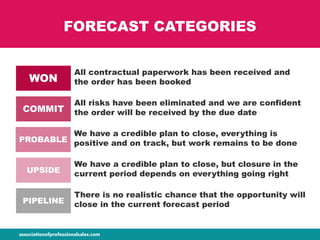
FORECAST CATEGORIES
WON
All contractual paperwork has been received and
the order has been booked
COMMIT
All risks have been eliminated and we are confident
the order will be received by the due date
PROBABLE
We have a credible plan to close, everything is
positive and on track, but work remains to be done
UPSIDE
We have a credible plan to close, but closure in the
current period depends on everything going right
PIPELINE
There is no realistic chance that the opportunity will
close in the current forecast period
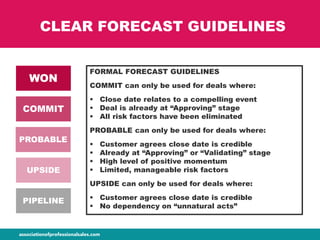
CLEAR FORECAST GUIDELINES
FORMAL FORECAST GUIDELINES
COMMIT can only be used for deals where:
 Close date relates to a compelling event
 Deal is already at “Approving” stage
 All risk factors have been eliminated
PROBABLE can only be used for deals where:
 Customer agrees close date is credible
 Already at “Approving” or “Validating” stage
 High level of positive momentum
 Limited, manageable risk factors
UPSIDE can only be used for deals where:
 Customer agrees close date is credible
 No dependency on “unnatural acts”
WON
COMMIT
PROBABLE
UPSIDE
PIPELINE
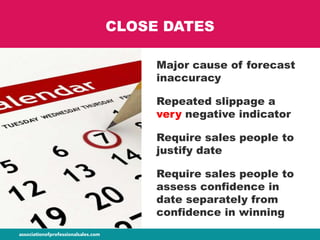
CLOSE DATES
Major cause of forecast
inaccuracy
Repeated slippage a
very negative indicator
Require sales people to
justify date
Require sales people to
assess confidence in
date separately from
confidence in winning
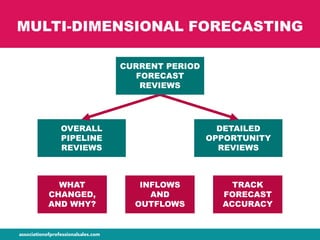
MULTI-DIMENSIONAL FORECASTING
OVERALL
PIPELINE
REVIEWS
DETAILED
OPPORTUNITY
REVIEWS
CURRENT PERIOD
FORECAST
REVIEWS
WHAT
CHANGED,
AND WHY?
TRACK
FORECAST
ACCURACY
INFLOWS
AND
OUTFLOWS
SUMMARY
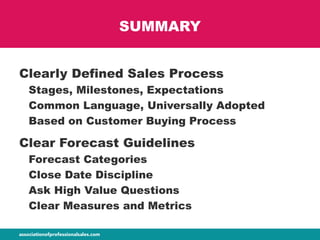
Clearly Defined Sales Process
Stages, Milestones, Expectations
Common Language, Universally Adopted
Based on Customer Buying Process
Clear Forecast Guidelines
Forecast Categories
Close Date Discipline
Ask High Value Questions
Clear Measures and Metrics
Beyond
the
Basics
Ensuring Your
Sales Process
is Adopted
THE CRITICAL TRANSFORMATION
ADMINISTRATION LIBERATION
A SIMPLE METAPHOR
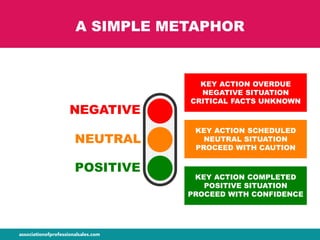
NEGATIVE
NEUTRAL
POSITIVE
KEY ACTION OVERDUE
NEGATIVE SITUATION
CRITICAL FACTS UNKNOWN
KEY ACTION SCHEDULED
NEUTRAL SITUATION
PROCEED WITH CAUTION
KEY ACTION COMPLETED
POSITIVE SITUATION
PROCEED WITH CONFIDENCE
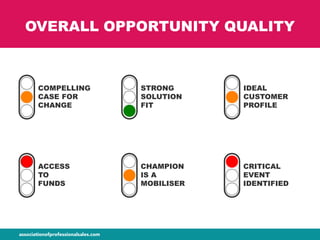
OVERALL OPPORTUNITY QUALITY
COMPELLING
CASE FOR
CHANGE
STRONG
SOLUTION
FIT
IDEAL
CUSTOMER
PROFILE
ACCESS
TO
FUNDS
CHAMPION
IS A
MOBILISER
CRITICAL
EVENT
IDENTIFIED
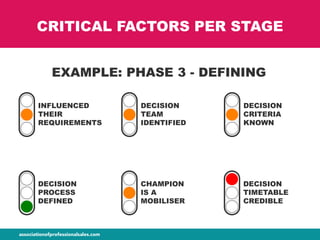
CRITICAL FACTORS PER STAGE
INFLUENCED
THEIR
REQUIREMENTS
DECISION
TEAM
IDENTIFIED
DECISION
CRITERIA
KNOWN
DECISION
PROCESS
DEFINED
CHAMPION
IS A
MOBILISER
DECISION
TIMETABLE
CREDIBLE
EXAMPLE: PHASE 3 - DEFINING
PROVEN POWER OF CHECKLISTS
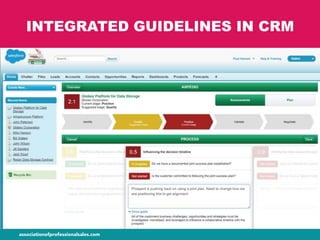
INTEGRATED GUIDELINES IN CRM
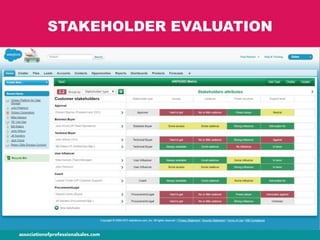
STAKEHOLDER EVALUATION
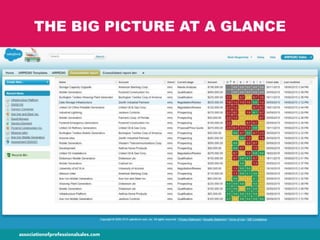
THE BIG PICTURE AT A GLANCE
The Compelling
Case for Sales
Analytics
“What just happened to my
sales pipeline - and why?”
Every Sales Leader
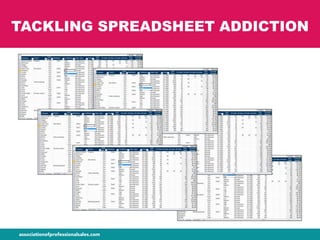
TACKLING SPREADSHEET ADDICTION
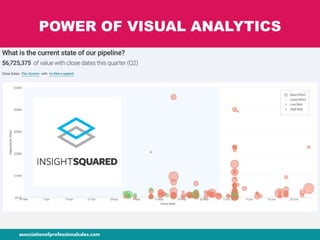
POWER OF VISUAL ANALYTICS
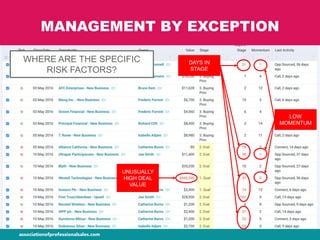
MANAGEMENT BY EXCEPTION
UNUSUALLY
HIGH DEAL
VALUE
LOW
MOMENTUM
DAYS IN
STAGE
WHERE ARE THE SPECIFIC
RISK FACTORS?
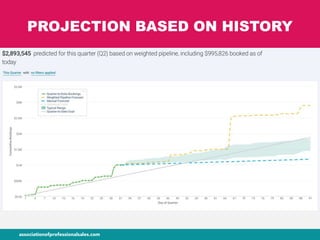
PROJECTION BASED ON HISTORY
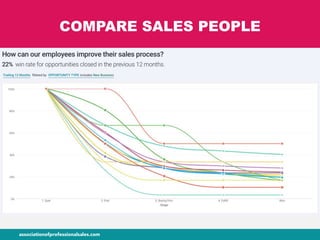
COMPARE SALES PEOPLE
SYSTEMATICALLY
IMPROVING
SALES FORECAST
ACCURAY
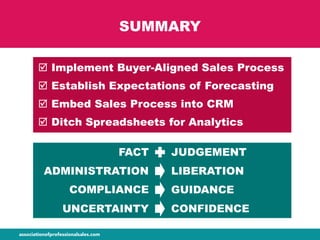
SUMMARY
 Implement Buyer-Aligned Sales Process
 Establish Expectations of Forecasting
 Embed Sales Process into CRM
 Ditch Spreadsheets for Analytics
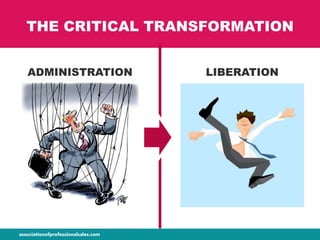
ADMINISTRATION LIBERATION
COMPLIANCE GUIDANCE
UNCERTAINTY CONFIDENCE
FACT JUDGEMENT
SALES PROCESS GUIDE
http://www.inflexion-point.com/sales-process-design-form
WANT TO LEARN MORE?
http://www.inflexion-point.com/arpedio
http://www.inflexion-point.com/insightsquared
Bob Apollo
bob@inflexion-point.com
www.inflexion-point.com
+44 7802 313300
http://www.inflexion-point.com/sales-process-design-form
APS ANNUAL CONFERENCE

Systematically Improving Sales Forecast Accuracy

  • 1.
    SYSTEMATICALLY IMPROVING SALES FORECASTACCURACY Bob Apollo | Inflexion-Point | 12-May-2016
  • 2.
  • 3.
  • 4.
    NO BETTER THANA COIN FLIP? Average win rate of forecasted deals remains stubbornly stuck below 50% CSO Insights
  • 5.
    LAYERS OF UNPREDICTABILITY OverallForecast Sales Teams/Regions Individual Opportunities Individual Salespeople
  • 6.
    THE CLASSIC SYMPTOMS UNRELIABLE CLOSEDATES DEPENDING ON MIRACLES UNJUSTIFIED CONFIDENCE INACCURATE STAGES REPEATEDLY MISSING THE FORECAST
  • 7.
  • 8.
  • 9.
    “If you can'tdescribe what you are doing as a process, you don't know what you're doing.” W Edwards Deming
  • 10.
  • 11.
    CLEAR STAGE DEFINITIONS EXPLORING1 JUSTIFYING2 DEFINING3 SELECTING4 VALIDATING5 APPROVING6 INACTIVE IMPLEMENTING Activelyexploring the issue and implications Passively consuming relevant information Determining the economic impact on the business Agreeing decision process and basis of decision Seeking consensus across the decision team Seeking to eliminate any remaining decision risk Establishing the best possible justification Expecting the projected results to be achieved
  • 12.
    WITH UNAMBIGUOUS MILESTONES EXPLORING1 JUSTIFYING2 DEFINING3 SELECTING4 VALIDATING5 APPROVING6 INACTIVE IMPLEMENTING AGREESTO TALK TO US ABOUT THE ISSUE ACKNOWLEDGES A NEED WE CAN ADDRESS COMPELLING CASE FOR CHANGE AGREED OPPORTUNITY IS REAL, WINNABLE AND WORTH WINNING CONFIRMED WE ARE THEIR PREFERRED OPTION PROJECT IS SUBMITTED FOR FINAL APPROVAL WE RECEIVE A BOOKABLE ORDER
  • 13.
    CLEAR GUIDANCE TOSALESPEOPLE EXPLORING1 JUSTIFYING2 DEFINING3 SELECTING4 VALIDATING5 APPROVING6 INACTIVE IMPLEMENTING DURING THE JUSTIFYING STAGE Things you are expected to know:  Have you uncovered (and have they agreed) a compelling case for change?  Have they agreed that our solution is a good fit against their needs?  What is the likelihood they will take action (and why)? Things you are expected to do:  Complete Solution Fit checklist  Complete Cost of Inaction model  Qualify and document intent EXAMPLE:
  • 14.
    We need toidentify our most valuable prospects, educate them on critical issues and establish a reputation as experts NEED TO KNOW  How do we identify our ideal prospects?  What critical issues should we focus on?  How can we detect indications of interest? NEED TO DO  Research the market  Build target database  Targeted marketing CRITICAL MILESTONE The prospect agrees to talk to us about the issue We need to learn more about the prospect’s situation, shape their thinking and start the qualification process NEED TO KNOW  How did they become aware of the issue?  What impact is the issue having on them?  Who else is likely to be affected by the issue? NEED TO DO  Problem fit checklist  Identify stakeholders  Qualify interest CRITICAL MILESTONE They acknowledge a need we can address We need to confirm technical and commercial fit and decide whether opportunity is real and winnable NEED TO KNOW  Is there a compelling case for change?  How good is our solution fit?  What is the likelihood they will take action? NEED TO DO  Solution fit checklist  Complete COI model  Qualify intent CRITICAL MILESTONE We conclude they are likely to take action We need to shape their requirements, influence their decision criteria, identify our competition and get on their shortlist NEED TO KNOW  What other options are they considering?  Who is on the decision making team?  How will they decide which one to adopt? NEED TO DO  Create buying vision  Influence criteria  Qualify process CRITICAL MILESTONE We conclude deal is real and winnable We need to develop a compelling proposal, become their preferred solution, and eliminate all other available options NEED TO KNOW  What do we need to do to get selected?  Have we established clear differentiation?  How can we eliminate all other options? NEED TO DO  Position for success  Establish superiority  Confirm selection CRITICAL MILESTONE We are informed that we are their preferred option We need to eliminate all remaining issues, agree mutually acceptable terms, and get ready for final formal approval NEED TO KNOW  What do we need to do to agree terms?  How can we eliminate any reservations?  How can we optimise business case? NEED TO DO  Finalise contract terms  Eliminate reservations  Finalise business case CRITICAL MILESTONE The project is submitted for final approval We need to fully support our sponsor(s) in their submission of the project to the final formal approval process NEED TO KNOW  What determines if the project is approved?  How can we support the approval process?  How can we maximise our chances of success? NEED TO DO  Support sponsor  Prepare for order  Get approved CRITICAL MILESTONE We receive a bookable order We need to ensure that the project delivers the expected benefits and that the customer will recommend us to others NEED TO KNOW  Are expected benefits being achieved?  Is customer prepared to recommend us?  Are there any prospects they could refer us to? NEED TO DO  Support project rollout  Deliver benefits  Get recommended CRITICAL MILESTONE We receive a bookable order ONE-PAGE B2B COMPLEX SALES PROCESS FRAMEWORK The entry stage is defined by where the customer is in their decision process. Before an opportunity can advance to the next stage, both the buyer’s critical questions and the vendor’s critical milestones must be satisfied. The prospect appears to be satisfied with their current situation and is not currently in the market for new solutions TYPICAL BEHAVIOUR Passively consume relevant information CRITICAL QUESTION What issues and trends do I need to be aware of? Something has happened to disturb the status quo and draw the prospect's attention to a potentially important business issue TYPICAL BEHAVIOUR Actively explore the issue and implications CRITICAL QUESTION Does this issue require serious investigation? The prospect is trying to decide whether there is a sufficiently powerful reason to justify action in response to the issue TYPICAL BEHAVIOUR Determine the economic impact on the business CRITICAL QUESTION Is there a sufficiently compelling reason to act? The prospect has decided to act and are in the process of defining their requirements, priorities and decision criteria TYPICAL BEHAVIOUR Agree decision process and basis of decision CRITICAL QUESTION How are we going to choose the best solution? They are evaluating their shortlisted options against their defined criteria and selecting their preferred vendor TYPICAL BEHAVIOUR Seek consensus across the decision team CRITICAL QUESTION Are we all agreed on our preferred solution? They are conducting due diligence, negotiating commercial and financial terms and finalising their internal business case TYPICAL BEHAVIOUR Seek to eliminate any remaining decision risk CRITICAL QUESTION Have we negotiated the best possible outcome? They are submitting the recommended solution and associated internal business case for final formal approval TYPICAL BEHAVIOUR Establish the best possible justification CRITICAL QUESTION Do we have formal approval to proceed? They are implementing their chosen solution and expecting to achieve the predicted results and benefits TYPICAL BEHAVIOUR Expect the projected results to be achieved CRITICAL QUESTION Would I recommend the solution to others? IMPLEMENTING6: CONFIRMING5: VALIDATING4: SELECTING3: DEFINING2: JUSTIFYING1: EXPLORINGINACTIVE HOW OUR PROSPECT’S PRIORITIES TYPICALLY EVOLVE FROM STAGE TO STAGE HOW WHAT WE NEED TO KNOW AND DO EVOLVES FROM STAGE TO STAGE IMPLEMENTING6: CONFIRMING5: VALIDATING4: SELECTING3: DEFINING2: JUSTIFYING1: EXPLORINGINACTIVE
  • 15.
  • 16.
    FORECAST CATEGORIES WON All contractualpaperwork has been received and the order has been booked COMMIT All risks have been eliminated and we are confident the order will be received by the due date PROBABLE We have a credible plan to close, everything is positive and on track, but work remains to be done UPSIDE We have a credible plan to close, but closure in the current period depends on everything going right PIPELINE There is no realistic chance that the opportunity will close in the current forecast period
  • 17.
    CLEAR FORECAST GUIDELINES FORMALFORECAST GUIDELINES COMMIT can only be used for deals where:  Close date relates to a compelling event  Deal is already at “Approving” stage  All risk factors have been eliminated PROBABLE can only be used for deals where:  Customer agrees close date is credible  Already at “Approving” or “Validating” stage  High level of positive momentum  Limited, manageable risk factors UPSIDE can only be used for deals where:  Customer agrees close date is credible  No dependency on “unnatural acts” WON COMMIT PROBABLE UPSIDE PIPELINE
  • 18.
    CLOSE DATES Major causeof forecast inaccuracy Repeated slippage a very negative indicator Require sales people to justify date Require sales people to assess confidence in date separately from confidence in winning
  • 19.
  • 20.
    SUMMARY Clearly Defined SalesProcess Stages, Milestones, Expectations Common Language, Universally Adopted Based on Customer Buying Process Clear Forecast Guidelines Forecast Categories Close Date Discipline Ask High Value Questions Clear Measures and Metrics
  • 21.
  • 22.
  • 23.
  • 24.
    A SIMPLE METAPHOR NEGATIVE NEUTRAL POSITIVE KEYACTION OVERDUE NEGATIVE SITUATION CRITICAL FACTS UNKNOWN KEY ACTION SCHEDULED NEUTRAL SITUATION PROCEED WITH CAUTION KEY ACTION COMPLETED POSITIVE SITUATION PROCEED WITH CONFIDENCE
  • 25.
    OVERALL OPPORTUNITY QUALITY COMPELLING CASEFOR CHANGE STRONG SOLUTION FIT IDEAL CUSTOMER PROFILE ACCESS TO FUNDS CHAMPION IS A MOBILISER CRITICAL EVENT IDENTIFIED
  • 26.
    CRITICAL FACTORS PERSTAGE INFLUENCED THEIR REQUIREMENTS DECISION TEAM IDENTIFIED DECISION CRITERIA KNOWN DECISION PROCESS DEFINED CHAMPION IS A MOBILISER DECISION TIMETABLE CREDIBLE EXAMPLE: PHASE 3 - DEFINING
  • 27.
    PROVEN POWER OFCHECKLISTS
  • 28.
  • 29.
  • 30.
    THE BIG PICTUREAT A GLANCE
  • 31.
    The Compelling Case forSales Analytics
  • 32.
    “What just happenedto my sales pipeline - and why?” Every Sales Leader
  • 33.
  • 34.
    POWER OF VISUALANALYTICS
  • 35.
    MANAGEMENT BY EXCEPTION UNUSUALLY HIGHDEAL VALUE LOW MOMENTUM DAYS IN STAGE WHERE ARE THE SPECIFIC RISK FACTORS?
  • 36.
  • 37.
  • 38.
  • 39.
    SUMMARY  Implement Buyer-AlignedSales Process  Establish Expectations of Forecasting  Embed Sales Process into CRM  Ditch Spreadsheets for Analytics ADMINISTRATION LIBERATION COMPLIANCE GUIDANCE UNCERTAINTY CONFIDENCE FACT JUDGEMENT
  • 40.
  • 41.
    WANT TO LEARNMORE? http://www.inflexion-point.com/arpedio http://www.inflexion-point.com/insightsquared Bob Apollo bob@inflexion-point.com www.inflexion-point.com +44 7802 313300 http://www.inflexion-point.com/sales-process-design-form
  • 42.