PROJECT MANAGEMENT FOR MARKETERS
April 27, 2017
© 2017 Proprietary & Confidential 1
How Project Management can give you an edge in shaping outcomes
Today’s speakers
© 2017 Proprietary & Confidential 2
Jeff Thaler Bill Hewson
• PM/Process Consultant
• 15+ years experience
• Small-Large B2B and B2C
• Finance, Pharma, Auto
• Marketing
Strategist/Agency
Leader
• 20+ years experience
• AMEX, Kraft, Philips,
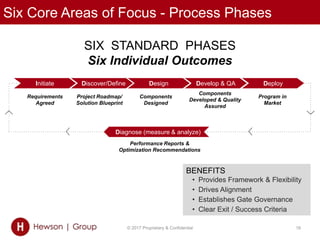
StarWood Hotels, GM
Agenda
• What is Project Management?
• Project Management Planning & Delivery Process
• Project Management Elements
• “Real-World” Example Walk Through
• Q&A
© 2017 Proprietary & Confidential 4
What We Want You to Take Away
• How Project Management is defined
• Why PM’s important and helpful for doing your work
more confidently
• How to get better results in your projects
• Tools and methods you can start applying immediately in
your day to day
© 2017 Proprietary & Confidential 5
© 2017 Proprietary & Confidential 6
What is Project Management?
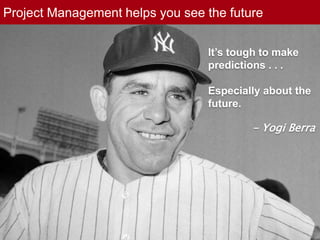
Project Management helps you see the future
It’s tough to make
predictions . . .
Especially about the
future.
- Yogi Berra
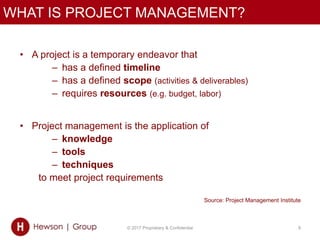
WHAT IS PROJECT MANAGEMENT?
• A project is a temporary endeavor that
– has a defined timeline
– has a defined scope (activities & deliverables)
– requires resources (e.g. budget, labor)
• Project management is the application of
– knowledge
– tools
– techniques
to meet project requirements
Source: Project Management Institute
© 2017 Proprietary & Confidential 8
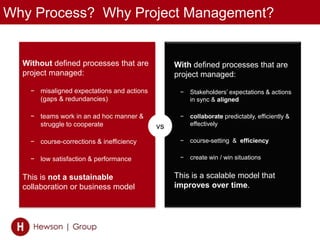
Why Process? Why Project Management?
Without defined processes that are
project managed:
− misaligned expectations and actions
(gaps & redundancies)
− teams work in an ad hoc manner &
struggle to cooperate
− course-corrections & inefficiency
− low satisfaction & performance
This is not a sustainable
collaboration or business model
With defined processes that are
project managed:
− Stakeholders’ expectations & actions
in sync & aligned
− collaborate predictably, efficiently &
effectively
− course-setting & efficiency
− create win / win situations
This is a scalable model that
improves over time.
vs
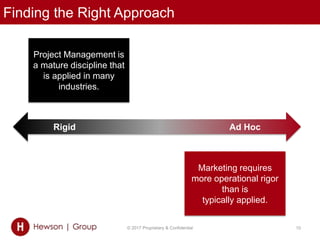
Finding the Right Approach
© 2017 Proprietary & Confidential 10
Project Management is
a mature discipline that
is applied in many
industries.
Rigid Ad Hoc
Marketing requires
more operational rigor
than is
typically applied.
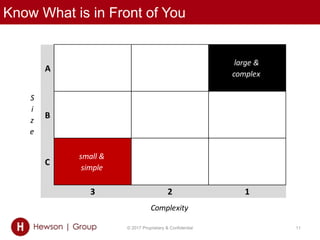
Know What is in Front of You
© 2017 Proprietary & Confidential 11
A
large &
complex
B
C
small &
simple
3 2 1
S
i
z
e
Complexity
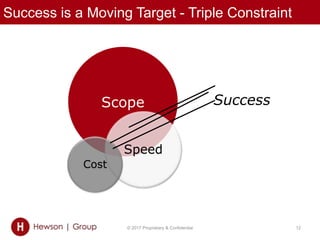
Success is a Moving Target - Triple Constraint
© 2017 Proprietary & Confidential 12
Scope
Speed
Cost
Success
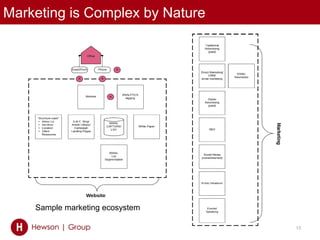
Marketing is Complex by Nature
© 2017 Proprietary & Confidential 13
Sample marketing ecosystem
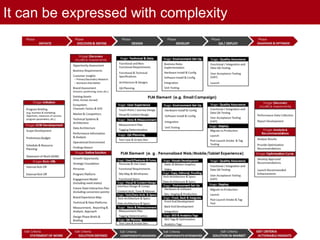
It can be expressed with complexity
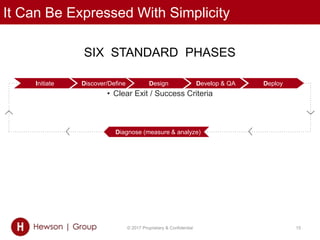
It Can Be Expressed With Simplicity
© 2017 Proprietary & Confidential 15
`
Diagnose (measure & analyze)
Initiate Discover/Define Design Develop & QA Deploy
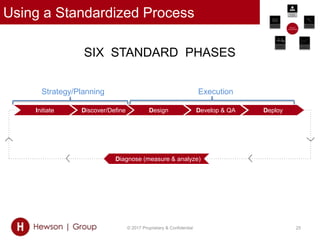
SIX STANDARD PHASES
• Clear Exit / Success Criteria
Six Core Areas of Focus - Process Phases

© 2017 Proprietary & Confidential 16
`
Requirements
Agreed
Project Roadmap/
Solution Blueprint
Components
Designed
Components
Developed & Quality
Assured
Program in
Market
BENEFITS
• Provides Framework & Flexibility
• Drives Alignment
• Establishes Gate Governance
• Clear Exit / Success Criteria
Performance Reports &
Optimization Recommendations
Diagnose (measure & analyze)
Initiate Discover/Define Design Develop & QA Deploy
SIX STANDARD PHASES
Six Individual Outcomes
© 2017 Proprietary & Confidential 17
Project Management Planning & Process
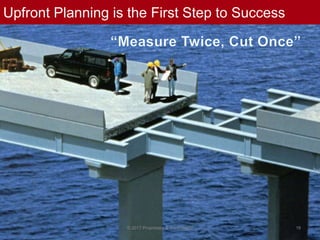
Upfront Planning is the First Step to Success
© 2017 Proprietary & Confidential 18
Upfront Planning is the First Step to Success
© 2017 Proprietary & Confidential 19
Measure Twice, Cut Once
– Ensures project alignment to company/team
objectives
– Less (or no) surprises to project team and
sponsors
– Necessary resources identified upfront
– Improves likelihood of a project meeting strategic
objectives
– Creates transparency to management
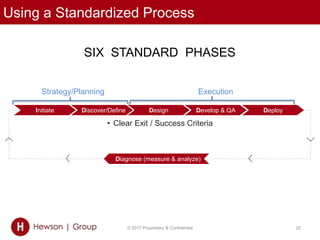
– Allows ID of steps and issues to be improved
Using a Standardized Process
© 2017 Proprietary & Confidential 20
`
Diagnose (measure & analyze)
Initiate Discover/Define Design Develop & QA Deploy
SIX STANDARD PHASES
Strategy/Planning Execution
• Clear Exit / Success Criteria
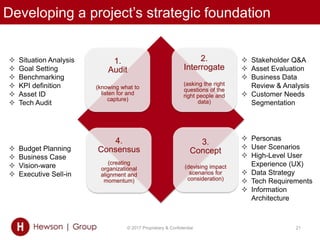
Developing a project’s strategic foundation
© 2017 Proprietary & Confidential 21
1.
Audit
(knowing what to
listen for and
capture)
2.
Interrogate
(asking the right
questions of the
right people and
data)
4.
Consensus
(creating
organizational
alignment and
momentum)
3.
Concept
(devising impact
scenarios for
consideration)
 Situation Analysis
 Goal Setting
 Benchmarking
 KPI definition
 Asset ID
 Tech Audit
 Budget Planning
 Business Case
 Vision-ware
 Executive Sell-in
 Stakeholder Q&A
 Asset Evaluation
 Business Data
Review & Analysis
 Customer Needs
Segmentation
 Personas
 User Scenarios
 High-Level User
Experience (UX)
 Data Strategy
 Tech Requirements
 Information
Architecture
© 2017 Proprietary & Confidential 22
Project Management Tools
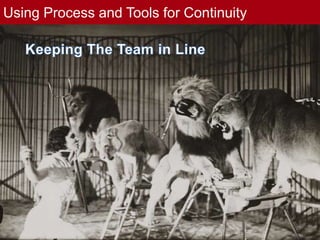
Using Process and Tools for Continuity
© 2017 Proprietary & Confidential 23
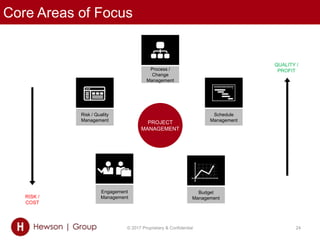
Core Areas of Focus
© 2017 Proprietary & Confidential 24
RISK /
COST
QUALITY /
PROFITProcess /
Change
Management
Budget
Management
Schedule
Management
Engagement
Management
Risk / Quality
Management
PROJECT
MANAGEMENT
Using a Standardized Process
© 2017 Proprietary & Confidential 25
`
Diagnose (measure & analyze)
Initiate Discover/Define Design Develop & QA Deploy
SIX STANDARD PHASES
Strategy/Planning Execution
Core Areas of Focus - Process & Schedule
© 2017 Proprietary & Confidential 26
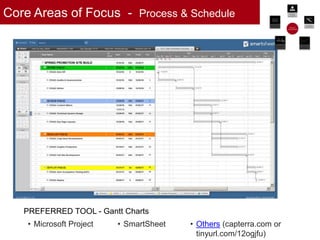
PREFERRED TOOL - Gantt Charts
• Microsoft Project • SmartSheet • Others (capterra.com or
tinyurl.com/12ogjfu)
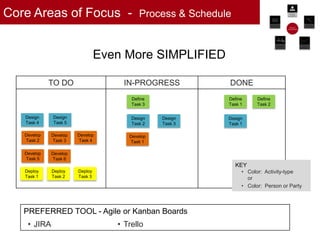
TO DO IN-PROGRESS DONE
Core Areas of Focus - Process & Schedule
Even More SIMPLIFIED
KEY
• Color: Activity-type
or
• Color: Person or Party
PREFERRED TOOL - Agile or Kanban Boards
• JIRA • Trello
Define
Task 3
Design
Task 1
Define
Task 2
Define
Task 1
Design
Task 2
Design
Task 3
Design
Task 4
Develop
Task 1
Develop
Task 2
Design
Task 5
Develop
Task 3
Deploy
Task 1
Develop
Task 4
Develop
Task 5
Develop
Task 6
Deploy
Task 2
Deploy
Task 3
© 2017 Proprietary & Confidential 28
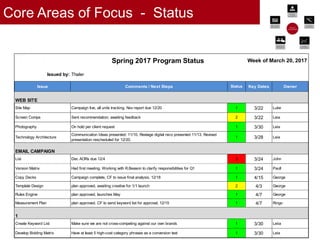
Core Areas of Focus - Status
Issued by: Thaler
Site Map Campaign live, all units tracking. Nov report due 12/20 1 3/22 Luke
Screen Comps Sent recommendation; awaiting feedback 2 3/22 Leia
Photography On hold per client request 1 3/30 Leia
Technology Architecture
Communication Ideas presented: 11/10, Restage digital reco presented 11/13. Revised
presentation rescheduled for 12/20.
1 3/28 Leia
List Dec AORs due 12/4 3 3/24 John
Version Matrix Had first meeting. Working with R.Beason to clarify responsibilities for Q1 1 3/24 Paull
Copy Decks Campaign complete, CF to issue final analysis, 12/18 1 4/15 George
Template Design plan approved, awaiting creative for 1/1 launch 2 4/3 George
Rules Engine plan approved, launches May 1 4/7 George
Measurement Plan plan approved, CF to send keyword list for approval, 12/15 1 4/7 Ringo
Create Keyword List Make sure we are not cross-competing against our own brands 1 3/30 Leiia
Develop Bidding Matrix Have at least 5 high-cost category phrases as a conversion test 1 3/30 Leia
Key Dates OwnerComments / Next StepsIssue
EMAIL CAMPAIGN
Status
WEB SITE
1
Week of March 20, 2017Spring 2017 Program Status
© 2017 Proprietary & Confidential 29
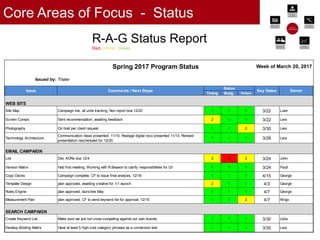
Core Areas of Focus - Status
Issued by: Thaler
Timing Budg. Output
Site Map Campaign live, all units tracking. Nov report due 12/20 1 1 1 3/22 Luke
Screen Comps Sent recommendation; awaiting feedback 2 1 1 3/22 Leia
Photography On hold per client request 1 1 2 3/30 Leia
Technology Architecture
Communication Ideas presented: 11/10, Restage digital reco presented 11/13. Revised
presentation rescheduled for 12/20.
1 1 1 3/28 Leia
List Dec AORs due 12/4 2 3 2 3/24 John
Version Matrix Had first meeting. Working with R.Beason to clarify responsibilities for Q1 1 1 1 3/24 Paull
Copy Decks Campaign complete, CF to issue final analysis, 12/18 1 1 1 4/15 George
Template Design plan approved, awaiting creative for 1/1 launch 2 1 1 4/3 George
Rules Engine plan approved, launches May 1 1 1 4/7 George
Measurement Plan plan approved, CF to send keyword list for approval, 12/15 1 1 2 4/7 Ringo
Create Keyword List Make sure we are not cross-competing against our own brands 1 1 1 3/30 Leiia
Develop Bidding Matrix Have at least 5 high-cost category phrases as a conversion test 1 1 1 3/30 Leia
Key Dates Owner
Status
Comments / Next StepsIssue
EMAIL CAMPAIGN
WEB SITE
SEARCH CAMPAIGN
Week of March 20, 2017Spring 2017 Program Status
R-A-G Status Report
Red, Amber, Green
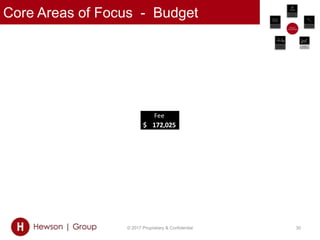
Core Areas of Focus - Budget
© 2017 Proprietary & Confidential 30
Hours Fee
1,750 172,025$
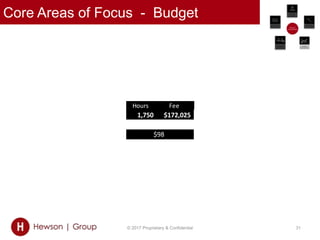
Core Areas of Focus - Budget
© 2017 Proprietary & Confidential 31
Hours Fee
1,750 $172,025
$98
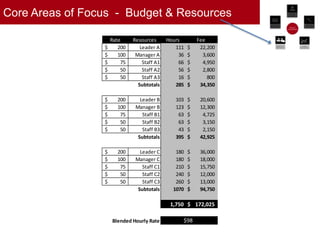
Core Areas of Focus - Budget & Resources
© 2017 Proprietary & Confidential 32
Rate Resources Hours Fee
200$ Leader A 111 22,200$
100$ Manager A 36 3,600$
75$ Staff A1 66 4,950$
50$ Staff A2 56 2,800$
50$ Staff A3 16 800$
Subtotals 285 34,350$
200$ Leader B 103 20,600$
100$ Manager B 123 12,300$
75$ Staff B1 63 4,725$
50$ Staff B2 63 3,150$
50$ Staff B3 43 2,150$
Subtotals 395 42,925$
200$ Leader C 180 36,000$
100$ Manager C 180 18,000$
75$ Staff C1 210 15,750$
50$ Staff C2 240 12,000$
50$ Staff C3 260 13,000$
Subtotals 1070 94,750$
Phase Subtotals 1,750 172,025$
$98Blended Hourly Rate
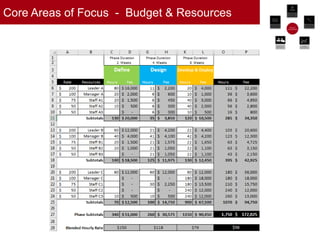
Core Areas of Focus - Budget & Resources
© 2017 Proprietary & Confidential 33
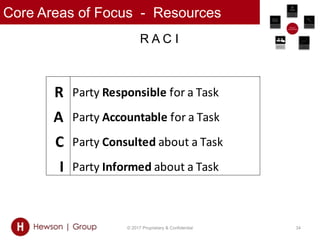
Core Areas of Focus - Resources
© 2017 Proprietary & Confidential 34
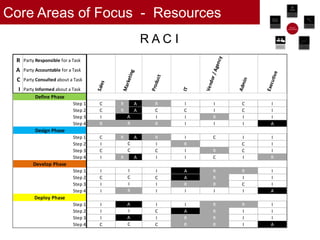
R A C I
R Party Responsible for a Task
A Party Accountable for a Task
C Party Consulted about a Task
I Party Informed about a Task
Core Areas of Focus - Resources
© 2017 Proprietary & Confidential 35
R Party Responsible for a Task
A Party Accountable for a Task
C Party Consulted about a Task
I Party Informed about a Task
C R A R I I C I
C R A C C I C I
I I I R I I
R R I I I A
C R A R I C I I
I I R C I
C C I R C I
I R A I I C I R
I I A R R I
C C A R I I
I I R R C I
I I I I I A
I I I R R I
I C A R I I
I I R R I I
C C R R I A
Design Phase
Sales
Product
Admin
Executive
Vendor/Agency
Define Phase
Step 1
Step 2
Step 3
Step 4
Step 2
Step 1
Step 2
Step 3
Step 4
Develop Phase
Step 1
C
Step 3
Step 4
IT
Marketing
A
R
C
C
I
CStep 2
Step 3
Step 4
Deploy Phase
Step 1
I
R
A
A
I
R A C I
Core Areas of Focus - Risk
© 2017 Proprietary & Confidential 36
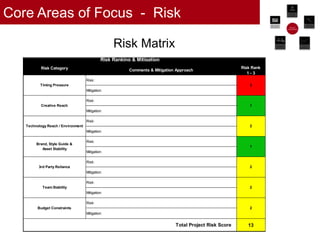
Risk Matrix
Risk Rank
1 - 3
13
Risk Category Comments & Mitigation Approach
Risk Ranking & Mitigation
2
Team Stability
Brand, Style Guide &
Asset Stability
3
1
2
1
2
2
Timing Pressure
Budget Constraints
Risk:
Mitigation:
Risk:
Mitigation:
Total Project Risk Score
3rd Party Reliance
Risk:
Mitigation:
Risk:
Mitigation:
Risk:
Mitigation:
Technology Reach / Environment
Creative Reach
Risk:
Risk:
Mitigation:
Mitigation:
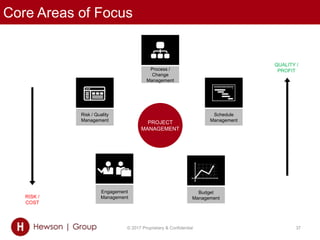
Core Areas of Focus
© 2017 Proprietary & Confidential 37
RISK /
COST
QUALITY /
PROFITProcess /
Change
Management
Budget
Management
Schedule
Management
Engagement
Management
Risk / Quality
Management
PROJECT
MANAGEMENT
Following a Real-World Example
© 2017 Proprietary & Confidential 38
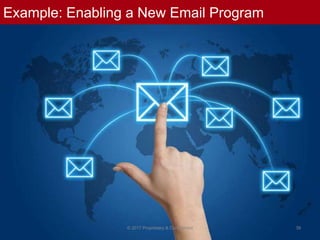
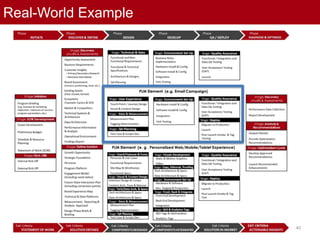
Example: Enabling a New Email Program
© 2017 Proprietary & Confidential 39
Real-World Example
© 2017 Proprietary & Confidential 40
Email Campaign Project Example
Situation
• Product Management is launching a new product
• Marketing wants to reach a segment of existing
customers
− Create awareness
− Drive trial, create habitual use
− Generate customer feedback
− Upsell premium upgrades
• Given the goals & the audience, email is the lead
communications channel
• You have been named project manager
• GO!
© 2017 Proprietary & Confidential 41
Email Campaign Project Example
© 2017 Proprietary & Confidential 42
`
Diagnose (measure & analyze)
Initiate Discover/Define Design Develop & QA Deploy
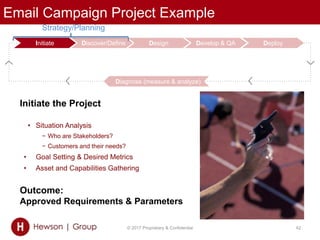
Initiate the Project
• Situation Analysis
− Who are Stakeholders?
− Customers and their needs?
• Goal Setting & Desired Metrics
• Asset and Capabilities Gathering
Outcome:
Approved Requirements & Parameters
Strategy/Planning
Email Campaign Project Example
© 2017 Proprietary & Confidential 43
Initiate Discover/Define Design Develop & QA Deploy
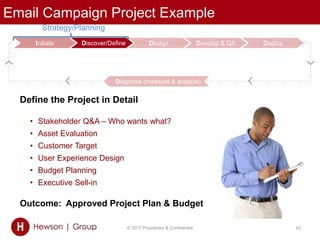
Define the Project in Detail
• Stakeholder Q&A – Who wants what?
• Asset Evaluation
• Customer Target
• User Experience Design
• Budget Planning
• Executive Sell-in
Outcome: Approved Project Plan & Budget
Strategy/Planning
`
Diagnose (measure & analyze)
Email Campaign Project Example
© 2017 Proprietary & Confidential 44
Initiate Discover/Define Design Develop & QA Deploy
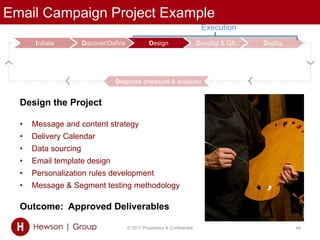
Design the Project
• Message and content strategy
• Delivery Calendar
• Data sourcing
• Email template design
• Personalization rules development
• Message & Segment testing methodology
Outcome: Approved Deliverables
`
Diagnose (measure & analyze)
Execution
Email Campaign Project Example
© 2017 Proprietary & Confidential 45
Initiate Discover/Define Design Develop & QA Deploy
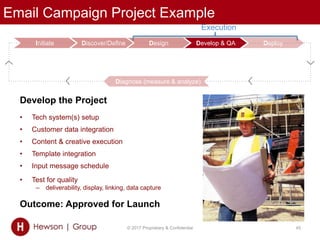
Develop the Project
• Tech system(s) setup
• Customer data integration
• Content & creative execution
• Template integration
• Input message schedule
• Test for quality
– deliverability, display, linking, data capture
Outcome: Approved for Launch
`
Diagnose (measure & analyze)
Execution
Email Campaign Project Example
© 2017 Proprietary & Confidential 46
Initiate Discover/Define Design Develop & QA Deploy
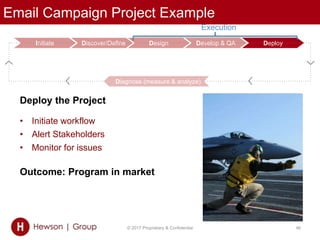
Deploy the Project
• Initiate workflow
• Alert Stakeholders
• Monitor for issues
Outcome: Program in market
`
Diagnose (measure & analyze)
Execution
Email Campaign Project Example
© 2017 Proprietary & Confidential 47
Initiate Discover/Define Design Develop & QA Deploy
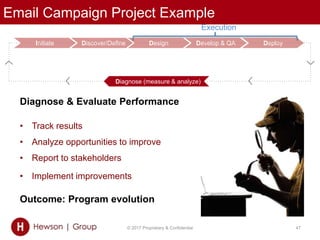
Diagnose & Evaluate Performance
• Track results
• Analyze opportunities to improve
• Report to stakeholders
• Implement improvements
Outcome: Program evolution
`
Diagnose (measure & analyze)
Execution
What We Hope You to Took Away
 How Project Management is defined
 Why PM is important and helpful for doing your work
more confidently
 How to get better results in your projects
 Tools and methods you can start applying immediately
in your day to day
© 2017 Proprietary & Confidential 48
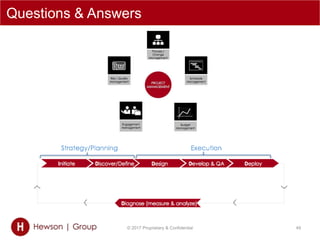
Questions & Answers
© 2017 Proprietary & Confidential 49
Thanks!
Bill Hewson
bill@hewsongroup.com
1.203.610.4649
50
Jeff Thaler
jeffrey.thaler@gmail.com
1.917.214.6357

Project Management for Marketers

  • 1.
    PROJECT MANAGEMENT FORMARKETERS April 27, 2017 © 2017 Proprietary & Confidential 1 How Project Management can give you an edge in shaping outcomes
  • 2.
    Today’s speakers © 2017Proprietary & Confidential 2 Jeff Thaler Bill Hewson • PM/Process Consultant • 15+ years experience • Small-Large B2B and B2C • Finance, Pharma, Auto • Marketing Strategist/Agency Leader • 20+ years experience • AMEX, Kraft, Philips, StarWood Hotels, GM
  • 4.
    Agenda • What isProject Management? • Project Management Planning & Delivery Process • Project Management Elements • “Real-World” Example Walk Through • Q&A © 2017 Proprietary & Confidential 4
  • 5.
    What We WantYou to Take Away • How Project Management is defined • Why PM’s important and helpful for doing your work more confidently • How to get better results in your projects • Tools and methods you can start applying immediately in your day to day © 2017 Proprietary & Confidential 5
  • 6.
    © 2017 Proprietary& Confidential 6 What is Project Management?
  • 7.
    Project Management helpsyou see the future It’s tough to make predictions . . . Especially about the future. - Yogi Berra
  • 8.
    WHAT IS PROJECTMANAGEMENT? • A project is a temporary endeavor that – has a defined timeline – has a defined scope (activities & deliverables) – requires resources (e.g. budget, labor) • Project management is the application of – knowledge – tools – techniques to meet project requirements Source: Project Management Institute © 2017 Proprietary & Confidential 8
  • 9.
    Why Process? WhyProject Management? Without defined processes that are project managed: − misaligned expectations and actions (gaps & redundancies) − teams work in an ad hoc manner & struggle to cooperate − course-corrections & inefficiency − low satisfaction & performance This is not a sustainable collaboration or business model With defined processes that are project managed: − Stakeholders’ expectations & actions in sync & aligned − collaborate predictably, efficiently & effectively − course-setting & efficiency − create win / win situations This is a scalable model that improves over time. vs
  • 10.
    Finding the RightApproach © 2017 Proprietary & Confidential 10 Project Management is a mature discipline that is applied in many industries. Rigid Ad Hoc Marketing requires more operational rigor than is typically applied.
  • 11.
    Know What isin Front of You © 2017 Proprietary & Confidential 11 A large & complex B C small & simple 3 2 1 S i z e Complexity
  • 12.
    Success is aMoving Target - Triple Constraint © 2017 Proprietary & Confidential 12 Scope Speed Cost Success
  • 13.
    Marketing is Complexby Nature © 2017 Proprietary & Confidential 13 Sample marketing ecosystem
  • 14.
    It can beexpressed with complexity
  • 15.
    It Can BeExpressed With Simplicity © 2017 Proprietary & Confidential 15 ` Diagnose (measure & analyze) Initiate Discover/Define Design Develop & QA Deploy SIX STANDARD PHASES • Clear Exit / Success Criteria
  • 16.
    Six Core Areasof Focus - Process Phases © 2017 Proprietary & Confidential 16 ` Requirements Agreed Project Roadmap/ Solution Blueprint Components Designed Components Developed & Quality Assured Program in Market BENEFITS • Provides Framework & Flexibility • Drives Alignment • Establishes Gate Governance • Clear Exit / Success Criteria Performance Reports & Optimization Recommendations Diagnose (measure & analyze) Initiate Discover/Define Design Develop & QA Deploy SIX STANDARD PHASES Six Individual Outcomes
  • 17.
    © 2017 Proprietary& Confidential 17 Project Management Planning & Process
  • 18.
    Upfront Planning isthe First Step to Success © 2017 Proprietary & Confidential 18
  • 19.
    Upfront Planning isthe First Step to Success © 2017 Proprietary & Confidential 19 Measure Twice, Cut Once – Ensures project alignment to company/team objectives – Less (or no) surprises to project team and sponsors – Necessary resources identified upfront – Improves likelihood of a project meeting strategic objectives – Creates transparency to management – Allows ID of steps and issues to be improved
  • 20.
    Using a StandardizedProcess © 2017 Proprietary & Confidential 20 ` Diagnose (measure & analyze) Initiate Discover/Define Design Develop & QA Deploy SIX STANDARD PHASES Strategy/Planning Execution • Clear Exit / Success Criteria
  • 21.
    Developing a project’sstrategic foundation © 2017 Proprietary & Confidential 21 1. Audit (knowing what to listen for and capture) 2. Interrogate (asking the right questions of the right people and data) 4. Consensus (creating organizational alignment and momentum) 3. Concept (devising impact scenarios for consideration)  Situation Analysis  Goal Setting  Benchmarking  KPI definition  Asset ID  Tech Audit  Budget Planning  Business Case  Vision-ware  Executive Sell-in  Stakeholder Q&A  Asset Evaluation  Business Data Review & Analysis  Customer Needs Segmentation  Personas  User Scenarios  High-Level User Experience (UX)  Data Strategy  Tech Requirements  Information Architecture
  • 22.
    © 2017 Proprietary& Confidential 22 Project Management Tools
  • 23.
    Using Process andTools for Continuity © 2017 Proprietary & Confidential 23
  • 24.
    Core Areas ofFocus © 2017 Proprietary & Confidential 24 RISK / COST QUALITY / PROFITProcess / Change Management Budget Management Schedule Management Engagement Management Risk / Quality Management PROJECT MANAGEMENT
  • 25.
    Using a StandardizedProcess © 2017 Proprietary & Confidential 25 ` Diagnose (measure & analyze) Initiate Discover/Define Design Develop & QA Deploy SIX STANDARD PHASES Strategy/Planning Execution
  • 26.
    Core Areas ofFocus - Process & Schedule © 2017 Proprietary & Confidential 26 PREFERRED TOOL - Gantt Charts • Microsoft Project • SmartSheet • Others (capterra.com or tinyurl.com/12ogjfu)
  • 27.
    TO DO IN-PROGRESSDONE Core Areas of Focus - Process & Schedule Even More SIMPLIFIED KEY • Color: Activity-type or • Color: Person or Party PREFERRED TOOL - Agile or Kanban Boards • JIRA • Trello Define Task 3 Design Task 1 Define Task 2 Define Task 1 Design Task 2 Design Task 3 Design Task 4 Develop Task 1 Develop Task 2 Design Task 5 Develop Task 3 Deploy Task 1 Develop Task 4 Develop Task 5 Develop Task 6 Deploy Task 2 Deploy Task 3
  • 28.
    © 2017 Proprietary& Confidential 28 Core Areas of Focus - Status Issued by: Thaler Site Map Campaign live, all units tracking. Nov report due 12/20 1 3/22 Luke Screen Comps Sent recommendation; awaiting feedback 2 3/22 Leia Photography On hold per client request 1 3/30 Leia Technology Architecture Communication Ideas presented: 11/10, Restage digital reco presented 11/13. Revised presentation rescheduled for 12/20. 1 3/28 Leia List Dec AORs due 12/4 3 3/24 John Version Matrix Had first meeting. Working with R.Beason to clarify responsibilities for Q1 1 3/24 Paull Copy Decks Campaign complete, CF to issue final analysis, 12/18 1 4/15 George Template Design plan approved, awaiting creative for 1/1 launch 2 4/3 George Rules Engine plan approved, launches May 1 4/7 George Measurement Plan plan approved, CF to send keyword list for approval, 12/15 1 4/7 Ringo Create Keyword List Make sure we are not cross-competing against our own brands 1 3/30 Leiia Develop Bidding Matrix Have at least 5 high-cost category phrases as a conversion test 1 3/30 Leia Key Dates OwnerComments / Next StepsIssue EMAIL CAMPAIGN Status WEB SITE 1 Week of March 20, 2017Spring 2017 Program Status
  • 29.
    © 2017 Proprietary& Confidential 29 Core Areas of Focus - Status Issued by: Thaler Timing Budg. Output Site Map Campaign live, all units tracking. Nov report due 12/20 1 1 1 3/22 Luke Screen Comps Sent recommendation; awaiting feedback 2 1 1 3/22 Leia Photography On hold per client request 1 1 2 3/30 Leia Technology Architecture Communication Ideas presented: 11/10, Restage digital reco presented 11/13. Revised presentation rescheduled for 12/20. 1 1 1 3/28 Leia List Dec AORs due 12/4 2 3 2 3/24 John Version Matrix Had first meeting. Working with R.Beason to clarify responsibilities for Q1 1 1 1 3/24 Paull Copy Decks Campaign complete, CF to issue final analysis, 12/18 1 1 1 4/15 George Template Design plan approved, awaiting creative for 1/1 launch 2 1 1 4/3 George Rules Engine plan approved, launches May 1 1 1 4/7 George Measurement Plan plan approved, CF to send keyword list for approval, 12/15 1 1 2 4/7 Ringo Create Keyword List Make sure we are not cross-competing against our own brands 1 1 1 3/30 Leiia Develop Bidding Matrix Have at least 5 high-cost category phrases as a conversion test 1 1 1 3/30 Leia Key Dates Owner Status Comments / Next StepsIssue EMAIL CAMPAIGN WEB SITE SEARCH CAMPAIGN Week of March 20, 2017Spring 2017 Program Status R-A-G Status Report Red, Amber, Green
  • 30.
    Core Areas ofFocus - Budget © 2017 Proprietary & Confidential 30 Hours Fee 1,750 172,025$
  • 31.
    Core Areas ofFocus - Budget © 2017 Proprietary & Confidential 31 Hours Fee 1,750 $172,025 $98
  • 32.
    Core Areas ofFocus - Budget & Resources © 2017 Proprietary & Confidential 32 Rate Resources Hours Fee 200$ Leader A 111 22,200$ 100$ Manager A 36 3,600$ 75$ Staff A1 66 4,950$ 50$ Staff A2 56 2,800$ 50$ Staff A3 16 800$ Subtotals 285 34,350$ 200$ Leader B 103 20,600$ 100$ Manager B 123 12,300$ 75$ Staff B1 63 4,725$ 50$ Staff B2 63 3,150$ 50$ Staff B3 43 2,150$ Subtotals 395 42,925$ 200$ Leader C 180 36,000$ 100$ Manager C 180 18,000$ 75$ Staff C1 210 15,750$ 50$ Staff C2 240 12,000$ 50$ Staff C3 260 13,000$ Subtotals 1070 94,750$ Phase Subtotals 1,750 172,025$ $98Blended Hourly Rate
  • 33.
    Core Areas ofFocus - Budget & Resources © 2017 Proprietary & Confidential 33
  • 34.
    Core Areas ofFocus - Resources © 2017 Proprietary & Confidential 34 R A C I R Party Responsible for a Task A Party Accountable for a Task C Party Consulted about a Task I Party Informed about a Task
  • 35.
    Core Areas ofFocus - Resources © 2017 Proprietary & Confidential 35 R Party Responsible for a Task A Party Accountable for a Task C Party Consulted about a Task I Party Informed about a Task C R A R I I C I C R A C C I C I I I I R I I R R I I I A C R A R I C I I I I R C I C C I R C I I R A I I C I R I I A R R I C C A R I I I I R R C I I I I I I A I I I R R I I C A R I I I I R R I I C C R R I A Design Phase Sales Product Admin Executive Vendor/Agency Define Phase Step 1 Step 2 Step 3 Step 4 Step 2 Step 1 Step 2 Step 3 Step 4 Develop Phase Step 1 C Step 3 Step 4 IT Marketing A R C C I CStep 2 Step 3 Step 4 Deploy Phase Step 1 I R A A I R A C I
  • 36.
    Core Areas ofFocus - Risk © 2017 Proprietary & Confidential 36 Risk Matrix Risk Rank 1 - 3 13 Risk Category Comments & Mitigation Approach Risk Ranking & Mitigation 2 Team Stability Brand, Style Guide & Asset Stability 3 1 2 1 2 2 Timing Pressure Budget Constraints Risk: Mitigation: Risk: Mitigation: Total Project Risk Score 3rd Party Reliance Risk: Mitigation: Risk: Mitigation: Risk: Mitigation: Technology Reach / Environment Creative Reach Risk: Risk: Mitigation: Mitigation:
  • 37.
    Core Areas ofFocus © 2017 Proprietary & Confidential 37 RISK / COST QUALITY / PROFITProcess / Change Management Budget Management Schedule Management Engagement Management Risk / Quality Management PROJECT MANAGEMENT
  • 38.
    Following a Real-WorldExample © 2017 Proprietary & Confidential 38
  • 39.
    Example: Enabling aNew Email Program © 2017 Proprietary & Confidential 39
  • 40.
    Real-World Example © 2017Proprietary & Confidential 40
  • 41.
    Email Campaign ProjectExample Situation • Product Management is launching a new product • Marketing wants to reach a segment of existing customers − Create awareness − Drive trial, create habitual use − Generate customer feedback − Upsell premium upgrades • Given the goals & the audience, email is the lead communications channel • You have been named project manager • GO! © 2017 Proprietary & Confidential 41
  • 42.
    Email Campaign ProjectExample © 2017 Proprietary & Confidential 42 ` Diagnose (measure & analyze) Initiate Discover/Define Design Develop & QA Deploy Initiate the Project • Situation Analysis − Who are Stakeholders? − Customers and their needs? • Goal Setting & Desired Metrics • Asset and Capabilities Gathering Outcome: Approved Requirements & Parameters Strategy/Planning
  • 43.
    Email Campaign ProjectExample © 2017 Proprietary & Confidential 43 Initiate Discover/Define Design Develop & QA Deploy Define the Project in Detail • Stakeholder Q&A – Who wants what? • Asset Evaluation • Customer Target • User Experience Design • Budget Planning • Executive Sell-in Outcome: Approved Project Plan & Budget Strategy/Planning ` Diagnose (measure & analyze)
  • 44.
    Email Campaign ProjectExample © 2017 Proprietary & Confidential 44 Initiate Discover/Define Design Develop & QA Deploy Design the Project • Message and content strategy • Delivery Calendar • Data sourcing • Email template design • Personalization rules development • Message & Segment testing methodology Outcome: Approved Deliverables ` Diagnose (measure & analyze) Execution
  • 45.
    Email Campaign ProjectExample © 2017 Proprietary & Confidential 45 Initiate Discover/Define Design Develop & QA Deploy Develop the Project • Tech system(s) setup • Customer data integration • Content & creative execution • Template integration • Input message schedule • Test for quality – deliverability, display, linking, data capture Outcome: Approved for Launch ` Diagnose (measure & analyze) Execution
  • 46.
    Email Campaign ProjectExample © 2017 Proprietary & Confidential 46 Initiate Discover/Define Design Develop & QA Deploy Deploy the Project • Initiate workflow • Alert Stakeholders • Monitor for issues Outcome: Program in market ` Diagnose (measure & analyze) Execution
  • 47.
    Email Campaign ProjectExample © 2017 Proprietary & Confidential 47 Initiate Discover/Define Design Develop & QA Deploy Diagnose & Evaluate Performance • Track results • Analyze opportunities to improve • Report to stakeholders • Implement improvements Outcome: Program evolution ` Diagnose (measure & analyze) Execution
  • 48.
    What We HopeYou to Took Away  How Project Management is defined  Why PM is important and helpful for doing your work more confidently  How to get better results in your projects  Tools and methods you can start applying immediately in your day to day © 2017 Proprietary & Confidential 48
  • 49.
    Questions & Answers ©2017 Proprietary & Confidential 49
  • 50.

Editor's Notes

  • #2 Welcome to Automotive Communications Council (ACC) webinar: Project Management for Marketers. Hosted by ACC Member and Board Chair, Tamra Ayers from Performance Technician magazine. University of the Aftermarket offers 0.1 CEU. This webinar is being recorded and will be available on the ACC website. Visit acc-online.org.
  • #3 Today’s speakers are Jeff Thaler and Bill Hewson. Jeff is a Consultant in Project Management, Service Delivery Process and Operations, for B2B and B2C companies of various sizes. He has over 15 years of experience leading Project Management Departments and Digital Marketing groups in a number of fields, including financial, pharmaceutical, and automotive industries (with clients such as Hyundai). Bill, principal operator of Hewson Group, is a Marketing Strategist and agency leader with 20+ years in digital and interactive marketing. Bill’s clients have included some of the world’s leading brands, such as Philips and General Motors. Hewson Group is a digital marketing solutions company, focused on developing big business expertise solutions for small and medium-sized businesses.
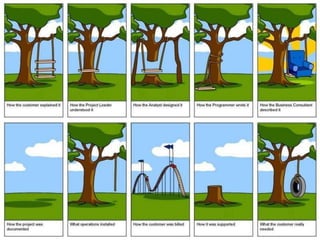
  • #4 This image (“comic strip”) demonstrates the various misconceptions that can occur within the group of people involved in a project – including your customer.
  • #5 In this webinar we intend to cover: 1.) What is Project Management, 2.) Project Management Planning & Process, 3.) Elements of Project Management (i.e. Tools and different areas of Focus). Lastly, we will walk through a Real World project example and address any remaining questions you may have.
  • #6 What we want you to take away is: 1.) How Project Management is defined, 2.) Why it is important to success, 3.) How to get better results, and 4.) Tools and methods you can begin to use immediately.
  • #8 It’s tough to tell what the future holds. Project Management can give you an edge in shaping outcomes.
  • #9 “What is Project Management?” First, a project is a temporary endeavor that has a defined timeline, scope, and resources. Project Management is the application of knowledge, tools, and techniques to meet project requirements.
  • #10 Without defined processes that are project managed, a number of things can happen, including: misaligned expectations & actions, team struggle to be on the same page, constant course-correction (& inefficiency). With defined processes that are project managed: people’s expectations are aligned, efficient and effective collaboration occurs, and goals are achieved. This model can even improve over time.
  • #11 Project Management is a mature discipline that can offer a rigid structure to the ad hoc nature of Marketing.
  • #12 Know what kind of project is in front of you. Is your project small and simple? Is it large and complex?
  • #13 Success is a moving target – a continuous “dance” of cost, speed, and scope. Have you ever had a client who wanted a large scope done quickly and at low cost? Project management offers tools to manage this triple constraint.
  • #14 Marketing is complex by nature. There are many components including traditional (print) & digital advertising, social media, public relations, email marketing, etc. It can involve many stakeholders and various platforms.
  • #15 It can be expressed with complexity….
  • #16 And it can be expressed with simplicity. Here we express marketing/project in a six phase approach: Initiate, Discover/Define, Design, Develop & Quality Assurance (QA), Deploy, and Diagnose (measure and analyze).
  • #17 This six standard phase approach provides framework (& flexibility), drives alignment, establishes governance, and a clear exit/success criteria. Each phase in this process has its own outcome (which enables movement to the next phase). In “Initiate”, for example, the outcome is agreed-upon project requirements; the “Discover” phase yields a roadmap/blueprint, and so on.
  • #19 You probably have heard the prudent advice: “Measure twice, cut once.” This also applies to Project Management – upfront planning is the first step to success.
  • #20 Upfront planning ensures project alignment to company objectives, reduces amount of surprise to stakeholders, identifies necessary resources upfront, improves the likelihood of meeting strategic objectives, creates transparency (important to management), and allows identification of steps and issues that need improvement.
  • #21 Using a standardized process for your project planning and execution (with clear “exit” and “success” criteria) can go a long way to ensuring a project’s success.
  • #22 This slide has a lot of great information on developing a project’s strategic foundation. You can think of this project foundation as being four “pillars” – around which we suggest resources to support each pillar. These four pillars to a creating a project strategy/plan are: audit (knowing what to listen for and capture); interrogate (asking the right questions of the right people/data), concept (considering different use/user scenarios), and consensus (creating alignment for the project).
  • #24 Using both process and tools for continuity helps keep the team/project on track and ensure project success.
  • #25 You can think of any project broken down by focusing on these five areas of management: schedule, budget, engagement (stakeholder management), risk/quality, and process/change management (i.e. manage the project process, including standardized steps to take when a change to scope, etc. occurs during a project). Focusing on these areas of management is an efficient way to break down projects of any size and (your success in doing so) directly affects the quality (profit) and risk (cost) of a project.
  • #26 Here we begin to discuss tools / methods for each area of focus. You can see the area(s) of focus that are relevant to the tool are highlighted in the upper right-hand corner of the slide. The six standard phases can be used to manage process / change management.
  • #27 There are many tools that can be used for process and schedule management. Here is an example of a Gantt Chart [which shows each phase of the project with dates and requirements (i.e. predecessors)]. Additional options include Microsoft Project and SmartSheet (very user friendly). See capterra.com or tinyurl.com/12ogjfu for many others.
  • #28 Here is process and schedule management – even more simplified. A preferred tool for this simplified approach is an Agile (or Kanban Board), which, depicted here, shows color-coded tasks per type of activity (or person), in various categories: To Do, In-Progress and Done. Other options for this simplified approach are JIRA and Trello.
  • #29 A status report is a great tool for both Process and Engagement (stakeholder) management. It lists each project task, status (1-3, 3 being “needs attention”), key dates and owner.
  • #30 A status report can be further broken down – specifically the “status” column – to show the status of Timing, Budget, and Output.
  • #31 Budget can be expressed in a variety of ways. For example, it can be expressed as a Total Fee/ cost.
  • #32 Or broken down into hours and cost per hour.
  • #33 Further yet, budget can be expressed as rate, hours, and cost per resource. This tool applies to budget and engagement management.
  • #34 Here is an example of budget expressed per phase. This can be an effective tool for engagement management, as it gives management a full view of the budget – per resource, throughout each phase of the project.
  • #35 Another tool for engagement management is the “RACI” (ra-s-ee) chart – which shows the party (person / people) Responsible for the task, the party Accountable for the task, the party that is Consulted about the task, and the party that is Informed about the task.
  • #36 Here is a RACI chart. You can see it defines the party / person(s) responsible, accountable, consulted and informed per phase of the project.
  • #37 Risk / Quality management can be managed by a Risk Matrix. A Risk Matrix shows the Category (timing pressure, 3rd party reliance, budget constraints, etc.), with comments and mitigation approach and risk rank (1-3).
  • #38 By focusing on each core area of management, using the tools we have discussed, you can effectively manage a project in a way that will help increase quality (profit) and reduce risk (cost), ensuring project success.
  • #39 Now that we have explained what Project Management is, discussed Planning & Process, and helpful Tools, we will walk through a real-world example.
  • #40 We will use the example of enabling a new email program / email campaign.
  • #41 Your marketing program may be complex. Nonetheless, the six standard phase approach can be used for each tactic.
  • #42 Here is situation. A new product is being launched; Marketing wants to reach existing customers (create awareness, drive use, generate feedback, promote premium upgrades). Given the goals and the audience, email has determined to be the lead communications channel. You have been named the Project Manager. Go!
  • #43 Using the six phased-approach, consider the tasks involved in the “Initiate” phase: Who are the stakeholders? Who are the customers and their needs?...Goal setting & metrics, and assets needed. The outcome of this phase will be approved requirements and parameters.
  • #44 The next phase in planning is “Discover/Define”. In this phase, you want to define the project in detail, including: stakeholder Q&A (who wants what?), asset evaluation, customer target, user experience design, budget planning and executive sell-in. The outcome is an approved plan and budget.
  • #45 The next phase is “Design” the project. This includes content strategy, calendar, data sourcing, email design, personalization rules development, message and segment testing methodology. The outcome is approved deliverables.
  • #46 This next phase in Execution is “Develop” – which includes tech system setup, customer data integration, content & creative execution, template integration, messaging schedule, and quality testing. The outcome is approval for launch.
  • #47 The final phase in execution is “Deploy.” In this phase a project manager: initiates workflow, alerts stakeholders, and monitors for issues. The outcome of the “Deploy” phase is the program is in market.
  • #48 As you may know, as a savvy marketer, the project is not complete with deployment. The next phase is very important: “Diagnose” (measure & analyze). In this phase, the project manager can: track results, analyze opportunities to improve, report to stakeholders, and implement improvements. The outcome is program evaluation. This evaluation can then be used as a resource in the Initiate phase of the next email campaign!
  • #49 What we hope you took away from this discussion is: how project management is defined, why project management is important and helpful for doing your work, how to get better results in your projects, and tools and methods you can start applying immediately in your day to day.
  • #50 We welcome you to ask any questions you may have. For your reference, we show on this slide, the 5 core areas of focus and the 6-phase process of project management.
  • #51 Thank you for your attendance, questions, and interest in the webinar: Project Management for Marketers! We hope you enjoyed and found it helpful for approaching your next project. Please feel free to reach out to Bill and Jeff directly at anytime. Any questions that have not yet been answered, due to time constraint, will be shared with our speakers and made available to you. Be sure to look out for the follow-up email after this webinar for further information, including how to obtain CEU credit. Thank you and have a great day!