


introducing the
value selling
system®
Bob Apollo
Founder
Inflexion-Point Strategy Partners
today’s toughest competitor?
the
status quo
when our customers fail to recognise
sufficient contrast between their current
situation and their future potential:
they will probably
stick with what they know
today’s #1 sales challenge?
failure to
differentiate
when our customers fail to recognise
sufficient contrast between the value of
our solution and their other options:
they will probably
buy on price
contrast
drives
change
until and unless we
understand the full
impact of their
issues...
...we can’t expect
them to appreciate
the full value of
our solution
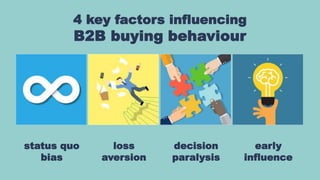
4 key factors influencing
B2B buying behaviour
status quo
bias
loss
aversion
decision
paralysis
early
influence
4 key
value-creating
strategies
targeting
the
right
opportunities
positioning
your
distinctive
value
engaging
all the
key
stakeholders
advancing
their
buying
journey
contrast
drives
change
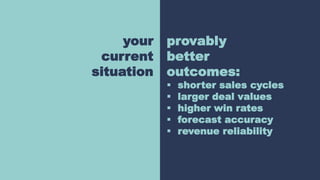
your
current
situation
provably
better
outcomes:
 shorter sales cycles
 larger deal values
 higher win rates
 forecast accuracy
 revenue reliability
find out more
browse our site
read our blog
visit our resources centre
book a call
www.inflexion-point.com

Introducing the Value Selling System®

Editor's Notes

  • #3 SLIDE 2 In any given market, you will always have strong and weak competitors. But across almost every market, sales people face the same consistently tough competitor. YOUR NOTES
  • #4 SLIDE 3 It is the status quo. Inertia. The tendency of your prospective customer to continue on their current path unless disturbed by a strong (often external) force. YOUR NOTES
  • #5 SLIDE 4 If your customer sees no significant difference between their current situation and their future potential, they are likely to stick with what they know. Can you think of any example where you might have “lost” an apparently promising sale to the status quo? YOUR NOTES
  • #6 SLIDE 5 And what about today’s number one challenge in complex B2B sales environments? Is it longer sales cycles, lower win rates, customers not being able to make decisions, or one of a number of other issues? These are all important, but they are symptoms, rather than the primary cause. And of course, the specific nature of the challenge may vary from sales person to sales person. What would you define as your number one sales challenge? YOUR NOTES
  • #7 SLIDE 6 The most common significant challenge - and one that results a large number of related problems - is simple to identify, but often hard to deal with. Very simply, it is the failure to meaningfully differentiate your offering from all the other options that your customer is considering. Many of the other challenges that you might be familiar with are symptoms or functions of this failure to differentiate. YOUR NOTES
  • #8 SLIDE 7 This is critically important - because if or when your customer sees no significant difference between the value of your solution and their other options, they are likely to buy on price, to choose what they perceive to be the lowest-risk option, or to simply decide to do nothing. If you happen to be their cheapest option, then this may help you. But if - like most sales organisations - you wish to justify a premium price, you first need to establish your distinctive value. YOUR NOTES
  • #10 SLIDE 9 There’s an important sequence to be followed here: before you can get the customer to appreciate the full value of your solution, you first need to understand the full impact of their issues. This is why - as we will see later - discovery is such an important part of the sales process. YOUR NOTES
  • #14 SLIDE 13 Here are some obvious contrasts that can be drawn. Can you think of examples of each of these types of contrast? Can you think of any other types of contrast that might apply in your environment? YOUR NOTES