An Academic presentation by
Dr. Nancy Agnes, Head, Technical Operations,
Pubrica Group: www.pubrica.com
Email: sales@pubrica.com
What is the Difference between
A S YS TEM ATIC
REVIEW AND A M ETA-
ANALYSIS?
TODAY'S
D I S C U S S I O N
In Brief
Introduction
The stages of systematic review
Why don't all systemic reviews use meta-analysis?
What does meta-analysis do?
What are the other ways to synthesize evidence?
Conclusion
About Pubrica
The terms systematic review and meta-analysis are also used
interchangeably. Each term refers to research about the study, but
there are significant variations between them.
A systematic review is a part of the work that poses a study question
and then responds by summarising the evidence that satisfies a
collection of pre-determined requirements.
A meta-analysis, a statistical implement for combining the results of
many trials to produce an average outcome, is used in some systematic
review writing to present their findings.
In addition, meta-analysis provides value because it can provide a more
accurate estimation of a treatment's impact than looking at each study
separately.
IN BRIEF
INTRODUCTION
A systematic review is a method of collecting,
evaluating, and synthesizing evidence to address a
well-defined question that is comprehensive,
systematic, and clear.
A meta-analysis is a statistical method for integrating
numerical data from different studies into a single
report. Only a systematic review should ever be used to
perform a meta-analysis.
Systematic reviews and meta-analyses combine and
analyze data from various studies on related research
subjects to present findings. In recent years, systematic
reviews and meta-analyses have become common in
various fields, including anesthesiology.
Contd...
These research approaches are effective tools for overcoming the challenges of large-scale
randomized controlled trials.
However, systematic reviews and meta-analyses, including studies with biases or inappropriately
measured quality of evidence, may lead to misleading results. As a result, different standards for
conducting systematic review evaluations and meta-analyses have been proposed to standardize
them further and improve their quality.
1. Identify your issue and, preferably, register the title of your proposed study.
2. Specify and publish your suggested approach as a protocol in advance.
3. Conduct a systematic literature quest.
4.Review your search results against your pre-determined selection criteria to find studies that
should be included.
5. Evaluate the consistency of the studies discovered
6. Compile the proof, which may or may not include a meta-analysis.
7. Make the analysis public by publishing and disseminating it.
8. Keep the study up to date as new information becomes available.
Systematic evaluations are distinguished by their efforts to eliminate bias at all levels of the review
process. The following are the steps involved in undertaking a review:
A research question and a protocol or research plan
are the foundations of a systematic analysis. Using a
compassionate search approach, a research team
looks for studies to address the issue.
The recovered studies are then screened for eligibility
(this is done by at least two people working
independently). The reviewers then extract the
relevant data and determine the validity of the studies
that have been included. Finally, the research team
synthesizes the data from the various studies
(possibly using meta-analysis) and presents the
findings.
THE S T A G E S OF S Y S T E M A T I C
REVIEW
Identify the research question
Define inclusion and exclusion criteria
Search for studies
Select studies
Extract data
Assess quality
Synthesize and present results
The stages of systematic review
Ev
Systematic
Review and
meta- analysis
Randomized
controlled double
blind test
Cohort studies
Case reports
Ideas,
editorials,
opinions
Case control
studies
Animal
Research
Case series
In Vitro
Research
A systematic review gathers all relevant research on a specific subject and design, then summarises
and analyses their findings. The quality of studies is assessed during the systematic review phase,
and the research findings are statistically meta-analyzed based on their quality.
A meta-analysis is a method of interpreting and integrating various accurate, analytical, and
empirical results. A meta-analysis is usually performed on randomized controlled trials (RCTs) with a
high degree of evidence to obtain more accurate findings.
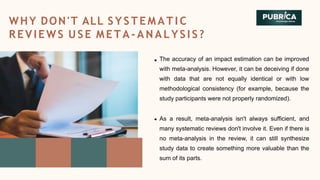
The accuracy of an impact estimation can be improved
with meta-analysis. However, it can be deceiving if done
with data that are not equally identical or with low
methodological consistency (for example, because the
study participants were not properly randomized).
As a result, meta-analysis isn't always sufficient, and
many systematic reviews don't involve it. Even if there is
no meta-analysis in the review, it can still synthesize
study data to create something more valuable than the
sum of its parts.
WHY DON'T ALL S Y S T E M A T I C
REVIEWS USE M ETA - ANALY SIS?
Meta-analysis produces a more accurate treatment
impact calculation. The evaluation committee
determined the most appropriate type of effect size
based on the kind of results and measures under
consideration.
The odds ratio, risk ratio, weighted mean difference,
and standardized mean difference are standard effect
sizes in systematic reviews.
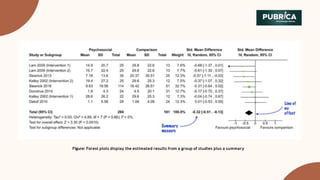
For example, a forest map, such as the one shown
below, is used to represent the effects of writing a
meta-analysis paper.
WHAT DOES META-
A N A L Y S I S DO?
Figure: Forest plots display the estimated results from a group of studies plus a summary
Subgroup analysis or meta-regression was used in several meta-analysis writing services.
These strategies are used to investigate a factor (such as the age of the research participant) that
can affect the treatment-intervention relationship.
To prevent bias, plans for analyzing data using these techniques should be explained and justified
before looking at the data, preferably during the research plan or protocol level.
Subgroup analysis and meta-regression, like meta-analysis, are only helpful in such situations.
Systematic reviews combine research data in various
ways to arrive at a comprehensive picture of the proof.
Meta-analysis is a mathematical synthesis technique.
The results of several studies are combined using terms
in a narrative synthesis. All systematic reviews, including
those that use meta-analysis, are likely to include a
narrative synthesis component, which summarises the
evidence in words.
However, narrative synthesis aims to clarify the
gathered data, for example, by examining similarities
and differences between study findings and investigating
potential explanations for those similarities and
differences systematically.
WHAT ARE THE OTHER
W A Y S TO S Y N T H E S I Z E
EVIDENCE?
CONCLUSION
Suppose the validity of research is not adequately assessed, or
proper protocol is not strictly followed when conducting a
systematic review or meta-analysis.
In that case, the findings can be biased, and the outcomes can be
wrong. When systematic reviews and meta-analyses are properly
applied, they can produce powerful results that are usually only
possible with large-scale clinical trials, which are challenging to
conduct in individual studies.
The number of systematic reviews and meta-analyses will continue
to rise as our understanding of evidence-based medicine improves
and its relevance is better understood. However, blind acceptance
of both meta-analyses can be harmful, so we suggest that their
findings be viewed critically based on a better understanding.
ABOUT PUBRICA
Pubrica's research team creates scientific and medical
research articles that clinical meta-analysis experts and
authors can use as a resource.
Pubrica medical writers assist you in writing and editing the
introduction by informing the reader of any flaws or blank
spots in the selected study field. Our professionals
understand the framework that follows the broad topic, the
difficulty, and the backdrop before moving on to a particular
topic to present the hypothesis.
UNITED KINGDOM
+44 1618186353
INDIA
+91-9884350006
EMAIL
sales@pubrica.com
Contact Us

Systematic review.pptx

  • 1.
    An Academic presentationby Dr. Nancy Agnes, Head, Technical Operations, Pubrica Group: www.pubrica.com Email: sales@pubrica.com What is the Difference between A S YS TEM ATIC REVIEW AND A M ETA- ANALYSIS?
  • 2.
    TODAY'S D I SC U S S I O N In Brief Introduction The stages of systematic review Why don't all systemic reviews use meta-analysis? What does meta-analysis do? What are the other ways to synthesize evidence? Conclusion About Pubrica
  • 3.
    The terms systematicreview and meta-analysis are also used interchangeably. Each term refers to research about the study, but there are significant variations between them. A systematic review is a part of the work that poses a study question and then responds by summarising the evidence that satisfies a collection of pre-determined requirements. A meta-analysis, a statistical implement for combining the results of many trials to produce an average outcome, is used in some systematic review writing to present their findings. In addition, meta-analysis provides value because it can provide a more accurate estimation of a treatment's impact than looking at each study separately. IN BRIEF
  • 4.
    INTRODUCTION A systematic reviewis a method of collecting, evaluating, and synthesizing evidence to address a well-defined question that is comprehensive, systematic, and clear. A meta-analysis is a statistical method for integrating numerical data from different studies into a single report. Only a systematic review should ever be used to perform a meta-analysis. Systematic reviews and meta-analyses combine and analyze data from various studies on related research subjects to present findings. In recent years, systematic reviews and meta-analyses have become common in various fields, including anesthesiology. Contd...
  • 5.
    These research approachesare effective tools for overcoming the challenges of large-scale randomized controlled trials. However, systematic reviews and meta-analyses, including studies with biases or inappropriately measured quality of evidence, may lead to misleading results. As a result, different standards for conducting systematic review evaluations and meta-analyses have been proposed to standardize them further and improve their quality.
  • 6.
    1. Identify yourissue and, preferably, register the title of your proposed study. 2. Specify and publish your suggested approach as a protocol in advance. 3. Conduct a systematic literature quest. 4.Review your search results against your pre-determined selection criteria to find studies that should be included. 5. Evaluate the consistency of the studies discovered 6. Compile the proof, which may or may not include a meta-analysis. 7. Make the analysis public by publishing and disseminating it. 8. Keep the study up to date as new information becomes available. Systematic evaluations are distinguished by their efforts to eliminate bias at all levels of the review process. The following are the steps involved in undertaking a review:
  • 7.
    A research questionand a protocol or research plan are the foundations of a systematic analysis. Using a compassionate search approach, a research team looks for studies to address the issue. The recovered studies are then screened for eligibility (this is done by at least two people working independently). The reviewers then extract the relevant data and determine the validity of the studies that have been included. Finally, the research team synthesizes the data from the various studies (possibly using meta-analysis) and presents the findings. THE S T A G E S OF S Y S T E M A T I C REVIEW
  • 8.
    Identify the researchquestion Define inclusion and exclusion criteria Search for studies Select studies Extract data Assess quality Synthesize and present results
  • 9.
    The stages ofsystematic review Ev Systematic Review and meta- analysis Randomized controlled double blind test Cohort studies Case reports Ideas, editorials, opinions Case control studies Animal Research Case series In Vitro Research
  • 10.
    A systematic reviewgathers all relevant research on a specific subject and design, then summarises and analyses their findings. The quality of studies is assessed during the systematic review phase, and the research findings are statistically meta-analyzed based on their quality. A meta-analysis is a method of interpreting and integrating various accurate, analytical, and empirical results. A meta-analysis is usually performed on randomized controlled trials (RCTs) with a high degree of evidence to obtain more accurate findings.
  • 11.
    The accuracy ofan impact estimation can be improved with meta-analysis. However, it can be deceiving if done with data that are not equally identical or with low methodological consistency (for example, because the study participants were not properly randomized). As a result, meta-analysis isn't always sufficient, and many systematic reviews don't involve it. Even if there is no meta-analysis in the review, it can still synthesize study data to create something more valuable than the sum of its parts. WHY DON'T ALL S Y S T E M A T I C REVIEWS USE M ETA - ANALY SIS?
  • 12.
    Meta-analysis produces amore accurate treatment impact calculation. The evaluation committee determined the most appropriate type of effect size based on the kind of results and measures under consideration. The odds ratio, risk ratio, weighted mean difference, and standardized mean difference are standard effect sizes in systematic reviews. For example, a forest map, such as the one shown below, is used to represent the effects of writing a meta-analysis paper. WHAT DOES META- A N A L Y S I S DO?
  • 13.
    Figure: Forest plotsdisplay the estimated results from a group of studies plus a summary
  • 14.
    Subgroup analysis ormeta-regression was used in several meta-analysis writing services. These strategies are used to investigate a factor (such as the age of the research participant) that can affect the treatment-intervention relationship. To prevent bias, plans for analyzing data using these techniques should be explained and justified before looking at the data, preferably during the research plan or protocol level. Subgroup analysis and meta-regression, like meta-analysis, are only helpful in such situations.
  • 15.
    Systematic reviews combineresearch data in various ways to arrive at a comprehensive picture of the proof. Meta-analysis is a mathematical synthesis technique. The results of several studies are combined using terms in a narrative synthesis. All systematic reviews, including those that use meta-analysis, are likely to include a narrative synthesis component, which summarises the evidence in words. However, narrative synthesis aims to clarify the gathered data, for example, by examining similarities and differences between study findings and investigating potential explanations for those similarities and differences systematically. WHAT ARE THE OTHER W A Y S TO S Y N T H E S I Z E EVIDENCE?
  • 16.
    CONCLUSION Suppose the validityof research is not adequately assessed, or proper protocol is not strictly followed when conducting a systematic review or meta-analysis. In that case, the findings can be biased, and the outcomes can be wrong. When systematic reviews and meta-analyses are properly applied, they can produce powerful results that are usually only possible with large-scale clinical trials, which are challenging to conduct in individual studies. The number of systematic reviews and meta-analyses will continue to rise as our understanding of evidence-based medicine improves and its relevance is better understood. However, blind acceptance of both meta-analyses can be harmful, so we suggest that their findings be viewed critically based on a better understanding.
  • 17.
    ABOUT PUBRICA Pubrica's researchteam creates scientific and medical research articles that clinical meta-analysis experts and authors can use as a resource. Pubrica medical writers assist you in writing and editing the introduction by informing the reader of any flaws or blank spots in the selected study field. Our professionals understand the framework that follows the broad topic, the difficulty, and the backdrop before moving on to a particular topic to present the hypothesis.
  • 18.