CASE STUDY
RESEARCH
METHODOLOGY
An Academic presentation by
Dr. Nancy Agnes, Head, Technical Operations, Pubrica
Group: www.pubrica.com
Email: sales@pubrica.com
01
TODAY DISCUSSION
02
03
Case study
Case studies used for
Case studies conducted
Case Study research
methodology
The case study method enables in-depth, multifaceted
analyses of complicated subjects in real-world contexts.
The importance of the case study technique is widely
acknowledged in business, law, and policy but less so in
healthcare research.
Based on pubrica team experts conducting multiple
health-related case studies, we reflect on the various
types of case study design, the specific research
questions this technique may help address, the data
sources often employed, and the pros and downsides of
utilizing this methodological approach.
Case study
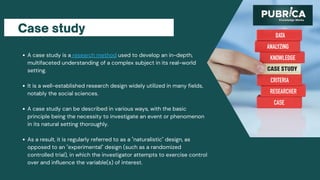
A case study is a research method used to develop an in-depth,
multifaceted understanding of a complex subject in its real-world
setting.
It is a well-established research design widely utilized in many fields,
notably the social sciences.
A case study can be described in various ways, with the basic
principle being the necessity to investigate an event or phenomenon
in its natural setting thoroughly.
As a result, it is regularly referred to as a "naturalistic" design, as
opposed to an "experimental" design (such as a randomized
controlled trial), in which the investigator attempts to exercise control
over and influence the variable(s) of interest.
Case studies used for
Case studies, according to Yin, may be used to explain, describe, or
analyze occurrences or phenomena in their everyday surroundings.
These can aid in understanding and elucidating causal relationships
and pathways emerging from a new policy initiative or service
development.
The case study approach works well for gathering data on more explanatory "how," "what," and "why"
questions, such as "how is the intervention being implemented and received on the ground?" Unlike
experimental designs, which aim to test a specific hypothesis by purposefully manipulating the
environment (for instance, in a randomized controlled trial, giving a new drug to randomly selected
individuals and then comparing outcomes with controls), the case study approach does not rely on
artificially controlled environments.
Instead, the case study method might provide further insights into what gaps exist in its delivery or
why one implementation technique may be preferred over another.
This, in turn, can assist in creating or refining theory, as demonstrated by our research on patient
safety education in undergraduate curricula.
Case studies conducted
defining the case;
selecting the case(s);
collecting and analyzing data;
interpreting data; and
reporting the findings.
The following sections focus on the key stages of research
activity when planning and conducting a case study:
Conclusion
Critical events, interventions, policy changes, and program-based service improvements, among other
things, can be researched in detail in a real-life environment using the case study approach.
It should thus be considered when an experimental design is either improper or impossible to carry out
in order to answer the research questions stated.
Given the regularity with which innovations are increasingly being implemented in healthcare settings
and how well the case study technique lends itself to in-depth, complicated health service research,
academics should study this approach more broadly.
Though intrinsically difficult, the research case study may give profound insights into many critical
health and healthcare delivery elements if thoroughly conceptualized, undertaken, and documented.
References
Crowe, S., Cresswell, K., Robertson, A.et al.The case study
approach.BMC Med Res Methodol11, 100 (2011).
https://doi.org/10.1186/1471-2288-11-100
+44 1618186353
UNITED KINGDOM
+91-9884350006
INDIA
EMAIL
sales@pubrica.com
Contact Us

Case Study research methodology.pdf

  • 1.
    CASE STUDY RESEARCH METHODOLOGY An Academicpresentation by Dr. Nancy Agnes, Head, Technical Operations, Pubrica Group: www.pubrica.com Email: sales@pubrica.com
  • 2.
    01 TODAY DISCUSSION 02 03 Case study Casestudies used for Case studies conducted
  • 3.
    Case Study research methodology Thecase study method enables in-depth, multifaceted analyses of complicated subjects in real-world contexts. The importance of the case study technique is widely acknowledged in business, law, and policy but less so in healthcare research. Based on pubrica team experts conducting multiple health-related case studies, we reflect on the various types of case study design, the specific research questions this technique may help address, the data sources often employed, and the pros and downsides of utilizing this methodological approach.
  • 4.
    Case study A casestudy is a research method used to develop an in-depth, multifaceted understanding of a complex subject in its real-world setting. It is a well-established research design widely utilized in many fields, notably the social sciences. A case study can be described in various ways, with the basic principle being the necessity to investigate an event or phenomenon in its natural setting thoroughly. As a result, it is regularly referred to as a "naturalistic" design, as opposed to an "experimental" design (such as a randomized controlled trial), in which the investigator attempts to exercise control over and influence the variable(s) of interest.
  • 5.
    Case studies usedfor Case studies, according to Yin, may be used to explain, describe, or analyze occurrences or phenomena in their everyday surroundings. These can aid in understanding and elucidating causal relationships and pathways emerging from a new policy initiative or service development.
  • 6.
    The case studyapproach works well for gathering data on more explanatory "how," "what," and "why" questions, such as "how is the intervention being implemented and received on the ground?" Unlike experimental designs, which aim to test a specific hypothesis by purposefully manipulating the environment (for instance, in a randomized controlled trial, giving a new drug to randomly selected individuals and then comparing outcomes with controls), the case study approach does not rely on artificially controlled environments. Instead, the case study method might provide further insights into what gaps exist in its delivery or why one implementation technique may be preferred over another. This, in turn, can assist in creating or refining theory, as demonstrated by our research on patient safety education in undergraduate curricula.
  • 7.
    Case studies conducted definingthe case; selecting the case(s); collecting and analyzing data; interpreting data; and reporting the findings. The following sections focus on the key stages of research activity when planning and conducting a case study:
  • 8.
    Conclusion Critical events, interventions,policy changes, and program-based service improvements, among other things, can be researched in detail in a real-life environment using the case study approach. It should thus be considered when an experimental design is either improper or impossible to carry out in order to answer the research questions stated. Given the regularity with which innovations are increasingly being implemented in healthcare settings and how well the case study technique lends itself to in-depth, complicated health service research, academics should study this approach more broadly. Though intrinsically difficult, the research case study may give profound insights into many critical health and healthcare delivery elements if thoroughly conceptualized, undertaken, and documented.
  • 9.
    References Crowe, S., Cresswell,K., Robertson, A.et al.The case study approach.BMC Med Res Methodol11, 100 (2011). https://doi.org/10.1186/1471-2288-11-100
  • 10.