1 |
Lopper
Bruce Ashfield & Stefano Stabellini
ELC NA 2022
2 |
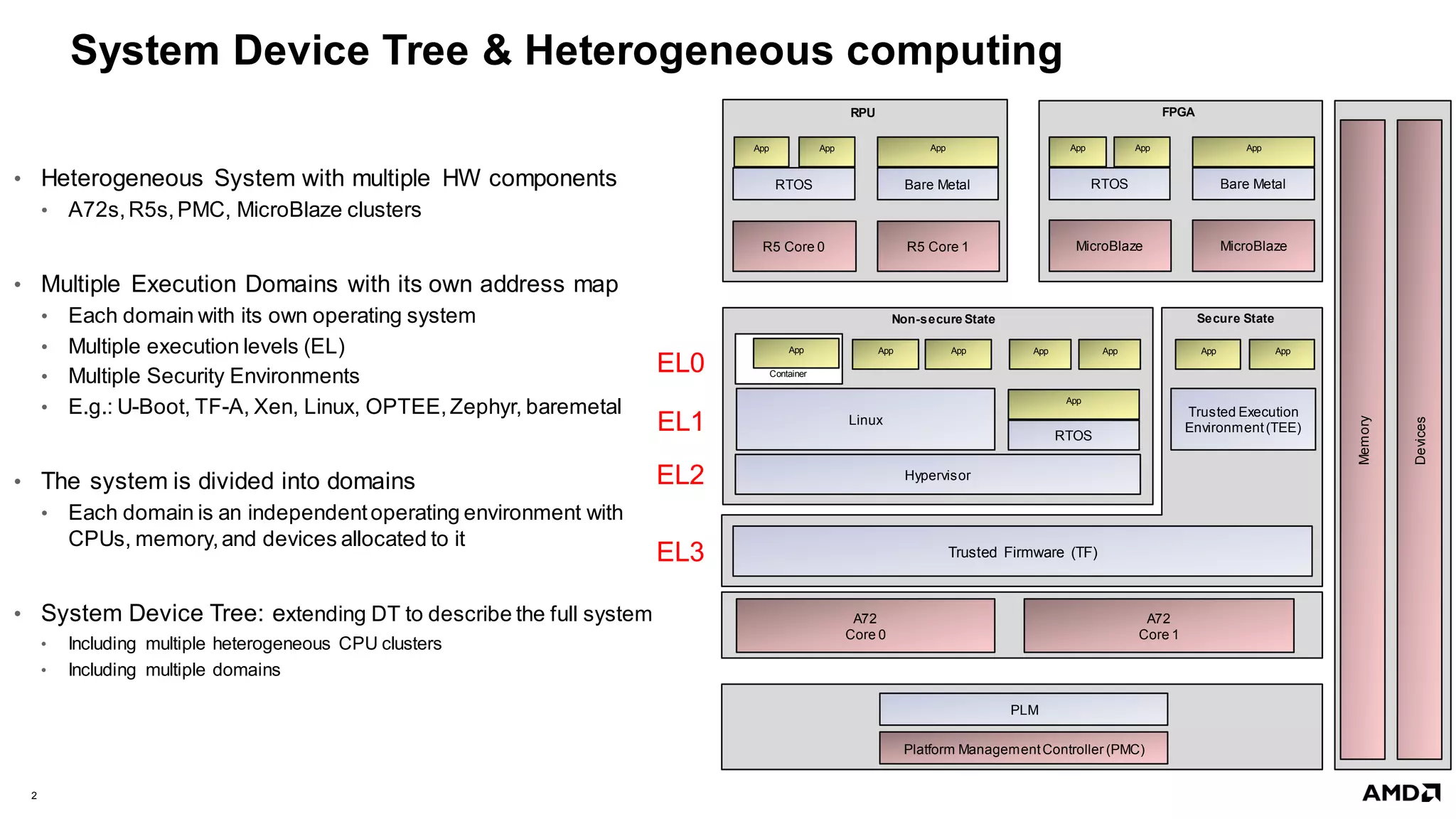
System Device Tree & Heterogeneous computing
• Heterogeneous System with multiple HW components
• A72s,R5s,PMC, MicroBlaze clusters
• Multiple Execution Domains with its own address map
• Each domain with its own operating system
• Multiple execution levels (EL)
• Multiple Security Environments
• E.g.: U-Boot, TF-A, Xen, Linux, OPTEE,Zephyr, baremetal
• The system is divided into domains
• Each domain is an independentoperating environment with
CPUs, memory,and devices allocated to it
• System Device Tree: extending DT to describe the full system
• Including multiple heterogeneous CPU clusters
• Including multiple domains
Secure State
Trusted Firmware (TF)
App App
Trusted Execution
Environment(TEE)
Non-secure State
Hypervisor
App App
Linux
App
RTOS
FPGA
MicroBlaze
App App
RTOS
MicroBlaze
App
Bare Metal
A72
Core 0
A72
Core 1
RPU
R5 Core 0
App App
RTOS
R5 Core 1
App
Bare Metal
Container
App
EL0
EL1
EL2
EL3
App App
Platform ManagementController (PMC)
PLM
Devices
Memory
3 |
System Device Tree
• Device Tree expresses HW information relevant to an operating environment
• Used by U-Boot, Linux, Xen, TF-A and others
• System Device Tree is an extension to Device Tree to describe the full system
• It describes multiple CPU clusters with different address maps
• Both A72s and R5s
• It describes multiple domains and the resources allocated to each
• A domain could be:
• an heterogenous computing unit, e.g. Zephyr on R5s
• an operating environment at a specific execution level, e.g. OPTEE
• a virtual machine, e.g. a Xen domain
4 |
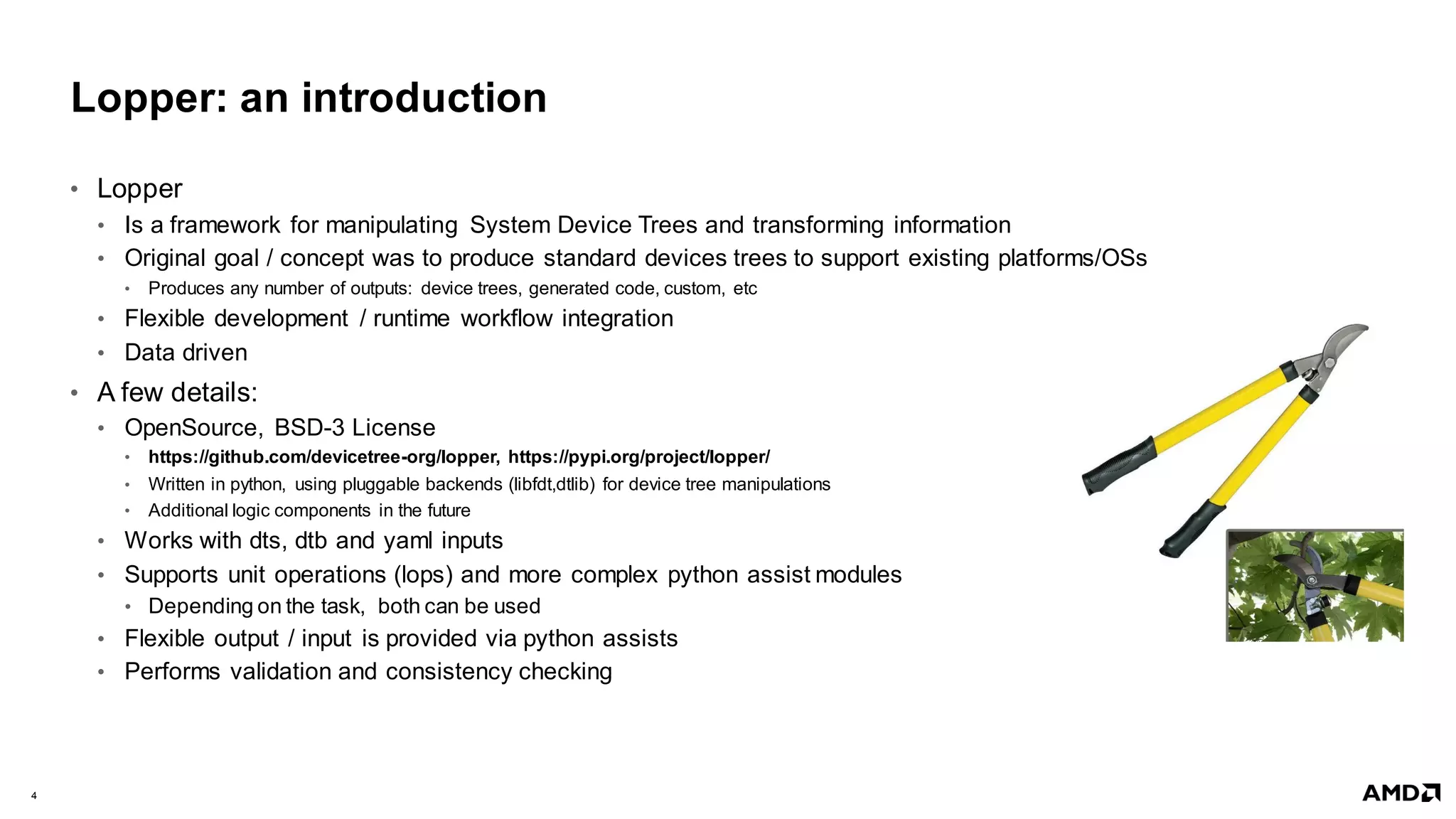
Lopper: an introduction
• Lopper
• Is a framework for manipulating System Device Trees and transforming information
• Original goal / concept was to produce standard devices trees to support existing platforms/OSs
• Produces any number of outputs: device trees, generated code, custom, etc
• Flexible development / runtime workflow integration
• Data driven
• A few details:
• OpenSource, BSD-3 License
• https://github.com/devicetree-org/lopper, https://pypi.org/project/lopper/
• Written in python, using pluggable backends (libfdt,dtlib) for device tree manipulations
• Additional logic components in the future
• Works with dts, dtb and yaml inputs
• Supports unit operations (lops) and more complex python assist modules
• Depending on the task, both can be used
• Flexible output / input is provided via python assists
• Performs validation and consistency checking
5 |
Lopper: a framework
• Common base for tooling inquiring or manipulating device trees​
• Built-in:
• Core tree manipulation, merging
• Input and output: dts / dtb / yaml
• Parsing: libfdt or dtlib
• Assist / lop management
• Device tree sanity and consistency checking
• Tree manipulation library / routines
6 |
Lopper: a framework
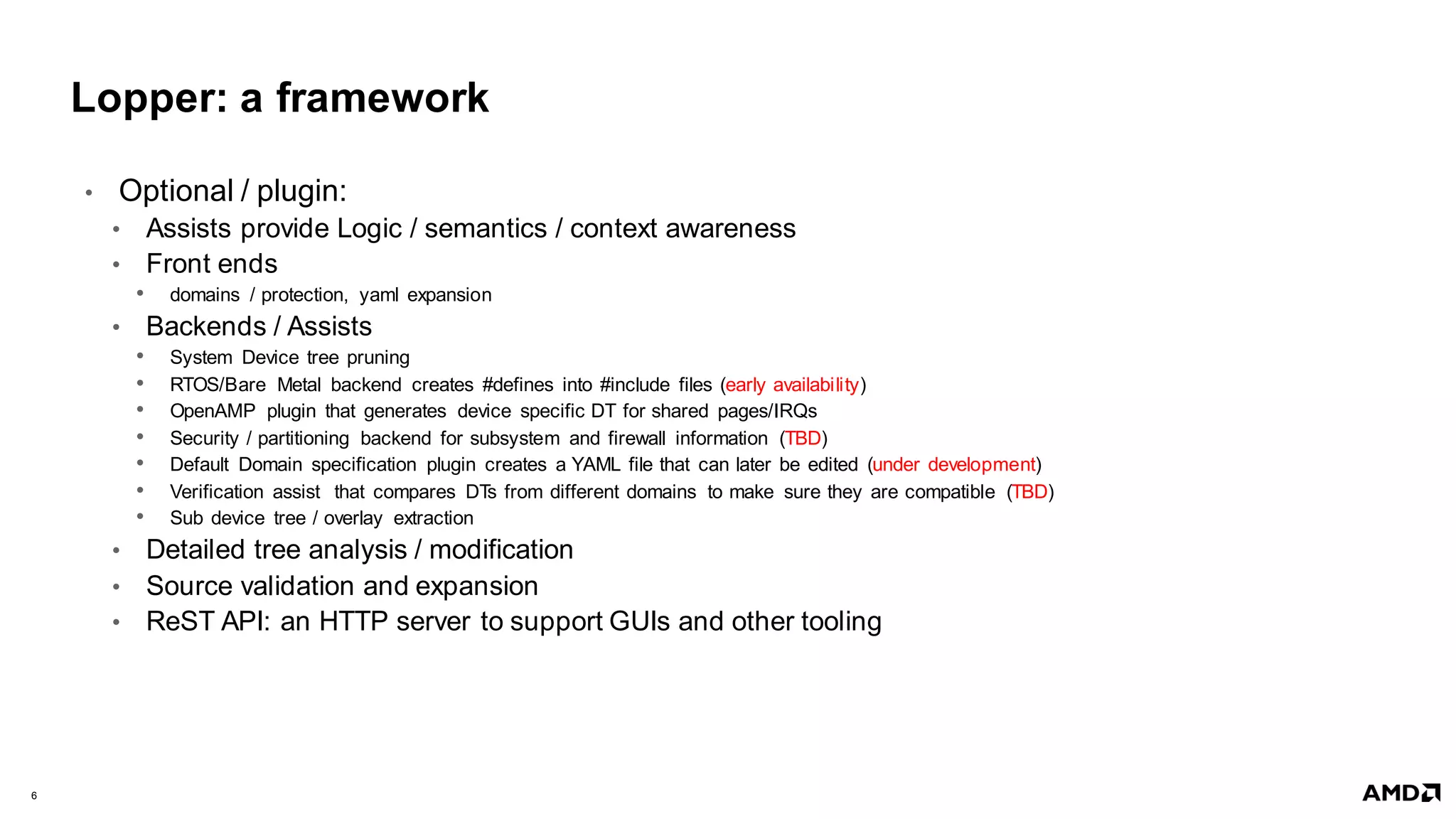
• Optional / plugin:
• Assists provide Logic / semantics / context awareness
• Front ends
• domains / protection, yaml expansion
• Backends / Assists
• System Device tree pruning
• RTOS/Bare Metal backend creates #defines into #include files (early availability)
• OpenAMP plugin that generates device specific DT for shared pages/IRQs
• Security / partitioning backend for subsystem and firewall information (TBD)
• Default Domain specification plugin creates a YAML file that can later be edited (under development)
• Verification assist that compares DTs from different domains to make sure they are compatible (TBD)
• Sub device tree / overlay extraction
• Detailed tree analysis / modification
• Source validation and expansion
• ReST API: an HTTP server to support GUIs and other tooling
7 |
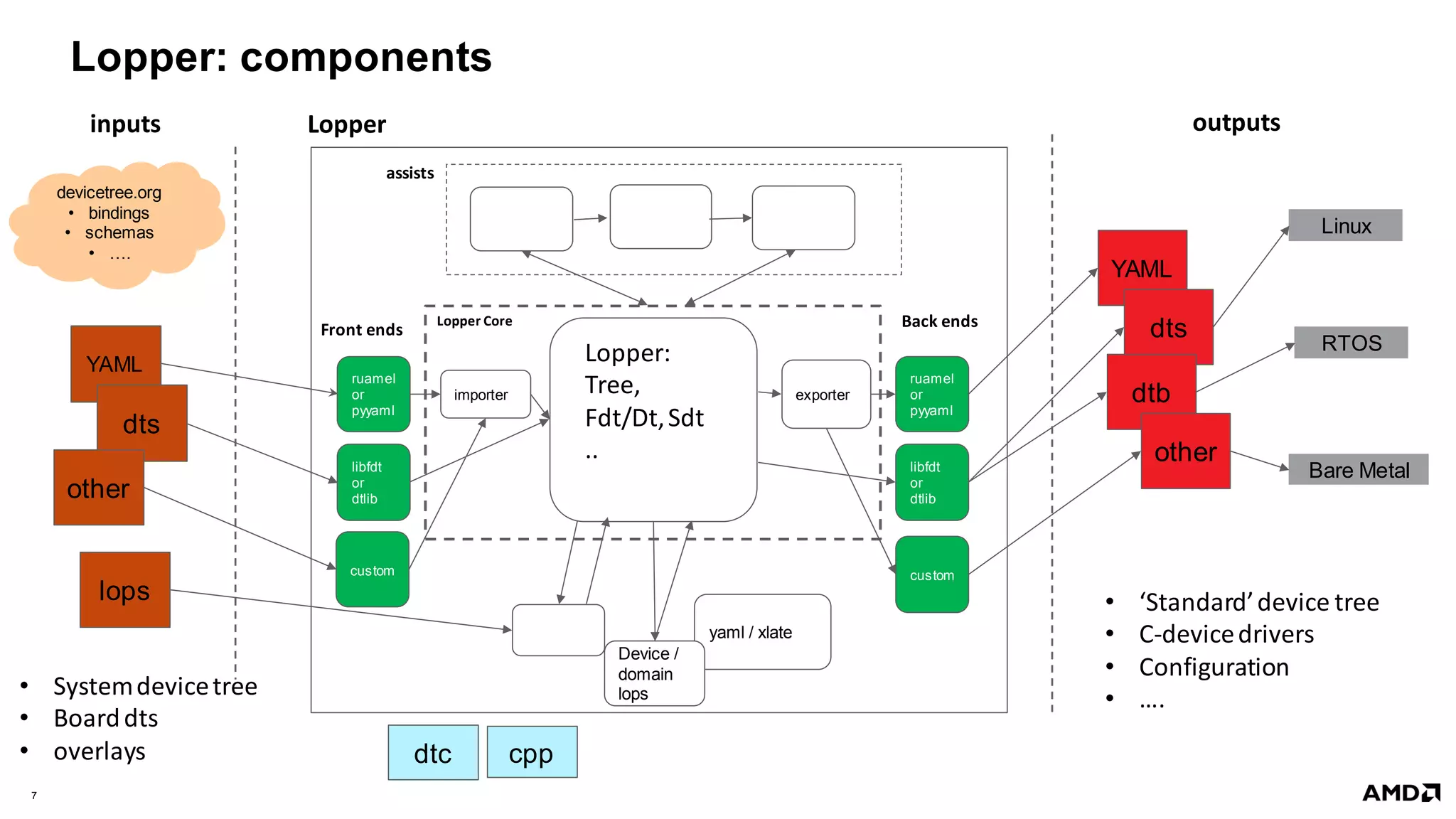
Lopper: components
Lopper Core
YAML
dts
other
YAML
dts
dtb
other
ruamel
or
pyyaml
libfdt
or
dtlib
Lopper
Lopper:
Tree,
Fdt/Dt,Sdt
..
importer
yaml / xlate
Device /
domain
lops
exporter
ruamel
or
pyyaml
libfdt
or
dtlib
custom custom
lops
inputs outputs
Front ends Back ends
assists
Linux
RTOS
Bare Metal
devicetree.org
• bindings
• schemas
• ….
• Systemdevicetree
• Boarddts
• overlays
• ‘Standard’device tree
• C-devicedrivers
• Configuration
• ….
dtc cpp
8 |
Xen Partial Device Trees
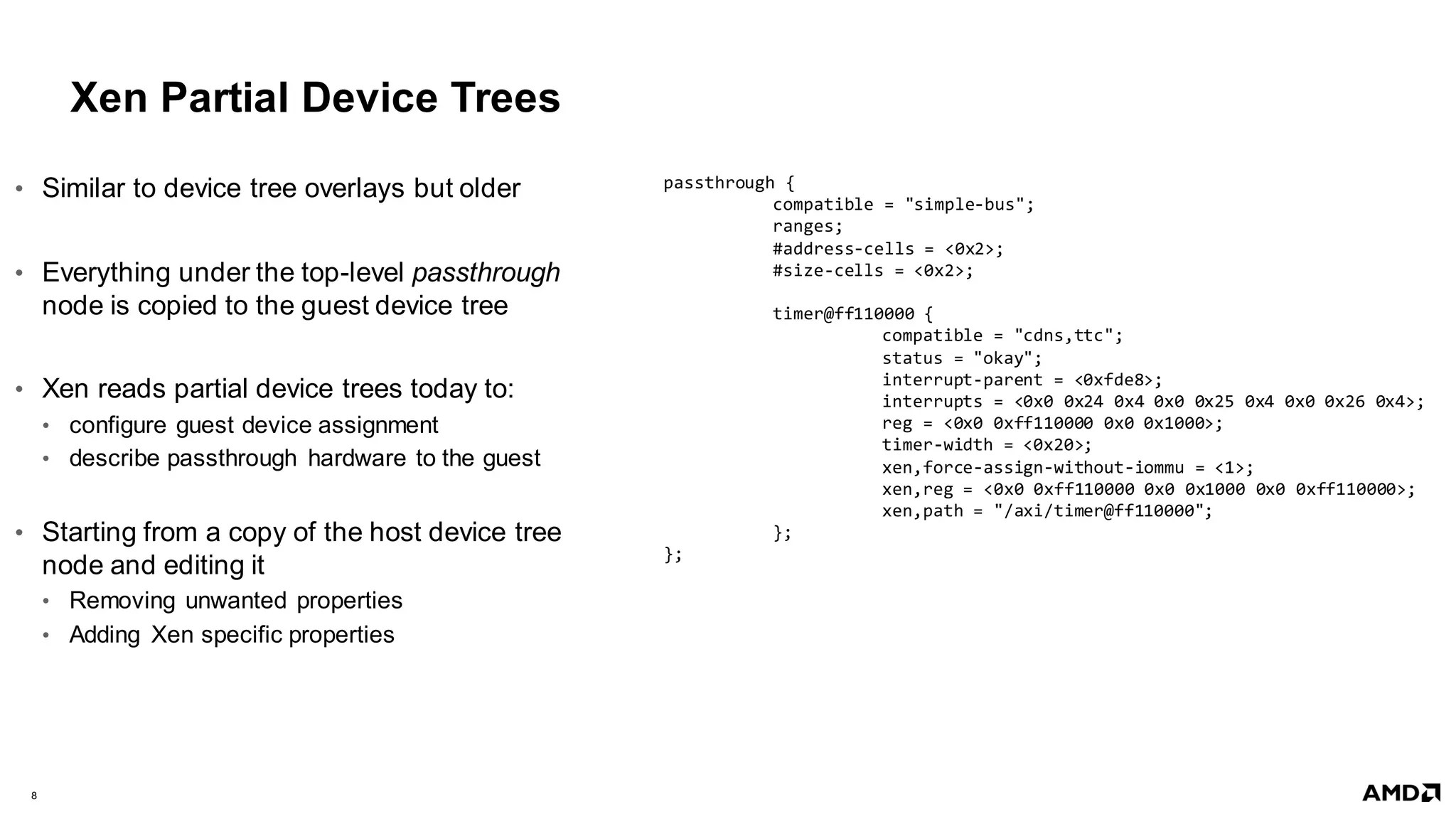
• Similar to device tree overlays but older
• Everything under the top-level passthrough
node is copied to the guest device tree
• Xen reads partial device trees today to:
• configure guest device assignment
• describe passthrough hardware to the guest
• Starting from a copy of the host device tree
node and editing it
• Removing unwanted properties
• Adding Xen specific properties
passthrough {
compatible = "simple-bus";
ranges;
#address-cells = <0x2>;
#size-cells = <0x2>;
timer@ff110000 {
compatible = "cdns,ttc";
status = "okay";
interrupt-parent = <0xfde8>;
interrupts = <0x0 0x24 0x4 0x0 0x25 0x4 0x0 0x26 0x4>;
reg = <0x0 0xff110000 0x0 0x1000>;
timer-width = <0x20>;
xen,force-assign-without-iommu = <1>;
xen,reg = <0x0 0xff110000 0x0 0x1000 0x0 0xff110000>;
xen,path = "/axi/timer@ff110000";
};
};
9 |
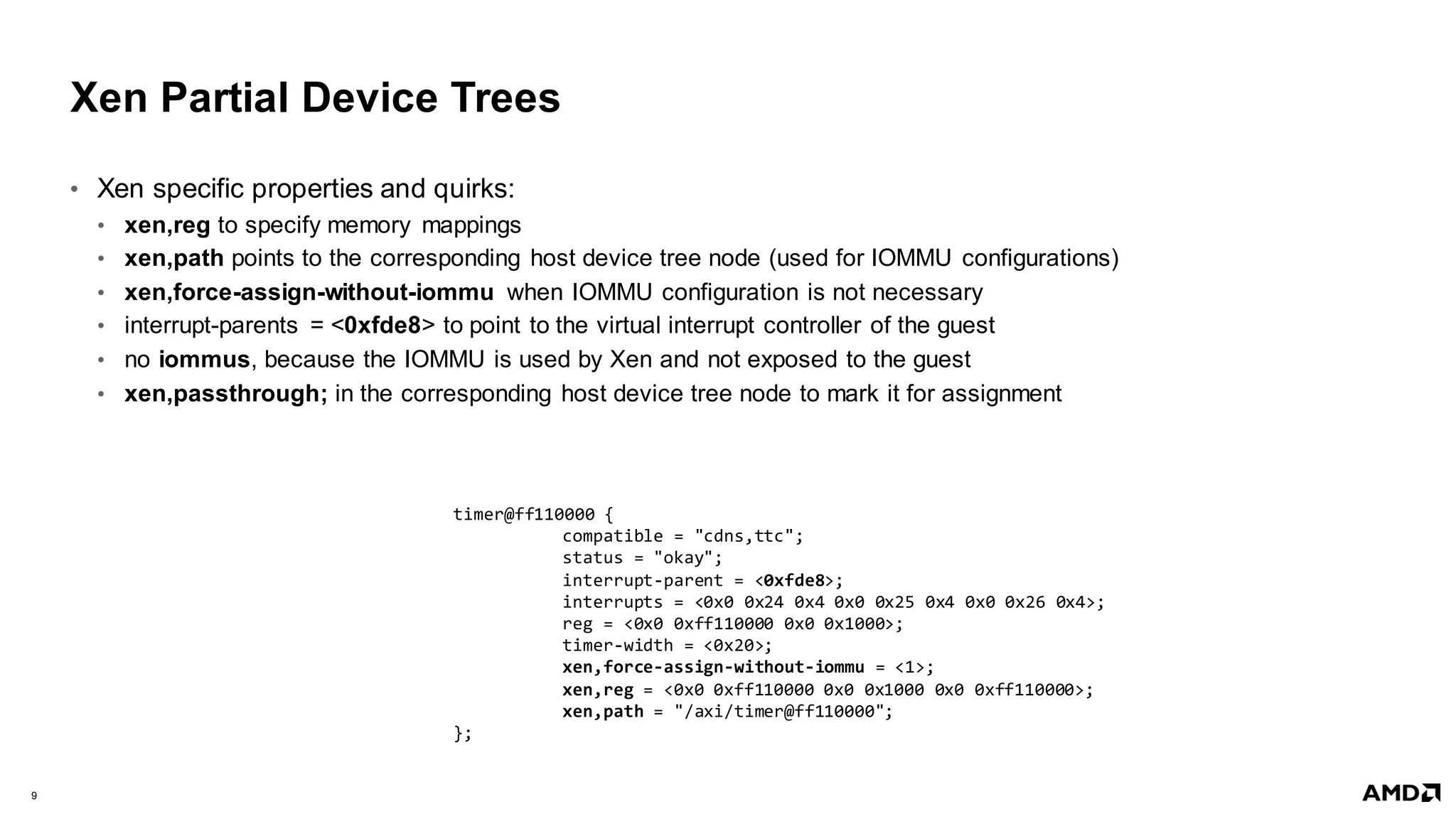
Xen Partial Device Trees
• Xen specific properties and quirks:
• xen,reg to specify memory mappings
• xen,path points to the corresponding host device tree node (used for IOMMU configurations)
• xen,force-assign-without-iommu when IOMMU configuration is not necessary
• interrupt-parents = <0xfde8> to point to the virtual interrupt controller of the guest
• no iommus, because the IOMMU is used by Xen and not exposed to the guest
• xen,passthrough; in the corresponding host device tree node to mark it for assignment
timer@ff110000 {
compatible = "cdns,ttc";
status = "okay";
interrupt-parent = <0xfde8>;
interrupts = <0x0 0x24 0x4 0x0 0x25 0x4 0x0 0x26 0x4>;
reg = <0x0 0xff110000 0x0 0x1000>;
timer-width = <0x20>;
xen,force-assign-without-iommu = <1>;
xen,reg = <0x0 0xff110000 0x0 0x1000 0x0 0xff110000>;
xen,path = "/axi/timer@ff110000";
};
10 |
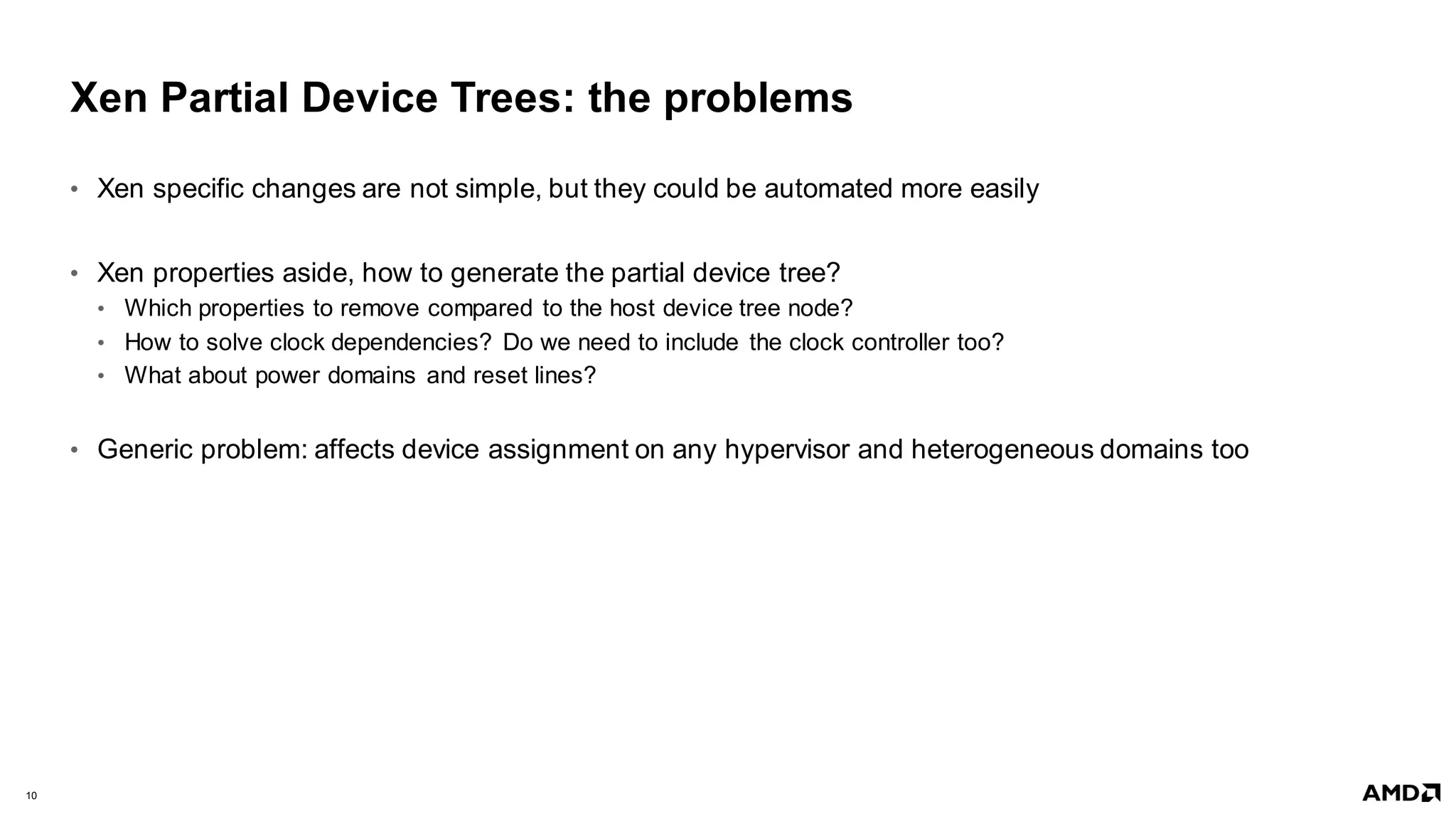
Xen Partial Device Trees: the problems
• Xen specific changes are not simple, but they could be automated more easily
• Xen properties aside, how to generate the partial device tree?
• Which properties to remove compared to the host device tree node?
• How to solve clock dependencies? Do we need to include the clock controller too?
• What about power domains and reset lines?
• Generic problem: affects device assignment on any hypervisor and heterogeneous domains too
11 |
Xen Partial Device Trees: a more complex example
zynqmp-firmware {
compatible = "xlnx,zynqmp-firmware", "xlnx,zynqmp";
method = "smc";
#power-domain-cells = <0x1>;
phandle = <0x1>;
clock-controller {
u-boot,dm-pre-reloc;
#clock-cells = <0x1>;
compatible = "xlnx,zynqmp-clk";
clocks = <0x6 0x7 0x8 0x9 0xa>;
clock-names = "pss_ref_clk", "video_clk",
"pss_alt_ref_clk",
"aux_ref_clk", "gt_crx_ref_clk";
phandle = <0x3>;
};
};
pss_ref_clk {
compatible = "fixed-clock";
#clock-cells = <0x0>;
clock-frequency = <0x1fc9350>;
phandle = <0x6>;
};
video_clk {
compatible = "fixed-clock";
#clock-cells = <0x0>;
clock-frequency = <0x1fc9f08>;
phandle = <0x7>;
};
pss_alt_ref_clk {
compatible = "fixed-clock";
#clock-cells = <0x0>;
clock-frequency = <0x0>;
phandle = <0x8>;
};
[…]
mmc@ff170000 {
compatible = "xlnx,zynqmp-8.9a", "arasan,sdhci-8.9a";
status = "okay";
interrupt-parent = <0xfde8>;
interrupts = <0x0 0x31 0x4>;
reg = <0x0 0xff170000 0x0 0x1000>;
xlnx,device_id = <0x1>;
clock-names = "clk_xin", "clk_ahb";
#clock-cells = <0x1>;
clock-output-names = "clk_out_sd1", "clk_in_sd1";
clocks = <0x3 0x37 0x3 0x1f>;
phandle = <0x37>;
xen,reg = <0x0 0xff170000 0x0 0x1000 0x0 0xff170000>;
xen,path = "/axi/mmc@ff170000";
};
12 |
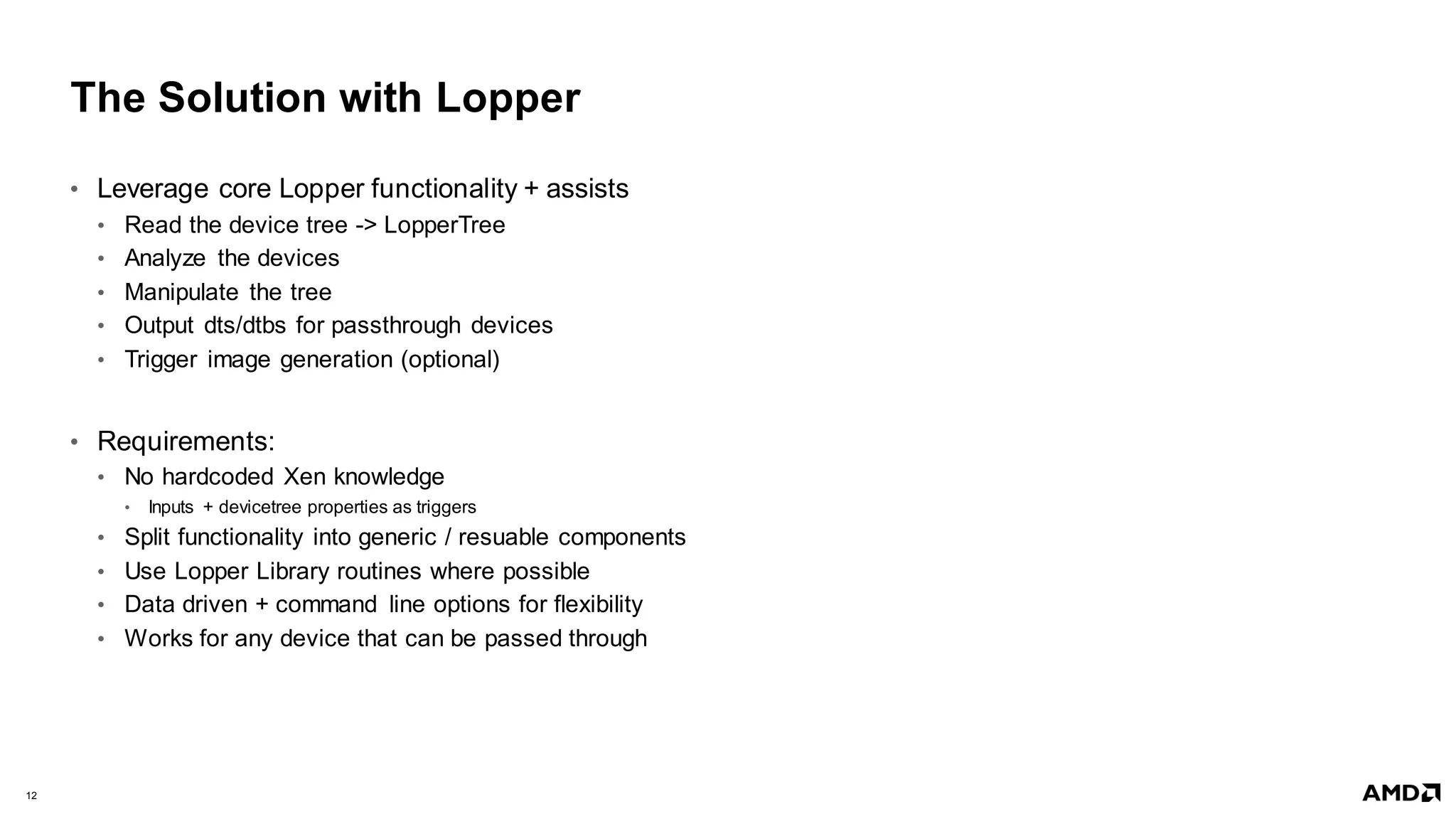
The Solution with Lopper
• Leverage core Lopper functionality + assists
• Read the device tree -> LopperTree
• Analyze the devices
• Manipulate the tree
• Output dts/dtbs for passthrough devices
• Trigger image generation (optional)
• Requirements:
• No hardcoded Xen knowledge
• Inputs + devicetree properties as triggers
• Split functionality into generic / resuable components
• Use Lopper Library routines where possible
• Data driven + command line options for flexibility
• Works for any device that can be passed through
13 |
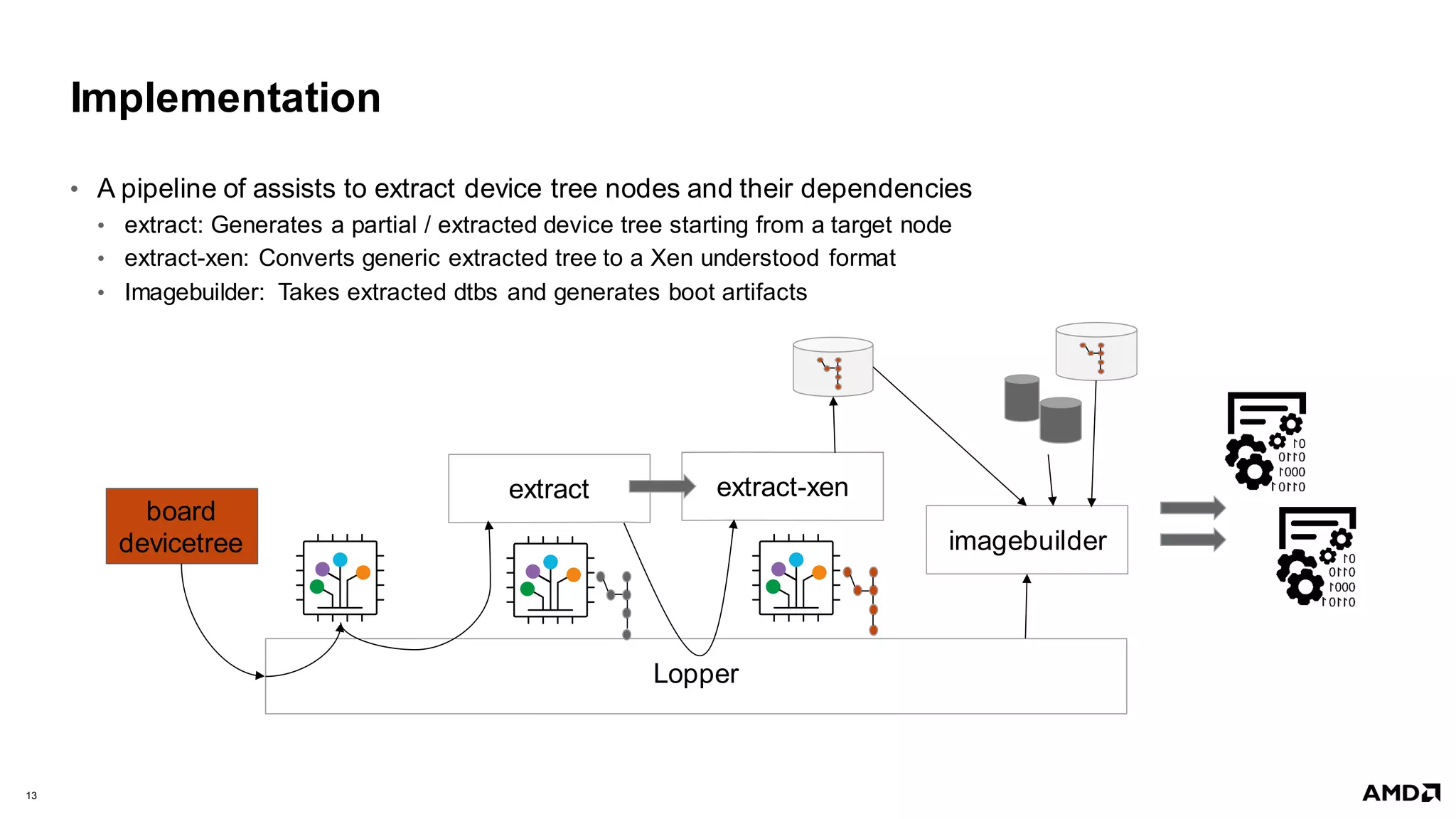
Implementation
• A pipeline of assists to extract device tree nodes and their dependencies
• extract: Generates a partial / extracted device tree starting from a target node
• extract-xen: Converts generic extracted tree to a Xen understood format
• Imagebuilder: Takes extracted dtbs and generates boot artifacts
extract
board
devicetree
Lopper
extract-xen
imagebuilder
14 |
Implementation: Assists
Usage: extract-xen -t <target node> [OPTION]
-t target node (full path)
-p permissive matching on target node (regex)
-v enable verbose debug/processing
-o output file for extracted device tree
Usage: extract -t <target node> [OPTION]
-t target node (full path)
-i include node if found in extracted node paths
-p permissive matching on target node (regex)
-v enable verbose debug/processing
-x exclude nodes or properties matching regex
-o output file for extracted device tree
Usage: image-builder [--uboot] -o <output dir> --imagebuilder <path to imagebuilder>
wrapper around imagebuilder (https://gitlab.com/xen-project/imagebuilder)
--uboot execute imagebuilder's "uboot-script-gen", with the
options: -t tftp -c ./config, and the supplied output directory
-i path to imagebuilder clone
-v enable verbose debug/processing
-o output directory for files
Demo
16 |
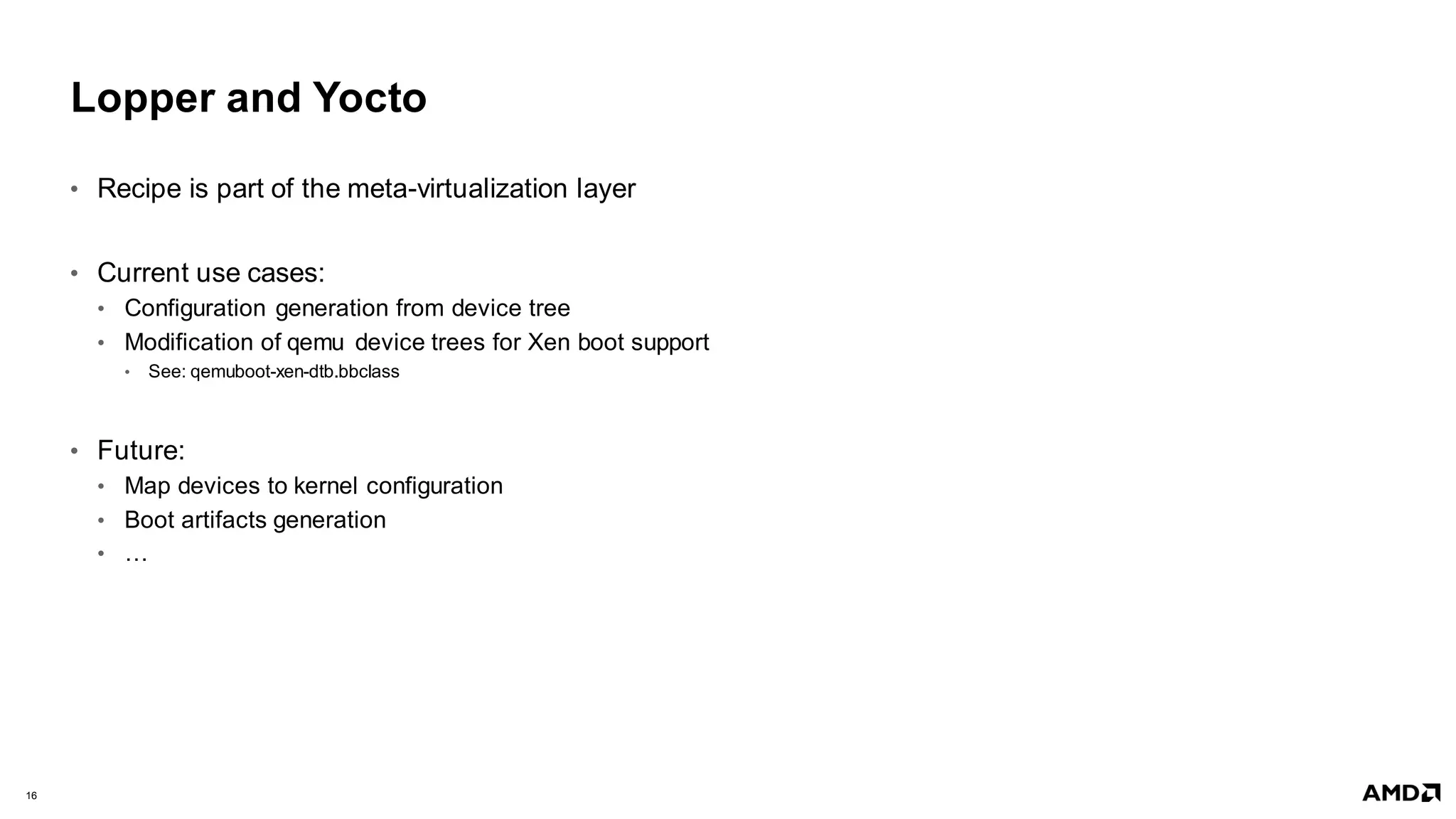
Lopper and Yocto
• Recipe is part of the meta-virtualization layer
• Current use cases:
• Configuration generation from device tree
• Modification of qemu device trees for Xen boot support
• See: qemuboot-xen-dtb.bbclass
• Future:
• Map devices to kernel configuration
• Boot artifacts generation
• …
17 |
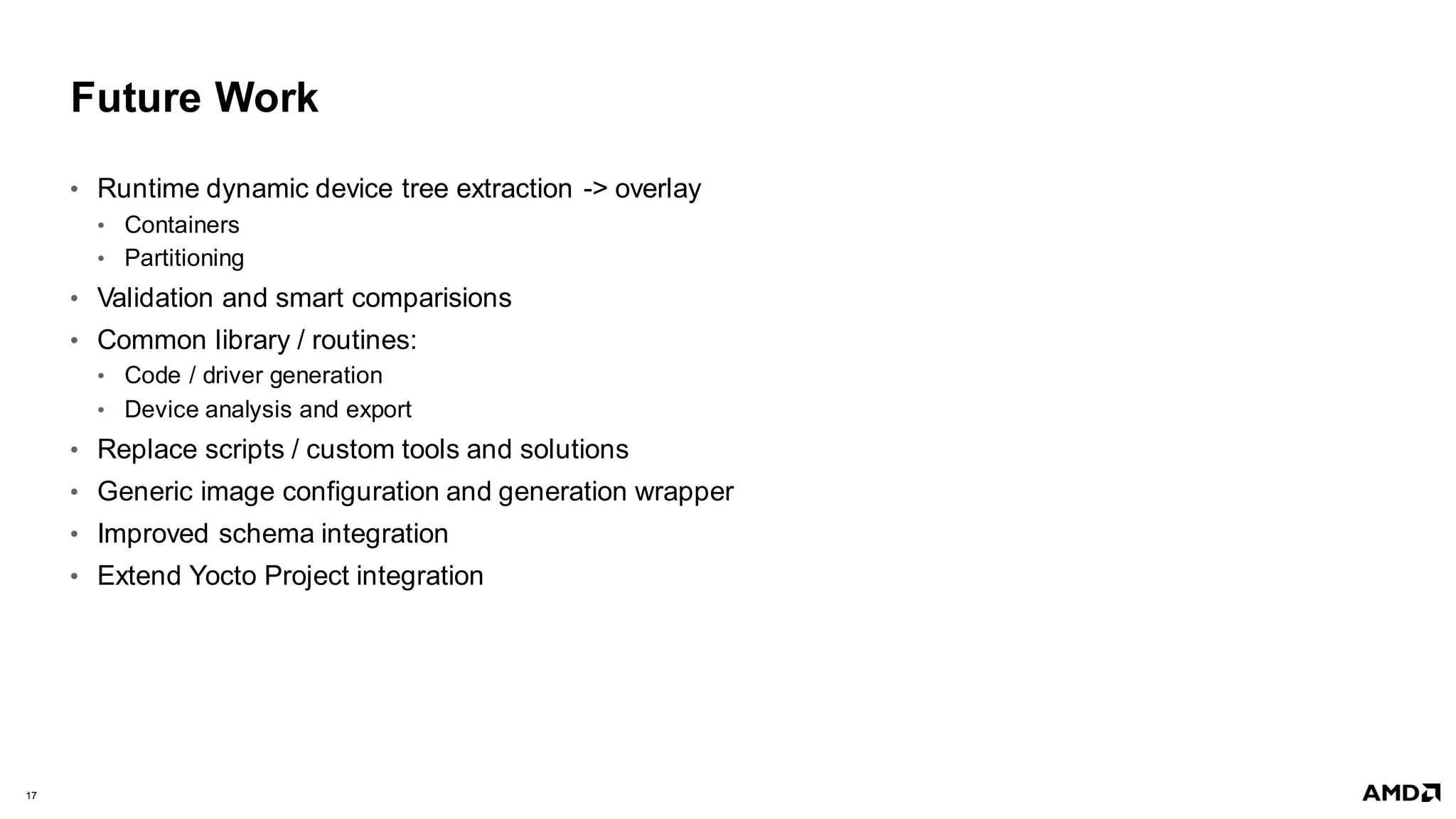
Future Work
• Runtime dynamic device tree extraction -> overlay
• Containers
• Partitioning
• Validation and smart comparisions
• Common library / routines:
• Code / driver generation
• Device analysis and export
• Replace scripts / custom tools and solutions
• Generic image configuration and generation wrapper
• Improved schema integration
• Extend Yocto Project integration
Questions?
System Device Tree and Lopper: Concrete Examples - ELC NA 2022

System Device Tree and Lopper: Concrete Examples - ELC NA 2022

  • 1.
    1 | Lopper Bruce Ashfield& Stefano Stabellini ELC NA 2022
  • 2.
    2 | System DeviceTree & Heterogeneous computing • Heterogeneous System with multiple HW components • A72s,R5s,PMC, MicroBlaze clusters • Multiple Execution Domains with its own address map • Each domain with its own operating system • Multiple execution levels (EL) • Multiple Security Environments • E.g.: U-Boot, TF-A, Xen, Linux, OPTEE,Zephyr, baremetal • The system is divided into domains • Each domain is an independentoperating environment with CPUs, memory,and devices allocated to it • System Device Tree: extending DT to describe the full system • Including multiple heterogeneous CPU clusters • Including multiple domains Secure State Trusted Firmware (TF) App App Trusted Execution Environment(TEE) Non-secure State Hypervisor App App Linux App RTOS FPGA MicroBlaze App App RTOS MicroBlaze App Bare Metal A72 Core 0 A72 Core 1 RPU R5 Core 0 App App RTOS R5 Core 1 App Bare Metal Container App EL0 EL1 EL2 EL3 App App Platform ManagementController (PMC) PLM Devices Memory
  • 3.
    3 | System DeviceTree • Device Tree expresses HW information relevant to an operating environment • Used by U-Boot, Linux, Xen, TF-A and others • System Device Tree is an extension to Device Tree to describe the full system • It describes multiple CPU clusters with different address maps • Both A72s and R5s • It describes multiple domains and the resources allocated to each • A domain could be: • an heterogenous computing unit, e.g. Zephyr on R5s • an operating environment at a specific execution level, e.g. OPTEE • a virtual machine, e.g. a Xen domain
  • 4.
    4 | Lopper: anintroduction • Lopper • Is a framework for manipulating System Device Trees and transforming information • Original goal / concept was to produce standard devices trees to support existing platforms/OSs • Produces any number of outputs: device trees, generated code, custom, etc • Flexible development / runtime workflow integration • Data driven • A few details: • OpenSource, BSD-3 License • https://github.com/devicetree-org/lopper, https://pypi.org/project/lopper/ • Written in python, using pluggable backends (libfdt,dtlib) for device tree manipulations • Additional logic components in the future • Works with dts, dtb and yaml inputs • Supports unit operations (lops) and more complex python assist modules • Depending on the task, both can be used • Flexible output / input is provided via python assists • Performs validation and consistency checking
  • 5.
    5 | Lopper: aframework • Common base for tooling inquiring or manipulating device trees​ • Built-in: • Core tree manipulation, merging • Input and output: dts / dtb / yaml • Parsing: libfdt or dtlib • Assist / lop management • Device tree sanity and consistency checking • Tree manipulation library / routines
  • 6.
    6 | Lopper: aframework • Optional / plugin: • Assists provide Logic / semantics / context awareness • Front ends • domains / protection, yaml expansion • Backends / Assists • System Device tree pruning • RTOS/Bare Metal backend creates #defines into #include files (early availability) • OpenAMP plugin that generates device specific DT for shared pages/IRQs • Security / partitioning backend for subsystem and firewall information (TBD) • Default Domain specification plugin creates a YAML file that can later be edited (under development) • Verification assist that compares DTs from different domains to make sure they are compatible (TBD) • Sub device tree / overlay extraction • Detailed tree analysis / modification • Source validation and expansion • ReST API: an HTTP server to support GUIs and other tooling
  • 7.
    7 | Lopper: components LopperCore YAML dts other YAML dts dtb other ruamel or pyyaml libfdt or dtlib Lopper Lopper: Tree, Fdt/Dt,Sdt .. importer yaml / xlate Device / domain lops exporter ruamel or pyyaml libfdt or dtlib custom custom lops inputs outputs Front ends Back ends assists Linux RTOS Bare Metal devicetree.org • bindings • schemas • …. • Systemdevicetree • Boarddts • overlays • ‘Standard’device tree • C-devicedrivers • Configuration • …. dtc cpp
  • 8.
    8 | Xen PartialDevice Trees • Similar to device tree overlays but older • Everything under the top-level passthrough node is copied to the guest device tree • Xen reads partial device trees today to: • configure guest device assignment • describe passthrough hardware to the guest • Starting from a copy of the host device tree node and editing it • Removing unwanted properties • Adding Xen specific properties passthrough { compatible = "simple-bus"; ranges; #address-cells = <0x2>; #size-cells = <0x2>; timer@ff110000 { compatible = "cdns,ttc"; status = "okay"; interrupt-parent = <0xfde8>; interrupts = <0x0 0x24 0x4 0x0 0x25 0x4 0x0 0x26 0x4>; reg = <0x0 0xff110000 0x0 0x1000>; timer-width = <0x20>; xen,force-assign-without-iommu = <1>; xen,reg = <0x0 0xff110000 0x0 0x1000 0x0 0xff110000>; xen,path = "/axi/timer@ff110000"; }; };
  • 9.
    9 | Xen PartialDevice Trees • Xen specific properties and quirks: • xen,reg to specify memory mappings • xen,path points to the corresponding host device tree node (used for IOMMU configurations) • xen,force-assign-without-iommu when IOMMU configuration is not necessary • interrupt-parents = <0xfde8> to point to the virtual interrupt controller of the guest • no iommus, because the IOMMU is used by Xen and not exposed to the guest • xen,passthrough; in the corresponding host device tree node to mark it for assignment timer@ff110000 { compatible = "cdns,ttc"; status = "okay"; interrupt-parent = <0xfde8>; interrupts = <0x0 0x24 0x4 0x0 0x25 0x4 0x0 0x26 0x4>; reg = <0x0 0xff110000 0x0 0x1000>; timer-width = <0x20>; xen,force-assign-without-iommu = <1>; xen,reg = <0x0 0xff110000 0x0 0x1000 0x0 0xff110000>; xen,path = "/axi/timer@ff110000"; };
  • 10.
    10 | Xen PartialDevice Trees: the problems • Xen specific changes are not simple, but they could be automated more easily • Xen properties aside, how to generate the partial device tree? • Which properties to remove compared to the host device tree node? • How to solve clock dependencies? Do we need to include the clock controller too? • What about power domains and reset lines? • Generic problem: affects device assignment on any hypervisor and heterogeneous domains too
  • 11.
    11 | Xen PartialDevice Trees: a more complex example zynqmp-firmware { compatible = "xlnx,zynqmp-firmware", "xlnx,zynqmp"; method = "smc"; #power-domain-cells = <0x1>; phandle = <0x1>; clock-controller { u-boot,dm-pre-reloc; #clock-cells = <0x1>; compatible = "xlnx,zynqmp-clk"; clocks = <0x6 0x7 0x8 0x9 0xa>; clock-names = "pss_ref_clk", "video_clk", "pss_alt_ref_clk", "aux_ref_clk", "gt_crx_ref_clk"; phandle = <0x3>; }; }; pss_ref_clk { compatible = "fixed-clock"; #clock-cells = <0x0>; clock-frequency = <0x1fc9350>; phandle = <0x6>; }; video_clk { compatible = "fixed-clock"; #clock-cells = <0x0>; clock-frequency = <0x1fc9f08>; phandle = <0x7>; }; pss_alt_ref_clk { compatible = "fixed-clock"; #clock-cells = <0x0>; clock-frequency = <0x0>; phandle = <0x8>; }; […] mmc@ff170000 { compatible = "xlnx,zynqmp-8.9a", "arasan,sdhci-8.9a"; status = "okay"; interrupt-parent = <0xfde8>; interrupts = <0x0 0x31 0x4>; reg = <0x0 0xff170000 0x0 0x1000>; xlnx,device_id = <0x1>; clock-names = "clk_xin", "clk_ahb"; #clock-cells = <0x1>; clock-output-names = "clk_out_sd1", "clk_in_sd1"; clocks = <0x3 0x37 0x3 0x1f>; phandle = <0x37>; xen,reg = <0x0 0xff170000 0x0 0x1000 0x0 0xff170000>; xen,path = "/axi/mmc@ff170000"; };
  • 12.
    12 | The Solutionwith Lopper • Leverage core Lopper functionality + assists • Read the device tree -> LopperTree • Analyze the devices • Manipulate the tree • Output dts/dtbs for passthrough devices • Trigger image generation (optional) • Requirements: • No hardcoded Xen knowledge • Inputs + devicetree properties as triggers • Split functionality into generic / resuable components • Use Lopper Library routines where possible • Data driven + command line options for flexibility • Works for any device that can be passed through
  • 13.
    13 | Implementation • Apipeline of assists to extract device tree nodes and their dependencies • extract: Generates a partial / extracted device tree starting from a target node • extract-xen: Converts generic extracted tree to a Xen understood format • Imagebuilder: Takes extracted dtbs and generates boot artifacts extract board devicetree Lopper extract-xen imagebuilder
  • 14.
    14 | Implementation: Assists Usage:extract-xen -t <target node> [OPTION] -t target node (full path) -p permissive matching on target node (regex) -v enable verbose debug/processing -o output file for extracted device tree Usage: extract -t <target node> [OPTION] -t target node (full path) -i include node if found in extracted node paths -p permissive matching on target node (regex) -v enable verbose debug/processing -x exclude nodes or properties matching regex -o output file for extracted device tree Usage: image-builder [--uboot] -o <output dir> --imagebuilder <path to imagebuilder> wrapper around imagebuilder (https://gitlab.com/xen-project/imagebuilder) --uboot execute imagebuilder's "uboot-script-gen", with the options: -t tftp -c ./config, and the supplied output directory -i path to imagebuilder clone -v enable verbose debug/processing -o output directory for files
  • 15.
  • 16.
    16 | Lopper andYocto • Recipe is part of the meta-virtualization layer • Current use cases: • Configuration generation from device tree • Modification of qemu device trees for Xen boot support • See: qemuboot-xen-dtb.bbclass • Future: • Map devices to kernel configuration • Boot artifacts generation • …
  • 17.
    17 | Future Work •Runtime dynamic device tree extraction -> overlay • Containers • Partitioning • Validation and smart comparisions • Common library / routines: • Code / driver generation • Device analysis and export • Replace scripts / custom tools and solutions • Generic image configuration and generation wrapper • Improved schema integration • Extend Yocto Project integration
  • 18.