UltraESB Configuration
Transports
Transport Listener
● TransportListeners
– accept / create messages and dispatch to proxy
– Can be event driven or Polling
● HTTP/S, File, SFTP, JMS..
– Could be transactional – e.g. JMS
– Can be blocking or non-blocking
– The payload of the received message is in the
MessageFormat picked by the TL
– Static, per ESB node – no changes at runtime
Transport Sender
● Sends an outgoing message using the selected
transport
● Selected by the ESB based on the URL of the endpoint
address
● Same transport can have multiple sender configurations
– e.g. JMS, HTTP (with/without proxy) etc
– {http-proxy}http://host:port/path
● Can be blocking or non-blocking
– Check for errors after sendToEndpoint() call for blocking
HTTP/S Transport
● Non-Blocking, uses Zero-Copy via RAM disk
●
RequestFilters
– authentication, service resources (WSDL, WADL, XSD), or custom..
● Supports HTTP Basic and Digest auth and Amazon S3 (outgoing)
– Authentication can be against any Spring Security backend such as LDAP,
DB etc.
● Two way SSL and client certificate DN and attributes could be used
during mediation
● Can assign custom error handlers (e.g. 404)
● Writes error log
● Can tune maximum payload size, connections etc
● Sender can use a proxy server and unzip responses, or keep
compressed
● SSL remote cert/hostname validation can be turned off
● Troubleshooting
– Connection Debug (log4j.properties, UTerm/UConsole)
– SSL debug (Only via system property in wrapper.conf/ultraesb.sh)
● Response validators can detect HTML error pages etc
● Be careful with HW Lbs that might terminate connections
– Make the ESB socket timeout less than the remote party timeout
● Requires tuning for optimal performance
● Connection and Socket timeouts
JMS Transport
● Configure via Spring with additional JARs
● SSL with MQ may require IBM JCE and JSSE
providers
● Dynamically scales as per Spring JMS
semantics
Polling Transports (Listener)
● File / Email / Timer
● Configurations
– Threads (default 4)
– ultra.polling.concurrent
● Single threaded if false
– (Note: IMAP may support concurrent downloads)
– ultra.polling.concurrent_execution
● Limit for concurrent execution
– Default MAX_INT, Setting to 1 => single threaded
● CRON or start delay / polling interval / count
File Transport
● Supports file, s/ftp, ftps
● Poll for files in local or remote file systems
– File URL or path pattern
– Specify operation after processing
● Delete / Move – can be troublesome on Windows*
● Move with time stamp appended to file name
– Based on CRON or delay
– Fetch files that are at lease <n> old
– When clustering is enabled, a node will acquire a cluster lock before
downloading each file, to prevent the same file being downloaded
concurrently
● When clustering is not available, defaults to file locking (Note: Windows*)
● Upload files
– Can specify an optional timestamp to apply to the
name
– FastSFTPConnector available for always-
connected SFTP
Can use certificate based authentication for
SFTP
Email Transport
● Poll POP3/IMAP accounts, or send via SMTP
● Can move email to folders after processing, or leave them on server
● Ability to process multiple emails concurrently
● Preserve headers or Remove headers
– Based on comma separated list
● e.g. “To, Subject, From”
● Main part identification
– list of content types in priority, other MIME parts become attachments
● mail.pop3|imap|smtp.* or other SSL properties as usual
● Endpoint properties can specify Email headers (e.g. Subject)
● Turn on debugging for detailed conversation
Custom TCP / New Transports
● TCP/S transport is an abstract framework
– MLLP/S is a concrete example for HL7
– Can cater to custom TCP based protocols
● Proprietary transports may require custom
implementations
– e.g. based on third party libraries etc
– LogB, FIX etc
Other - Transports
● Support for WebSockets in the pipeline
● Support for SWIFT, FIX, MLLP available
● AMQP support is available
– No production user yet
● AS2 protocol support
– Extensive, e.g. http://as2gateway.org
UltraESB is a Spring application
● In reality, UltraESB is a Spring application
● The standalone deployment is always
recommended
● The [almost never used] Web container
deployment model too triggers Spring
initialization
– This should ONLY be used where JTA XA is
required over a JEE server such as Jboss
Root Configuration
● Static Configuration
– Root configuration file is conf/ultra-root.xml
– Defines the key Spring beans
● Should be used to tune the UltraESB specifics
– Clustering, HA, JMX, FileCache, Thread Pools etc
– Static includes
● conf/ultra-custom.xml
– For users to define custom Spring beans
– Define one or more
● monitoring/ultra-metrics.xml (Monitoring aspects)
– Any changes to static configuration requires a restart
● Dynamic includes
– Deployment units from conf/deployments
– DUs can be added/updated/removed during use
conf/ultra-root.xml
● File-cache
– Used by the HTTP/S transports, and transformations as
the default internal message format
– PooledMessageFileCache
● Originally used memory mapped files, but now deprecated,
and disk based.
● Fine for development time, but do not run benchmarks
●
Defaults to “tmp” directory
● 10 files for development is fine (grows if required)
– RAMDiskFileCache (Next)
RAMDiskFileCache
● RAM disk must be created at the OS level
– sudo mount -t tmpfs -o size=2048M tmpfs /tmp/ram/
– edit /etc/fstab and add line for persistence
● tmpfs /tmp/ram tmpfs defaults,size=2048M
– Specify path, number of initial files, warn/stop thresholds,
max files on RAM disk, and overflow
– Reaching stop threshold implies a file cache that's too
small, or a file leak*
– Size is based on concurrency and Message size
● Overflow to a disk {java.io.tmp} is possible
Setting System Properties
● Sometimes, easier to define/manage within config
– e.g. MQ connectivity over SSL
<bean id="system-properties" class="org.springframework.beans.factory.config.MethodInvokingFactoryBean">
<property name="targetObject" value="#{@systemProperties}" />
<property name="targetMethod" value="putAll" />
<property name="arguments">
<util:properties>
<prop key="javax.net.ssl.keyStore">conf/keys/esb.jks</prop>
<prop key="javax.net.ssl.keyStorePassword">password</prop>
<prop key="javax.net.ssl.trustStore">conf/keys/esb.jks</prop>
<prop key="javax.net.ssl.trustStorePassword">password</prop>
</util:properties>
</property>
</bean>
● [Note: System properties can be also set though the conf/wrapper.conf; or via the bin/ultraesb.sh during
development]
Use and Encryption of Properties
● Externalize properties with a Spring
PropertyPlaceholder
● To encrypt properties such as passwords
– Use simple / non-secure password
– Use secure password, with master password as
environment variable
– Use bin/encrypt.sh to encrypt values
Example of secured properties
<bean id="secure-property-configurer" class="org.jasypt.spring.properties.EncryptablePropertyPlaceholderConfigurer">
<constructor-arg>
<bean class="org.jasypt.encryption.pbe.StandardPBEStringEncryptor">
<property name="config">
<!-- Use this to specify the Jasypt password as an Environment variable (e.g. APP_PASSWORD=jasypt)-->
<bean class="org.jasypt.encryption.pbe.config.EnvironmentStringPBEConfig">
<property name="algorithm" value="PBEWithMD5AndDES"/>
<property name="passwordEnvName" value="APP_PASSWORD"/>
<property name="providerClassName" value="org.bouncycastle.jce.provider.BouncyCastleProvider"/>
<property name="providerName" value="BC"/>
</bean>
</property>
</bean>
</constructor-arg>
<property name="locations">
<list>
<value>file:conf/sgx-config.properties</value>
</list>
</property>
</bean>
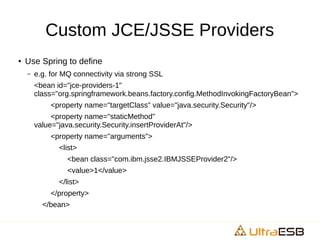
Custom JCE/JSSE Providers
● Use Spring to define
– e.g. for MQ connectivity via strong SSL
<bean id="jce-providers-1"
class="org.springframework.beans.factory.config.MethodInvokingFactoryBean">
<property name="targetClass" value="java.security.Security"/>
<property name="staticMethod"
value="java.security.Security.insertProviderAt"/>
<property name="arguments">
<list>
<bean class="com.ibm.jsse2.IBMJSSEProvider2"/>
<value>1</value>
</list>
</property>
</bean>
Environment
● Configure a few environment specifics
– OnTheFlyCompilation
– binaryClassReloading
– deploymentUnitsEnabled
– UnitTestMode
● Predefined environments
– e.g. dev, unit_test, sample, test, stage, prod
Miscellaneous
● Clustering, HA and FO
– Separate set of slides
● Metrics / Monitoring
– monitoring/ultra-metrics.xml
– Separate set of slides
● Cache Manager
– Configure underlying EHCache
● Zabbix Agent
– Expose JMX metrics over Zabbix native protocol
– Specify host/IP and port
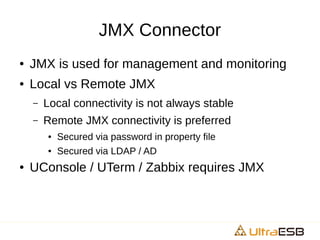
JMX Connector
● JMX is used for management and monitoring
● Local vs Remote JMX
– Local connectivity is not always stable
– Remote JMX connectivity is preferred
● Secured via password in property file
● Secured via LDAP / AD
● UConsole / UTerm / Zabbix requires JMX
ultra-custom.xml
● Use to define custom Spring beans and
transports
– e.g. Easier to keep JMS specifics separated
● Define transaction managers, connection pools
● Define any common artifacts
– e.g. services, endpoints, error handlers
– e.g. health check service, default error handler
● Define AuditInterceptors etc
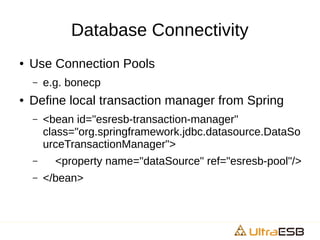
Database Connectivity
● Use Connection Pools
– e.g. bonecp
● Define local transaction manager from Spring
– <bean id="esresb-transaction-manager"
class="org.springframework.jdbc.datasource.DataSo
urceTransactionManager">
– <property name="dataSource" ref="esresb-pool"/>
– </bean>
<bean id="esresb-pool" class="com.jolbox.bonecp.BoneCPDataSource" destroy-method="close">
<property name="poolName" value="esresb" />
<property name="driverClass" value="oracle.jdbc.OracleDriver" />
<property name="jdbcUrl" value="${oracle.jdbc-url}" />
<property name="username" value="${oracle.jdbc-username}"/>
<property name="password" value="${oracle.jdbc-password}"/>
<property name="maxConnectionsPerPartition" value="20"/>
<property name="minConnectionsPerPartition" value="2"/>
<property name="partitionCount" value="2"/>
<property name="statementsCacheSize" value="10"/>
<property name="acquireRetryAttempts" value="3"/>
<property name="acquireRetryDelayInMs" value="5000"/>
<property name="acquireIncrement" value="2"/>
<property name="driverProperties">
<util:props>
<prop key="SetBigStringTryClob">true</prop>
</util:props>
</property>
<property name="statisticsEnabled" value="true"/>
<property name="disableJMX" value="false"/>
<property name="connectionTestStatement" value="select 1 from dual"/>
<property name="idleConnectionTestPeriodInSeconds" value="300"/>
<property name="idleMaxAgeInSeconds" value="600"/>
<property name="maxConnectionAgeInSeconds" value="3600"/>
<property name="lazyInit" value="false"/>
<property name="connectionTimeoutInMs" value="5000"/>
<!--<property name="logStatementsEnabled" value="true"/>-->
</bean>
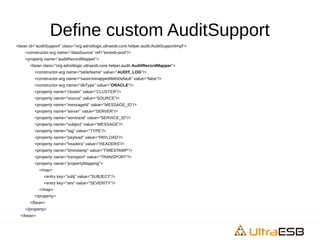
Define custom AuditSupport
<bean id="auditSupport" class="org.adroitlogic.ultraesb.core.helper.audit.AuditSupportImpl">
<constructor-arg name="dataSource" ref="esresb-pool"/>
<property name="auditRecordMapper">
<bean class="org.adroitlogic.ultraesb.core.helper.audit.AuditRecordMapper">
<constructor-arg name="tableName" value="AUDIT_LOG"/>
<constructor-arg name="saveUnmappedWithDefault" value="false"/>
<constructor-arg name="dbType" value="ORACLE"/>
<property name="cluster" value="CLUSTER"/>
<property name="source" value="SOURCE"/>
<property name="messageId" value="MESSAGE_ID"/>
<property name="server" value="SERVER"/>
<property name="serviceId" value="SERVICE_ID"/>
<property name="subject" value="MESSAGE"/>
<property name="tag" value="TYPE"/>
<property name="payload" value="PAYLOAD"/>
<property name="headers" value="HEADERS"/>
<property name="timestamp" value="TIMESTAMP"/>
<property name="transport" value="TRANSPORT"/>
<property name="propertyMapping">
<map>
<entry key="subj" value="SUBJECT"/>
<entry key="sev" value="SEVERITY"/>
</map>
</property>
</bean>
</property>
</bean>
Security
● HTTP Authentication
● SSL Configurartion
– 2-way SSL
● WS-Security
● XACML
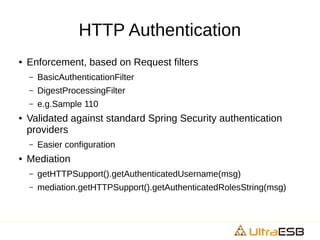
HTTP Authentication
● Enforcement, based on Request filters
– BasicAuthenticationFilter
– DigestProcessingFilter
– e.g.Sample 110
● Validated against standard Spring Security authentication
providers
– Easier configuration
● Mediation
– getHTTPSupport().getAuthenticatedUsername(msg)
– mediation.getHTTPSupport().getAuthenticatedRolesString(msg)
● Outgoing can be pre-emptive
● Configured at
– Endpoint
<u:inDestination>
<u:address>http://localhost:8281/service/rest-mock</u:address>
<u:property name="ultra.http.auth_username" value="asankha"/>
<u:property name="ultra.http.auth_password" value="adroitlogic"/>
<u:property name="ultra.http.auth_scheme" value="basic"/>
</u:inDestination>
– Mediation
● getHTTPSupport().addPreemptiveBasicAuthentication()
● mediation.getHTTPSupport().setAuthenticationCredentials()
SSL Configuration
● Support TLS
● Transport Listener and Sender accepts key stores
– Trust store – defaults to Java
– Identity store
● Must be configured
● Can turn off remote certificate validation for testing / debugging
– NonProductionNoRemoteCertValidation
● Remote hostname verification
– HostnameVerifier: Default, Strict, DefaultAndLocalHost
● Patch security policy files for high strength security support
● Use SSL debugging to detect serious issues
– Note: Captured on standard output/error and not in the log file
SSL Client Authentication
● Listener
– SslVerifyClient: none, optional, required
– Read in Mediation
● HttpConstants.SSL_CLIENT_DN
● HttpConstants.SSL_CLIENT_CERTS
● Sender will send automatically if reqested
– Identity store must be configured
WS-Security
● WSSecurityManager - Spring bean
– Does not implement all of WS-Security, especially WS-Policy support
– timestamp, sign, encrypt
● plus combinations
– UsernameToken authentication
● Plain, with Digest, with Timestamp
– Incoming verified against Spring Security authentication provider
● Verify received messages
● Based on configured keystores
● Read during mediation
– MessageSecurityContext.USER_NAME | USER_ROLES | USER_CERTS
● Consider cost of message level security vs SSL
XACML
● For fine grained authorization
● Based on JBoss XACML
● Could be overkill?
– No production customers
● See sample #216 if interested

System Configuration for UltraESB

  • 1.
  • 2.
  • 3.
    Transport Listener ● TransportListeners –accept / create messages and dispatch to proxy – Can be event driven or Polling ● HTTP/S, File, SFTP, JMS.. – Could be transactional – e.g. JMS – Can be blocking or non-blocking – The payload of the received message is in the MessageFormat picked by the TL – Static, per ESB node – no changes at runtime
  • 4.
    Transport Sender ● Sendsan outgoing message using the selected transport ● Selected by the ESB based on the URL of the endpoint address ● Same transport can have multiple sender configurations – e.g. JMS, HTTP (with/without proxy) etc – {http-proxy}http://host:port/path ● Can be blocking or non-blocking – Check for errors after sendToEndpoint() call for blocking
  • 5.
    HTTP/S Transport ● Non-Blocking,uses Zero-Copy via RAM disk ● RequestFilters – authentication, service resources (WSDL, WADL, XSD), or custom.. ● Supports HTTP Basic and Digest auth and Amazon S3 (outgoing) – Authentication can be against any Spring Security backend such as LDAP, DB etc. ● Two way SSL and client certificate DN and attributes could be used during mediation ● Can assign custom error handlers (e.g. 404) ● Writes error log ● Can tune maximum payload size, connections etc
  • 6.
    ● Sender canuse a proxy server and unzip responses, or keep compressed ● SSL remote cert/hostname validation can be turned off ● Troubleshooting – Connection Debug (log4j.properties, UTerm/UConsole) – SSL debug (Only via system property in wrapper.conf/ultraesb.sh) ● Response validators can detect HTML error pages etc ● Be careful with HW Lbs that might terminate connections – Make the ESB socket timeout less than the remote party timeout ● Requires tuning for optimal performance ● Connection and Socket timeouts
  • 7.
    JMS Transport ● Configurevia Spring with additional JARs ● SSL with MQ may require IBM JCE and JSSE providers ● Dynamically scales as per Spring JMS semantics
  • 8.
    Polling Transports (Listener) ●File / Email / Timer ● Configurations – Threads (default 4) – ultra.polling.concurrent ● Single threaded if false – (Note: IMAP may support concurrent downloads) – ultra.polling.concurrent_execution ● Limit for concurrent execution – Default MAX_INT, Setting to 1 => single threaded ● CRON or start delay / polling interval / count
  • 9.
    File Transport ● Supportsfile, s/ftp, ftps ● Poll for files in local or remote file systems – File URL or path pattern – Specify operation after processing ● Delete / Move – can be troublesome on Windows* ● Move with time stamp appended to file name – Based on CRON or delay – Fetch files that are at lease <n> old – When clustering is enabled, a node will acquire a cluster lock before downloading each file, to prevent the same file being downloaded concurrently ● When clustering is not available, defaults to file locking (Note: Windows*)
  • 10.
    ● Upload files –Can specify an optional timestamp to apply to the name – FastSFTPConnector available for always- connected SFTP Can use certificate based authentication for SFTP
  • 11.
    Email Transport ● PollPOP3/IMAP accounts, or send via SMTP ● Can move email to folders after processing, or leave them on server ● Ability to process multiple emails concurrently ● Preserve headers or Remove headers – Based on comma separated list ● e.g. “To, Subject, From” ● Main part identification – list of content types in priority, other MIME parts become attachments ● mail.pop3|imap|smtp.* or other SSL properties as usual ● Endpoint properties can specify Email headers (e.g. Subject) ● Turn on debugging for detailed conversation
  • 12.
    Custom TCP /New Transports ● TCP/S transport is an abstract framework – MLLP/S is a concrete example for HL7 – Can cater to custom TCP based protocols ● Proprietary transports may require custom implementations – e.g. based on third party libraries etc – LogB, FIX etc
  • 13.
    Other - Transports ●Support for WebSockets in the pipeline ● Support for SWIFT, FIX, MLLP available ● AMQP support is available – No production user yet ● AS2 protocol support – Extensive, e.g. http://as2gateway.org
  • 14.
    UltraESB is aSpring application ● In reality, UltraESB is a Spring application ● The standalone deployment is always recommended ● The [almost never used] Web container deployment model too triggers Spring initialization – This should ONLY be used where JTA XA is required over a JEE server such as Jboss
  • 15.
    Root Configuration ● StaticConfiguration – Root configuration file is conf/ultra-root.xml – Defines the key Spring beans ● Should be used to tune the UltraESB specifics – Clustering, HA, JMX, FileCache, Thread Pools etc – Static includes ● conf/ultra-custom.xml – For users to define custom Spring beans – Define one or more ● monitoring/ultra-metrics.xml (Monitoring aspects) – Any changes to static configuration requires a restart ● Dynamic includes – Deployment units from conf/deployments – DUs can be added/updated/removed during use
  • 16.
    conf/ultra-root.xml ● File-cache – Usedby the HTTP/S transports, and transformations as the default internal message format – PooledMessageFileCache ● Originally used memory mapped files, but now deprecated, and disk based. ● Fine for development time, but do not run benchmarks ● Defaults to “tmp” directory ● 10 files for development is fine (grows if required) – RAMDiskFileCache (Next)
  • 17.
    RAMDiskFileCache ● RAM diskmust be created at the OS level – sudo mount -t tmpfs -o size=2048M tmpfs /tmp/ram/ – edit /etc/fstab and add line for persistence ● tmpfs /tmp/ram tmpfs defaults,size=2048M – Specify path, number of initial files, warn/stop thresholds, max files on RAM disk, and overflow – Reaching stop threshold implies a file cache that's too small, or a file leak* – Size is based on concurrency and Message size ● Overflow to a disk {java.io.tmp} is possible
  • 18.
    Setting System Properties ●Sometimes, easier to define/manage within config – e.g. MQ connectivity over SSL <bean id="system-properties" class="org.springframework.beans.factory.config.MethodInvokingFactoryBean"> <property name="targetObject" value="#{@systemProperties}" /> <property name="targetMethod" value="putAll" /> <property name="arguments"> <util:properties> <prop key="javax.net.ssl.keyStore">conf/keys/esb.jks</prop> <prop key="javax.net.ssl.keyStorePassword">password</prop> <prop key="javax.net.ssl.trustStore">conf/keys/esb.jks</prop> <prop key="javax.net.ssl.trustStorePassword">password</prop> </util:properties> </property> </bean> ● [Note: System properties can be also set though the conf/wrapper.conf; or via the bin/ultraesb.sh during development]
  • 19.
    Use and Encryptionof Properties ● Externalize properties with a Spring PropertyPlaceholder ● To encrypt properties such as passwords – Use simple / non-secure password – Use secure password, with master password as environment variable – Use bin/encrypt.sh to encrypt values
  • 20.
    Example of securedproperties <bean id="secure-property-configurer" class="org.jasypt.spring.properties.EncryptablePropertyPlaceholderConfigurer"> <constructor-arg> <bean class="org.jasypt.encryption.pbe.StandardPBEStringEncryptor"> <property name="config"> <!-- Use this to specify the Jasypt password as an Environment variable (e.g. APP_PASSWORD=jasypt)--> <bean class="org.jasypt.encryption.pbe.config.EnvironmentStringPBEConfig"> <property name="algorithm" value="PBEWithMD5AndDES"/> <property name="passwordEnvName" value="APP_PASSWORD"/> <property name="providerClassName" value="org.bouncycastle.jce.provider.BouncyCastleProvider"/> <property name="providerName" value="BC"/> </bean> </property> </bean> </constructor-arg> <property name="locations"> <list> <value>file:conf/sgx-config.properties</value> </list> </property> </bean>
  • 21.
    Custom JCE/JSSE Providers ●Use Spring to define – e.g. for MQ connectivity via strong SSL <bean id="jce-providers-1" class="org.springframework.beans.factory.config.MethodInvokingFactoryBean"> <property name="targetClass" value="java.security.Security"/> <property name="staticMethod" value="java.security.Security.insertProviderAt"/> <property name="arguments"> <list> <bean class="com.ibm.jsse2.IBMJSSEProvider2"/> <value>1</value> </list> </property> </bean>
  • 22.
    Environment ● Configure afew environment specifics – OnTheFlyCompilation – binaryClassReloading – deploymentUnitsEnabled – UnitTestMode ● Predefined environments – e.g. dev, unit_test, sample, test, stage, prod
  • 23.
    Miscellaneous ● Clustering, HAand FO – Separate set of slides ● Metrics / Monitoring – monitoring/ultra-metrics.xml – Separate set of slides ● Cache Manager – Configure underlying EHCache ● Zabbix Agent – Expose JMX metrics over Zabbix native protocol – Specify host/IP and port
  • 24.
    JMX Connector ● JMXis used for management and monitoring ● Local vs Remote JMX – Local connectivity is not always stable – Remote JMX connectivity is preferred ● Secured via password in property file ● Secured via LDAP / AD ● UConsole / UTerm / Zabbix requires JMX
  • 25.
    ultra-custom.xml ● Use todefine custom Spring beans and transports – e.g. Easier to keep JMS specifics separated ● Define transaction managers, connection pools ● Define any common artifacts – e.g. services, endpoints, error handlers – e.g. health check service, default error handler ● Define AuditInterceptors etc
  • 26.
    Database Connectivity ● UseConnection Pools – e.g. bonecp ● Define local transaction manager from Spring – <bean id="esresb-transaction-manager" class="org.springframework.jdbc.datasource.DataSo urceTransactionManager"> – <property name="dataSource" ref="esresb-pool"/> – </bean>
  • 27.
    <bean id="esresb-pool" class="com.jolbox.bonecp.BoneCPDataSource"destroy-method="close"> <property name="poolName" value="esresb" /> <property name="driverClass" value="oracle.jdbc.OracleDriver" /> <property name="jdbcUrl" value="${oracle.jdbc-url}" /> <property name="username" value="${oracle.jdbc-username}"/> <property name="password" value="${oracle.jdbc-password}"/> <property name="maxConnectionsPerPartition" value="20"/> <property name="minConnectionsPerPartition" value="2"/> <property name="partitionCount" value="2"/> <property name="statementsCacheSize" value="10"/> <property name="acquireRetryAttempts" value="3"/> <property name="acquireRetryDelayInMs" value="5000"/> <property name="acquireIncrement" value="2"/> <property name="driverProperties"> <util:props> <prop key="SetBigStringTryClob">true</prop> </util:props> </property> <property name="statisticsEnabled" value="true"/> <property name="disableJMX" value="false"/> <property name="connectionTestStatement" value="select 1 from dual"/> <property name="idleConnectionTestPeriodInSeconds" value="300"/> <property name="idleMaxAgeInSeconds" value="600"/> <property name="maxConnectionAgeInSeconds" value="3600"/> <property name="lazyInit" value="false"/> <property name="connectionTimeoutInMs" value="5000"/> <!--<property name="logStatementsEnabled" value="true"/>--> </bean>
  • 28.
    Define custom AuditSupport <beanid="auditSupport" class="org.adroitlogic.ultraesb.core.helper.audit.AuditSupportImpl"> <constructor-arg name="dataSource" ref="esresb-pool"/> <property name="auditRecordMapper"> <bean class="org.adroitlogic.ultraesb.core.helper.audit.AuditRecordMapper"> <constructor-arg name="tableName" value="AUDIT_LOG"/> <constructor-arg name="saveUnmappedWithDefault" value="false"/> <constructor-arg name="dbType" value="ORACLE"/> <property name="cluster" value="CLUSTER"/> <property name="source" value="SOURCE"/> <property name="messageId" value="MESSAGE_ID"/> <property name="server" value="SERVER"/> <property name="serviceId" value="SERVICE_ID"/> <property name="subject" value="MESSAGE"/> <property name="tag" value="TYPE"/> <property name="payload" value="PAYLOAD"/> <property name="headers" value="HEADERS"/> <property name="timestamp" value="TIMESTAMP"/> <property name="transport" value="TRANSPORT"/> <property name="propertyMapping"> <map> <entry key="subj" value="SUBJECT"/> <entry key="sev" value="SEVERITY"/> </map> </property> </bean> </property> </bean>
  • 29.
    Security ● HTTP Authentication ●SSL Configurartion – 2-way SSL ● WS-Security ● XACML
  • 30.
    HTTP Authentication ● Enforcement,based on Request filters – BasicAuthenticationFilter – DigestProcessingFilter – e.g.Sample 110 ● Validated against standard Spring Security authentication providers – Easier configuration ● Mediation – getHTTPSupport().getAuthenticatedUsername(msg) – mediation.getHTTPSupport().getAuthenticatedRolesString(msg)
  • 31.
    ● Outgoing canbe pre-emptive ● Configured at – Endpoint <u:inDestination> <u:address>http://localhost:8281/service/rest-mock</u:address> <u:property name="ultra.http.auth_username" value="asankha"/> <u:property name="ultra.http.auth_password" value="adroitlogic"/> <u:property name="ultra.http.auth_scheme" value="basic"/> </u:inDestination> – Mediation ● getHTTPSupport().addPreemptiveBasicAuthentication() ● mediation.getHTTPSupport().setAuthenticationCredentials()
  • 32.
    SSL Configuration ● SupportTLS ● Transport Listener and Sender accepts key stores – Trust store – defaults to Java – Identity store ● Must be configured ● Can turn off remote certificate validation for testing / debugging – NonProductionNoRemoteCertValidation ● Remote hostname verification – HostnameVerifier: Default, Strict, DefaultAndLocalHost ● Patch security policy files for high strength security support ● Use SSL debugging to detect serious issues – Note: Captured on standard output/error and not in the log file
  • 33.
    SSL Client Authentication ●Listener – SslVerifyClient: none, optional, required – Read in Mediation ● HttpConstants.SSL_CLIENT_DN ● HttpConstants.SSL_CLIENT_CERTS ● Sender will send automatically if reqested – Identity store must be configured
  • 34.
    WS-Security ● WSSecurityManager -Spring bean – Does not implement all of WS-Security, especially WS-Policy support – timestamp, sign, encrypt ● plus combinations – UsernameToken authentication ● Plain, with Digest, with Timestamp – Incoming verified against Spring Security authentication provider ● Verify received messages ● Based on configured keystores ● Read during mediation – MessageSecurityContext.USER_NAME | USER_ROLES | USER_CERTS ● Consider cost of message level security vs SSL
  • 35.
    XACML ● For finegrained authorization ● Based on JBoss XACML ● Could be overkill? – No production customers ● See sample #216 if interested