
A PROJECT REPORT
@
ON
INDIAN ORGANIZED RETAIL INDUSTRY
(BIG BAZAR)
IN PARTIAL FULFILLMENT FOR THE AWARD OF THE DEGREE
OF
MASTER OF BUSINESS ADMINISTRATION
IN
RETAIL MANAGEMENT
SUBMITTED BY
NISHANT RASTOGI
Registration No: - 1308009208
1
SIKKIM MANIPAL UNIVERSITY FOR DISTANCE
LEARNING
Acknowledgement
A task or project cannot be completed alone. It requires the effort of
many individuals. I take this opportunity to thank all those who helped
me complete this project.
I express my sincere gratitude to Miss Vandana Sral (SRO) for giving us the
opportunity to undergo this project. I further thank his for lending a
helping hand when it came to solving my problems related to the
project. This project would not have been possible without his valuable
time and support.
I also thank Sikkim Manipal University for an opportunity to undertake
a Soft skills project at the start of our MBA course which helped us to
understand deeply for those topics which are untouched.
This project is an attempt to talk about the Scenario of Indian
Organized Retail Industry (Big-Bazaar)
Any suggestions to improve are always welcome.
2
3
TABLE OF CONTENT
• Acknowledgement
• Executive Summary
• Objective
• Research Methodology
CHAPTER -1: -INTRODUCTION
CHAPTER -2: INDUSTRY PROFILE
a. Retailing
b. Indian Retail Industry
c. Growth Of Indian Retail Industry
d. Major Retailer In India
e. Retail Format In India
f. Challenges facing Indian Retail Industry
g. Category Of Indian Retailer
h. Classification Of Indian Retailer
CHAPTER -3: - COMPANY PROFILE
a. Future Retail
b. Corporate Statement
c. Board Of Director (BOD)
4
d. Company Timelines
e. Award & Recognitions
f. Company Of Future Group
g. Future Brands
h. Line Of Business
i. Big-Bazaar India’s Real Retail Story
j. About Big-Bazaar
k. Store Organisation
CHAPTER -4: - FASHION DEPARTMENT AT BIG-BAAZAR
a. Learning Process For Summer Training At Big-
Bazaar
b. Tagging Pattern
c. Birthday Celebration At Big-Bazaar
d. Space Mix And Space Management
CONCLUSION
SUGGESTION
BIBLIOGRAPHY
5
Executive Summary
Demographics continue to show a positive report to spur retailing
growth. Consumers aged 20-45 years is emerging as the fastest
growing consumer group and the mean age of Indians is now pegged
at 27, a mean age that reinforces spending across all the retailing
channels of grocery, non-grocery and non-store.
The government stance of protecting local retailers and prohibiting
100% foreign direct investment in retailing continued in 2005,
restraining international retailers' entry. However, there was gradual
economic reform, giving way to easier and faster franchising
agreements as well as the loosening of zonal regulations on retail
expansion, thus stimulating retailing.
Non-store retailing is expected to continue its fast-paced growth from
a miniscule base. Across all channels, growth in retailing is expected to
be boosted heightened competition during the forecast period due to
the growing.
6
OBJECTIVE OF THE STUDY:-
The present study was undertaken with the main objective of
examining the current practices of Supply Chain Management followed
in Process Operation Industry and comparing them with the best
practices.
The other objectives are:
• To study the degree of Operation.
• To identify the status of Information Technology implementation in
these Companies Effective supply-chain management is a powerful
tool for business transformation.
• It can dramatically increase a company’s profitability while
simultaneously improving customer service.
• While today’s competitive environments are forcing businesses in
this direction, the steps to take are often not evident.
• Problems of Operation management can be complex, and their
solution requires special knowledge and experience.
7
RESEARCH METHDOLOGY
Primary Data:
It is the information collected directly without any references. In the
study it was mainly interviews with concerned officers and staffs either individual
or collectively. Some of the information had verified or supplemented with
personal observation, the data collected through conducting the personal
interview with the customers. This is through a well-designed questionnaire.
Secondary Data:
The secondary data was collected from already published sources such as
pamphlets, annual reports, reports and internal records the data includes.
Reference from text books and relating to articles published in business details
like economic times, business time etc.
Sample Design:
sample selection is of random type.
Sample Size:
sample size is 100 customers of Big Bazaar
LIMITATIONS
1. Accuracy of the study is based on the information given by the respondents.
2. Data collection cannot be asserted to be free from errors, as the sample
size is small
3. The project duration was only for 45 days.
4. The project is done for the partial fulfilment of the MBA program
5. The knowledge of the employee regarding the “Quality of Work Life” is
taken for granted which may not be true because the understanding and
knowledge of various person in the organisation vary from employee to
employee.
8
Chapter-1
Introduction
Retailing is evolving into a global, high-tech business. Wal-Mart is
now the world’s largest corporation and has become the largest food
retailer in the United States. French based Carrefour is the world’s
second largest retailer. Retailing in developed countries is big business
and better organized. But the retail scenario in India is different much
of it is in unorganized sector. There are more than 12 million retail
outlets of various sizes and formats. And almost 90% of them are less
than 500 sq. ft. in size and the per capita retail space is only 2 sq. ft.
while US has 16 sq. ft.
India has the largest number of outlet in world i.e. 9 outlets for
1000 people. Most of them are independent and contribute to the
retail sales. Because of increasing number of nuclear families, working
women, greater work pressure and greater commuting time,
convenience has become a priority for Indian customers. They ever
want things under one roof for easy access and multiplicity of choice.
The growth and development of organized retailing is driven by two
main factors- prices and benefits the customer can’t resist.
India is rapidly involving into a competitive market place with
potential target consumers in the niche middle class segments. The
market trend indicates tremendous growth opportunities. The buying
behavior and lifestyle in India too are changing and the concept of
“value for money” is fast catching on in Indian retailing. This is the
evident from the expansion of the Pantaloons chain into the large
format, Big Bazaar. This growth in retail sector is making the retailers
9
powerful intermediates in the marketing channel, bridging the gap
between manufactures and consumers.
Keeping in mind the rapid growth of Indian retail industry and its
bright future, this has always been a thrust area for me. Big Bazaar is at
the top position in Indian retail industry. That is why it attracted me to
have summer training (on the job training) in Big Bazaar, Lucknow. Big
Bazaar is the retail chain of Future Retail (India) Ltd. And it provides a
wide range of products availability for the customers.
As a matter of fact, retail is the buzz word of the Indian economy
today. As retail industry is growing at a high pace I wanted to have an
overview of the subject. I have chosen Big Bazaar retail chain for the
summer training (on the job training) because Big Bazaar retail is very
upcoming retail company which is continuously changing its activities
with the change of time. I wanted to understand their marketing
activities and liked to relate how similar or dissimilar it is from what I
have studied in marketing management.
To execute the project, I underwent on the job training at Big
Bazaar, Lucknow. The interaction with the Store Manager, Operational
Manager and other staff personnel was fruitful to me as it cleared
many core concepts when it came to practical application.
The main objective of the project was to get practical training of
what we have learnt theoretical in the classroom. In other words, it
was to get practical exposure of all the marketing skills and how to
implement in the real situation.
10
The other objectives of the project were the following:
 To look at the current trends in the Indian organized retail
industry.
 To understand the Big Bazaar organization as how systematically
it is run by the management personnel.
 To know about the marketing activities of the Big Bazaar done
round the year.
 To know the customer queries, comments and suggestions
about the store and its products.
 To know about the promotional activities done at Big Bazaar to
increase the sales.
 To get acquainted with the major issues in the Indian organized
retail industry.
In fact, the training was for the practical aspects of the
management skills and it was fruitful as the main objective of
the project was fulfilled satisfactorily. During the training period,
I learnt about the store organization and different activities
performed by staff personnel. Big Bazaar brings various schemes
for the festival season and offers wide product choice to the
customers.
11
Chapter-2
Industry Profile
Retailing
The word ‘retail’ is derived from the French word ‘retailer’,
meaning ‘to cut a piece off’ or ‘to break bulk’. In simple terms, it
implies a first-hand transaction with the customer.
Retailing involvers a direct interface with the customer and
the coordination of business activities right from the concept or design
stage of a product or offering to its delivery and post-delivery service
to the customer. The industry has contributed to the economic growth
of many countries and is undoubtedly one of the fastest changing and
dynamic industries in the world today.
Indian retail industry
The Indian retail industry is the fifth largest in the world.
Comprising of organized and unorganized sectors, India retail industry
is one of the fastest growing industries in India, especially over the last
few years. Though initially, the retail industry in India was mostly
unorganized, however with the change of tastes and preferences of
the consumers, the industry is getting more popular these days and
getting organized as well. With growing market demand, the industry
is expected to grow at a pace of 25-30% annually. The India retail
12
industry is expected to grow from Rs. 35,000 crore in 2004-05 to Rs.
109,000 crore by the year 2010.
The retail scenario in India is unique. Much of it is in the unorganized
sector, with over 12 million retail outlets of various sizes and formats.
Almost 96% of these retail outlets are less than 500 square feet in size,
the per capital retail space India being 2 square feet compared to the
US figure of 16 square feet India’s per capital retailing space is thus the
lowest in the world.
With more than 9 outlets per 1000 people, India has the largest
number in the world. Most of them are independent and contribute as
much as 96% to total retail sales. Because of the increasing number of
the nuclear families, working women, greater work pressure and
increased commuting time, convenience has become a priority for
Indian consumers. They want everything under one roof for easy
access and multiplicity of choice. This offers an excellent opportunity
for organized retailers in the country which account for just 2% and
modern stores 0.5% of the estimated US Dollar 180 billion worth of
goods that are retailed in India every chain, Wal-Mart.
Growth of Indian retail industry
According to the 8th Annual Global Retail Development Index (GRDI)
of AT Kearney, India retail industry is the most promising
emerging market for investment. In 2007, the retail trade in India had a
share of 8-10% in the GDP (Gross Domestic Product) of the country. In
2009, it rose to 12%. It is also expected to reach 22% by 2010.
According to a report by North bride Capita, the India retail
industry is expected to grow to US$ 700 billion by 2010. By the same
time, the organized sector will be 20% of the total market share. It
can be mentioned here that, the share of organized sector in 2007
was 7.5% of the total retail market.
13
India is rapidly evolving into a competitive marketplace with
potential target consumers in the niche and middle class segments.
The market trends indicate tremendous growth opportunities. Global
majors too are showing a keen interest in the Indian retail market.
Over the years, international brands like marks and spencer,
Samsonite, Lacoste, McDonald’s, Swarovski, Domino’s among a host of
others have come into India through the franchise route following the
relaxation of FDI (Foreign Direct Investment) restrictions. Large Indian
companies- among them the Tata, Goenka and the Piramal groups are
investing heavily in this
Industry.
Major Retailers in India
Pantaloons:
Pantaloons is one of the biggest retailers in India with more than 450
stores across the country. Headquartered in Mumbai, it has more than
5 million sq. ft retail space located across the country. It's growing at
an enviable pace and is expected to reach 30 million sq. ft by the year
2010. In 2001, Pantaloon launched country's first hypermarket ‘Big
Bazaar’. It has the following retail segments:
• Food & Grocery: Big Bazaar, Food Bazaar
• Home Solutions: Hometown, Furniture Bazaar, Collection-I
• Consumer Electronics: e-zone
• Shoes: Shoe Factory
• Books, Music & Gifts: Depot
• Health & Beauty Care: Star, Sitara
• E-tailing: Futurebazaar.com
• Entertainment: Bowling Co.
14
Tata Group
Tata group is another major player in Indian retail industry with its
subsidiary Trent, which operates Westside and Star India Bazaar.
Established in 1998, it also acquired the largest book and music retailer
in India ‘Landmark’ in 2005. Trent owns over 4 lake sq. ft retail space
across the country.
RPG Group
RPG Group is one of the earlier entrants in the Indian retail market,
when it came into food & grocery retailing in 1996 with its retail Food
world stores. Later it also opened the pharmacy and beauty care
outlets ‘Health & Glow’.
Reliance
Reliance is one of the biggest players in Indian retail industry. More
than 300 Reliance Fresh stores and Reliance Mart are quite popular in
the Indian retail market. It’s expecting its sales to reach Rs. 90,000
crores by 2010.
AV Birla Group
AV Birla Group has a strong presence in Indian apparel retailing.
The brands like Louis Philippe, Allen Solly, Van Heusen, and Peter
England are quite popular. It's also investing in other segments of
retail. It will invest Rs. 8000-9000 crores by 2010.
15
Another big player in the segment will be the Bharti group.
Overhauling this part of the supply chain will be the key to the success
of any retail venture in food and groceries segment.
Wal-Mart, the world’s largest retailer, and Bharti Enterprises have
signed a Memorandum of Understanding (MoU) to explore business
opportunities in the Indian retail industry. This joint venture will mark
the entry of Wal-Mart into the Indian retailing industry a retail chain
like Future Group’s Big Bazaar may be clocking heady sales (growing at
100% year- on- year), but the dozen odd shops operating in its
proximity wear a deserted look, giving a somewhat hollow ring to the
much- talked- about retail boom in the country. The key players
currently operating in the Indian retail industry includes Future Group,
Trent Ltd, RPG Enterprise, Vishal Retail Ltd, Shoppers Stop Ltd, Bata
India Ltd, Provogue India Ltd, Videocon Appliances Ltd, ITC Ltd, Godrej
Agrovert Ltd, and DCM-Hariyah Kisan Bazaar.
Retailers ranging from Pantaloon to RPG to Piramal or the Tata’s
are working towards exploiting this model, perceived by consumers as
more value enhancing. But in the long run, what is most likely to
succeed is a more balanced multi-format strategy. Finally, while in the
first flush of the retail boom, the elimination of traditional
intermediaries may bring windfall gains (as well as bring welcome and
much-needed relief to the producers), this source will increasingly dry
out as competition intensifies and margins come under pressure a few
years down the line. What would set the survivors apart from those
who are forced to sell out or go belly-up will be differentiators like
location, value-added services (convenience), private labels and
customer loyalty programs other than price. The last, a result of
retailer-manufacturer tie-ups, state-of-the-art supply chain
infrastructure, global sourcing and scale will be a key factor. And, if
16
experience in other markets is anything to go by, an uncanny ability to
read shifting trends.
Retail formats in India
Hyper marts /supermarkets: large self-servicing outlets offering
products from a variety of categories.
• Mom-and-pop stores: they are family owned business catering
to small sections; they are individually handled retail outlets and
have a personal touch.
• Departmental stores: are general retail merchandisers offering
quality products and services.
• Convenience stores: are located in residential areas with slightly
higher prices goods due to the convenience offered.
• Shopping malls: the biggest form of retail in India, malls offers
customers a mix of all types of products and services including
entertainment and food under a single roof.
• E-trailers: are retailers providing online buying and selling of
products and services.
• Discount stores: these are factory outlets that give discount on
the MRP.
• Vending: it is a relatively new entry, in the retail sector. Here
beverages, snacks and other small items can be bought via
vending machine.
• Category killers: small specialty stores that offer a variety of
categories. They are known as category killers as they focus on
specific categories, such as electronics and sporting goods. This
is also known as Multi Brand Outlets or MBO's.
• Specialty stores: are retail chains dealing in specific categories
and provide deep assortment. Mumbai's Crossword Book Store
and RPG's Music World is a couple of examples.
17
Challenges facing Indian retail industry
• The tax structure in India favors small business
• Lack of adequate infrastructure facilities
• High cost of real estate
• Dissimilarity in consumer groups
• Restrictions in Foreign Direct Investment
• Shortage of retail study options
• Shortage of trained manpower
• Low retail management skill
The retail industry in India is currently growing at a great pace
and is expected to go up to US$ 833 billion by the year 2013. It is
further expected to reach US$ 1.3 trillion by the year 2018 at a CAGR
of 10%. As the country has got a high growth rates, the consumer
spending has also gone up and is also expected to go up further in the
future. In the last four year, the consumer spending in India climbed up
to 75%. As a result, the India retail industry is expected to grow further
in the future days. By the year 2013, the organized sector is also
expected to grow at a CAGR of 40%.
Categories of Indian Retailers:-
Corporate Houses
Tata’s: Tata Trent
 RPG group: Food World, Health and Glow etc.
 ITC: Wills Life Style
 Raheja group: (Shoppers’ Stop), DLF (DT cinemas).
 Nike, Rbk. Zodiac
18
 Multi-brand outlets
 Vijay Sales, Viveks etc.
 Manufacturers/ Exporters
 Pantaloons, Bata, Weekender
Classifying Indian Retailers:
1. Modern Format Retailers
 Supermarkets (food World)
 Hypermarkets (Big Bazaar)
 Department Stores(shopper’s Stop)
 Specialty Chains (Ikea)
 Company Owned Company Operated
2. Traditional Format Retailers
 Kiranas: traditional Mom and Pop Stores
 Kiosks
 Street Market
 Exclusive /Multiple Brand Outlets
3. Hypermarket
 Big Bazaar
 Giants
 Shoprite
 Star
4. Department
 Lifestyle
 Pantaloons
 Pyramids
 Shoppers Stop
 Trent
5. Entertainment
19
 Fame Ad labs
 Fun Republic
 Inox
 PVR
Chapter-3
Company Profile
Future Group, led by its founder and Group CEO, Mr. Kishore
Biyani, is one of India’s leading business houses with multiple
businesses spanning across the consumption space. While retail forms
the core business activity of Future Group, group subsidiaries are
present in consumer finance, capital, insurance, leisure and
entertainment, brand development, retail real estate development,
retail media and logistics.
Led by its flagship enterprise, Pantaloon Retail, the group operates
over 16 million square feet of retail space in 73 cities and towns and 65
rural locations across India. Headquartered in Mumbai (Bombay),
Pantaloon Retail employs around 30,000 people and is listed on the
Indian stock exchanges. The company follows a multi-format retail
strategy that captures almost the entire consumption basket of Indian
customers. In the lifestyle segment, the group operates Pantaloons, a
fashion retail chain and Central, a chain of seamless malls. In the value
segment, its marquee brand, Big Bazaar is a hypermarket format that
combines the look, touch and feel of Indian bazaars with the choice
and convenience of modern retail.
In 2008, Big Bazaar opened its 100th store, marking the fastest
20
ever organic expansion of a hypermarket. The first set of Big Bazaar
stores opened in 2001 in Kolkata, Hyderabad and Bangalore.
The group’s speciality retail formats include supermarket chain
– Food Bazaar, sportswear retailer - Planet Sports, electronics retailer -
eZone, home improvement chain - Home Town and rural retail chain,
Aadhaar, among others.
Future Capital Holdings, the group’s financial arm provides
investment advisory to assets worth over $1 Billion that are being
invested in consumer brands and companies, real estate, hotels and
logistics. It also operates a consumer finance arm with branches in 150
locations.
Other group companies include, Future Generali, the group’s
insurance venture in partnership with Italy’s Generali Group, Future
Brands, a brand development and IPR company, Future Logistics,
providing logistics and distribution solutions to group companies and
business partners and Future Media, a retail media initiative.
The group’s presence in Leisure & Entertainment segment is led
through, Mumbai-based listed company Galaxy Entertainment Limited.
Galaxy leading leisure chains, Sports Bar and Bowling Co. and family
entertainment centres, F123. Through its partner company, Blue
Foods the group operates around 100 restaurants and food courts
through brands like Bombay Blues, Spaghetti Kitchen, Noodle Bar, The
Spoon, Copper Chimney and Gelato.
Future Group’s joint venture partners include, US-based
stationery products retailer, Staples and Middle East-based Axiom
Communications.
Future Group believes in developing strong insights on Indian
consumers and building businesses based on Indian ideas, as espoused
21
in the group’s core value of ‘Indianness.’ The group’s corporate credo
is, ‘Rewrite rules, Retain values.’
Future Retail
Retail forms the core business activity at Future Group and most of
its businesses in the consumption space are built around retail. Future
Group’s retail network touches the lives of more than 200 million
Indians in 73 cities and 65 rural locations across the country. The
group currently operates around 1,000 stores spread over 16 million
square feet of retail space. Present in the value and lifestyle segments,
the group’s retail formats cater to almost the entire consumption
expenditure of a wide cross-section of Indian consumers.
Led by Pantaloon Retail, the group’s flagship company, the group
manages some of India’s most popular retail chains like Pantaloons - a
chain of fashion destinations, Big Bazaar - a uniquely Indian
hypermarket chain, Food Bazaar - a supermarket chain that blends the
look, touch and feel of Indian bazaars with aspects of modern retail
like choice, convenience and quality and Central - a chain of seamless
destination malls. Some of its other formats include Ethnicity - India's
first concept store, which recreates the experience of a traditional
ethnic market in a modern retail format, Brand Factory, Planet Sports,
ALL, Top 10 and Star and Sitar.
Retailing of products and services related to home building and
home improvement is led through the group’s formats, Home Town, a
large-format home solutions store, along with specialized formats for
home furniture and home furnishing through, Collection i and
22
Furniture Bazaar and consumer electronics through eZone and
Electronics Bazaar.
The group also operates India’s leading rural retailing chain,
Aadhaar that is present in over 65 locations in rural India. Aadhaar, an
agri-service cum rural retail initiative, provides a complete solution
provider for the Indian farmer.
In 2007, Pantaloon Retail was awarded the International Retailer
of the Year by the US-based National Retail Federation (NRF) and the
Emerging Market Retailer of the Year at the World Retail Congress held
in Barcelona.
Corporate Statements:-
Future Group manifesto
‘Future’- the word which signifies optimism, growth, achievement,
strength, beauty, rewards and perfection. Future encourages us to
explore areas yet unexplored, write rules yet unwritten, create new
opportunities and new successes. To strive for a glorious future, it
brings to us our strength, our ability to learn, unlearn and re-learn our
ability to evolve.
We, in Future Group, will not wait for the future to unfold itself but
create future scenarios in the consumer in the consumer space and
23
facilitate consumption because consumption is development. Thereby,
we will effect socio-economic development for our customers,
employees, shareholders, associates and partners.
Our customers will not just get what they need, but also get them
where, how and when they need.
We will not just post satisfactory results, we will create success stories.
We will not just operate efficiently in the Indian economy, we will
evolve it.
We will not just spot trends, we will set trends by marrying our
understanding of the Indian consumer to their needs of tomorrow.
It is this understanding that has helped us succeed. And it is this that
will help us succeed in the future. We shall keep relearning.
And in this process, do just one thing.
Rewrite Rules, retain Values
Vision
24
“Future Group shall deliver Everything, Everywhere, Every time for
Every Indian consumer in the most profitable manner.”
Mission
1. We share the vision and belief that our customers and
stakeholders shall be served only by creating and executing
future scenarios in the consumption space leading to economic
development.
2. We will be the trendsetters in evolving delivery formats, creating
retail realty, making consumption affordable for all customer
segment- for classes and for masses.
3. We shall infuse Indian brand with confidence and renewed
ambition.
4. We shall be efficient, cost- conscious and committed to quality
in whatever we do.
5. We shall ensure that our positive attitude, sincerity, humility and
united determination shall be the driving force to make us
successful.
Core Values
 Indianness: confidence in ourselves.
 Leadership: to be a leader, both in thought and business.
25
 Respect & Humility: to respect every individual and be humble in
our conduct.
 Introspection: Leading to purposeful thinking.
 Openness: to be open and respective to new ideas, knowledge
and information.
 Valuing and nurturing relationship: to build long term
relationships.
 Simplicity & positivity: Simplicity and positivity in our thought,
business and action.
 Adaptability: to be Flexible and adaptable, to meet challenges.
Board of Directors
Mr. Kishore Biyani, Managing Director
Kishore Biyani is the Managing Director of Pantaloon Retail (India)
Limited and the Group Chief Executive Officer of Future Group.
Mr. Gopikishan Biyani, Whole time Director
Gopikishan Biyani, is a commerce graduate and has more than
twenty years of experience in the textile business.
Mr. Rakesh Biyani, Whole time Director
Rakesh Biyani, is a commerce graduate and has been actively
involved in category management; retail stores operations, IT and
exports. He has been instrumental in the implementation of the
various new retail formats.
26
Mr. Vijay Biyani, Whole time Director
Vijay Biyani has more than twenty years of experience in
manufacturing, textiles and retail industry and has been actively
involved in the financial, audit and corporate governance related
issues within the company.
Mr. Vijay Kumar Chopra, Independent Director
V.K.Chopra is a fellow member of The Institute of Chartered
Accountants of India (ICAI) by profession and is a Certified Associate
of Indian Institute of Bankers (CAIIB). His banking career spans over
31 years and he has served senior management positions in Central
Bank of India, Oriental Bank of Commerce, SIDBI, Corporation Bank
and SEBI.
Mr. Shailesh Haribhakti, Independent Director
Shri Shailesh Haribhakti, is a Chartered Accountant, Cost Accountant,
and a Certified Internal Auditor. He is the Deputy Managing Partner
of Haribhakti & Co., Chartered Accountants and past president of
Indian merchant Chambers. He is on the Board of several Public
Limited Companies, including Indian Petrochemicals Corporation
Ltd., Ambuja Cement Eastern Ltd. etc. He is on the Board of Company
since June 1, 1999.
Mr. S Doreswamy, Independent Director
27
S. Doreswamy, is a former Chairman and Managing Director of
Central Bank of India and serves on the board of DSP Merrill Lynch
Trustee Co and Ceat Limited among others.
Dr. D O Koshy, Independent Director
Dr. Darlie Koshy, a PhD from IIT Delhi and rank holder in MBA headed
NID (Ministry of Commerce, GOI) as Director for 2 terms of office
prior to which he was the founding Chairperson of Fashion
Management at the National Institute of Fashion Technology
(Ministry of Textiles, GOI). He is currently the Director General and
CEO of ATDC Network of 58 Institutes / Centre’s and two premier
campuses of Institute of Apparel Management under the aegis of
AEPC (Sponsored by Ministry of Textiles, GOI). Dr. Koshy received
the Delhi IIT Alumni Award for contribution of National Development
in 2008. Dr. Darlie Koshy was also conferred with the “Star of Italian
Solidarity” one of the highest civilian awards of the Government of
Italy. Dr. Koshy is the author of three pioneering books including the
much acclaimed “Indian Design Edge”.
Ms. Bala Deshpande, Independent Director
Bala Deshpande, is Independent Director, Pantaloon Retail (India)
Ltd. and also serves on the boards of Deccan Aviation, Nagarjuna
Construction, Welspun India and Indus League Clothing Ltd, among
others.
Mr. Anil Harish, Independent Director
Anil Harish, is the partner of DM Harish & Co. Associates &
Solicitors and an LLM from University of Miami. He also serves
28
On the board of Mahindra Gesco, Unitech, IndusInd Bank and
Hinduja TMT, among others.
Company Timeline
Major Milestones
1987 Company incorporated as Manz Wear Private
Limited. Launch of Pantaloons trouser, India’s
first formal trouser brand.
1991 Launch of BARE, the Indian jeans brand.
1992 Initial public offer (IPO) was made in the month
of May.
1994 The Pantaloon Shoppe – exclusive menswear
store in franchisee format launched across the
nation. The company starts the distribution of
branded garments through multi-brand retail
outlets across the nation.
1995 John Miller – Formal shirt brand launched.
1997 Company enters modern retail with the launch
of the first 8000 square feet store, Pantaloons in
Kolkata.
2001 Three Big Bazaar stores launched within a span
of 22 days in Kolkata, Bangalore and Hyderabad.
2002 Food Bazaar, the supermarket chain is launched.
2004 Central - India’s first seamless mall is launched in
Bangalore.
2005 Group moves beyond retail, acquires stakes in
29
Galaxy Entertainment, Indus League Clothing and
Planet Retail.
Sets up India’s first real estate investment fund
Kshitij to build a chain of shopping malls.
2006 Future Capital Holdings, the company’s financial
is formed to manage over $1.5 billion in real
estate, private equity and retail infrastructure
funds. Plans forays into retailing of consumer
finance products.
Home Town, a home building and improvement
products retail chain is launched along with
consumer durables format, Ozone and furniture
chain, Furniture Bazaar.
Future Group enters into joint venture
agreements to launch insurance products with
Italian insurance major, Generali.
Forms joint ventures with US office stationery
retailer, Staples.
2007 Future Group crosses $1 billion turnover mark.
Specialized companies in retail media, logistics,
IPR and brand development and retail-led
technology services become operational.
Pantaloon Retail wins the International Retailer
of the Year at US-based National Retail
Federation convention in New York and
Emerging Retailer of the Year award at the
World Retail Congress held in Barcelona.
Futurebazaar.com becomes India’s most popular
shopping portal.
30
2008 Future Capital Holdings becomes the second
group company to make a successful Initial
Public Offering in the Indian capital markets.
Big Bazaar crosses the 100-store mark, marking
one of the fastest ever expansion of a
hypermarket format anywhere in the world.
Total operational retail space crosses 10 million
square feet mark.
Future Group acquires rural retail chain, Aadhar
present in 65 rural locations.
Awards and recognition
2009
CNBC Awaaz Consumer Awards 2009
• Most Preferred Multi Product Chain - Big Bazaar
• Most Preferred Multi Brand Food & Beverage Chain - Big Bazaar
Images Fashion Forum 2009
• Most Admired Fashion Group Of The Year - Future Group
• Most Admired Private Label - Pantaloons, the lifestyle format
31
• Critics Choice For Pioneering Effort In Retail Concept
Creation - Central
•
Coca-Cola Golden Spoon Awards 2009
• Most Admired Food & Grocery Retailer Of The Year
• Most Admired Food Court
• Most Admired Food Professional
2008
Indian Retail Forum Awards 2008
• Most Admired Retail Company of the year - Future Group
• Retail Face of the Year - Kishore Biyani
• Best Retailer Of The Year ( Hypermarket) - Big Bazaar
Future Group was awarded the Most Admired Retail Company of the
year by the Indian Retail Forum at a glittering ceremony organized in
Mumbai. Mr. Kishore Biyani also won Retail Face of the Year.
India Retail Forum (IRF) is a platform for intellectual insights and
information exchange for the retail business in the Indian
subcontinent. The forum presents the business of retail in the region
to a global audience, with the express aim of facilitating
understanding about and encouraging investment in this massive
marketplace.
Big Bazaar, the value format of Future Group bagged the Best
Retailer Of The Year (Hypermarket).
32
The INDIASTAR Award 2008
Food Bazaar: Best Packaging Innovation
Food Bazaar bagged the INDIASTAR Award for Best Packaging
Innovation in India, for its private label brand Fresh And Pure Chakki
Atta.
INDIASTAR Award is a biennial event which aims to promote and
encourage excellence in packaging design, innovation and
technology. The contest was established in 1972 and is considered as
the most popular and premier event for India’s packaging fraternity.
This year there were around 357 entries and the participants had to
submit a sample of their designs for selection.
With this award, Pantaloon Retail (India) Limited becomes the first
Indian Retailer to win the prestigious INDIASTAR Award.
Retail Asia Pacific 500 Top Awards 2008
Gold Winner - Top Retailer 2008 Asia Pacific
Retail Asia Publishing Pte, the institutor of these awards, aims to set
a platform that appraise, raises and recognizes the development and
growth of retailing throughout the Asia Pacific region.
Coca-Cola Golden Spoon Awards 2008
• Most Admired Food & Grocery Retail Visionary of the Year:
Kishore Biyani
• Most Admired Food & Grocery Retailer of the Year –
33
Supermarkets: Food Bazaar
• Most Admired Food & Grocery Retailer of the Year -
Hypermarkets: Big Bazaar
• Most Admired Retailer of the Year - Dynamic Growth in Network
Expansion across Food, Beverages & Grocery: Future Group
• Most Admired Food & Grocery Retailer of the Year - Consumer's
Choice: Big Bazaar
The Coca-Cola Golden Spoon Awards 2008, were given away for the
first time as a culmination of the ‘Food Forum India 2008’ – a two day
convention, which saw the participation of leading brands, retailers &
retail support organizations from across the globe. The awards were
presented to honors enterprise, innovation and achievement in the
food retailing business as a benchmark of excellence.
The Reid & Taylor Awards For Retail Excellence 2008
• Retail Leadership Award: Kishore Biyani
• Retail Best Employer of the Year: Future Group
• Retailer of The Year: Home Products and Office Improvements:
Hometown
The Reid & Taylor Awards for Retail Excellence are an important
feature of the Asia Retail Congress, Asia’s single most important
global platform to promote world-class retail practices. These awards
are aimed at honouring the best, in the Asian Retail scenario. India
played host to Asia Retail Congress 2008.
2007
Images Retail Awards
Most Admired Retail Face of the Year: Kishore Biyani
34
Most admired retailer of the year: Large format, multi product store:
Big Bazaar
Most admired retailer of the year: Food and Grocery: Food Bazaar
Most admired retailer of the year: Home & office improvement:
Hometown
Most admired Retail Company of the year: Pantaloon Retail (India)
Ltd.
• Images Retail Forum followed strict international benchmarks in
deciding the top honours for Images Retail Awards ’07, with IRIS
as knowledge partner and global consulting firm AT Kearney as
the Process Approver.
National Retail Federation Awards
International Retailer for the Year 2007 – Pantaloon Retail (India)
Ltd
• The National Retail Federation is the world’s largest retail trade
association with over 1.4 million members in the US and across
the world. Some of the past winners of the award include Metro
AG (Germany), Carrefour (France), Zara (Spain), Boticario (Brazil)
and Ito Yokado (Japan). The award was presented at the Retail’s
Big Show held in January 2007 in New York.
World Retail Congress Awards
Emerging Market Retailer of the Year 2007 – Pantaloon Retail
(India) Ltd
• The inaugural World Retail Congress held in Barcelona, Spain in
March 2007 attracted over one thousand retail professionals
from over sixty countries. The awards were decided by a
multinational Grand Jury. Winners in other categories included
35
Inditex, Mall of Emirates, Marks & Spencer and IKEA.
Hewitt Best Employers 2007
Best Employers in India (Rank 14th) – Pantaloon Retail (India) Ltd
• Leading human resources consultancy, Hewitt Associates
conducts an annual survey of the best employers in India, as part
of its global initiative. It is based on CEO interview, People
Practices Inventory and Employee Opinion Surveys. Pantaloon
Retail became the only retailer to feature among the twenty-five
best employers in India.
PC World Indian Website Awards
Best Indian Website In The Shopping Category -
Futurebazaar.com
• PC World, a leading consumer technology magazine selected the
best Indian websites in various categories based on use of
technology for delivering solutions, information being presented
in an intuitive and concise manner and overall experience aided
by design.
Reader’s Digest Trusted Brands Platinum Awards
Trusted Brands Platinum Award (Supermarket Category) – Big
Bazaar
• The Reader’s Digest awards are based on surveys done among
consumers by independent research agency, Nielsen Media
Research. This is the second consecutive time Big Bazaar has
won this award.
2006
36
Retail Asia Pacific Top 500 Awards
Asia Pacific Best of the Best Retailers – Pantaloon Retail (India)
Ltd
Best Retailer in India – Pantaloon Retail (India) Ltd
• The Retail Asia publication in association with Euro Monitor and
KPMG honors the best retailers in 14 countries across the Asia
Pacific region. The awards were presented in Singapore in
October, 2006.
Asia money Awards
Best Managed Company in India (Mid-cap) – Pantaloon retail
(India) Ltd.
• The Asia money publication conducts a poll among fund
manages and investors and does a quantitative analysis of
financial performance to select best managed companies in
Asian countries.
Ernst & Young Entrepreneur of the Year Award
Ernst & Young Entrepreneur of the Year (Services) – Kishore
Biyani.
• Considered to be one of the most prestigious business awards in
India, a jury comprising leading names in Indian business
selected the winners based on courage, creativity, passion,
endurance and vision.
CNBC Indian Business Leaders Awards
The First Generation Entrepreneur of the Year – Kishore Biyani
• Organized by CNBC-TV18, the twelve awardees in various
categories are decided by a high profile jury, along with research
partners - The University of Chicago Graduate School of
Business, Development Dimensions International (DDI) and AC
Neilson ORG MARG.
37
•
Lakshmipat Singhania – IIM Lucknow National Leadership Awards
• Young Business Leader – Kishore Biyani
The award recognizes and honors individuals who have
contributed consistently to the betterment of our country through
their pursuit of excellence. The awards were presented in New Delhi
by the Prime Minister Dr. Man Mohan Singh in December, 2006.
Images Retail Awards
Best Value Retail Store – Big Bazaar
Best Retail Destination – Big Bazaar
Best Food & Grocery Store – Food Bazaar
Retail Face of the Year – Kishore Biyani
• The Images Retail Awards are decided through a nationwide
consumer & industry poll and nominations followed by
performance assessment by team of analysts and jury.
Readers’ Digest Awards
Platinum Trusted Brand Award - Big Bazaar
• The Reader’s Digest awards are based on surveys done among
consumers by independent research agency, Nielsen Media
Research.
CNBC Awaaz Consumer Awards
Most Preferred Large Food & Grocery Supermarket – Big Bazaar
• Conducted in association with AC Nielsen-ORG Marg across 21
major cities, nearly 10,000 consumers were asked to choose
their most preferred brands.
Reid & Taylor Awards for Retail Excellence
38
Retail Entrepreneur of the Year – Kishore Biyani
2005
Images Retail Awards 2005
• PRIL- Most Admired Retailer of the Year
• Food Bazaar- Retailer of the Year(Food and Grocery)
• Big Bazaar-Retailer of the Year(Value Retailing)
• Central-Retail Launch of the Year
Voted by Business Today magazine as one of the
• Top 20 Companies in India to watch in 2005
• India’s most investor-friendly companies in the top 75
• India’s Biggest wealth creators in the top 100
DAKS London
• PRIL- Brand Builder of the Year
2004
Images Retail Awards 2004
• PRIL- Most Admired Retailer of the Year
• Food Bazaar- Retailer of the Year(Food and Grocery)
• Big Bazaar-Retailer of the Year(Value Retailing)
• Central-Retail Launch of the Year
Reid & Taylor and DLF Awards
• PRIL - Retailer of the year
39
2003
Indian Express Award
• PRIL –Marketing Excellence and Excellence in Brand Building
Indus land Bank (India Brand Summit)
• PRIL - Excellence in Brand Building
Companies of future group
 Future Retail (India) Limited
 Home Solutions Retail India Limited
 Future Brands Limited
 Future Media (India) Limited
 Future Supply Chain Solutions Limited
 Convergem Communication (India) Limited
 Pantaloon Food Product (India) Limited
 Future Knowledge Services Limited
 Future Capital Holdings Limited
 Future Generali India Insurance Company Limited
 Future Generali India Life Insurance Company Limited
 Future bazaar India Limited
 Winner Sports Private Limited
40
 Staples Future Office Products Private Limited
 Talwalkars Pantaloon Fitness Private Limited
 ConvergeM
 Indus League Clothing
 Galaxy Entertainment Corporation Ltd
 Future Consumer Products Limited
 Future Ventures India Limited
 Foot Mart Retail.
Future Brands
The Future Group has built a strong portfolio of some of the fastest
growing consumer brands in India. This activity is led through Future
Brands India Limited, a specialized subsidiary company that was set up
to create and build powerful brands that address the aspirations of the
new Indian consumer.
Some of the key brands in this portfolio include, John Miller, Lombard,
Bare, DJ&C, Buffalo and RIG in the fashion and apparel space.
Dreamline, present in the home segment, offers a wide range of
products in kitchenware, bed & bath linen, and Home Décor
categories.
In the food and home care segment brands include Tasty Treat,
Premium Harvest, Fresh & Pure, Care Mate and Clean Mate.
41
In consumer durables and electronics space, the group’s brands
include Koryo and Sensei.
Line of Business
The company is present across several lines of business which have
various formats (stores) lywood, The Doller store (JV).
 Fashion – Pantaloons, Central, All, Brand Factory, Blue Sky, Top
10, Fashion Station, Big Bazaar, Lee Cooper (JV).
 General Merchandise – Big Bazaar, Shoe Factory, Navras,
Electronics Bazaar, Furniture Bazaar, KB’s Fair Price.
 Electronics- e-Zone, Staples (JV).
 Home improvement- Home Town
 Furniture – Collection I, Furniture Bazaar, Home Bazaar.
 E-tailing (Online Shopping).
 Books & Entertainment – Bowling Co., F123.
 Wellness – Star & Sitara, Tulsi.
 Telecom & IT – Gen M, M-bazaar, M-Port, and Converge M.
 Consumer Durables – Koryo, Sensei.
 Service – E-Care.
42
 Malls – TGIP, Central Gurgaon.
Big Bazaar India’s Real Retail Story
Big Bazaar, the flagship retail chain of the Future Group, is on the
verge of achieving a unique milestone in the History of World retail- by
being the first hypermarket format in the globe to rollout fastest 101
stores in a short span of seven years.
Big bazaar’s journey began in October 2001, when the young first
generation entrepreneur Kishore Biyani opened the country’s first
hypermarket retail outlet in Kolkata [Then Calcutta] .In the same
month, two more stores were added – one each in Hyderabad and
Mumbai, thus starting on a successful sojourn which began the chapter
of organized retailing in India.
Speaking on this momentous occasion and remembering the days
of conceptualizing the hypermarket idea Mr. Kishore Biyani said, ‘’We
initially decided to name the format as ‘’ Bazaar’’ because we had
designed the store keeping the Indian mandi style in mind . Since the
size of the hypermarket was big than an average mandi, the thought
came to name it as ‘’ Big Bazaar ‘’. However we had free zed on the
punch line ‘’ Is Se Sasta Aur Accha kahin Nahi’’ much before we met
the creative agency to design the final logo of Big Bazaar’.’
43
Though, Big Bazaar was started purely as a fashion format
including apparel cosmetics, accessory and merchandise, the First food
bazaar format was added as shop-In shop within big bazaar in the year
2002. Today, Big Bazaar, with its wide range of products and service
offering, reflects the aspirations of millions of Indians.
The journey of Big Bazaar can be divided into two phases –one pre
and the other post January 26th
, 2005 when the company rewrote the
retail chapter in India, with the introduction of a never –before sales
campaign ‘’ Sasbe Sasta Din’’ In just one day, almost the whole of India
descended at various Big Bazaar stores In the country to shop at their
favorite shopping destination.
Further, what followed was the time and again rewriting of the
Indian Retail experience wherein understanding of the Indian
consumers reflected in the products and services offered, creating
innovative deals, expanding in the tier II and tier III towns, tying up
with branded merchandise to offer exclusive products and services to
its customers.
Big Bazaar is present today in 59 cities and occupying over 5
million sq. ft. retail space and driving over 110 million footfalls into its
stores. The format is expecting the number of footfall in the stores to
increase by over 140 million by this financial year. Over the years, Mr.
Biyani for his vision and leadership, and Big Bazaar for its unique
proposition to its customers’, have received every prestigious
consumer awards both nationally and internationally.
Says Rajan Malhotra, President, Strategy & Convergence, Big
Bazaar, “what is important in our journey is not the number of stores,
but the customers’ faith in us. It’s the India and the Indians, which
44
have helped us, reach this feat in such a short time span and today our
country is creating a history in the word organized retail.
Rajan Malhotra, who is also the first employee of Big Bazaar,
joining the organization in early 2001 adds, “Since beginning, we have
kept Big Bazaar as a soft brand, which reflects the India and the
Indianness. We believed in growing with the society, participating and
celebrating all regional and local community festivals, giving customers
preferences above everything else.”
Every Big Bazaar is a small family by its own and the head of the
family – Karta- is the store manager. Kishore Biyani, the CEO of the
Future Group, has a vast understanding of the consumer’s insight, has
inculcated the habit of observing, understanding customers, in every
employee of the group.
Future Group is confident of the Indian Retail Story. The group has
not slowed down its expansion plans despite the fiscal woes in the
economy present today. Future Group plans to have 300 stores and is
expecting revenues of Rs 13,000 crore by year 2011.
About Big Bazaar
Type : Hypermarket type
Founded : 2001
Industry : Retail
Product : Department store
45
MD & CEO: Mr. Kishore Biyani
Parent : Future Group
Website : www.bigbazaar.com
Big Bazaar is a chain of hypermarkets in India, with more than 100
stores in operations. It is a subsidiary of Pantaloon Retail India Ltd,
Future Group, offers a wide range of products including clothing,
footwear, electronic appliances, groceries and kitchen utensils. You
can also buy branded stuff from Reebok, Nike and Puma here. It
caters to every need of your family. Where Big Bazaar scores over
other stores is its value for money proposition for the Indian
customers.
The word hypermarket is derived from the French word hypermarket,
which is a combination of a supermarket and department store.
The stores occupy an area which ranges from anywhere between
80000 to 220000 sq. ft. and offer a variety of food products like
clothes, jewelry, hardware, sports equipment, books, CDs, DVDs, TVs,
electrical equipment and computers etc.
Hypermarkets are today synonymous with one stop shopping. The
cheapest prices will normally be found in these stores. Across thre
world, hypermarkets are usually part of a retail park, along with other
shops, cafeterias and restaurants. A key element of differentiation
between the hypermarket and the other retail formats is that they
typically have destination locations. The hypermarkets are designed to
attract customers from a significantly large area with their low price
offers, unique range and offers. It is the largest form of organized
46
retailing today. It is an ideal shopping experience with an
amalgamation of product, service and entertainment all under of a
common roof.
The company has been able to leverage on its multi-formats-multi-
brand stores, secure prime locations at the best possible prices and
command a strong bargaining power with suppliers, which provide it
an edge over its competitors.
Customers come in Big Bazaar for purchasing, entertainment and
pacing here and there.
It gives many facility to the customers like; Helpline, Baggage Counter,
Parking, Exchange etc. big Bazaar trying to provide customer with 3V’s
• Value
• Variety
• Volume
Big Bazaar has different categories; such as
• Food Bazaar
• Apparels
• General Merchandise: - At Big Bazaar, you will definitely get the
best products at the best prices- that’s what it guarantees. With
the ever increasing array of private labels, it has opened the
doors into the world of fashion and general merchandise
including home furnishings, utensils, crockery, cutlery, sports
goods and much more at prices that surprise us. Here we talk
about the department stores, because Big Bazaar based on the
departments.
47
Department Stores:-
Carry broad variety and deep assortment organized into separate
department for displaying merchandise,
Major departments includes:-
• Utensils
• Plastics
• Home décor
• Luggage
• Toys
• Footwear etc.
Chains are very diverse and appeal to different markets. They are
unique in terms of the shopping experience they offer, the services
they provide and the atmosphere of the store. They are promotion-
oriented. They increase competition with discount and specialty stores
creating problems.
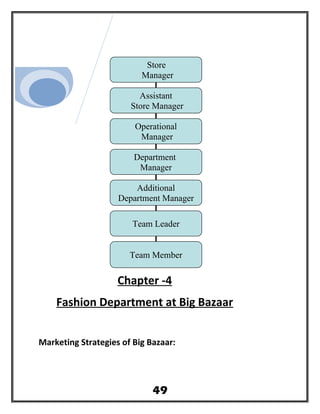
Store Organization:-
48
Chapter -4
Fashion Department at Big Bazaar
Marketing Strategies of Big Bazaar:
Store
Manager
Assistant
Store Manager
Operational
Manager
Department
Manager
Additional
Department Manager
Team Leader
Team Member
49
At the time of the launch of Big Bazaar in Lucknow last year, there
was no real precedent in the Indian Market. A western model had to
be adapted to suits the needs of the Indian environment. Various local
markets were studied to understand the product mix and the prices
offered.
Savings is to the key to the Indian middle class consumers. The
store that would be launched had to offer value to the consumers.
Keeping this in mind the concept of Big Bazaar was created.
In India, when a customer needs something for home, a typical
thought is to seek it from bazaar where a complete range of products
is available to the consumers. As the store offers a large mix of
products at a discounted price, the name Big Bazaar was finalized. The
idea was to re-create a complete bazaar, with a large product offering
and to offer a good depth and width in terms of range.
Price was the basic value proposition at Big Bazaar. The Big Bazaar
outlets sold a variety of products at prices which were 5 to 60% lower
than the market price. The line “Is Se Sasta Aur Accha Kahin Nahi”
emphasized this. The key question faced by the management was
whether the low margins on the products would allow the company to
sustain growth. With the aim of answer in order to allow the company
decides on the right locations.
The key learning which came out of this exercise was that for a large
store like Big Bazaar, a large catchments area was needed. The
management decided to stick to the existing market places within the
city as the western model of hypermarkets, where the store was
located in large area on the mid of the city would also really work in
India. The cost of time spent on travels and the cost of petrol in India
would really become a plus point for the customers. Some of the key
marketing strategies and promotional activities that are successfully
employed by Big Bazaar are:-
50
Discount Selling
Big Bazaar sells all its products at a much cheaper price as compared to
the local markets. The range of discounts ranges from 5 to 60%.
Although the store sells the products at a cheaper rates it does not
compromises with the qualities of the products.
Huge No. of Brands
Big Bazaar maintains a huge number of brands under its dispose which
give the customers the liberty of buying the product of their favorite
brand. This helps the customers as they don’t go looking out for a
product of a particular brand.
Large Product Line
Big Bazaar also stocks a large product line of a single brand or multiple
brands which give the customers the choice to select the most
appropriate product out of many available at the most economical
prices.
Frequent Promotional Activities
Frequent promotional programs like “Wednesday- Haftey Ka Sabse
Sasta Din”, “Fashion Shows”, “Monthly Bachat”, “Price Challenge”, etc.
were conducted in store in which the customers were provided special
discounts, offers in addition to the normal discounts and offers of the
store. The main purpose of this sort of activities is to generate in the
dull days of the week or of the month.
Learning Process for Summer Training at Big Bazaar
51
The following learning process for summer training at Big Bazaar of
Lucknow city was given to me. According to this learning process, I had
to undertake my summer training in Big Bazaar. The learning process is
given below in brief:-
Merchandising
This includes
 Inward,
 Display,
 Replenishing (FIFO),
 Offer Updating,
 Top Selling SKU’s,
 Bottom Line SKU’s,
 Liquidation Process,
 Defective Goods Handling (DAD- Damage & Defective),
 Margins,
 Buying,
 Outward,
 Stocktake.
Customer Service
It has
 CSD (Customer Service Desk) Operations,
 Customer Movement,
 Customer Touch Point,
 After Sale Services,
 Home Delivery,
 Alteration and Customer Grievance Handling.
52
Visual Merchandising
It has Signages,
 Details of Materials,
 VM Frames,
 Shelf Talkers,
 Focal Piont/ Hot Spots,
 Execution of Promotions,
 Communication of Offers,
 Directional Signages in the Store,
 Window Display.
Cash Department
 It works on Cash Till Operations,
 Billing Process,
 Handling Cash,
 Tallying Cash,
 Allocation of Till wise Cashiers,
 Depositing of Cash in Bank,
 Shortage/ Excess Cash Treatment,
 All Modes of Payments,
 Checking of Currency Note,
 Foreign Exchange,
 Cash Float of Cashier,
 Grab Process,
 Currency Handling & System.
Information Technology
 REM Knowledge,
 SAP Knowledge,
 System Generated Report,
 Stock Adjustment,
 Scheme Updation,
53
 Hardware Knowledge,
 Day Closing Activity.
Human Resources
 PERK,
 Sanjeevani,
 Fun Jone,
 Atithee,
 Employee of the Month,
 HR Policies,
 Prerna,
 Staff In / Out Management,
 Sturday Meeting,
 Payroll Process,
 Skip Meeting.
Operations
 Entire SOP,
 Opening of Stores,
 H. K. Activities throughout the Day,
 Security Activities,
 H. K. positioning,
 Security Positioning,
 Discipline & Attire Check of Security & H. K.,
 Parking Management,
 Trolley management,
 Scrap Disposal process,
 Waste Management,
 Daily Check Points,
 Fixed Asset Knowledge,
 AMC’s Checklist of Fire Safety Equipments,
 A/C’s, Electricals, Lifts, Invertors, Chakkis,
54
 DG’s, LPC Process & Team Management.
Analysis Study
 Stock Cover,
 DSR Study, Age Analysis,
 Stock Turns, Sales Mix, Sales Trend,
 Margin Analysis, Per Sq. Ft. Return Analysis,
 Ticket Size, Conversion,
 Return on Capital Employed/ Working Capital Analysis.
FASHION DEPARTMENT @ BIG BAZAAR, LUCKNOW
Introduction
Fashion department is a Line of Business (LOB) at Big Bazaar,
Lucknow. Location of Fashion department is situated on 3 floor of the
store. Fashion department has large range of Product mix. It has
collection of huge brands. Fashion department plays an important role
in Big Bazaar, Lucknow as it attracts the customers to visit the store.
Everyday, it also contributes almost 25% sale of the entire store.
FASHION AT BIG BAZAAR
Fashion
55
Fashion is trend to change that whatever happen in some
period
It come in all three month with the new product and with the
modification of old product.
It change simultaneously with the season.
Fashion @ bazaar
At Big Bazaar fashion include all apparels
Fashion is a very important LOB for big bazaar
Big Bazaar get highest margin by fashion department
The average contribution of fashion in Lucknow Big Bazaar is
23%
The target contribution of fashion sub department in fashion are
Men’s wear- 50%,
Ladies wear-30%
Kid’s wear-20%
We “PROMISE”-that from today –we will start selling “FASHION”
& not just apparel & take BIG BAZAAR to the next level by selling
more & more fashion.
Kar ke dikhana hai……
Process of Fashion
 Warehouse (Receiving)
 Sub department
 Tagging
 On floor
 Staking (MPM)
Sub department of Fashion
56
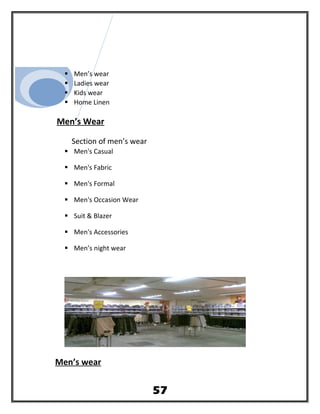
 Men’s wear
 Ladies wear
 Kids wear
 Home Linen
Men’s Wear
Section of men’s wear
 Men's Casual
 Men's Fabric
 Men's Formal
 Men's Occasion Wear
 Suit & Blazer
 Men's Accessories
 Men’s night wear
Men’s wear
57
Brand’s of products
 AFL
 Knighthood
 John Miller
 DJ&C
 Famous Basics
 Signature
 Shatranj
 VIP
Ladies Wear
Section of ladies wear
 Ladies Ethanic
 Ladies Western
 Saree & Dress Material
 Ladies Accessories
 Ladies night wear
Brands of Merchandises
 Sharisty
 DJ&C
 SHAYLA
58
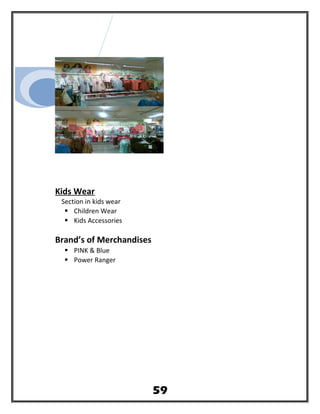
Kids Wear
Section in kids wear
 Children Wear
 Kids Accessories
Brand’s of Merchandises
 PINK & Blue
 Power Ranger
59
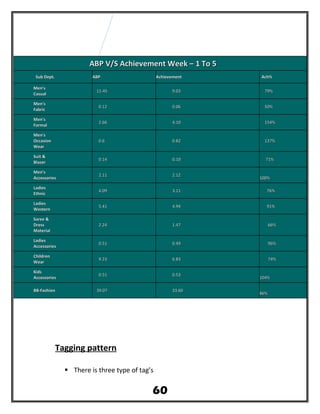
Tagging pattern
 There is three type of tag’s
ABP V/S Achievement Week – 1 To 5ABP V/S Achievement Week – 1 To 5
Sub Dept.Sub Dept. ABPABP AchievementAchievement Ach%Ach%
Men'sMen's
CasualCasual
11.4511.45 9.039.03 79%79%
Men'sMen's
FabricFabric
0.120.12 0.060.06 50%50%
Men'sMen's
FormalFormal
2.662.66 4.104.10 154%154%
Men'sMen's
OccasionOccasion
WearWear
0.60.6 0.820.82 137%137%
Suit &Suit &
BlazerBlazer
0.140.14 0.100.10 71%71%
Men'sMen's
AccessoriesAccessories
2.112.11 2.122.12
100%100%
LadiesLadies
EthnicEthnic
4.094.09 3.113.11 76%76%
LadiesLadies
WesternWestern
5.415.41 4.944.94 91%91%
Saree &Saree &
DressDress
MaterialMaterial
2.242.24 1.471.47 66%66%
LadiesLadies
AccessoriesAccessories
0.510.51 0.490.49 96%96%
ChildrenChildren
WearWear
9.239.23 6.836.83 74%74%
KidsKids
AccessoriesAccessories
0.510.51 0.530.53
104%104%
BB-FashionBB-Fashion 39.0739.07 33.6033.60
86%86%
60
 Soft Tag
 Hard Tag
 String Tag
Types of Tag
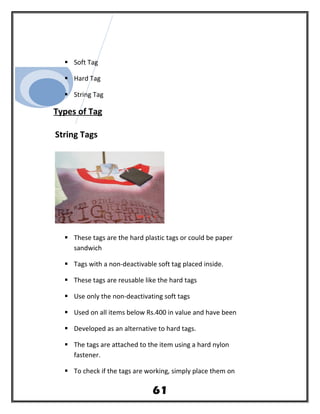
String Tags
 These tags are the hard plastic tags or could be paper
sandwich
 Tags with a non-deactivable soft tag placed inside.
 These tags are reusable like the hard tags
 Use only the non-deactivating soft tags
 Used on all items below Rs.400 in value and have been
 Developed as an alternative to hard tags.
 The tags are attached to the item using a hard nylon
fastener.
 To check if the tags are working, simply place them on
61
 The deactivating pad. If the tag does not beep stop use of
the tag.
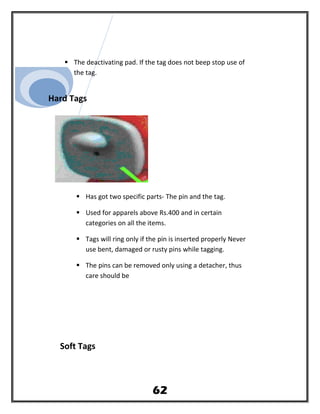
Hard Tags
 Has got two specific parts- The pin and the tag.
 Used for apparels above Rs.400 and in certain
categories on all the items.
 Tags will ring only if the pin is inserted properly Never
use bent, damaged or rusty pins while tagging.
 The pins can be removed only using a detacher, thus
care should be
Soft Tags
62
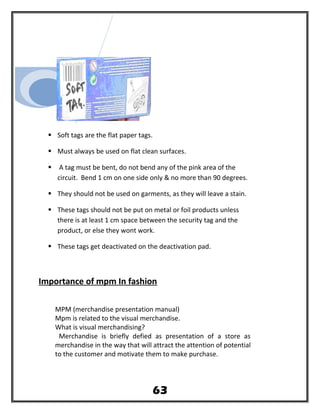
 Soft tags are the flat paper tags.
 Must always be used on flat clean surfaces.
 A tag must be bent, do not bend any of the pink area of the
circuit. Bend 1 cm on one side only & no more than 90 degrees.
 They should not be used on garments, as they will leave a stain.
 These tags should not be put on metal or foil products unless
there is at least 1 cm space between the security tag and the
product, or else they wont work.
 These tags get deactivated on the deactivation pad.
Importance of mpm In fashion
MPM (merchandise presentation manual)
Mpm is related to the visual merchandise.
What is visual merchandising?
Merchandise is briefly defied as presentation of a store as
merchandise in the way that will attract the attention of potential
to the customer and motivate them to make purchase.
63
Advantage of Mpm
 Arranged merchandise properly
 Easy to find
 Easy to pick
 Easy to buy
 to put best forward the merchandise highlight I terms of
colour ,quality
 Who can we make effective Mpm Product should be
tagged from manufacturing house.
 Focus light should be o the flor.
 Availability of Proper mannequins for all the product.
 Hygienic product should be packed.
 Stock should be properly displayed.
Birthday Celebrations at Big Bazaar
16th
-25th
July
Big Bazaar Store located in the heart of Lucknow city had
completed its third year since opening in the city in the month of July
2010. Keeping in mind its third anniversary, the store was celebrating it
with the customers in the form of Birthday Celebrations. The store
celebrated it for ten days from 16th
July to 25th
July 2010. The slogan for
64
the birthday celebrations was “Khushiyon Ke Din Khushiyon Ke
Upahaar”.
Big Bazaar was celebrating its 3th Birthday from 16th
to 25th
July.
The theme for this celebration was “come celebrate with us, get
fabulous gifts, bumper prizes, and enjoy loads of exciting activities in
store.”
Continuing its efforts to provide the best shopping deals and
savings to Indian consumer, Big Bazaar was all set to celebrate this
Birthday Anniversary with its Customers. It was truly memorable eith
rock bottom prices, best possible discounts, mega offers and lucky
draw also. Apart from the flagship Big Bazaar and its Food Bazaar,
other departments like FurnitureBazaar, Electronic Bazaar, Depot,
General Merchandise, and Fashion Department were also the part of
this celebration.
From daily household needs of food and grocery to apparels,
footwear, toys, luggage, kitchenware, home decor, furniture and
electronics; ‘Birthday Celebrations’ had an exciting array of attractive
offers, deals and discounts, ensuring something for everyone in the
family, to shop for, and a maximum ‘value for money’ for all
customers. With this new shopping concept, Big Bazaar touches the
heart of its customers and also maintains the company-customer
relationship.
During the Birthday Celebrations, the following were the main offers in
the Food Bazaar:
65
Space Mix and Space Management
Space Mix
For the retailer space is money. The store has to be planned in
such a way that it optimizes the selling area and minimizes the non-
selling parts. The selling area is used to present the merchandise and
the non-selling part is accounted for by circulation space, staircases,
lifts, facilities, the back area, etc. The area mix in a typical department
store is: selling area about 60%, circulation area 15%and back area
25%.
Space Management
The placement of merchandise within the store in the most
profitable manner is called space management .it is one of the most
important activities, because the location of merchandise at different
location have different values. Some parts of store are more valuable
because customers visit those more frequently, which results in higher
sales. It is easier to make sales along.
Space closest to the entrances and exits is the most is the
valuable, and values decrease further into the store.
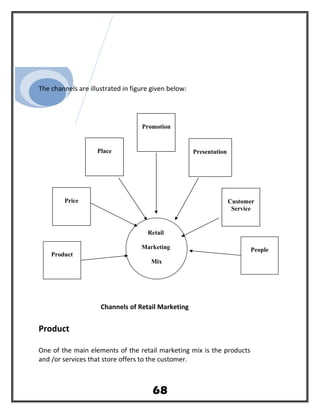
Retail Marketing Mix
The basic function of retail is to provide the right goods to the
consumer, at the right place and time. Through the retail marketing
mix we can compete with our competitors and achieve the sales
66
target. The marketing tools that a retail organization uses to pursue its
marketing objectives are termed as the retail marketing mix.
The most channels are:
• Product
• Price
• Place
• Promotion
• Presentation
• Customer Service
• People
67
The channels are illustrated in figure given below:
Channels of Retail Marketing
Product
One of the main elements of the retail marketing mix is the products
and /or services that store offers to the customer.
Retail
Marketing
Mix
People
Product
68
Place Presentation
Promotion
Customer
Service
Price
Products are also termed as merchandise. The different products that
the store offers are together termed as the merchandise mix.
For example, if we consider the Fashion at department store, the
merchandise line comprises:
• Mans wear
• Mans accessory
• Party wear
• Ladies wear
• Kids wear
• Home fashion
Price
Pricing is an integral part of the retail marketing mix. The price policy
that the organization decides to follow depends on the customer
profile of the target audience for its range of products.
Big Bazaar gives the good price to the customer .price makes the good
relationship to the customers.
Big Bazaar has a punch line “Isse Sasta Aur Accha Kahin Nahi”
It gives the high discount on the price like; foods products (20%, 25%,
35%), non food products (10%, 20%, 35%), buy one get one free Top
Price, buy 3 get one free Park Avenue soap, etc.
69
Big Bazaar gives many offers to the customer like; the great Indian
festival Big Days, Sabse Saste 3 Din, etc. In these types of days it gives
the huge discount on the products.
Place
The location of the retail store was considered to be the most
important element of the retail marketing mix.
Big Bazaar is situated at premier location in Lucknow, where Levis, E-
Zone, Cafe Coffee Day, and Reebok like stores are situated. It is the
best place for Big Bazaar.
Promotion
The advertising budget, sales promotion, publicity and the public
relations play a very important role in the competitive world of
retailing .these help the store to achieve the short term goals.
Promotion may be price led or occasional led, in which case special
merchandise offered by the stores only for the occasion. Most retail
organization run promotions during festival seasons.
Big Bazaar also provides the promotional offers on festival like Diwali,
New Year, ID, Valentine day, etc. Discounts depend on the products.
70
Presentation
The manner in which the merchandise is presented at the store level is
very important. This aspect not only deals with the store layout and
the ambience created, but also with visual merchandising.
Visual merchandising is the orderly, systematic way of putting stock on
display in the retail store.
Big Bazaar presents the store as per the season and occasions like; on
Diwali store is decorated with candles and flowers, on Christmas store
is decorated with stars, ribbons, balloons, Christmas tree and on
Independence Day and Republic Day store is decorated with green,
orange, and white balloons, etc. that attract the customers.
Customer Service
The support services that a retailer offers have become very important
today. The credit policies and the product returns policies need to be
clear marketing, buzzwords in the industry today and all these are
aimed at enhancing customer service.
71
In the Big Bazaar, the product range is good and availability of the
products is very easy. Bag Bazaar provides the low price comparison to
the other retailers.
Big Bazaar provides the good services to their customer like; baggage
counter, parking, product, help line, etc.
People
Retailers operate in a unique environment. The retail industry is
characterized by a large number of inexperienced workers, who need
to put in long hours of work. Most of the time, these employees are in
direct contact with the customer and may face irate or unreasonable
customer.
The people who work at the front-end of a retail organization are very
important, as they are the manners and products knowledge plays a
very important role in building long –term relations with the customer.
Retail Communication Mix
Communication is an integral part of the retailer’s marketing strategy.
Primarily, communication is used to inform the customers about the
retailer, the merchandise and the services. It also serves as a tool for
the building the store image.
72
The retailer can used various platform / channel for communication.
The most tools are:
• Advertising
• Sales Promotion
• Public Relation
• Personal Selling
• Point of Purchase (POP) Displays
The tools are illustrated in figure given below:
73
Sales
Promotion
Advertising
Advertising can be defined as any paid form of non- personal
presention and communication through mass media. It is popularly
believed that one of the main aims of the advertising is to sell to wide
mix of consumers and also to induce repeat purchase.
However, a retailer may use advertising to achieve any of the following
objectives:
Creating awareness about a product or store
Advertising
Retail
Communicatio
n Mix
Public
Relatio
ns
74
Point of
Purchase
(POP)
Displays
Personal
Selling
Communication information in order to create a specific image in the
customer’s mind in terms of the store merchandise, price, quality,
benefits, etc. Create a desire to want a product. To communicate the
store’s policy on various issues. Advertising can also help identify a
store carrying nationally advertised brands. It can also help in
repositioning the store in the mind of the customer. To increase sale of
specific categories or to generate short term cash flows by way of sale,
bargain days, midnight madness, etc. Advertising can also help
reinforce the retailer’s corporate identity.
For advertising, the retailer may use one or a combination of the
following mediums:
Press advertisements
Posters and leaflets, brochures, booklets
Point of purchase displays
Advertising can also be done through mediums like radio, television,
outdoor hoardings and the internet.
Sales Promotion
Sales promotion helps a retailer by way of attracting customer traffic
and enables quick result to be achieved. Depending on the type of
75
promotion carried out, it can help increase impulse buying, generate
excitement and can motivate other channel members.
Common retail promotions are illustrated:
• Coupon:
A coupon allows the buyer a reduction in price on specific
merchandise or products, when the coupon is redeemed
.coupons may be delivered through newspaper, magazines, post
or in products.
• Contests:
A contest needs consumers to compete and the prizes are based
on skill. In the case of sweepstakes, the customer only needs to
enter in his name and the winner is determined by chance.
Many retailers allow customers to enter into competitions on
the basis of the amount of purchases they have made.
• Demonstrations:
Demonstrations are used to show the customer, the
performance capabilities of the products. Videos may also be
76
used to aid the demonstration and show the use of the
products.
• Product /Brand Promotions and Schemes:
This is a straightforward scheme in which the consumer either
gets a monetary discount on the purchase of a particular
product/s or gets two products of the same type for the price of
one –the “by one get one free” scheme is example of same.
Big Bazaar also does this type of sales promotion like; in plastics
department important container buy one get one free.
• Samples:
Sampling provides the consumers with an opportunity to use the
product at no cost. Various techniques may be adopted for
sampling and this may take the form of in-store sampling-where
the in-store staff hands out the samples.
• Shopping Card:
Many retailers make the own shopping card. It is very easy to
promote the sales.
77
Future group introduces the new future prepaid card .it is easily
used in all future groups’ retail outlets.
Public Relations and Publicity
Public relations (PR) are a marketing communication function,
which aims at fostering goodwill. An important component of
public relations is publicity. By way of public relations, the retail
organization strives to create and sustain a favorable image with
consumer, shareholders, suppliers and the public at large. The
job of public relation is usually handled by an outside Public
Relations firm and it may be under taken to promote goodwill
for the organization, to promote a particular product or to
counteract negative publicity.
Publicity is a non paid form of media coverage. In today’s world,
it is rarely free and a fair amount of skill has to be exercised by
the organization to ensure that right media coverage is
achieved.
Examples of events in retail which merit publicity are:
• Store openings
• Store renovations
78
• Celebrity visits and affiliations
• Designer associations
• New product ranges and launches
• Awards received by the retailer
• Fashion shows and sponsored events
Personal Selling
Personal selling is a paid form of personal advertising where
salespeople assist customer in satisfying their needs though a
person-to-person exchange of information .it is a process of
learning the needs and the wants of the buys and striving to
satisfy them with the required product or service. Personal
selling may occur within the environs of the retail store-where
personal selling requires the sales person to satisfy the needs of
the consumer. It may also occur outside the retail store, where
orders taken form customer by way of the telephone, internet or
mail and them serviced. Personal selling is precise. It is aimed at
a specific individual/s. Developing a strong sales force is hence
an expensive proposition, as the sales person has to be trained
on various aspects of communication, like understanding the
body language of the customer, etc. He also needs to be
79
knowledgeable about the features of products and services
being offered by the retailer.
Point of Purchase (POP) Displays
The dictionary of retailing defines Point of Purchase
communication as the promotional signs and interior displays,
often located at the point of sale or alongside displays
merchandise. Point of Purchase (POP) Displays have become
integral to retail today. They help reinforce in-store product
branding, enhance retail sales floor communication and provide
information to the customer. The basic function of pop in a retail
store, include posters, danglers, flyers glow signs, translites,
banners, etc.
The role of POP changes significantly with the type of product
being sold and the customer’s involvement in the purchase.
Different types of POP material would relevant in different types
of stores and environment.
In the case of a supermarket, POP may be used to indicate
prices, the location of products and any special or bargain offer
in the store. POP in a store selling consumer durables and
electronics may lay stress on the features of the product, the
80
warranties and guarantees and the after sales services provided
by the outlet.
Conclusion & Suggestions
As a matter of fact, this on the job training was fruitful for me as I
learnt many management skills practically during training period at Big
Bazaar. Right from the beginning of my training I observed so many
things which are the part of daily routine of Big Bazaar, Lucknow. The
store works smoothly as it is the chain of a well- known reputed
organization. The retail staff personnel are of helping nature as they
supported and co-operated me during training period and tried their
level best to give me proper training of the retail store.
I also learnt how to apply all the management skills in the real
situation in any organization. During my on the job training, however, I
observed the following things at Big Bazaar, Lucknow:-
 Everyday many people came only for visit at Big Bazaar.
 The foot- falls of customers are good at Big Bazaar, Lucknow.
 Mostly middle class family prefers Big Bazaar.
 Customers come at Big Bazaar because it gives the huge
discounts and offers.
 During big days (5 Days Mahabachat), it has huge crowd of
customers and the sale is very high.
81
 The offers/discounts changed any time if there is technical
problem or shortage of stock.
 Team members sometimes do not pay proper attention to the
customers on the floor.
 Sinages were not maintained on the floor by team members.
 There were more than 10 cash counters at the store but they
didn’t open every day. All cash counters are open only on
festival season or on the mega offers of Big Bazaar.
 The order processing take huge time and sometimes gets
delayed due to lack of stock at the vendor side.
 The collection of vegetables and fruits are done from local
markets and local farmers.
 There was at least one meeting of Store Manager with
employees in a week.
 Communication between the employer and employee is good.
 Employees have the good knowledge about the products in their
own sections.
Conclusion
From all the available results this can be concluded that people
have huge expectations from the company. They not only want all the
things they are getting from other companies but in addition they also
want some other benefits which in turn can give them security of being
a part of Big Bazaar as a customer in long run.
82
Big Bazaar has many brands in Food Bazaar such as Nestle, HUL,
Cadbury, Amul, Tata, Parle, Bikaji, Marico, Adani’s Suffola, etc. but
after that they do not have the large product range of these brands
that is why they are losing their customers. Since many customers have
different brand preferences.
In Food Bazaar they have big brands as mentioned above but
many times they do not achieve the target due to the arrangements of
merchandise is not good and employees interaction with customers
are very less.
However, Food Bazaar contributes almost 50% of daily sale of the
store. But sometimes in normal days, Food Bazaar does not achieve
the target. In fact, during festival offers and Big Days, Food Bazaar has
the major contribution in attracting customers and increasing the store
sale.
So we can say that customers want huge offers and discounts. If
Big Bazaar gives huge discount and offers, it will definitely increase its
sales.
All the customers know about the Big Bazaar that is:
“Isse Sasta Aur Achha Kahin Nahi!”
Although Big Bazaar provides many services yet there are many
areas where customers demand for more than what they should get
and which is beyond company policy like, free servicing, additional free
gifts and extra term benefits.
Company also facing some problems from its previous customer’s
side that had some bad experience about the company product and
service. It is due to the less attention of team members to the
customers and not giving them complete information about the
products. Big Bazaar also needs good service at CSD for their
83
customers. In brief, the organization is working on all these aspects
continuously by filling feedback forms from customers and conducting
market research on products range and customers’ preferences.
Suggestions
The following suggestions could be made for the better performance
of Big Bazaar, Lucknow:-
 Review of everyday discounts/offers at signage whether they are
updated properly or not.
 Signages should be displayed properly on the floor and near the
entrance gate.
 More security gadgets and checks should be there to control
thefts and employees working.
 Availability of products in each size should be at the floor.
 At least 6 to 8 cash counter should remain open everyday to
avoid crowd at cash counter.
 Increase the number of supporting staff (team members) on the
floor of Food Bazaar to pay proper attention to the customers.
 Increase the brand and products range in the Food Bazaar to
increase the sale.
 Interaction should be there between employees and customers.
 Sitting arrangement and drinking water facilities on the floor for
customers should be maintained regularly.
84
 The arrangement of merchandise should be proper on the floor.
Bibliography
• Pride, William M., and Ferrell O. C. Marketing: Concepts and
Strategies. 12th
ed. Houghton Mifflin Co., USA, 2005
• Ramaswamy, V. S., and Namakumari S. Marketing Management:
Planning, implementation and Control. 3rd
ed. Macmillan India
Ltd., 2002
• Kotler, Philip, and Keller Kevin Lane. Marketing Management.
Pearson Education, Inc., 2006
• Kotler, Philip, and Armstrong Gary. Principles of Marketing. 11th
ed. Pearson Prentice Hall, 2006
• Pradhan, Swapna. Retailing Management. Tata McGraw Hill,
2004
Web Sites:
• www.pantaloon.com
• www.wikipedia.com
• www.retailindia.com
85
• www.google.co.in
• www.bigbazaar.com
• www.futuregroup.in
86

Synopsis-bb

  • 1.
    A PROJECT REPORT @ ON INDIANORGANIZED RETAIL INDUSTRY (BIG BAZAR) IN PARTIAL FULFILLMENT FOR THE AWARD OF THE DEGREE OF MASTER OF BUSINESS ADMINISTRATION IN RETAIL MANAGEMENT SUBMITTED BY NISHANT RASTOGI Registration No: - 1308009208 1
  • 2.
    SIKKIM MANIPAL UNIVERSITYFOR DISTANCE LEARNING Acknowledgement A task or project cannot be completed alone. It requires the effort of many individuals. I take this opportunity to thank all those who helped me complete this project. I express my sincere gratitude to Miss Vandana Sral (SRO) for giving us the opportunity to undergo this project. I further thank his for lending a helping hand when it came to solving my problems related to the project. This project would not have been possible without his valuable time and support. I also thank Sikkim Manipal University for an opportunity to undertake a Soft skills project at the start of our MBA course which helped us to understand deeply for those topics which are untouched. This project is an attempt to talk about the Scenario of Indian Organized Retail Industry (Big-Bazaar) Any suggestions to improve are always welcome. 2
  • 3.
  • 4.
    TABLE OF CONTENT •Acknowledgement • Executive Summary • Objective • Research Methodology CHAPTER -1: -INTRODUCTION CHAPTER -2: INDUSTRY PROFILE a. Retailing b. Indian Retail Industry c. Growth Of Indian Retail Industry d. Major Retailer In India e. Retail Format In India f. Challenges facing Indian Retail Industry g. Category Of Indian Retailer h. Classification Of Indian Retailer CHAPTER -3: - COMPANY PROFILE a. Future Retail b. Corporate Statement c. Board Of Director (BOD) 4
  • 5.
    d. Company Timelines e.Award & Recognitions f. Company Of Future Group g. Future Brands h. Line Of Business i. Big-Bazaar India’s Real Retail Story j. About Big-Bazaar k. Store Organisation CHAPTER -4: - FASHION DEPARTMENT AT BIG-BAAZAR a. Learning Process For Summer Training At Big- Bazaar b. Tagging Pattern c. Birthday Celebration At Big-Bazaar d. Space Mix And Space Management CONCLUSION SUGGESTION BIBLIOGRAPHY 5
  • 6.
    Executive Summary Demographics continueto show a positive report to spur retailing growth. Consumers aged 20-45 years is emerging as the fastest growing consumer group and the mean age of Indians is now pegged at 27, a mean age that reinforces spending across all the retailing channels of grocery, non-grocery and non-store. The government stance of protecting local retailers and prohibiting 100% foreign direct investment in retailing continued in 2005, restraining international retailers' entry. However, there was gradual economic reform, giving way to easier and faster franchising agreements as well as the loosening of zonal regulations on retail expansion, thus stimulating retailing. Non-store retailing is expected to continue its fast-paced growth from a miniscule base. Across all channels, growth in retailing is expected to be boosted heightened competition during the forecast period due to the growing. 6
  • 7.
    OBJECTIVE OF THESTUDY:- The present study was undertaken with the main objective of examining the current practices of Supply Chain Management followed in Process Operation Industry and comparing them with the best practices. The other objectives are: • To study the degree of Operation. • To identify the status of Information Technology implementation in these Companies Effective supply-chain management is a powerful tool for business transformation. • It can dramatically increase a company’s profitability while simultaneously improving customer service. • While today’s competitive environments are forcing businesses in this direction, the steps to take are often not evident. • Problems of Operation management can be complex, and their solution requires special knowledge and experience. 7
  • 8.
    RESEARCH METHDOLOGY Primary Data: Itis the information collected directly without any references. In the study it was mainly interviews with concerned officers and staffs either individual or collectively. Some of the information had verified or supplemented with personal observation, the data collected through conducting the personal interview with the customers. This is through a well-designed questionnaire. Secondary Data: The secondary data was collected from already published sources such as pamphlets, annual reports, reports and internal records the data includes. Reference from text books and relating to articles published in business details like economic times, business time etc. Sample Design: sample selection is of random type. Sample Size: sample size is 100 customers of Big Bazaar LIMITATIONS 1. Accuracy of the study is based on the information given by the respondents. 2. Data collection cannot be asserted to be free from errors, as the sample size is small 3. The project duration was only for 45 days. 4. The project is done for the partial fulfilment of the MBA program 5. The knowledge of the employee regarding the “Quality of Work Life” is taken for granted which may not be true because the understanding and knowledge of various person in the organisation vary from employee to employee. 8
  • 9.
    Chapter-1 Introduction Retailing is evolvinginto a global, high-tech business. Wal-Mart is now the world’s largest corporation and has become the largest food retailer in the United States. French based Carrefour is the world’s second largest retailer. Retailing in developed countries is big business and better organized. But the retail scenario in India is different much of it is in unorganized sector. There are more than 12 million retail outlets of various sizes and formats. And almost 90% of them are less than 500 sq. ft. in size and the per capita retail space is only 2 sq. ft. while US has 16 sq. ft. India has the largest number of outlet in world i.e. 9 outlets for 1000 people. Most of them are independent and contribute to the retail sales. Because of increasing number of nuclear families, working women, greater work pressure and greater commuting time, convenience has become a priority for Indian customers. They ever want things under one roof for easy access and multiplicity of choice. The growth and development of organized retailing is driven by two main factors- prices and benefits the customer can’t resist. India is rapidly involving into a competitive market place with potential target consumers in the niche middle class segments. The market trend indicates tremendous growth opportunities. The buying behavior and lifestyle in India too are changing and the concept of “value for money” is fast catching on in Indian retailing. This is the evident from the expansion of the Pantaloons chain into the large format, Big Bazaar. This growth in retail sector is making the retailers 9
  • 10.
    powerful intermediates inthe marketing channel, bridging the gap between manufactures and consumers. Keeping in mind the rapid growth of Indian retail industry and its bright future, this has always been a thrust area for me. Big Bazaar is at the top position in Indian retail industry. That is why it attracted me to have summer training (on the job training) in Big Bazaar, Lucknow. Big Bazaar is the retail chain of Future Retail (India) Ltd. And it provides a wide range of products availability for the customers. As a matter of fact, retail is the buzz word of the Indian economy today. As retail industry is growing at a high pace I wanted to have an overview of the subject. I have chosen Big Bazaar retail chain for the summer training (on the job training) because Big Bazaar retail is very upcoming retail company which is continuously changing its activities with the change of time. I wanted to understand their marketing activities and liked to relate how similar or dissimilar it is from what I have studied in marketing management. To execute the project, I underwent on the job training at Big Bazaar, Lucknow. The interaction with the Store Manager, Operational Manager and other staff personnel was fruitful to me as it cleared many core concepts when it came to practical application. The main objective of the project was to get practical training of what we have learnt theoretical in the classroom. In other words, it was to get practical exposure of all the marketing skills and how to implement in the real situation. 10
  • 11.
    The other objectivesof the project were the following:  To look at the current trends in the Indian organized retail industry.  To understand the Big Bazaar organization as how systematically it is run by the management personnel.  To know about the marketing activities of the Big Bazaar done round the year.  To know the customer queries, comments and suggestions about the store and its products.  To know about the promotional activities done at Big Bazaar to increase the sales.  To get acquainted with the major issues in the Indian organized retail industry. In fact, the training was for the practical aspects of the management skills and it was fruitful as the main objective of the project was fulfilled satisfactorily. During the training period, I learnt about the store organization and different activities performed by staff personnel. Big Bazaar brings various schemes for the festival season and offers wide product choice to the customers. 11
  • 12.
    Chapter-2 Industry Profile Retailing The word‘retail’ is derived from the French word ‘retailer’, meaning ‘to cut a piece off’ or ‘to break bulk’. In simple terms, it implies a first-hand transaction with the customer. Retailing involvers a direct interface with the customer and the coordination of business activities right from the concept or design stage of a product or offering to its delivery and post-delivery service to the customer. The industry has contributed to the economic growth of many countries and is undoubtedly one of the fastest changing and dynamic industries in the world today. Indian retail industry The Indian retail industry is the fifth largest in the world. Comprising of organized and unorganized sectors, India retail industry is one of the fastest growing industries in India, especially over the last few years. Though initially, the retail industry in India was mostly unorganized, however with the change of tastes and preferences of the consumers, the industry is getting more popular these days and getting organized as well. With growing market demand, the industry is expected to grow at a pace of 25-30% annually. The India retail 12
  • 13.
    industry is expectedto grow from Rs. 35,000 crore in 2004-05 to Rs. 109,000 crore by the year 2010. The retail scenario in India is unique. Much of it is in the unorganized sector, with over 12 million retail outlets of various sizes and formats. Almost 96% of these retail outlets are less than 500 square feet in size, the per capital retail space India being 2 square feet compared to the US figure of 16 square feet India’s per capital retailing space is thus the lowest in the world. With more than 9 outlets per 1000 people, India has the largest number in the world. Most of them are independent and contribute as much as 96% to total retail sales. Because of the increasing number of the nuclear families, working women, greater work pressure and increased commuting time, convenience has become a priority for Indian consumers. They want everything under one roof for easy access and multiplicity of choice. This offers an excellent opportunity for organized retailers in the country which account for just 2% and modern stores 0.5% of the estimated US Dollar 180 billion worth of goods that are retailed in India every chain, Wal-Mart. Growth of Indian retail industry According to the 8th Annual Global Retail Development Index (GRDI) of AT Kearney, India retail industry is the most promising emerging market for investment. In 2007, the retail trade in India had a share of 8-10% in the GDP (Gross Domestic Product) of the country. In 2009, it rose to 12%. It is also expected to reach 22% by 2010. According to a report by North bride Capita, the India retail industry is expected to grow to US$ 700 billion by 2010. By the same time, the organized sector will be 20% of the total market share. It can be mentioned here that, the share of organized sector in 2007 was 7.5% of the total retail market. 13
  • 14.
    India is rapidlyevolving into a competitive marketplace with potential target consumers in the niche and middle class segments. The market trends indicate tremendous growth opportunities. Global majors too are showing a keen interest in the Indian retail market. Over the years, international brands like marks and spencer, Samsonite, Lacoste, McDonald’s, Swarovski, Domino’s among a host of others have come into India through the franchise route following the relaxation of FDI (Foreign Direct Investment) restrictions. Large Indian companies- among them the Tata, Goenka and the Piramal groups are investing heavily in this Industry. Major Retailers in India Pantaloons: Pantaloons is one of the biggest retailers in India with more than 450 stores across the country. Headquartered in Mumbai, it has more than 5 million sq. ft retail space located across the country. It's growing at an enviable pace and is expected to reach 30 million sq. ft by the year 2010. In 2001, Pantaloon launched country's first hypermarket ‘Big Bazaar’. It has the following retail segments: • Food & Grocery: Big Bazaar, Food Bazaar • Home Solutions: Hometown, Furniture Bazaar, Collection-I • Consumer Electronics: e-zone • Shoes: Shoe Factory • Books, Music & Gifts: Depot • Health & Beauty Care: Star, Sitara • E-tailing: Futurebazaar.com • Entertainment: Bowling Co. 14
  • 15.
    Tata Group Tata groupis another major player in Indian retail industry with its subsidiary Trent, which operates Westside and Star India Bazaar. Established in 1998, it also acquired the largest book and music retailer in India ‘Landmark’ in 2005. Trent owns over 4 lake sq. ft retail space across the country. RPG Group RPG Group is one of the earlier entrants in the Indian retail market, when it came into food & grocery retailing in 1996 with its retail Food world stores. Later it also opened the pharmacy and beauty care outlets ‘Health & Glow’. Reliance Reliance is one of the biggest players in Indian retail industry. More than 300 Reliance Fresh stores and Reliance Mart are quite popular in the Indian retail market. It’s expecting its sales to reach Rs. 90,000 crores by 2010. AV Birla Group AV Birla Group has a strong presence in Indian apparel retailing. The brands like Louis Philippe, Allen Solly, Van Heusen, and Peter England are quite popular. It's also investing in other segments of retail. It will invest Rs. 8000-9000 crores by 2010. 15
  • 16.
    Another big playerin the segment will be the Bharti group. Overhauling this part of the supply chain will be the key to the success of any retail venture in food and groceries segment. Wal-Mart, the world’s largest retailer, and Bharti Enterprises have signed a Memorandum of Understanding (MoU) to explore business opportunities in the Indian retail industry. This joint venture will mark the entry of Wal-Mart into the Indian retailing industry a retail chain like Future Group’s Big Bazaar may be clocking heady sales (growing at 100% year- on- year), but the dozen odd shops operating in its proximity wear a deserted look, giving a somewhat hollow ring to the much- talked- about retail boom in the country. The key players currently operating in the Indian retail industry includes Future Group, Trent Ltd, RPG Enterprise, Vishal Retail Ltd, Shoppers Stop Ltd, Bata India Ltd, Provogue India Ltd, Videocon Appliances Ltd, ITC Ltd, Godrej Agrovert Ltd, and DCM-Hariyah Kisan Bazaar. Retailers ranging from Pantaloon to RPG to Piramal or the Tata’s are working towards exploiting this model, perceived by consumers as more value enhancing. But in the long run, what is most likely to succeed is a more balanced multi-format strategy. Finally, while in the first flush of the retail boom, the elimination of traditional intermediaries may bring windfall gains (as well as bring welcome and much-needed relief to the producers), this source will increasingly dry out as competition intensifies and margins come under pressure a few years down the line. What would set the survivors apart from those who are forced to sell out or go belly-up will be differentiators like location, value-added services (convenience), private labels and customer loyalty programs other than price. The last, a result of retailer-manufacturer tie-ups, state-of-the-art supply chain infrastructure, global sourcing and scale will be a key factor. And, if 16
  • 17.
    experience in othermarkets is anything to go by, an uncanny ability to read shifting trends. Retail formats in India Hyper marts /supermarkets: large self-servicing outlets offering products from a variety of categories. • Mom-and-pop stores: they are family owned business catering to small sections; they are individually handled retail outlets and have a personal touch. • Departmental stores: are general retail merchandisers offering quality products and services. • Convenience stores: are located in residential areas with slightly higher prices goods due to the convenience offered. • Shopping malls: the biggest form of retail in India, malls offers customers a mix of all types of products and services including entertainment and food under a single roof. • E-trailers: are retailers providing online buying and selling of products and services. • Discount stores: these are factory outlets that give discount on the MRP. • Vending: it is a relatively new entry, in the retail sector. Here beverages, snacks and other small items can be bought via vending machine. • Category killers: small specialty stores that offer a variety of categories. They are known as category killers as they focus on specific categories, such as electronics and sporting goods. This is also known as Multi Brand Outlets or MBO's. • Specialty stores: are retail chains dealing in specific categories and provide deep assortment. Mumbai's Crossword Book Store and RPG's Music World is a couple of examples. 17
  • 18.
    Challenges facing Indianretail industry • The tax structure in India favors small business • Lack of adequate infrastructure facilities • High cost of real estate • Dissimilarity in consumer groups • Restrictions in Foreign Direct Investment • Shortage of retail study options • Shortage of trained manpower • Low retail management skill The retail industry in India is currently growing at a great pace and is expected to go up to US$ 833 billion by the year 2013. It is further expected to reach US$ 1.3 trillion by the year 2018 at a CAGR of 10%. As the country has got a high growth rates, the consumer spending has also gone up and is also expected to go up further in the future. In the last four year, the consumer spending in India climbed up to 75%. As a result, the India retail industry is expected to grow further in the future days. By the year 2013, the organized sector is also expected to grow at a CAGR of 40%. Categories of Indian Retailers:- Corporate Houses Tata’s: Tata Trent  RPG group: Food World, Health and Glow etc.  ITC: Wills Life Style  Raheja group: (Shoppers’ Stop), DLF (DT cinemas).  Nike, Rbk. Zodiac 18
  • 19.
     Multi-brand outlets Vijay Sales, Viveks etc.  Manufacturers/ Exporters  Pantaloons, Bata, Weekender Classifying Indian Retailers: 1. Modern Format Retailers  Supermarkets (food World)  Hypermarkets (Big Bazaar)  Department Stores(shopper’s Stop)  Specialty Chains (Ikea)  Company Owned Company Operated 2. Traditional Format Retailers  Kiranas: traditional Mom and Pop Stores  Kiosks  Street Market  Exclusive /Multiple Brand Outlets 3. Hypermarket  Big Bazaar  Giants  Shoprite  Star 4. Department  Lifestyle  Pantaloons  Pyramids  Shoppers Stop  Trent 5. Entertainment 19
  • 20.
     Fame Adlabs  Fun Republic  Inox  PVR Chapter-3 Company Profile Future Group, led by its founder and Group CEO, Mr. Kishore Biyani, is one of India’s leading business houses with multiple businesses spanning across the consumption space. While retail forms the core business activity of Future Group, group subsidiaries are present in consumer finance, capital, insurance, leisure and entertainment, brand development, retail real estate development, retail media and logistics. Led by its flagship enterprise, Pantaloon Retail, the group operates over 16 million square feet of retail space in 73 cities and towns and 65 rural locations across India. Headquartered in Mumbai (Bombay), Pantaloon Retail employs around 30,000 people and is listed on the Indian stock exchanges. The company follows a multi-format retail strategy that captures almost the entire consumption basket of Indian customers. In the lifestyle segment, the group operates Pantaloons, a fashion retail chain and Central, a chain of seamless malls. In the value segment, its marquee brand, Big Bazaar is a hypermarket format that combines the look, touch and feel of Indian bazaars with the choice and convenience of modern retail. In 2008, Big Bazaar opened its 100th store, marking the fastest 20
  • 21.
    ever organic expansionof a hypermarket. The first set of Big Bazaar stores opened in 2001 in Kolkata, Hyderabad and Bangalore. The group’s speciality retail formats include supermarket chain – Food Bazaar, sportswear retailer - Planet Sports, electronics retailer - eZone, home improvement chain - Home Town and rural retail chain, Aadhaar, among others. Future Capital Holdings, the group’s financial arm provides investment advisory to assets worth over $1 Billion that are being invested in consumer brands and companies, real estate, hotels and logistics. It also operates a consumer finance arm with branches in 150 locations. Other group companies include, Future Generali, the group’s insurance venture in partnership with Italy’s Generali Group, Future Brands, a brand development and IPR company, Future Logistics, providing logistics and distribution solutions to group companies and business partners and Future Media, a retail media initiative. The group’s presence in Leisure & Entertainment segment is led through, Mumbai-based listed company Galaxy Entertainment Limited. Galaxy leading leisure chains, Sports Bar and Bowling Co. and family entertainment centres, F123. Through its partner company, Blue Foods the group operates around 100 restaurants and food courts through brands like Bombay Blues, Spaghetti Kitchen, Noodle Bar, The Spoon, Copper Chimney and Gelato. Future Group’s joint venture partners include, US-based stationery products retailer, Staples and Middle East-based Axiom Communications. Future Group believes in developing strong insights on Indian consumers and building businesses based on Indian ideas, as espoused 21
  • 22.
    in the group’score value of ‘Indianness.’ The group’s corporate credo is, ‘Rewrite rules, Retain values.’ Future Retail Retail forms the core business activity at Future Group and most of its businesses in the consumption space are built around retail. Future Group’s retail network touches the lives of more than 200 million Indians in 73 cities and 65 rural locations across the country. The group currently operates around 1,000 stores spread over 16 million square feet of retail space. Present in the value and lifestyle segments, the group’s retail formats cater to almost the entire consumption expenditure of a wide cross-section of Indian consumers. Led by Pantaloon Retail, the group’s flagship company, the group manages some of India’s most popular retail chains like Pantaloons - a chain of fashion destinations, Big Bazaar - a uniquely Indian hypermarket chain, Food Bazaar - a supermarket chain that blends the look, touch and feel of Indian bazaars with aspects of modern retail like choice, convenience and quality and Central - a chain of seamless destination malls. Some of its other formats include Ethnicity - India's first concept store, which recreates the experience of a traditional ethnic market in a modern retail format, Brand Factory, Planet Sports, ALL, Top 10 and Star and Sitar. Retailing of products and services related to home building and home improvement is led through the group’s formats, Home Town, a large-format home solutions store, along with specialized formats for home furniture and home furnishing through, Collection i and 22
  • 23.
    Furniture Bazaar andconsumer electronics through eZone and Electronics Bazaar. The group also operates India’s leading rural retailing chain, Aadhaar that is present in over 65 locations in rural India. Aadhaar, an agri-service cum rural retail initiative, provides a complete solution provider for the Indian farmer. In 2007, Pantaloon Retail was awarded the International Retailer of the Year by the US-based National Retail Federation (NRF) and the Emerging Market Retailer of the Year at the World Retail Congress held in Barcelona. Corporate Statements:- Future Group manifesto ‘Future’- the word which signifies optimism, growth, achievement, strength, beauty, rewards and perfection. Future encourages us to explore areas yet unexplored, write rules yet unwritten, create new opportunities and new successes. To strive for a glorious future, it brings to us our strength, our ability to learn, unlearn and re-learn our ability to evolve. We, in Future Group, will not wait for the future to unfold itself but create future scenarios in the consumer in the consumer space and 23
  • 24.
    facilitate consumption becauseconsumption is development. Thereby, we will effect socio-economic development for our customers, employees, shareholders, associates and partners. Our customers will not just get what they need, but also get them where, how and when they need. We will not just post satisfactory results, we will create success stories. We will not just operate efficiently in the Indian economy, we will evolve it. We will not just spot trends, we will set trends by marrying our understanding of the Indian consumer to their needs of tomorrow. It is this understanding that has helped us succeed. And it is this that will help us succeed in the future. We shall keep relearning. And in this process, do just one thing. Rewrite Rules, retain Values Vision 24
  • 25.
    “Future Group shalldeliver Everything, Everywhere, Every time for Every Indian consumer in the most profitable manner.” Mission 1. We share the vision and belief that our customers and stakeholders shall be served only by creating and executing future scenarios in the consumption space leading to economic development. 2. We will be the trendsetters in evolving delivery formats, creating retail realty, making consumption affordable for all customer segment- for classes and for masses. 3. We shall infuse Indian brand with confidence and renewed ambition. 4. We shall be efficient, cost- conscious and committed to quality in whatever we do. 5. We shall ensure that our positive attitude, sincerity, humility and united determination shall be the driving force to make us successful. Core Values  Indianness: confidence in ourselves.  Leadership: to be a leader, both in thought and business. 25
  • 26.
     Respect &Humility: to respect every individual and be humble in our conduct.  Introspection: Leading to purposeful thinking.  Openness: to be open and respective to new ideas, knowledge and information.  Valuing and nurturing relationship: to build long term relationships.  Simplicity & positivity: Simplicity and positivity in our thought, business and action.  Adaptability: to be Flexible and adaptable, to meet challenges. Board of Directors Mr. Kishore Biyani, Managing Director Kishore Biyani is the Managing Director of Pantaloon Retail (India) Limited and the Group Chief Executive Officer of Future Group. Mr. Gopikishan Biyani, Whole time Director Gopikishan Biyani, is a commerce graduate and has more than twenty years of experience in the textile business. Mr. Rakesh Biyani, Whole time Director Rakesh Biyani, is a commerce graduate and has been actively involved in category management; retail stores operations, IT and exports. He has been instrumental in the implementation of the various new retail formats. 26
  • 27.
    Mr. Vijay Biyani,Whole time Director Vijay Biyani has more than twenty years of experience in manufacturing, textiles and retail industry and has been actively involved in the financial, audit and corporate governance related issues within the company. Mr. Vijay Kumar Chopra, Independent Director V.K.Chopra is a fellow member of The Institute of Chartered Accountants of India (ICAI) by profession and is a Certified Associate of Indian Institute of Bankers (CAIIB). His banking career spans over 31 years and he has served senior management positions in Central Bank of India, Oriental Bank of Commerce, SIDBI, Corporation Bank and SEBI. Mr. Shailesh Haribhakti, Independent Director Shri Shailesh Haribhakti, is a Chartered Accountant, Cost Accountant, and a Certified Internal Auditor. He is the Deputy Managing Partner of Haribhakti & Co., Chartered Accountants and past president of Indian merchant Chambers. He is on the Board of several Public Limited Companies, including Indian Petrochemicals Corporation Ltd., Ambuja Cement Eastern Ltd. etc. He is on the Board of Company since June 1, 1999. Mr. S Doreswamy, Independent Director 27
  • 28.
    S. Doreswamy, isa former Chairman and Managing Director of Central Bank of India and serves on the board of DSP Merrill Lynch Trustee Co and Ceat Limited among others. Dr. D O Koshy, Independent Director Dr. Darlie Koshy, a PhD from IIT Delhi and rank holder in MBA headed NID (Ministry of Commerce, GOI) as Director for 2 terms of office prior to which he was the founding Chairperson of Fashion Management at the National Institute of Fashion Technology (Ministry of Textiles, GOI). He is currently the Director General and CEO of ATDC Network of 58 Institutes / Centre’s and two premier campuses of Institute of Apparel Management under the aegis of AEPC (Sponsored by Ministry of Textiles, GOI). Dr. Koshy received the Delhi IIT Alumni Award for contribution of National Development in 2008. Dr. Darlie Koshy was also conferred with the “Star of Italian Solidarity” one of the highest civilian awards of the Government of Italy. Dr. Koshy is the author of three pioneering books including the much acclaimed “Indian Design Edge”. Ms. Bala Deshpande, Independent Director Bala Deshpande, is Independent Director, Pantaloon Retail (India) Ltd. and also serves on the boards of Deccan Aviation, Nagarjuna Construction, Welspun India and Indus League Clothing Ltd, among others. Mr. Anil Harish, Independent Director Anil Harish, is the partner of DM Harish & Co. Associates & Solicitors and an LLM from University of Miami. He also serves 28
  • 29.
    On the boardof Mahindra Gesco, Unitech, IndusInd Bank and Hinduja TMT, among others. Company Timeline Major Milestones 1987 Company incorporated as Manz Wear Private Limited. Launch of Pantaloons trouser, India’s first formal trouser brand. 1991 Launch of BARE, the Indian jeans brand. 1992 Initial public offer (IPO) was made in the month of May. 1994 The Pantaloon Shoppe – exclusive menswear store in franchisee format launched across the nation. The company starts the distribution of branded garments through multi-brand retail outlets across the nation. 1995 John Miller – Formal shirt brand launched. 1997 Company enters modern retail with the launch of the first 8000 square feet store, Pantaloons in Kolkata. 2001 Three Big Bazaar stores launched within a span of 22 days in Kolkata, Bangalore and Hyderabad. 2002 Food Bazaar, the supermarket chain is launched. 2004 Central - India’s first seamless mall is launched in Bangalore. 2005 Group moves beyond retail, acquires stakes in 29
  • 30.
    Galaxy Entertainment, IndusLeague Clothing and Planet Retail. Sets up India’s first real estate investment fund Kshitij to build a chain of shopping malls. 2006 Future Capital Holdings, the company’s financial is formed to manage over $1.5 billion in real estate, private equity and retail infrastructure funds. Plans forays into retailing of consumer finance products. Home Town, a home building and improvement products retail chain is launched along with consumer durables format, Ozone and furniture chain, Furniture Bazaar. Future Group enters into joint venture agreements to launch insurance products with Italian insurance major, Generali. Forms joint ventures with US office stationery retailer, Staples. 2007 Future Group crosses $1 billion turnover mark. Specialized companies in retail media, logistics, IPR and brand development and retail-led technology services become operational. Pantaloon Retail wins the International Retailer of the Year at US-based National Retail Federation convention in New York and Emerging Retailer of the Year award at the World Retail Congress held in Barcelona. Futurebazaar.com becomes India’s most popular shopping portal. 30
  • 31.
    2008 Future CapitalHoldings becomes the second group company to make a successful Initial Public Offering in the Indian capital markets. Big Bazaar crosses the 100-store mark, marking one of the fastest ever expansion of a hypermarket format anywhere in the world. Total operational retail space crosses 10 million square feet mark. Future Group acquires rural retail chain, Aadhar present in 65 rural locations. Awards and recognition 2009 CNBC Awaaz Consumer Awards 2009 • Most Preferred Multi Product Chain - Big Bazaar • Most Preferred Multi Brand Food & Beverage Chain - Big Bazaar Images Fashion Forum 2009 • Most Admired Fashion Group Of The Year - Future Group • Most Admired Private Label - Pantaloons, the lifestyle format 31
  • 32.
    • Critics ChoiceFor Pioneering Effort In Retail Concept Creation - Central • Coca-Cola Golden Spoon Awards 2009 • Most Admired Food & Grocery Retailer Of The Year • Most Admired Food Court • Most Admired Food Professional 2008 Indian Retail Forum Awards 2008 • Most Admired Retail Company of the year - Future Group • Retail Face of the Year - Kishore Biyani • Best Retailer Of The Year ( Hypermarket) - Big Bazaar Future Group was awarded the Most Admired Retail Company of the year by the Indian Retail Forum at a glittering ceremony organized in Mumbai. Mr. Kishore Biyani also won Retail Face of the Year. India Retail Forum (IRF) is a platform for intellectual insights and information exchange for the retail business in the Indian subcontinent. The forum presents the business of retail in the region to a global audience, with the express aim of facilitating understanding about and encouraging investment in this massive marketplace. Big Bazaar, the value format of Future Group bagged the Best Retailer Of The Year (Hypermarket). 32
  • 33.
    The INDIASTAR Award2008 Food Bazaar: Best Packaging Innovation Food Bazaar bagged the INDIASTAR Award for Best Packaging Innovation in India, for its private label brand Fresh And Pure Chakki Atta. INDIASTAR Award is a biennial event which aims to promote and encourage excellence in packaging design, innovation and technology. The contest was established in 1972 and is considered as the most popular and premier event for India’s packaging fraternity. This year there were around 357 entries and the participants had to submit a sample of their designs for selection. With this award, Pantaloon Retail (India) Limited becomes the first Indian Retailer to win the prestigious INDIASTAR Award. Retail Asia Pacific 500 Top Awards 2008 Gold Winner - Top Retailer 2008 Asia Pacific Retail Asia Publishing Pte, the institutor of these awards, aims to set a platform that appraise, raises and recognizes the development and growth of retailing throughout the Asia Pacific region. Coca-Cola Golden Spoon Awards 2008 • Most Admired Food & Grocery Retail Visionary of the Year: Kishore Biyani • Most Admired Food & Grocery Retailer of the Year – 33
  • 34.
    Supermarkets: Food Bazaar •Most Admired Food & Grocery Retailer of the Year - Hypermarkets: Big Bazaar • Most Admired Retailer of the Year - Dynamic Growth in Network Expansion across Food, Beverages & Grocery: Future Group • Most Admired Food & Grocery Retailer of the Year - Consumer's Choice: Big Bazaar The Coca-Cola Golden Spoon Awards 2008, were given away for the first time as a culmination of the ‘Food Forum India 2008’ – a two day convention, which saw the participation of leading brands, retailers & retail support organizations from across the globe. The awards were presented to honors enterprise, innovation and achievement in the food retailing business as a benchmark of excellence. The Reid & Taylor Awards For Retail Excellence 2008 • Retail Leadership Award: Kishore Biyani • Retail Best Employer of the Year: Future Group • Retailer of The Year: Home Products and Office Improvements: Hometown The Reid & Taylor Awards for Retail Excellence are an important feature of the Asia Retail Congress, Asia’s single most important global platform to promote world-class retail practices. These awards are aimed at honouring the best, in the Asian Retail scenario. India played host to Asia Retail Congress 2008. 2007 Images Retail Awards Most Admired Retail Face of the Year: Kishore Biyani 34
  • 35.
    Most admired retailerof the year: Large format, multi product store: Big Bazaar Most admired retailer of the year: Food and Grocery: Food Bazaar Most admired retailer of the year: Home & office improvement: Hometown Most admired Retail Company of the year: Pantaloon Retail (India) Ltd. • Images Retail Forum followed strict international benchmarks in deciding the top honours for Images Retail Awards ’07, with IRIS as knowledge partner and global consulting firm AT Kearney as the Process Approver. National Retail Federation Awards International Retailer for the Year 2007 – Pantaloon Retail (India) Ltd • The National Retail Federation is the world’s largest retail trade association with over 1.4 million members in the US and across the world. Some of the past winners of the award include Metro AG (Germany), Carrefour (France), Zara (Spain), Boticario (Brazil) and Ito Yokado (Japan). The award was presented at the Retail’s Big Show held in January 2007 in New York. World Retail Congress Awards Emerging Market Retailer of the Year 2007 – Pantaloon Retail (India) Ltd • The inaugural World Retail Congress held in Barcelona, Spain in March 2007 attracted over one thousand retail professionals from over sixty countries. The awards were decided by a multinational Grand Jury. Winners in other categories included 35
  • 36.
    Inditex, Mall ofEmirates, Marks & Spencer and IKEA. Hewitt Best Employers 2007 Best Employers in India (Rank 14th) – Pantaloon Retail (India) Ltd • Leading human resources consultancy, Hewitt Associates conducts an annual survey of the best employers in India, as part of its global initiative. It is based on CEO interview, People Practices Inventory and Employee Opinion Surveys. Pantaloon Retail became the only retailer to feature among the twenty-five best employers in India. PC World Indian Website Awards Best Indian Website In The Shopping Category - Futurebazaar.com • PC World, a leading consumer technology magazine selected the best Indian websites in various categories based on use of technology for delivering solutions, information being presented in an intuitive and concise manner and overall experience aided by design. Reader’s Digest Trusted Brands Platinum Awards Trusted Brands Platinum Award (Supermarket Category) – Big Bazaar • The Reader’s Digest awards are based on surveys done among consumers by independent research agency, Nielsen Media Research. This is the second consecutive time Big Bazaar has won this award. 2006 36
  • 37.
    Retail Asia PacificTop 500 Awards Asia Pacific Best of the Best Retailers – Pantaloon Retail (India) Ltd Best Retailer in India – Pantaloon Retail (India) Ltd • The Retail Asia publication in association with Euro Monitor and KPMG honors the best retailers in 14 countries across the Asia Pacific region. The awards were presented in Singapore in October, 2006. Asia money Awards Best Managed Company in India (Mid-cap) – Pantaloon retail (India) Ltd. • The Asia money publication conducts a poll among fund manages and investors and does a quantitative analysis of financial performance to select best managed companies in Asian countries. Ernst & Young Entrepreneur of the Year Award Ernst & Young Entrepreneur of the Year (Services) – Kishore Biyani. • Considered to be one of the most prestigious business awards in India, a jury comprising leading names in Indian business selected the winners based on courage, creativity, passion, endurance and vision. CNBC Indian Business Leaders Awards The First Generation Entrepreneur of the Year – Kishore Biyani • Organized by CNBC-TV18, the twelve awardees in various categories are decided by a high profile jury, along with research partners - The University of Chicago Graduate School of Business, Development Dimensions International (DDI) and AC Neilson ORG MARG. 37
  • 38.
    • Lakshmipat Singhania –IIM Lucknow National Leadership Awards • Young Business Leader – Kishore Biyani The award recognizes and honors individuals who have contributed consistently to the betterment of our country through their pursuit of excellence. The awards were presented in New Delhi by the Prime Minister Dr. Man Mohan Singh in December, 2006. Images Retail Awards Best Value Retail Store – Big Bazaar Best Retail Destination – Big Bazaar Best Food & Grocery Store – Food Bazaar Retail Face of the Year – Kishore Biyani • The Images Retail Awards are decided through a nationwide consumer & industry poll and nominations followed by performance assessment by team of analysts and jury. Readers’ Digest Awards Platinum Trusted Brand Award - Big Bazaar • The Reader’s Digest awards are based on surveys done among consumers by independent research agency, Nielsen Media Research. CNBC Awaaz Consumer Awards Most Preferred Large Food & Grocery Supermarket – Big Bazaar • Conducted in association with AC Nielsen-ORG Marg across 21 major cities, nearly 10,000 consumers were asked to choose their most preferred brands. Reid & Taylor Awards for Retail Excellence 38
  • 39.
    Retail Entrepreneur ofthe Year – Kishore Biyani 2005 Images Retail Awards 2005 • PRIL- Most Admired Retailer of the Year • Food Bazaar- Retailer of the Year(Food and Grocery) • Big Bazaar-Retailer of the Year(Value Retailing) • Central-Retail Launch of the Year Voted by Business Today magazine as one of the • Top 20 Companies in India to watch in 2005 • India’s most investor-friendly companies in the top 75 • India’s Biggest wealth creators in the top 100 DAKS London • PRIL- Brand Builder of the Year 2004 Images Retail Awards 2004 • PRIL- Most Admired Retailer of the Year • Food Bazaar- Retailer of the Year(Food and Grocery) • Big Bazaar-Retailer of the Year(Value Retailing) • Central-Retail Launch of the Year Reid & Taylor and DLF Awards • PRIL - Retailer of the year 39
  • 40.
    2003 Indian Express Award •PRIL –Marketing Excellence and Excellence in Brand Building Indus land Bank (India Brand Summit) • PRIL - Excellence in Brand Building Companies of future group  Future Retail (India) Limited  Home Solutions Retail India Limited  Future Brands Limited  Future Media (India) Limited  Future Supply Chain Solutions Limited  Convergem Communication (India) Limited  Pantaloon Food Product (India) Limited  Future Knowledge Services Limited  Future Capital Holdings Limited  Future Generali India Insurance Company Limited  Future Generali India Life Insurance Company Limited  Future bazaar India Limited  Winner Sports Private Limited 40
  • 41.
     Staples FutureOffice Products Private Limited  Talwalkars Pantaloon Fitness Private Limited  ConvergeM  Indus League Clothing  Galaxy Entertainment Corporation Ltd  Future Consumer Products Limited  Future Ventures India Limited  Foot Mart Retail. Future Brands The Future Group has built a strong portfolio of some of the fastest growing consumer brands in India. This activity is led through Future Brands India Limited, a specialized subsidiary company that was set up to create and build powerful brands that address the aspirations of the new Indian consumer. Some of the key brands in this portfolio include, John Miller, Lombard, Bare, DJ&C, Buffalo and RIG in the fashion and apparel space. Dreamline, present in the home segment, offers a wide range of products in kitchenware, bed & bath linen, and Home Décor categories. In the food and home care segment brands include Tasty Treat, Premium Harvest, Fresh & Pure, Care Mate and Clean Mate. 41
  • 42.
    In consumer durablesand electronics space, the group’s brands include Koryo and Sensei. Line of Business The company is present across several lines of business which have various formats (stores) lywood, The Doller store (JV).  Fashion – Pantaloons, Central, All, Brand Factory, Blue Sky, Top 10, Fashion Station, Big Bazaar, Lee Cooper (JV).  General Merchandise – Big Bazaar, Shoe Factory, Navras, Electronics Bazaar, Furniture Bazaar, KB’s Fair Price.  Electronics- e-Zone, Staples (JV).  Home improvement- Home Town  Furniture – Collection I, Furniture Bazaar, Home Bazaar.  E-tailing (Online Shopping).  Books & Entertainment – Bowling Co., F123.  Wellness – Star & Sitara, Tulsi.  Telecom & IT – Gen M, M-bazaar, M-Port, and Converge M.  Consumer Durables – Koryo, Sensei.  Service – E-Care. 42
  • 43.
     Malls –TGIP, Central Gurgaon. Big Bazaar India’s Real Retail Story Big Bazaar, the flagship retail chain of the Future Group, is on the verge of achieving a unique milestone in the History of World retail- by being the first hypermarket format in the globe to rollout fastest 101 stores in a short span of seven years. Big bazaar’s journey began in October 2001, when the young first generation entrepreneur Kishore Biyani opened the country’s first hypermarket retail outlet in Kolkata [Then Calcutta] .In the same month, two more stores were added – one each in Hyderabad and Mumbai, thus starting on a successful sojourn which began the chapter of organized retailing in India. Speaking on this momentous occasion and remembering the days of conceptualizing the hypermarket idea Mr. Kishore Biyani said, ‘’We initially decided to name the format as ‘’ Bazaar’’ because we had designed the store keeping the Indian mandi style in mind . Since the size of the hypermarket was big than an average mandi, the thought came to name it as ‘’ Big Bazaar ‘’. However we had free zed on the punch line ‘’ Is Se Sasta Aur Accha kahin Nahi’’ much before we met the creative agency to design the final logo of Big Bazaar’.’ 43
  • 44.
    Though, Big Bazaarwas started purely as a fashion format including apparel cosmetics, accessory and merchandise, the First food bazaar format was added as shop-In shop within big bazaar in the year 2002. Today, Big Bazaar, with its wide range of products and service offering, reflects the aspirations of millions of Indians. The journey of Big Bazaar can be divided into two phases –one pre and the other post January 26th , 2005 when the company rewrote the retail chapter in India, with the introduction of a never –before sales campaign ‘’ Sasbe Sasta Din’’ In just one day, almost the whole of India descended at various Big Bazaar stores In the country to shop at their favorite shopping destination. Further, what followed was the time and again rewriting of the Indian Retail experience wherein understanding of the Indian consumers reflected in the products and services offered, creating innovative deals, expanding in the tier II and tier III towns, tying up with branded merchandise to offer exclusive products and services to its customers. Big Bazaar is present today in 59 cities and occupying over 5 million sq. ft. retail space and driving over 110 million footfalls into its stores. The format is expecting the number of footfall in the stores to increase by over 140 million by this financial year. Over the years, Mr. Biyani for his vision and leadership, and Big Bazaar for its unique proposition to its customers’, have received every prestigious consumer awards both nationally and internationally. Says Rajan Malhotra, President, Strategy & Convergence, Big Bazaar, “what is important in our journey is not the number of stores, but the customers’ faith in us. It’s the India and the Indians, which 44
  • 45.
    have helped us,reach this feat in such a short time span and today our country is creating a history in the word organized retail. Rajan Malhotra, who is also the first employee of Big Bazaar, joining the organization in early 2001 adds, “Since beginning, we have kept Big Bazaar as a soft brand, which reflects the India and the Indianness. We believed in growing with the society, participating and celebrating all regional and local community festivals, giving customers preferences above everything else.” Every Big Bazaar is a small family by its own and the head of the family – Karta- is the store manager. Kishore Biyani, the CEO of the Future Group, has a vast understanding of the consumer’s insight, has inculcated the habit of observing, understanding customers, in every employee of the group. Future Group is confident of the Indian Retail Story. The group has not slowed down its expansion plans despite the fiscal woes in the economy present today. Future Group plans to have 300 stores and is expecting revenues of Rs 13,000 crore by year 2011. About Big Bazaar Type : Hypermarket type Founded : 2001 Industry : Retail Product : Department store 45
  • 46.
    MD & CEO:Mr. Kishore Biyani Parent : Future Group Website : www.bigbazaar.com Big Bazaar is a chain of hypermarkets in India, with more than 100 stores in operations. It is a subsidiary of Pantaloon Retail India Ltd, Future Group, offers a wide range of products including clothing, footwear, electronic appliances, groceries and kitchen utensils. You can also buy branded stuff from Reebok, Nike and Puma here. It caters to every need of your family. Where Big Bazaar scores over other stores is its value for money proposition for the Indian customers. The word hypermarket is derived from the French word hypermarket, which is a combination of a supermarket and department store. The stores occupy an area which ranges from anywhere between 80000 to 220000 sq. ft. and offer a variety of food products like clothes, jewelry, hardware, sports equipment, books, CDs, DVDs, TVs, electrical equipment and computers etc. Hypermarkets are today synonymous with one stop shopping. The cheapest prices will normally be found in these stores. Across thre world, hypermarkets are usually part of a retail park, along with other shops, cafeterias and restaurants. A key element of differentiation between the hypermarket and the other retail formats is that they typically have destination locations. The hypermarkets are designed to attract customers from a significantly large area with their low price offers, unique range and offers. It is the largest form of organized 46
  • 47.
    retailing today. Itis an ideal shopping experience with an amalgamation of product, service and entertainment all under of a common roof. The company has been able to leverage on its multi-formats-multi- brand stores, secure prime locations at the best possible prices and command a strong bargaining power with suppliers, which provide it an edge over its competitors. Customers come in Big Bazaar for purchasing, entertainment and pacing here and there. It gives many facility to the customers like; Helpline, Baggage Counter, Parking, Exchange etc. big Bazaar trying to provide customer with 3V’s • Value • Variety • Volume Big Bazaar has different categories; such as • Food Bazaar • Apparels • General Merchandise: - At Big Bazaar, you will definitely get the best products at the best prices- that’s what it guarantees. With the ever increasing array of private labels, it has opened the doors into the world of fashion and general merchandise including home furnishings, utensils, crockery, cutlery, sports goods and much more at prices that surprise us. Here we talk about the department stores, because Big Bazaar based on the departments. 47
  • 48.
    Department Stores:- Carry broadvariety and deep assortment organized into separate department for displaying merchandise, Major departments includes:- • Utensils • Plastics • Home décor • Luggage • Toys • Footwear etc. Chains are very diverse and appeal to different markets. They are unique in terms of the shopping experience they offer, the services they provide and the atmosphere of the store. They are promotion- oriented. They increase competition with discount and specialty stores creating problems. Store Organization:- 48
  • 49.
    Chapter -4 Fashion Departmentat Big Bazaar Marketing Strategies of Big Bazaar: Store Manager Assistant Store Manager Operational Manager Department Manager Additional Department Manager Team Leader Team Member 49
  • 50.
    At the timeof the launch of Big Bazaar in Lucknow last year, there was no real precedent in the Indian Market. A western model had to be adapted to suits the needs of the Indian environment. Various local markets were studied to understand the product mix and the prices offered. Savings is to the key to the Indian middle class consumers. The store that would be launched had to offer value to the consumers. Keeping this in mind the concept of Big Bazaar was created. In India, when a customer needs something for home, a typical thought is to seek it from bazaar where a complete range of products is available to the consumers. As the store offers a large mix of products at a discounted price, the name Big Bazaar was finalized. The idea was to re-create a complete bazaar, with a large product offering and to offer a good depth and width in terms of range. Price was the basic value proposition at Big Bazaar. The Big Bazaar outlets sold a variety of products at prices which were 5 to 60% lower than the market price. The line “Is Se Sasta Aur Accha Kahin Nahi” emphasized this. The key question faced by the management was whether the low margins on the products would allow the company to sustain growth. With the aim of answer in order to allow the company decides on the right locations. The key learning which came out of this exercise was that for a large store like Big Bazaar, a large catchments area was needed. The management decided to stick to the existing market places within the city as the western model of hypermarkets, where the store was located in large area on the mid of the city would also really work in India. The cost of time spent on travels and the cost of petrol in India would really become a plus point for the customers. Some of the key marketing strategies and promotional activities that are successfully employed by Big Bazaar are:- 50
  • 51.
    Discount Selling Big Bazaarsells all its products at a much cheaper price as compared to the local markets. The range of discounts ranges from 5 to 60%. Although the store sells the products at a cheaper rates it does not compromises with the qualities of the products. Huge No. of Brands Big Bazaar maintains a huge number of brands under its dispose which give the customers the liberty of buying the product of their favorite brand. This helps the customers as they don’t go looking out for a product of a particular brand. Large Product Line Big Bazaar also stocks a large product line of a single brand or multiple brands which give the customers the choice to select the most appropriate product out of many available at the most economical prices. Frequent Promotional Activities Frequent promotional programs like “Wednesday- Haftey Ka Sabse Sasta Din”, “Fashion Shows”, “Monthly Bachat”, “Price Challenge”, etc. were conducted in store in which the customers were provided special discounts, offers in addition to the normal discounts and offers of the store. The main purpose of this sort of activities is to generate in the dull days of the week or of the month. Learning Process for Summer Training at Big Bazaar 51
  • 52.
    The following learningprocess for summer training at Big Bazaar of Lucknow city was given to me. According to this learning process, I had to undertake my summer training in Big Bazaar. The learning process is given below in brief:- Merchandising This includes  Inward,  Display,  Replenishing (FIFO),  Offer Updating,  Top Selling SKU’s,  Bottom Line SKU’s,  Liquidation Process,  Defective Goods Handling (DAD- Damage & Defective),  Margins,  Buying,  Outward,  Stocktake. Customer Service It has  CSD (Customer Service Desk) Operations,  Customer Movement,  Customer Touch Point,  After Sale Services,  Home Delivery,  Alteration and Customer Grievance Handling. 52
  • 53.
    Visual Merchandising It hasSignages,  Details of Materials,  VM Frames,  Shelf Talkers,  Focal Piont/ Hot Spots,  Execution of Promotions,  Communication of Offers,  Directional Signages in the Store,  Window Display. Cash Department  It works on Cash Till Operations,  Billing Process,  Handling Cash,  Tallying Cash,  Allocation of Till wise Cashiers,  Depositing of Cash in Bank,  Shortage/ Excess Cash Treatment,  All Modes of Payments,  Checking of Currency Note,  Foreign Exchange,  Cash Float of Cashier,  Grab Process,  Currency Handling & System. Information Technology  REM Knowledge,  SAP Knowledge,  System Generated Report,  Stock Adjustment,  Scheme Updation, 53
  • 54.
     Hardware Knowledge, Day Closing Activity. Human Resources  PERK,  Sanjeevani,  Fun Jone,  Atithee,  Employee of the Month,  HR Policies,  Prerna,  Staff In / Out Management,  Sturday Meeting,  Payroll Process,  Skip Meeting. Operations  Entire SOP,  Opening of Stores,  H. K. Activities throughout the Day,  Security Activities,  H. K. positioning,  Security Positioning,  Discipline & Attire Check of Security & H. K.,  Parking Management,  Trolley management,  Scrap Disposal process,  Waste Management,  Daily Check Points,  Fixed Asset Knowledge,  AMC’s Checklist of Fire Safety Equipments,  A/C’s, Electricals, Lifts, Invertors, Chakkis, 54
  • 55.
     DG’s, LPCProcess & Team Management. Analysis Study  Stock Cover,  DSR Study, Age Analysis,  Stock Turns, Sales Mix, Sales Trend,  Margin Analysis, Per Sq. Ft. Return Analysis,  Ticket Size, Conversion,  Return on Capital Employed/ Working Capital Analysis. FASHION DEPARTMENT @ BIG BAZAAR, LUCKNOW Introduction Fashion department is a Line of Business (LOB) at Big Bazaar, Lucknow. Location of Fashion department is situated on 3 floor of the store. Fashion department has large range of Product mix. It has collection of huge brands. Fashion department plays an important role in Big Bazaar, Lucknow as it attracts the customers to visit the store. Everyday, it also contributes almost 25% sale of the entire store. FASHION AT BIG BAZAAR Fashion 55
  • 56.
    Fashion is trendto change that whatever happen in some period It come in all three month with the new product and with the modification of old product. It change simultaneously with the season. Fashion @ bazaar At Big Bazaar fashion include all apparels Fashion is a very important LOB for big bazaar Big Bazaar get highest margin by fashion department The average contribution of fashion in Lucknow Big Bazaar is 23% The target contribution of fashion sub department in fashion are Men’s wear- 50%, Ladies wear-30% Kid’s wear-20% We “PROMISE”-that from today –we will start selling “FASHION” & not just apparel & take BIG BAZAAR to the next level by selling more & more fashion. Kar ke dikhana hai…… Process of Fashion  Warehouse (Receiving)  Sub department  Tagging  On floor  Staking (MPM) Sub department of Fashion 56
  • 57.
     Men’s wear Ladies wear  Kids wear  Home Linen Men’s Wear Section of men’s wear  Men's Casual  Men's Fabric  Men's Formal  Men's Occasion Wear  Suit & Blazer  Men's Accessories  Men’s night wear Men’s wear 57
  • 58.
    Brand’s of products AFL  Knighthood  John Miller  DJ&C  Famous Basics  Signature  Shatranj  VIP Ladies Wear Section of ladies wear  Ladies Ethanic  Ladies Western  Saree & Dress Material  Ladies Accessories  Ladies night wear Brands of Merchandises  Sharisty  DJ&C  SHAYLA 58
  • 59.
    Kids Wear Section inkids wear  Children Wear  Kids Accessories Brand’s of Merchandises  PINK & Blue  Power Ranger 59
  • 60.
    Tagging pattern  Thereis three type of tag’s ABP V/S Achievement Week – 1 To 5ABP V/S Achievement Week – 1 To 5 Sub Dept.Sub Dept. ABPABP AchievementAchievement Ach%Ach% Men'sMen's CasualCasual 11.4511.45 9.039.03 79%79% Men'sMen's FabricFabric 0.120.12 0.060.06 50%50% Men'sMen's FormalFormal 2.662.66 4.104.10 154%154% Men'sMen's OccasionOccasion WearWear 0.60.6 0.820.82 137%137% Suit &Suit & BlazerBlazer 0.140.14 0.100.10 71%71% Men'sMen's AccessoriesAccessories 2.112.11 2.122.12 100%100% LadiesLadies EthnicEthnic 4.094.09 3.113.11 76%76% LadiesLadies WesternWestern 5.415.41 4.944.94 91%91% Saree &Saree & DressDress MaterialMaterial 2.242.24 1.471.47 66%66% LadiesLadies AccessoriesAccessories 0.510.51 0.490.49 96%96% ChildrenChildren WearWear 9.239.23 6.836.83 74%74% KidsKids AccessoriesAccessories 0.510.51 0.530.53 104%104% BB-FashionBB-Fashion 39.0739.07 33.6033.60 86%86% 60
  • 61.
     Soft Tag Hard Tag  String Tag Types of Tag String Tags  These tags are the hard plastic tags or could be paper sandwich  Tags with a non-deactivable soft tag placed inside.  These tags are reusable like the hard tags  Use only the non-deactivating soft tags  Used on all items below Rs.400 in value and have been  Developed as an alternative to hard tags.  The tags are attached to the item using a hard nylon fastener.  To check if the tags are working, simply place them on 61
  • 62.
     The deactivatingpad. If the tag does not beep stop use of the tag. Hard Tags  Has got two specific parts- The pin and the tag.  Used for apparels above Rs.400 and in certain categories on all the items.  Tags will ring only if the pin is inserted properly Never use bent, damaged or rusty pins while tagging.  The pins can be removed only using a detacher, thus care should be Soft Tags 62
  • 63.
     Soft tagsare the flat paper tags.  Must always be used on flat clean surfaces.  A tag must be bent, do not bend any of the pink area of the circuit. Bend 1 cm on one side only & no more than 90 degrees.  They should not be used on garments, as they will leave a stain.  These tags should not be put on metal or foil products unless there is at least 1 cm space between the security tag and the product, or else they wont work.  These tags get deactivated on the deactivation pad. Importance of mpm In fashion MPM (merchandise presentation manual) Mpm is related to the visual merchandise. What is visual merchandising? Merchandise is briefly defied as presentation of a store as merchandise in the way that will attract the attention of potential to the customer and motivate them to make purchase. 63
  • 64.
    Advantage of Mpm Arranged merchandise properly  Easy to find  Easy to pick  Easy to buy  to put best forward the merchandise highlight I terms of colour ,quality  Who can we make effective Mpm Product should be tagged from manufacturing house.  Focus light should be o the flor.  Availability of Proper mannequins for all the product.  Hygienic product should be packed.  Stock should be properly displayed. Birthday Celebrations at Big Bazaar 16th -25th July Big Bazaar Store located in the heart of Lucknow city had completed its third year since opening in the city in the month of July 2010. Keeping in mind its third anniversary, the store was celebrating it with the customers in the form of Birthday Celebrations. The store celebrated it for ten days from 16th July to 25th July 2010. The slogan for 64
  • 65.
    the birthday celebrationswas “Khushiyon Ke Din Khushiyon Ke Upahaar”. Big Bazaar was celebrating its 3th Birthday from 16th to 25th July. The theme for this celebration was “come celebrate with us, get fabulous gifts, bumper prizes, and enjoy loads of exciting activities in store.” Continuing its efforts to provide the best shopping deals and savings to Indian consumer, Big Bazaar was all set to celebrate this Birthday Anniversary with its Customers. It was truly memorable eith rock bottom prices, best possible discounts, mega offers and lucky draw also. Apart from the flagship Big Bazaar and its Food Bazaar, other departments like FurnitureBazaar, Electronic Bazaar, Depot, General Merchandise, and Fashion Department were also the part of this celebration. From daily household needs of food and grocery to apparels, footwear, toys, luggage, kitchenware, home decor, furniture and electronics; ‘Birthday Celebrations’ had an exciting array of attractive offers, deals and discounts, ensuring something for everyone in the family, to shop for, and a maximum ‘value for money’ for all customers. With this new shopping concept, Big Bazaar touches the heart of its customers and also maintains the company-customer relationship. During the Birthday Celebrations, the following were the main offers in the Food Bazaar: 65
  • 66.
    Space Mix andSpace Management Space Mix For the retailer space is money. The store has to be planned in such a way that it optimizes the selling area and minimizes the non- selling parts. The selling area is used to present the merchandise and the non-selling part is accounted for by circulation space, staircases, lifts, facilities, the back area, etc. The area mix in a typical department store is: selling area about 60%, circulation area 15%and back area 25%. Space Management The placement of merchandise within the store in the most profitable manner is called space management .it is one of the most important activities, because the location of merchandise at different location have different values. Some parts of store are more valuable because customers visit those more frequently, which results in higher sales. It is easier to make sales along. Space closest to the entrances and exits is the most is the valuable, and values decrease further into the store. Retail Marketing Mix The basic function of retail is to provide the right goods to the consumer, at the right place and time. Through the retail marketing mix we can compete with our competitors and achieve the sales 66
  • 67.
    target. The marketingtools that a retail organization uses to pursue its marketing objectives are termed as the retail marketing mix. The most channels are: • Product • Price • Place • Promotion • Presentation • Customer Service • People 67
  • 68.
    The channels areillustrated in figure given below: Channels of Retail Marketing Product One of the main elements of the retail marketing mix is the products and /or services that store offers to the customer. Retail Marketing Mix People Product 68 Place Presentation Promotion Customer Service Price
  • 69.
    Products are alsotermed as merchandise. The different products that the store offers are together termed as the merchandise mix. For example, if we consider the Fashion at department store, the merchandise line comprises: • Mans wear • Mans accessory • Party wear • Ladies wear • Kids wear • Home fashion Price Pricing is an integral part of the retail marketing mix. The price policy that the organization decides to follow depends on the customer profile of the target audience for its range of products. Big Bazaar gives the good price to the customer .price makes the good relationship to the customers. Big Bazaar has a punch line “Isse Sasta Aur Accha Kahin Nahi” It gives the high discount on the price like; foods products (20%, 25%, 35%), non food products (10%, 20%, 35%), buy one get one free Top Price, buy 3 get one free Park Avenue soap, etc. 69
  • 70.
    Big Bazaar givesmany offers to the customer like; the great Indian festival Big Days, Sabse Saste 3 Din, etc. In these types of days it gives the huge discount on the products. Place The location of the retail store was considered to be the most important element of the retail marketing mix. Big Bazaar is situated at premier location in Lucknow, where Levis, E- Zone, Cafe Coffee Day, and Reebok like stores are situated. It is the best place for Big Bazaar. Promotion The advertising budget, sales promotion, publicity and the public relations play a very important role in the competitive world of retailing .these help the store to achieve the short term goals. Promotion may be price led or occasional led, in which case special merchandise offered by the stores only for the occasion. Most retail organization run promotions during festival seasons. Big Bazaar also provides the promotional offers on festival like Diwali, New Year, ID, Valentine day, etc. Discounts depend on the products. 70
  • 71.
    Presentation The manner inwhich the merchandise is presented at the store level is very important. This aspect not only deals with the store layout and the ambience created, but also with visual merchandising. Visual merchandising is the orderly, systematic way of putting stock on display in the retail store. Big Bazaar presents the store as per the season and occasions like; on Diwali store is decorated with candles and flowers, on Christmas store is decorated with stars, ribbons, balloons, Christmas tree and on Independence Day and Republic Day store is decorated with green, orange, and white balloons, etc. that attract the customers. Customer Service The support services that a retailer offers have become very important today. The credit policies and the product returns policies need to be clear marketing, buzzwords in the industry today and all these are aimed at enhancing customer service. 71
  • 72.
    In the BigBazaar, the product range is good and availability of the products is very easy. Bag Bazaar provides the low price comparison to the other retailers. Big Bazaar provides the good services to their customer like; baggage counter, parking, product, help line, etc. People Retailers operate in a unique environment. The retail industry is characterized by a large number of inexperienced workers, who need to put in long hours of work. Most of the time, these employees are in direct contact with the customer and may face irate or unreasonable customer. The people who work at the front-end of a retail organization are very important, as they are the manners and products knowledge plays a very important role in building long –term relations with the customer. Retail Communication Mix Communication is an integral part of the retailer’s marketing strategy. Primarily, communication is used to inform the customers about the retailer, the merchandise and the services. It also serves as a tool for the building the store image. 72
  • 73.
    The retailer canused various platform / channel for communication. The most tools are: • Advertising • Sales Promotion • Public Relation • Personal Selling • Point of Purchase (POP) Displays The tools are illustrated in figure given below: 73 Sales Promotion
  • 74.
    Advertising Advertising can bedefined as any paid form of non- personal presention and communication through mass media. It is popularly believed that one of the main aims of the advertising is to sell to wide mix of consumers and also to induce repeat purchase. However, a retailer may use advertising to achieve any of the following objectives: Creating awareness about a product or store Advertising Retail Communicatio n Mix Public Relatio ns 74 Point of Purchase (POP) Displays Personal Selling
  • 75.
    Communication information inorder to create a specific image in the customer’s mind in terms of the store merchandise, price, quality, benefits, etc. Create a desire to want a product. To communicate the store’s policy on various issues. Advertising can also help identify a store carrying nationally advertised brands. It can also help in repositioning the store in the mind of the customer. To increase sale of specific categories or to generate short term cash flows by way of sale, bargain days, midnight madness, etc. Advertising can also help reinforce the retailer’s corporate identity. For advertising, the retailer may use one or a combination of the following mediums: Press advertisements Posters and leaflets, brochures, booklets Point of purchase displays Advertising can also be done through mediums like radio, television, outdoor hoardings and the internet. Sales Promotion Sales promotion helps a retailer by way of attracting customer traffic and enables quick result to be achieved. Depending on the type of 75
  • 76.
    promotion carried out,it can help increase impulse buying, generate excitement and can motivate other channel members. Common retail promotions are illustrated: • Coupon: A coupon allows the buyer a reduction in price on specific merchandise or products, when the coupon is redeemed .coupons may be delivered through newspaper, magazines, post or in products. • Contests: A contest needs consumers to compete and the prizes are based on skill. In the case of sweepstakes, the customer only needs to enter in his name and the winner is determined by chance. Many retailers allow customers to enter into competitions on the basis of the amount of purchases they have made. • Demonstrations: Demonstrations are used to show the customer, the performance capabilities of the products. Videos may also be 76
  • 77.
    used to aidthe demonstration and show the use of the products. • Product /Brand Promotions and Schemes: This is a straightforward scheme in which the consumer either gets a monetary discount on the purchase of a particular product/s or gets two products of the same type for the price of one –the “by one get one free” scheme is example of same. Big Bazaar also does this type of sales promotion like; in plastics department important container buy one get one free. • Samples: Sampling provides the consumers with an opportunity to use the product at no cost. Various techniques may be adopted for sampling and this may take the form of in-store sampling-where the in-store staff hands out the samples. • Shopping Card: Many retailers make the own shopping card. It is very easy to promote the sales. 77
  • 78.
    Future group introducesthe new future prepaid card .it is easily used in all future groups’ retail outlets. Public Relations and Publicity Public relations (PR) are a marketing communication function, which aims at fostering goodwill. An important component of public relations is publicity. By way of public relations, the retail organization strives to create and sustain a favorable image with consumer, shareholders, suppliers and the public at large. The job of public relation is usually handled by an outside Public Relations firm and it may be under taken to promote goodwill for the organization, to promote a particular product or to counteract negative publicity. Publicity is a non paid form of media coverage. In today’s world, it is rarely free and a fair amount of skill has to be exercised by the organization to ensure that right media coverage is achieved. Examples of events in retail which merit publicity are: • Store openings • Store renovations 78
  • 79.
    • Celebrity visitsand affiliations • Designer associations • New product ranges and launches • Awards received by the retailer • Fashion shows and sponsored events Personal Selling Personal selling is a paid form of personal advertising where salespeople assist customer in satisfying their needs though a person-to-person exchange of information .it is a process of learning the needs and the wants of the buys and striving to satisfy them with the required product or service. Personal selling may occur within the environs of the retail store-where personal selling requires the sales person to satisfy the needs of the consumer. It may also occur outside the retail store, where orders taken form customer by way of the telephone, internet or mail and them serviced. Personal selling is precise. It is aimed at a specific individual/s. Developing a strong sales force is hence an expensive proposition, as the sales person has to be trained on various aspects of communication, like understanding the body language of the customer, etc. He also needs to be 79
  • 80.
    knowledgeable about thefeatures of products and services being offered by the retailer. Point of Purchase (POP) Displays The dictionary of retailing defines Point of Purchase communication as the promotional signs and interior displays, often located at the point of sale or alongside displays merchandise. Point of Purchase (POP) Displays have become integral to retail today. They help reinforce in-store product branding, enhance retail sales floor communication and provide information to the customer. The basic function of pop in a retail store, include posters, danglers, flyers glow signs, translites, banners, etc. The role of POP changes significantly with the type of product being sold and the customer’s involvement in the purchase. Different types of POP material would relevant in different types of stores and environment. In the case of a supermarket, POP may be used to indicate prices, the location of products and any special or bargain offer in the store. POP in a store selling consumer durables and electronics may lay stress on the features of the product, the 80
  • 81.
    warranties and guaranteesand the after sales services provided by the outlet. Conclusion & Suggestions As a matter of fact, this on the job training was fruitful for me as I learnt many management skills practically during training period at Big Bazaar. Right from the beginning of my training I observed so many things which are the part of daily routine of Big Bazaar, Lucknow. The store works smoothly as it is the chain of a well- known reputed organization. The retail staff personnel are of helping nature as they supported and co-operated me during training period and tried their level best to give me proper training of the retail store. I also learnt how to apply all the management skills in the real situation in any organization. During my on the job training, however, I observed the following things at Big Bazaar, Lucknow:-  Everyday many people came only for visit at Big Bazaar.  The foot- falls of customers are good at Big Bazaar, Lucknow.  Mostly middle class family prefers Big Bazaar.  Customers come at Big Bazaar because it gives the huge discounts and offers.  During big days (5 Days Mahabachat), it has huge crowd of customers and the sale is very high. 81
  • 82.
     The offers/discountschanged any time if there is technical problem or shortage of stock.  Team members sometimes do not pay proper attention to the customers on the floor.  Sinages were not maintained on the floor by team members.  There were more than 10 cash counters at the store but they didn’t open every day. All cash counters are open only on festival season or on the mega offers of Big Bazaar.  The order processing take huge time and sometimes gets delayed due to lack of stock at the vendor side.  The collection of vegetables and fruits are done from local markets and local farmers.  There was at least one meeting of Store Manager with employees in a week.  Communication between the employer and employee is good.  Employees have the good knowledge about the products in their own sections. Conclusion From all the available results this can be concluded that people have huge expectations from the company. They not only want all the things they are getting from other companies but in addition they also want some other benefits which in turn can give them security of being a part of Big Bazaar as a customer in long run. 82
  • 83.
    Big Bazaar hasmany brands in Food Bazaar such as Nestle, HUL, Cadbury, Amul, Tata, Parle, Bikaji, Marico, Adani’s Suffola, etc. but after that they do not have the large product range of these brands that is why they are losing their customers. Since many customers have different brand preferences. In Food Bazaar they have big brands as mentioned above but many times they do not achieve the target due to the arrangements of merchandise is not good and employees interaction with customers are very less. However, Food Bazaar contributes almost 50% of daily sale of the store. But sometimes in normal days, Food Bazaar does not achieve the target. In fact, during festival offers and Big Days, Food Bazaar has the major contribution in attracting customers and increasing the store sale. So we can say that customers want huge offers and discounts. If Big Bazaar gives huge discount and offers, it will definitely increase its sales. All the customers know about the Big Bazaar that is: “Isse Sasta Aur Achha Kahin Nahi!” Although Big Bazaar provides many services yet there are many areas where customers demand for more than what they should get and which is beyond company policy like, free servicing, additional free gifts and extra term benefits. Company also facing some problems from its previous customer’s side that had some bad experience about the company product and service. It is due to the less attention of team members to the customers and not giving them complete information about the products. Big Bazaar also needs good service at CSD for their 83
  • 84.
    customers. In brief,the organization is working on all these aspects continuously by filling feedback forms from customers and conducting market research on products range and customers’ preferences. Suggestions The following suggestions could be made for the better performance of Big Bazaar, Lucknow:-  Review of everyday discounts/offers at signage whether they are updated properly or not.  Signages should be displayed properly on the floor and near the entrance gate.  More security gadgets and checks should be there to control thefts and employees working.  Availability of products in each size should be at the floor.  At least 6 to 8 cash counter should remain open everyday to avoid crowd at cash counter.  Increase the number of supporting staff (team members) on the floor of Food Bazaar to pay proper attention to the customers.  Increase the brand and products range in the Food Bazaar to increase the sale.  Interaction should be there between employees and customers.  Sitting arrangement and drinking water facilities on the floor for customers should be maintained regularly. 84
  • 85.
     The arrangementof merchandise should be proper on the floor. Bibliography • Pride, William M., and Ferrell O. C. Marketing: Concepts and Strategies. 12th ed. Houghton Mifflin Co., USA, 2005 • Ramaswamy, V. S., and Namakumari S. Marketing Management: Planning, implementation and Control. 3rd ed. Macmillan India Ltd., 2002 • Kotler, Philip, and Keller Kevin Lane. Marketing Management. Pearson Education, Inc., 2006 • Kotler, Philip, and Armstrong Gary. Principles of Marketing. 11th ed. Pearson Prentice Hall, 2006 • Pradhan, Swapna. Retailing Management. Tata McGraw Hill, 2004 Web Sites: • www.pantaloon.com • www.wikipedia.com • www.retailindia.com 85
  • 86.