What Is a Symbol?
Where Do We Get Symbols?
Symbols in Literature
Allegory
Practice Part A
Practice Part B
Symbolism and Allegory
Feature Menu
[End of Section]
A symbol is an ordinary object, event, person, or
animal to which we have attached a special
meaning.
What Is a Symbol?
Public symbols
• have been inherited, or
handed down over time
• show up in art and
literature
Where Do We Get Symbols?
• are widely known
Note
What does each of these symbols stand for? Why
do you think they have taken on the meanings
they have?
justice luck
love
Where Do We Get Symbols?
[End of Section]
Invented symbols
• come about when writers
make a character, object,
or event stand for some
human concern
• sometimes become
well known and gain
the status of public
symbol
Where Do We Get Symbols?
Writers use symbols to
• suggest layers of meaning that a simple, literal
statement could never convey
• speak more powerfully to the reader’s
emotions and imagination
• make their stories rich and memorable
Symbols in Literature
What might the
cake symbolize
in this passage?
What is your
emotional
response to the
description of
the cake?
Symbols in Literature
Quick Check
The most prominent object was a long
table with a tablecloth spread on it. . . .
An épergne or centrepiece of some kind
was in the middle of this cloth; it was so
heavily overhung with cobwebs that its
form was quite undistinguishable; . . . I
saw speckled-legged spiders with blotchy
bodies running home to it, and running
out from it. . . .
“What do you think that is?” she asked
me, again pointing with her stick; “that,
where those cobwebs are?” . . .
“It’s a great cake. A bride-cake. Mine!”
from Great Expectations by Charles Dickens [End of Section]
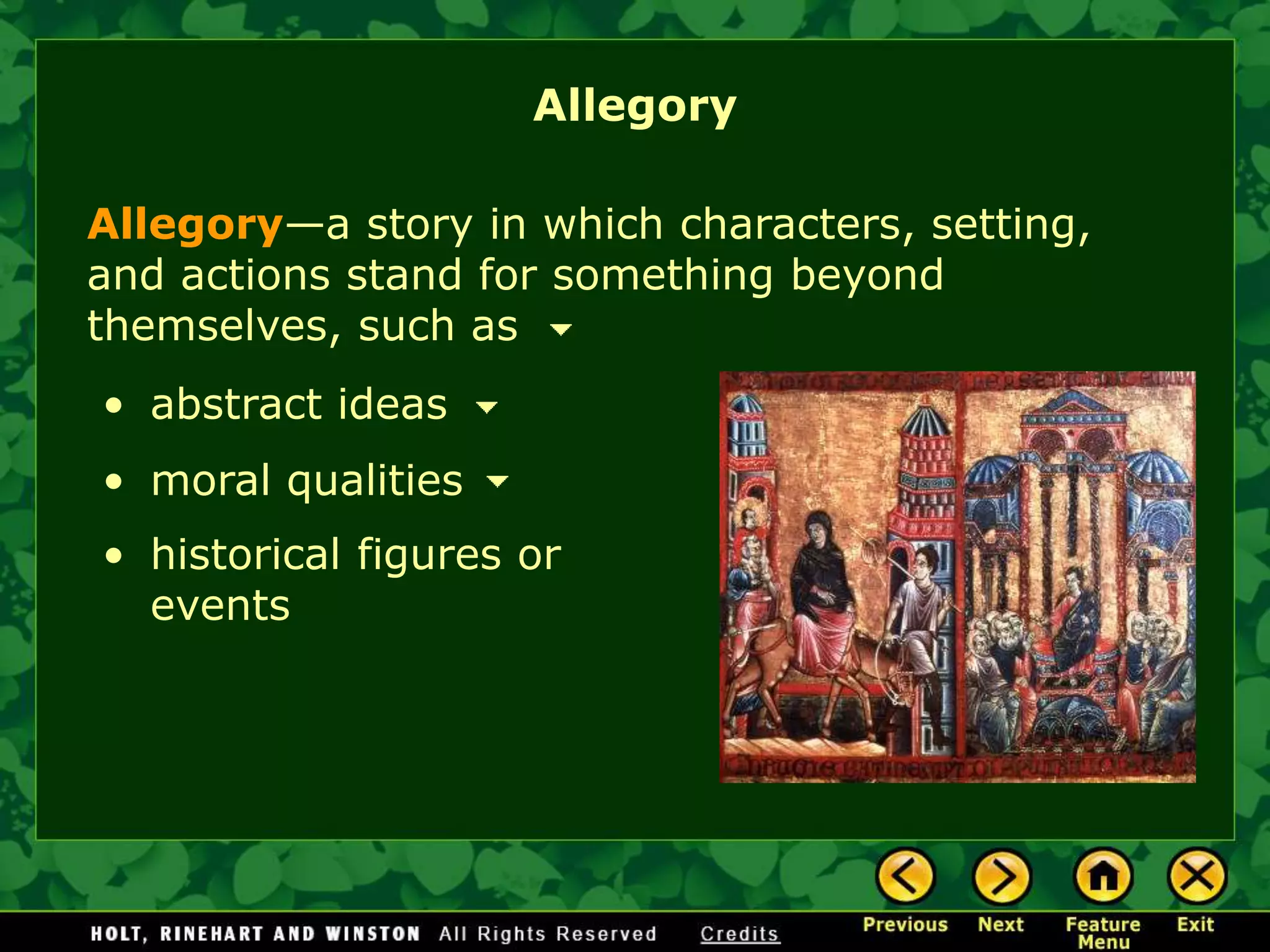
Allegory—a story in which characters, setting,
and actions stand for something beyond
themselves, such as
• abstract ideas
• moral qualities
• historical figures or
events
Allegory
Allegories
• can be read on two levels: literal and symbolic
• are often intended to
teach a moral lesson
or make a comment
about goodness and
vice
Allegory
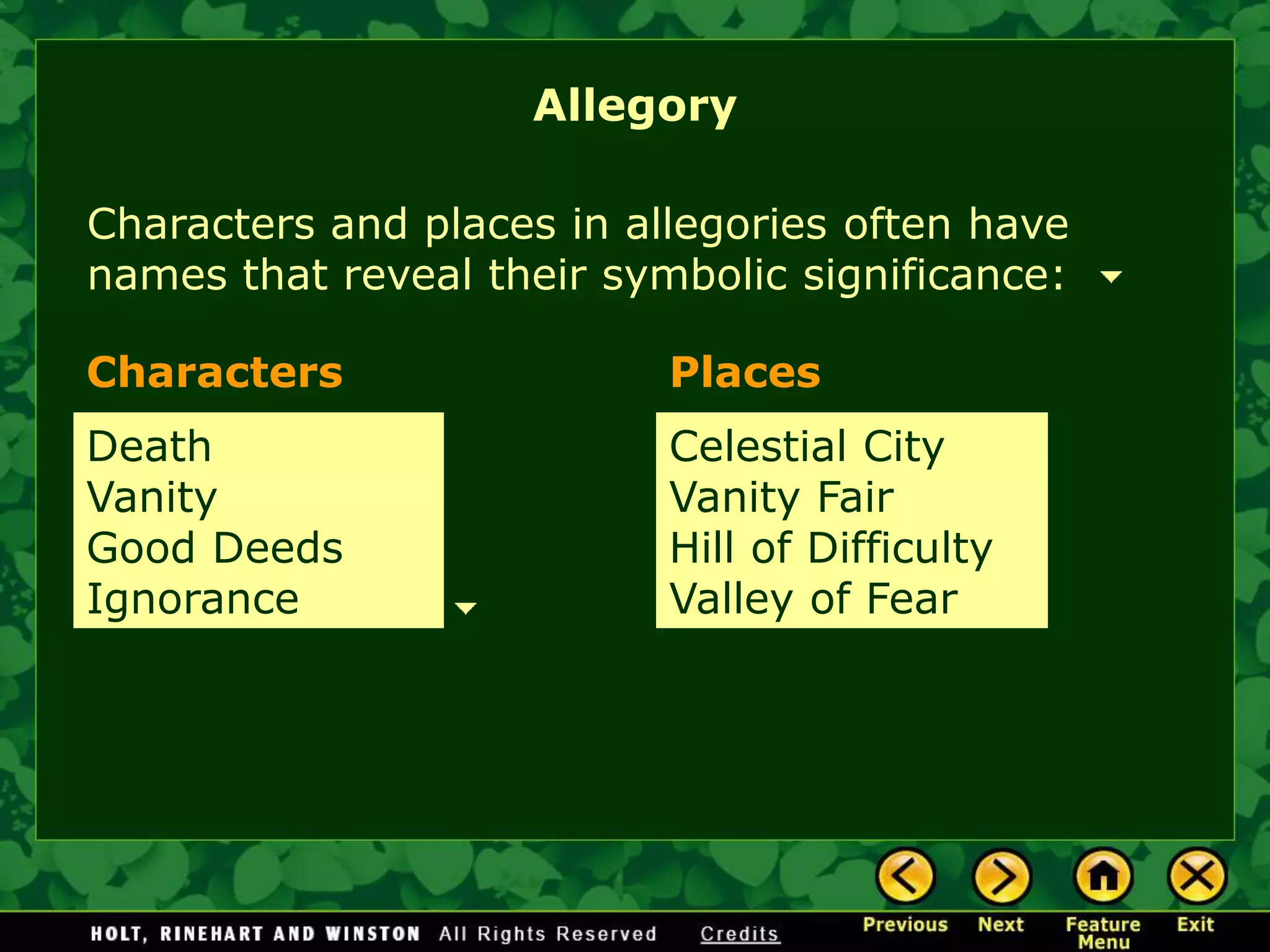
Characters and places in allegories often have
names that reveal their symbolic significance:
Characters Places
Death
Vanity
Good Deeds
Ignorance
Celestial City
Vanity Fair
Hill of Difficulty
Valley of Fear
Allegory
What do you think
Everyman, the main
character of the
allegory, stands for?
What comment about
fellowship, beauty, and
strength does this
allegory make?
Allegory
Quick Check
One day, Everyman is
summoned by Death to give an
accounting of his life. Everyman
ask his friends Fellowship, Beauty,
Strength, and Good Deeds to go
with him to tell Death that he has
led a good life. Only Good Deeds
stays with him to the end.
—summary of “Everyman”
[End of Section]
On a symbolic level,
what does it mean that
only Good Deeds stays
with Everyman to the
end?
Allegory
Quick Check
One day, Everyman is
summoned by Death to give an
accounting of his life. Everyman
ask his friends Fellowship, Beauty,
Strength, and Good Deeds to go
with him to tell Death that he has
led a good life. Only Good Deeds
stays with him to the end.
—summary of “Everyman”
A. Think about the great number of symbols we’re
surrounded by in everyday life. For starters,
identify what the items below stand for. Then, see
if you can explain the basis for the symbol—why is
this symbol appropriate for what it stands for?
• A snake
• An eagle
• Spring
• An owl
• A white flag
Practice
[End of Section]
B. Here is a brief poem that works on two levels: a
literal level and a symbolic level. A fen is a
swampy place. What does the fen symbolize in this
poem?
Practice
I May, I Might, I Must
If you will tell me why the fen
appears impassable, I then
will tell you why I think that I
can get across it if I try.
—Marianne Moore
[End of Section]
The End

Symbolism and Allegory.ppt

  • 1.
    What Is aSymbol? Where Do We Get Symbols? Symbols in Literature Allegory Practice Part A Practice Part B Symbolism and Allegory Feature Menu
  • 2.
    [End of Section] Asymbol is an ordinary object, event, person, or animal to which we have attached a special meaning. What Is a Symbol?
  • 3.
    Public symbols • havebeen inherited, or handed down over time • show up in art and literature Where Do We Get Symbols? • are widely known Note
  • 4.
    What does eachof these symbols stand for? Why do you think they have taken on the meanings they have? justice luck love Where Do We Get Symbols?
  • 5.
    [End of Section] Inventedsymbols • come about when writers make a character, object, or event stand for some human concern • sometimes become well known and gain the status of public symbol Where Do We Get Symbols?
  • 6.
    Writers use symbolsto • suggest layers of meaning that a simple, literal statement could never convey • speak more powerfully to the reader’s emotions and imagination • make their stories rich and memorable Symbols in Literature
  • 7.
    What might the cakesymbolize in this passage? What is your emotional response to the description of the cake? Symbols in Literature Quick Check The most prominent object was a long table with a tablecloth spread on it. . . . An épergne or centrepiece of some kind was in the middle of this cloth; it was so heavily overhung with cobwebs that its form was quite undistinguishable; . . . I saw speckled-legged spiders with blotchy bodies running home to it, and running out from it. . . . “What do you think that is?” she asked me, again pointing with her stick; “that, where those cobwebs are?” . . . “It’s a great cake. A bride-cake. Mine!” from Great Expectations by Charles Dickens [End of Section]
  • 8.
    Allegory—a story inwhich characters, setting, and actions stand for something beyond themselves, such as • abstract ideas • moral qualities • historical figures or events Allegory
  • 9.
    Allegories • can beread on two levels: literal and symbolic • are often intended to teach a moral lesson or make a comment about goodness and vice Allegory
  • 10.
    Characters and placesin allegories often have names that reveal their symbolic significance: Characters Places Death Vanity Good Deeds Ignorance Celestial City Vanity Fair Hill of Difficulty Valley of Fear Allegory
  • 11.
    What do youthink Everyman, the main character of the allegory, stands for? What comment about fellowship, beauty, and strength does this allegory make? Allegory Quick Check One day, Everyman is summoned by Death to give an accounting of his life. Everyman ask his friends Fellowship, Beauty, Strength, and Good Deeds to go with him to tell Death that he has led a good life. Only Good Deeds stays with him to the end. —summary of “Everyman” [End of Section]
  • 12.
    On a symboliclevel, what does it mean that only Good Deeds stays with Everyman to the end? Allegory Quick Check One day, Everyman is summoned by Death to give an accounting of his life. Everyman ask his friends Fellowship, Beauty, Strength, and Good Deeds to go with him to tell Death that he has led a good life. Only Good Deeds stays with him to the end. —summary of “Everyman”
  • 13.
    A. Think aboutthe great number of symbols we’re surrounded by in everyday life. For starters, identify what the items below stand for. Then, see if you can explain the basis for the symbol—why is this symbol appropriate for what it stands for? • A snake • An eagle • Spring • An owl • A white flag Practice [End of Section]
  • 14.
    B. Here isa brief poem that works on two levels: a literal level and a symbolic level. A fen is a swampy place. What does the fen symbolize in this poem? Practice I May, I Might, I Must If you will tell me why the fen appears impassable, I then will tell you why I think that I can get across it if I try. —Marianne Moore [End of Section]
  • 15.