EXECUTIVE SUMMARY
Protecting Corporate
Information in the Cloud
©2015 WSJ. Custom Studios, a unit of The Wall Street Journal Advertising Department. The Wall Street Journal news organization was not involved in the creation of this content.
IN COLLABORATION WITH
©2015 WSJ. Custom Studios.	 2
ABOUT THE STUDY
Keeping Your Data Safe: Protecting Corporate Information in the
Cloud is an insights-driven thought leadership study conducted by
WSJ. Custom Studios in collaboration with Symantec Corporation.
The goal of this research is to better understand worldwide cloud
adoption across leading organizations and the challenges associated
with its use. This survey also explores attitudes toward security
as well as the behaviors that can lead to potential data loss and
security breaches.
An online survey was conducted from February to March 2015
among 360 global business and IT executives with 180 respondents
from the United States, 60 from the United Kingdom, 60 from
Germany and 60 from Japan. Of these, 15% are CEOs, presidents or
owners; 14% are CIOs/CTOs/CSOs; 5% are other C-level executives;
13% are heads of business units or EVPs/VPs/directors; 23% are IT/
security professionals; and 30% are managers or other business
professionals (e.g., engineering, research and development, sales,
legal and compliance, etc.).
KEY FINDINGS
Cloud applications and technologies are becoming increasingly
mainstream across organizations worldwide: Two-thirds of
global executives now have a cloud strategy in place within their
organization. While the majority of executives realize the benefits,
data security and privacy concerns remain the biggest challenges of
usingthecloud.Infact,confidenceinthesecurityofcloudapplications
is subpar at most, and organizations with cloud applications were
more likely to have suffered a data breach than organizations
without them. This study reveals that employees often engage in
high-risk behaviors, either knowingly or unknowingly, that can lead
to data loss and breaches. Part of the challenge for organizations
will be to create a culture that welcomes new technologies, such as
the cloud, to drive business growth and productivity, yet fosters a
safe haven for valuable information.
©2015 WSJ. Custom Studios.	 3
INTRODUCTION
Seeing Above the Horizon
Cloud applications and technologies are revolutionizing the way
businesses communicate, collaborate and access information. From
increased productivity to lower operational costs, organizations
around the world are realizing the true value of the cloud, its vast
impact on the future of work and its potential to drive business growth
and innovation. With revenues expected to surpass $500 billion by
2020, cloud solutions are poised to become the dominant IT model
across organizations.1
In fact, two-thirds of corporate executives
worldwide have now adopted cloud solutions, according to the WSJ.
Custom Studios/Symantec Corporation survey.
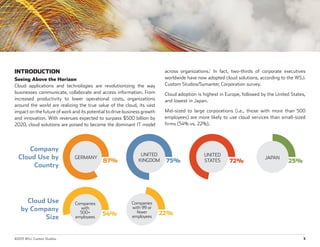
Cloud adoption is highest in Europe, followed by the United States,
and lowest in Japan.
Mid-sized to large corporations (i.e., those with more than 500
employees) are more likely to use cloud services than small-sized
firms (54% vs. 22%).
Company
Cloud Use by
Country
Cloud Use
by Company
Size
87%
GERMANY
72%
UNITED
STATES 25%
JAPAN
75%
UNITED
KINGDOM
54%
Companies
with
500+
employees
22%
Companies
with 99 or
fewer
employees
©2015 WSJ. Custom Studios.	 4
As cloud technologies become more common, it’s not surprising
that nearly three-quarters of C-level executives, including IT
leaders, now believe that the benefits of the cloud outweigh any
potential risk to corporate data security. This is in stark contrast
to opinions held in 2010, where only 17% of executives held the
same belief.2
The Cloud’s Biggest Challenge Remains
However, this isn’t to say concerns over data security and privacy are
abating. In fact, the opposite is true: Among non-users of the cloud,
about seven in 10 (68%) cite concerns over data security as the
number one roadblock to cloud implementation of any kind within
their organization. These concerns are more likely to be echoed by
C-level executives than IT management (74% vs. 61%).
Among companies with a cloud strategy, confidence in the
cloud’s ability to safely store corporate assets is subpar: Only
four in 10 executives worldwide are “very confident” that their
company’s confidential and sensitive information is secure when
using cloud-based services. Additionally, companies who have
adopted cloud services were more likely to have had a security
breach in the past year than companies with no cloud—18% vs.
3%. Clearly these results are discouraging, but they demonstrate
the complexities and challenges surrounding company-wide
cloud adoption.
With security hacks becoming a daily fact of digital life, nearly
all executives say safeguarding corporate data (which includes
intellectual property, customer data, financial information and
records) is a critical business priority.
Employees Don’t Always Know
Yet, there’s a dichotomy between what executives say and what
they do when it comes to keeping company-sensitive data secure.
Despite the recent high-profile data breaches and increased privacy
regulations, employees (including those in IT and top management
as well as others) appear to be largely unaware of the behaviors
that put corporate and personal data at risk.
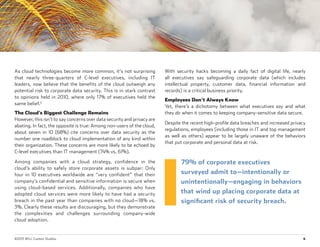
79% of corporate executives
surveyed admit to—intentionally or
unintentionally—engaging in behaviors
that wind up placing corporate data at
significant risk of security breach.
©2015 WSJ. Custom Studios.	 5
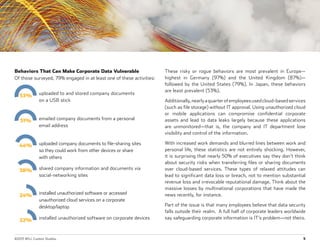
Behaviors That Can Make Corporate Data Vulnerable
Of those surveyed, 79% engaged in at least one of these activities:
These risky or rogue behaviors are most prevalent in Europe—
highest in Germany (97%) and the United Kingdom (87%)—
followed by the United States (79%). In Japan, these behaviors
are least prevalent (53%).
Additionally,nearlyaquarterofemployeesusedcloud-basedservices
(such as file storage) without IT approval. Using unauthorized cloud
or mobile applications can compromise confidential corporate
assets and lead to data leaks largely because these applications
are unmonitored—that is, the company and IT department lose
visibility and control of the information.
With increased work demands and blurred lines between work and
personal life, these statistics are not entirely shocking. However,
it is surprising that nearly 50% of executives say they don’t think
about security risks when transferring files or sharing documents
over cloud-based services. These types of relaxed attitudes can
lead to significant data loss or breach, not to mention substantial
revenue loss and irrevocable reputational damage. Think about the
massive losses by multinational corporations that have made the
news recently, for instance.
Part of the issue is that many employees believe that data security
falls outside their realm. A full half of corporate leaders worldwide
say safeguarding corporate information is IT’s problem—not theirs.
uploaded to and stored company documents
on a USB stick
emailed company documents from a personal
email address
uploaded company documents to file-sharing sites
so they could work from other devices or share
with others
shared company information and documents via
social-networking sites
installed unauthorized software or accessed
unauthorized cloud services on a corporate
desktop/laptop
installed unauthorized software on corporate devices
53%
51%
44%
38%
24%
22%
©2015 WSJ. Custom Studios.	 6
So even though employees say security is a top business priority,
at the end of the day, many believe corporate security rests on the
shoulders of IT.
Keeping Data Secure When Using the Cloud
So what are companies doing to better manage the risk of potential
data loss or breach? Worldwide, 71% of corporate executives have
increased their technology and security budgets. This percentage
jumps to 98% across companies that have suffered from a data
breach in the past year. It’s a tall order, but spending additional
funds is necessary to keep businesses flowing efficiently and safely.
Additionally, close to eight in 10 have implemented company-wide
training initiatives, including new-hire security orientation, to raise
security awareness and curb risky behavior. Staggeringly, only 28%
have a formalized plan that outlines policies and procedures for
reporting and responding to security threats. Clearly, a lot remains
to be done.
CONCLUSION
Cloud technologies are here to stay: Two-thirds of leading
organizations have now embraced the cloud and many believe its
benefits outweigh any potential security risk. However, managing
security risk and preventing data loss continues to be a business-
wide challenge. Employees care about the security of their
company’s assets but often overlook potential security risks. Many
executives and employees alike are simply unaware of how their
behaviors can place their company at risk of data loss or breach.
This study reveals a gap between what executives say and do as it
relates to data security and illustrates how leading organizations
are taking numerous steps to ensure that progress is being made
toward better safety controls.
1
Bessemer Venture Partners: State of the Cloud Report, 2015:
www.bvp.com/cloud/cloudreport#sthash.o4mBXBrv.dpuf
2
ISACA IT Risk/Reward Barometer Survey, March 2010:
www.isaca.org/About-ISACA/Press-room/News-Releases/2010/Pages/
ISACA-US-IT-Risk-Reward-Barometer-Survey.aspx
NEW YORK
1211 Avenue of the Americas
9th Floor
New York, NY 10036
LONDON
The News Building
1 London Bridge Street
London SE1 9GF
HONG KONG
25/F, Central Plaza
18 Harbour Road
Wanchai
Hong Kong
Sarah Dale
Vice President, Media Sales
212.597.5729
sarah.dale@dowjones.com
WSJ. Custom Studios
WSJ. Custom Studios, the content marketing division within
The Wall Street Journal’s advertising department, crafts stories that
engage consumers and elevate the conversation for brands.
Its global team of award-winning editors, designers and interactive
developers are all held to the high standards for which
The Wall Street Journal is known, resulting in highly original and
credible content that resonates with the client’s target audience.
This work was commissioned by
Symantec Corporation.
Symantec Corporation (NASDAQ:
SYMC) is an information protection
expert that helps people, businesses
and governments seeking the
freedom to unlock the opportunities
technology brings—anytime,
anywhere. Founded in April 1982,
Symantec, a Fortune 500 company,
operating one of the largest global
data-intelligence networks, has
provided leading security, backup
and availability solutions for where
vital information is stored, accessed
and shared. The company’s more
than 19,000 employees reside in
more than 50 countries. Ninety-nine
percent of Fortune 500 companies
are Symantec customers. In fiscal
2015, it recorded revenues of
$6.5 billion. To learn more go to
www.symantec.com or connect
with Symantec at: go.symantec.com/
socialmedia.
IN COLLABORATION WITH
©2015 WSJ. Custom Studios, a unit of The Wall Street Journal Advertising Department. The Wall Street Journal news organization was not involved in the creation of this content.

Protecting Corporate Information in the Cloud

  • 1.
    EXECUTIVE SUMMARY Protecting Corporate Informationin the Cloud ©2015 WSJ. Custom Studios, a unit of The Wall Street Journal Advertising Department. The Wall Street Journal news organization was not involved in the creation of this content. IN COLLABORATION WITH
  • 2.
    ©2015 WSJ. CustomStudios. 2 ABOUT THE STUDY Keeping Your Data Safe: Protecting Corporate Information in the Cloud is an insights-driven thought leadership study conducted by WSJ. Custom Studios in collaboration with Symantec Corporation. The goal of this research is to better understand worldwide cloud adoption across leading organizations and the challenges associated with its use. This survey also explores attitudes toward security as well as the behaviors that can lead to potential data loss and security breaches. An online survey was conducted from February to March 2015 among 360 global business and IT executives with 180 respondents from the United States, 60 from the United Kingdom, 60 from Germany and 60 from Japan. Of these, 15% are CEOs, presidents or owners; 14% are CIOs/CTOs/CSOs; 5% are other C-level executives; 13% are heads of business units or EVPs/VPs/directors; 23% are IT/ security professionals; and 30% are managers or other business professionals (e.g., engineering, research and development, sales, legal and compliance, etc.). KEY FINDINGS Cloud applications and technologies are becoming increasingly mainstream across organizations worldwide: Two-thirds of global executives now have a cloud strategy in place within their organization. While the majority of executives realize the benefits, data security and privacy concerns remain the biggest challenges of usingthecloud.Infact,confidenceinthesecurityofcloudapplications is subpar at most, and organizations with cloud applications were more likely to have suffered a data breach than organizations without them. This study reveals that employees often engage in high-risk behaviors, either knowingly or unknowingly, that can lead to data loss and breaches. Part of the challenge for organizations will be to create a culture that welcomes new technologies, such as the cloud, to drive business growth and productivity, yet fosters a safe haven for valuable information.
  • 3.
    ©2015 WSJ. CustomStudios. 3 INTRODUCTION Seeing Above the Horizon Cloud applications and technologies are revolutionizing the way businesses communicate, collaborate and access information. From increased productivity to lower operational costs, organizations around the world are realizing the true value of the cloud, its vast impact on the future of work and its potential to drive business growth and innovation. With revenues expected to surpass $500 billion by 2020, cloud solutions are poised to become the dominant IT model across organizations.1 In fact, two-thirds of corporate executives worldwide have now adopted cloud solutions, according to the WSJ. Custom Studios/Symantec Corporation survey. Cloud adoption is highest in Europe, followed by the United States, and lowest in Japan. Mid-sized to large corporations (i.e., those with more than 500 employees) are more likely to use cloud services than small-sized firms (54% vs. 22%). Company Cloud Use by Country Cloud Use by Company Size 87% GERMANY 72% UNITED STATES 25% JAPAN 75% UNITED KINGDOM 54% Companies with 500+ employees 22% Companies with 99 or fewer employees
  • 4.
    ©2015 WSJ. CustomStudios. 4 As cloud technologies become more common, it’s not surprising that nearly three-quarters of C-level executives, including IT leaders, now believe that the benefits of the cloud outweigh any potential risk to corporate data security. This is in stark contrast to opinions held in 2010, where only 17% of executives held the same belief.2 The Cloud’s Biggest Challenge Remains However, this isn’t to say concerns over data security and privacy are abating. In fact, the opposite is true: Among non-users of the cloud, about seven in 10 (68%) cite concerns over data security as the number one roadblock to cloud implementation of any kind within their organization. These concerns are more likely to be echoed by C-level executives than IT management (74% vs. 61%). Among companies with a cloud strategy, confidence in the cloud’s ability to safely store corporate assets is subpar: Only four in 10 executives worldwide are “very confident” that their company’s confidential and sensitive information is secure when using cloud-based services. Additionally, companies who have adopted cloud services were more likely to have had a security breach in the past year than companies with no cloud—18% vs. 3%. Clearly these results are discouraging, but they demonstrate the complexities and challenges surrounding company-wide cloud adoption. With security hacks becoming a daily fact of digital life, nearly all executives say safeguarding corporate data (which includes intellectual property, customer data, financial information and records) is a critical business priority. Employees Don’t Always Know Yet, there’s a dichotomy between what executives say and what they do when it comes to keeping company-sensitive data secure. Despite the recent high-profile data breaches and increased privacy regulations, employees (including those in IT and top management as well as others) appear to be largely unaware of the behaviors that put corporate and personal data at risk. 79% of corporate executives surveyed admit to—intentionally or unintentionally—engaging in behaviors that wind up placing corporate data at significant risk of security breach.
  • 5.
    ©2015 WSJ. CustomStudios. 5 Behaviors That Can Make Corporate Data Vulnerable Of those surveyed, 79% engaged in at least one of these activities: These risky or rogue behaviors are most prevalent in Europe— highest in Germany (97%) and the United Kingdom (87%)— followed by the United States (79%). In Japan, these behaviors are least prevalent (53%). Additionally,nearlyaquarterofemployeesusedcloud-basedservices (such as file storage) without IT approval. Using unauthorized cloud or mobile applications can compromise confidential corporate assets and lead to data leaks largely because these applications are unmonitored—that is, the company and IT department lose visibility and control of the information. With increased work demands and blurred lines between work and personal life, these statistics are not entirely shocking. However, it is surprising that nearly 50% of executives say they don’t think about security risks when transferring files or sharing documents over cloud-based services. These types of relaxed attitudes can lead to significant data loss or breach, not to mention substantial revenue loss and irrevocable reputational damage. Think about the massive losses by multinational corporations that have made the news recently, for instance. Part of the issue is that many employees believe that data security falls outside their realm. A full half of corporate leaders worldwide say safeguarding corporate information is IT’s problem—not theirs. uploaded to and stored company documents on a USB stick emailed company documents from a personal email address uploaded company documents to file-sharing sites so they could work from other devices or share with others shared company information and documents via social-networking sites installed unauthorized software or accessed unauthorized cloud services on a corporate desktop/laptop installed unauthorized software on corporate devices 53% 51% 44% 38% 24% 22%
  • 6.
    ©2015 WSJ. CustomStudios. 6 So even though employees say security is a top business priority, at the end of the day, many believe corporate security rests on the shoulders of IT. Keeping Data Secure When Using the Cloud So what are companies doing to better manage the risk of potential data loss or breach? Worldwide, 71% of corporate executives have increased their technology and security budgets. This percentage jumps to 98% across companies that have suffered from a data breach in the past year. It’s a tall order, but spending additional funds is necessary to keep businesses flowing efficiently and safely. Additionally, close to eight in 10 have implemented company-wide training initiatives, including new-hire security orientation, to raise security awareness and curb risky behavior. Staggeringly, only 28% have a formalized plan that outlines policies and procedures for reporting and responding to security threats. Clearly, a lot remains to be done. CONCLUSION Cloud technologies are here to stay: Two-thirds of leading organizations have now embraced the cloud and many believe its benefits outweigh any potential security risk. However, managing security risk and preventing data loss continues to be a business- wide challenge. Employees care about the security of their company’s assets but often overlook potential security risks. Many executives and employees alike are simply unaware of how their behaviors can place their company at risk of data loss or breach. This study reveals a gap between what executives say and do as it relates to data security and illustrates how leading organizations are taking numerous steps to ensure that progress is being made toward better safety controls. 1 Bessemer Venture Partners: State of the Cloud Report, 2015: www.bvp.com/cloud/cloudreport#sthash.o4mBXBrv.dpuf 2 ISACA IT Risk/Reward Barometer Survey, March 2010: www.isaca.org/About-ISACA/Press-room/News-Releases/2010/Pages/ ISACA-US-IT-Risk-Reward-Barometer-Survey.aspx
  • 7.
    NEW YORK 1211 Avenueof the Americas 9th Floor New York, NY 10036 LONDON The News Building 1 London Bridge Street London SE1 9GF HONG KONG 25/F, Central Plaza 18 Harbour Road Wanchai Hong Kong Sarah Dale Vice President, Media Sales 212.597.5729 sarah.dale@dowjones.com WSJ. Custom Studios WSJ. Custom Studios, the content marketing division within The Wall Street Journal’s advertising department, crafts stories that engage consumers and elevate the conversation for brands. Its global team of award-winning editors, designers and interactive developers are all held to the high standards for which The Wall Street Journal is known, resulting in highly original and credible content that resonates with the client’s target audience. This work was commissioned by Symantec Corporation. Symantec Corporation (NASDAQ: SYMC) is an information protection expert that helps people, businesses and governments seeking the freedom to unlock the opportunities technology brings—anytime, anywhere. Founded in April 1982, Symantec, a Fortune 500 company, operating one of the largest global data-intelligence networks, has provided leading security, backup and availability solutions for where vital information is stored, accessed and shared. The company’s more than 19,000 employees reside in more than 50 countries. Ninety-nine percent of Fortune 500 companies are Symantec customers. In fiscal 2015, it recorded revenues of $6.5 billion. To learn more go to www.symantec.com or connect with Symantec at: go.symantec.com/ socialmedia. IN COLLABORATION WITH ©2015 WSJ. Custom Studios, a unit of The Wall Street Journal Advertising Department. The Wall Street Journal news organization was not involved in the creation of this content.