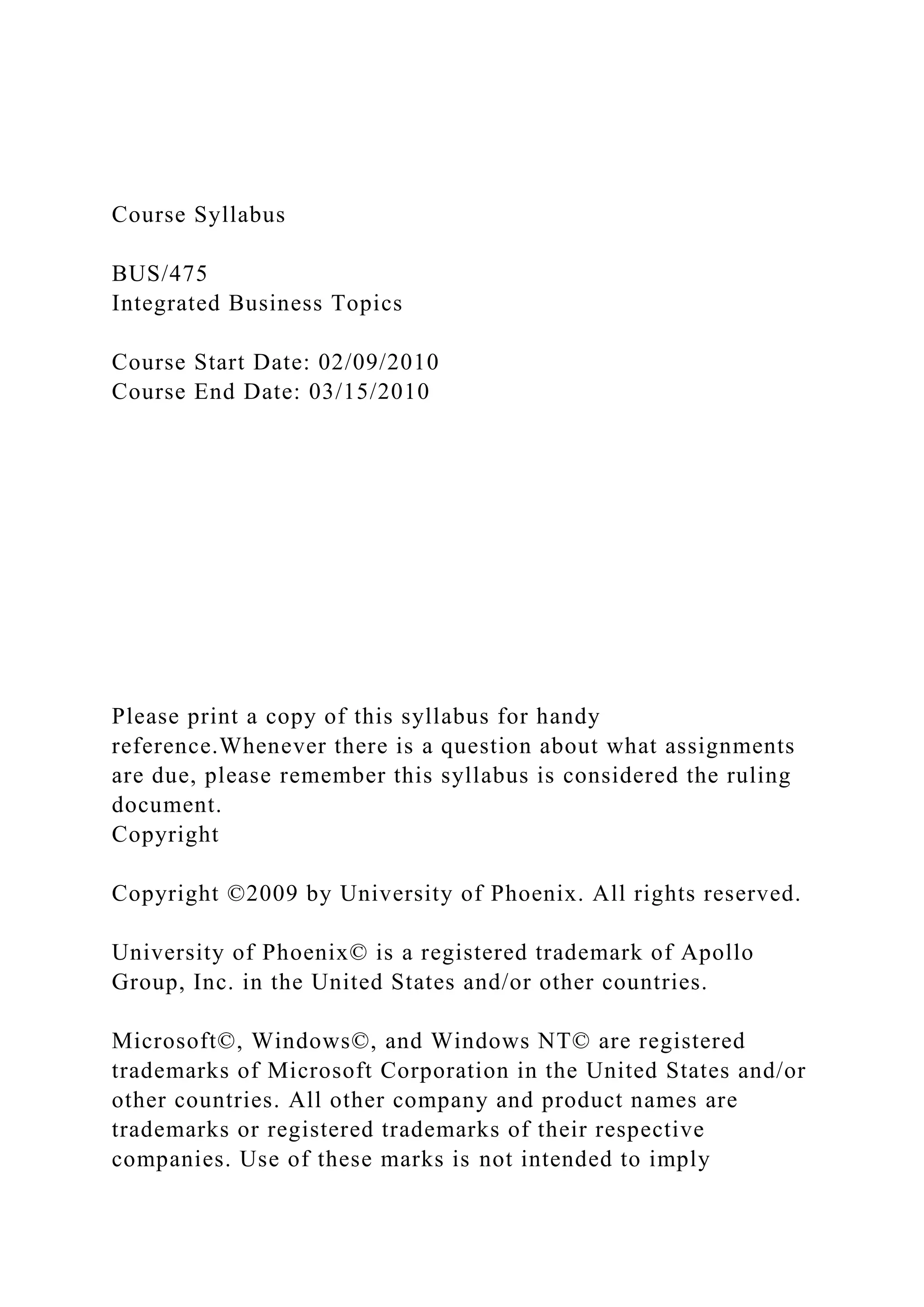
Course Syllabus
BUS/475
Integrated Business Topics
Course Start Date: 02/09/2010
Course End Date: 03/15/2010
Please print a copy of this syllabus for handy
reference.Whenever there is a question about what assignments
are due, please remember this syllabus is considered the ruling
document.
Copyright
Copyright ©2009 by University of Phoenix. All rights reserved.
University of Phoenix© is a registered trademark of Apollo
Group, Inc. in the United States and/or other countries.
Microsoft©, Windows©, and Windows NT© are registered
trademarks of Microsoft Corporation in the United States and/or
other countries. All other company and product names are
trademarks or registered trademarks of their respective
companies. Use of these marks is not intended to imply
endorsement, sponsorship, or affiliation.
Edited in accordance with University of Phoenix© editorial
standards and practices.
Facilitator Information
Dr. Laura Pogue[email protected] (University of Phoenix)
[email protected] (Personal)
248-866-0443 (Arizona Time)
Facilitator Availability
I am in the classroom frequently and questions will be answered
within 24 hours. I also have office hours Wednesday and
Thursday evenings from 7-8 PM Arizona Time.
Please do not hesitate to contact me, if you have questions or
need assistance. The best way to contact me is through the
classroom. Please post a note in your Individual Forum or, if the
answer to the question may benefit the entire class, in the
current week’s question forum.
For emergencies, when you are not able to gain access to your
class, please send a message to my alternate email address,
which is listed within my Contact Information post or contact
tech support.
Where to Go to
Class
Main: This is the main forum for the class and is
where discussion is conducted. It has read-and-write access for
everyone.
Chat-Room: This is a read-and-write access forum. It is
designed as a place to discuss issues not related to the course
content. This is the forum to which we will send our bios.
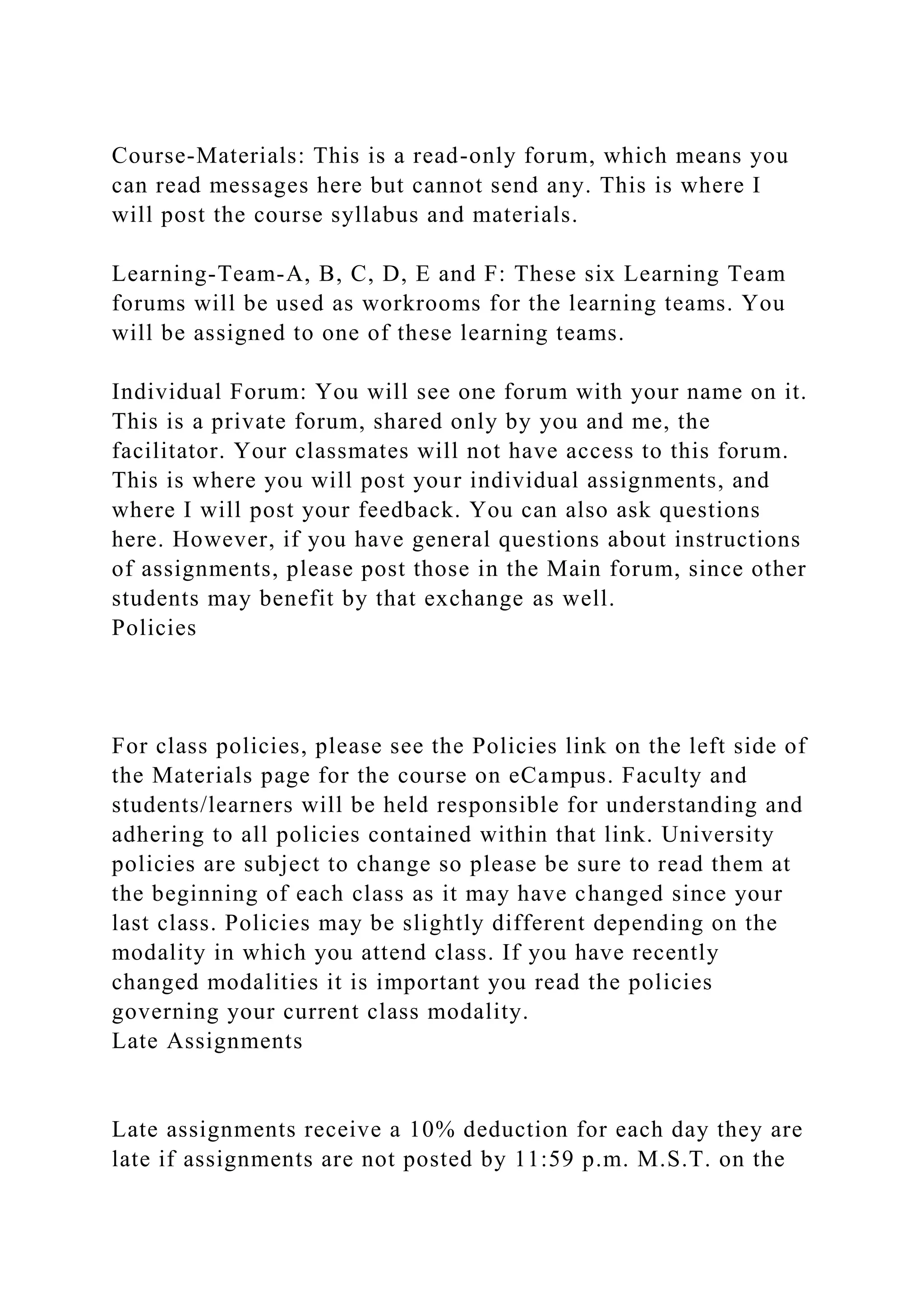
Course-Materials: This is a read-only forum, which means you
can read messages here but cannot send any. This is where I
will post the course syllabus and materials.
Learning-Team-A, B, C, D, E and F: These six Learning Team
forums will be used as workrooms for the learning teams. You
will be assigned to one of these learning teams.
Individual Forum: You will see one forum with your name on it.
This is a private forum, shared only by you and me, the
facilitator. Your classmates will not have access to this forum.
This is where you will post your individual assignments, and
where I will post your feedback. You can also ask questions
here. However, if you have general questions about instructions
of assignments, please post those in the Main forum, since other
students may benefit by that exchange as well.
Policies
For class policies, please see the Policies link on the left side of
the Materials page for the course on eCampus. Faculty and
students/learners will be held responsible for understanding and
adhering to all policies contained within that link. University
policies are subject to change so please be sure to read them at
the beginning of each class as it may have changed since your
last class. Policies may be slightly different depending on the
modality in which you attend class. If you have recently
changed modalities it is important you read the policies
governing your current class modality.
Late Assignments
Late assignments receive a 10% deduction for each day they are
late if assignments are not posted by 11:59 p.m. M.S.T. on the
day they are due. Assignments more than 4 days late will not be
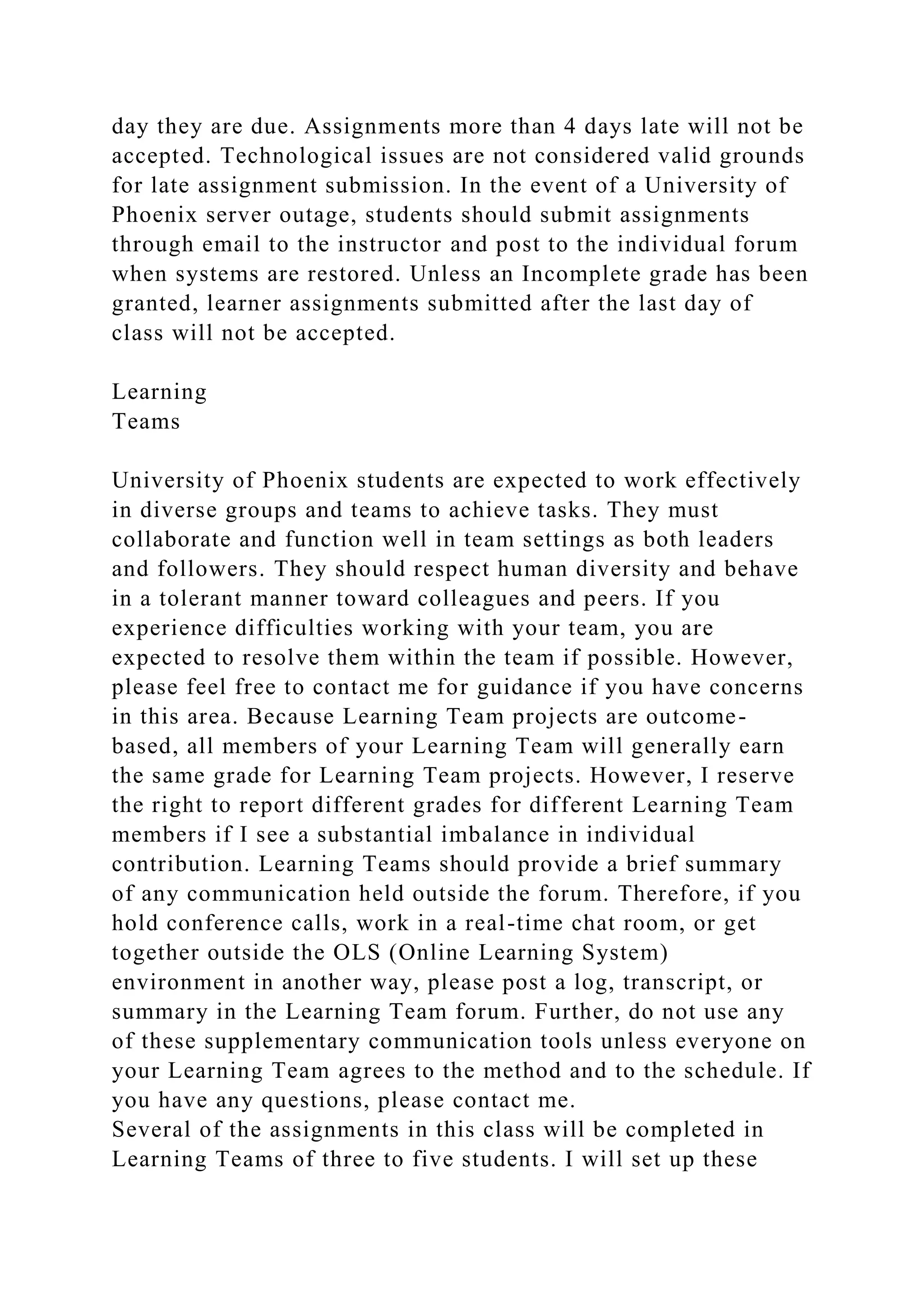
accepted. Technological issues are not considered valid grounds
for late assignment submission. In the event of a University of
Phoenix server outage, students should submit assignments
through email to the instructor and post to the individual forum
when systems are restored. Unless an Incomplete grade has been
granted, learner assignments submitted after the last day of
class will not be accepted.
Learning
Teams
University of Phoenix students are expected to work effectively
in diverse groups and teams to achieve tasks. They must
collaborate and function well in team settings as both leaders
and followers. They should respect human diversity and behave
in a tolerant manner toward colleagues and peers. If you
experience difficulties working with your team, you are
expected to resolve them within the team if possible. However,
please feel free to contact me for guidance if you have concerns
in this area. Because Learning Team projects are outcome-
based, all members of your Learning Team will generally earn
the same grade for Learning Team projects. However, I reserve
the right to report different grades for different Learning Team
members if I see a substantial imbalance in individual
contribution. Learning Teams should provide a brief summary
of any communication held outside the forum. Therefore, if you
hold conference calls, work in a real-time chat room, or get
together outside the OLS (Online Learning System)
environment in another way, please post a log, transcript, or
summary in the Learning Team forum. Further, do not use any
of these supplementary communication tools unless everyone on
your Learning Team agrees to the method and to the schedule. If
you have any questions, please contact me.
Several of the assignments in this class will be completed in
Learning Teams of three to five students. I will set up these
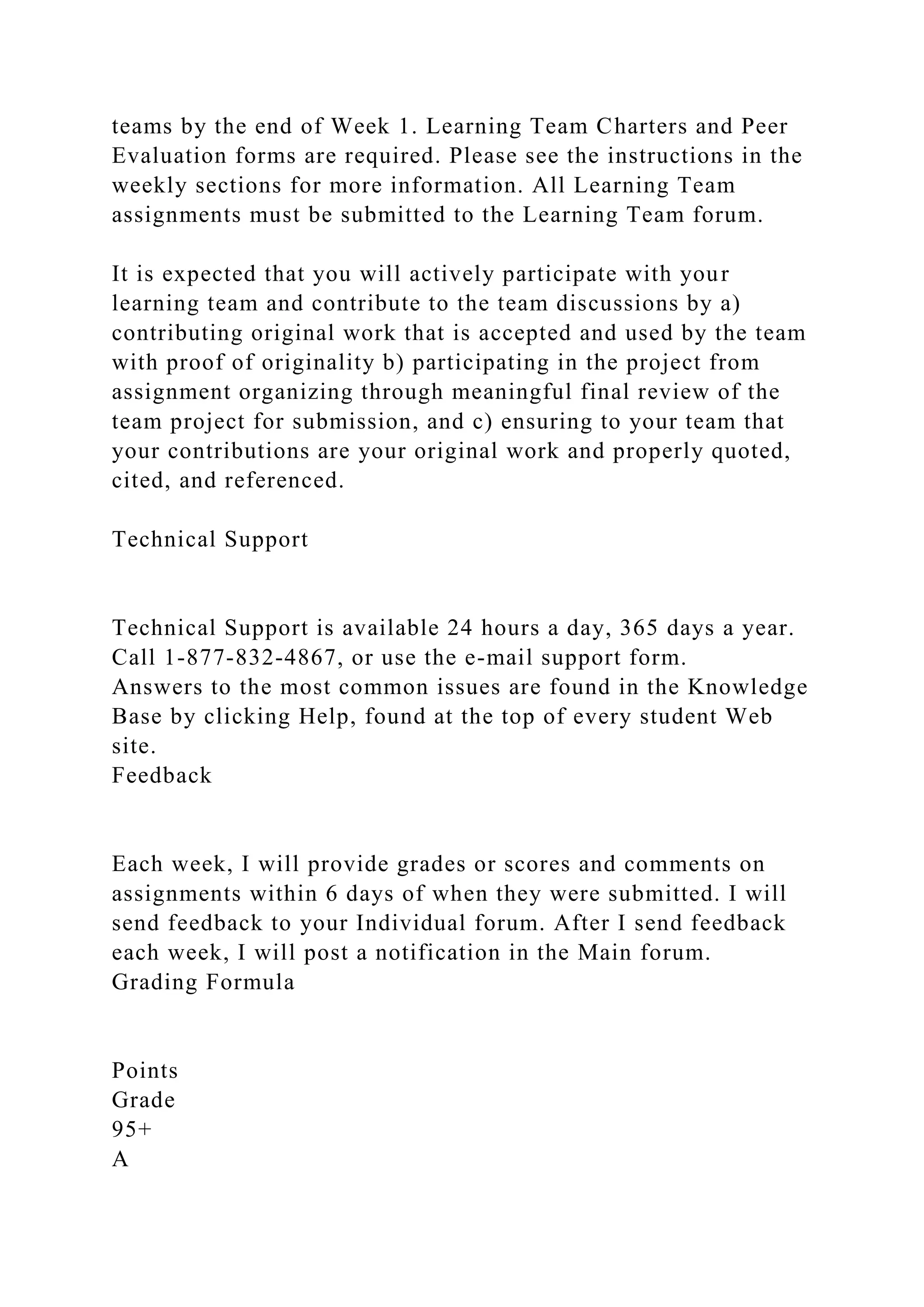
teams by the end of Week 1. Learning Team Charters and Peer
Evaluation forms are required. Please see the instructions in the
weekly sections for more information. All Learning Team
assignments must be submitted to the Learning Team forum.
It is expected that you will actively participate with your
learning team and contribute to the team discussions by a)
contributing original work that is accepted and used by the team
with proof of originality b) participating in the project from
assignment organizing through meaningful final review of the
team project for submission, and c) ensuring to your team that
your contributions are your original work and properly quoted,
cited, and referenced.
Technical Support
Technical Support is available 24 hours a day, 365 days a year.
Call 1-877-832-4867, or use the e-mail support form.
Answers to the most common issues are found in the Knowledge
Base by clicking Help, found at the top of every student Web
site.
Feedback
Each week, I will provide grades or scores and comments on
assignments within 6 days of when they were submitted. I will
send feedback to your Individual forum. After I send feedback
each week, I will post a notification in the Main forum.
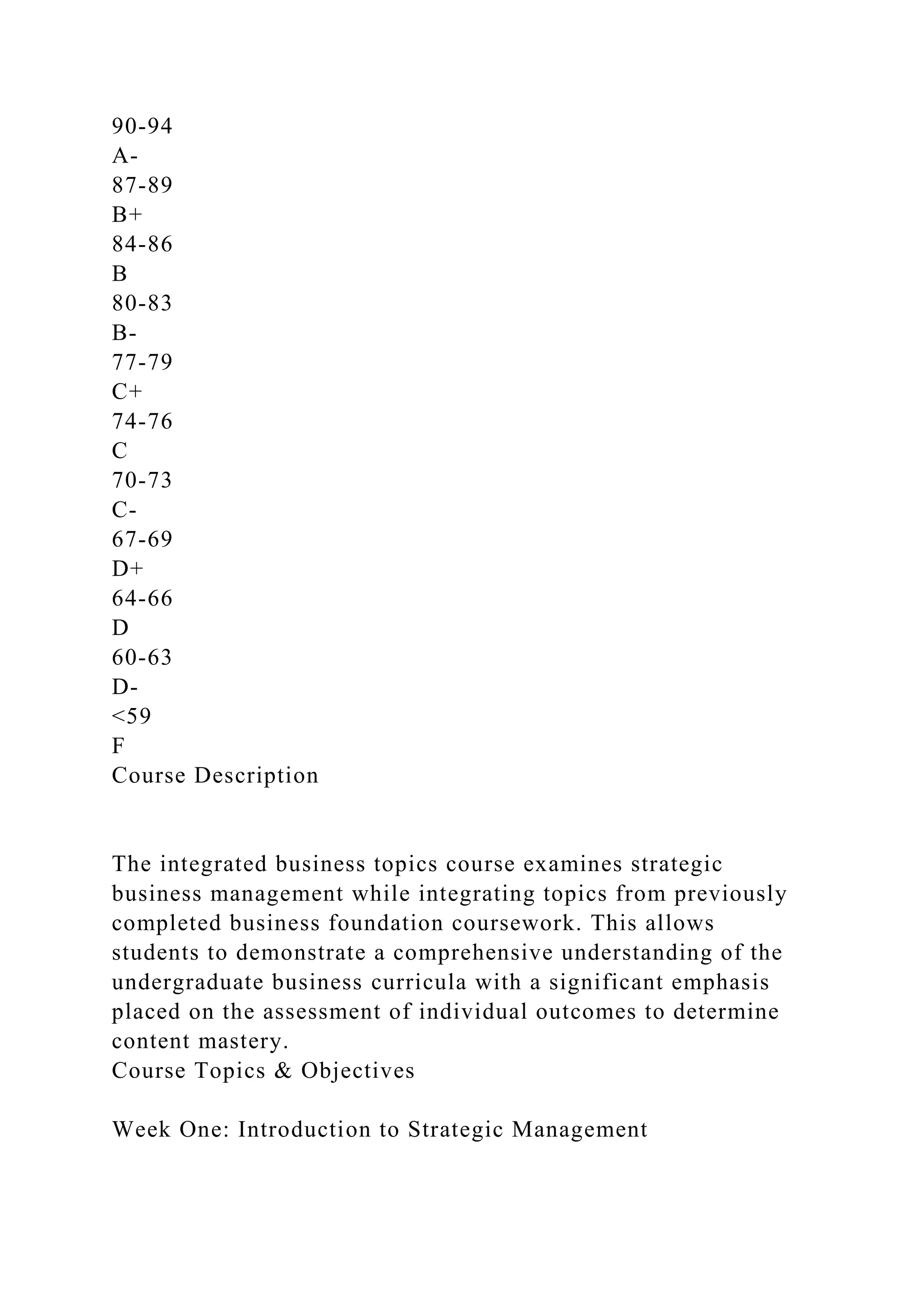
Grading Formula
Points
Grade
95+
A
90-94
A-
87-89
B+
84-86
B
80-83
B-
77-79
C+
74-76
C
70-73
C-
67-69
D+
64-66
D
60-63
D-
<59
F
Course Description
The integrated business topics course examines strategic
business management while integrating topics from previously
completed business foundation coursework. This allows
students to demonstrate a comprehensive understanding of the
undergraduate business curricula with a significant emphasis
placed on the assessment of individual outcomes to determine
content mastery.
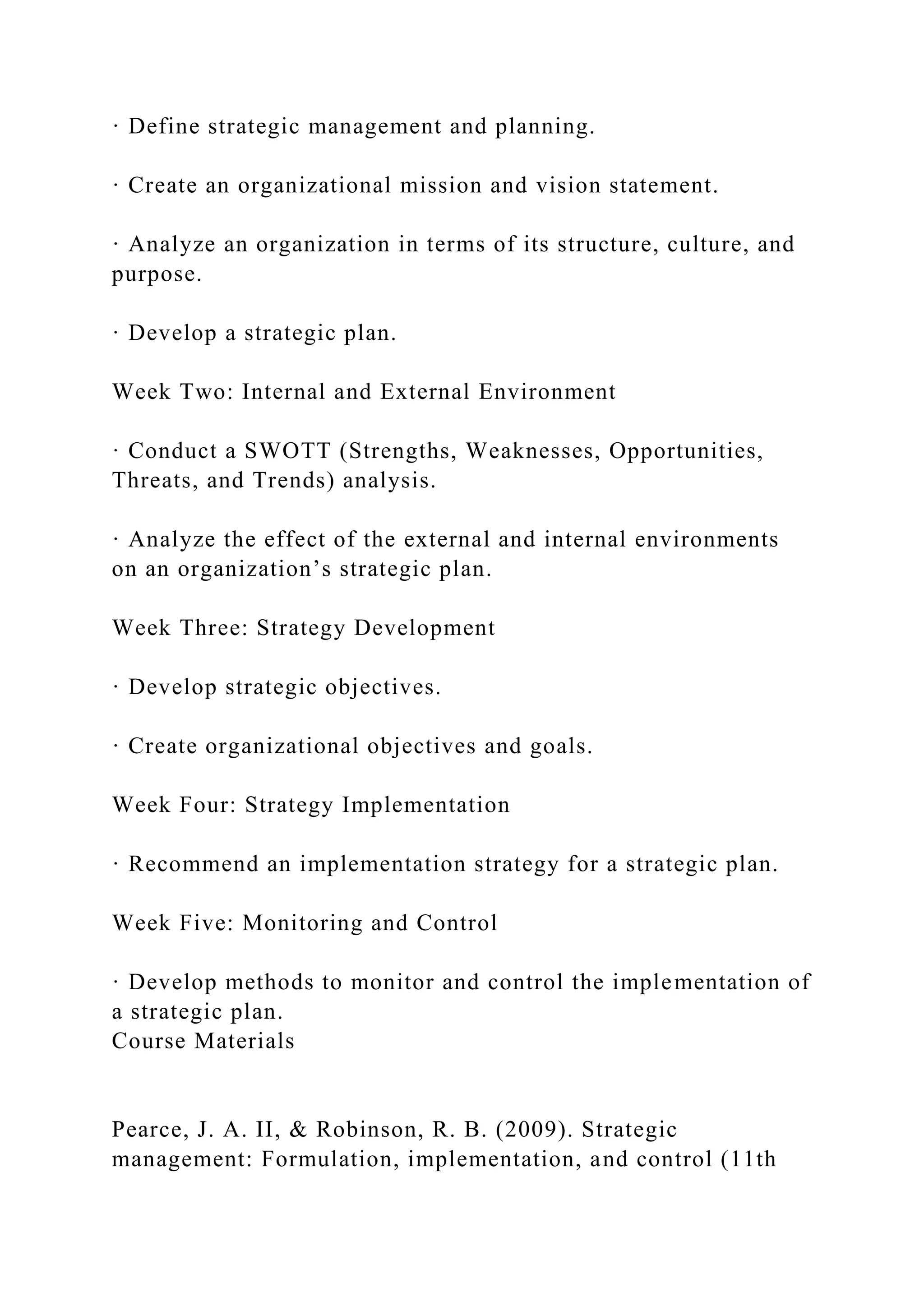
Course Topics & Objectives
Week One: Introduction to Strategic Management
· Define strategic management and planning.
· Create an organizational mission and vision statement.
· Analyze an organization in terms of its structure, culture, and
purpose.
· Develop a strategic plan.
Week Two: Internal and External Environment
· Conduct a SWOTT (Strengths, Weaknesses, Opportunities,
Threats, and Trends) analysis.
· Analyze the effect of the external and internal environments
on an organization’s strategic plan.
Week Three: Strategy Development
· Develop strategic objectives.
· Create organizational objectives and goals.
Week Four: Strategy Implementation
· Recommend an implementation strategy for a strategic plan.
Week Five: Monitoring and Control
· Develop methods to monitor and control the implementation of
a strategic plan.
Course Materials
Pearce, J. A. II, & Robinson, R. B. (2009). Strategic
management: Formulation, implementation, and control (11th
ed.). New York: McGraw-Hill.
Thompson, A. A., Gamble, J. E., & Strickland, A. J. (2006).
Strategy: Winning in the marketplace: Core concepts, analytical
tools, cases (2nd ed.). New York: McGraw-Hill.
All electronic materials are available on your student Web site.
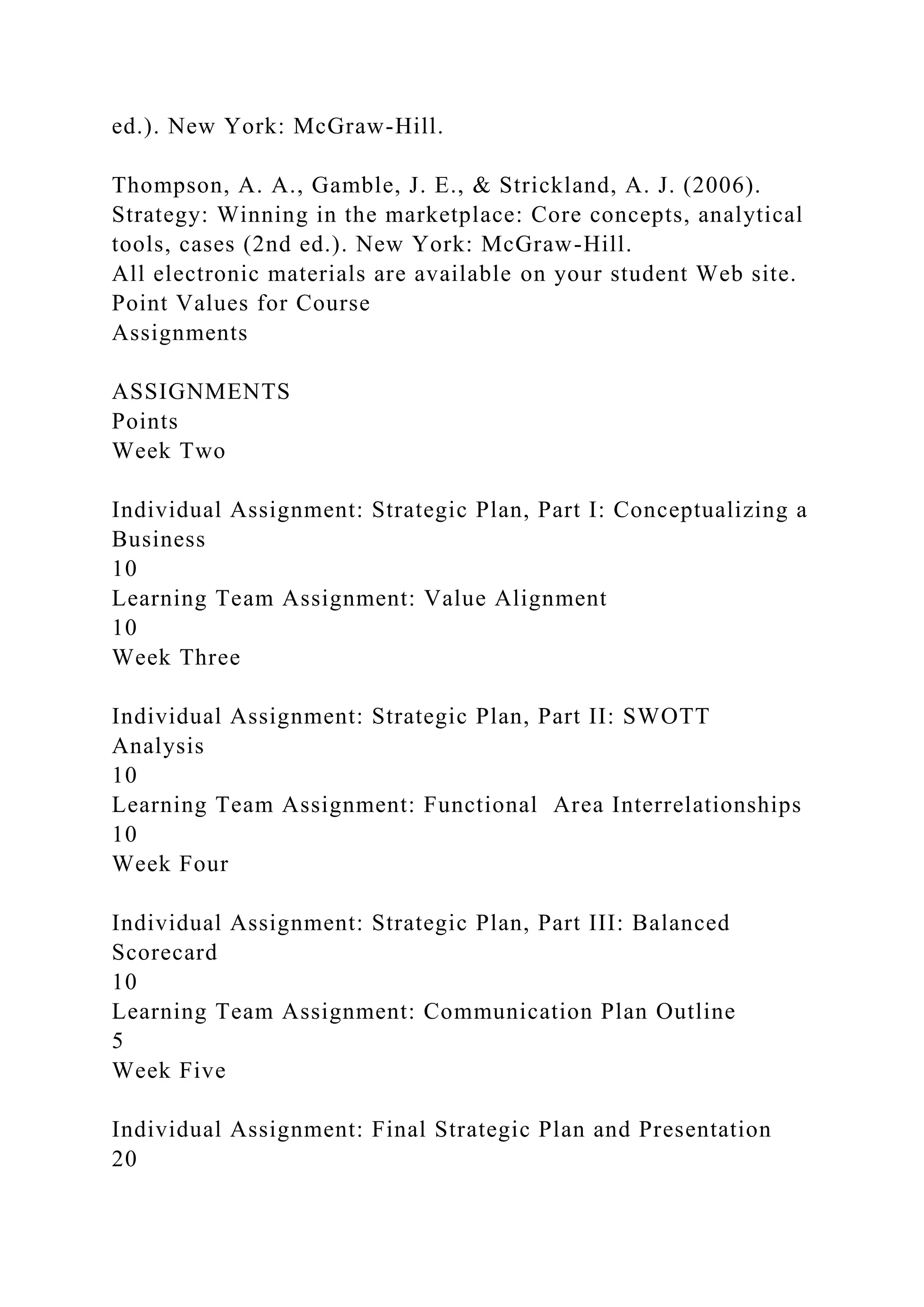
Point Values for Course
Assignments
ASSIGNMENTS
Points
Week Two
Individual Assignment: Strategic Plan, Part I: Conceptualizing a
Business
10
Learning Team Assignment: Value Alignment
10
Week Three
Individual Assignment: Strategic Plan, Part II: SWOTT
Analysis
10
Learning Team Assignment: Functional Area Interrelationships
10
Week Four
Individual Assignment: Strategic Plan, Part III: Balanced
Scorecard
10
Learning Team Assignment: Communication Plan Outline
5
Week Five
Individual Assignment: Final Strategic Plan and Presentation
20
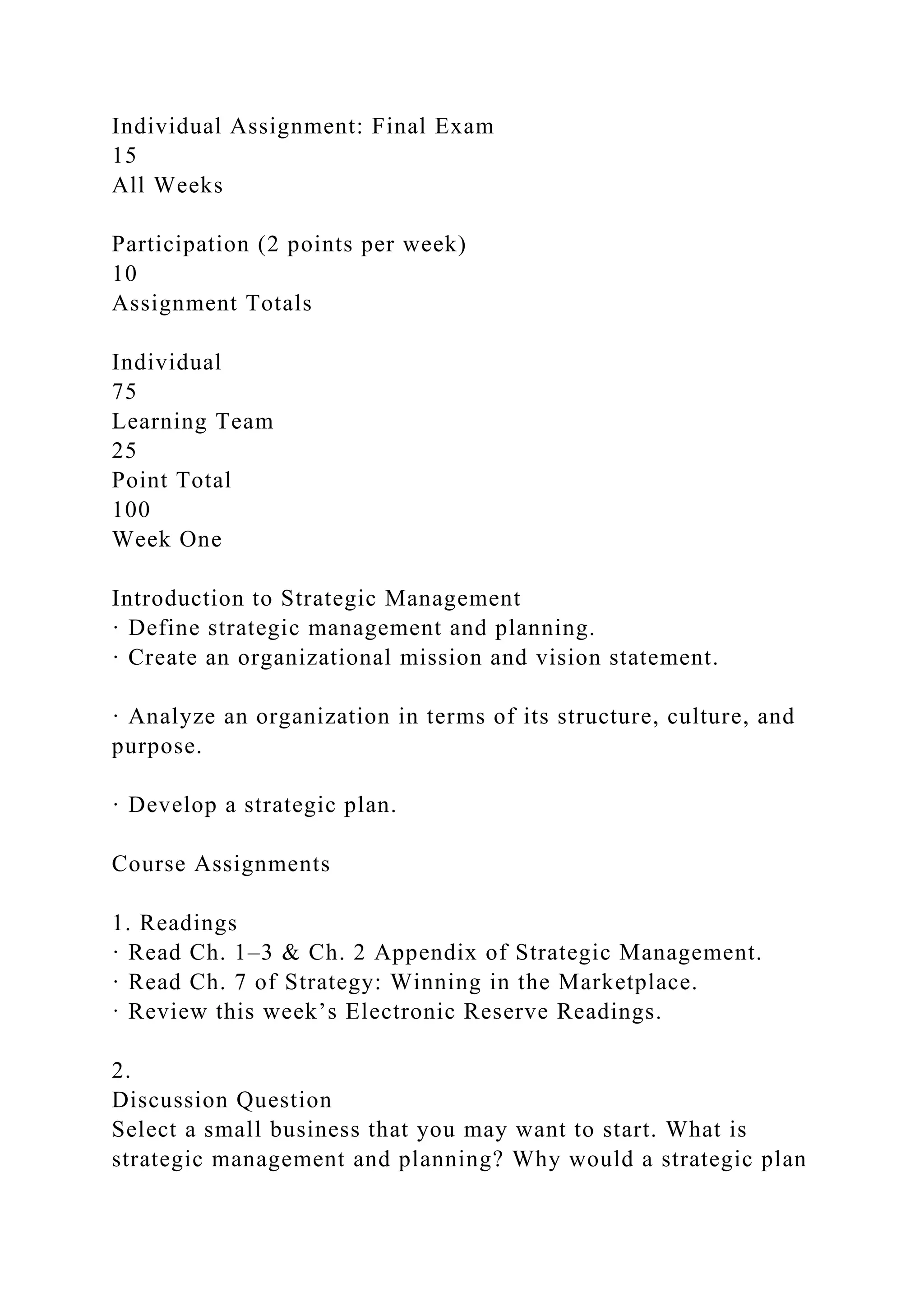
Individual Assignment: Final Exam
15
All Weeks
Participation (2 points per week)
10
Assignment Totals
Individual
75
Learning Team
25
Point Total
100
Week One
Introduction to Strategic Management
· Define strategic management and planning.
· Create an organizational mission and vision statement.
· Analyze an organization in terms of its structure, culture, and
purpose.
· Develop a strategic plan.
Course Assignments
1. Readings
· Read Ch. 1–3 & Ch. 2 Appendix of Strategic Management.
· Read Ch. 7 of Strategy: Winning in the Marketplace.
· Review this week’s Electronic Reserve Readings.
2.
Discussion Question
Select a small business that you may want to start. What is
strategic management and planning? Why would a strategic plan
be important to the success of this business? How are the four
functions of management relative to creating and implementing
a strategic plan?
Weekly Reminders
Weekly Summaries
Weekly summaries will be required in this course and counted
as class participation.
Discussion Question
Discussion question responses will count towards the class
participation requirement.
Only posts in the Main classroom forum will count towards your
class participation score.
Participation
All Week: Remember to participate in the class discussions 4
out of 7 days during the week.
Summary of Week 1 Deliverables
Assignment
Individual or Learning Team
Location
Due
Discussion Question Response
Individual
Main Forum
2/11/10
Participation
Individual
Main Forum
2/15/10
Weekly Summary
Individual
Main Forum
2/15/10
Week Two
Internal and External Environment
· Conduct a SWOTT (Strengths, Weaknesses, Opportunities,
Threats, and Trends) analysis.
· Analyze the effect of the external and internal environments
on an organization’s strategic plan.
Course Assignments
2. Readings
· Read Ch. 4–6 of Strategic Management.
· Read Ch. 3 of Strategy: Winning in the Marketplace.
· Review this week’s Electronic Reserve Readings.
3. Individual Assignment: Strategic Plan, Part I:Conceptualizing
a Business
· Write a 1,050- to 1,400-word paper in which you explain the
importance of your selected business’s vision, mission, and
values in determining your strategic direction. Include the
following:
· Define your business, products or services, and customers by
developing a mission statement. Ensure that you are
differentiating your product or service.
· Create a vision for this organization that clearly demonstrates
your decision on what you want your business to become in the
future.
· Define your guiding principles or values for your selected
business considering the topics of culture, social responsibility,
and ethics.
· Analyze how the vision, mission, and values guide the
organization’s strategic direction.
· Evaluate how the organization addresses customer needs and
critique how they achieve competitive advantage.
· Format your paper according to APA guidelines.
· Prepare to discuss this assignment with the class.
4. Learning Team Assignment: Value Alignment
· Discuss with your Learning Team an existing organization
with which you are familiar that is different than the one you
used for the Conceptualizing a Business paper.
· Write a 700- to 1,050-word paper in which you analyze the
individual values and the organization’s values as reflected by
the organization’s plans and actions. Include the following in
your paper:
· Analyze the origin(s) and subsequent evolution of your
personal and workplace values.
· Explain how your individual values drive your actions and
behaviors, and analyze the alignment between your values and
actions and behaviors.
· Analyze the degree of alignment between the organization’s
stated values and the organization’s actual plans and actions.
· Explain the differences and analyze the degree of alignment
between your values and the organization’s values as reflected
by the organization’s plans and actions.
· Format your paper according to APA guidelines.
· Prepare to discuss this assignment with the class.
5. Discussion Questions
· What is a SWOTT analysis? What is its purpose in strategic
planning? Must you conduct a SWOTT analysis to have an
effective strategic plan? Why or why not?
Weekly Reminders
Weekly Summaries
Weekly summaries will be required in this course and counted
as class participation.
Discussion Question
Discussion question responses will count towards the class
participation requirement.
Only posts in the Main classroom forum will count towards your
class participation score.
Participation
All Week: Remember to participate in the class discussions 4
out of 7 days during the week.
Summary of Week 2 Deliverables
Assignment
Individual or Learning Team
Location
Due
Discussion Question Response
Individual
Main Forum
2/18/10
Participation
Individual
Main Forum
2/22/10
Weekly Summary
Individual
Main Forum
2/22/10
Strategic Plan, Part I: Conceptualizing a Business
Individual
Individual Forum
2/21/10
Value Alignment
Learning Team
Team Forum
2/22/10
Week Three
Strategy Development
· Develop strategic objectives.
· Create organizational objectives and goals.
Course Assignments
6. Readings
· Read Ch. 7 of Strategic Management.
· Read Ch. 4 of Strategy: Winning in the Marketplace.
· Review this week’s Electronic Reserve Readings.
7. Individual Assignment: Strategic Plan, Part II: SWOTT
Analysis
· Conduct an internal and external environmental analysis for
your proposed business.
· Discuss with your Learning Team the forces and trends below
that must be taken into consideration while developing a
strategic plan. Given today’s business environment and each
Learning Team members’ selected business idea, provide a list
of the lessons learned from your Learning Team’s discussion for
each of the items listed below. Use this discussion to complete
this assignment.
· Create a SWOTT table summarizing your findings. Your
environmental analysis should take into account, at a minimum,
the following factors. For each factor, identify the one primary
strength, weakness, opportunity, threat, and trend, and include
it in your table.
· External forces and trends considerations:
· Legal and regulatory
· Global
· Economic
· Technological
· Innovation
· Social
· Environmental
· Competitive analysis
· Internal forces and trends considerations:
· Strategy
· Structures
· Processes and systems
· Resources
· Goals
· Strategic capabilities
· Culture
· Technologies
· Innovations
· Intellectual property
· Leadership
· Write a 1,400- to 1,750-word synopsis in which you analyze at
least seven of the forces and trends from the list above. Your
analysis must include the following:
· Include economic as well as legal and regulatory forces and
trends.
· Critique how well the organization adapts to change.
· Analyze the supply chain operations of the organization.
· Identify issues and/or opportunities:
· Identify the major issues and/or opportunities that the
company faces based on your analysis above.
· Generate a hypothesis surrounding each issue and research
questions to use for conducting analysis.
· Identify the circumstances surrounding each issue; classify the
circumstances; attribute the importance of each classification;
and test the accuracy of the importance for each classification.
· Format your paper according to APA guidelines.
8. Learning Team Assignment: Functional Area
Interrelationships
· Select one organization of the Virtual Organizations from the
student Web site.
· Write a 1,400- to 2,100-word paper in which you complete the
following:
· State the primary reasons for the organization’s existence from
an analysis of the mission, vision, values, and goals.
· Analyze the reason for the type of organizational structure
employed by the organization, and identify the key positions
that support that organizational structure.
· Identify and explain the steps of the collaboration process
among the functional areas that must be employed to achieve
organizational goals, and prepare an action plan to implement
the collaboration process.
· Identify and provide an example of the use of lateral
collaboration and vertical collaboration within the organization,
and prepare an action plan to use lateral and vertical
collaboration.
· Identify the key stakeholders and their roles needed to achieve
the organizational goals, and recommend the collaborative
interactions among the key stakeholders to facilitate the
organization’s success.
9. Discussion Question
· What are the different types of strategies? What are the
differences among these strategies? How do you determine
which type of strategy is most appropriate for your
organization?
Weekly Reminders
Weekly Summaries
Weekly summaries will be required in this course and counted
as class participation.
Discussion Questions
Discussion question responses will count towards the class
participation requirement.
Only posts in the Main classroom forum will count towards your
class participation score.
Participation
All Week: Remember to participate in the class discussions 4
out of 7 days during the week.
Summary of Week 3 Deliverables
Assignment
Individual or Learning Team
Location
Due
Discussion Question Response
Individual
Main Forum
2/25/10
Participation
Individual
Main Forum
3/1/10
Weekly Summary
Individual
Main Forum
3/1/10
Strategic Plan, Part II: SWOTT Analysis
Individual
Individual Forum
2/28/10
Functional Area Interrelationships
Learning Team
TeamForum
3/1/10
Week Four
Strategy Implementation
· Recommend an implementation strategy for a strategic plan.
Course Assignments
10. Readings
· Read Ch. 10–12 of Strategic Management.
· Read Ch. 8 of Strategy: Winning in the Marketplace.
· Review this week’s Electronic Reserve Readings.
11. Individual Assignment: Strategic Plan, Part III:Balanced
Scorecard
· Resources: Exhibit 7-1 in Ch. 7 of Strategic Management
· Develop the strategic objectives for your business in the
format of a balanced scorecard.The strategic objectives are
measures of attaining your vision and mission. As you develop
them consider the vision, mission, and values for your business
and the outcomes of your SWOTT analysis. Consider the
following four quadrants of the balanced scorecard when
developing your strategic objectives:
· Shareholder Value or Financial Perspective, includes strategic
objectives in areas such as:
· Market share
· Revenues and costs
· Profitability
· Competitive position
· Customer Value Perspective, includes strategic objectives in
areas such as:
· Customer retention or turnover
· Customer satisfaction
· Customer value
· Process or Internal Operations Perspective, includes strategic
objectives in areas such as:
· Measure of process performance
· Productivity or productivity improvement
· Operations metrics
· Learning and Growth (Employee) Perspective, includes
strategic objectives in areas such as:
· Employee satisfaction
· Employee turnover or retention
· Level of organizational capability
· Nature of organizational culture or climate
· Technological innovation
· Develop at least three strategic objectives for each of the
following four balanced scorecard areas identified above
(Financial, Customer, Process, Learning and Growth). Your
objectives should be selected, in part, based on an evaluation of
a number of potential alternatives to the issues and/or
opportunities identified in the SWOTT Analysis paper and table
you completed in Week Three. Base your solutions on a ranking
of alternative solutions that includes an identification of
potential risks and mitigation plans, and a stakeholder analysis
that includes mitigation and contingency strategies. You should
also incorporate the ethical implications of your solutions into
your selection.
· For each strategic objective, develop a metric and target using
a balanced scorecard format. (For example, a strategic objective
in the shareholder or Financial Perspective is to increase market
share. A metric to actually measure this strategic objective
of market share increase is, "The percentage of increase in
market share." The target is the specific number to be achieved
in a particular time period. The target for the metric of
"Increase market share" could be "Increase market share by 2%
for each of the next 3 years" of an increase of 2% per year for 3
years.)
· Write a 700- to 1,050-word summary that explains your
critical thinking on how you derived your objectives from your
vision, mission, values, and SWOTT analysis.
· Format paper according to APA guidelines.
12. Learning Team Assignment: Communication Plan Outline
· Develop a generic communications plan and template. This
template will be used to develop a communication plan for your
Final Strategic Plan, due in Week Five.
13. Discussion Question
· Why is it important tocontinuously update the implementation
and communication of a strategic plan? Who should be
responsible for updating and communicating a strategic plan?
Why?
Weekly Reminders
Weekly Summaries
Weekly summaries will be required in this course and counted
as class participation.
Discussion Questions
Discussion question responses will count towards the class
participation requirement.
Only posts in the Main classroom forum will count towards your
class participation score.
Participation
All Week: Remember to participate in the class discussions 4
out of 7 days during the week.
Summary of Week 4 Deliverables
Assignment
Individual or Learning Team
Location
Due
Discussion Question Response
Individual
Main Forum
3/4/10
Participation
Individual
Main Forum
3/8/10
Weekly Summary
Individual
Main Forum
3/8/10
Strategic Plan, Part III: Balanced Scorecard
Individual
Individual Forum
3/7/10
Communication Plan Outline
Learning Team
Team Forum
3/8/10
Week Five
Monitoring and Control
· Develop methods to monitor and control the implementation of
a strategic plan.
Course Assignments
14. Readings
· Read Ch. 13 of Strategic Management.
· Review this week’s Electronic Reserve Readings.
15. Individual Assignment: Final Strategic Plan and
Presentation
· Resources: Vision, mission, values, SWOTT analysis,
balanced scorecards, and communication plan
· Write a 700- to 1,050-word section for your strategic plan in
which you add your strategies and tactics to implement and
realize your strategic objectives, measures, and targets. Include
marketing and information technology strategies and tactics.
Develop at least three methods to monitor and control your
proposed strategic plan, being sure to analyze how the measures
will advance organizational goals financially and operationally.
Finally, recommend actions needed to address ethical, legal, and
regulatory issues faced by the organization, and how they can
improve corporate citizenship.
· Combine your completed strategic plan. This includes the
vision, mission, values, SWOTT analysis, balanced scorecard,
and communication plan. Your consolidated final strategic plan
should be 2,800 to 4,200 words in length.
· Prepare three to five Microsoft® PowerPoint® slides, in which
you briefly outline the vision, mission, values, and balanced
scorecard that you have developed for your business. Share your
presentation with your classmates and provide substantive
feedback by commenting on the work of your classmates.
16. Individual Assignment: Final Exam
· Resources: Final Exam & assigned readings from all weeks
· Select the link to the final exam on your student Web site. The
exam is available from the end of Week Four through the end of
Week Five.
· Complete the final exam. Only one attempt is allowed, which
is timed and must be completed in 3 hours. Results are auto-
graded and sent to your instructor.
Note.Final exam questions are adapted from business content
students will have completed in the Bachelor of Science in
Business program.
17. Discussion Question
· What are examples of regulatory issues that affect the
controlling aspect of a strategic plan? What are examples of
organizations that have failed to comply with regulatory
requirements in controlling their strategic plans? What were
some repercussions that these organizations have faced?
Weekly Reminders
Weekly Summaries
Weekly summaries will be required in this course and counted
as class participation.
Final Week Requirements
Discussion question responses will be required during the final
week of the course.
Only posts in the Main classroom forum will count towards your
class participation score.
Participation
All Week: Remember to participate in the class discussions 4
out of 7 days during the week.
Summary of Week 5 Deliverables
Assignment
Individual or Learning Team
Location
Due
Discussion Question Response
Individual
Main Forum
3/11/10
Participation
Individual
Main Forum
3/15/10
Weekly Summary
Individual
Main Forum
3/15/09
Final Strategic Plan and Presentation
Individual
Individual Forum/Main Forum
3/14/10
Final Exam
Individual
Individual Forum
3/15/10
· Question 1 Class, as you begin analysis of your new
product/service line, a key component of the strategic planning
process is to achieve competitive advantage. In this chapter (pg
111), the authors identified 8 common mistakes executives
make when identifying their competition. Of these 8 (section:
Common Mistakes in Identifying Competition), do any have
greater applicability to your new product/service line? What
recommendations do you have for ways in which to overcome
these mistakes?
Global enterprises analysis
This chapter is focused on global enterprise, and brings up
unique considerations when conducting business in that realm.
The authors contend that due to six events (increased scope of
global management task, increased globalization of firms, the
information explosion, the increase in global competition, rapid
development of technology, and strategic management planning
breeds managerial confidence), soon all industries should
evaluate global environments.After reading more about these six
factors, do you agree with the authors? Will you consider
global environments for your new division and the new
product/service you are developing? Why/why not?
Question 3
· Class, an essential element of analysis concerns monitoring
external influences/drivers. The goal is to assess the drivers of
change and ascertain the impact of these change drivers as it
relates to market demand, competition, and industry
profitability.
Of the 12 most common drivers of industry change (copied
below), which have applicability to your industry and which do
you believe will have greatest impact, to the extent you will
devote effort to monitoring the driver(s)?
"Table 3.3 The Most Common Drivers of Industry Change
1. Changes in the long-term industry growth rate
2. Increasing globalization
3. Changes in who buys the product and how they use it
4. Technological change
5. Emerging new Internet capabilities and applications
6. Product and marketing innovation
7. Entry or exit of major firms
8. Diffusion of technical know-how across companies and
countries
9. Improvements in efficiency in adjacent markets
10. Reductions in uncertainty and business risk
11. Regulatory influences and government policy changes
12. Changing societal concerns, attitudes, and lifestyles"
Question 4 What are the key planning factors for competitive
success? Provide an example of an organization that has
achieved competitive success through planning. Provide an
example of an organization that has failed to achieve
competitive success as the result of failed planning.
· Question 5 In Chapter 5, the authors discussed 5 generic
competitive strategies (overall low-cost, broad differentiation,
focused low-cost, focused differentiation, or best-cost). After
reading more about these strategies, which do you believe is the
best strategy to adopt for your new product/service? Please
explain.
Question 6 Class, Mr. Stewart, in this video, states his
organization's expansion efforts into the global marketplace,
specifically supply chain management, were due, in large part,
to a cultural match between their organization and that of the
supply chain partners. I especially liked his comment about it
wasn't "us" (e.g., Americans) heading over to China, but rather
they needed local experts to ensure supply chain management
was effective. It reminds of the many times management feels
the need to step in. Oftentimes, I believe, employees would be
better served if management got out of their way and let them
do the things they do best. Of course, Mr. Stewart provided the
strategy, but left it up to the employees to carry it out. All, what
do you think - it doesn't necessarily need to relate to global
supply chain, but perhaps supply chain in general? Any success
stories to share? World-Class Supply Chain Management
videohttps://portal.phoenix.edu/medialibrary/videodetails.01-
vid-f1db34dd4f01c5aea9e14f1636b4663f.html
· Question 7 Class, you might find this video interesting, as it
shows how one organization is partnering with its customers,
providing development services. This is interesting in a couple
of fronts: first, the organization has begun offering
development services (possibly revenue-generating); second, it
has figured out a way to provide true value-add, meaning their
customers may think twice before leaving them for a
competitor. Another consideration is the partnership and
relationship with external stakeholders. As you begin to
develop a new product or service, please consider ways in
which you will engage your stakeholders. While the focus of
the video was on products, what about the service sector? How
could you use supply chain to your benefit?
·
https://portal.phoenix.edu/medialibrary/videodetails.50V101227
001745096.html

Course SyllabusBUS475Integrated Business TopicsCourse.docx

  • 1.
    Course Syllabus BUS/475 Integrated BusinessTopics Course Start Date: 02/09/2010 Course End Date: 03/15/2010 Please print a copy of this syllabus for handy reference.Whenever there is a question about what assignments are due, please remember this syllabus is considered the ruling document. Copyright Copyright ©2009 by University of Phoenix. All rights reserved. University of Phoenix© is a registered trademark of Apollo Group, Inc. in the United States and/or other countries. Microsoft©, Windows©, and Windows NT© are registered trademarks of Microsoft Corporation in the United States and/or other countries. All other company and product names are trademarks or registered trademarks of their respective companies. Use of these marks is not intended to imply
  • 2.
    endorsement, sponsorship, oraffiliation. Edited in accordance with University of Phoenix© editorial standards and practices. Facilitator Information Dr. Laura Pogue[email protected] (University of Phoenix) [email protected] (Personal) 248-866-0443 (Arizona Time) Facilitator Availability I am in the classroom frequently and questions will be answered within 24 hours. I also have office hours Wednesday and Thursday evenings from 7-8 PM Arizona Time. Please do not hesitate to contact me, if you have questions or need assistance. The best way to contact me is through the classroom. Please post a note in your Individual Forum or, if the answer to the question may benefit the entire class, in the current week’s question forum. For emergencies, when you are not able to gain access to your class, please send a message to my alternate email address, which is listed within my Contact Information post or contact tech support. Where to Go to Class Main: This is the main forum for the class and is where discussion is conducted. It has read-and-write access for everyone. Chat-Room: This is a read-and-write access forum. It is designed as a place to discuss issues not related to the course content. This is the forum to which we will send our bios.
  • 3.
    Course-Materials: This isa read-only forum, which means you can read messages here but cannot send any. This is where I will post the course syllabus and materials. Learning-Team-A, B, C, D, E and F: These six Learning Team forums will be used as workrooms for the learning teams. You will be assigned to one of these learning teams. Individual Forum: You will see one forum with your name on it. This is a private forum, shared only by you and me, the facilitator. Your classmates will not have access to this forum. This is where you will post your individual assignments, and where I will post your feedback. You can also ask questions here. However, if you have general questions about instructions of assignments, please post those in the Main forum, since other students may benefit by that exchange as well. Policies For class policies, please see the Policies link on the left side of the Materials page for the course on eCampus. Faculty and students/learners will be held responsible for understanding and adhering to all policies contained within that link. University policies are subject to change so please be sure to read them at the beginning of each class as it may have changed since your last class. Policies may be slightly different depending on the modality in which you attend class. If you have recently changed modalities it is important you read the policies governing your current class modality. Late Assignments Late assignments receive a 10% deduction for each day they are late if assignments are not posted by 11:59 p.m. M.S.T. on the
  • 4.
    day they aredue. Assignments more than 4 days late will not be accepted. Technological issues are not considered valid grounds for late assignment submission. In the event of a University of Phoenix server outage, students should submit assignments through email to the instructor and post to the individual forum when systems are restored. Unless an Incomplete grade has been granted, learner assignments submitted after the last day of class will not be accepted. Learning Teams University of Phoenix students are expected to work effectively in diverse groups and teams to achieve tasks. They must collaborate and function well in team settings as both leaders and followers. They should respect human diversity and behave in a tolerant manner toward colleagues and peers. If you experience difficulties working with your team, you are expected to resolve them within the team if possible. However, please feel free to contact me for guidance if you have concerns in this area. Because Learning Team projects are outcome- based, all members of your Learning Team will generally earn the same grade for Learning Team projects. However, I reserve the right to report different grades for different Learning Team members if I see a substantial imbalance in individual contribution. Learning Teams should provide a brief summary of any communication held outside the forum. Therefore, if you hold conference calls, work in a real-time chat room, or get together outside the OLS (Online Learning System) environment in another way, please post a log, transcript, or summary in the Learning Team forum. Further, do not use any of these supplementary communication tools unless everyone on your Learning Team agrees to the method and to the schedule. If you have any questions, please contact me. Several of the assignments in this class will be completed in Learning Teams of three to five students. I will set up these
  • 5.
    teams by theend of Week 1. Learning Team Charters and Peer Evaluation forms are required. Please see the instructions in the weekly sections for more information. All Learning Team assignments must be submitted to the Learning Team forum. It is expected that you will actively participate with your learning team and contribute to the team discussions by a) contributing original work that is accepted and used by the team with proof of originality b) participating in the project from assignment organizing through meaningful final review of the team project for submission, and c) ensuring to your team that your contributions are your original work and properly quoted, cited, and referenced. Technical Support Technical Support is available 24 hours a day, 365 days a year. Call 1-877-832-4867, or use the e-mail support form. Answers to the most common issues are found in the Knowledge Base by clicking Help, found at the top of every student Web site. Feedback Each week, I will provide grades or scores and comments on assignments within 6 days of when they were submitted. I will send feedback to your Individual forum. After I send feedback each week, I will post a notification in the Main forum. Grading Formula Points Grade 95+ A
  • 6.
    90-94 A- 87-89 B+ 84-86 B 80-83 B- 77-79 C+ 74-76 C 70-73 C- 67-69 D+ 64-66 D 60-63 D- <59 F Course Description The integratedbusiness topics course examines strategic business management while integrating topics from previously completed business foundation coursework. This allows students to demonstrate a comprehensive understanding of the undergraduate business curricula with a significant emphasis placed on the assessment of individual outcomes to determine content mastery. Course Topics & Objectives Week One: Introduction to Strategic Management
  • 7.
    · Define strategicmanagement and planning. · Create an organizational mission and vision statement. · Analyze an organization in terms of its structure, culture, and purpose. · Develop a strategic plan. Week Two: Internal and External Environment · Conduct a SWOTT (Strengths, Weaknesses, Opportunities, Threats, and Trends) analysis. · Analyze the effect of the external and internal environments on an organization’s strategic plan. Week Three: Strategy Development · Develop strategic objectives. · Create organizational objectives and goals. Week Four: Strategy Implementation · Recommend an implementation strategy for a strategic plan. Week Five: Monitoring and Control · Develop methods to monitor and control the implementation of a strategic plan. Course Materials Pearce, J. A. II, & Robinson, R. B. (2009). Strategic management: Formulation, implementation, and control (11th
  • 8.
    ed.). New York:McGraw-Hill. Thompson, A. A., Gamble, J. E., & Strickland, A. J. (2006). Strategy: Winning in the marketplace: Core concepts, analytical tools, cases (2nd ed.). New York: McGraw-Hill. All electronic materials are available on your student Web site. Point Values for Course Assignments ASSIGNMENTS Points Week Two Individual Assignment: Strategic Plan, Part I: Conceptualizing a Business 10 Learning Team Assignment: Value Alignment 10 Week Three Individual Assignment: Strategic Plan, Part II: SWOTT Analysis 10 Learning Team Assignment: Functional Area Interrelationships 10 Week Four Individual Assignment: Strategic Plan, Part III: Balanced Scorecard 10 Learning Team Assignment: Communication Plan Outline 5 Week Five Individual Assignment: Final Strategic Plan and Presentation 20
  • 9.
    Individual Assignment: FinalExam 15 All Weeks Participation (2 points per week) 10 Assignment Totals Individual 75 Learning Team 25 Point Total 100 Week One Introduction to Strategic Management · Define strategic management and planning. · Create an organizational mission and vision statement. · Analyze an organization in terms of its structure, culture, and purpose. · Develop a strategic plan. Course Assignments 1. Readings · Read Ch. 1–3 & Ch. 2 Appendix of Strategic Management. · Read Ch. 7 of Strategy: Winning in the Marketplace. · Review this week’s Electronic Reserve Readings. 2. Discussion Question Select a small business that you may want to start. What is strategic management and planning? Why would a strategic plan
  • 10.
    be important tothe success of this business? How are the four functions of management relative to creating and implementing a strategic plan? Weekly Reminders Weekly Summaries Weekly summaries will be required in this course and counted as class participation. Discussion Question Discussion question responses will count towards the class participation requirement. Only posts in the Main classroom forum will count towards your class participation score. Participation All Week: Remember to participate in the class discussions 4 out of 7 days during the week. Summary of Week 1 Deliverables Assignment Individual or Learning Team Location Due Discussion Question Response Individual Main Forum 2/11/10 Participation Individual Main Forum 2/15/10 Weekly Summary Individual Main Forum 2/15/10 Week Two
  • 11.
    Internal and ExternalEnvironment · Conduct a SWOTT (Strengths, Weaknesses, Opportunities, Threats, and Trends) analysis. · Analyze the effect of the external and internal environments on an organization’s strategic plan. Course Assignments 2. Readings · Read Ch. 4–6 of Strategic Management. · Read Ch. 3 of Strategy: Winning in the Marketplace. · Review this week’s Electronic Reserve Readings. 3. Individual Assignment: Strategic Plan, Part I:Conceptualizing a Business · Write a 1,050- to 1,400-word paper in which you explain the importance of your selected business’s vision, mission, and values in determining your strategic direction. Include the following: · Define your business, products or services, and customers by developing a mission statement. Ensure that you are differentiating your product or service. · Create a vision for this organization that clearly demonstrates your decision on what you want your business to become in the future. · Define your guiding principles or values for your selected business considering the topics of culture, social responsibility, and ethics. · Analyze how the vision, mission, and values guide the organization’s strategic direction. · Evaluate how the organization addresses customer needs and
  • 12.
    critique how theyachieve competitive advantage. · Format your paper according to APA guidelines. · Prepare to discuss this assignment with the class. 4. Learning Team Assignment: Value Alignment · Discuss with your Learning Team an existing organization with which you are familiar that is different than the one you used for the Conceptualizing a Business paper. · Write a 700- to 1,050-word paper in which you analyze the individual values and the organization’s values as reflected by the organization’s plans and actions. Include the following in your paper: · Analyze the origin(s) and subsequent evolution of your personal and workplace values. · Explain how your individual values drive your actions and behaviors, and analyze the alignment between your values and actions and behaviors. · Analyze the degree of alignment between the organization’s stated values and the organization’s actual plans and actions. · Explain the differences and analyze the degree of alignment between your values and the organization’s values as reflected by the organization’s plans and actions. · Format your paper according to APA guidelines. · Prepare to discuss this assignment with the class. 5. Discussion Questions · What is a SWOTT analysis? What is its purpose in strategic planning? Must you conduct a SWOTT analysis to have an
  • 13.
    effective strategic plan?Why or why not? Weekly Reminders Weekly Summaries Weekly summaries will be required in this course and counted as class participation. Discussion Question Discussion question responses will count towards the class participation requirement. Only posts in the Main classroom forum will count towards your class participation score. Participation All Week: Remember to participate in the class discussions 4 out of 7 days during the week. Summary of Week 2 Deliverables Assignment Individual or Learning Team Location Due Discussion Question Response Individual Main Forum 2/18/10 Participation Individual Main Forum 2/22/10 Weekly Summary Individual Main Forum 2/22/10 Strategic Plan, Part I: Conceptualizing a Business Individual Individual Forum
  • 14.
    2/21/10 Value Alignment Learning Team TeamForum 2/22/10 Week Three Strategy Development · Develop strategic objectives. · Create organizational objectives and goals. Course Assignments 6. Readings · Read Ch. 7 of Strategic Management. · Read Ch. 4 of Strategy: Winning in the Marketplace. · Review this week’s Electronic Reserve Readings. 7. Individual Assignment: Strategic Plan, Part II: SWOTT Analysis · Conduct an internal and external environmental analysis for your proposed business. · Discuss with your Learning Team the forces and trends below that must be taken into consideration while developing a strategic plan. Given today’s business environment and each Learning Team members’ selected business idea, provide a list of the lessons learned from your Learning Team’s discussion for each of the items listed below. Use this discussion to complete this assignment. · Create a SWOTT table summarizing your findings. Your environmental analysis should take into account, at a minimum, the following factors. For each factor, identify the one primary strength, weakness, opportunity, threat, and trend, and include it in your table.
  • 15.
    · External forcesand trends considerations: · Legal and regulatory · Global · Economic · Technological · Innovation · Social · Environmental · Competitive analysis · Internal forces and trends considerations: · Strategy · Structures · Processes and systems · Resources · Goals · Strategic capabilities · Culture · Technologies · Innovations · Intellectual property · Leadership · Write a 1,400- to 1,750-word synopsis in which you analyze at least seven of the forces and trends from the list above. Your analysis must include the following: · Include economic as well as legal and regulatory forces and trends. · Critique how well the organization adapts to change. · Analyze the supply chain operations of the organization. · Identify issues and/or opportunities: · Identify the major issues and/or opportunities that the company faces based on your analysis above. · Generate a hypothesis surrounding each issue and research
  • 16.
    questions to usefor conducting analysis. · Identify the circumstances surrounding each issue; classify the circumstances; attribute the importance of each classification; and test the accuracy of the importance for each classification. · Format your paper according to APA guidelines. 8. Learning Team Assignment: Functional Area Interrelationships · Select one organization of the Virtual Organizations from the student Web site. · Write a 1,400- to 2,100-word paper in which you complete the following: · State the primary reasons for the organization’s existence from an analysis of the mission, vision, values, and goals. · Analyze the reason for the type of organizational structure employed by the organization, and identify the key positions that support that organizational structure. · Identify and explain the steps of the collaboration process among the functional areas that must be employed to achieve organizational goals, and prepare an action plan to implement the collaboration process. · Identify and provide an example of the use of lateral collaboration and vertical collaboration within the organization, and prepare an action plan to use lateral and vertical collaboration. · Identify the key stakeholders and their roles needed to achieve the organizational goals, and recommend the collaborative interactions among the key stakeholders to facilitate the organization’s success.
  • 17.
    9. Discussion Question ·What are the different types of strategies? What are the differences among these strategies? How do you determine which type of strategy is most appropriate for your organization? Weekly Reminders Weekly Summaries Weekly summaries will be required in this course and counted as class participation. Discussion Questions Discussion question responses will count towards the class participation requirement. Only posts in the Main classroom forum will count towards your class participation score. Participation All Week: Remember to participate in the class discussions 4 out of 7 days during the week. Summary of Week 3 Deliverables Assignment Individual or Learning Team Location Due Discussion Question Response Individual Main Forum 2/25/10 Participation Individual Main Forum 3/1/10 Weekly Summary Individual Main Forum 3/1/10
  • 18.
    Strategic Plan, PartII: SWOTT Analysis Individual Individual Forum 2/28/10 Functional Area Interrelationships Learning Team TeamForum 3/1/10 Week Four Strategy Implementation · Recommend an implementation strategy for a strategic plan. Course Assignments 10. Readings · Read Ch. 10–12 of Strategic Management. · Read Ch. 8 of Strategy: Winning in the Marketplace. · Review this week’s Electronic Reserve Readings. 11. Individual Assignment: Strategic Plan, Part III:Balanced Scorecard · Resources: Exhibit 7-1 in Ch. 7 of Strategic Management · Develop the strategic objectives for your business in the format of a balanced scorecard.The strategic objectives are measures of attaining your vision and mission. As you develop them consider the vision, mission, and values for your business and the outcomes of your SWOTT analysis. Consider the following four quadrants of the balanced scorecard when developing your strategic objectives: · Shareholder Value or Financial Perspective, includes strategic objectives in areas such as: · Market share
  • 19.
    · Revenues andcosts · Profitability · Competitive position · Customer Value Perspective, includes strategic objectives in areas such as: · Customer retention or turnover · Customer satisfaction · Customer value · Process or Internal Operations Perspective, includes strategic objectives in areas such as: · Measure of process performance · Productivity or productivity improvement · Operations metrics · Learning and Growth (Employee) Perspective, includes strategic objectives in areas such as: · Employee satisfaction · Employee turnover or retention · Level of organizational capability · Nature of organizational culture or climate · Technological innovation · Develop at least three strategic objectives for each of the
  • 20.
    following four balancedscorecard areas identified above (Financial, Customer, Process, Learning and Growth). Your objectives should be selected, in part, based on an evaluation of a number of potential alternatives to the issues and/or opportunities identified in the SWOTT Analysis paper and table you completed in Week Three. Base your solutions on a ranking of alternative solutions that includes an identification of potential risks and mitigation plans, and a stakeholder analysis that includes mitigation and contingency strategies. You should also incorporate the ethical implications of your solutions into your selection. · For each strategic objective, develop a metric and target using a balanced scorecard format. (For example, a strategic objective in the shareholder or Financial Perspective is to increase market share. A metric to actually measure this strategic objective of market share increase is, "The percentage of increase in market share." The target is the specific number to be achieved in a particular time period. The target for the metric of "Increase market share" could be "Increase market share by 2% for each of the next 3 years" of an increase of 2% per year for 3 years.) · Write a 700- to 1,050-word summary that explains your critical thinking on how you derived your objectives from your vision, mission, values, and SWOTT analysis. · Format paper according to APA guidelines. 12. Learning Team Assignment: Communication Plan Outline · Develop a generic communications plan and template. This template will be used to develop a communication plan for your Final Strategic Plan, due in Week Five. 13. Discussion Question
  • 21.
    · Why isit important tocontinuously update the implementation and communication of a strategic plan? Who should be responsible for updating and communicating a strategic plan? Why? Weekly Reminders Weekly Summaries Weekly summaries will be required in this course and counted as class participation. Discussion Questions Discussion question responses will count towards the class participation requirement. Only posts in the Main classroom forum will count towards your class participation score. Participation All Week: Remember to participate in the class discussions 4 out of 7 days during the week. Summary of Week 4 Deliverables Assignment Individual or Learning Team Location Due Discussion Question Response Individual Main Forum 3/4/10 Participation Individual Main Forum 3/8/10 Weekly Summary Individual Main Forum 3/8/10 Strategic Plan, Part III: Balanced Scorecard
  • 22.
    Individual Individual Forum 3/7/10 Communication PlanOutline Learning Team Team Forum 3/8/10 Week Five Monitoring and Control · Develop methods to monitor and control the implementation of a strategic plan. Course Assignments 14. Readings · Read Ch. 13 of Strategic Management. · Review this week’s Electronic Reserve Readings. 15. Individual Assignment: Final Strategic Plan and Presentation · Resources: Vision, mission, values, SWOTT analysis, balanced scorecards, and communication plan · Write a 700- to 1,050-word section for your strategic plan in which you add your strategies and tactics to implement and realize your strategic objectives, measures, and targets. Include marketing and information technology strategies and tactics. Develop at least three methods to monitor and control your proposed strategic plan, being sure to analyze how the measures will advance organizational goals financially and operationally. Finally, recommend actions needed to address ethical, legal, and regulatory issues faced by the organization, and how they can improve corporate citizenship.
  • 23.
    · Combine yourcompleted strategic plan. This includes the vision, mission, values, SWOTT analysis, balanced scorecard, and communication plan. Your consolidated final strategic plan should be 2,800 to 4,200 words in length. · Prepare three to five Microsoft® PowerPoint® slides, in which you briefly outline the vision, mission, values, and balanced scorecard that you have developed for your business. Share your presentation with your classmates and provide substantive feedback by commenting on the work of your classmates. 16. Individual Assignment: Final Exam · Resources: Final Exam & assigned readings from all weeks · Select the link to the final exam on your student Web site. The exam is available from the end of Week Four through the end of Week Five. · Complete the final exam. Only one attempt is allowed, which is timed and must be completed in 3 hours. Results are auto- graded and sent to your instructor. Note.Final exam questions are adapted from business content students will have completed in the Bachelor of Science in Business program. 17. Discussion Question · What are examples of regulatory issues that affect the controlling aspect of a strategic plan? What are examples of organizations that have failed to comply with regulatory requirements in controlling their strategic plans? What were some repercussions that these organizations have faced? Weekly Reminders Weekly Summaries
  • 24.
    Weekly summaries willbe required in this course and counted as class participation. Final Week Requirements Discussion question responses will be required during the final week of the course. Only posts in the Main classroom forum will count towards your class participation score. Participation All Week: Remember to participate in the class discussions 4 out of 7 days during the week. Summary of Week 5 Deliverables Assignment Individual or Learning Team Location Due Discussion Question Response Individual Main Forum 3/11/10 Participation Individual Main Forum 3/15/10 Weekly Summary Individual Main Forum 3/15/09 Final Strategic Plan and Presentation Individual Individual Forum/Main Forum 3/14/10 Final Exam Individual Individual Forum 3/15/10
  • 25.
    · Question 1Class, as you begin analysis of your new product/service line, a key component of the strategic planning process is to achieve competitive advantage. In this chapter (pg 111), the authors identified 8 common mistakes executives make when identifying their competition. Of these 8 (section: Common Mistakes in Identifying Competition), do any have greater applicability to your new product/service line? What recommendations do you have for ways in which to overcome these mistakes? Global enterprises analysis This chapter is focused on global enterprise, and brings up unique considerations when conducting business in that realm. The authors contend that due to six events (increased scope of global management task, increased globalization of firms, the information explosion, the increase in global competition, rapid development of technology, and strategic management planning breeds managerial confidence), soon all industries should evaluate global environments.After reading more about these six factors, do you agree with the authors? Will you consider global environments for your new division and the new product/service you are developing? Why/why not? Question 3 · Class, an essential element of analysis concerns monitoring external influences/drivers. The goal is to assess the drivers of change and ascertain the impact of these change drivers as it relates to market demand, competition, and industry profitability. Of the 12 most common drivers of industry change (copied below), which have applicability to your industry and which do you believe will have greatest impact, to the extent you will devote effort to monitoring the driver(s)?
  • 26.
    "Table 3.3 TheMost Common Drivers of Industry Change 1. Changes in the long-term industry growth rate 2. Increasing globalization 3. Changes in who buys the product and how they use it 4. Technological change 5. Emerging new Internet capabilities and applications 6. Product and marketing innovation 7. Entry or exit of major firms 8. Diffusion of technical know-how across companies and countries 9. Improvements in efficiency in adjacent markets 10. Reductions in uncertainty and business risk 11. Regulatory influences and government policy changes 12. Changing societal concerns, attitudes, and lifestyles" Question 4 What are the key planning factors for competitive success? Provide an example of an organization that has achieved competitive success through planning. Provide an example of an organization that has failed to achieve competitive success as the result of failed planning. · Question 5 In Chapter 5, the authors discussed 5 generic competitive strategies (overall low-cost, broad differentiation, focused low-cost, focused differentiation, or best-cost). After reading more about these strategies, which do you believe is the best strategy to adopt for your new product/service? Please explain. Question 6 Class, Mr. Stewart, in this video, states his organization's expansion efforts into the global marketplace, specifically supply chain management, were due, in large part, to a cultural match between their organization and that of the supply chain partners. I especially liked his comment about it wasn't "us" (e.g., Americans) heading over to China, but rather they needed local experts to ensure supply chain management was effective. It reminds of the many times management feels the need to step in. Oftentimes, I believe, employees would be better served if management got out of their way and let them do the things they do best. Of course, Mr. Stewart provided the
  • 27.
    strategy, but leftit up to the employees to carry it out. All, what do you think - it doesn't necessarily need to relate to global supply chain, but perhaps supply chain in general? Any success stories to share? World-Class Supply Chain Management videohttps://portal.phoenix.edu/medialibrary/videodetails.01- vid-f1db34dd4f01c5aea9e14f1636b4663f.html · Question 7 Class, you might find this video interesting, as it shows how one organization is partnering with its customers, providing development services. This is interesting in a couple of fronts: first, the organization has begun offering development services (possibly revenue-generating); second, it has figured out a way to provide true value-add, meaning their customers may think twice before leaving them for a competitor. Another consideration is the partnership and relationship with external stakeholders. As you begin to develop a new product or service, please consider ways in which you will engage your stakeholders. While the focus of the video was on products, what about the service sector? How could you use supply chain to your benefit? · https://portal.phoenix.edu/medialibrary/videodetails.50V101227 001745096.html