MGB 619 : Social Capital for Managers
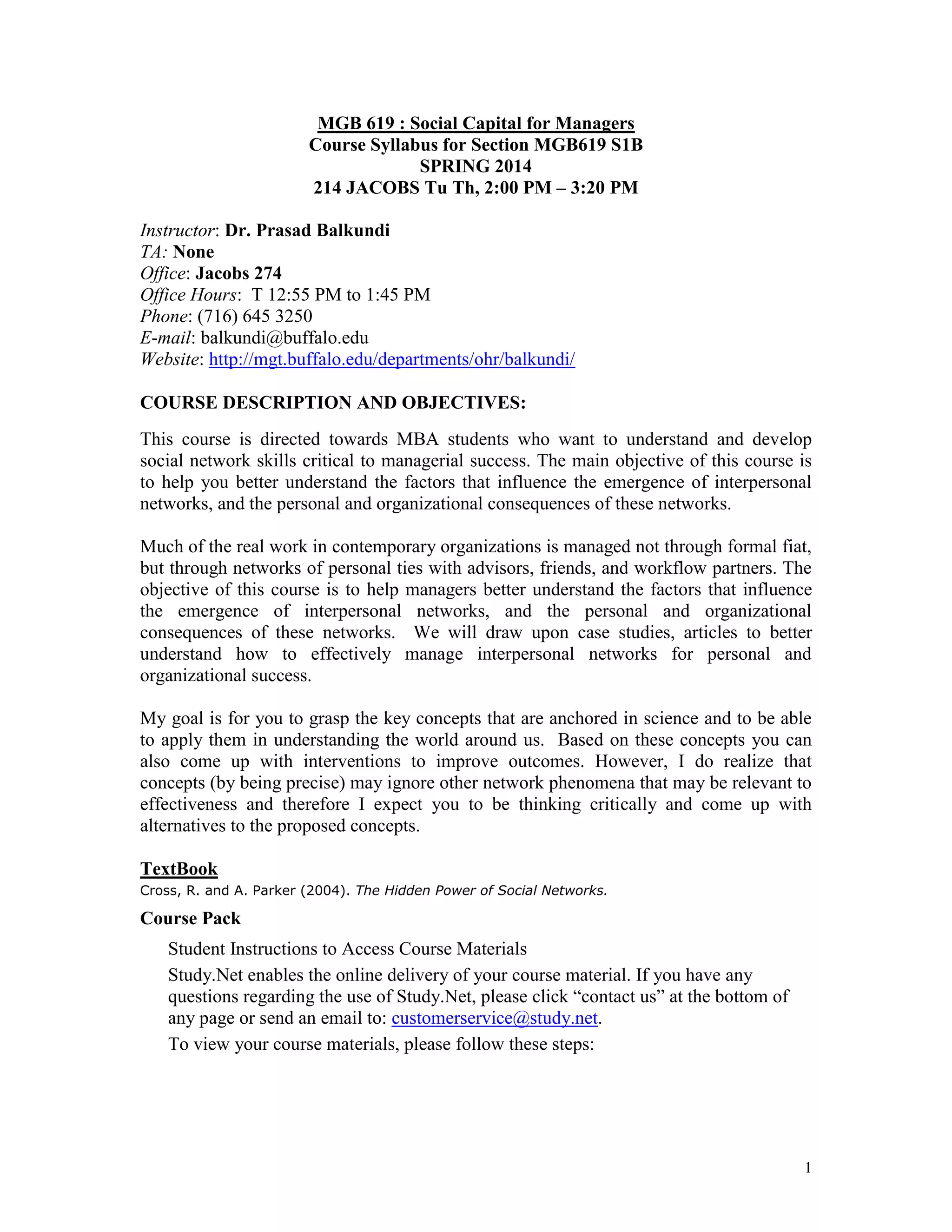
Course Syllabus for Section MGB619 S1B
SPRING 2014
214 JACOBS Tu Th, 2:00 PM – 3:20 PM
Instructor: Dr. Prasad Balkundi
TA: None
Office: Jacobs 274
Office Hours: T 12:55 PM to 1:45 PM
Phone: (716) 645 3250
E-mail: balkundi@buffalo.edu
Website: http://mgt.buffalo.edu/departments/ohr/balkundi/
COURSE DESCRIPTION AND OBJECTIVES:
This course is directed towards MBA students who want to understand and develop
social network skills critical to managerial success. The main objective of this course is
to help you better understand the factors that influence the emergence of interpersonal
networks, and the personal and organizational consequences of these networks.
Much of the real work in contemporary organizations is managed not through formal fiat,
but through networks of personal ties with advisors, friends, and workflow partners. The
objective of this course is to help managers better understand the factors that influence
the emergence of interpersonal networks, and the personal and organizational
consequences of these networks. We will draw upon case studies, articles to better
understand how to effectively manage interpersonal networks for personal and
organizational success.
My goal is for you to grasp the key concepts that are anchored in science and to be able
to apply them in understanding the world around us. Based on these concepts you can
also come up with interventions to improve outcomes. However, I do realize that
concepts (by being precise) may ignore other network phenomena that may be relevant to
effectiveness and therefore I expect you to be thinking critically and come up with
alternatives to the proposed concepts.
TextBook
Cross, R. and A. Parker (2004). The Hidden Power of Social Networks.

Course Pack
Student Instructions to Access Course Materials
Study.Net enables the online delivery of your course material. If you have any
questions regarding the use of Study.Net, please click ―contact us‖ at the bottom of
any page or send an email to: customerservice@study.net.
To view your course materials, please follow these steps:

1
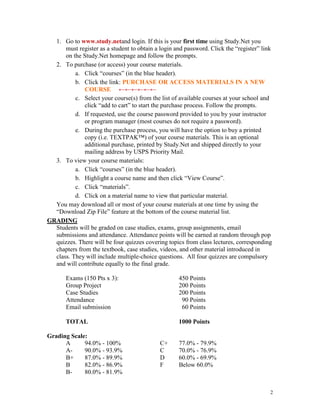
1. Go to www.study.netand login. If this is your first time using Study.Net you
must register as a student to obtain a login and password. Click the ―register‖ link
on the Study.Net homepage and follow the prompts.
2. To purchase (or access) your course materials.
a. Click ―courses‖ (in the blue header).
b. Click the link: PURCHASE OR ACCESS MATERIALS IN A NEW
COURSE ←←←←←←
c. Select your course(s) from the list of available courses at your school and
click ―add to cart‖ to start the purchase process. Follow the prompts.
d. If requested, use the course password provided to you by your instructor
or program manager (most courses do not require a password).
e. During the purchase process, you will have the option to buy a printed
copy (i.e. TEXTPAK™) of your course materials. This is an optional
additional purchase, printed by Study.Net and shipped directly to your
mailing address by USPS Priority Mail.
3. To view your course materials:
a. Click ―courses‖ (in the blue header).
b. Highlight a course name and then click ―View Course‖.
c. Click ―materials‖.
d. Click on a material name to view that particular material.
You may download all or most of your course materials at one time by using the
―Download Zip File‖ feature at the bottom of the course material list.
GRADING
Students will be graded on case studies, exams, group assignments, email
submissions and attendance. Attendance points will be earned at random through pop
quizzes. There will be four quizzes covering topics from class lectures, corresponding
chapters from the textbook, case studies, videos, and other material introduced in
class. They will include multiple-choice questions. All four quizzes are compulsory
and will contribute equally to the final grade.
Exams (150 Pts x 3):
Group Project
Case Studies
Attendance
Email submission

450 Points
200 Points
200 Points
90 Points
60 Points

TOTAL

1000 Points

Grading Scale:
A
94.0% - 100%
A90.0% - 93.9%
B+
87.0% - 89.9%
B
82.0% - 86.9%
B80.0% - 81.9%

C+
C
D
F

77.0% - 79.9%
70.0% - 76.9%
60.0% - 69.9%
Below 60.0%

2
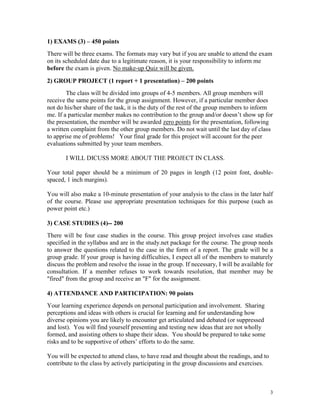
1) EXAMS (3) – 450 points
There will be three exams. The formats may vary but if you are unable to attend the exam
on its scheduled date due to a legitimate reason, it is your responsibility to inform me
before the exam is given. No make-up Quiz will be given.
2) GROUP PROJECT (1 report + 1 presentation) – 200 points
The class will be divided into groups of 4-5 members. All group members will
receive the same points for the group assignment. However, if a particular member does
not do his/her share of the task, it is the duty of the rest of the group members to inform
me. If a particular member makes no contribution to the group and/or doesn’t show up for
the presentation, the member will be awarded zero points for the presentation, following
a written complaint from the other group members. Do not wait until the last day of class
to apprise me of problems! Your final grade for this project will account for the peer
evaluations submitted by your team members.
I WILL DICUSS MORE ABOUT THE PROJECT IN CLASS.
Your total paper should be a minimum of 20 pages in length (12 point font, doublespaced, 1 inch margins).
You will also make a 10-minute presentation of your analysis to the class in the later half
of the course. Please use appropriate presentation techniques for this purpose (such as
power point etc.)
3) CASE STUDIES (4)-- 200
There will be four case studies in the course. This group project involves case studies
specified in the syllabus and are in the study.net package for the course. The group needs
to answer the questions related to the case in the form of a report. The grade will be a
group grade. If your group is having difficulties, I expect all of the members to maturely
discuss the problem and resolve the issue in the group. If necessary, I will be available for
consultation. If a member refuses to work towards resolution, that member may be
"fired" from the group and receive an "F" for the assignment.
4) ATTENDANCE AND PARTICIPATION: 90 points
Your learning experience depends on personal participation and involvement. Sharing
perceptions and ideas with others is crucial for learning and for understanding how
diverse opinions you are likely to encounter get articulated and debated (or suppressed
and lost). You will find yourself presenting and testing new ideas that are not wholly
formed, and assisting others to shape their ideas. You should be prepared to take some
risks and to be supportive of others’ efforts to do the same.
You will be expected to attend class, to have read and thought about the readings, and to
contribute to the class by actively participating in the group discussions and exercises.

3
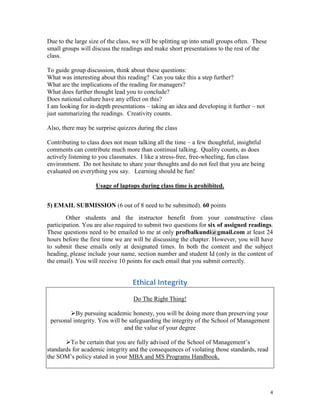
Due to the large size of the class, we will be splitting up into small groups often. These
small groups will discuss the readings and make short presentations to the rest of the
class.
To guide group discussion, think about these questions:
What was interesting about this reading? Can you take this a step further?
What are the implications of the reading for managers?
What does further thought lead you to conclude?
Does national culture have any effect on this?
I am looking for in-depth presentations – taking an idea and developing it further – not
just summarizing the readings. Creativity counts.
Also, there may be surprise quizzes during the class
Contributing to class does not mean talking all the time – a few thoughtful, insightful
comments can contribute much more than continual talking. Quality counts, as does
actively listening to you classmates. I like a stress-free, free-wheeling, fun class
environment. Do not hesitate to share your thoughts and do not feel that you are being
evaluated on everything you say. Learning should be fun!
Usage of laptops during class time is prohibited.
5) EMAIL SUBMISSION (6 out of 8 need to be submitted). 60 points
Other students and the instructor benefit from your constructive class
participation. You are also required to submit two questions for six of assigned readings.
These questions need to be emailed to me at only profbalkundi@gmail.com at least 24
hours before the first time we are will be discussing the chapter. However, you will have
to submit these emails only at designated times. In both the content and the subject
heading, please include your name, section number and student Id (only in the content of
the email). You will receive 10 points for each email that you submit correctly.

Ethical Integrity
Do The Right Thing!
By pursuing academic honesty, you will be doing more than preserving your
personal integrity. You will be safeguarding the integrity of the School of Management
and the value of your degree
To be certain that you are fully advised of the School of Management’s
standards for academic integrity and the consequences of violating those standards, read
the SOM’s policy stated in your MBA and MS Programs Handbook.

4
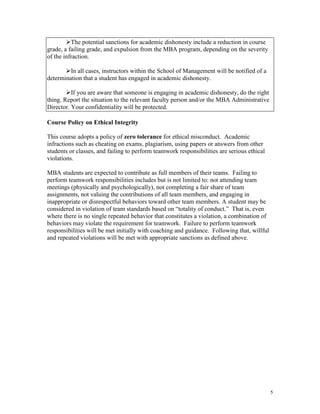
The potential sanctions for academic dishonesty include a reduction in course
grade, a failing grade, and expulsion from the MBA program, depending on the severity
of the infraction.
In all cases, instructors within the School of Management will be notified of a
determination that a student has engaged in academic dishonesty.
If you are aware that someone is engaging in academic dishonesty, do the right
thing. Report the situation to the relevant faculty person and/or the MBA Administrative
Director. Your confidentiality will be protected.
Course Policy on Ethical Integrity
This course adopts a policy of zero tolerance for ethical misconduct. Academic
infractions such as cheating on exams, plagiarism, using papers or answers from other
students or classes, and failing to perform teamwork responsibilities are serious ethical
violations.
MBA students are expected to contribute as full members of their teams. Failing to
perform teamwork responsibilities includes but is not limited to: not attending team
meetings (physically and psychologically), not completing a fair share of team
assignments, not valuing the contributions of all team members, and engaging in
inappropriate or disrespectful behaviors toward other team members. A student may be
considered in violation of team standards based on ―totality of conduct.‖ That is, even
where there is no single repeated behavior that constitutes a violation, a combination of
behaviors may violate the requirement for teamwork. Failure to perform teamwork
responsibilities will be met initially with coaching and guidance. Following that, willful
and repeated violations will be met with appropriate sanctions as defined above.

5
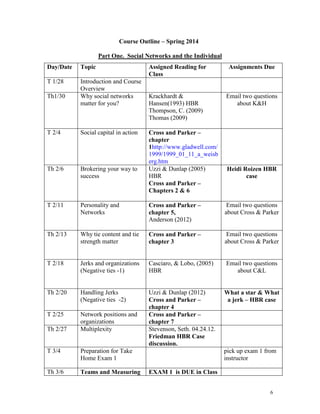
Course Outline – Spring 2014
Part One. Social Networks and the Individual
Day/Date

Topic

T 1/28

Introduction and Course
Overview
Why social networks
matter for you?

Th1/30

Assigned Reading for
Class

Assignments Due

Krackhardt &
Hansen(1993) HBR
Thompson, C. (2009)
Thomas (2009)

Email two questions
about K&H

T 2/4

Social capital in action

Th 2/6

Brokering your way to
success

T 2/11

Personality and
Networks

Cross and Parker –
chapter 5,
Anderson (2012)

Email two questions
about Cross & Parker

Th 2/13

Why tie content and tie
strength matter

Cross and Parker –
chapter 3

Email two questions
about Cross & Parker

T 2/18

Jerks and organizations
(Negative ties -1)

Casciaro, & Lobo, (2005)
HBR

Email two questions
about C&L

Th 2/20

Handling Jerks
(Negative ties -2)

What a star & What
a jerk – HBR case

T 2/25

Network positions and
organizations
Multiplexity

Uzzi & Dunlap (2012)
Cross and Parker –
chapter 4
Cross and Parker –
chapter 7
Stevenson, Seth. 04.24.12.
Friedman HBR Case
discussion.

Th 2/27
T 3/4

Preparation for Take
Home Exam 1

Th 3/6

Teams and Measuring

Cross and Parker –
chapter
1http://www.gladwell.com/
1999/1999_01_11_a_weisb
erg.htm
Uzzi & Dunlap (2005)
HBR
Cross and Parker –
Chapters 2 & 6

Heidi Roizen HBR
case

pick up exam 1 from
instructor
EXAM 1 is DUE in Class
6
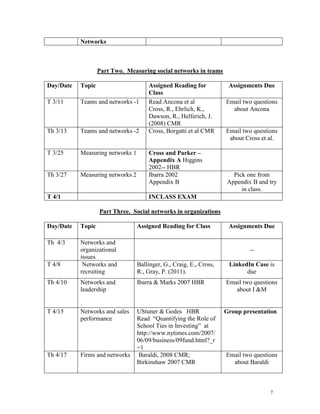
Networks

Part Two. Measuring social networks in teams
Day/Date

Topic

T 3/11

Teams and networks -1

Th 3/13

Teams and networks -2

T 3/25

Measuring networks 1

Th 3/27

Measuring networks 2

T 4/1

Assigned Reading for
Class
Read Ancona et al
Cross, R., Ehrlich, K.,
Dawson, R., Helferich, J.
(2008) CMR
Cross, Borgatti et al CMR
Cross and Parker –
Appendix A Higgins
2002-- HBR
Ibarra 2002
Appendix B

Assignments Due
Email two questions
about Ancona

Email two questions
about Cross et al.

Pick one from
Appendix B and try
in class.

INCLASS EXAM
Part Three. Social networks in organizations

Day/Date

Topic

Th 4/3

Networks and
organizational
issues
Networks and
recruiting

T 4/8

Assigned Reading for Class

Assignments Due

-Ballinger, G., Craig, E., Cross,
R., Gray, P. (2011).

Th 4/10

Networks and
leadership

Ibarra & Marks 2007 HBR

T 4/15

Networks and sales
performance

Th 4/17

Firms and networks

UStuner & Godes HBR
Read “Quantifying the Role of
School Ties in Investing” at
http://www.nytimes.com/2007/
06/09/business/09fund.html?_r
=1
Baraldi, 2008 CMR;
Birkinshaw 2007 CMR

LinkedIn Case is
due
Email two questions
about I &M
Group presentation

Email two questions
about Baraldi

7
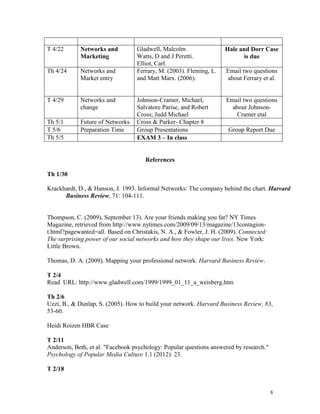
T 4/22

Networks and
Marketing

Th 4/24

Networks and
Market entry

T 4/29

Networks and
change

Th 5/1
T 5/6
Th 5/5

Future of Networks
Preparation Time

Gladwell, Malcolm
Watts, D and J Peretti.
Elliot, Carl.
Ferrary, M. (2003). Fleming, L.
and Matt Marx. (2006).

Hale and Dorr Case
is due

Johnson-Cramer, Michael,
Salvatore Parise, and Robert
Cross; Judd Michael
Cross & Parker- Chapter 8
Group Presentations
EXAM 3 – In class

Email two questions
about JohnsonCramer etal

Email two questions
about Ferrary et al.

Group Report Due

References
Th 1/30
Krackhardt, D., & Hanson, J. 1993. Informal Networks: The company behind the chart. Harvard
Business Review, 71: 104-111.
Thompson, C. (2009), September 13). Are your friends making you fat? NY Times
Magazine, retrieved from http://www.nytimes.com/2009/09/13/magazine/13contagiont.html?pagewanted=all. Based on Christakis, N. A., & Fowler, J. H. (2009). Connected:
The surprising power of our social networks and how they shape our lives. New York:
Little Brown.
Thomas, D. A. (2009). Mapping your professional network. Harvard Business Review.
T 2/4
Read URL: http://www.gladwell.com/1999/1999_01_11_a_weisberg.htm
Th 2/6
Uzzi, B., & Dunlap, S. (2005). How to build your network. Harvard Business Review, 83,
53-60.
Heidi Roizen HBR Case
T 2/11
Anderson, Beth, et al. "Facebook psychology: Popular questions answered by research."
Psychology of Popular Media Culture 1.1 (2012): 23.
T 2/18

8
Casciaro, T., & Lobo, M. S. (2005). Competent jerks, lovable fools, and the formation of
social networks. Harvard Business Review, 83, 92-99.
Th 2/20
Uzzi, Brian, and Shannon Dunlap. "Make your enemies your allies." Harvard business
review 90.5 (2012): 133.
What a Star--What a Jerk (HBR Case Study and Commentary)
by Sarah Cliffe, Mary Rowe, Chris McKenzie, Chuck McKenzie, Kathy Jordan, James
Waldroop 
 Source: Harvard Business Review Case Discussion
T 2/27
Friedman, Ray. "The case of the religious network group." Harvard business review 77.4
(1999): 28.
Stevenson, Seth. 04.24.12. “What Your Klout Score Really Means.” Wired.
http://www.wired.com/business/2012/04/ff_klout/all/
T 3/11
Ancona, Deborah, and Henrik Bresman. X-teams: How to build teams that lead, innovate,
and succeed. Harvard Business Press, 2007. Chapter 3
Cross, R., Ehrlich, K., Dawson, R., Helferich, J. (2008). Managing collaboration:
Improving team effectiveness through a network perspective. California Management
Review, 50, 74-98.
Th 3/13
Parker, Andrew, Stephen P. Borgatti, and Rob Cross. "Making invisible work visible:
Using social network analysis to support strategic collaboration." California Management
Review 44.2 (2002): 25-46.
T 3/25
Higgins, M. (2004). Developmental network Questionnaire. Harvard Business Review.
Th 3/7
Ibarra, H. (2002). Network assessment exercise. Harvard Business Review.
T 4/8
Ballinger, G., Craig, E., Cross, R., Gray, P. (2011). A stitch in time saves nine:
Leveraging networks to reduce costs of turnover. California Management Review, 53,
111-133.

9
Th 4/10
Ibarra, Herminia, and Mark Hunter. "How leaders create and use networks." Harvard
Business Review 85.1 (2007): 40
T 4/15
Üstüner, Tuba, and David Godes. "Better sales networks." Harvard Business Review
84.7/8 (2006): 102-112.
Read “Quantifying the Role of School Ties in Investing” at
http://www.nytimes.com/2007/06/09/business/09fund.html?_r=1
Th 4/17
Mikolaj Jan Piskorski LinkedIn A – HBR case.
Baraldi, Enrico. "Strategy in industrial networks: Experiences from IKEA." California
Management Review 50.4 (2008): 99-126.
Birkinshaw, J.M., J. Bessant and R. Delbridge. 2007. Finding, forming and
performing: Creating new networks for discontinuous innovation. California
Management Review, 49(3): 67-84.
T 4/22
Networks and Marketing
Case Hale and Dorr
Gladwell, Malcolm. 2002. The Tipping Point. Back Bay Books. Chapter 2: The Law of
the Few: Connectors, Mavens, and Salesmen.
Watts, D and J Peretti. “Viral Marketing for the Real World.” Harvard Business Review.
2 pages
Elliot, Carl. 2006. “The Drug Pushers.” Atlantic Magazine
http://www.theatlantic.com/magazine/archive/2006/04/the-drug-pushers/4714/
Th 4/24
Networks and Market Entry
Ferrary, M. (2003). “The Gift Exchange in the Social Networks of Silicon Valley.”
California
Management Review, 45, 4, 120-138. We will focus on pages 128-138.
Fleming, L. and Matt Marx. (2006). “Managing Creativity in Small Worlds.” California
Management Review, 48, 4, 6-27.

10
T 4/29
Networks and change
Johnson-Cramer, Michael, Salvatore Parise, and Robert Cross. 2007. “Managing Change
through Networks and Values.” California Management Review 49:85-106.
Michael, J. H. 1997. Labor dispute reconciliation in a forest products manufacturing facility
Forest Products Journal, 47(11/12): 41-45.

GROUP PROJECT

Your own career success will depend at least in part on how effectively you manage your
professional relationships. These relationships will give you access to information, skills,
and expertise and will help you build a solid base of power, control, and opportunities.
This project provides an opportunity to spend some time developing a sophisticated
understanding of how successful leaders and senior executives initiate, develop, and
manage their interpersonal relationships to accomplish their key professional objectives.
Each group should interview at least two senior managers regarding their experiences.
These executives can be from firms you have worked for, from industries that interest
you, or simply be individuals that you would like to meet. Try to choose someone who
you believe will be candid, open, and insightful.
Anticipate having to interview each executive at least once to gain an understanding of
his or her situation, the nature of his or her relationships, how his or her social network is
managed, and how it is used to tackle the kinds of organizational challenges discussed in
class. Following these interviews, your group will write an analysis of two (or more)
executives’ networks. In this analysis, you will compare and contrast the managers’
approaches to meeting the challenges they face, apply concepts you have learned about
social networks and power, and integrate other key concepts and frameworks from the
class. Projects will be graded for their grasp of the class material, displayed insight into
the manager’s social situation, and clarity of presentation.
The analysis of the managers, their networks, and the lessons you have learned from
examining them is due by the date I specify in Class.
Key Elements of the Analysis
The analysis should be no more than 10 double-spaced pages with 12 point Times New
Roman font and 1‖ margins all around. The paper should have a three-part structure:

11
1.An introduction to your analysis and the manager/executives. What is the focus of
your paper? Who are the executives you interviewed? This introduction should include a
brief (1-2 paragraphs) description of each executive’s situation, and if applicable, the
problem being faced. What is the executive’s situation? Is he or she attempting to
assemble a team? Is he or she looking to change jobs? Is the executive gaining support
for a controversial new program?
2. The experiences of at least two leaders should be compared and contrasted to
draw general lessons about which kinds of strategies are most useful under which
kinds of conditions. You should organize and focus your analysis in terms of course
concepts, and should use those concepts to explain the similarities and differences you
observed. Assess each leader’s strategy for networking – What are its strengths? How
could the strategy be improved? Are there any opportunities the individual has
overlooked? What role have their relationships played in their success both within their
current firms and across their careers? Think about how each leader uses resources
lodged in their network ties to get things done. What interpersonal strategies are used to
cultivate contacts and expand a network? What tactics are used to successfully gain the
buy-in of powerful actors or circumvent them? Include a network map for each
executive you are discussing (these may be placed in the Appendix). Be critical in
your analysis.
3. There should be a conclusion section titled: “Recommendations for Rawls
Students.” This section should be one page and include concrete recommendations for
building value into the vital activities of Rawls students. They should focus on what
students could potentially do the next day in their teams, the next summer in their jobs, or
during the first years after graduation. For example, describe how what you learned can
help students do better in selecting company presentations; meeting company presenters;
making contacts during their first summer jobs; preparing for the transition from student
to employee; and other critical activities related to career advancement or building
company equity.
NOTE: The most informative analyses go beyond description(a story about or
description of the executives’ networks) to an explanation of why something happened
the way it did, applying course concepts to situations that we may not have discussed
explicitly in class. Well-organized papers that stress the most important factors rather
than simply provide a data-dump of all the possible factors are evaluated more highly.
Be creative. Find issues that are important to you that we may not have covered
explicitly in class, such as work-family balance, diversity, cross-cultural relations,
implementing a new technology, starting a new company, the effects of downsizing, etc.
Tips for How to Approach this Assignment
1. You should assure the executives that their names will be kept strictly confidential.

12
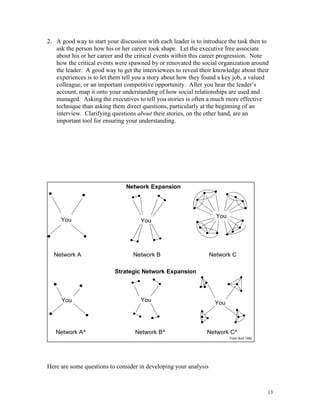
2. A good way to start your discussion with each leader is to introduce the task then to
ask the person how his or her career took shape. Let the executive free associate
about his or her career and the critical events within this career progression. Note
how the critical events were spawned by or renovated the social organization around
the leader. A good way to get the interviewees to reveal their knowledge about their
experiences is to let them tell you a story about how they found a key job, a valued
colleague, or an important competitive opportunity. After you hear the leader’s
account, map it onto your understanding of how social relationships are used and
managed. Asking the executives to tell you stories is often a much more effective
technique than asking them direct questions, particularly at the beginning of an
interview. Clarifying questions about their stories, on the other hand, are an
important tool for ensuring your understanding.

Network Expansion

You

Network A

You

You

Network B

Network C

Strategic Network Expansion

You

Network A^

You

Network B^

You

Network C^
From Burt 1992

Here are some questions to consider in developing your analysis

13
What is the summary network map of the executive’s key contacts in his or her current
job? Consider drawing a network diagram during the interview in which you identify
contacts and the types of exchanges and relationships the executive uses to cultivate them
(see the above diagram). Analyze the network map. What is the strongest entrepreneurial
opportunity (i.e., where can the most value be added)? Cite examples from your
discussions or observations to illustrate your view of the leader’s entrepreneurial skill.
Be careful not to jump to quick conclusions that blind you to alternative interpretations.
1. How is the leader positioned for action and getting things done? How are barriers to
action overcome? You could ask about a recent example of this (this could provide a
focal situation for the analysis): For example, ask how she or he leveraged contacts
to respond to a situation and why it worked or did not work. Probe for how networks
could be better structured, maintained or used, in light of the pattern of dependencies
the person faces.
2. What are the kinds of contacts and exchanges that the executive uses for different
purposes and in different contexts -- for example, to make decisions, to get a specific
task accomplished quickly, to gain influence, to get information, to advocate or
implement change?
3. How does the executive build trust in relationships? What kind of information is
shared with different contacts and why? What role does reputation play? Does
he/she form many ties or few ties? How much redundancy is there in the person’s
network?
4. How is the executive positioned in terms of diversity of relationships? Where is the
executive’s sponsorship or mentoring structure? How has this changed over his/her
career? What was the person’s experience with ―developmental‖ relationships—
either as a protégé, mentor, sponsor, or combinations of these?
5. How does the corporate culture impact the leader’s relationships?
6. How do the leader’s relationships map onto the formal organizational structure?

14
Interviewing Skills
Keep in mind that interviewing skills are extremely important to managers and
consultants because they are a major tool by which to collect data about competitive
processes and outcomes. Use this opportunity to test and develop your skill base.
Furthermore, you will learn what makes a good interviewee; this knowledge will
enhance your performance on the job market when you are being interviewed.
You should go into the interview with a set of questions, but remember that asking
direct questions about executives’ views on power or networking may put them on
the defensive or make them uncomfortable. Ask them to tell you stories at the
beginning of the interview, and then use their stories to guide your questions. Use
your questions as an outline but be prepared to give up your sequencing. It is your
job to navigate back to them when the time is ripe. If you try to stick too closely to
your outline you are likely to lose the interviewee’s attention and stall the interview
when the conversation shifts in another direction.
Probing: It is important to probe during the interview. If your interviewee makes a
general statement such as, ―I use trust to build my network,‖ ask, ―how do you build
trust?‖ ―What approaches do you use and under what circumstances?‖ ―What
activities don’t work?‖ ―If you do X, won’t Y be a possible unanticipated
consequence?‖ This is the best way to get fine-grained and accurate information
about how networks are used by your interviewees.
Here are some sample questions for revealing the structure of the network:
1. If you look back over the last six months, who are the four or five people with whom
you discussed matters of importance to you? Just list their first names or initials.
2. Consider the people with whom you spend your free time. Over the last six months,
who are the three people you have been with most often for informal social activities
such as going out to lunch, dinner, drinks, films, visiting on another’s homes, and so
on?
3. Who are the four or five people who have contributed most to your professional
growth and where are they in the network? Are they connected to each other?
4. Who do you see as your single, most important contact for your continued success
and where are they in your network?
5. At the other extreme, what people working at your company have made it the most
difficult for you to carry out your job responsibilities? Again, just list the person’s
first name or initials (and remind them that this data is strictly confidential).
6. As part of your notes, you may want to diagram the manager’s key contacts. Which
are most and least connected?
You would also like to gather a sense of how successful the executive has been. You
may want to get a sense of how much the executives agree with some of the following

15
statements. I would not go through this list item by item, but instead try to embed
these issues into your discussion.
Risk taking:
I am encouraged to speak my mind about the way I think things should be done in the
firm.
I can take chances here without fear of negative repercussions.
I am discouraged from experimenting with new ways of solving company problems.
It is fatal for me to make a mistake.
Information Access:
I get very little information about what other people are doing.
It is difficult for me to approach senior management with a concern.
In my department, we are the last to hear about anything.
I believe that senior management is ―in touch‖ with the opinions and thinking of the
people who work here.
Autonomy:
I am managed by my boss too tightly.
I can use my personal initiative and judgment in carrying out my work.
I seldom get a chance to do things without my boss ―holding my hand‖.
I am very closely supervised in my work.
The Company’s Landscape:
Turf struggles among departments are common here.
At my company, the departments ―rise and fall‖ as one; there is little territorialism
here.
By and large, the different departments work cooperatively to an unusual degree here.
I believe that conflicts between departments get in the way of getting things done.

16

Social capital for Managers: Balkundi

  • 1.
    MGB 619 :Social Capital for Managers Course Syllabus for Section MGB619 S1B SPRING 2014 214 JACOBS Tu Th, 2:00 PM – 3:20 PM Instructor: Dr. Prasad Balkundi TA: None Office: Jacobs 274 Office Hours: T 12:55 PM to 1:45 PM Phone: (716) 645 3250 E-mail: balkundi@buffalo.edu Website: http://mgt.buffalo.edu/departments/ohr/balkundi/ COURSE DESCRIPTION AND OBJECTIVES: This course is directed towards MBA students who want to understand and develop social network skills critical to managerial success. The main objective of this course is to help you better understand the factors that influence the emergence of interpersonal networks, and the personal and organizational consequences of these networks. Much of the real work in contemporary organizations is managed not through formal fiat, but through networks of personal ties with advisors, friends, and workflow partners. The objective of this course is to help managers better understand the factors that influence the emergence of interpersonal networks, and the personal and organizational consequences of these networks. We will draw upon case studies, articles to better understand how to effectively manage interpersonal networks for personal and organizational success. My goal is for you to grasp the key concepts that are anchored in science and to be able to apply them in understanding the world around us. Based on these concepts you can also come up with interventions to improve outcomes. However, I do realize that concepts (by being precise) may ignore other network phenomena that may be relevant to effectiveness and therefore I expect you to be thinking critically and come up with alternatives to the proposed concepts. TextBook Cross, R. and A. Parker (2004). The Hidden Power of Social Networks. Course Pack Student Instructions to Access Course Materials Study.Net enables the online delivery of your course material. If you have any questions regarding the use of Study.Net, please click ―contact us‖ at the bottom of any page or send an email to: customerservice@study.net. To view your course materials, please follow these steps: 1
  • 2.
    1. Go towww.study.netand login. If this is your first time using Study.Net you must register as a student to obtain a login and password. Click the ―register‖ link on the Study.Net homepage and follow the prompts. 2. To purchase (or access) your course materials. a. Click ―courses‖ (in the blue header). b. Click the link: PURCHASE OR ACCESS MATERIALS IN A NEW COURSE ←←←←←← c. Select your course(s) from the list of available courses at your school and click ―add to cart‖ to start the purchase process. Follow the prompts. d. If requested, use the course password provided to you by your instructor or program manager (most courses do not require a password). e. During the purchase process, you will have the option to buy a printed copy (i.e. TEXTPAK™) of your course materials. This is an optional additional purchase, printed by Study.Net and shipped directly to your mailing address by USPS Priority Mail. 3. To view your course materials: a. Click ―courses‖ (in the blue header). b. Highlight a course name and then click ―View Course‖. c. Click ―materials‖. d. Click on a material name to view that particular material. You may download all or most of your course materials at one time by using the ―Download Zip File‖ feature at the bottom of the course material list. GRADING Students will be graded on case studies, exams, group assignments, email submissions and attendance. Attendance points will be earned at random through pop quizzes. There will be four quizzes covering topics from class lectures, corresponding chapters from the textbook, case studies, videos, and other material introduced in class. They will include multiple-choice questions. All four quizzes are compulsory and will contribute equally to the final grade. Exams (150 Pts x 3): Group Project Case Studies Attendance Email submission 450 Points 200 Points 200 Points 90 Points 60 Points TOTAL 1000 Points Grading Scale: A 94.0% - 100% A90.0% - 93.9% B+ 87.0% - 89.9% B 82.0% - 86.9% B80.0% - 81.9% C+ C D F 77.0% - 79.9% 70.0% - 76.9% 60.0% - 69.9% Below 60.0% 2
  • 3.
    1) EXAMS (3)– 450 points There will be three exams. The formats may vary but if you are unable to attend the exam on its scheduled date due to a legitimate reason, it is your responsibility to inform me before the exam is given. No make-up Quiz will be given. 2) GROUP PROJECT (1 report + 1 presentation) – 200 points The class will be divided into groups of 4-5 members. All group members will receive the same points for the group assignment. However, if a particular member does not do his/her share of the task, it is the duty of the rest of the group members to inform me. If a particular member makes no contribution to the group and/or doesn’t show up for the presentation, the member will be awarded zero points for the presentation, following a written complaint from the other group members. Do not wait until the last day of class to apprise me of problems! Your final grade for this project will account for the peer evaluations submitted by your team members. I WILL DICUSS MORE ABOUT THE PROJECT IN CLASS. Your total paper should be a minimum of 20 pages in length (12 point font, doublespaced, 1 inch margins). You will also make a 10-minute presentation of your analysis to the class in the later half of the course. Please use appropriate presentation techniques for this purpose (such as power point etc.) 3) CASE STUDIES (4)-- 200 There will be four case studies in the course. This group project involves case studies specified in the syllabus and are in the study.net package for the course. The group needs to answer the questions related to the case in the form of a report. The grade will be a group grade. If your group is having difficulties, I expect all of the members to maturely discuss the problem and resolve the issue in the group. If necessary, I will be available for consultation. If a member refuses to work towards resolution, that member may be "fired" from the group and receive an "F" for the assignment. 4) ATTENDANCE AND PARTICIPATION: 90 points Your learning experience depends on personal participation and involvement. Sharing perceptions and ideas with others is crucial for learning and for understanding how diverse opinions you are likely to encounter get articulated and debated (or suppressed and lost). You will find yourself presenting and testing new ideas that are not wholly formed, and assisting others to shape their ideas. You should be prepared to take some risks and to be supportive of others’ efforts to do the same. You will be expected to attend class, to have read and thought about the readings, and to contribute to the class by actively participating in the group discussions and exercises. 3
  • 4.
    Due to thelarge size of the class, we will be splitting up into small groups often. These small groups will discuss the readings and make short presentations to the rest of the class. To guide group discussion, think about these questions: What was interesting about this reading? Can you take this a step further? What are the implications of the reading for managers? What does further thought lead you to conclude? Does national culture have any effect on this? I am looking for in-depth presentations – taking an idea and developing it further – not just summarizing the readings. Creativity counts. Also, there may be surprise quizzes during the class Contributing to class does not mean talking all the time – a few thoughtful, insightful comments can contribute much more than continual talking. Quality counts, as does actively listening to you classmates. I like a stress-free, free-wheeling, fun class environment. Do not hesitate to share your thoughts and do not feel that you are being evaluated on everything you say. Learning should be fun! Usage of laptops during class time is prohibited. 5) EMAIL SUBMISSION (6 out of 8 need to be submitted). 60 points Other students and the instructor benefit from your constructive class participation. You are also required to submit two questions for six of assigned readings. These questions need to be emailed to me at only profbalkundi@gmail.com at least 24 hours before the first time we are will be discussing the chapter. However, you will have to submit these emails only at designated times. In both the content and the subject heading, please include your name, section number and student Id (only in the content of the email). You will receive 10 points for each email that you submit correctly. Ethical Integrity Do The Right Thing! By pursuing academic honesty, you will be doing more than preserving your personal integrity. You will be safeguarding the integrity of the School of Management and the value of your degree To be certain that you are fully advised of the School of Management’s standards for academic integrity and the consequences of violating those standards, read the SOM’s policy stated in your MBA and MS Programs Handbook. 4
  • 5.
    The potential sanctionsfor academic dishonesty include a reduction in course grade, a failing grade, and expulsion from the MBA program, depending on the severity of the infraction. In all cases, instructors within the School of Management will be notified of a determination that a student has engaged in academic dishonesty. If you are aware that someone is engaging in academic dishonesty, do the right thing. Report the situation to the relevant faculty person and/or the MBA Administrative Director. Your confidentiality will be protected. Course Policy on Ethical Integrity This course adopts a policy of zero tolerance for ethical misconduct. Academic infractions such as cheating on exams, plagiarism, using papers or answers from other students or classes, and failing to perform teamwork responsibilities are serious ethical violations. MBA students are expected to contribute as full members of their teams. Failing to perform teamwork responsibilities includes but is not limited to: not attending team meetings (physically and psychologically), not completing a fair share of team assignments, not valuing the contributions of all team members, and engaging in inappropriate or disrespectful behaviors toward other team members. A student may be considered in violation of team standards based on ―totality of conduct.‖ That is, even where there is no single repeated behavior that constitutes a violation, a combination of behaviors may violate the requirement for teamwork. Failure to perform teamwork responsibilities will be met initially with coaching and guidance. Following that, willful and repeated violations will be met with appropriate sanctions as defined above. 5
  • 6.
    Course Outline –Spring 2014 Part One. Social Networks and the Individual Day/Date Topic T 1/28 Introduction and Course Overview Why social networks matter for you? Th1/30 Assigned Reading for Class Assignments Due Krackhardt & Hansen(1993) HBR Thompson, C. (2009) Thomas (2009) Email two questions about K&H T 2/4 Social capital in action Th 2/6 Brokering your way to success T 2/11 Personality and Networks Cross and Parker – chapter 5, Anderson (2012) Email two questions about Cross & Parker Th 2/13 Why tie content and tie strength matter Cross and Parker – chapter 3 Email two questions about Cross & Parker T 2/18 Jerks and organizations (Negative ties -1) Casciaro, & Lobo, (2005) HBR Email two questions about C&L Th 2/20 Handling Jerks (Negative ties -2) What a star & What a jerk – HBR case T 2/25 Network positions and organizations Multiplexity Uzzi & Dunlap (2012) Cross and Parker – chapter 4 Cross and Parker – chapter 7 Stevenson, Seth. 04.24.12. Friedman HBR Case discussion. Th 2/27 T 3/4 Preparation for Take Home Exam 1 Th 3/6 Teams and Measuring Cross and Parker – chapter 1http://www.gladwell.com/ 1999/1999_01_11_a_weisb erg.htm Uzzi & Dunlap (2005) HBR Cross and Parker – Chapters 2 & 6 Heidi Roizen HBR case pick up exam 1 from instructor EXAM 1 is DUE in Class 6
  • 7.
    Networks Part Two. Measuringsocial networks in teams Day/Date Topic T 3/11 Teams and networks -1 Th 3/13 Teams and networks -2 T 3/25 Measuring networks 1 Th 3/27 Measuring networks 2 T 4/1 Assigned Reading for Class Read Ancona et al Cross, R., Ehrlich, K., Dawson, R., Helferich, J. (2008) CMR Cross, Borgatti et al CMR Cross and Parker – Appendix A Higgins 2002-- HBR Ibarra 2002 Appendix B Assignments Due Email two questions about Ancona Email two questions about Cross et al. Pick one from Appendix B and try in class. INCLASS EXAM Part Three. Social networks in organizations Day/Date Topic Th 4/3 Networks and organizational issues Networks and recruiting T 4/8 Assigned Reading for Class Assignments Due -Ballinger, G., Craig, E., Cross, R., Gray, P. (2011). Th 4/10 Networks and leadership Ibarra & Marks 2007 HBR T 4/15 Networks and sales performance Th 4/17 Firms and networks UStuner & Godes HBR Read “Quantifying the Role of School Ties in Investing” at http://www.nytimes.com/2007/ 06/09/business/09fund.html?_r =1 Baraldi, 2008 CMR; Birkinshaw 2007 CMR LinkedIn Case is due Email two questions about I &M Group presentation Email two questions about Baraldi 7
  • 8.
    T 4/22 Networks and Marketing Th4/24 Networks and Market entry T 4/29 Networks and change Th 5/1 T 5/6 Th 5/5 Future of Networks Preparation Time Gladwell, Malcolm Watts, D and J Peretti. Elliot, Carl. Ferrary, M. (2003). Fleming, L. and Matt Marx. (2006). Hale and Dorr Case is due Johnson-Cramer, Michael, Salvatore Parise, and Robert Cross; Judd Michael Cross & Parker- Chapter 8 Group Presentations EXAM 3 – In class Email two questions about JohnsonCramer etal Email two questions about Ferrary et al. Group Report Due References Th 1/30 Krackhardt, D., & Hanson, J. 1993. Informal Networks: The company behind the chart. Harvard Business Review, 71: 104-111. Thompson, C. (2009), September 13). Are your friends making you fat? NY Times Magazine, retrieved from http://www.nytimes.com/2009/09/13/magazine/13contagiont.html?pagewanted=all. Based on Christakis, N. A., & Fowler, J. H. (2009). Connected: The surprising power of our social networks and how they shape our lives. New York: Little Brown. Thomas, D. A. (2009). Mapping your professional network. Harvard Business Review. T 2/4 Read URL: http://www.gladwell.com/1999/1999_01_11_a_weisberg.htm Th 2/6 Uzzi, B., & Dunlap, S. (2005). How to build your network. Harvard Business Review, 83, 53-60. Heidi Roizen HBR Case T 2/11 Anderson, Beth, et al. "Facebook psychology: Popular questions answered by research." Psychology of Popular Media Culture 1.1 (2012): 23. T 2/18 8
  • 9.
    Casciaro, T., &Lobo, M. S. (2005). Competent jerks, lovable fools, and the formation of social networks. Harvard Business Review, 83, 92-99. Th 2/20 Uzzi, Brian, and Shannon Dunlap. "Make your enemies your allies." Harvard business review 90.5 (2012): 133. What a Star--What a Jerk (HBR Case Study and Commentary) by Sarah Cliffe, Mary Rowe, Chris McKenzie, Chuck McKenzie, Kathy Jordan, James Waldroop 
 Source: Harvard Business Review Case Discussion T 2/27 Friedman, Ray. "The case of the religious network group." Harvard business review 77.4 (1999): 28. Stevenson, Seth. 04.24.12. “What Your Klout Score Really Means.” Wired. http://www.wired.com/business/2012/04/ff_klout/all/ T 3/11 Ancona, Deborah, and Henrik Bresman. X-teams: How to build teams that lead, innovate, and succeed. Harvard Business Press, 2007. Chapter 3 Cross, R., Ehrlich, K., Dawson, R., Helferich, J. (2008). Managing collaboration: Improving team effectiveness through a network perspective. California Management Review, 50, 74-98. Th 3/13 Parker, Andrew, Stephen P. Borgatti, and Rob Cross. "Making invisible work visible: Using social network analysis to support strategic collaboration." California Management Review 44.2 (2002): 25-46. T 3/25 Higgins, M. (2004). Developmental network Questionnaire. Harvard Business Review. Th 3/7 Ibarra, H. (2002). Network assessment exercise. Harvard Business Review. T 4/8 Ballinger, G., Craig, E., Cross, R., Gray, P. (2011). A stitch in time saves nine: Leveraging networks to reduce costs of turnover. California Management Review, 53, 111-133. 9
  • 10.
    Th 4/10 Ibarra, Herminia,and Mark Hunter. "How leaders create and use networks." Harvard Business Review 85.1 (2007): 40 T 4/15 Üstüner, Tuba, and David Godes. "Better sales networks." Harvard Business Review 84.7/8 (2006): 102-112. Read “Quantifying the Role of School Ties in Investing” at http://www.nytimes.com/2007/06/09/business/09fund.html?_r=1 Th 4/17 Mikolaj Jan Piskorski LinkedIn A – HBR case. Baraldi, Enrico. "Strategy in industrial networks: Experiences from IKEA." California Management Review 50.4 (2008): 99-126. Birkinshaw, J.M., J. Bessant and R. Delbridge. 2007. Finding, forming and performing: Creating new networks for discontinuous innovation. California Management Review, 49(3): 67-84. T 4/22 Networks and Marketing Case Hale and Dorr Gladwell, Malcolm. 2002. The Tipping Point. Back Bay Books. Chapter 2: The Law of the Few: Connectors, Mavens, and Salesmen. Watts, D and J Peretti. “Viral Marketing for the Real World.” Harvard Business Review. 2 pages Elliot, Carl. 2006. “The Drug Pushers.” Atlantic Magazine http://www.theatlantic.com/magazine/archive/2006/04/the-drug-pushers/4714/ Th 4/24 Networks and Market Entry Ferrary, M. (2003). “The Gift Exchange in the Social Networks of Silicon Valley.” California Management Review, 45, 4, 120-138. We will focus on pages 128-138. Fleming, L. and Matt Marx. (2006). “Managing Creativity in Small Worlds.” California Management Review, 48, 4, 6-27. 10
  • 11.
    T 4/29 Networks andchange Johnson-Cramer, Michael, Salvatore Parise, and Robert Cross. 2007. “Managing Change through Networks and Values.” California Management Review 49:85-106. Michael, J. H. 1997. Labor dispute reconciliation in a forest products manufacturing facility Forest Products Journal, 47(11/12): 41-45. GROUP PROJECT Your own career success will depend at least in part on how effectively you manage your professional relationships. These relationships will give you access to information, skills, and expertise and will help you build a solid base of power, control, and opportunities. This project provides an opportunity to spend some time developing a sophisticated understanding of how successful leaders and senior executives initiate, develop, and manage their interpersonal relationships to accomplish their key professional objectives. Each group should interview at least two senior managers regarding their experiences. These executives can be from firms you have worked for, from industries that interest you, or simply be individuals that you would like to meet. Try to choose someone who you believe will be candid, open, and insightful. Anticipate having to interview each executive at least once to gain an understanding of his or her situation, the nature of his or her relationships, how his or her social network is managed, and how it is used to tackle the kinds of organizational challenges discussed in class. Following these interviews, your group will write an analysis of two (or more) executives’ networks. In this analysis, you will compare and contrast the managers’ approaches to meeting the challenges they face, apply concepts you have learned about social networks and power, and integrate other key concepts and frameworks from the class. Projects will be graded for their grasp of the class material, displayed insight into the manager’s social situation, and clarity of presentation. The analysis of the managers, their networks, and the lessons you have learned from examining them is due by the date I specify in Class. Key Elements of the Analysis The analysis should be no more than 10 double-spaced pages with 12 point Times New Roman font and 1‖ margins all around. The paper should have a three-part structure: 11
  • 12.
    1.An introduction toyour analysis and the manager/executives. What is the focus of your paper? Who are the executives you interviewed? This introduction should include a brief (1-2 paragraphs) description of each executive’s situation, and if applicable, the problem being faced. What is the executive’s situation? Is he or she attempting to assemble a team? Is he or she looking to change jobs? Is the executive gaining support for a controversial new program? 2. The experiences of at least two leaders should be compared and contrasted to draw general lessons about which kinds of strategies are most useful under which kinds of conditions. You should organize and focus your analysis in terms of course concepts, and should use those concepts to explain the similarities and differences you observed. Assess each leader’s strategy for networking – What are its strengths? How could the strategy be improved? Are there any opportunities the individual has overlooked? What role have their relationships played in their success both within their current firms and across their careers? Think about how each leader uses resources lodged in their network ties to get things done. What interpersonal strategies are used to cultivate contacts and expand a network? What tactics are used to successfully gain the buy-in of powerful actors or circumvent them? Include a network map for each executive you are discussing (these may be placed in the Appendix). Be critical in your analysis. 3. There should be a conclusion section titled: “Recommendations for Rawls Students.” This section should be one page and include concrete recommendations for building value into the vital activities of Rawls students. They should focus on what students could potentially do the next day in their teams, the next summer in their jobs, or during the first years after graduation. For example, describe how what you learned can help students do better in selecting company presentations; meeting company presenters; making contacts during their first summer jobs; preparing for the transition from student to employee; and other critical activities related to career advancement or building company equity. NOTE: The most informative analyses go beyond description(a story about or description of the executives’ networks) to an explanation of why something happened the way it did, applying course concepts to situations that we may not have discussed explicitly in class. Well-organized papers that stress the most important factors rather than simply provide a data-dump of all the possible factors are evaluated more highly. Be creative. Find issues that are important to you that we may not have covered explicitly in class, such as work-family balance, diversity, cross-cultural relations, implementing a new technology, starting a new company, the effects of downsizing, etc. Tips for How to Approach this Assignment 1. You should assure the executives that their names will be kept strictly confidential. 12
  • 13.
    2. A goodway to start your discussion with each leader is to introduce the task then to ask the person how his or her career took shape. Let the executive free associate about his or her career and the critical events within this career progression. Note how the critical events were spawned by or renovated the social organization around the leader. A good way to get the interviewees to reveal their knowledge about their experiences is to let them tell you a story about how they found a key job, a valued colleague, or an important competitive opportunity. After you hear the leader’s account, map it onto your understanding of how social relationships are used and managed. Asking the executives to tell you stories is often a much more effective technique than asking them direct questions, particularly at the beginning of an interview. Clarifying questions about their stories, on the other hand, are an important tool for ensuring your understanding. Network Expansion You Network A You You Network B Network C Strategic Network Expansion You Network A^ You Network B^ You Network C^ From Burt 1992 Here are some questions to consider in developing your analysis 13
  • 14.
    What is thesummary network map of the executive’s key contacts in his or her current job? Consider drawing a network diagram during the interview in which you identify contacts and the types of exchanges and relationships the executive uses to cultivate them (see the above diagram). Analyze the network map. What is the strongest entrepreneurial opportunity (i.e., where can the most value be added)? Cite examples from your discussions or observations to illustrate your view of the leader’s entrepreneurial skill. Be careful not to jump to quick conclusions that blind you to alternative interpretations. 1. How is the leader positioned for action and getting things done? How are barriers to action overcome? You could ask about a recent example of this (this could provide a focal situation for the analysis): For example, ask how she or he leveraged contacts to respond to a situation and why it worked or did not work. Probe for how networks could be better structured, maintained or used, in light of the pattern of dependencies the person faces. 2. What are the kinds of contacts and exchanges that the executive uses for different purposes and in different contexts -- for example, to make decisions, to get a specific task accomplished quickly, to gain influence, to get information, to advocate or implement change? 3. How does the executive build trust in relationships? What kind of information is shared with different contacts and why? What role does reputation play? Does he/she form many ties or few ties? How much redundancy is there in the person’s network? 4. How is the executive positioned in terms of diversity of relationships? Where is the executive’s sponsorship or mentoring structure? How has this changed over his/her career? What was the person’s experience with ―developmental‖ relationships— either as a protégé, mentor, sponsor, or combinations of these? 5. How does the corporate culture impact the leader’s relationships? 6. How do the leader’s relationships map onto the formal organizational structure? 14
  • 15.
    Interviewing Skills Keep inmind that interviewing skills are extremely important to managers and consultants because they are a major tool by which to collect data about competitive processes and outcomes. Use this opportunity to test and develop your skill base. Furthermore, you will learn what makes a good interviewee; this knowledge will enhance your performance on the job market when you are being interviewed. You should go into the interview with a set of questions, but remember that asking direct questions about executives’ views on power or networking may put them on the defensive or make them uncomfortable. Ask them to tell you stories at the beginning of the interview, and then use their stories to guide your questions. Use your questions as an outline but be prepared to give up your sequencing. It is your job to navigate back to them when the time is ripe. If you try to stick too closely to your outline you are likely to lose the interviewee’s attention and stall the interview when the conversation shifts in another direction. Probing: It is important to probe during the interview. If your interviewee makes a general statement such as, ―I use trust to build my network,‖ ask, ―how do you build trust?‖ ―What approaches do you use and under what circumstances?‖ ―What activities don’t work?‖ ―If you do X, won’t Y be a possible unanticipated consequence?‖ This is the best way to get fine-grained and accurate information about how networks are used by your interviewees. Here are some sample questions for revealing the structure of the network: 1. If you look back over the last six months, who are the four or five people with whom you discussed matters of importance to you? Just list their first names or initials. 2. Consider the people with whom you spend your free time. Over the last six months, who are the three people you have been with most often for informal social activities such as going out to lunch, dinner, drinks, films, visiting on another’s homes, and so on? 3. Who are the four or five people who have contributed most to your professional growth and where are they in the network? Are they connected to each other? 4. Who do you see as your single, most important contact for your continued success and where are they in your network? 5. At the other extreme, what people working at your company have made it the most difficult for you to carry out your job responsibilities? Again, just list the person’s first name or initials (and remind them that this data is strictly confidential). 6. As part of your notes, you may want to diagram the manager’s key contacts. Which are most and least connected? You would also like to gather a sense of how successful the executive has been. You may want to get a sense of how much the executives agree with some of the following 15
  • 16.
    statements. I wouldnot go through this list item by item, but instead try to embed these issues into your discussion. Risk taking: I am encouraged to speak my mind about the way I think things should be done in the firm. I can take chances here without fear of negative repercussions. I am discouraged from experimenting with new ways of solving company problems. It is fatal for me to make a mistake. Information Access: I get very little information about what other people are doing. It is difficult for me to approach senior management with a concern. In my department, we are the last to hear about anything. I believe that senior management is ―in touch‖ with the opinions and thinking of the people who work here. Autonomy: I am managed by my boss too tightly. I can use my personal initiative and judgment in carrying out my work. I seldom get a chance to do things without my boss ―holding my hand‖. I am very closely supervised in my work. The Company’s Landscape: Turf struggles among departments are common here. At my company, the departments ―rise and fall‖ as one; there is little territorialism here. By and large, the different departments work cooperatively to an unusual degree here. I believe that conflicts between departments get in the way of getting things done. 16