PUNJAB COLLEGE OF TECHNICAL EDUCATION
                            LUDHIANA

                                     Course Plan
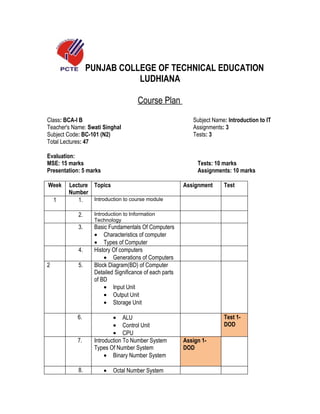
Class: BCA-I B                                             Subject Name: Introduction to IT
Teacher's Name: Swati Singhal                              Assignments: 3
Subject Code: BC-101 (N2)                                  Tests: 3
Total Lectures: 47

Evaluation:
MSE: 15 marks                                                Tests: 10 marks
Presentation: 5 marks                                        Assignments: 10 marks

Week    Lecture Topics                                  Assignment     Test
        Number
    1      1.   Introduction to course module


            2.    Introduction to Information
                  Technology
            3.    Basic Fundamentals Of Computers
                  • Characteristics of computer
                  • Types of Computer
            4.    History Of computers
                      • Generations of Computers
2           5.    Block Diagram(BD) of Computer
                  Detailed Significance of each parts
                  of BD
                      • Input Unit
                      • Output Unit
                      • Storage Unit

            6.            • ALU                                        Test 1-
                          • Control Unit                               DOD
                          • CPU
            7.    Introduction To Number System         Assign 1-
                  Types Of Number System                DOD
                       • Binary Number System

            8.          •   Octal Number System
•   Hexadecimal Number
                 System


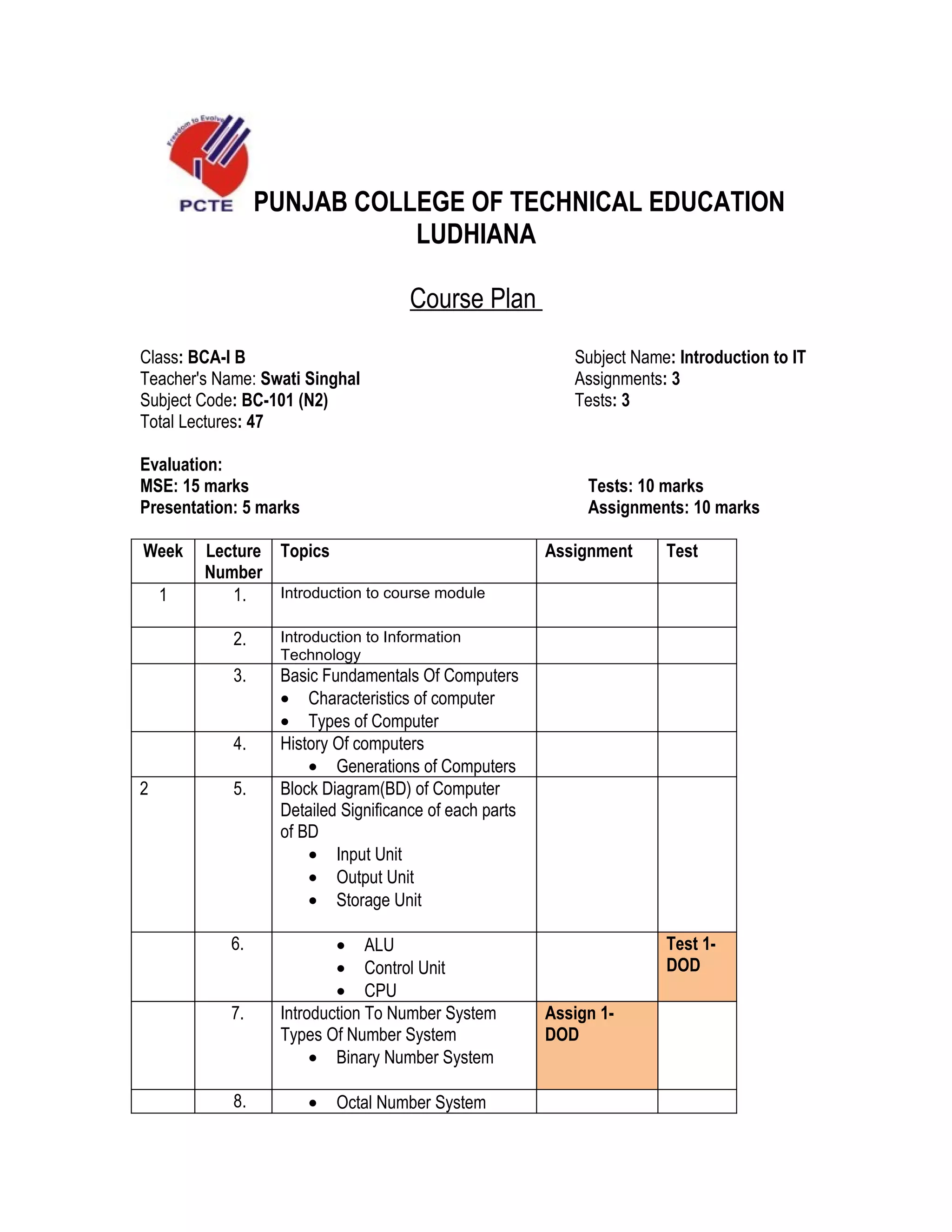
3   9.    Types Of Number System           Assign 1-DOS
             • BCD
             • EBCDIC
             • ASCII
                 CLASS DISCUSSION
    10.

                                                          TEST -1
    11.

    12.   Conversion of Number system
             • Binary to Decimal

4   13.      •   Binary to Octal
             •   Binary to Hexadecimal

    14.   Conversion of Number system
             • Octal to Binary

    15.       • Hexadecimal to Binary
              • Hexadecimal to Octal
    16.   Input devices                    Assign 2-
              • Keyboard                   DOD
              • Mouse
              • Scanner
              • Joystick
              • Light Pen

5   17.   Input devices                                   Test 2-
              • Track ball                                DOD
              • Touch screen
              • MICR, OMR, OBR
    18.   Output devices                   Assign 2-
              • Monitor                    DOS
              • Speaker
              • Plotters
              • Punched Card
    19.   Printers & their Types
              • Impact(Dot Matrix, Daisy
                   Wheel, Drum & Chain)
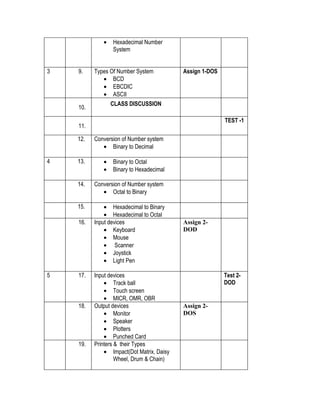
•   Non Impact (Ink Jet, Laser)

6    20.   Storage Devices & their types
               • Magnetic tape
               • Magnetic Disk
     21.       1. Optical Disk
               2. Mass Storage Device
                  (Floppy , CD ROM, DVD)

     22.   What is VDU?
     23.   Intro. to Memory & Types of
           Memory
                 • RAM,ROM,PROM

7    24.       •    EPROM,EEPROM                 E-Assign 3-
                                                 DOD
     25.           CLASS DISCUSSION

     26.                                                       Test-2

     27.   Intro to Operating System & its
           Types
           GUI, CUI
8    28.   Various Functions of the Operating
           System
                • Processor Mgnt.
                • Memory Mgnt.
     29.   Functions of the Operating System     E-Assign 3-
                • Device Mgnt.                   DOS
                • File Mgnt.
                • Security Mgnt
     30.   Definition of simple batch
           processing
                • Buffering
                • Spooling.
     31.   Difference b/w Multiprogramming,
           Multiprocessing , Timesharing etc
9    32.   Real time system and online system
     33.   What is DOS and its Internal
           commands
     34.   Typical DOS External Commands
     35.   How to make the Batch Files
10   36.   Practice on DOS Commands              Assign 4-
                                                 DOD
     37.   Application of Computers in various
           fields
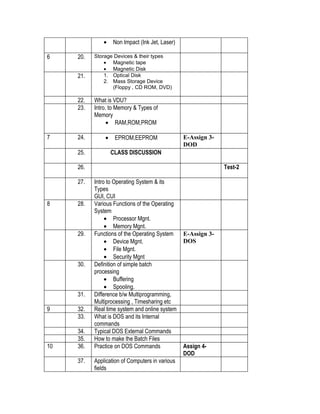
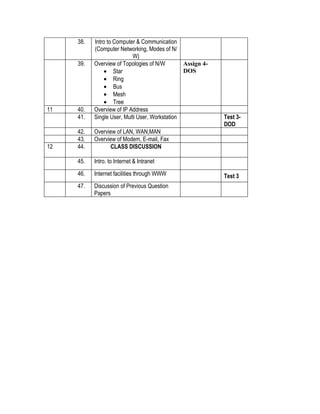
38.   Intro to Computer & Communication
           (Computer Networking, Modes of N/
                           W)
     39.   Overview of Topologies of N/W        Assign 4-
               • Star                           DOS
               • Ring
               • Bus
               • Mesh
               • Tree
11   40.   Overview of IP Address
     41.   Single User, Multi User, Workstation             Test 3-
                                                            DOD
     42.   Overview of LAN, WAN,MAN
     43.   Overview of Modem, E-mail, Fax
12   44.         CLASS DISCUSSION

     45.   Intro. to Internet & Intranet
     46.   Internet facilities through WWW                  Test 3
     47.   Discussion of Previous Question
           Papers
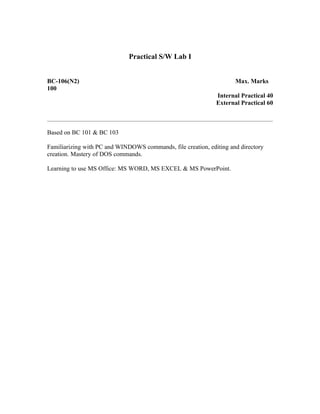
Practical S/W Lab I


BC-106(N2)                                                           Max. Marks
100
                                                              Internal Practical 40
                                                              External Practical 60


Based on BC 101 & BC 103

Familiarizing with PC and WINDOWS commands, file creation, editing and directory
creation. Mastery of DOS commands.

Learning to use MS Office: MS WORD, MS EXCEL & MS PowerPoint.
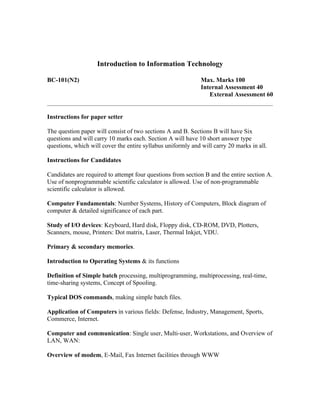
Introduction to Information Technology

BC-101(N2)                                                    Max. Marks 100
                                                              Internal Assessment 40
                                                                 External Assessment 60


Instructions for paper setter

The question paper will consist of two sections A and B. Sections B will have Six
questions and will carry 10 marks each. Section A will have 10 short answer type
questions, which will cover the entire syllabus uniformly and will carry 20 marks in all.

Instructions for Candidates

Candidates are required to attempt four questions from section B and the entire section A.
Use of nonprogrammable scientific calculator is allowed. Use of non-programmable
scientific calculator is allowed.

Computer Fundamentals: Number Systems, History of Computers, Block diagram of
computer & detailed significance of each part.

Study of I/O devices: Keyboard, Hard disk, Floppy disk, CD-ROM, DVD, Plotters,
Scanners, mouse, Printers: Dot matrix, Laser, Thermal Inkjet, VDU.

Primary & secondary memories.

Introduction to Operating Systems & its functions

Definition of Simple batch processing, multiprogramming, multiprocessing, real-time,
time-sharing systems, Concept of Spooling.

Typical DOS commands, making simple batch files.

Application of Computers in various fields: Defense, Industry, Management, Sports,
Commerce, Internet.

Computer and communication: Single user, Multi-user, Workstations, and Overview of
LAN, WAN:

Overview of modem, E-Mail, Fax Internet facilities through WWW
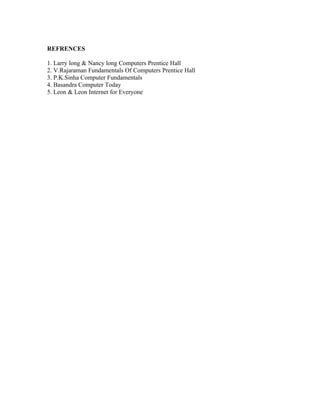
REFRENCES

1. Larry long & Nancy long Computers Prentice Hall
2. V.Rajaraman Fundamentals Of Computers Prentice Hall
3. P.K.Sinha Computer Fundamentals
4. Basandra Computer Today
5. Leon & Leon Internet for Everyone

Syllabus & Course Module for IT

  • 1.
    PUNJAB COLLEGE OFTECHNICAL EDUCATION LUDHIANA Course Plan Class: BCA-I B Subject Name: Introduction to IT Teacher's Name: Swati Singhal Assignments: 3 Subject Code: BC-101 (N2) Tests: 3 Total Lectures: 47 Evaluation: MSE: 15 marks Tests: 10 marks Presentation: 5 marks Assignments: 10 marks Week Lecture Topics Assignment Test Number 1 1. Introduction to course module 2. Introduction to Information Technology 3. Basic Fundamentals Of Computers • Characteristics of computer • Types of Computer 4. History Of computers • Generations of Computers 2 5. Block Diagram(BD) of Computer Detailed Significance of each parts of BD • Input Unit • Output Unit • Storage Unit 6. • ALU Test 1- • Control Unit DOD • CPU 7. Introduction To Number System Assign 1- Types Of Number System DOD • Binary Number System 8. • Octal Number System
  • 2.
    Hexadecimal Number System 3 9. Types Of Number System Assign 1-DOS • BCD • EBCDIC • ASCII CLASS DISCUSSION 10. TEST -1 11. 12. Conversion of Number system • Binary to Decimal 4 13. • Binary to Octal • Binary to Hexadecimal 14. Conversion of Number system • Octal to Binary 15. • Hexadecimal to Binary • Hexadecimal to Octal 16. Input devices Assign 2- • Keyboard DOD • Mouse • Scanner • Joystick • Light Pen 5 17. Input devices Test 2- • Track ball DOD • Touch screen • MICR, OMR, OBR 18. Output devices Assign 2- • Monitor DOS • Speaker • Plotters • Punched Card 19. Printers & their Types • Impact(Dot Matrix, Daisy Wheel, Drum & Chain)
  • 3.
    Non Impact (Ink Jet, Laser) 6 20. Storage Devices & their types • Magnetic tape • Magnetic Disk 21. 1. Optical Disk 2. Mass Storage Device (Floppy , CD ROM, DVD) 22. What is VDU? 23. Intro. to Memory & Types of Memory • RAM,ROM,PROM 7 24. • EPROM,EEPROM E-Assign 3- DOD 25. CLASS DISCUSSION 26. Test-2 27. Intro to Operating System & its Types GUI, CUI 8 28. Various Functions of the Operating System • Processor Mgnt. • Memory Mgnt. 29. Functions of the Operating System E-Assign 3- • Device Mgnt. DOS • File Mgnt. • Security Mgnt 30. Definition of simple batch processing • Buffering • Spooling. 31. Difference b/w Multiprogramming, Multiprocessing , Timesharing etc 9 32. Real time system and online system 33. What is DOS and its Internal commands 34. Typical DOS External Commands 35. How to make the Batch Files 10 36. Practice on DOS Commands Assign 4- DOD 37. Application of Computers in various fields
  • 4.
    38. Intro to Computer & Communication (Computer Networking, Modes of N/ W) 39. Overview of Topologies of N/W Assign 4- • Star DOS • Ring • Bus • Mesh • Tree 11 40. Overview of IP Address 41. Single User, Multi User, Workstation Test 3- DOD 42. Overview of LAN, WAN,MAN 43. Overview of Modem, E-mail, Fax 12 44. CLASS DISCUSSION 45. Intro. to Internet & Intranet 46. Internet facilities through WWW Test 3 47. Discussion of Previous Question Papers
  • 5.
    Practical S/W LabI BC-106(N2) Max. Marks 100 Internal Practical 40 External Practical 60 Based on BC 101 & BC 103 Familiarizing with PC and WINDOWS commands, file creation, editing and directory creation. Mastery of DOS commands. Learning to use MS Office: MS WORD, MS EXCEL & MS PowerPoint.
  • 6.
    Introduction to InformationTechnology BC-101(N2) Max. Marks 100 Internal Assessment 40 External Assessment 60 Instructions for paper setter The question paper will consist of two sections A and B. Sections B will have Six questions and will carry 10 marks each. Section A will have 10 short answer type questions, which will cover the entire syllabus uniformly and will carry 20 marks in all. Instructions for Candidates Candidates are required to attempt four questions from section B and the entire section A. Use of nonprogrammable scientific calculator is allowed. Use of non-programmable scientific calculator is allowed. Computer Fundamentals: Number Systems, History of Computers, Block diagram of computer & detailed significance of each part. Study of I/O devices: Keyboard, Hard disk, Floppy disk, CD-ROM, DVD, Plotters, Scanners, mouse, Printers: Dot matrix, Laser, Thermal Inkjet, VDU. Primary & secondary memories. Introduction to Operating Systems & its functions Definition of Simple batch processing, multiprogramming, multiprocessing, real-time, time-sharing systems, Concept of Spooling. Typical DOS commands, making simple batch files. Application of Computers in various fields: Defense, Industry, Management, Sports, Commerce, Internet. Computer and communication: Single user, Multi-user, Workstations, and Overview of LAN, WAN: Overview of modem, E-Mail, Fax Internet facilities through WWW
  • 7.
    REFRENCES 1. Larry long& Nancy long Computers Prentice Hall 2. V.Rajaraman Fundamentals Of Computers Prentice Hall 3. P.K.Sinha Computer Fundamentals 4. Basandra Computer Today 5. Leon & Leon Internet for Everyone