VMs,
Interpreters,
  JIT & Co

   A First
Introduction

Marcus Denker
Overview

 •   Virtual Machines: How and Why
     – Bytecode
     – Garbage Collection (GC)

 •   Code Execution
     –   Interpretation
     –   Just-In-Time
     –   Optimizing method lookup
     –   Dynamic optimization


Marcus Denker
Caveat


 •   Virtual Machines are not trivial!

 •   This lecture can only give a very high-level overview

 •   You will not be a VM Hacker afterwards ;-)

 •   Many slides of this talk should be complete lectures
     (or even courses)


Marcus Denker
Virtual Machine: What’s that?

 •   Software implementation of a machine

 •   Process VMs
     – Processor emulation (e.g. run PowerPC on Intel)
         • FX32!, MacOS 68k, powerPC
     – Optimization: HP Dynamo
     – High level language VMs

 •   System Virtual Machines
     – IBM z/OS
     – Virtual PC


Marcus Denker
High Level Language VM

 •   We focus on HLL VMs
 •   Examples: Java, Smalltalk, Python, Perl....

 •   Three parts:
     – The Processor
         • Simulated Instruction Set Architecture (ISA)
     – The Memory: Garbage Collection
     – Abstraction for other OS / Hardware (e.g, I/O)

 •   Very near to the implemented language
 •   Provides abstraction from OS


Marcus Denker
The Processor

 •   VM has an instruction set. (virtual ISA)
     – Stack machine
     – Bytecode
     – High level: models the language quite directly
         • e.g, “Send” bytecode in Smalltalk

 •   VM needs to run this Code
 •   Many designs possible:
     –   Interpreter (simple)
     –   Threaded code
     –   Simple translation to machine code
     –   Dynamic optimization (“HotSpot”)


Marcus Denker
Garbage Collection

 •   Provides a high level model for memory
 •   No need to explicitly free memory
 •   Different implementations:
     – Reference counting
     – Mark and sweep
     – Generational GC

 •   A modern GC is *very* efficient
 •   It’s hard to do better


Marcus Denker
Other Hardware Abstraction
 •   We need a way to access Operating System APIs
     – Graphics
     – Networking (TCP/IP)
     – Disc / Keyboard....

 •   Simple solution:
     – Define an API for this Hardware
     – Implement this as part of the VM (“Primitives”)
     – Call OS library functions directly


Marcus Denker
Virtual Machine: Lessons learned
•   VM: Simulated Machine
•   Consists of
    – Virtual ISA
    – Memory Management
    – API for Hardware/OS


•   Next: Bytecode
Bytecode

 •   Byte-encoded instruction set
 •   This means: 256 main instructions
 •   Stack based

 •   Positive:
     – Very compact
     – Easy to interpret

 •   Important: The ISA of a VM does not need to be
     Bytecode.


Marcus Denker
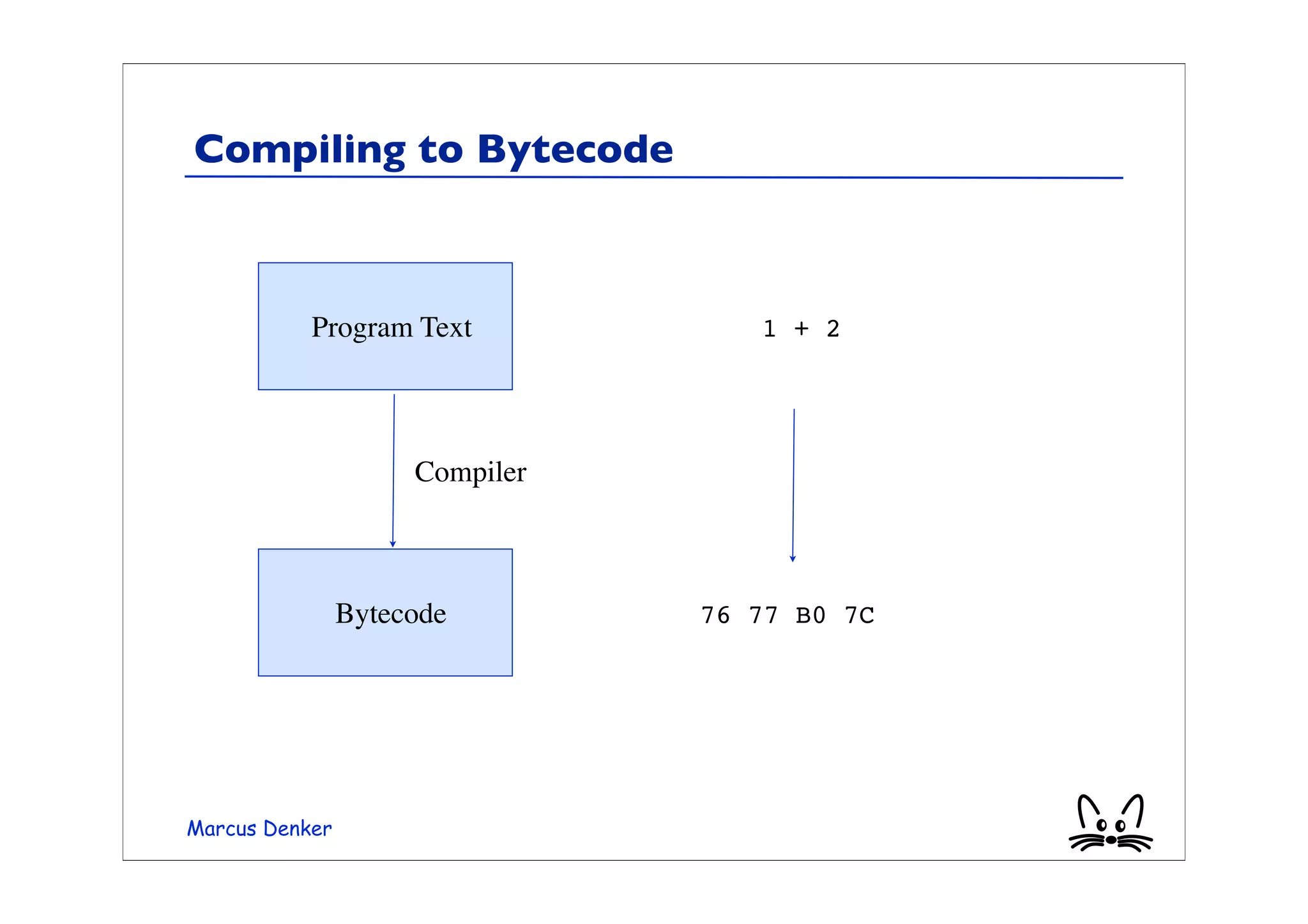
Compiling to Bytecode


           Program Text            1 + 2


                     Compiler


                Bytecode        76 77 B0 7C


Marcus Denker
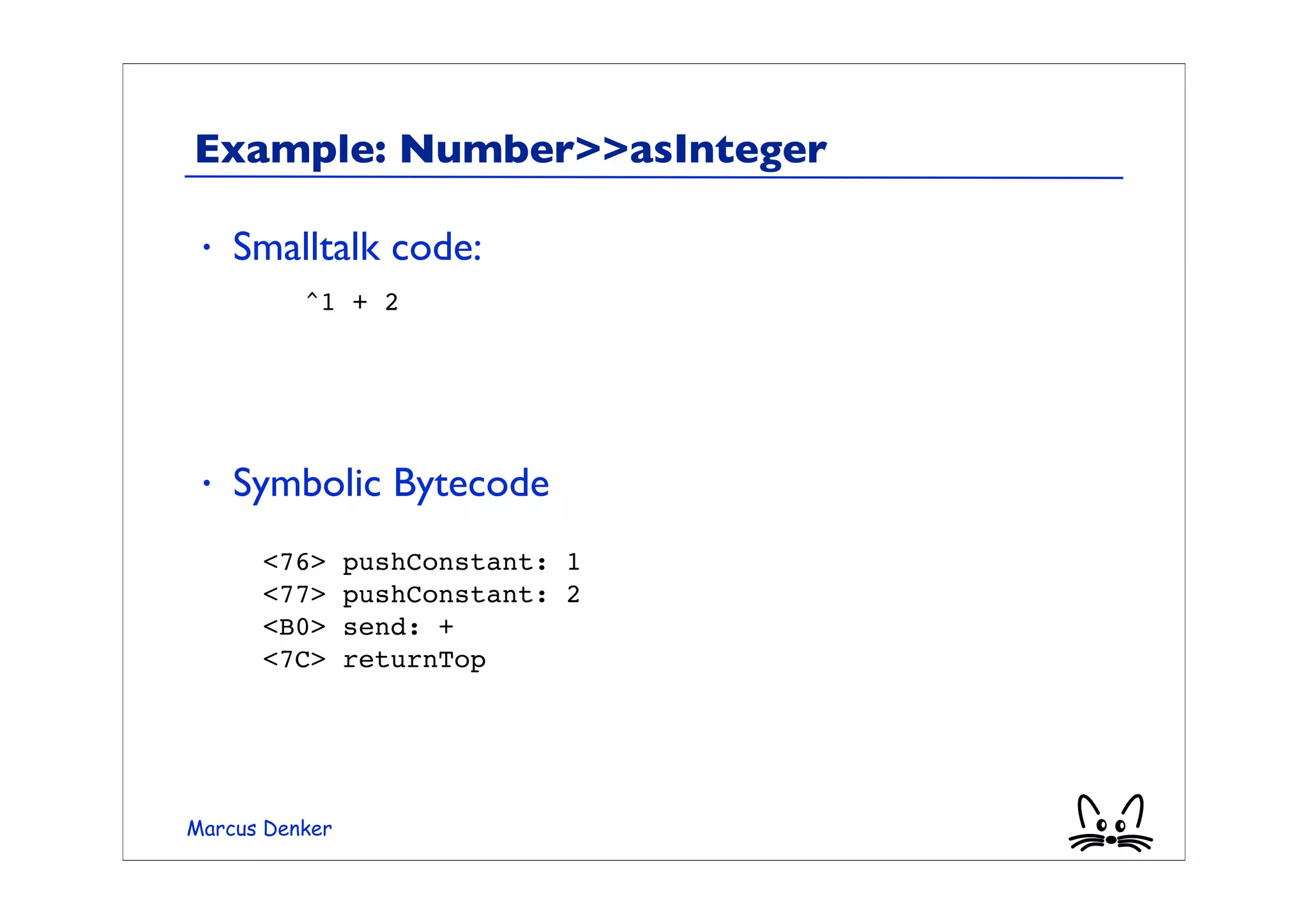
Example: Number>>asInteger

 •   Smalltalk code:
      	

 ^1 + 2


 •   Symbolic Bytecode
      <76>      pushConstant: 1
      <77>      pushConstant: 2
      <B0>      send: +
      <7C>      returnTop


Marcus Denker
Example: Java Bytecode

 •   From class Rectangle
public int perimeter()

0: iconst_2
1: aload_0         “push this”
2: getfield#2      “value of sides”
5: iconst_0
6: iaload
7: aload_0                        2*(sides[0]+sides[1])
8: getfield#2
11: iconst_1
12: iaload
13: iadd
14: imul
15: ireturn


Marcus Denker
Difference Java and Squeak

 •   Instruction for arithmetic
     – Just method calls in Smalltalk
 •   Typed: special bytecode for int, long, float
 •   Bytecode for array access


 •   Not shown:
     – Jumps for loops and control structures
     – Exceptions (java)
     – ....


Marcus Denker
Systems Using Bytecode

 •   USCD Pascal (first, ~1970)
 •   Smalltalk
 •   Java
 •   PHP
 •   Python


 •   No bytecode:
     – Ruby: Interprets the AST


Marcus Denker
Bytecode: Lessons Learned
•   Instruction set of a VM
•   Stack based
•   Fairly simple

•   Next: Bytecode Execution
Running Bytecode

 •   Invented for Interpretation
 •   But there are faster ways to do it

 •   We will see
     – Interpreter
     – Threaded code
     – Translation to machine code (JIT, Hotspot)


Marcus Denker
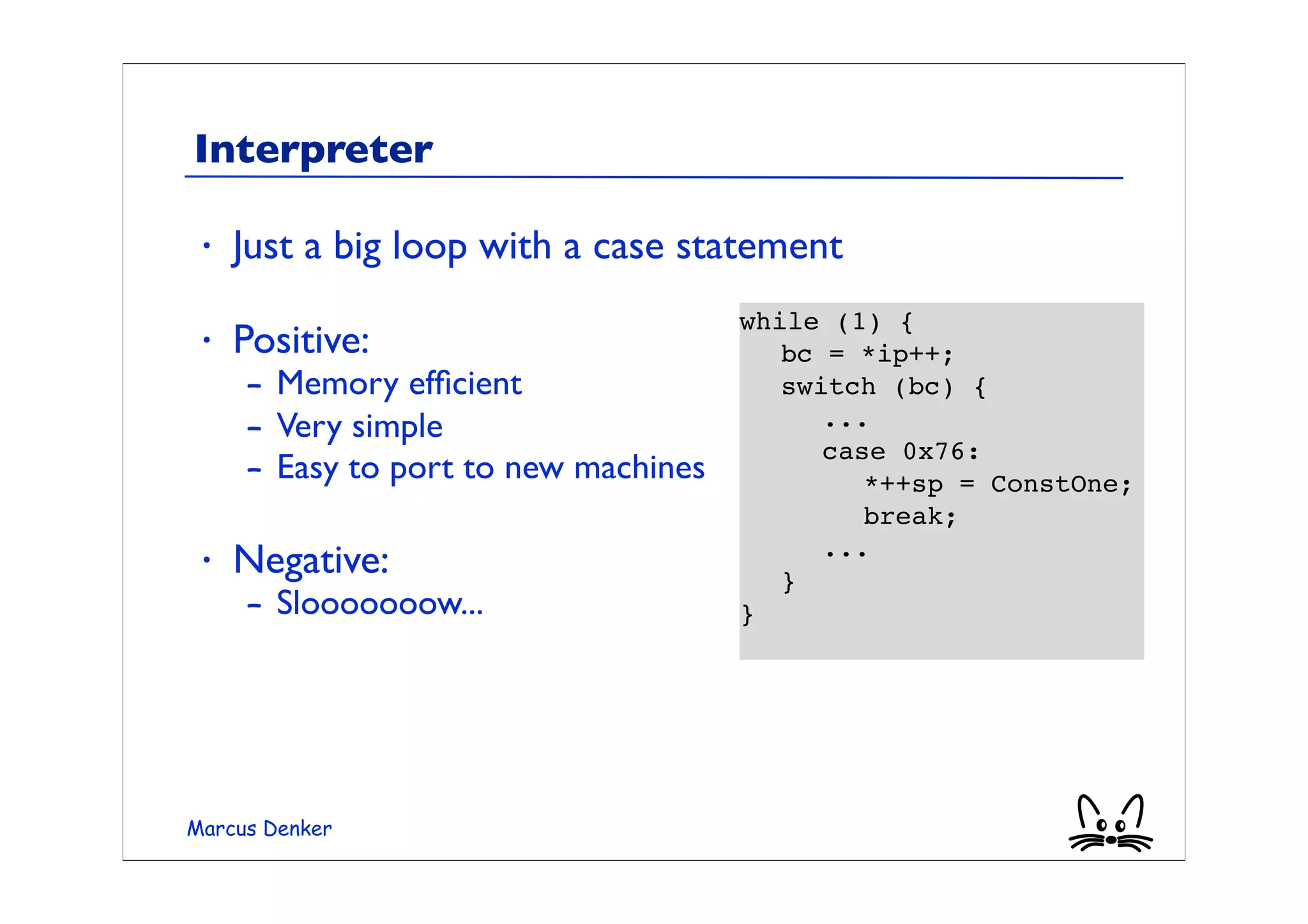
Interpreter

 •   Just a big loop with a case statement
                                      while (1) {
 •   Positive:                        	

 bc = *ip++;
     – Memory efficient                	

 switch (bc) {
     – Very simple                    	


 ...


 case 0x76:
     – Easy to port to new machines   	


 *++sp = ConstOne;


 break;
 •   Negative:                        	


 ...
                                      	

 }
     – Slooooooow...                  }


Marcus Denker
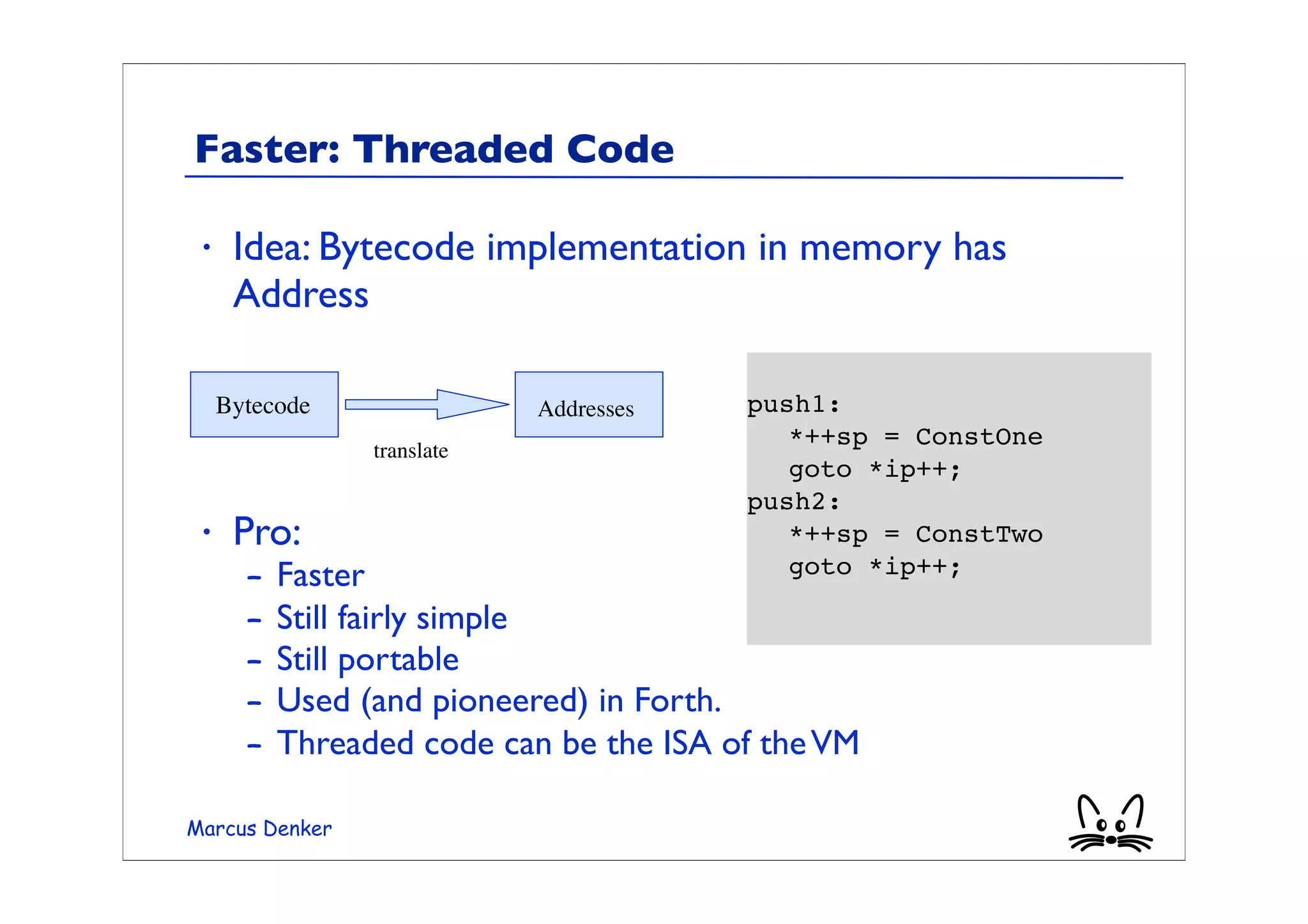
Faster: Threaded Code

 •    Idea: Bytecode implementation in memory has
      Address
                                         	

     Bytecode                Addresses   push1:
                                         	

 *++sp = ConstOne
                 translate
                                         	

 goto *ip++;
                                         push2:
 •    Pro:                               	

 *++sp = ConstTwo
       –   Faster                        	

 goto *ip++;

       –   Still fairly simple
       –   Still portable
       –   Used (and pioneered) in Forth.
       –   Threaded code can be the ISA of the VM

Marcus Denker
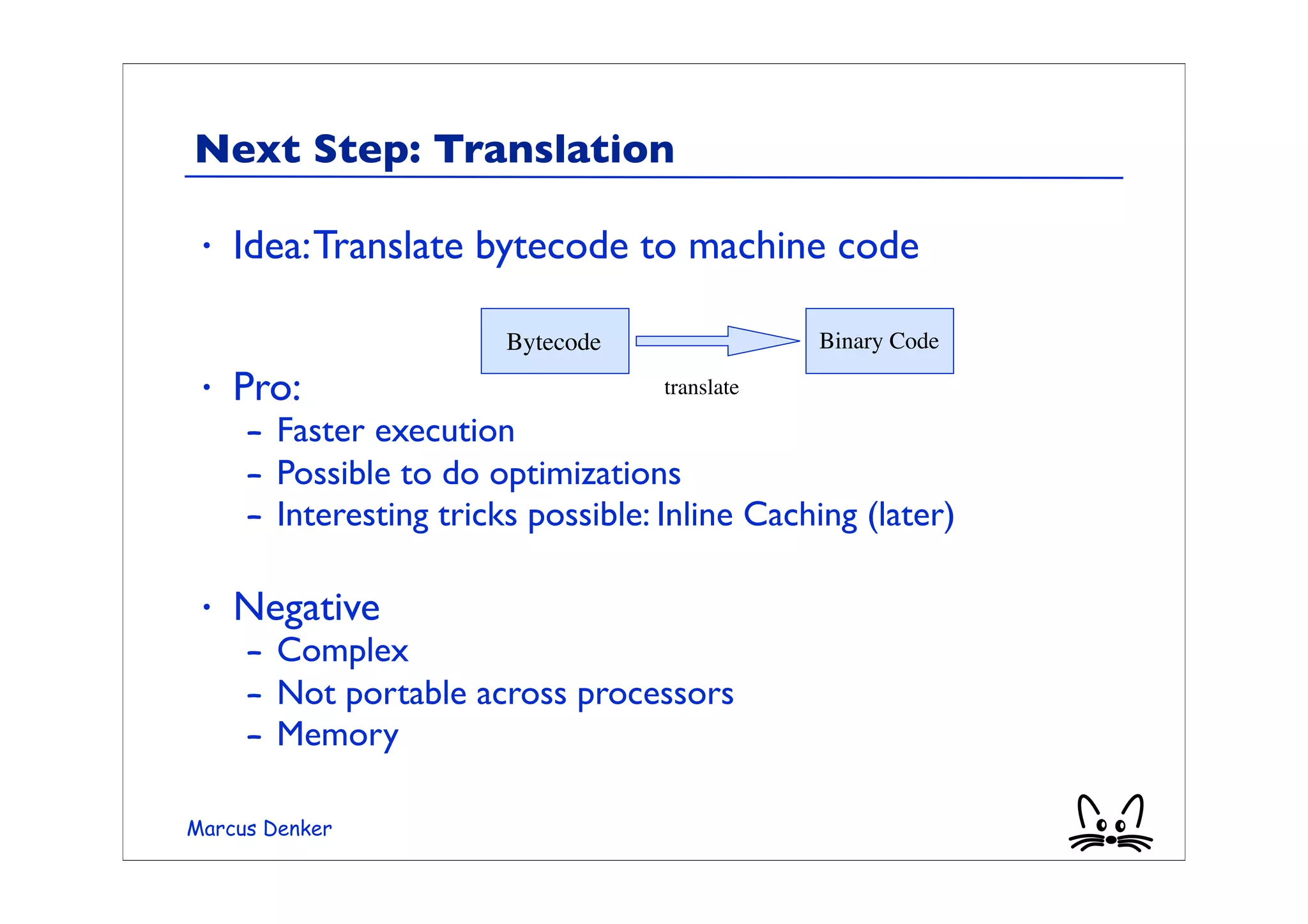
Next Step: Translation

 •   Idea: Translate bytecode to machine code

                        Bytecode                Binary Code

 •   Pro:                           translate

     – Faster execution
     – Possible to do optimizations
     – Interesting tricks possible: Inline Caching (later)

 •   Negative
     – Complex
     – Not portable across processors
     – Memory

Marcus Denker
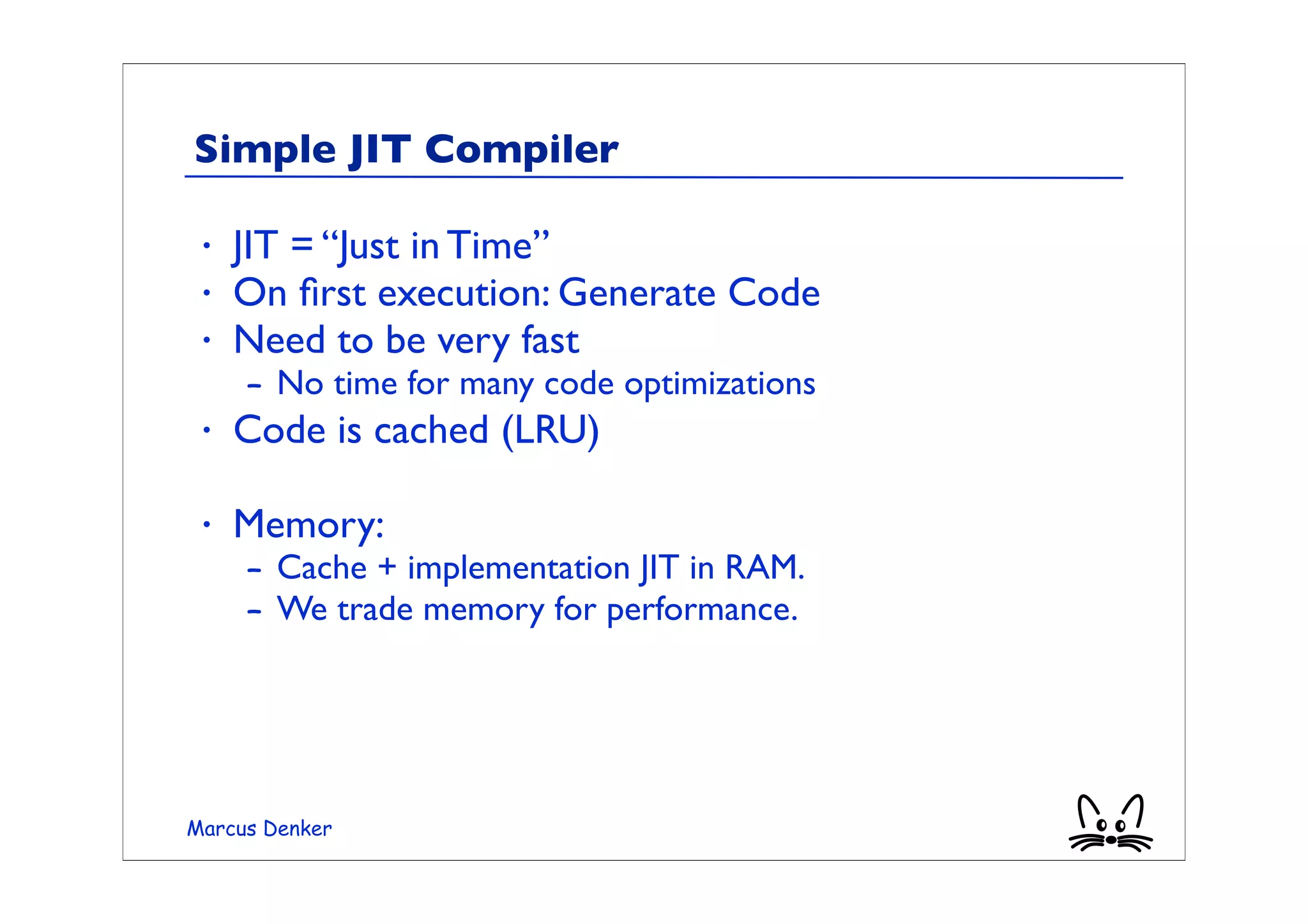
Simple JIT Compiler

 •   JIT = “Just in Time”
 •   On first execution: Generate Code
 •   Need to be very fast
     – No time for many code optimizations
 •   Code is cached (LRU)

 •   Memory:
     – Cache + implementation JIT in RAM.
     – We trade memory for performance.


Marcus Denker
Bytecode Execution: Lessons Learned
•   We have seen
    – Interpreter
    – Threaded Code
    – Simple JIT

•   Next: Optimizations
Optimizing Method Lookup

 •   What is slow in OO virtual machines?

 •   Overhead of Bytecode Interpretation
     – Solved with JIT

 •   Method Lookup
     – Java: Polymorph
     – Smalltalk: Polymorph and dynamically typed
     – Method to call can only be looked up at runtime


Marcus Denker
Example Method Lookup

 •   A simple example:

      array := #(0 1 2 2.5).

      array collect: [:each | each + 1]


 •   The method “+” executed depends on the receiving
     object


Marcus Denker
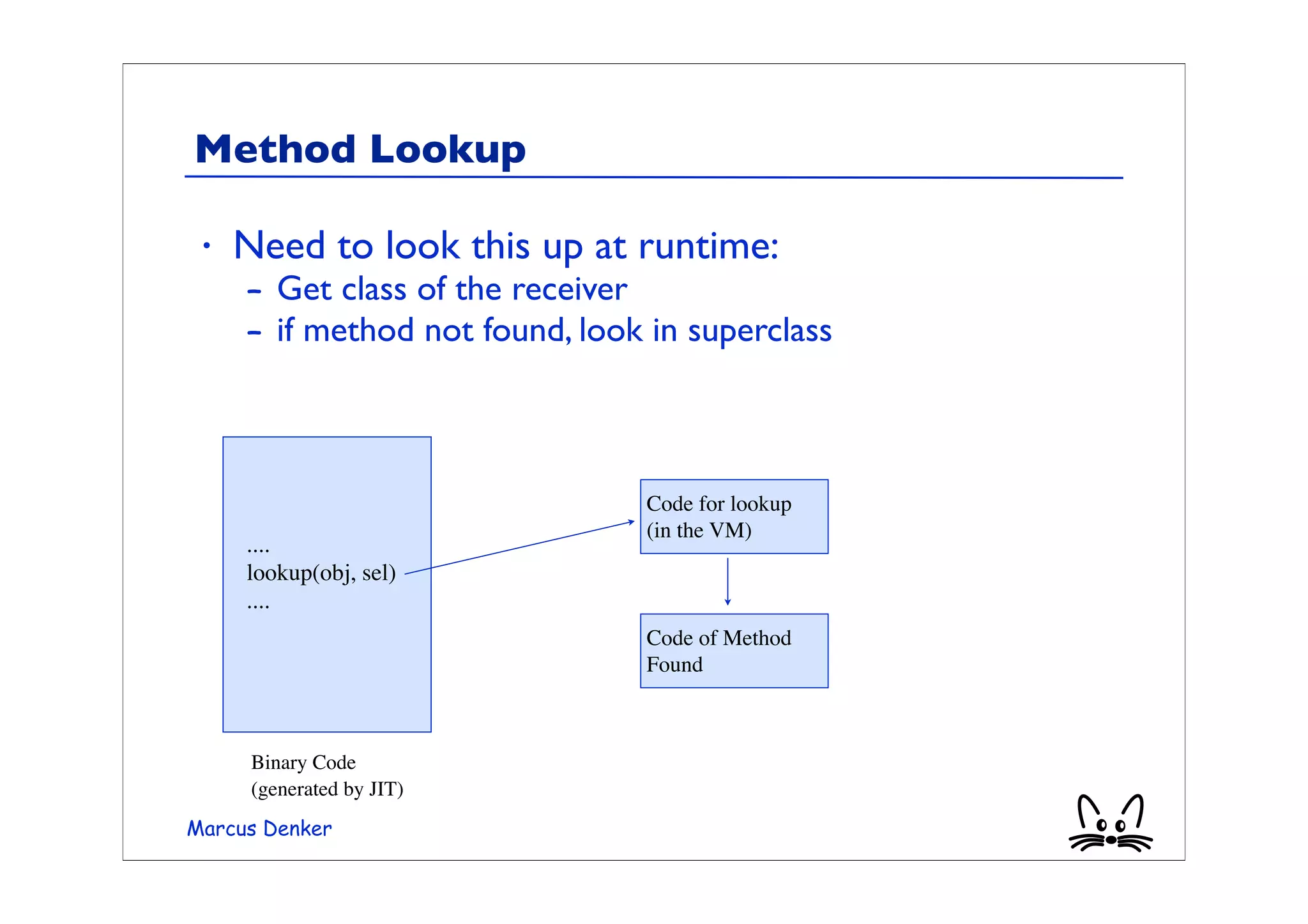
Method Lookup

 •   Need to look this up at runtime:
     – Get class of the receiver
     – if method not found, look in superclass


                                Code for lookup
                                (in the VM)
     ....
     lookup(obj, sel)
     ....
                                Code of Method
                                Found


      Binary Code
      (generated by JIT)
Marcus Denker
Observation: Yesterday’s Weather

 •   Predict the weather of tomorrow: Same as today
 •   Is right in over 80%

 •   Similar for method lookup:
     – Look up method on first execution of a send
     – The next lookup would likely get the same method

 •   True polymorphic sends are seldom


Marcus Denker
Inline Cache

 •   Goal: Make sends faster in many cases
 •   Solution: remember the last lookup

 •   Trick:
     – Inline cache (IC)
     – In the binary code of the sender


Marcus Denker
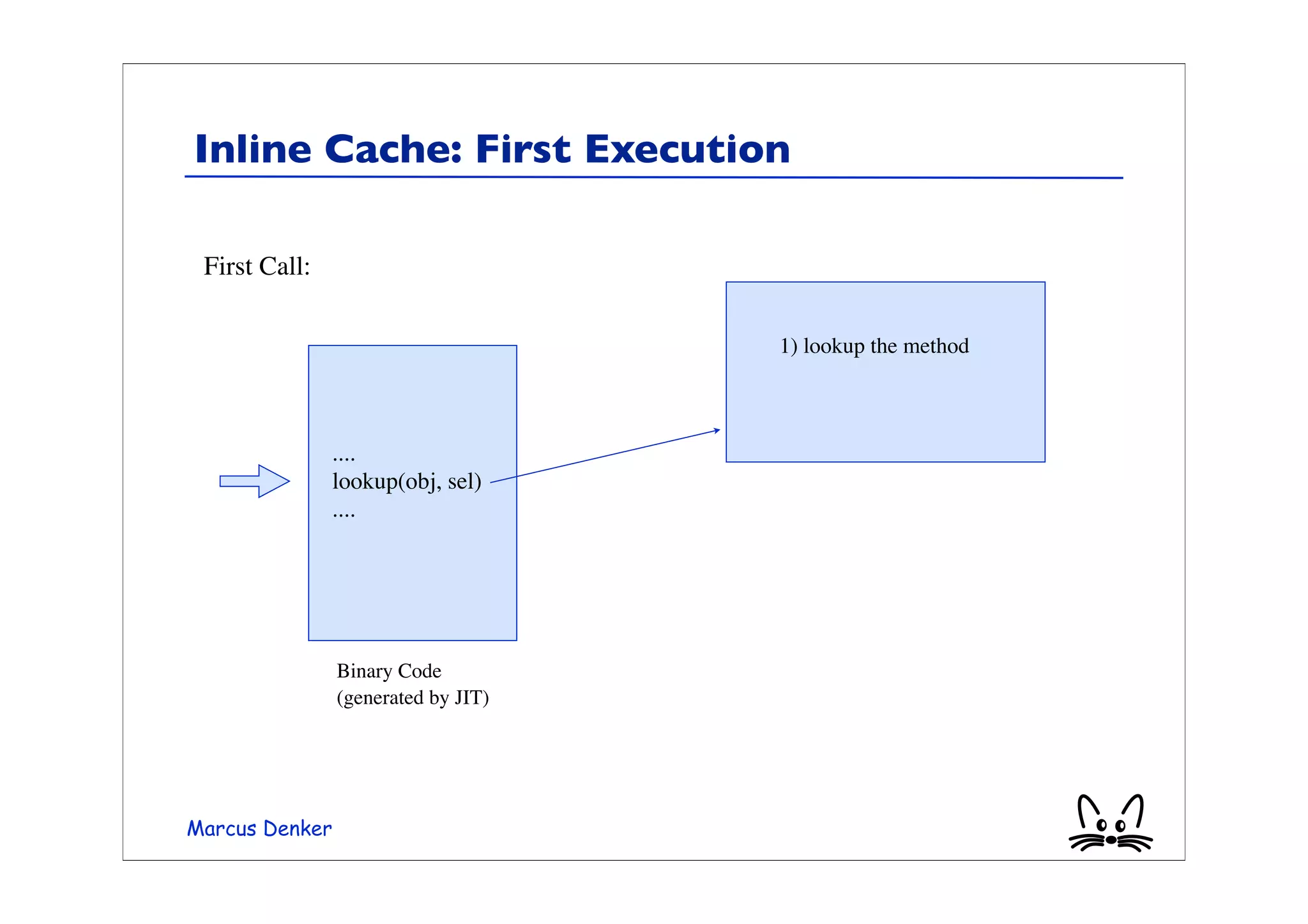
Inline Cache: First Execution

 First Call:

                                     1) lookup the method


                ....
                lookup(obj, sel)
                ....


                Binary Code
                (generated by JIT)


Marcus Denker
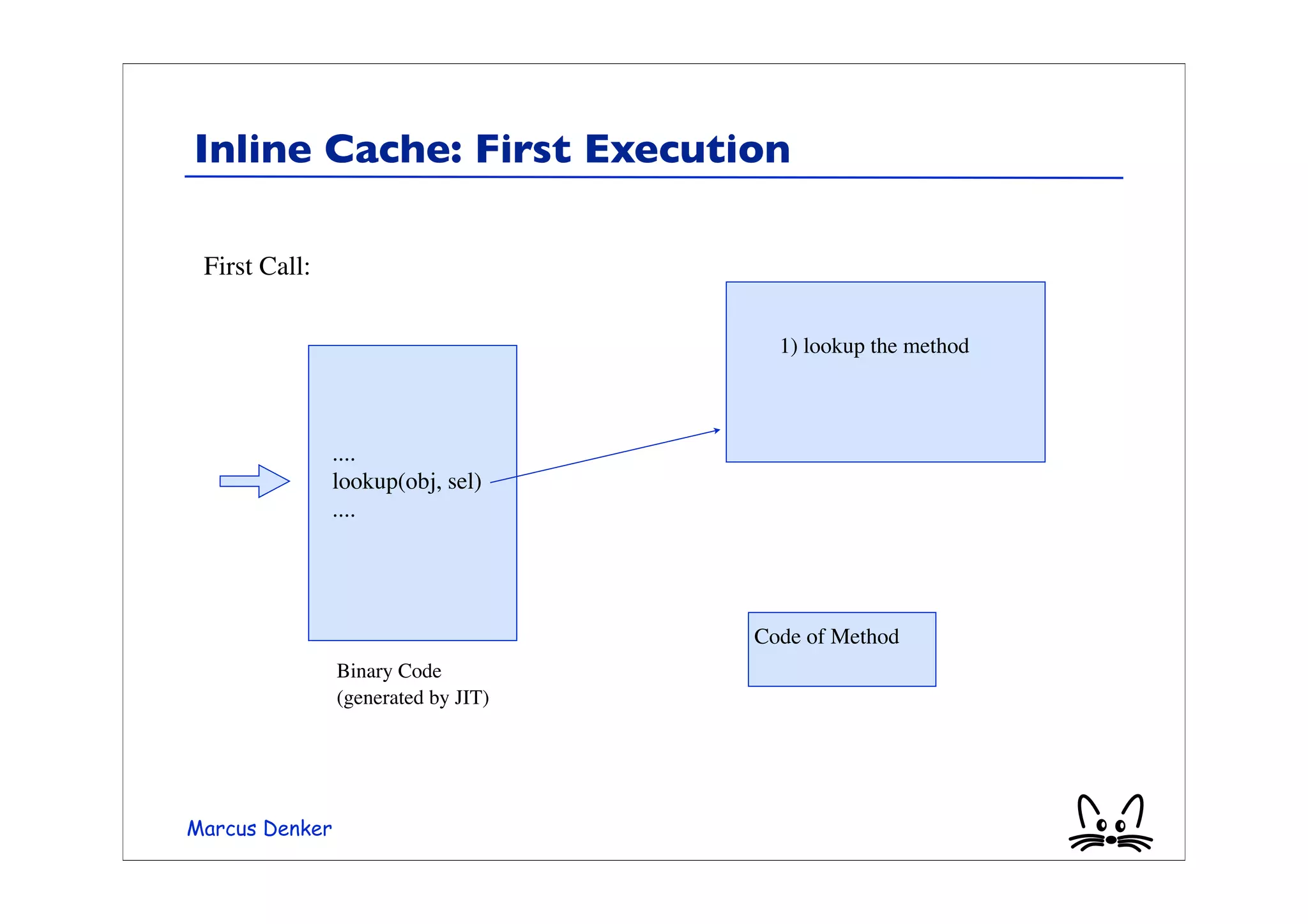
Inline Cache: First Execution

 First Call:

                                       1) lookup the method


                ....
                lookup(obj, sel)
                ....


                                     Code of Method
                Binary Code
                (generated by JIT)


Marcus Denker
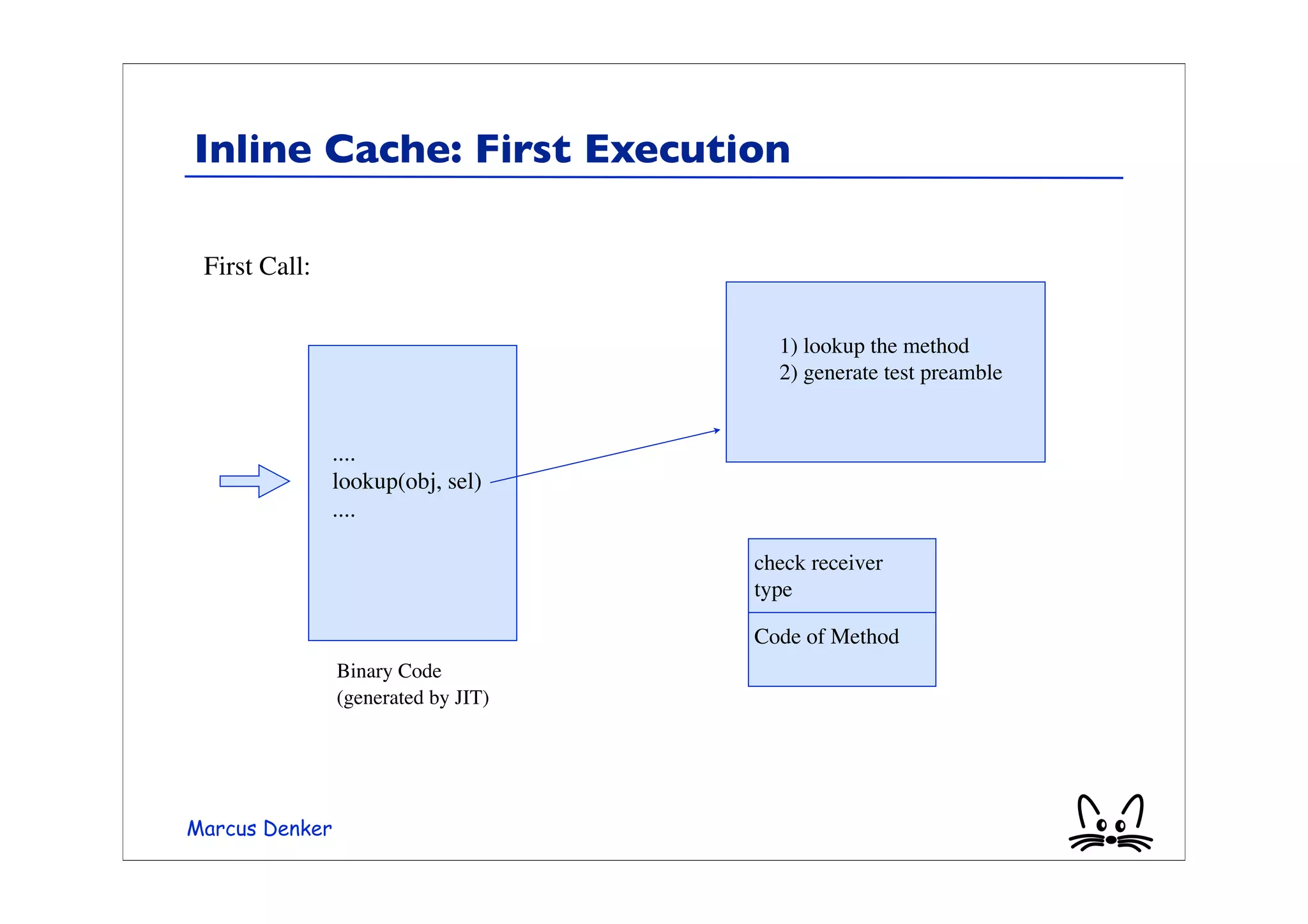
Inline Cache: First Execution

 First Call:

                                       1) lookup the method
                                       2) generate test preamble


                ....
                lookup(obj, sel)
                ....

                                     check receiver
                                     type

                                     Code of Method
                Binary Code
                (generated by JIT)


Marcus Denker
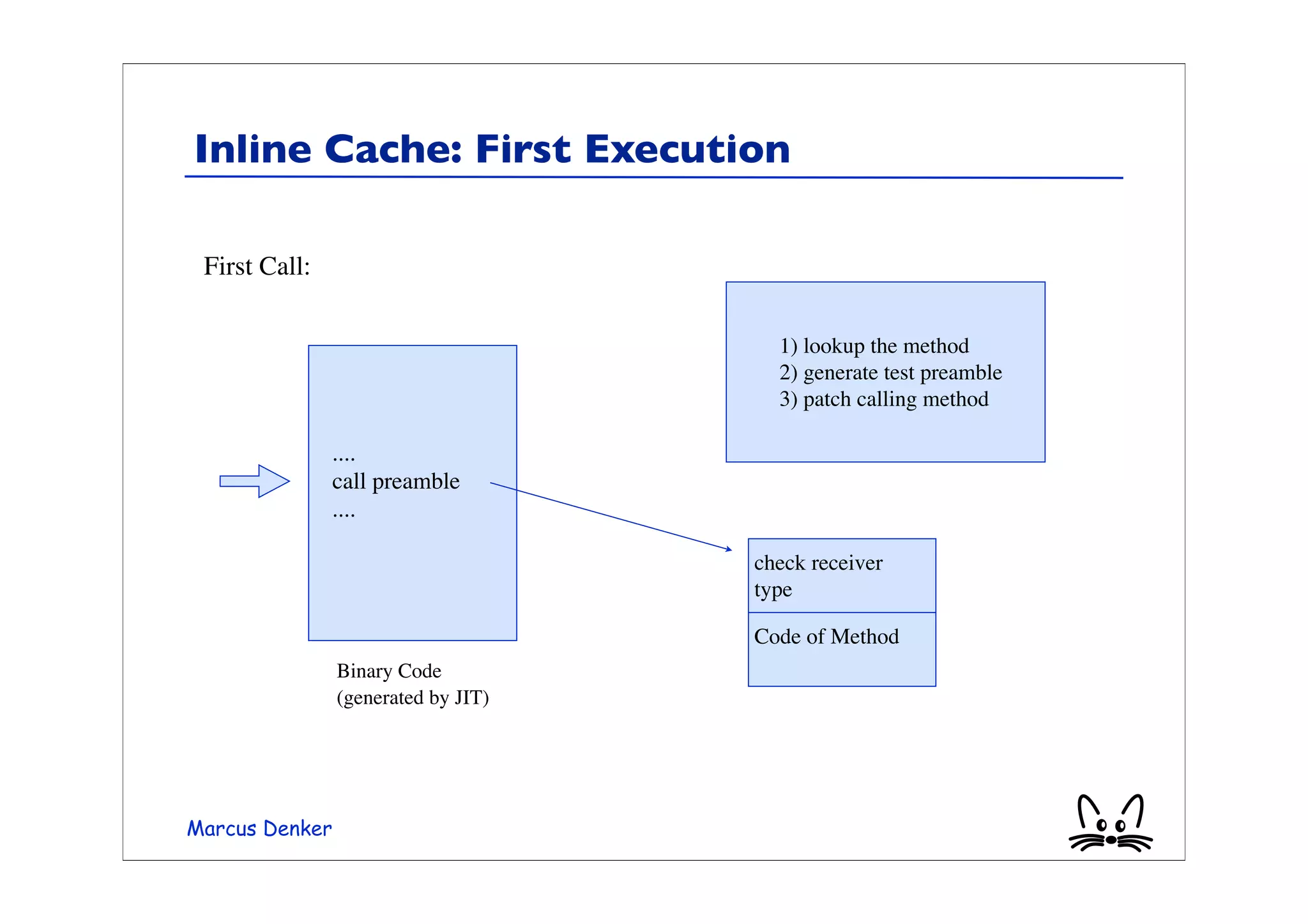
Inline Cache: First Execution

 First Call:

                                       1) lookup the method
                                       2) generate test preamble
                                       3) patch calling method

                ....
                call preamble
                ....

                                     check receiver
                                     type

                                     Code of Method
                Binary Code
                (generated by JIT)


Marcus Denker
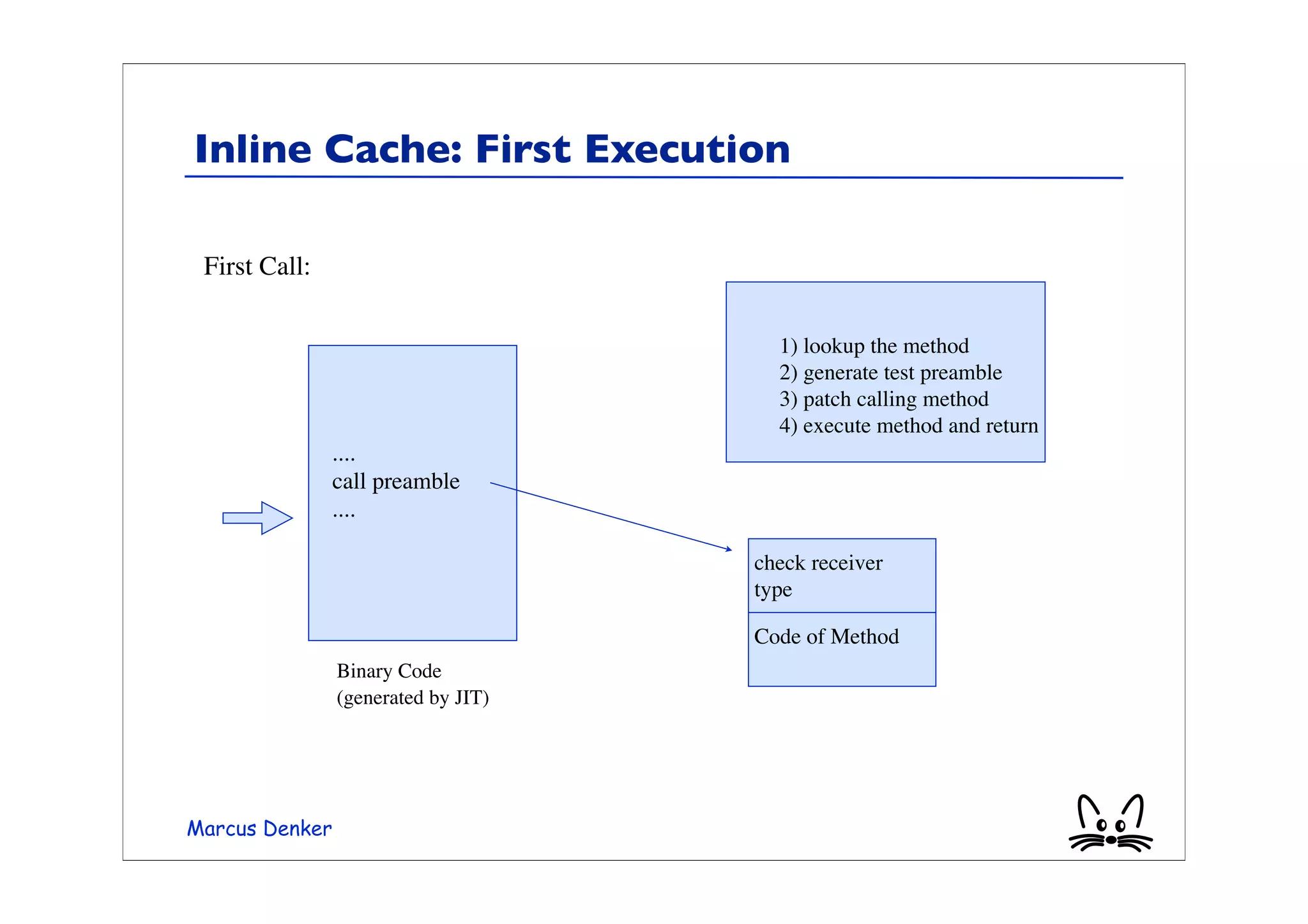
Inline Cache: First Execution

 First Call:

                                       1) lookup the method
                                       2) generate test preamble
                                       3) patch calling method
                                       4) execute method and return
                ....
                call preamble
                ....

                                     check receiver
                                     type

                                     Code of Method
                Binary Code
                (generated by JIT)


Marcus Denker
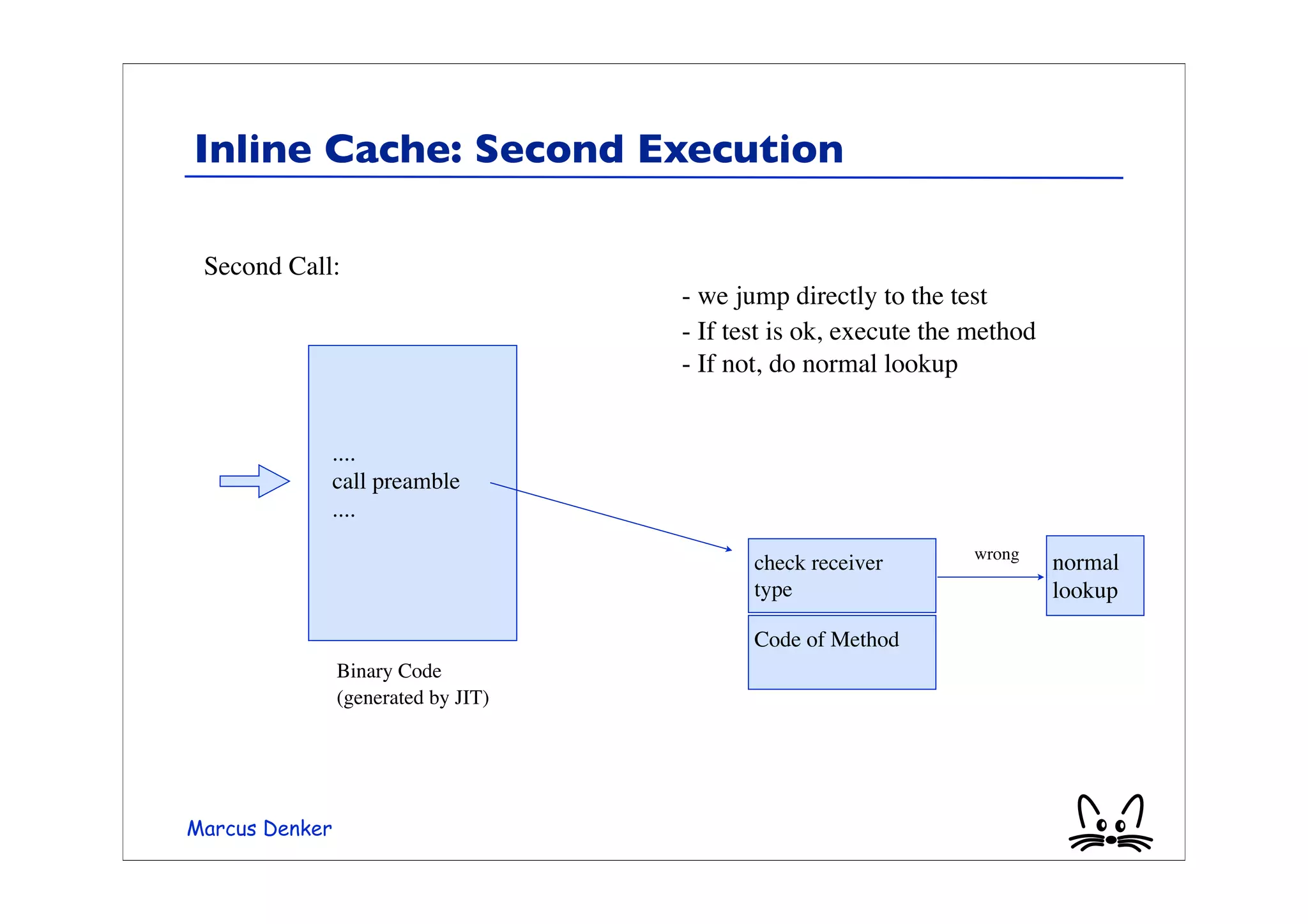
Inline Cache: Second Execution

 Second Call:
                                     - we jump directly to the test
                                     - If test is ok, execute the method
                                     - If not, do normal lookup


                ....
                call preamble
                ....
                                                                 wrong
                                            check receiver                 normal
                                            type                           lookup

                                            Code of Method
                Binary Code
                (generated by JIT)


Marcus Denker
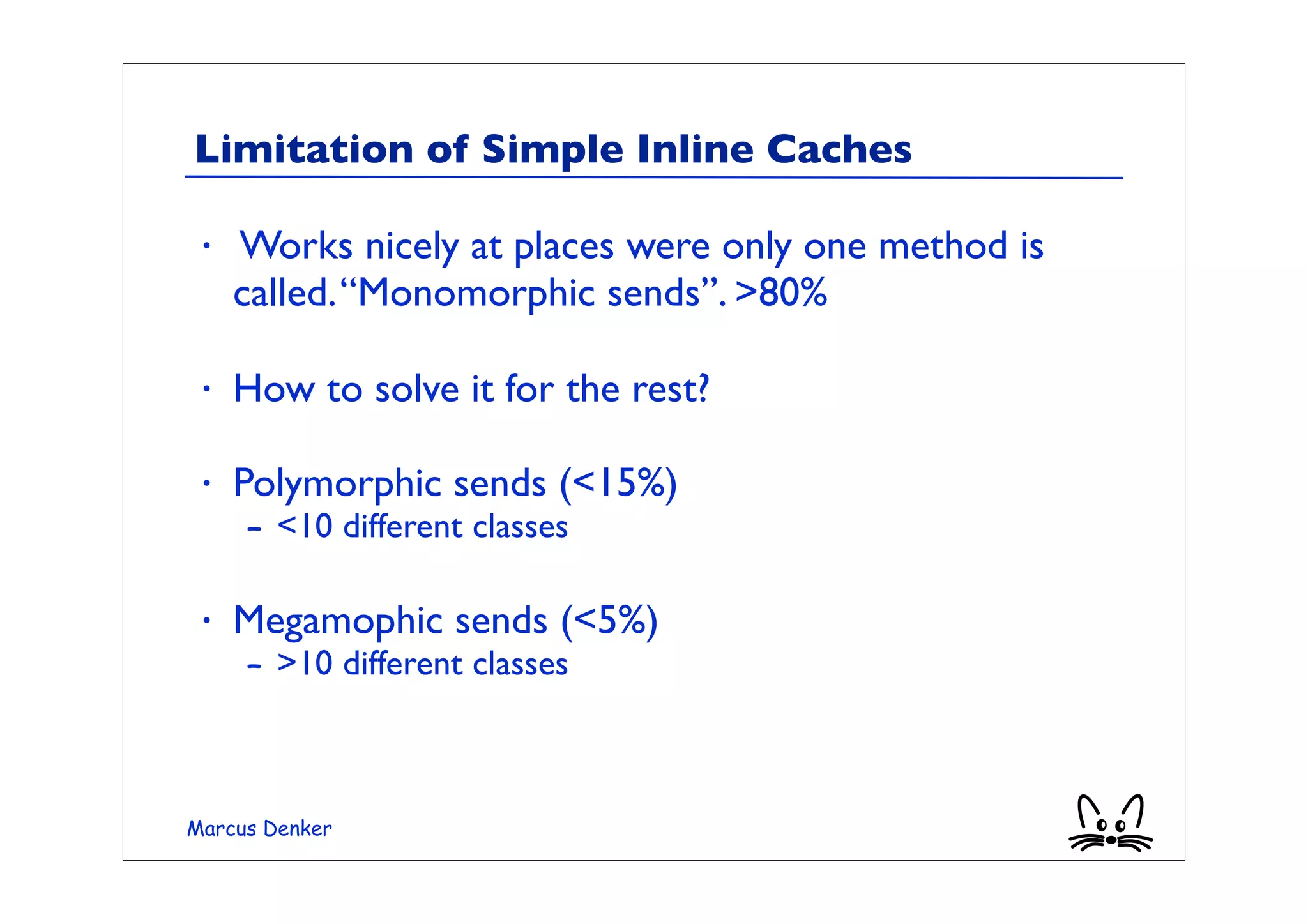
Limitation of Simple Inline Caches

 •   Works nicely at places were only one method is
     called. “Monomorphic sends”. >80%

 •   How to solve it for the rest?

 •   Polymorphic sends (<15%)
     – <10 different classes

 •   Megamophic sends (<5%)
     – >10 different classes


Marcus Denker
Example Polymorphic Send

 •   This example is Polymorphic.

      array := #(1 1.5 2 2.5 3 3.5).

      array collect: [:each | each + 1]

 •   Two classes: Integer and Float

 •   Inline cache will fail at every send
 •   It will be slower than doing just a lookup!


Marcus Denker
Polymorphic Inline Caches

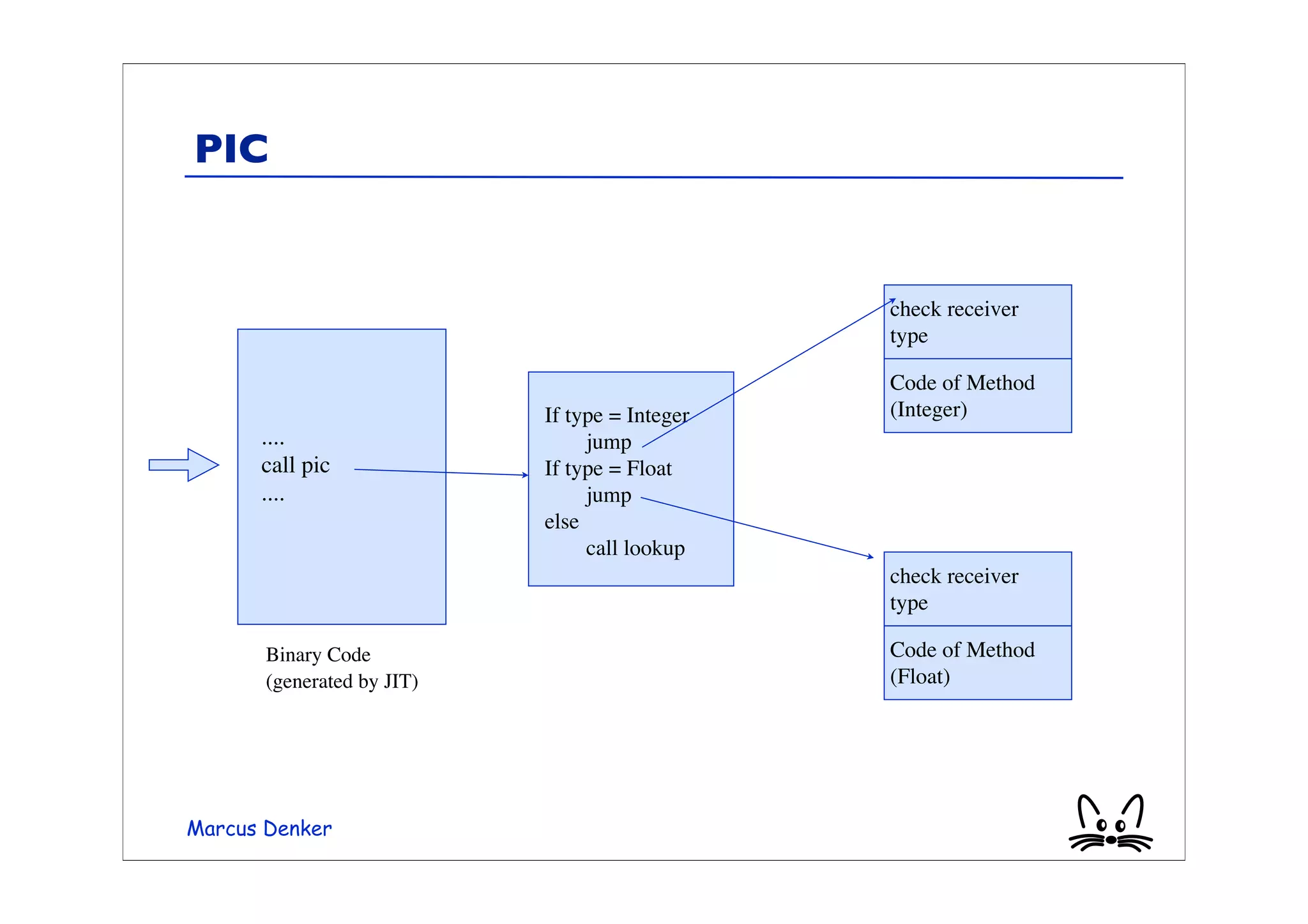
 •   Solution: When inline cache fails, build up a PIC

 •   Basic idea:
     – For each receiver, remember the method found
     – Generate stub to call the correct method


Marcus Denker
PIC


                                                check receiver
                                                type

                                                Code of Method
                            If type = Integer   (Integer)
      ....                  
    jump
      call pic              If type = Float
      ....                  
    jump
                            else
                            
    call lookup
                                                check receiver
                                                type

       Binary Code                              Code of Method
       (generated by JIT)                       (Float)


Marcus Denker
PIC

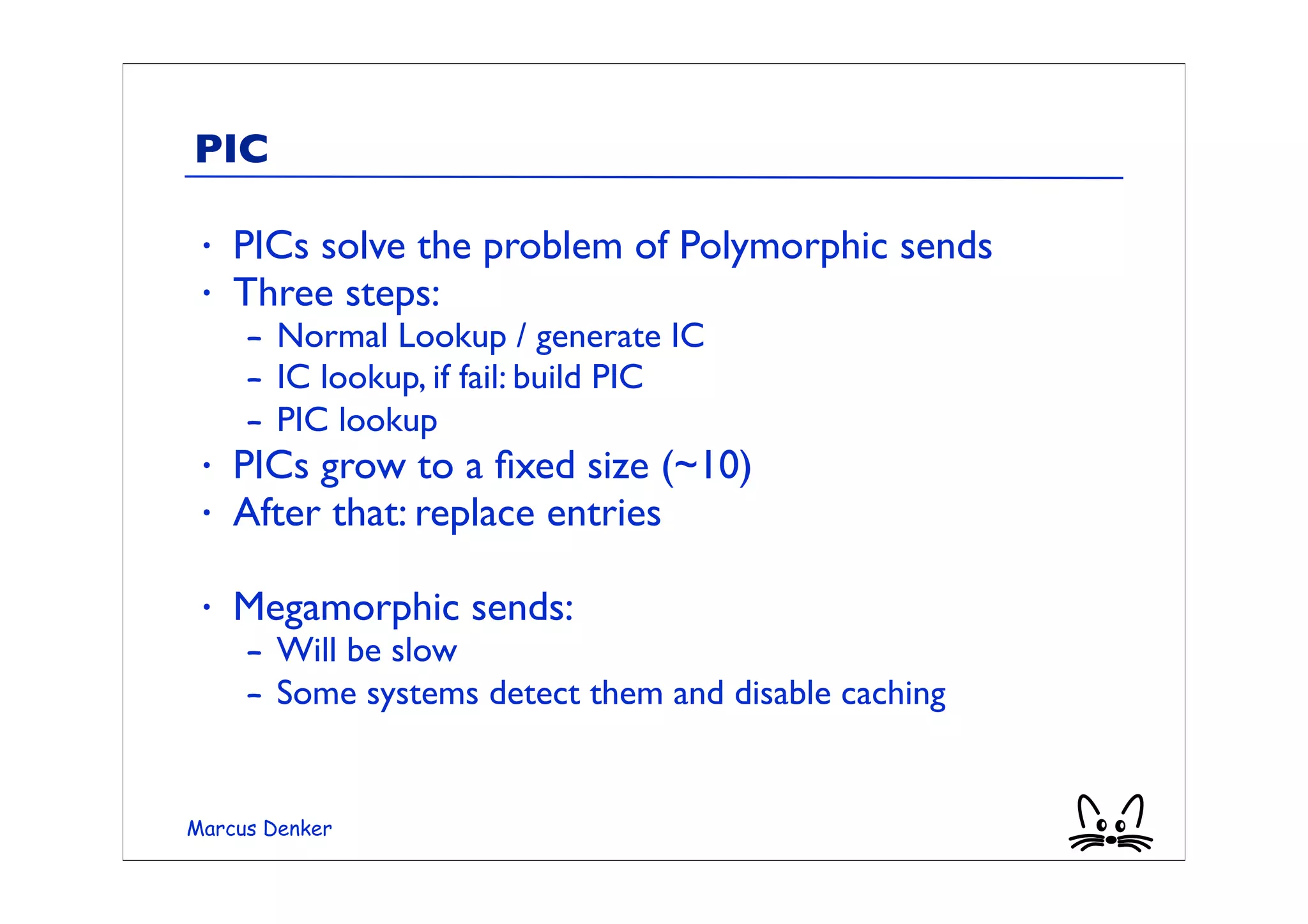
 •   PICs solve the problem of Polymorphic sends
 •   Three steps:
     – Normal Lookup / generate IC
     – IC lookup, if fail: build PIC
     – PIC lookup
 •   PICs grow to a fixed size (~10)
 •   After that: replace entries

 •   Megamorphic sends:
     – Will be slow
     – Some systems detect them and disable caching


Marcus Denker
Optimizations: Lessons Learned
•   We have seen
    – Inline Caches
    – Polymorphic Inline Caches

•   Next: Beyond Just-In-Time
Beyond JIT: Dynamic Optimization

 •   Just-In-Time == Not-Enough-Time
     – No complex optimization possible
     – No whole-program-optimization

 •   We want to do real optimizations!


Marcus Denker
Excursion: Optimizations

 •   Or: Why is a modern compiler so slow?

 •   There is a lot to do to generate good code!
     – Transformation in a good intermediate form (SSA)
     – Many different optimization passes
         • Constant subexpression elimination (CSE)
         • Dead code elimination
         • Inlining
     – Register allocation
     – Instruction selection


Marcus Denker
State of the Art: HotSpot et. al.

 •   Pioneered in Self
 •   Use multiple compilers
     – Fast but bad code
     – Slow but good code

 •   Only invest time were it really pays off
 •   Here we can invest some more

 •   Problem:Very complicated, huge warmup, lots of
     Memory
 •   Examples: Self, Java Hotspot, Jikes

Marcus Denker
PIC Data for Inlining

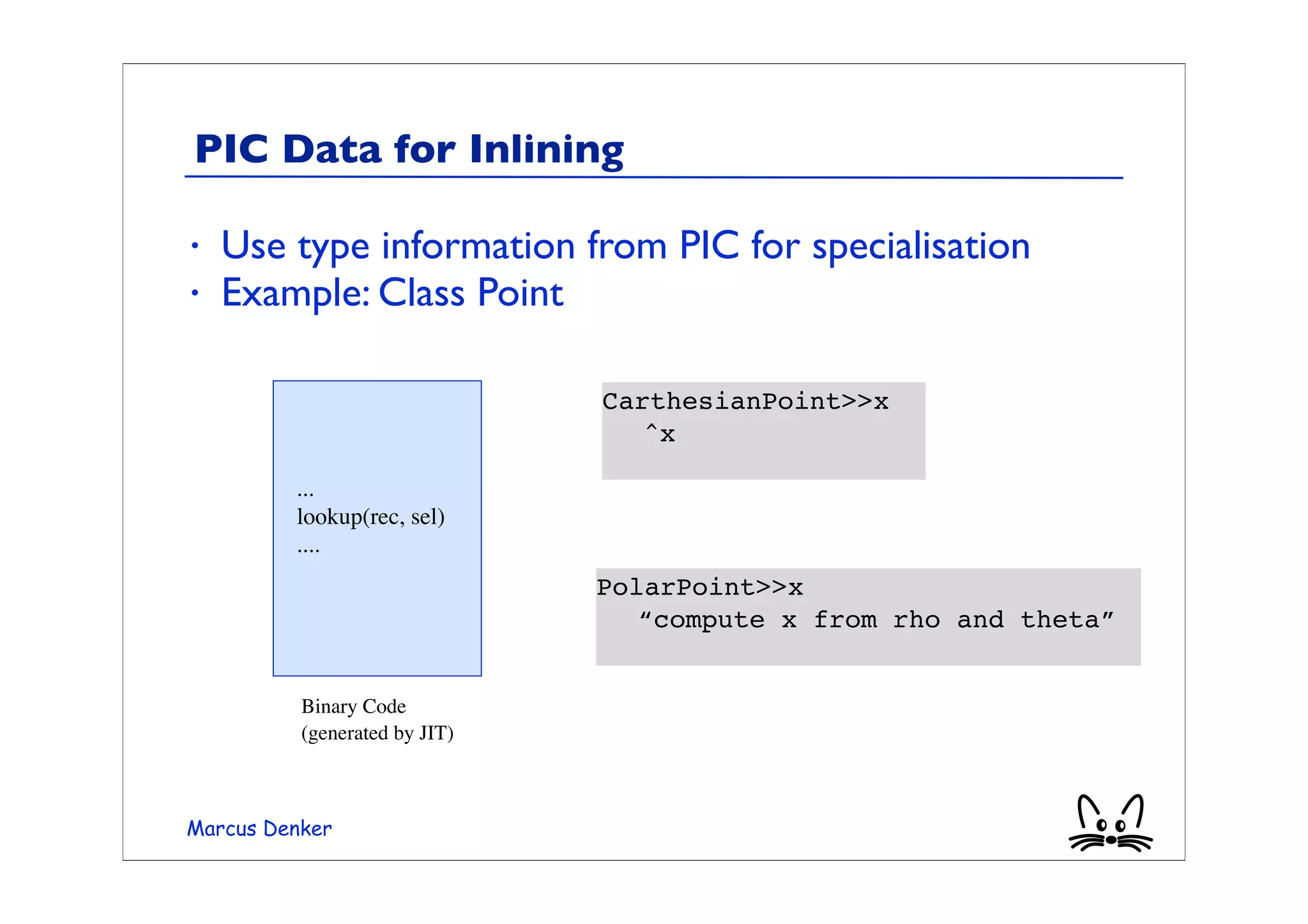
•   Use type information from PIC for specialisation
•   Example: Class Point

                               CarthesianPoint>>x
                               	

 ^x

         ...
         lookup(rec, sel)
         ....
                               PolarPoint>>x
                               	

 “compute x from rho and theta”


          Binary Code
          (generated by JIT)


Marcus Denker
Example Inlining

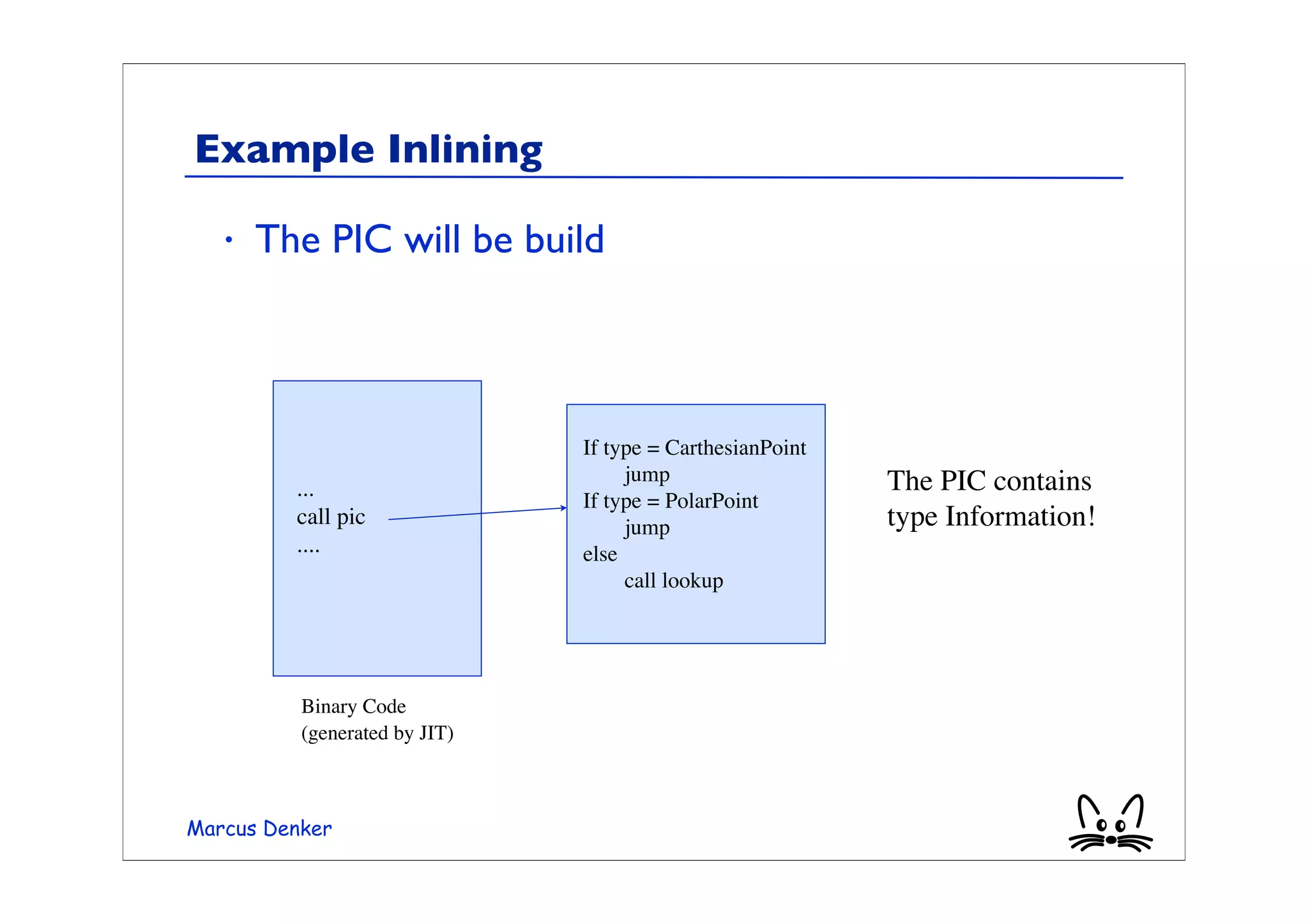
   •   The PIC will be build


                               If type = CarthesianPoint
                               
    jump                   The PIC contains
         ...                   If type = PolarPoint
         call pic              
    jump                   type Information!
         ....                  else
                               
    call lookup


          Binary Code
          (generated by JIT)


Marcus Denker
Example Inlining

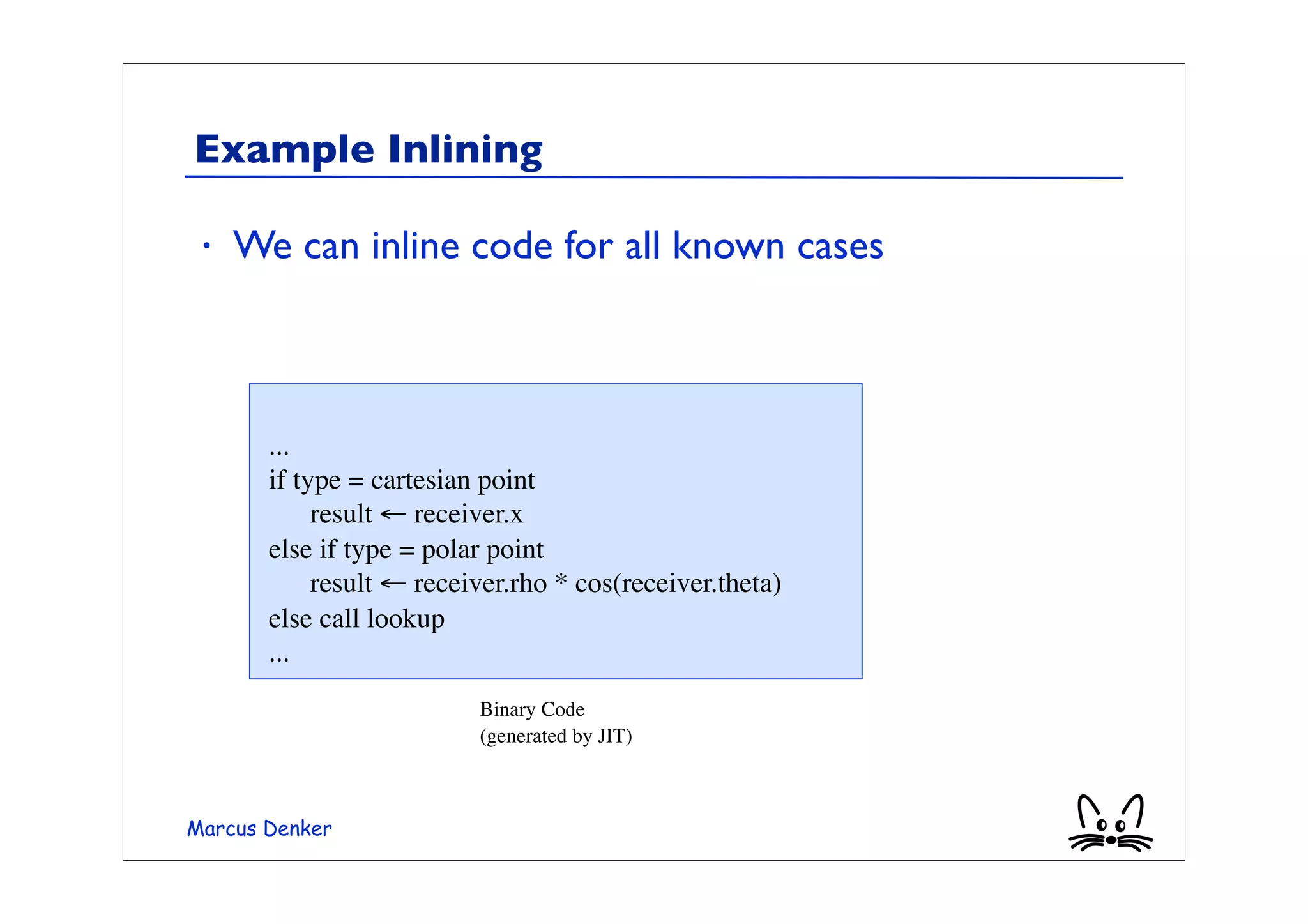
 •   We can inline code for all known cases


       ...
       if type = cartesian point
       
 result ← receiver.x
       else if type = polar point
       
 result ← receiver.rho * cos(receiver.theta)
       else call lookup
       ...
                         Binary Code
                         (generated by JIT)


Marcus Denker
End


•   What is a VM
•   Overview about bytecode interpreter / compiler
•   Inline Caching / PICs
•   Dynamic Optimization


•   Questions?
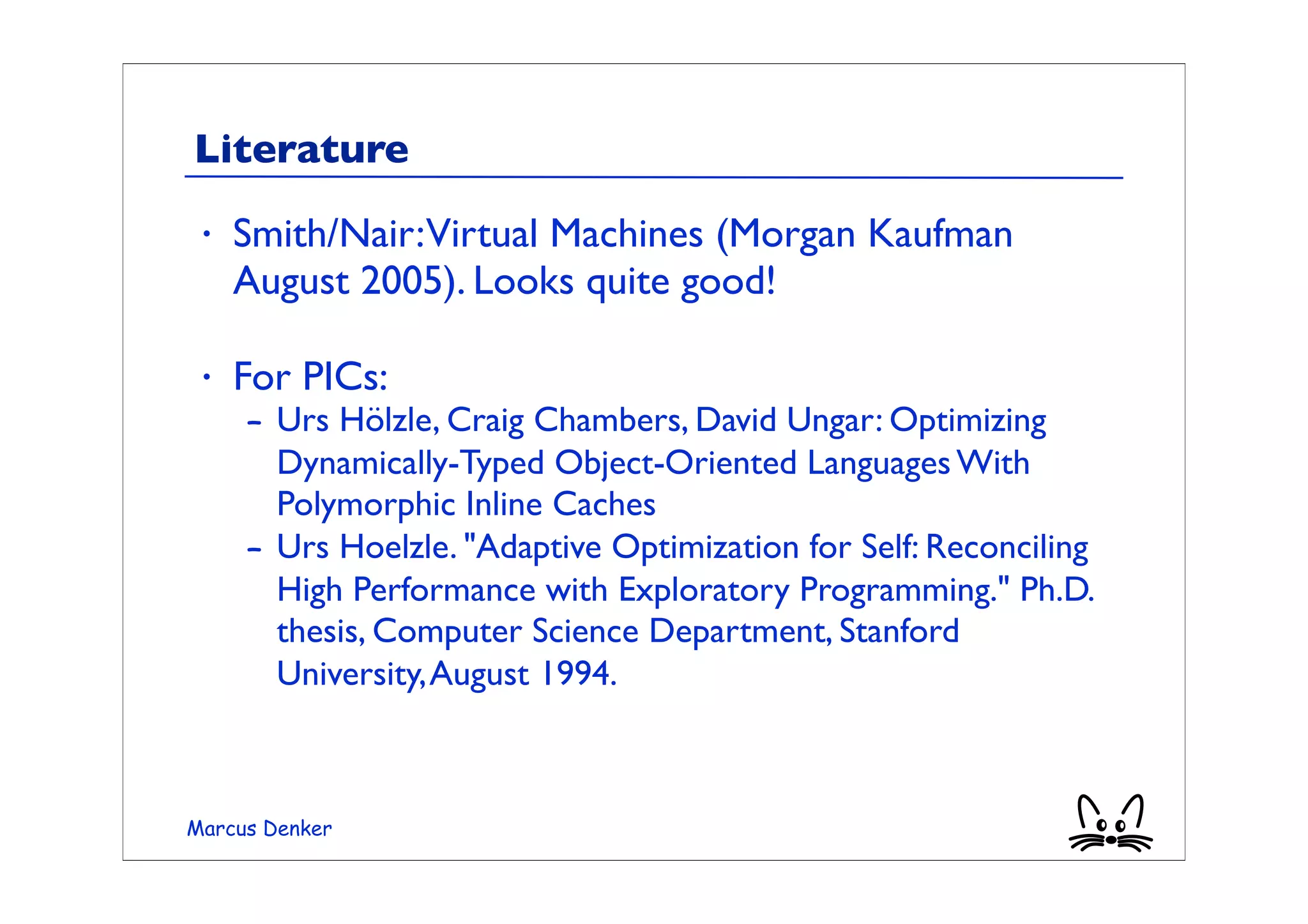
Literature
 •   Smith/Nair:Virtual Machines (Morgan Kaufman
     August 2005). Looks quite good!

 •   For PICs:
     – Urs Hölzle, Craig Chambers, David Ungar: Optimizing
       Dynamically-Typed Object-Oriented Languages With
       Polymorphic Inline Caches
     – Urs Hoelzle. "Adaptive Optimization for Self: Reconciling
       High Performance with Exploratory Programming." Ph.D.
       thesis, Computer Science Department, Stanford
       University, August 1994.


Marcus Denker

VMs, Interpreters, JIT

  • 1.
    VMs, Interpreters, JIT& Co A First Introduction Marcus Denker
  • 2.
    Overview • Virtual Machines: How and Why – Bytecode – Garbage Collection (GC) • Code Execution – Interpretation – Just-In-Time – Optimizing method lookup – Dynamic optimization Marcus Denker
  • 3.
    Caveat • Virtual Machines are not trivial! • This lecture can only give a very high-level overview • You will not be a VM Hacker afterwards ;-) • Many slides of this talk should be complete lectures (or even courses) Marcus Denker
  • 4.
    Virtual Machine: What’sthat? • Software implementation of a machine • Process VMs – Processor emulation (e.g. run PowerPC on Intel) • FX32!, MacOS 68k, powerPC – Optimization: HP Dynamo – High level language VMs • System Virtual Machines – IBM z/OS – Virtual PC Marcus Denker
  • 5.
    High Level LanguageVM • We focus on HLL VMs • Examples: Java, Smalltalk, Python, Perl.... • Three parts: – The Processor • Simulated Instruction Set Architecture (ISA) – The Memory: Garbage Collection – Abstraction for other OS / Hardware (e.g, I/O) • Very near to the implemented language • Provides abstraction from OS Marcus Denker
  • 6.
    The Processor • VM has an instruction set. (virtual ISA) – Stack machine – Bytecode – High level: models the language quite directly • e.g, “Send” bytecode in Smalltalk • VM needs to run this Code • Many designs possible: – Interpreter (simple) – Threaded code – Simple translation to machine code – Dynamic optimization (“HotSpot”) Marcus Denker
  • 7.
    Garbage Collection • Provides a high level model for memory • No need to explicitly free memory • Different implementations: – Reference counting – Mark and sweep – Generational GC • A modern GC is *very* efficient • It’s hard to do better Marcus Denker
  • 8.
    Other Hardware Abstraction • We need a way to access Operating System APIs – Graphics – Networking (TCP/IP) – Disc / Keyboard.... • Simple solution: – Define an API for this Hardware – Implement this as part of the VM (“Primitives”) – Call OS library functions directly Marcus Denker
  • 9.
    Virtual Machine: Lessonslearned • VM: Simulated Machine • Consists of – Virtual ISA – Memory Management – API for Hardware/OS • Next: Bytecode
  • 10.
    Bytecode • Byte-encoded instruction set • This means: 256 main instructions • Stack based • Positive: – Very compact – Easy to interpret • Important: The ISA of a VM does not need to be Bytecode. Marcus Denker
  • 11.
    Compiling to Bytecode Program Text 1 + 2 Compiler Bytecode 76 77 B0 7C Marcus Denker
  • 12.
    Example: Number>>asInteger • Smalltalk code: ^1 + 2 • Symbolic Bytecode <76> pushConstant: 1 <77> pushConstant: 2 <B0> send: + <7C> returnTop Marcus Denker
  • 13.
    Example: Java Bytecode • From class Rectangle public int perimeter() 0: iconst_2 1: aload_0 “push this” 2: getfield#2 “value of sides” 5: iconst_0 6: iaload 7: aload_0 2*(sides[0]+sides[1]) 8: getfield#2 11: iconst_1 12: iaload 13: iadd 14: imul 15: ireturn Marcus Denker
  • 14.
    Difference Java andSqueak • Instruction for arithmetic – Just method calls in Smalltalk • Typed: special bytecode for int, long, float • Bytecode for array access • Not shown: – Jumps for loops and control structures – Exceptions (java) – .... Marcus Denker
  • 15.
    Systems Using Bytecode • USCD Pascal (first, ~1970) • Smalltalk • Java • PHP • Python • No bytecode: – Ruby: Interprets the AST Marcus Denker
  • 16.
    Bytecode: Lessons Learned • Instruction set of a VM • Stack based • Fairly simple • Next: Bytecode Execution
  • 17.
    Running Bytecode • Invented for Interpretation • But there are faster ways to do it • We will see – Interpreter – Threaded code – Translation to machine code (JIT, Hotspot) Marcus Denker
  • 18.
    Interpreter • Just a big loop with a case statement while (1) { • Positive: bc = *ip++; – Memory efficient switch (bc) { – Very simple ... case 0x76: – Easy to port to new machines *++sp = ConstOne; break; • Negative: ... } – Slooooooow... } Marcus Denker
  • 19.
    Faster: Threaded Code • Idea: Bytecode implementation in memory has Address Bytecode Addresses push1: *++sp = ConstOne translate goto *ip++; push2: • Pro: *++sp = ConstTwo – Faster goto *ip++; – Still fairly simple – Still portable – Used (and pioneered) in Forth. – Threaded code can be the ISA of the VM Marcus Denker
  • 20.
    Next Step: Translation • Idea: Translate bytecode to machine code Bytecode Binary Code • Pro: translate – Faster execution – Possible to do optimizations – Interesting tricks possible: Inline Caching (later) • Negative – Complex – Not portable across processors – Memory Marcus Denker
  • 21.
    Simple JIT Compiler • JIT = “Just in Time” • On first execution: Generate Code • Need to be very fast – No time for many code optimizations • Code is cached (LRU) • Memory: – Cache + implementation JIT in RAM. – We trade memory for performance. Marcus Denker
  • 22.
    Bytecode Execution: LessonsLearned • We have seen – Interpreter – Threaded Code – Simple JIT • Next: Optimizations
  • 23.
    Optimizing Method Lookup • What is slow in OO virtual machines? • Overhead of Bytecode Interpretation – Solved with JIT • Method Lookup – Java: Polymorph – Smalltalk: Polymorph and dynamically typed – Method to call can only be looked up at runtime Marcus Denker
  • 24.
    Example Method Lookup • A simple example: array := #(0 1 2 2.5). array collect: [:each | each + 1] • The method “+” executed depends on the receiving object Marcus Denker
  • 25.
    Method Lookup • Need to look this up at runtime: – Get class of the receiver – if method not found, look in superclass Code for lookup (in the VM) .... lookup(obj, sel) .... Code of Method Found Binary Code (generated by JIT) Marcus Denker
  • 26.
    Observation: Yesterday’s Weather • Predict the weather of tomorrow: Same as today • Is right in over 80% • Similar for method lookup: – Look up method on first execution of a send – The next lookup would likely get the same method • True polymorphic sends are seldom Marcus Denker
  • 27.
    Inline Cache • Goal: Make sends faster in many cases • Solution: remember the last lookup • Trick: – Inline cache (IC) – In the binary code of the sender Marcus Denker
  • 28.
    Inline Cache: FirstExecution First Call: 1) lookup the method .... lookup(obj, sel) .... Binary Code (generated by JIT) Marcus Denker
  • 29.
    Inline Cache: FirstExecution First Call: 1) lookup the method .... lookup(obj, sel) .... Code of Method Binary Code (generated by JIT) Marcus Denker
  • 30.
    Inline Cache: FirstExecution First Call: 1) lookup the method 2) generate test preamble .... lookup(obj, sel) .... check receiver type Code of Method Binary Code (generated by JIT) Marcus Denker
  • 31.
    Inline Cache: FirstExecution First Call: 1) lookup the method 2) generate test preamble 3) patch calling method .... call preamble .... check receiver type Code of Method Binary Code (generated by JIT) Marcus Denker
  • 32.
    Inline Cache: FirstExecution First Call: 1) lookup the method 2) generate test preamble 3) patch calling method 4) execute method and return .... call preamble .... check receiver type Code of Method Binary Code (generated by JIT) Marcus Denker
  • 33.
    Inline Cache: SecondExecution Second Call: - we jump directly to the test - If test is ok, execute the method - If not, do normal lookup .... call preamble .... wrong check receiver normal type lookup Code of Method Binary Code (generated by JIT) Marcus Denker
  • 34.
    Limitation of SimpleInline Caches • Works nicely at places were only one method is called. “Monomorphic sends”. >80% • How to solve it for the rest? • Polymorphic sends (<15%) – <10 different classes • Megamophic sends (<5%) – >10 different classes Marcus Denker
  • 35.
    Example Polymorphic Send • This example is Polymorphic. array := #(1 1.5 2 2.5 3 3.5). array collect: [:each | each + 1] • Two classes: Integer and Float • Inline cache will fail at every send • It will be slower than doing just a lookup! Marcus Denker
  • 36.
    Polymorphic Inline Caches • Solution: When inline cache fails, build up a PIC • Basic idea: – For each receiver, remember the method found – Generate stub to call the correct method Marcus Denker
  • 37.
    PIC check receiver type Code of Method If type = Integer (Integer) .... jump call pic If type = Float .... jump else call lookup check receiver type Binary Code Code of Method (generated by JIT) (Float) Marcus Denker
  • 38.
    PIC • PICs solve the problem of Polymorphic sends • Three steps: – Normal Lookup / generate IC – IC lookup, if fail: build PIC – PIC lookup • PICs grow to a fixed size (~10) • After that: replace entries • Megamorphic sends: – Will be slow – Some systems detect them and disable caching Marcus Denker
  • 39.
    Optimizations: Lessons Learned • We have seen – Inline Caches – Polymorphic Inline Caches • Next: Beyond Just-In-Time
  • 40.
    Beyond JIT: DynamicOptimization • Just-In-Time == Not-Enough-Time – No complex optimization possible – No whole-program-optimization • We want to do real optimizations! Marcus Denker
  • 41.
    Excursion: Optimizations • Or: Why is a modern compiler so slow? • There is a lot to do to generate good code! – Transformation in a good intermediate form (SSA) – Many different optimization passes • Constant subexpression elimination (CSE) • Dead code elimination • Inlining – Register allocation – Instruction selection Marcus Denker
  • 42.
    State of theArt: HotSpot et. al. • Pioneered in Self • Use multiple compilers – Fast but bad code – Slow but good code • Only invest time were it really pays off • Here we can invest some more • Problem:Very complicated, huge warmup, lots of Memory • Examples: Self, Java Hotspot, Jikes Marcus Denker
  • 43.
    PIC Data forInlining • Use type information from PIC for specialisation • Example: Class Point CarthesianPoint>>x ^x ... lookup(rec, sel) .... PolarPoint>>x “compute x from rho and theta” Binary Code (generated by JIT) Marcus Denker
  • 44.
    Example Inlining • The PIC will be build If type = CarthesianPoint jump The PIC contains ... If type = PolarPoint call pic jump type Information! .... else call lookup Binary Code (generated by JIT) Marcus Denker
  • 45.
    Example Inlining • We can inline code for all known cases ... if type = cartesian point result ← receiver.x else if type = polar point result ← receiver.rho * cos(receiver.theta) else call lookup ... Binary Code (generated by JIT) Marcus Denker
  • 46.
    End • What is a VM • Overview about bytecode interpreter / compiler • Inline Caching / PICs • Dynamic Optimization • Questions?
  • 47.
    Literature • Smith/Nair:Virtual Machines (Morgan Kaufman August 2005). Looks quite good! • For PICs: – Urs Hölzle, Craig Chambers, David Ungar: Optimizing Dynamically-Typed Object-Oriented Languages With Polymorphic Inline Caches – Urs Hoelzle. "Adaptive Optimization for Self: Reconciling High Performance with Exploratory Programming." Ph.D. thesis, Computer Science Department, Stanford University, August 1994. Marcus Denker