SWASH+ impacts and outcomes
2006-2012
December 5th, 2012
The Team
 CARE: Peter Lochery, Brooks Keene, Malaika Wright, Ben Okech, Alex
Mwaki, Betty Ojeny, John Migele, Jason Oyugi, Peter Waka
 Water.org: Liz Were, Caroline Teti, Patrick Alubbe
 GLUK: Richard Muga, Emily Awino, Imelda Akinyi
 Emory: Matthew Freeman, Robert Dreibelbis, Leslie Greene, Shadi
Saboori, Kelly Alexander, Victoria Trinies, Bethany Caruso
 UF: Richard Rheingans
 GoK: Leah Rotich and the MoE team
Sustaining and scaling school WASH + community impact
 Research Question: What is the impact of a school-based
WASH intervention on pupil absence, helminth infection,
and diarrhea?
 Objective 1: Develop and test a scalable model for school
WASH
 Objective 2: Determine how to get the government to “take
up” proven interventions
 Implementation packages based on previous pilots
 Post-election violence in 2007-08
 All findings in addition to effect seen with deworming
The program
Research Question
Where we worked
School locations in Nyanza Province, Kenya
 Hygiene promotion and water treatment (HP&WT) (n=45)
 HP&WT + Sanitation arm (n=45)
 Control (n=45)
Water “available” schools (n=135)
Methods
Study arms
Behavior change education
Handwashing promotion
Water treatment
Sanitation
Behavior change education
Handwashing promotion
Water treatment
Helminth schools (n=40)
randomly selected
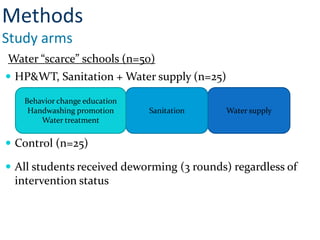
 HP&WT, Sanitation + Water supply (n=25)
 Control (n=25)
Water “scarce” schools (n=50)
Methods
Study arms
Water supplySanitation
Behavior change education
Handwashing promotion
Water treatment
 All students received deworming (3 rounds) regardless of
intervention status
Controlling for pupil grade, gender baseline school and community covariates, SES,
secular trend, baseline imbalance
Results: Absenteeism
Modeling overall effect
 No sig. effect of basic intervention on school absenteeism
 37% reduction for HP, WT. Significant at <0.1
 29% reduction for HP, WT + Sanitation, NS
Freeman MC et al 2012 TMIH
Controlling for pupil age, baseline school and community covariates, SES, secular trend,
baseline imbalance
Results: Absenteeism
Modeling effect on girls
 58% reduction in the odds of absence for the basic
intervention
 Similar reduction in the schools that also received sanitation
 3.4 days of absence avoided per year
Impact of school WASH on absence from school among girls
Freeman MC et al 2012 TMIH
Impacts for CRT
HP&WT HP&WT+San HP&WT+San+WS
Absence OR 0.63 OR 0.71 OR 1.35
Enrollment
- Gender parity
+6 pupils per school
PR 1.00
+8 pupils / school
PR 1.00
+26 pupils per school
PR 1.03
Helminth
- A. lumbricoides
- Hookworm
-
-
OR 0.56 / IRR 0.34
OR 0.80 / IRR 0.58
-
-
Pupil Diarrhea RR 1.00 / IRR 1.03 RR 0.95 / IRR 0.94 RR 0.39 / IRR 0.43
Under 5 diarrhea RR 1.21 / IRR 1.03 RR 0.76 / IRR 0.94 RR 0.44 / IRR 0.43
Under 5 clinic OR 0.64 OR 0.65 OR 0.36
 OR = Odds ratio
 RR = Risk ratio
 PR = Prevalence ratio
 IRR = Incidence rate ratio
 Significant <0.01
 Significant <0.05
 Significant <0.1
 What did we learn and how can we improve school-
WASH provision?
 The role of latrine cleanliness
 The role of hand cleanliness
 Gender dimensions
 Menstrual hygiene management is a considerable challenge
to attendance, concentration and participation
 Need a better understanding of the behavioral drivers that
resulted in observed impacts
Session 2
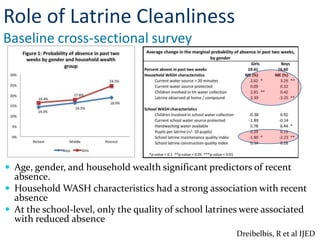
 Age, gender, and household wealth significant predictors of recent
absence.
 Household WASH characteristics had a strong association with recent
absence
 At the school-level, only the quality of school latrines were associated
with reduced absence
Role of Latrine Cleanliness
Baseline cross-sectional survey
Dreibelbis, R et al IJED
 Sanitation intervention did not meet standards
 Latrine conditions did not improve
Role of latrine cleanliness
Increased comfort and use
0.0
10.0
20.0
30.0
40.0
50.0
60.0
70.0
80.0
90.0
Basic +Sanitation Control
Basline
Final
0.0
10.0
20.0
30.0
40.0
50.0
60.0
70.0
80.0
90.0
Basic +Sanitation Control
**
**significant at 0.05
**
Girls per latrine Boys per latrine
Porter S, et al, unpublished data
 Even so, we see an increase in comfort and reported use
0
0.1
0.2
0.3
0.4
0.5
0.6
0.7
0.8
0.9
1
0 1 2 3 4 5 6 7
Proportionofuse
Proportion of block use
out of total school use
Mean proportion of
use by block
58 36 14 9 3 2 1
30
n
Role of latrine cleanliness
Proportion of use by latrine for girls
Role of latrine cleanliness
Important for predicting helminth outcomes
 CART analysis
 Inconsistent availability of soap
0.0
10.0
20.0
30.0
40.0
50.0
60.0
70.0
80.0
Basic +Sanitation Control
0.0
5.0
10.0
15.0
20.0
25.0
30.0
35.0
40.0
45.0
Basic +Sanitation Control
Baseline
Final
Handwashing water always available Soap always available
**significant at 0.05
** **
****
Role of hand cleanliness
Soap provision is low, handwashing was low
 This is one of a few studies that have shown that achieving
and sustaining handwashing is a critical challenge
43%
37%
41%
56%
91%
52%
0%
10%
20%
30%
40%
50%
60%
70%
80%
90%
100%
HP&WT
(n= 199; 233)*
San + HP&WT
(n= 88; 97)
Control
(n= 292; 322)
Baseline
Follow-up
31%
16%
27%
40%
88%
29%
0%
10%
20%
30%
40%
50%
60%
70%
80%
90%
100%
HP&WT
(n= 197; 215)*
San + HP&WT
(n= 88; 97)
Control
(n= 292; 319)
Any E. coli High* E. coli
* ≥ 100 CFU/hand
31%
16%
27%
40%
88%
29%
0%
10%
20%
30%
40%
50%
60%
70%
80%
90%
100%
HP&WT
(n= 197; 215)*
San + HP&WT
(n= 88; 97)
Control
(n= 292; 319)
Baseline
Follow-up
• Significant increase in hand contamination in sanitation package schools
• No change in schools with basic hygiene promotion
Role of hand cleanliness
Sanitation schools: higher hand contamination
1Greene L, Freeman MC, AJTM 2012
Methods
• Survey of head teachers in 114 schools.
• 6 Focus Group Discussions (FGDs) with girls and boys (age 12-15) in 3 schools.
Results
• 111 (97%) reported never providing materials for anal cleansing.
• Only 9 schools (8%) actually provided soap & water on the day of the unannounced visit.
• Students confirmed lack of access to anal cleansing materials.
• Desired materials, such as tissue paper and schoolbook paper, were described as difficult to
acquire.
‘I find it difficult to get the materials for bottom cleaning. Maybe you have money for food only.
Do you go hungry and buy wiping tissue?...
…Maybe your younger sibling in class 1 sees you tearing your book, just a sheet or two, but
they may get the wrong idea and pluck sheets ruthlessly’
– female student, grade 7, School 1.
Role of hand cleanliness
Anal cleansing materials is a key issue
McMahon, et al, TMIH 2010
Intervention
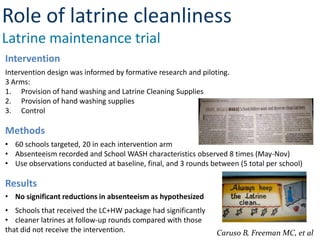
Intervention design was informed by formative research and piloting.
3 Arms:
1. Provision of hand washing and Latrine Cleaning Supplies
2. Provision of hand washing supplies
3. Control
Methods
• 60 schools targeted, 20 in each intervention arm
• Absenteeism recorded and School WASH characteristics observed 8 times (May-Nov)
• Use observations conducted at baseline, final, and 3 rounds between (5 total per school)
Results
• No significant reductions in absenteeism as hypothesized
• Schools that received the LC+HW package had significantly
• cleaner latrines at follow-up rounds compared with those
that did not receive the intervention.
Role of latrine cleanliness
Latrine maintenance trial
Caruso B, Freeman MC, et al
Methods
• 6 Schools: Focus Group Discussions (FGDs) and In-depth Interviews (IDIs) with girls and IDIs
with teachers.
Results
Menstruation is difficult for girls to manage in the school setting
“A girl will be among the most lively in class, she will participate and make good marks. Then she
turns a corner and she will not partake and she is gone.”
- Teacher
“You will not be free even when you are in class, you will be
thinking about your period and not pay attention to the
teacher.”
-Pupil, Standard 8
“The girl with her period is the one to hang her head.”
-Pupil, Standard 7
McMahon, et al, BMC 2010
Gender dimensions
Menstrual hygiene management
 How can we improve the sustainability of school WASH?
 Recognizing the challenge – SWASH Pilot sustainability
 Identifying barriers
 Tracking progress
 Testing solutions
Session 3
 SWASH pilots established in 2005
 Short-term follow up of SWASH pilots showed high level of
continued provision of water treatment and soap
 In 2008 we conducted follow up in 60 schools (2.5 yrs)
 Results were disappointing to partners and others
 38% provided water for drinking
 9% had chlorine
 18% had handwashing water
 1 school provided soap
 Key opportunity for learning within SWASH and beyond
Evaluating Sustainability of SWASH
Pilot
 Identified barriers
to sustained
services: internal
and external
environment
 Identified potential
solutions (e.g. soapy
water) to address
them within
SWASH schools
 Identified ways to
monitor these
within sustainability
toolkit
Domains of an Enabling Environment for
Sustaining School WASH
 Improved provision over time compared to the pilot, however still low
 Over 80 % of schools budgeted for key inputs, but less than 25% budgeted
enough
 Supply chain for spare parts remained a barrier
 Community wealth and nearby water source associated higher level of
sustaining
Tracking Sustainability for SWASH
Trial School
 Develop interventions to address sustainability challenges
 Improved service delivery through funding of recurrent and
maintenance costs and service staff (janitors)
 Improved roles and responsibilities trial to test the effects of
improved accountability
 Key findings
 Improved funding can improve provision of basic services
such as treated drinking water and soap for handwashing
 Schools have diverse funding needs based on their
conditions  solutions for some may not work for others
Testing Strategies for Improving
Sustainability
 Sustainability strongly constrains impacts
 School-level and administrative solutions (e.g. better
planning and M&E) can increase awareness and
accountability
 Remaining external constraints
 Costs: recurrent, maintenance and improvements
 School cannot do it on their own
 Environmental and infrastructure
 While some schools can benefit from increased provision of
supplies such as drinking water treatment, soap and latrine
cleaning supplies, others require basic water and sanitation
infrastructure
Sustainability: Key Messages
 UNICEF funded a 4 country study on MHM in schools
 WASH-B ran a trial of soapy water in B’desh
 SHARE funded WASH indicators as part of longitudinal
surveillance of STH in Kenya
 Development of WASH in schools Mapping
 WASH in schools online course for practitioners and
policy makers: 170 students from 50 countries
 SPLASH Zambia running an impact study of school
WASH, focusing on sustainability
 Dubai Consortium in Mali has funded evaluation of
country-wide program (16m) on educational impacts
Beyond SWASH+

Swash impacts outcomes

  • 1.
    SWASH+ impacts andoutcomes 2006-2012 December 5th, 2012
  • 2.
    The Team  CARE:Peter Lochery, Brooks Keene, Malaika Wright, Ben Okech, Alex Mwaki, Betty Ojeny, John Migele, Jason Oyugi, Peter Waka  Water.org: Liz Were, Caroline Teti, Patrick Alubbe  GLUK: Richard Muga, Emily Awino, Imelda Akinyi  Emory: Matthew Freeman, Robert Dreibelbis, Leslie Greene, Shadi Saboori, Kelly Alexander, Victoria Trinies, Bethany Caruso  UF: Richard Rheingans  GoK: Leah Rotich and the MoE team
  • 3.
    Sustaining and scalingschool WASH + community impact  Research Question: What is the impact of a school-based WASH intervention on pupil absence, helminth infection, and diarrhea?  Objective 1: Develop and test a scalable model for school WASH  Objective 2: Determine how to get the government to “take up” proven interventions  Implementation packages based on previous pilots  Post-election violence in 2007-08  All findings in addition to effect seen with deworming The program Research Question
  • 4.
    Where we worked Schoollocations in Nyanza Province, Kenya
  • 5.
     Hygiene promotionand water treatment (HP&WT) (n=45)  HP&WT + Sanitation arm (n=45)  Control (n=45) Water “available” schools (n=135) Methods Study arms Behavior change education Handwashing promotion Water treatment Sanitation Behavior change education Handwashing promotion Water treatment Helminth schools (n=40) randomly selected
  • 6.
     HP&WT, Sanitation+ Water supply (n=25)  Control (n=25) Water “scarce” schools (n=50) Methods Study arms Water supplySanitation Behavior change education Handwashing promotion Water treatment  All students received deworming (3 rounds) regardless of intervention status
  • 7.
    Controlling for pupilgrade, gender baseline school and community covariates, SES, secular trend, baseline imbalance Results: Absenteeism Modeling overall effect  No sig. effect of basic intervention on school absenteeism  37% reduction for HP, WT. Significant at <0.1  29% reduction for HP, WT + Sanitation, NS Freeman MC et al 2012 TMIH
  • 8.
    Controlling for pupilage, baseline school and community covariates, SES, secular trend, baseline imbalance Results: Absenteeism Modeling effect on girls  58% reduction in the odds of absence for the basic intervention  Similar reduction in the schools that also received sanitation  3.4 days of absence avoided per year Impact of school WASH on absence from school among girls Freeman MC et al 2012 TMIH
  • 9.
    Impacts for CRT HP&WTHP&WT+San HP&WT+San+WS Absence OR 0.63 OR 0.71 OR 1.35 Enrollment - Gender parity +6 pupils per school PR 1.00 +8 pupils / school PR 1.00 +26 pupils per school PR 1.03 Helminth - A. lumbricoides - Hookworm - - OR 0.56 / IRR 0.34 OR 0.80 / IRR 0.58 - - Pupil Diarrhea RR 1.00 / IRR 1.03 RR 0.95 / IRR 0.94 RR 0.39 / IRR 0.43 Under 5 diarrhea RR 1.21 / IRR 1.03 RR 0.76 / IRR 0.94 RR 0.44 / IRR 0.43 Under 5 clinic OR 0.64 OR 0.65 OR 0.36  OR = Odds ratio  RR = Risk ratio  PR = Prevalence ratio  IRR = Incidence rate ratio  Significant <0.01  Significant <0.05  Significant <0.1
  • 10.
     What didwe learn and how can we improve school- WASH provision?  The role of latrine cleanliness  The role of hand cleanliness  Gender dimensions  Menstrual hygiene management is a considerable challenge to attendance, concentration and participation  Need a better understanding of the behavioral drivers that resulted in observed impacts Session 2
  • 11.
     Age, gender,and household wealth significant predictors of recent absence.  Household WASH characteristics had a strong association with recent absence  At the school-level, only the quality of school latrines were associated with reduced absence Role of Latrine Cleanliness Baseline cross-sectional survey Dreibelbis, R et al IJED
  • 12.
     Sanitation interventiondid not meet standards  Latrine conditions did not improve Role of latrine cleanliness Increased comfort and use 0.0 10.0 20.0 30.0 40.0 50.0 60.0 70.0 80.0 90.0 Basic +Sanitation Control Basline Final 0.0 10.0 20.0 30.0 40.0 50.0 60.0 70.0 80.0 90.0 Basic +Sanitation Control ** **significant at 0.05 ** Girls per latrine Boys per latrine Porter S, et al, unpublished data  Even so, we see an increase in comfort and reported use
  • 13.
    0 0.1 0.2 0.3 0.4 0.5 0.6 0.7 0.8 0.9 1 0 1 23 4 5 6 7 Proportionofuse Proportion of block use out of total school use Mean proportion of use by block 58 36 14 9 3 2 1 30 n Role of latrine cleanliness Proportion of use by latrine for girls
  • 14.
    Role of latrinecleanliness Important for predicting helminth outcomes  CART analysis
  • 15.
     Inconsistent availabilityof soap 0.0 10.0 20.0 30.0 40.0 50.0 60.0 70.0 80.0 Basic +Sanitation Control 0.0 5.0 10.0 15.0 20.0 25.0 30.0 35.0 40.0 45.0 Basic +Sanitation Control Baseline Final Handwashing water always available Soap always available **significant at 0.05 ** ** **** Role of hand cleanliness Soap provision is low, handwashing was low  This is one of a few studies that have shown that achieving and sustaining handwashing is a critical challenge
  • 16.
    43% 37% 41% 56% 91% 52% 0% 10% 20% 30% 40% 50% 60% 70% 80% 90% 100% HP&WT (n= 199; 233)* San+ HP&WT (n= 88; 97) Control (n= 292; 322) Baseline Follow-up 31% 16% 27% 40% 88% 29% 0% 10% 20% 30% 40% 50% 60% 70% 80% 90% 100% HP&WT (n= 197; 215)* San + HP&WT (n= 88; 97) Control (n= 292; 319) Any E. coli High* E. coli * ≥ 100 CFU/hand 31% 16% 27% 40% 88% 29% 0% 10% 20% 30% 40% 50% 60% 70% 80% 90% 100% HP&WT (n= 197; 215)* San + HP&WT (n= 88; 97) Control (n= 292; 319) Baseline Follow-up • Significant increase in hand contamination in sanitation package schools • No change in schools with basic hygiene promotion Role of hand cleanliness Sanitation schools: higher hand contamination 1Greene L, Freeman MC, AJTM 2012
  • 17.
    Methods • Survey ofhead teachers in 114 schools. • 6 Focus Group Discussions (FGDs) with girls and boys (age 12-15) in 3 schools. Results • 111 (97%) reported never providing materials for anal cleansing. • Only 9 schools (8%) actually provided soap & water on the day of the unannounced visit. • Students confirmed lack of access to anal cleansing materials. • Desired materials, such as tissue paper and schoolbook paper, were described as difficult to acquire. ‘I find it difficult to get the materials for bottom cleaning. Maybe you have money for food only. Do you go hungry and buy wiping tissue?... …Maybe your younger sibling in class 1 sees you tearing your book, just a sheet or two, but they may get the wrong idea and pluck sheets ruthlessly’ – female student, grade 7, School 1. Role of hand cleanliness Anal cleansing materials is a key issue McMahon, et al, TMIH 2010
  • 18.
    Intervention Intervention design wasinformed by formative research and piloting. 3 Arms: 1. Provision of hand washing and Latrine Cleaning Supplies 2. Provision of hand washing supplies 3. Control Methods • 60 schools targeted, 20 in each intervention arm • Absenteeism recorded and School WASH characteristics observed 8 times (May-Nov) • Use observations conducted at baseline, final, and 3 rounds between (5 total per school) Results • No significant reductions in absenteeism as hypothesized • Schools that received the LC+HW package had significantly • cleaner latrines at follow-up rounds compared with those that did not receive the intervention. Role of latrine cleanliness Latrine maintenance trial Caruso B, Freeman MC, et al
  • 19.
    Methods • 6 Schools:Focus Group Discussions (FGDs) and In-depth Interviews (IDIs) with girls and IDIs with teachers. Results Menstruation is difficult for girls to manage in the school setting “A girl will be among the most lively in class, she will participate and make good marks. Then she turns a corner and she will not partake and she is gone.” - Teacher “You will not be free even when you are in class, you will be thinking about your period and not pay attention to the teacher.” -Pupil, Standard 8 “The girl with her period is the one to hang her head.” -Pupil, Standard 7 McMahon, et al, BMC 2010 Gender dimensions Menstrual hygiene management
  • 20.
     How canwe improve the sustainability of school WASH?  Recognizing the challenge – SWASH Pilot sustainability  Identifying barriers  Tracking progress  Testing solutions Session 3
  • 21.
     SWASH pilotsestablished in 2005  Short-term follow up of SWASH pilots showed high level of continued provision of water treatment and soap  In 2008 we conducted follow up in 60 schools (2.5 yrs)  Results were disappointing to partners and others  38% provided water for drinking  9% had chlorine  18% had handwashing water  1 school provided soap  Key opportunity for learning within SWASH and beyond Evaluating Sustainability of SWASH Pilot
  • 22.
     Identified barriers tosustained services: internal and external environment  Identified potential solutions (e.g. soapy water) to address them within SWASH schools  Identified ways to monitor these within sustainability toolkit Domains of an Enabling Environment for Sustaining School WASH
  • 23.
     Improved provisionover time compared to the pilot, however still low  Over 80 % of schools budgeted for key inputs, but less than 25% budgeted enough  Supply chain for spare parts remained a barrier  Community wealth and nearby water source associated higher level of sustaining Tracking Sustainability for SWASH Trial School
  • 24.
     Develop interventionsto address sustainability challenges  Improved service delivery through funding of recurrent and maintenance costs and service staff (janitors)  Improved roles and responsibilities trial to test the effects of improved accountability  Key findings  Improved funding can improve provision of basic services such as treated drinking water and soap for handwashing  Schools have diverse funding needs based on their conditions  solutions for some may not work for others Testing Strategies for Improving Sustainability
  • 25.
     Sustainability stronglyconstrains impacts  School-level and administrative solutions (e.g. better planning and M&E) can increase awareness and accountability  Remaining external constraints  Costs: recurrent, maintenance and improvements  School cannot do it on their own  Environmental and infrastructure  While some schools can benefit from increased provision of supplies such as drinking water treatment, soap and latrine cleaning supplies, others require basic water and sanitation infrastructure Sustainability: Key Messages
  • 26.
     UNICEF fundeda 4 country study on MHM in schools  WASH-B ran a trial of soapy water in B’desh  SHARE funded WASH indicators as part of longitudinal surveillance of STH in Kenya  Development of WASH in schools Mapping  WASH in schools online course for practitioners and policy makers: 170 students from 50 countries  SPLASH Zambia running an impact study of school WASH, focusing on sustainability  Dubai Consortium in Mali has funded evaluation of country-wide program (16m) on educational impacts Beyond SWASH+

Editor's Notes

  • #10 TITLE!
  • #17 TITLE!
  • #22 Three-level logistic regression model used to calculate average marginal effect of selected individual, household, and school characteristics by gender
  • #28 MATT: this and the next are the main slides that are most informative. Be sure to give enough time to these.
  • #29 We could say we are looking at use now.
  • #30 We could say we are looking at use now.
  • #31 We could say we are looking at use now.
  • #33 Working with CARE to better understand the
  • #41 Add name, fix chart, titles