GRAMMAR :
SUBJECT - VERB
AGREEMENT
BY:
NUR SHAMSINAR RAMLI
INTRODUCTION
 In sentences the subject and the verb have to
agree in number.
Ok..well, what does that mean?
Let’s break it down. We’re going to talk about:
Subjects Number
Verbs Agreement
SUBJECT
 The subject is what the sentence is about. It’s the
WHO that does something.
The cat ate some cheese.
My sister and I love to dance.
While riding my bike, I ran over a tree.
VERB
 The verb is an action or state of being.
 The action verbs are the easiest to find, because
they are verbs of DOING.
The girl ate a hot dog.
My sister dances for hours.
 A state of being verb shows that something
EXISTS. (You just have to memorize these verbs)
You are my friend.My sister was tired.
AGREEMENT AND NUMBER
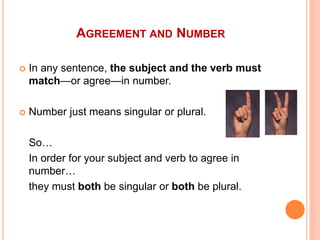
 In any sentence, the subject and the verb must
match—or agree—in number.
 Number just means singular or plural.
So…
In order for your subject and verb to agree in
number…
they must both be singular or both be plural.
Basic Principle
 Singular subjects need singular verbs; plural subjects
need plural verbs.
-My brother is a nutritionist.
-My sisters are mathematicians.
RULE 1
 When nor or or is used, the subject closer to the verb
determines the number of the verb.
 Example:
-My aunt or my uncle is arriving by train today.
-Either my father or my brothers are going to sell the
house.
-Neither my brothers nor my father is going to sell the
house.
RULE 2
 The pronouns neither and either are singular and
require singular verbs.
 Examples:
-Neither Juan nor Carmen is available.
-Either Kiana or Casey is helping today with stage
decorations.
Neither and either sometimes take a plural verb
when they are followed by a prepositional phrase
beginning with of.
Examples: Are either of you taking this seriously?
RULE 3
 When I is one of the two subjects connected
by either/or or neither/nor, put it second and follow it
with the singular verb am.
 Example:
Neither she nor I am going to the festival.
RULE 4
 The pronouns each, nobody, everyone, everybody,
anyone, anybody, someone, and somebody are
singular and require singular verbs.
 Examples:
-Each of the girls sings well.
-Every one of the cakes is gone.
RULE 5
 With words that indicate portions—percent, fraction,
part, majority, some, all, none, remainder, and so
forth —look at the noun in your of phrase to determine
the verb.
 If the object of the preposition is singular, use a singular
verb.
 If the object of the preposition is plural, use a plural
verb.
 Examples:
-Fifty percent of the pie has disappeared.
-Fifty percent of the pies have disappeared.
RULE 6
 The expression the number is followed by a singular
verb while the expression a number is followed by a
plural verb.
 Examples:
-The number of people we need to hire is thirteen.
-A number of people have written in about this subject.
RULE 7
 Use a singular verb with sums of money or periods of
time.
 Examples:
-Ten dollars is a high price to pay.
-Five years is the maximum sentence for that offense.
RULE 8
 Sometimes the pronoun who, that, or which is the
subject of a verb in the middle of the sentence.
 They become singular or plural according to the noun
directly in front of them.
 So, if that noun is singular, use a singular verb. If it is
plural, use a plural verb.
 Examples:
-Salma is the scientist who writes the reports.
-He is one of the men who do the work.
RULE 9
 Collective nouns such as team and staff may be either
singular or plural depending on their use in the sentence.
 Examples:
-The staff is in a meeting.(Staff is acting as a unit here)
RULE 10
 Sometimes the subject is separated from the verb by
words such as along with, as well as, besides, or not.
 Ignore these expressions when determining the verb.
 Examples:
-The politician, along with the newsmen, is
expected shortly.

Sva my version

  • 1.
    GRAMMAR : SUBJECT -VERB AGREEMENT BY: NUR SHAMSINAR RAMLI
  • 2.
    INTRODUCTION  In sentencesthe subject and the verb have to agree in number. Ok..well, what does that mean? Let’s break it down. We’re going to talk about: Subjects Number Verbs Agreement
  • 3.
    SUBJECT  The subjectis what the sentence is about. It’s the WHO that does something. The cat ate some cheese. My sister and I love to dance. While riding my bike, I ran over a tree.
  • 4.
    VERB  The verbis an action or state of being.  The action verbs are the easiest to find, because they are verbs of DOING. The girl ate a hot dog. My sister dances for hours.  A state of being verb shows that something EXISTS. (You just have to memorize these verbs) You are my friend.My sister was tired.
  • 5.
    AGREEMENT AND NUMBER In any sentence, the subject and the verb must match—or agree—in number.  Number just means singular or plural. So… In order for your subject and verb to agree in number… they must both be singular or both be plural.
  • 6.
    Basic Principle  Singularsubjects need singular verbs; plural subjects need plural verbs. -My brother is a nutritionist. -My sisters are mathematicians. RULE 1  When nor or or is used, the subject closer to the verb determines the number of the verb.  Example: -My aunt or my uncle is arriving by train today. -Either my father or my brothers are going to sell the house. -Neither my brothers nor my father is going to sell the house.
  • 7.
    RULE 2  Thepronouns neither and either are singular and require singular verbs.  Examples: -Neither Juan nor Carmen is available. -Either Kiana or Casey is helping today with stage decorations. Neither and either sometimes take a plural verb when they are followed by a prepositional phrase beginning with of. Examples: Are either of you taking this seriously?
  • 8.
    RULE 3  WhenI is one of the two subjects connected by either/or or neither/nor, put it second and follow it with the singular verb am.  Example: Neither she nor I am going to the festival. RULE 4  The pronouns each, nobody, everyone, everybody, anyone, anybody, someone, and somebody are singular and require singular verbs.  Examples: -Each of the girls sings well. -Every one of the cakes is gone.
  • 9.
    RULE 5  Withwords that indicate portions—percent, fraction, part, majority, some, all, none, remainder, and so forth —look at the noun in your of phrase to determine the verb.  If the object of the preposition is singular, use a singular verb.  If the object of the preposition is plural, use a plural verb.  Examples: -Fifty percent of the pie has disappeared. -Fifty percent of the pies have disappeared.
  • 10.
    RULE 6  Theexpression the number is followed by a singular verb while the expression a number is followed by a plural verb.  Examples: -The number of people we need to hire is thirteen. -A number of people have written in about this subject. RULE 7  Use a singular verb with sums of money or periods of time.  Examples: -Ten dollars is a high price to pay. -Five years is the maximum sentence for that offense.
  • 11.
    RULE 8  Sometimesthe pronoun who, that, or which is the subject of a verb in the middle of the sentence.  They become singular or plural according to the noun directly in front of them.  So, if that noun is singular, use a singular verb. If it is plural, use a plural verb.  Examples: -Salma is the scientist who writes the reports. -He is one of the men who do the work.
  • 12.
    RULE 9  Collectivenouns such as team and staff may be either singular or plural depending on their use in the sentence.  Examples: -The staff is in a meeting.(Staff is acting as a unit here) RULE 10  Sometimes the subject is separated from the verb by words such as along with, as well as, besides, or not.  Ignore these expressions when determining the verb.  Examples: -The politician, along with the newsmen, is expected shortly.