DESCRIBE THE MATERIALS AND
METHODS USED FOR SURGICAL
WOUND CLOSURE AND ANASTOMOSIS
(SUTURES, KNOTS AND NEEDLES)
MATERIALS USED FOR SURGICAL WOUND
CLOSURE
 Suture materials
 Barbed sutures
 Skin adhesive strips
 Tissue glue
 Staples
SUTURE MATERIALS
Desired characteristsics
 Easy to handle
 Predictable behaviour in tissues
 Predictable tensile strength
 Sterile
 Glides through tissues easily
 Secure knotting ability
 Inexpensive
 Minimal tissue reaction
 Non-capillary
 Non-allergenic
 Non-carcinogenic
 Non-electrolytic
TYPES OF SUTURES
A. Absorbable sutures:
These sutures get absorbed in the tissues either by enzymatic digestion
or by phagocytosis. Depending on the source, these sutures may be:
1. Natural absorbable sutures:
− Plain and chromic catgut.
2. Synthetic absorbable sutures:
− Polyglycolic acid (dexon)
− Polyglactin 910 (vicryl)
− Polyglactin 910 rapide (vicryl rapide)
− Polydioxanone suture (PDS)
− Polyglecaprone 25 (monocryl).
B. Nonabsorbable sutures:
These sutures remain in the tissues for indefinite period.
Depending on the source, these sutures may be:
1. Natural nonabsorbable sutures:
− Linen thread
− Silk.
2. Synthetic nonabsorbable sutures:
− Polypropylene (prolene)
− Monofilament polyamide (ethilon)
− Polyester (ethibond)
− Nylon.
Depending on the number of strands in the suture materials, sutures may be:
„Monofilament sutures:
• Sutures consisting of a single strand of fiber are called monofilament sutures.
• These sutures are smooth and strong.
• Chance of bacterial contamination is less.
• The disadvantage is that knot tied may become loose.
• E.g. Polypropylene, Polyamide, Catgut, Monocryl, Polydioxanone
„Polyfilament sutures:
• Sutures consisting of multiple strands braided together are called polyfilament sutures.
• They are easier to handle and the knot tied does not slip.
• The disadvantage is that the bacteria may lodge in the crevices of the sutures so these
sutures are not suitable in presence of infection, e.g. silk, linen, polyglycolic acid,
polyglactin 910, braided polyamide and braided polyester.
STAPLES
 Wide range of mechanical devices are
available
- Linear
- Side-to-side
- End-to-end stapling devices
 Disposable and relatively expensive.
 Less of operative time.
TISSUE GLUE
 Based upon a solution of n-butyl-2-cyanoacrylate
monomer. When it is applied to a wound, it polymerises
to form a firm adhesive bond.
 Wound does need to be clean, dry, with near perfect
haemostasis and under no tension.
SKIN ADHESIVE STRIPS
 For the skin, self-adhesive tapes or steristrips may
be used.
 There is no tension and not too much moisture.
 They may also be used to minimise ‘spreading’ of a
scar.
 Other adhesive polyurethane films, such as Opsite,
Tegaderm or Bioclusive, may provide a similar
benefit.
METHODS USED FOR SURGICAL WOUND CLOSURE AND
ANASTOMOSIS
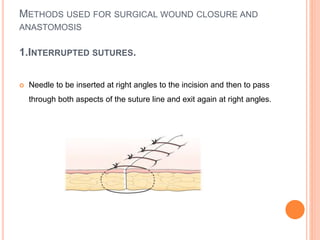
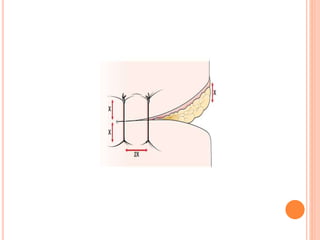
1.INTERRUPTED SUTURES.
 Needle to be inserted at right angles to the incision and then to pass
through both aspects of the suture line and exit again at right angles.
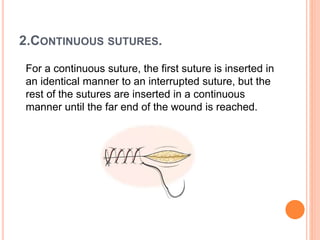
2.CONTINUOUS SUTURES.
For a continuous suture, the first suture is inserted in
an identical manner to an interrupted suture, but the
rest of the sutures are inserted in a continuous
manner until the far end of the wound is reached.
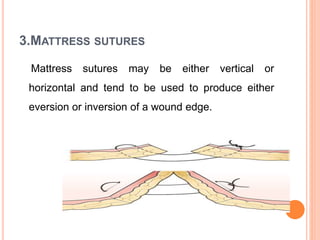
3.MATTRESS SUTURES
Mattress sutures may be either vertical or
horizontal and tend to be used to produce either
eversion or inversion of a wound edge.
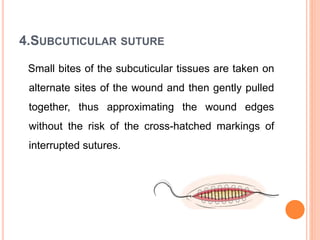
4.SUBCUTICULAR SUTURE
Small bites of the subcuticular tissues are taken on
alternate sites of the wound and then gently pulled
together, thus approximating the wound edges
without the risk of the cross-hatched markings of
interrupted sutures.
NEEDLES
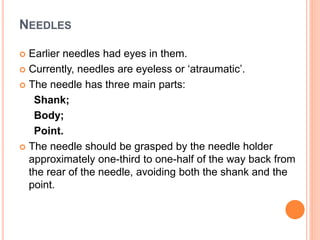
 Earlier needles had eyes in them.
 Currently, needles are eyeless or ‘atraumatic’.
 The needle has three main parts:
Shank;
Body;
Point.
 The needle should be grasped by the needle holder
approximately one-third to one-half of the way back from
the rear of the needle, avoiding both the shank and the
point.
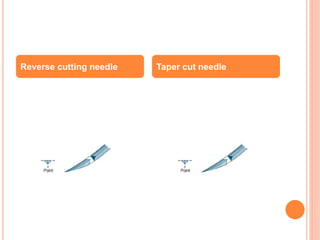
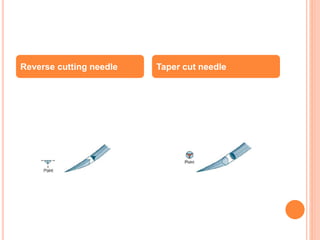
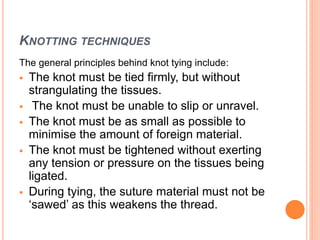
Reverse cutting needle Taper cut needle
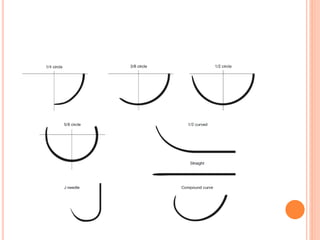
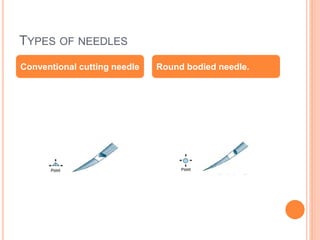
TYPES OF NEEDLES
Conventional cutting needle Round bodied needle.
Reverse cutting needle Taper cut needle
KNOTTING TECHNIQUES
The general principles behind knot tying include:
 The knot must be tied firmly, but without
strangulating the tissues.
 The knot must be unable to slip or unravel.
 The knot must be as small as possible to
minimise the amount of foreign material.
 The knot must be tightened without exerting
any tension or pressure on the tissues being
ligated.
 During tying, the suture material must not be
‘sawed’ as this weakens the thread.
 The suture material must be laid square during
tying, otherwise tension applied during tightening
may cause breakage or fracture of the thread.
 When tying an instrument knot, the thread should
only be grasped at the free end, as gripping the
thread with artery forceps or needle holders can
damage the material and again result in breakage
or fracture.
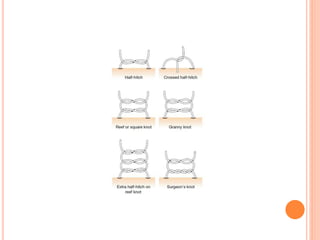
 The standard surgical knot is the reef knot with a
third throw for security
 A granny knot involves two throws of the same type
of throw and is a slip knot.
 When added security is required, a surgeon’s knot
using a two throw technique is advisable to prevent
slippage.
 When using a continuous suture technique, an
Aberdeen knot may be used for the final knot.
 When the suture is cut after knotting, the ends
should be left about 1–2 mm long to prevent
unraveling, particularly with monofilament material.
sutures and knots.pptx

sutures and knots.pptx

  • 1.
    DESCRIBE THE MATERIALSAND METHODS USED FOR SURGICAL WOUND CLOSURE AND ANASTOMOSIS (SUTURES, KNOTS AND NEEDLES)
  • 2.
    MATERIALS USED FORSURGICAL WOUND CLOSURE  Suture materials  Barbed sutures  Skin adhesive strips  Tissue glue  Staples
  • 3.
    SUTURE MATERIALS Desired characteristsics Easy to handle  Predictable behaviour in tissues  Predictable tensile strength  Sterile  Glides through tissues easily  Secure knotting ability  Inexpensive  Minimal tissue reaction  Non-capillary  Non-allergenic  Non-carcinogenic  Non-electrolytic
  • 4.
    TYPES OF SUTURES A.Absorbable sutures: These sutures get absorbed in the tissues either by enzymatic digestion or by phagocytosis. Depending on the source, these sutures may be: 1. Natural absorbable sutures: − Plain and chromic catgut. 2. Synthetic absorbable sutures: − Polyglycolic acid (dexon) − Polyglactin 910 (vicryl) − Polyglactin 910 rapide (vicryl rapide) − Polydioxanone suture (PDS) − Polyglecaprone 25 (monocryl).
  • 5.
    B. Nonabsorbable sutures: Thesesutures remain in the tissues for indefinite period. Depending on the source, these sutures may be: 1. Natural nonabsorbable sutures: − Linen thread − Silk. 2. Synthetic nonabsorbable sutures: − Polypropylene (prolene) − Monofilament polyamide (ethilon) − Polyester (ethibond) − Nylon.
  • 6.
    Depending on thenumber of strands in the suture materials, sutures may be: „Monofilament sutures: • Sutures consisting of a single strand of fiber are called monofilament sutures. • These sutures are smooth and strong. • Chance of bacterial contamination is less. • The disadvantage is that knot tied may become loose. • E.g. Polypropylene, Polyamide, Catgut, Monocryl, Polydioxanone „Polyfilament sutures: • Sutures consisting of multiple strands braided together are called polyfilament sutures. • They are easier to handle and the knot tied does not slip. • The disadvantage is that the bacteria may lodge in the crevices of the sutures so these sutures are not suitable in presence of infection, e.g. silk, linen, polyglycolic acid, polyglactin 910, braided polyamide and braided polyester.
  • 7.
    STAPLES  Wide rangeof mechanical devices are available - Linear - Side-to-side - End-to-end stapling devices  Disposable and relatively expensive.  Less of operative time.
  • 8.
    TISSUE GLUE  Basedupon a solution of n-butyl-2-cyanoacrylate monomer. When it is applied to a wound, it polymerises to form a firm adhesive bond.  Wound does need to be clean, dry, with near perfect haemostasis and under no tension.
  • 9.
    SKIN ADHESIVE STRIPS For the skin, self-adhesive tapes or steristrips may be used.  There is no tension and not too much moisture.  They may also be used to minimise ‘spreading’ of a scar.  Other adhesive polyurethane films, such as Opsite, Tegaderm or Bioclusive, may provide a similar benefit.
  • 10.
    METHODS USED FORSURGICAL WOUND CLOSURE AND ANASTOMOSIS 1.INTERRUPTED SUTURES.  Needle to be inserted at right angles to the incision and then to pass through both aspects of the suture line and exit again at right angles.
  • 12.
    2.CONTINUOUS SUTURES. For acontinuous suture, the first suture is inserted in an identical manner to an interrupted suture, but the rest of the sutures are inserted in a continuous manner until the far end of the wound is reached.
  • 13.
    3.MATTRESS SUTURES Mattress suturesmay be either vertical or horizontal and tend to be used to produce either eversion or inversion of a wound edge.
  • 14.
    4.SUBCUTICULAR SUTURE Small bitesof the subcuticular tissues are taken on alternate sites of the wound and then gently pulled together, thus approximating the wound edges without the risk of the cross-hatched markings of interrupted sutures.
  • 15.
    NEEDLES  Earlier needleshad eyes in them.  Currently, needles are eyeless or ‘atraumatic’.  The needle has three main parts: Shank; Body; Point.  The needle should be grasped by the needle holder approximately one-third to one-half of the way back from the rear of the needle, avoiding both the shank and the point.
  • 17.
    Reverse cutting needleTaper cut needle
  • 18.
    TYPES OF NEEDLES Conventionalcutting needle Round bodied needle.
  • 19.
    Reverse cutting needleTaper cut needle
  • 20.
    KNOTTING TECHNIQUES The generalprinciples behind knot tying include:  The knot must be tied firmly, but without strangulating the tissues.  The knot must be unable to slip or unravel.  The knot must be as small as possible to minimise the amount of foreign material.  The knot must be tightened without exerting any tension or pressure on the tissues being ligated.  During tying, the suture material must not be ‘sawed’ as this weakens the thread.
  • 21.
     The suturematerial must be laid square during tying, otherwise tension applied during tightening may cause breakage or fracture of the thread.  When tying an instrument knot, the thread should only be grasped at the free end, as gripping the thread with artery forceps or needle holders can damage the material and again result in breakage or fracture.
  • 22.
     The standardsurgical knot is the reef knot with a third throw for security  A granny knot involves two throws of the same type of throw and is a slip knot.  When added security is required, a surgeon’s knot using a two throw technique is advisable to prevent slippage.  When using a continuous suture technique, an Aberdeen knot may be used for the final knot.  When the suture is cut after knotting, the ends should be left about 1–2 mm long to prevent unraveling, particularly with monofilament material.