Sustained Profits With
Total Cost of Risk
Understanding Total Cost of Risk (TCOR)
Risk exists everywhere in business. If your business is only focusing on insurance premiums as your way of
quantifying risk, you may be missing costs that you have more control over.
For example, premiums may be the least controllable costs, as insurance rates are determined by outside
forces such as weather related events, the stock market, interest rates and the insurance marketplace.
Furthermore, the benefit of decreasing premiums is negated if an organization sees an increase in indirect
costs of claims and administrative costs. True cost reduction is most impacted by lowering indirect costs,
which can cost more than the actual claim itself. TCOR helps identify those costs.
Components of TCOR
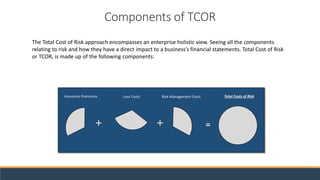
+ + =
Insurance Premiums Loss Costs Risk Management Costs Total Costs of Risk
The Total Cost of Risk approach encompasses an enterprise holistic view. Seeing all the components
relating to risk and how they have a direct impact to a business’s financial statements. Total Cost of Risk
or TCOR, is made up of the following components:
Components of TCOR
• Insurance Premiums - A traditional method of accounting for the total amount of premiums paid to
insurers.
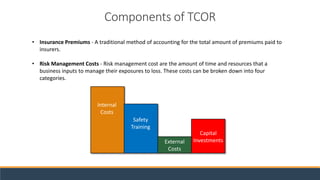
• Risk Management Costs - Risk management cost are the amount of time and resources that a
business inputs to manage their exposures to loss. These costs can be broken down into four
categories.
Internal
Costs
Safety
Training
External
Costs
Capital
Investments
Components of TCOR
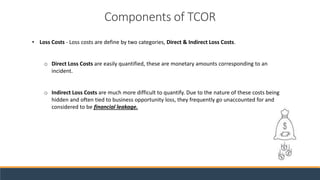
• Loss Costs - Loss costs are define by two categories, Direct & Indirect Loss Costs.
o Direct Loss Costs are easily quantified, these are monetary amounts corresponding to an
incident.
o Indirect Loss Costs are much more difficult to quantify. Due to the nature of these costs being
hidden and often tied to business opportunity loss, they frequently go unaccounted for and
considered to be financial leakage.
Financial Leakage
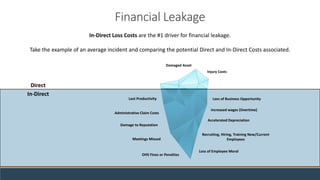
In-Direct Loss Costs are the #1 driver for financial leakage.
Take the example of an average incident and comparing the potential Direct and In-Direct Costs associated.
Meetings Missed
Damage to Reputation
OHS Fines or Penalties
Lost Productivity
Administrative Claim Costs
Loss of Business Opportunity
Loss of Employee Moral
Recruiting, Hiring, Training New/Current
Employees
Accelerated Depreciation
Increased wages (Overtime)
Damaged Asset
Injury Costs
Direct
In-Direct
Financial Leakage
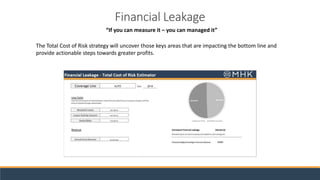
“If you can measure it – you can managed it”
The Total Cost of Risk strategy will uncover those keys areas that are impacting the bottom line and
provide actionable steps towards greater profits.
Total Cost of Risk
0.00
5.00
10.00
15.00
20.00
25.00
30.00
2017 2018 2019
TCOR Rate
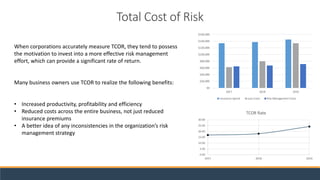
When corporations accurately measure TCOR, they tend to possess
the motivation to invest into a more effective risk management
effort, which can provide a significant rate of return.
Many business owners use TCOR to realize the following benefits:
• Increased productivity, profitability and efficiency
• Reduced costs across the entire business, not just reduced
insurance premiums
• A better idea of any inconsistencies in the organization’s risk
management strategy
$0
$20,000
$40,000
$60,000
$80,000
$100,000
$120,000
$140,000
$160,000
2017 2018 2019
Insurance Spend Loss Costs Risk Management Costs
For more information on how to utilize TCOR to maximize the bottom line – Feel free to contact:
Brad Gaboury
bgaboury@mhkinsurance.com
Text/Call: 780-887-7755

Sustained profits with TCOR

  • 1.
  • 2.
    Understanding Total Costof Risk (TCOR) Risk exists everywhere in business. If your business is only focusing on insurance premiums as your way of quantifying risk, you may be missing costs that you have more control over. For example, premiums may be the least controllable costs, as insurance rates are determined by outside forces such as weather related events, the stock market, interest rates and the insurance marketplace. Furthermore, the benefit of decreasing premiums is negated if an organization sees an increase in indirect costs of claims and administrative costs. True cost reduction is most impacted by lowering indirect costs, which can cost more than the actual claim itself. TCOR helps identify those costs.
  • 3.
    Components of TCOR ++ = Insurance Premiums Loss Costs Risk Management Costs Total Costs of Risk The Total Cost of Risk approach encompasses an enterprise holistic view. Seeing all the components relating to risk and how they have a direct impact to a business’s financial statements. Total Cost of Risk or TCOR, is made up of the following components:
  • 4.
    Components of TCOR •Insurance Premiums - A traditional method of accounting for the total amount of premiums paid to insurers. • Risk Management Costs - Risk management cost are the amount of time and resources that a business inputs to manage their exposures to loss. These costs can be broken down into four categories. Internal Costs Safety Training External Costs Capital Investments
  • 5.
    Components of TCOR •Loss Costs - Loss costs are define by two categories, Direct & Indirect Loss Costs. o Direct Loss Costs are easily quantified, these are monetary amounts corresponding to an incident. o Indirect Loss Costs are much more difficult to quantify. Due to the nature of these costs being hidden and often tied to business opportunity loss, they frequently go unaccounted for and considered to be financial leakage.
  • 6.
    Financial Leakage In-Direct LossCosts are the #1 driver for financial leakage. Take the example of an average incident and comparing the potential Direct and In-Direct Costs associated. Meetings Missed Damage to Reputation OHS Fines or Penalties Lost Productivity Administrative Claim Costs Loss of Business Opportunity Loss of Employee Moral Recruiting, Hiring, Training New/Current Employees Accelerated Depreciation Increased wages (Overtime) Damaged Asset Injury Costs Direct In-Direct
  • 7.
    Financial Leakage “If youcan measure it – you can managed it” The Total Cost of Risk strategy will uncover those keys areas that are impacting the bottom line and provide actionable steps towards greater profits.
  • 8.
    Total Cost ofRisk 0.00 5.00 10.00 15.00 20.00 25.00 30.00 2017 2018 2019 TCOR Rate When corporations accurately measure TCOR, they tend to possess the motivation to invest into a more effective risk management effort, which can provide a significant rate of return. Many business owners use TCOR to realize the following benefits: • Increased productivity, profitability and efficiency • Reduced costs across the entire business, not just reduced insurance premiums • A better idea of any inconsistencies in the organization’s risk management strategy $0 $20,000 $40,000 $60,000 $80,000 $100,000 $120,000 $140,000 $160,000 2017 2018 2019 Insurance Spend Loss Costs Risk Management Costs
  • 9.
    For more informationon how to utilize TCOR to maximize the bottom line – Feel free to contact: Brad Gaboury bgaboury@mhkinsurance.com Text/Call: 780-887-7755