A Lynda.com Tutorial Summary
Prepared by: Mitchell Krcelic
Linkedin Profile
02/12/19

 Risk Management is essential in any type of
business.
 What happened in the past would stay in the past.
 Predicting the future before it is too late.
 Without Risk Management business would not stand
for long. Example (Enron)
Bottom Line

 Risk management is crucial in a company as it will
either help avoid downside risks and focus more on
the upside risks.
 There are Financial and Non-Financial risks.
Understanding Risk in
Cooptation

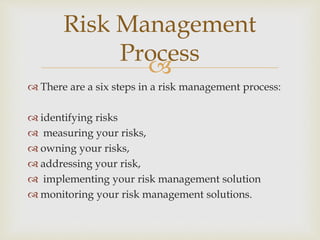
 There are a six steps in a risk management process:
 identifying risks
 measuring your risks,
 owning your risks,
 addressing your risk,
 implementing your risk management solution
 monitoring your risk management solutions.
Risk Management
Process

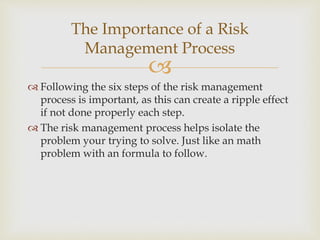
 Following the six steps of the risk management
process is important, as this can create a ripple effect
if not done properly each step.
 The risk management process helps isolate the
problem your trying to solve. Just like an math
problem with an formula to follow.
The Importance of a Risk
Management Process

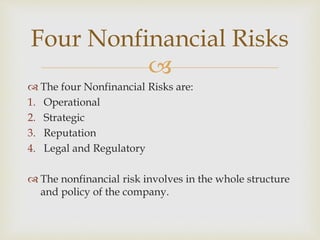
 The four Nonfinancial Risks are:
1. Operational
2. Strategic
3. Reputation
4. Legal and Regulatory
 The nonfinancial risk involves in the whole structure
and policy of the company.
Four Nonfinancial Risks

 The five financial corporate risks are:
1. Business
2. Market
3. Credit
4. Liquidity
5. Counterparty
 Financial corporate risks involves more how the
company creates loss and profits.
Five Financial Corporate Risks

 Interest rates, currencies, and commodity prices can
hurt the company’s bottom line as these three factors
decreases or increases.
 Understanding how interest rate and prices affect the
companies bottom line shows how valuable you are.
Overview of Financial Market Risks

 Direct and Indirect risks can be derived from a
vendor.
 Direct risks are something that you can see physical
and financial meaning, you are able to predict what
might happen.
 Indirect risks are currency and commodity’s you
never know when an economy might crash or a
country adds on tariffs to certain goods.
Direct and Indirect Risks

 the central bank, OPEC and the weather which could
have a positive or negative effect upon companies
profits. Owning and selling risks.
Financial Risk Management
Solutions

 When a call option is above the striking price it is
called “In the Money” and similary if the put option
is below the striking price it is also called “In the
Money”.
Financial Solutions: Options

 Increase in interest rates going up is bad for a
business’s cash flows. Interest rate swaps provides
an exchange between two parties.
Financial Solutions:
Interest Rates Swap

 Forward or commodity future contracts are used
mainly for hedging and applies to agricultural,
energy and metal. This is mainly use for buyer and
seller’s assets.
Financial Solutions: Futures and
Forwards

 Four types of factors that impact the price of solution:
1. Standardization
2. Time
3. Liquidity
4. Market Volatility
 All of these factors are related to the market such as
product, timing or geography. Understanding how the
market works and the risks behind it could help with
companies cash flows in the future.
Financial Risk Management Solution
Costs: Standardization and Time.

 Less liquid in markets means more expensive due to
higher implied volatility which ultimately impacts
the pricing models in hedging.
Financial Risk Management Solution
Costs: Liquidity and Volatility

 Nonfinancial Solutions are natural hedges, physical
agreements, acquisitions and diversities. These types
of management solutions are not financial based,
instead more operational.
Nonfinancial Solutions

 A professional risk manager’s goal should be
monitor, measure and actively manage risks in a
corporation.
Professionals in Risk Management

 Quantitative data are used for prediction or
government based numbers and qualitative data are
media sources or human derived data.
Quantitative and Qualitative Data
Collection for Risk Management

Understanding Risk in Corporation

  • 1.
    A Lynda.com TutorialSummary Prepared by: Mitchell Krcelic Linkedin Profile 02/12/19
  • 2.
      Risk Managementis essential in any type of business.  What happened in the past would stay in the past.  Predicting the future before it is too late.  Without Risk Management business would not stand for long. Example (Enron) Bottom Line
  • 4.
      Risk managementis crucial in a company as it will either help avoid downside risks and focus more on the upside risks.  There are Financial and Non-Financial risks. Understanding Risk in Cooptation
  • 5.
      There area six steps in a risk management process:  identifying risks  measuring your risks,  owning your risks,  addressing your risk,  implementing your risk management solution  monitoring your risk management solutions. Risk Management Process
  • 6.
      Following thesix steps of the risk management process is important, as this can create a ripple effect if not done properly each step.  The risk management process helps isolate the problem your trying to solve. Just like an math problem with an formula to follow. The Importance of a Risk Management Process
  • 8.
      The fourNonfinancial Risks are: 1. Operational 2. Strategic 3. Reputation 4. Legal and Regulatory  The nonfinancial risk involves in the whole structure and policy of the company. Four Nonfinancial Risks
  • 9.
      The fivefinancial corporate risks are: 1. Business 2. Market 3. Credit 4. Liquidity 5. Counterparty  Financial corporate risks involves more how the company creates loss and profits. Five Financial Corporate Risks
  • 10.
      Interest rates,currencies, and commodity prices can hurt the company’s bottom line as these three factors decreases or increases.  Understanding how interest rate and prices affect the companies bottom line shows how valuable you are. Overview of Financial Market Risks
  • 11.
      Direct andIndirect risks can be derived from a vendor.  Direct risks are something that you can see physical and financial meaning, you are able to predict what might happen.  Indirect risks are currency and commodity’s you never know when an economy might crash or a country adds on tariffs to certain goods. Direct and Indirect Risks
  • 13.
      the centralbank, OPEC and the weather which could have a positive or negative effect upon companies profits. Owning and selling risks. Financial Risk Management Solutions
  • 14.
      When acall option is above the striking price it is called “In the Money” and similary if the put option is below the striking price it is also called “In the Money”. Financial Solutions: Options
  • 15.
      Increase ininterest rates going up is bad for a business’s cash flows. Interest rate swaps provides an exchange between two parties. Financial Solutions: Interest Rates Swap
  • 16.
      Forward orcommodity future contracts are used mainly for hedging and applies to agricultural, energy and metal. This is mainly use for buyer and seller’s assets. Financial Solutions: Futures and Forwards
  • 17.
      Four typesof factors that impact the price of solution: 1. Standardization 2. Time 3. Liquidity 4. Market Volatility  All of these factors are related to the market such as product, timing or geography. Understanding how the market works and the risks behind it could help with companies cash flows in the future. Financial Risk Management Solution Costs: Standardization and Time.
  • 18.
      Less liquidin markets means more expensive due to higher implied volatility which ultimately impacts the pricing models in hedging. Financial Risk Management Solution Costs: Liquidity and Volatility
  • 19.
      Nonfinancial Solutionsare natural hedges, physical agreements, acquisitions and diversities. These types of management solutions are not financial based, instead more operational. Nonfinancial Solutions
  • 21.
      A professionalrisk manager’s goal should be monitor, measure and actively manage risks in a corporation. Professionals in Risk Management
  • 22.
      Quantitative dataare used for prediction or government based numbers and qualitative data are media sources or human derived data. Quantitative and Qualitative Data Collection for Risk Management