Sustainable Reverse Logistics Network Engineering And Management Daoud Aitkadi
1.
Sustainable Reverse LogisticsNetwork
Engineering And Management Daoud Aitkadi
download
https://ebookbell.com/product/sustainable-reverse-logistics-
network-engineering-and-management-daoud-aitkadi-4312832
Explore and download more ebooks at ebookbell.com
2.
Here are somerecommended products that we believe you will be
interested in. You can click the link to download.
Two Meals A Day The Simple Sustainable Strategy To Lose Fat Reverse
Aging And Break Free From Diet Frustration Forever Mark Sisson Brad
Kearns
https://ebookbell.com/product/two-meals-a-day-the-simple-sustainable-
strategy-to-lose-fat-reverse-aging-and-break-free-from-diet-
frustration-forever-mark-sisson-brad-kearns-24138710
Sustainable Development Report 2022 Jeffrey Sachs Christian Kroll
https://ebookbell.com/product/sustainable-development-
report-2022-jeffrey-sachs-christian-kroll-44874438
Sustainable Food Packaging Technology Athanassia Athanassiou
https://ebookbell.com/product/sustainable-food-packaging-technology-
athanassia-athanassiou-44881282
Sustainable Living At The Centre For Alternative Technology Radical
Ideas And Practical Solutions Stephen Jacobs
https://ebookbell.com/product/sustainable-living-at-the-centre-for-
alternative-technology-radical-ideas-and-practical-solutions-stephen-
jacobs-44939322
3.
Sustainable Microbial TechnologiesFor Valorization Of Agroindustrial
Wastes 1st Jitendra Kumar Saini
https://ebookbell.com/product/sustainable-microbial-technologies-for-
valorization-of-agroindustrial-wastes-1st-jitendra-kumar-
saini-44993164
Sustainable Places Addressing Social Inequality And Environmental
Crisis David Adamson
https://ebookbell.com/product/sustainable-places-addressing-social-
inequality-and-environmental-crisis-david-adamson-44993194
Sustainable Development In Postpandemic Africa Fred Olayele
https://ebookbell.com/product/sustainable-development-in-postpandemic-
africa-fred-olayele-44993196
Sustainable Supply Chain Management 1st Edition Jolle Morana
https://ebookbell.com/product/sustainable-supply-chain-management-1st-
edition-jolle-morana-45015136
Sustainable Management Of Mediterranean Coastal Fresh And Transitional
Water Bodies A Socioeconomic And Environmental Analysis Of Changes And
Trends To Enhance And Sustain Stakeholders Benefits 1st Edition
Felicita Scapini
https://ebookbell.com/product/sustainable-management-of-mediterranean-
coastal-fresh-and-transitional-water-bodies-a-socioeconomic-and-
environmental-analysis-of-changes-and-trends-to-enhance-and-sustain-
stakeholders-benefits-1st-edition-felicita-scapini-45210068
Introduction
Reverse logistics isbooming. This expression is not even 20 years old yet! As a
teenager, reverse logistics is still being defined and is still maturing. Ongoing
research into this subject brings out appropriate methods to be implemented. Much
remains to be said, much remains to be suggested.
In this introduction, we will look back at the changes in the design and
management methods of production systems of goods and services. This historical
perspective will provide us with a better understanding of where the preoccupation
about logistics aspects comes from. Changes in the make-up of our society have
brought us to notice that reverse logistics answer current concerns and that businesses
cannot really avoid it. This brief review of the events that had a great impact on
business design and management throughout the last few decades are examined in this
book which also gives the author’s point of view and positioning of perspectives.
The core mission of any business producing goods and services is focused on
profitability. Profitability can be achieved in two ways: increasing the profit margin
or reducing costs. Increasing the profit margin can be successful in monopoly
situations, but not within a competitive market. The first industrial engineering tools
(1940–1946) [HAM 71], such as operation process charts, flow process charts, and
assembly charts, can be analyzed with the help of the interrogation technique (who,
what, how, where, and why). These tools were mainly developed in order to reduce
costs. Simplifying methods, organizing the workload, stopping wasting human,
material and financial resources, and choosing the most productive processes were
the first contributions of industrial engineering. The value analysis technique that
was developed by Miles in 1945 [LAC 80] is another example. Miles worked on
how to focus only on the product or service functions that are expected by
consumers and on the value that consumers attach to the solutions suggested
answering their needs.
12.
x Sustainable ReverseLogistics Network
During each economic crisis, new techniques are proposed to systematically hunt
down waste. Therefore, some variants are emerging, but all of them are based on
work simplification techniques. Some will tell you that they are not the same, but it
is tempting to say, for example, that value-added production advocates the same
philosophy as an updated value analysis. Productivity gains of a few percentages
become significant in times of crisis and for some this is often a matter of survival.
These methods have been suggested and used to optimize production systems
with an economic perspective and by an optimization-based analytical approach.
This is called an insular approach, i.e. when businesses try to optimize their
processes, they reduce their costs and indirectly their production lead time. This
approach is focused on the business, on its entity.
In the 1990s [BRE 99], some quality-based approaches appeared. The Total
quality, 5S method, Six sigma quality, activity-based costing (ABC), and Quality
costs have brought new dimensions. Some concepts, such as total quality, have
shown that a business is a link in a chain. A business offers a product or a service to
another business and so on until it reaches the end consumer. If we take the example
of a simple pencil, the number of “actors” taking part in its production is quite
impressive, including a mining business to extract graphite, a forest enterprise to get
wood, and a retail store to sell pencils. This example underlines the extent of the
supply chain. The ISO 9000 certification was very popular in the 1990s, which fits
with this approach, because it suggests a corporate image, which is synonymous
with process control. This is supposed to be a guarantee, going beyond the good
functioning of the products at the time of purchase and beyond the compliance with
specifications. This is a guarantee to ensure a promising partnership with the various
supply chain actors. In parallel, business computerization was spreading and
accessibility to information technologies offered new possibilities and practices.
The emergence of the Internet has enabled businesses, which were geographically
isolated, to become known worldwide. Distances are not obstacles anymore.
Marketing budgets do not have to be excessive anymore to ensure the marketing of its
range of products. Market globalization has arrived. Information technologies help in
the integration of various stakeholders. We can now dream of high-level partnerships
with the exchange of information reducing again the reaction and delivery times
expected by customers.
The Web has led to electronic commerce. It comprises four stages:
brochureware, e-commerce, e-business, and e-enterprise. Figure I.1 shows the
relationship between those four stages of electronic commerce. The brochureware
and e-commerce stages are widespread, and there are more and more successful
implementations of the other two stages, even if they are not yet generalized.
Table I.1 presents the characteristics of electronic commerce.
13.
Introduction xi
Figure I.1.Relationships between the electronic commerce stages [MAR 05]
Brochureware. At this stage, visitors can access via the website a static display of
information that could be of interest to them, including contacts, information on products,
and the description of the business.
E-commerce. At this stage, customers can buy the products sold by businesses online.
Most of the time, this stage is applicable for retail businesses.
E-business. This stage consists of exchanging data between businesses. They can also
make transactions among themselves.
E-enterprise. The integration of their business processes with the processes of the
three other stages.
Table I.1. Description of the four stages [VAL 05]
First, the emergence of the Internet has transformed the commercial relationships
between businesses and customers, and second, the business relationships between
partners (stage 3 of electronic commerce). Distance is not limiting the possibilities
of relationships anymore, nor is it restricting the choice to local businesses with a
good reputation. With globalization, customers have access to a larger supply of
products and services and to an increased number of potential suppliers. In this
context, businesses must differentiate themselves with a better customer service. We
thought that the ISO 9000:1994 standard would allow us to distinguish the
businesses on which we should focus, but this norm showed many loopholes. We
have quickly noticed that it was not enough for a business to demonstrate its
mastering of its processes to ensure the required quality. Indeed, one thing was
forgotten in this version, one of the main raison d’être of the businesses (if not the
main reason): customers and their expectations. The ISO 9000:2000 version puts
customers and their requirements back at the center of the standard.
14.
xii Sustainable ReverseLogistics Network
Market globalization has also been materialized by the implementation of free-
trade agreements between countries. World associations (World Trade Organization
and World Bank) and free-trade agreements (NAFTA: Canada and the USA, which
were joined in 1973 by Mexico and by the “Inner Six of Europe”, and now by the
European Union with its 27 member states) have all contributed to accelerate the
circulation of goods. All barriers are removed with these organizations and
agreements and everyone seems to be favorable to collaboration. Global supply
chains were thus facilitated. This process was stimulated by the emergence of the
Web. The vertical integration of businesses has helped refocusing on business core
competencies. After having reduced costs, controlled processes, reduced delays,
ensured the quality, and reduced waste of any kind, supply chains are in an era of
global optimization. The chain implementation enables a specialization of the
business core competencies; each business being a link of the chain. Insular
optimization is outdated.
Since the 1990s, it is understood that businesses differentiate themselves not
only with the price, but by quality, and delivery times of their products. A fourth
aspect should be taken into account: customer service (technical support and
maintenance). Customers need to be guaranteed the proper operation of the product.
Online technical support has appeared with electronic commerce. With customer
service spreading, business practices have changed.
The pressure of competition is strong in the context of globalization. The right
product must reach the right customer’s (taking into account the fact that products
are more and more customized), in the right place, and at the right time. Supply is
considered complete when the product is installed and is operational at the customer
location or point of use. The supply chain design and monitoring have, therefore,
become key elements to reach profitability objectives.
The supply chain must create value for the business. Each step of the value
creation process must contribute to reach the customer’s expectations. Businesses
interrogate themselves on their products, while trying to anticipate customer
expectations in line with technological developments. On the other hand, with the
accelerated emergence of China and India, the beginning of the 2000s has led to an
explosion in the prices of raw materials because of their scarcity. Sustainable
development has awakened people to the importance of consuming without
jeopardizing the capacity of the future generations to meet their own requirements,
while meeting current needs [WCE 87]. The collective awareness of the fragility of
our planet has increased with the Kyoto Summit of 1997.
With the concept of sustainable development, a regulatory framework was born to
minimize the environmental impacts of business activities. The European Commission
has passed and implemented a law giving a sense of responsibility to businesses. One
15.
Introduction xiii
of thedirectives is about Waste Electrical and Electronic Equipment. This waste is
constantly increasing because of the new applications and technological developments
that are tremendously facilitating the daily tasks of modern life.
Sustainable development increases the need to systematically implement reverse
logistics, even though this logistic function has been present within a few businesses
for longer than we would expect. Up until very recently, only catalog sales shopping
service businesses were struggling with this problem. Retail shops were accepting
returns, but very often there was no policy to take care of these returns. Products
were simply destroyed. Pricing was consequently set. Nowadays, there are more and
more returned products, because the return policies of competitors are very liberal,
to satisfy customers fully.
As mentioned above, the customer service activity is now omnipresent in
businesses. Their core mission is no longer only focused on satisfying customers.
We are quite removed from the simple concept of warranty return that manufacturers
must provide. This redefines their mission and the concept of responsible business is
emerging. It must answer to customer expectations, while customers are nowadays
demanding from businesses an environmental and social awareness. Paradoxically,
consumers are nowadays little inclined to carry out the necessary changes in their
consumption habits. And yet, we need to contribute towards the development of new
methods and tools, which will materialize these new responsibilities. Customers have
more and more expectations from the products and services supplied by all the actors
of the supply chain. The time when businesses were “running the show” is over.
The future has always belonged to the businesses outstripping regulations and
modifying their processes to offer customers a little extra in comparison to their
competitors. Proactive versus reactive approaches have often won strategically.
Reverse logistics can be useful for businesses to differentiate themselves from others
that have not already integrated it. However, many questions have not yet been
answered, such as:
– How can we make the reverse logistics of all the currently offered products
profitable?
– How can we make the reverse logistics of older products profitable?
– How can we ensure the traceability of products while respecting the customer’s
private life?
– How can we control unknown costs?
– How can we be sure when we start up these operations that costs will be
significant?
– How can we justify this investment and identify its opportunities?
16.
xiv Sustainable ReverseLogistics Network
Such interesting challenges!
The book is organized as follows. Chapter 1 presents the forward logistics
progression about the flows from suppliers to end consumers. It tackles cash,
material and information flows, actors, as well as the main activities of the forward
supply chain. Then, it shows how chains are evolving in more complex structures
that become networks, where the link customer–supplier is no longer as clearly
defined and where the game leader is changing. Moreover, customers are not only
scattered throughout the world, but also have increasingly varying tastes and
characteristics for each specific region. This leads to a multiplication of flows and
thus to more complex transport networks, as well as to a widespread use of natural
resources. The chapter highlights the impact of this massive consumption and
tackles some insights that will be developed in the following chapters.
Chapter 2 presents reverse logistics, as well as the various types of products that
can be returned. The organization of reverse logistics is shown in the form of
processes that businesses can use. The generic process we have chosen to present is
widely known and well established. Each stage is detailed. The objective is to
increase practitioner awareness to challenges they will have to face during the
deployment of this logistic function within the business. Strategic, tactical, and
operational stakes are reviewed, without forgetting potential income sources and the
invested costs. We also list which decisions should be taken to implement reverse
logistics within a business. We will attach much importance to the potential
processing of the returned products. Businesses do not have to implement all these
processes, because they generally depend on the nature of the products, on the
salvaged quantities, and on the age of the products when they are returned. We have
tried to establish an exhaustive inventory of processes to provide a strategic plan
within a reasonable time frame. The implementation of the processes could be
spread out over time and some of these processes could be removed one day, if the
concepts mentioned in Chapter 3 are implemented.
Chapter 3 presents the context in which reverse logistics in businesses is carried
out, i.e. the increasing interest toward sustainable development in their logistic
networks. Sustainable development leads businesses to include “triple bottomline”
in their decision-making process, which leads to new economic, environmental, and
social considerations. Taking into account these considerations raises some
questions about the engineering and management of products, processes, and logistic
networks. Businesses have various motivations to take them into account. They are
usually tackled in a voluntary approach or under outside pressures. Various solutions
are available depending on motivations. Several concepts, methods, and tools are
available to tackle specific aspects of sustainable development. These are the basics
for a smart and responsible usage of the resources at the disposal of logistic
networks.
17.
Introduction xv
Chapter 4is about the main changes to be tackled in preparation for the suitable
integration of reverse logistics into a supply chain in a sustainable development
context. The resulting network is represented in the form of a value loop. The
concept of a loop is used to underline the impact of the decisions that can occur
throughout the life cycle of the activities, products, and services. The value is
the valve perceived by the various stakeholders involved, i.e. businesses and
their business partners, consumers, and society. It represents the economic,
environmental, and social opportunities resulting from it. First, the chapter presents
various engineering and management decisions. It then sheds light on the definition
of this value, on the mechanisms to be implemented in order to monitor and control
it, and finally on the necessary collaboration between stakeholders to ensure this
value in everybody’s eyes. It presents ideas of solution for the deployment of
sustainable networks.
We wanted throughout the book to provide examples, actual cases of application
and questioning to illustrate our subject. They are found in the text in boxes. Each
box summarizes a specific idea from the current section. We have made them short
and concise to help the reader understand the stakes and challenges. Some of them
are inspired from our research projects and others from our own experience as
consumers.
The objective of this book is to supply an educational tool for engineering
schools and a management tool for an efficient implementation of the reverse
logistics function. It brings together the knowledge acquired by the scientific
community. Even if reverse logistics has been the subject of several books in the
past 15 years, very few theories have been developed and the subject is far from
being exhausted.
This book proposes generic concepts and processes that can be adapted to all
businesses producing goods and services and which aim to integrate reverse
logistics. These processes will enable us to shed light on their complexity and to
take into account all the important variables.
I.1. Bibliography
[BRE 99] BREYFOGLE III F.W., Six Sigma Overview and Implementation, Wiley-Interscience,
Hoboken, 1999.
[HAM 71] HAMMOND R.W., “The history and development of industrial engineering”, in
MAYNARD H.B. (ed.), Industrial Engineering Handbook, 3rd edition, McGraw-Hill,
Columbus, pp. 1.3–1.17, 1–11, 1971.
[LAC 80] LACHNITT J., L’analyse de la valeur, Presses Universitaires de France (Collection
Que sais-je), Paris, 1980.
18.
xvi Sustainable ReverseLogistics Network
[MAR 05] MARCOUX N., RIOPEL D., LANGEVIN A., “Re-engineering of logistics activities for
electronic commerce”, in CHAN C.-K., LEE J.H.W. (eds), Successful Strategy in Supply
Chain Management, Idea Group Inc., pp. 194–221, 2005.
[VAL 05] VALLÉE P., RIOPEL D., “La première phase: le Brochureware”, Journal industriel
du Québec, vol. 21, no. 5, pp. 16–17, 2005.
[WCE 87] WCED, Our common future, Report for the World Commission on Environment
and Development, United Nations, 1987.
2 Sustainable ReverseLogistics Network
The conclusion of this chapter summarizes the most important problems and
limits of actual supply chains. It also provides some ideas of solutions, which are
then developed in the next chapters.
1.2. Forward supply chain
This section summarizes the main concepts of the logistic process, which will
be used as a basis to understand the reverse logistics challenges presented in
Chapters 2, 3 and 4. This does not intend to be an exhaustive compiling of what
logistics is, but rather refers the reader toward more specialized books [BLA 07,
SIM 08, STO 01].
1.2.1. Structure and actors
To summarize, logistics is defined as a set of activities involved in the flows
between suppliers and customers. Supplier must be understood here in the broad
sense of the word. Indeed, it can stand for raw material suppliers as well as for
finished goods or service suppliers, such as a mechanical maintenance service
for the vehicles of a public urban carrier. Customers can be business units as well as
end customers. We can then, respectively, speak of business-to-business (B2B)
commerce and business-to-customer (B2C) commerce. More specifically, the
actors are suppliers of raw materials, components or modules, subcontractors,
manufacturers, assemblers, distribution and sale centers, wholesalers, carriers,
retailers, and end customers.
Supply chain activities can be described in three main functions. These functions
are illustrated in Figure 1.1 [LEE 93]:
− supply of raw material;
− transformation of raw materials into intermediate products and finished goods;
− distribution of finished goods to end customers.
Supply includes activities whose purpose is to receive the right materials and
components at the right time, in the right quantities, and at the right place.
Complying with business quality standards, it includes the choice and the type of
relationships with suppliers, decisions on quantities and on formats to be ordered,
and when orders should be placed. Moreover, decisions on the activities carried out
by the businesses or those that are subcontracted are intimately linked to the supply
function. These activities also concern the choice of transportation mode (air,
marine, rail, road, and multimodal), the type of carrier (private, public, and own
21.
Logistics Challenges 3
account),and the means of transport (pickup truck, semi-trailer, etc.) that we will
use to transport orders to the businesses.
Figure 1.1. Forward supply chain [CHO 07]
Materials and components are then received by manufacturers or assemblers.
They are processed or assembled according to the required transformation operation.
The quantity to be produced for each time period, the production and transfer batch
size, and the resources to be used are all parts of the decisions that should be taken
for the transformation operation.
Finished goods are distributed to retailers or directly to end customers. There
are several distribution channels to dispatch products and services between
manufacturers and end customers. Indeed, more and more businesses offer their
products via websites, where consumers can choose the desired products. This leads
to different combinations of conventional transportation modes, types, and means.
The most frequently used distribution channel consisted of transporting products
from manufacturers to distributors, who were transporting these products to
retailers; all of that in large batch sizes to favor an economy of scale. However,
online purchases by consumers involves transporting small packages directly to
private individuals instead of full pallet loads transported to retailers.
Products, components, and materials are sometimes in transit in cross-docking
centers. The cross-docking activity occurs during the supply, as well as during
the distribution of goods. This consists of transferring the goods directly from one
means of transportation to another, without any warehousing in-between. It
can also be done, among other things, during a change in the transportation mode
22.
4 Sustainable ReverseLogistics Network
(e.g. from rail to road) or during the freight consolidation. A very tight
synchronization is thus needed between acceptances and dispatching.
To ensure the product quality, businesses offer a customer service. This service
can comprise the maintenance of sold goods, such as cars or computers. It can also
involve answering customer questions about the maintenance that should be done
and, if necessary, of guiding them through the actions that need to be carried out.
Customer questions are quite diverse: for example, where can they get spare parts
or accessories, what to do if they want to return or exchange their products, how to
use products in a specific context … These services take various forms: customer
service at the outlet, at the point of use, phone customer service, and nowadays,
online customer service.
1.2.2. Flows
The type of flow that usually first comes to mind is the finished good flow.
However, flows between customers and suppliers are more diverse and comprise
material, information, or financial flows, or often a combination of all of the above.
Material flows other than finished good flows are often neglected during the
design and management of a supply chain or of one of its components. However,
they have a major impact on the fluidity in the operations. For example, the
design of a factory is mostly based on the production process [HER 08, SUL 09,
TOM 03]. This process results from the connection necessary to the routing of
products between work centers. These work centers’ inventories must be regularly
replenished. However, the required flows are rarely taken into account during
design. The same is true for spare parts, components, pallets, and unit loads.
They can be handled in one specific place or transported between two different
facilities.
Activities requiring information flows can be found on all levels of the supply
chain. Information circulates as much between suppliers and manufacturers as
between manufacturers and customers. Traditionally, information between business
units was transmitted via paperwork and thus involved physical flows, via the
post office or other mail services. Similarly, the transfer between work centers was
also done through paperwork. However, the percentage of information circulating
electronically has significantly increased over the past few years. This has
significantly reduced times compared to the transmission of printed documents.
This has also changed business processes between partners and has involved data
exchange software.
23.
Logistics Challenges 5
Asfor financial flows, they have also changed by following the trend and by
taking advantage of new technologies. Indeed, checks and bank drafts were, in the
past, the only ways to transfer money between two businesses. Concerning
private individuals, sending checks by mail and cash payments at the counter of a
bank were the most common payment methods. In all these cases, movements
were required, which then resulted in delays. Information technologies have
revolutionized payment methods by enabling money transfer in a single click. They
have unbelievably shortened delays in financial flows, since they are nowadays
electronically transferred. Transactions are carried out on bank accounts by
businesses and private individuals via secure websites. Credit notes, various taxes,
tax relief, subsidies, and payments can all be transferred in a few seconds.
1.2.3. Design and management objectives
It is important to note that up until very recently, decisions were taken
strictly from an economic point of view. Business objectives are mostly oriented
toward profitability and competitiveness. After minimizing costs, businesses then
understood that it was preferable to maximize profits, while aiming to improve the
performances of each chain activity. This is still an economic performance.
However, the competition between businesses gives more and more influence to
customers, because it indirectly forces businesses to satisfy customer needs better
than their competitors. The concept of referred service level corresponds to the
customer satisfaction level. For example, for a retailer, this corresponds to the
percentage of times when customers find the desired product in the shops.
The service level is also measured in terms of delays. Section 1.3.2 is about the
evolution of consumer needs.
It is recognized that globalization increases the product supply. This increase
leads to a change in consumer behaviors. Not only do they seek cheaper products,
but also good quality products that will be delivered in a shorter time and that are
moreover customized! This increases the competition between businesses, which
then must seek at any costs to reduce their expenses and must be ingenious in order
to survive.
1.3. Higher, further, bigger …
This section presents various actors and their internationalization options. It
discusses changes on the level of the relationships between businesses, customers,
suppliers, and their business partners, as well as the consequences on transportation
needs.
24.
6 Sustainable ReverseLogistics Network
1.3.1. Suppliers throughout the world
The reduction of supply costs of all input forms is one of the most frequently
used strategies by businesses. This strategy is used no matter what type of business
it is (production, assembly, distribution, or retailing), even if the customer service
is concerned. Supply can take several forms: purchasing, subcontracting, and
outsourcing. Up until recently, they were carried out mainly locally or at least
within a single country. However, the development of transport networks and the
suppression of tariff gatekeeping facilitate the trade between countries and the
access to new suppliers.
Therefore, manufacturers import raw materials from all over the world
because of their availabilities and lesser costs. Let us take the example of paper
manufacturers. Canada is one of the main wood fiber producers for paper. Tropical
countries, such as Brazil, produce eucalyptus with a growing rate much higher than
trees from Scandinavian forests [COS 06]. Therefore, Canadian businesses are
nowadays less competitive in this industry. Manufacturers are also dealing with
foreign subcontractors and suppliers for their parts. For example, for computer,
phone, and game console manufacturers, electronic boards are manufactured in
emerging countries, such as Mexico and China.
The same phenomenon can be observed for independent retailers. They had
already started gathering together to increase their purchasing power. For example,
in Canada, Rona is a retailer selling hardware, gardening, and refurbishment
products. It was created in 1939 [RON 10]. Groupings of retailers have enabled
them to make profit on merchandise bulk buying, and this, well before globalization.
The strong competition between businesses involves finding products at the best
price and ensuring that retailers do their purchasing in emerging and developing
countries. In those countries, some goods are available at a lesser cost, because of
the low cost of labor among other things.
The odyssey of a suit
Suits are associated with important brands. However, nowadays, suits made
in India or Ecuador are now found in the shops of these major brands. With
globalization, suits cover sometimes more than 100,000 kilometers and are
dealt with by about six different countries. They are designed, cut, sewed,
assembled and pressed by employees with different cultural backgrounds. The
journey without borders of this piece of clothing is fascinating: from the fleece
collected on an Australian farm to the hanger of a large North American shop,
via the shoulder pad manufactured in China and buttons manufactured in
Canada. These elements coming from different countries will be transported to
Russia, where they will be assembled and then sent to customers [PUC 99].
25.
Logistics Challenges 7
Customerservices are also influenced by this wave of subcontracting and
outsourcing. When consumers called a business to obtain information on the
products they just bought or on the received service, customer service phone calls
were local. New technologies, such as cable telephony and satellite multiplication,
have broken down the obstacles. These technologies facilitate communications
between continents in a completely transparent way. Customer services that do not
require any physical contact with customers can easily be relocated in countries
where the workforce is cheaper. It is nowadays quite common that North American
customers interact with telephone operators in Asia, who are working for a
European business.
Businesses also delegate product maintenance to customer service providers
when their in-house resources cannot take care of it. This situation can notably be
seen for airliners, the electrical goods industry, and manufacturing equipment. These
products are quite complex and their maintenance requires expertise and specialized
equipment, which would not easily be made profitable by a business acquiring it.
Suppliers come from countries, regions, and businesses with their own business
culture and environment. Unionization, the political system, and the level of
education of the employees are some of the aspects that need to be taken into
consideration.
1.3.2. International customers
Because businesses deal with international suppliers, these “supplying”
businesses have international customers. These customers are not only businesses,
but also end customers. Indeed, another form of purchase abroad is developing
phenomenally thanks to websites: consumers can buy goods in the comfort of their
home by browsing through online catalogs. Some businesses even offer a selection
of options enabling consumers to order customized products. Electronic commerce
provides businesses a costless window in order to make known their products in real
time to global consumers. Nowadays, borders are crumbling. The Internet enables us
to reach an area of population that we could not have imagined reaching a few years
ago. However, some language, tariff, and monetary (traded currency or not) barriers
remain, and, therefore, they slow down this form of trade.
It is very important to take into account customer cultural specificities, as well as
the norms and standards varying from one continent to another, from one country to
another, and even from a region to another. Let us just think of the simple example
of plugs in North America and Europe. Standards, regarding languages, are specific
to the countries and regions where the products are sold. The same toy is sold with a
different packaging and a multilingual instruction booklet according to the laws and
26.
8 Sustainable ReverseLogistics Network
rules of the country of export. We need to ensure that the needs and expectations of
the customers are well mastered.
A matter of color
Several businesses have made serious mistakes in terms of export
policies. Let us quote John Deer who tried to sell green tractors to Indian
farmers. The color green in India symbolizes bad luck. Indian culture is very
much influenced by “mystical and religious” values and no farmer wanted to
cultivate their lands with green tractors.
The unique taste
Coca-Cola is promoting its “unique taste” and the fact that their Coke
products have the same taste anywhere in the world. However, exporting
toward the furthest points of the planet has significantly increased
transportation costs of full homogeneously manufactured bottles. Profitability
was then jeopardized and alternative solutions were imagined, such as
sending a concentrate of the product, to which case, bottles could be
manufactured and filled on the premises. However, sources of drinking water
throughout the world contain variable quantities of minerals. The water used
with the concentrate then has a slightly different taste, which does not
guarantee anymore the “unique taste”. The business had to sacrifice its slogan
for profitability reasons.
1.3.3. More complex businesses
As mentioned previously, retailer groupings are often more and more inevitable
to face competitors. Another form of grouping is the merger of businesses or the
purchase of small- and medium-sized businesses by international market leaders.
When the involved businesses produce the same goods or at least similar goods
and when they aim at expanding their market, it is called horizontal integration.
This also enables them to answer to more and more varied and more and more
customized customer needs. The integration is vertical when there are businesses
with customer–supplier relationships. This facilitates the confidentiality and quality
aspects of the products between the various actors of the chain.
These groupings are sometimes permanent. In other cases, as for consortiums,
they try to establish a collaboration with a common and specific objective in a given
time frame. Knowledge, resources, and expertise are then shared for the innovation,
design, and production of a good. This type of sharing is sought after by businesses
looking into just-in-time and lean production. They seek to reduce the number of
27.
Logistics Challenges 9
suppliersand to have business relationships, such as partnerships. However,
we should be cautious when giving our trust to business partners. Indeed, the
information must be well controlled, the business processes must be officially
identified, and partnership agreements must be clear and detailed. If these rules are
not scrupulously followed, it can lead to tragic consequences.
The odyssey of a suit and management complexity
To have an information system compatible with that of the parent
enterprise is not the only difficult aspect. Let us take again the example of the
suits. The business Utex is dealing with a farmer who then has to send their
fleece to a textile manufacturer. However, Utex is certainly not the only
customer of this farmer. The farmer thus has other customers, who probably
have a different management system than his and Utex. It is also quite
probable that the textile manufacturer does not have only the farmer as
supplier and that it provides textile to other businesses. It is not easy to
submit all business partners to a single management system. Therefore, it is
important, even though difficult, to create bridges, in order to facilitate the
communication and exchanges between management systems.
Mergers, acquisitions, partnerships, or outsourcing lead to data exchange
problems. Business processes and information systems within businesses are
heterogeneous and sometimes incompatible. This makes communications and
exchanges difficult. It is then very complex to standardize or at least make
compatible management systems of facilities, which initially belong to various
businesses. The necessary efforts for this standardization are profitable when
relationships between businesses are considered long term. However, in the case of
28.
10 Sustainable ReverseLogistics Network
partnerships or outsourcing, this relationship can only be taken short or mid term.
The time necessary to standardize systems can be equivalent or even longer than the
duration of the partnership between the businesses. When this is about managing
facilities that belong to the same “big” business, it would seem easier that these
facilities follow the example of the parent enterprise. However, in some cases, this
consists of business groupings, whose structure enables a certain form of operational
independence. Businesses often prefer to continue with their own operating system
rather than adapting to that of the parent enterprise. Bridges must be built.
The more facilities and larger business volume businesses have, the more they
gather the production of similar products in the same place. This enables them to
specialize facility operations and significantly increase their performances. The
development of specialization brings businesses to focus on their core competency
and on their expertise. They use outsourcing to seek specialists. And then again we
face the same heterogeneity problem of the used computer systems and the
management complexity. For example, while some customers want to order via
emails, some suppliers are not even equipped with fax machines. This technological
discrepancy is harmful to trade.
Some businesses even subcontract all their activities. Therefore, all the functions
usually carried out by a department of the business are then carried out by
businesses specialized in this specific field. For example, marketing, consumer
needs studies, and even advertising campaigns are outsourced. The same thing goes
for material transportation and delivery throughout the supply chain. When a
business uses so much outsourcing, it can be described as a virtual organization
[POU 94].
Knowingly choosing outsourcing on a small or large scale requires an in-depth
analysis of the selection criteria that have a significant impact on the quality of the
outsourced operations. As mentioned previously, language can be a source of bad
communication of customer specifications and requirements. Delays resulting from
transport must be taken into account while planning operations. Will components
and modules be there on time? There are many risks during transport. The quality of
the products can be affected by vibrations and bumps.
As seen in this section, it is more and more difficult to identify the “country” of
origin of consumer goods and the “business” in charge of the product quality. Who
will provide parts for a defective product, if we wish to replace them? How will we
be able to identify the necessary parts? If there are several suppliers for a single part
and if there are quality problems with this part, will we be able to trace it back to the
right supplier? Will product traceability imply an identification of each part, even if
they all come from different businesses? This traceability is indeed more difficult,
29.
Logistics Challenges 11
becauseproducts transit through several businesses. Will we massively apply the
new radio frequency identification (RFID) technologies that help identify products,
their origin, as well as many other useful pieces of information? Where will
traceability needs stop? With all these businesses blooming, merging, disappearing,
or just changing owners, how can we ensure the long-term reliability of a product?
Evidently, our current consumer society has simplified this problem for a long time:
it is often less expensive to throw away defective products than to buy new ones!
1.3.4. Transportation networks
The subsections 1.3.1 to 1.3.3 have tackled the internationalization of businesses,
as well as the increase of the number of international suppliers and customers. These
phenomena lead to the increase of physical flows, not only within a country and a
continent, but also in-between them. Therefore, they also lead to an increased need
for transportation. Costs, delays, availabilities, and handling should thus be taken
into account.
Transport constraints and specificities
When choosing a transportation mode, means, and type, we need to ask
ourselves the following questions:
− What are the connections offered by airlines between airports?
− Which airports have the right infrastructure for landing of planes?
− What is the flight frequency?
− Which facilities are available to assist intermodal transfers?
Similar questions apply to maritime transport:
− What are the served sectors?
− What are the facilities available for berthing, loading and unloading of
the ships?
− How much time does it take to unload a ship?
− How long can unit loads stay in port installations before being taken in
charge by another carrier?
These are the many constraints and specificities that should be taken into
account.
30.
12 Sustainable ReverseLogistics Network
Costs and delays are some of the usual factors that help decide in favor
of a specific transportation mode. For example, for long distances, using air
transportation is much quicker, but much more expensive than marine transportation
businesses. This is why, except in the case of an emergency or for specific cases,
merchandise transportation is carried out by ships for all overseas routes. We should
also take into account the characteristics of the facilities available. Goods
transported by ship or plane often require a transfer to a land transportation mode.
Each intermodal transfer requires specific equipment, whether it is to unload a ship
or load a unit load on to a freight car. The invention of unit loads (standardized
dimensions in 1967) has significantly facilitated these transfers.
Within continents, land transport is usually done by trucks or trains. Transport by
train is usually less costly than by truck. Once again, we can ask ourselves a few
questions similar to that for air and maritime transport when choosing a land carrier:
delays, frequency, and available facilities. Other constraints should be taken into
account. Road transport is limited by maximum width and weight regulations,
because of the weight that a bridge can support or by the maximal vertical clearance.
In Scandinavian countries subjected to freezing and thawing cycles, there is a limit
on the maximum weight of a truck load on the road network depending on the time
of the year.
Transport by rail is subjected to an additional constraint. There are no standards
on the track width and, in some countries and continents, several widths are used,
including three main widths. It seems that at the start these different widths were
established to create monopolies in some regions. Sometimes, this still forces
railways to have specific equipment to adapt to various track gauges.
Material dispatching (abnormal load)
Some heavy loads require lots of resources and obstruct roads when they
are transported by trucks. Wind turbine towers are a good example. In
Québec, transporting each section of a tower typically requires it to be
accompanied with four vehicles. These vehicles help, for example, to identify
that this is an abnormal load (abnormal width), but also to deal with road
traffic when the truck needs to do repeated maneuvers at narrow
intersections. All of this process is necessary during the whole journey. And
this convoy is for one section at a time only! And yet, each wind turbine is
usually made up of three sections of about 15–20 m. In order to decrease the
necessary costs and resources, a new railway line connecting the facilities of
the business to the railway network has been created. This facilitates the
transport of several sections at the same time.
Land transport is used to connect major transport networks to businesses. It is
thus imperative to take into account which facilities are available on the sites that
31.
Logistics Challenges 13
needto be connected. For example, we cannot imagine transporting goods by train if
no railway tracks are available relatively close to the business, unless by planning an
intermodal transfer. The accessibility to transportation modes depends on the region
or continent. For example, railway networks are much more developed in Europe
than in North America.
Receiving products with the desired quality and within the promised delivery
timeframe is very important. However, all transportation modes include risks on
different scales. Airplane crashes, shipwrecks, train derailments, and road accidents
lead to content losses. Smaller incidents can cause losses or damages. During
train transport, pebbles can damage car bodywork and paintwork. Even merchandise
protected in wagon trucks can be damaged, due to the vibrations during transport
and the bumps during the wagon assembly while building the set of wagons. Our
first reaction would be to think of the purchase cost to replace goods and to ensure
that these costs are covered by insurance. However, insurances do not compensate
for delay problems and the emergency measures to be implemented in case of a
problem. For example, missing merchandises can create a bottleneck momentarily
stopping production, until replacement merchandise is received. Many replacement
options can be considered.
We can take the example of product transport between Montreal and Toronto.
The delay risk is more significant for air transport because if flights are cancelled,
there are very few or not any alternatives available to us. Delivery times are then
longer than expected. Depending on the importance of the part expected for
delivery, these delays can cause production shutdowns. On the contrary, if a truck
breaks down, it is quite easy to replace it by another truck. Therefore, to overcome
this problem, within a single continent and for quite small distances, products are
not usually transported by plane.
Another element should also be taken into account for the choice of
transportation: the ease of handling and the space necessary for transport. For
example, it is easier to handle goods on pallets. Goods are then moved more quickly
with the help of material handling equipment, such as lift trucks or pallet trucks.
However, these pallets take up a significant space during transportation, whatever
the chosen transportation mode. It then seems preferable, despite additional handling
costs, to fill in unit loads, wagons, and trucks without using pallets, because
handling costs could be less significant than those in relation to the use of space.
Products are then often palletized in the country of destination before distribution.
An economic survey should be carried out on the whole supply chain to study more
closely these aspects.
With globalization, transport networks are more and more needed. Customers
require a high level of performance, not only in terms of cost but also in terms of
32.
14 Sustainable ReverseLogistics Network
the transport speed of the goods to the right place. This puts pressure on transporters
and forces them to find quicker means, at a lesser cost and effort. This is also
applicable to intermodal transfers and cross-docking that have become more and
more necessary.
An incredible number of movements are necessary because of the multiple
nationalities of raw materials, components, and modules used in the manufacturing
of one single product! Transport networks are thus more and more necessary for
the interactions within logistic networks. However, despite the involved transport
costs, it seems to be the most economical solution. But what about the impact on the
environment. Is this the most ecological solution?
1.4. Nothing is lost, nothing is created, everything goes somewhere …
The previous section has presented the use of logistic networks in the
manufacturing and delivery of consumer goods, as well as for service deliveries.
The current section introduces the outputs of these networks, which are different
from the finished products. It then discusses the unit loads and packaging used
in delivery. Finally, it underlines a few aberrations observed in logistic networks.
Possibly, the generated products will be one day out of use. Where do these products
go when consumers do not want them anymore? These broad subjects are thus
discussed in this section.
1.4.1. From suppliers to customers
Natural resources are used from the extraction of raw materials up to the routing
of the product to end customers. Indeed, various energy sources are necessary
for the transportation of materials, parts, and finished goods between suppliers,
manufacturers, distributors, retailers, and finally consumers. They are generally not
renewable. Most of the time, these resources are derived from oil and are gradually
but slowly replaced by greener energy sources or at least energy sources with less
negative impacts on the environment. At the various production stages, resources are
transformed and their transformation requires yet again, energy.
Plastic recycling
The industry has created a seven code system for plastic recycling. Have
you ever looked under your bottle of juice, detergents, bags and other plastic
packaging? No? It is maybe about time, because even if plastic is known to
be recyclable, several types of plastic are not. For example, PETE (1), HDPE
(2) and PP (5) types are recyclable. Others are more difficult to recycle or
33.
Logistics Challenges 15
sometimeseven not recyclable at all. Many studies remain to be done on
chemical and mechanical processes. Some types require too costly facilities
and are not profitable in regions where the consumption is not sufficiently
concentrated. Whether they are recyclable or not, plastics always end up
sooner or later being incinerated or landfilled.
In order to compensate for the problem of plastics needing several years
to decompose, biodegradable plastics have been put on the market. However,
some are rather bio-fragmentable, which means that even if the bag or the
unit load is not visible anymore, it is still present but in the form of very
small fragments! We should thus be wary of so-called biodegradable bags
and unit loads. Thus, it seems preferable to avoid plastics when more
ecological alternatives are available [EKO 10], [REC 08a].
In the perspective of lean production and logistics, businesses seek to minimize
several sources of wasting: overproduction, important stocks, waiting time,
unnecessary material handling and transport, unnecessary movements, defective
production, and oversized process [LIK 06]. This hunt for wasting is mainly carried
out to reduce costs, for example reducing the number of non-compliant products,
reducing packaging costs, and maximizing the use of reusable material handling
packaging. Reducing waste is even extended to the reuse of postconsumer raw
materials, if they reduce operations’ costs. The most profitable recyclable material is
aluminum. Indeed, it costs up to 95% less energy to resmelt aluminum and make
bars again, which will be used for various products, than making aluminum bars
from raw materials [CHE 10, FRA 10]. It is also profitable to recycle several metals;
but for all metals, including aluminum, the metal homogeneity influences the quality
of the recycled materials. Because of this lack of homogeneity, recyclers sometimes
refuse some material unit loads needing to be recycled. Some transformed materials,
such as products derived from oil to make plastic products, are reusable. To recover
as much raw material as possible, plastic must be separated by type for recycling,
because each type of plastic has different properties.
Concerning products, the manufacturer’s responsibility stops during the sale to
the customer, except for after-sale service. If the product turns out to be defective,
with reverse logistics processes that are not yet implemented, it is currently often
cheaper for the business to throw away the product and replace it than taking it back,
repairing it, and returning it to the consumer. There is then no proper disposal of the
product thrown away, and this happens throughout the supply chain. Everyone
34.
16 Sustainable ReverseLogistics Network
wants perfect products and what is not perfect becomes scrap that we need to get rid
of. Even when a product has reached its useful end-of-life in the consumers’ eyes, in
several parts of the world, consumers are the ones with the responsibility to dispose
of the products. Still, a very significant percentage of domestic waste goes toward
landfills or incinerators.
1.4.2. Unit loads and packaging
Finished goods are not the only ones drawing the attention of businesses. They
seek to avoid any form of waste of the various unit loads or supports used in
delivery. In this section, unit loads are pallets, boxes, bottles, or any form of items
that enable the handling, support, and transportation of goods. It is not limited to
ship unit loads, as those mentioned in the section 1.3.4. Wood pallets were not very
robust and were sometimes used as firewood or were disassembled for shavings.
Nowadays, they are, however, repaired more and more and maintained in order
to extend their lifetime. Other materials are used, such as composite material,
metal, aluminum, cardboard, and plastic [RIO 08]. Some pallet models have
been created in order to provide more solid and durable pallets with specific
characteristics, such as being washable and with constant tares. These are notably
used when exchanges with the sender are regular, as in the case of deliveries to
distribution centers.
Customized supports are particularly interesting in the case of parts with
irregular forms, such as the hull or seats of a jet ski. They are designed in order to
facilitate material handling and transport. However, this leads to an additional
management complexity. We thus have to plan unit load return. Who will be in
charge of these returns? Moreover, unit loads occupy quite a significant space
during their return, while they do not support anything. We should thus consider
some solutions to reduce the impact of the empty transport of these unit loads.
Return of containers (drinks)
According to RECYC-QUÉBEC (a Québec business of collection and
recycling created in 1990 by the government of Québec) in 2005, more than
4.7 billion drink containers have been sold to Québec: containers of beer,
wine, spirits, cider, soft drinks, juice, bottled water, etc. These containers are
in glass, plastic, metal (aluminum for cans) or in multiple coating cardboard.
In Québec, glass containers are collected via two complementary systems:
consignment and separate collection. Consignment is a money incentive
encouraging consumers to adopt environmental practices.
35.
Logistics Challenges 17
Consignmentin Québec can be divided in two categories: private and
public consignment. This is not funded by the State, but rather by the industry
and polluting consumers who do not bring back their containers.
Private consignment has been implemented by brewers to collect the
refillable containers that they use to bottle their products. It is entirely
administered by brewing businesses and mainly aims at the typical brown
beer bottles of standard size (341 ml, 500 ml and 750 ml). These bottles can
be reused 10 to 20 times depending on their format before being discarded.
This consignment consists of creating a money reward so that consumers
bring back their intact containers, so that they can then be sterilized and
available for reuse by brewers.
Public consignment consists of the collection of non-refillable containers
to recycle them. This is possible for all the bottles identified “CONSIGNÉE
QUÉBEC”. This consignment is administrated by RECYC-QUÉBEC and by
the organization Boissons Gazeuses Environnement. This a not-for-profit
organization, which was created by the Québec industry of soft drinks, in
order to administrate the consignment system of the non-refillable containers
of soft drinks and to ensure the compliance to the law and regulations. It was
established in 1984 to transport deposited containers after use towards
recycling plants.
For other non-refillable containers, which are not managed by private or
public systems, consumers do not give any consignment money and thus do
not receive any money back for the return of the containers, such as water or
juice bottles, etc. These empty containers are put in recycling bins or bags for
separate collection, so that they are transported to waste sorting units.
[ABQ 08a], [ABQ 08b], [REC 04], [REC 05], [REC 07], [REC 08a],
[REC 08b], [REC 10a], [REC 10b], [REC 10c].
Food is wrapped again and again in single serving, which creates even more waste.
Plastic materials are more and more frequently used for packaging, but they are not
often recyclable. The same goes for polystyrene foam packaging, which ensures
product stability. Product packaging in stock also causes a lot of problems. For
example, what happens to a product whose packaging has been damaged during
transport, handling, or, simply, when it was on the edge of an alley and was then
bumped into and damaged? The same problem happens when a product is returned
by the consumer because it was not suitable, and is still like new. If the product is
edible or if there is a contamination risk because of an open packaging, the product is
generally irrecoverable. If there is no contamination risk, for example, for toys,
clothes, and electrical devices, resale options can be considered. However, there is no
replacement packaging by retailers. Will the product have to go back to the distributor
36.
18 Sustainable ReverseLogistics Network
or manufacturer for a simple packaging issue? Will we have to order a replacement
packaging? Some packaging can cause problems, because they are sealed with the
help of thermoforming and a specific mold. We cannot consider bringing the device
and mold to the retailer, in order to put back the product on shelves in its initial state.
Retailers are then selling them at a discount price or reject them.
Nowadays, decisions about the management of products and their packaging
concern above all costs rather than the reduction of their pollution.
1.4.3. “Adding insult to injury” …
The previous subsections have shown a few examples of stages in the product
lifecycle when these products are transported to landfills. Unfortunately, we should
not only consider these few stages, but the whole lifecycle and supply chain. As
illustrated in Figure 1.2, much earlier than the distribution to consumers, products
and materials rejected because of manufacturing defects or unsold production
surplus are often rejected in appalling quantities. Let us take the example of an
institutional furniture manufacturer. Each of the manufactured products has a
significant volume of material, and thus only a single rejected product has a major
impact on the environment. We also need to take into account the loss of raw
materials while cutting off the parts. There are many discards, because one of the
business performance indicators is nothing less than the number of waste unit loads
coming out of the assembly lines.
Figure 1.2. Outputs coming from various actors
37.
Logistics Challenges 19
Distributioncenters and retailers are also generating a lot of waste. Their
purchase management is sometimes blind and does not take into account the impact
of the quantity of waste on inventory management. Therefore, businesses are left
with bulk-buying surplus, in order to favor an economy of scale. Distribution
centers, retailers, as well as manufacturers often buy more materials and products
than necessary, because of the attractive discounts granted by suppliers if they order
an entire unit load of the product in question. This sometimes leads to aberrations
because these quantities correspond to the equivalent long-term production or sales
needs. Obsolescence and breakings during warehousing are only a few examples
that once more lead to materials and products going to landfills. Therefore, not only
are there end-of-life products and domestic wastes, but there are also all the
industrial wastes that are lost and are not recycled or collected.
With all the wastes generated by the supply chain and its components, it is easy
to link it to the significant ecological problems they cause. The situation has become
worse. For several years, environmentalists have blown the whistle [GRE 10]. Some
solutions are slowly emerging to answer the problems presented in this section.
There is still a long way to go before Mother Nature claims its rights.
1.5. Nothing goes well anymore
Facing the previously presented problems, this section discusses the problems
and breaches of logistics. First, it describes the main environmental concerns and
then the main social concerns. But how did we get there? The last two subsections
try to answer this crucial question. One of the subsections discusses output
management and the other discusses product design.
1.5.1. Environmental concerns
The consumer society and how various outputs are at the disposal of everybody
have a major impact on the environment. The used resources are called renewable,
such as electricity when it comes from a hydroelectric source, wood, and solar
energy. Other resources are non-renewable and become exhausted at a frenzied pace.
The excessive use of natural resources leads to a possible resource shortage among
other things. In order to compensate for these shortages and for the pollution due to
our consumer society, the last decade has been marked by more active research in the
field of natural resource recycling, whether they are renewable or not. However, this
recycling needs much effort and has some consequences on the environment, because
collected materials are rarely homogeneous, and mechanical or chemical disassembly
processes are often required. Some of these processes cast toxic gases into the
atmosphere. Among the most frequently recovered materials, we can note some types
38.
20 Sustainable ReverseLogistics Network
of metals and fibrous materials, such as paper and cardboard. The proportion of
metals of each type sometimes leads recyclers not to carry out the recycling of a
specific batch. What happens then with these metals? Where do they go?
Paper is often printed. We then need to carry out deinking, which requires many
chemical products. They also cause some pollution if they are not properly collected
during the process. Moreover, many inks and printing processes make the deinking
process and the collection of “clean” fibers more difficult.
Moreover, wood fibers cannot be indefinitely recycled. Indeed, they break and
shorten during re-pulp or deinking. The production of paper and other derivatives of
wood fibers require a contribution of new fibers to ensure the sought-after solidity
characteristics.
The massive production of fast-growing trees, such as eucalyptus, draws
nutrients from the ground faster than they can regenerate. How long can the ground
survive this massive production? What is the impact of a production non-indigenous
to the initial ecosystem on ecosystems?
Other resources, such as oil, are transformed into materials. Some of the forms of
these materials are very small or not at all reusable or recyclable, and they are
moreover non-biodegradable. They pile up for decades, or even sometimes more
than a hundred years. Non-biodegradable waste is piling up in huge quantities which
means that countries have to export their waste.
Some forms of exportation are indirect. For example, industrialized countries
generously sell at a low price or even give to underdeveloped countries second-hand
computers. The very short useful life of these computers then generates incredibly
quickly gigantic piles of electronic wastes [AGE 10, DEL 09b]. However, the
burden of computers at the end of their life is left to underdeveloped countries. And
yet, they do not have the infrastructures and facilities to properly dispose of them.
The products end up in landfills and contaminate the surrounding ground and rivers.
Using oceans as landfills is another common practice to get rid of wastes, however
dubious it might be.
All these wastes generate toxic materials. Throughout the world, computers are
used and each computer contains at least 38% of metals (not including aluminum),
14% of aluminum, 25% of glass, and 23% of plastic [GRO 02]. One of the problems
encountered by computer recyclers is the lack of identification of plastic parts, in
order to properly sort them out [HAL 09]. Evidently, pollution by waste has
consequences on natural habitats, as well as on inhabitants. For example, wastes
rejected in oceans generate plastic microfragments, which can then be found in
fish, and this, without considering all the toxic products such as mercury
39.
Logistics Challenges 21
[DEL09a, DUP 10, SAC 10]. The quantity of waste is such that floating masses of
plastic products can be found in oceans. Not only does the pollution affect the sea,
the oceans, and the ground, but it also affects the air we breathe. The phenomenal
growth in the use of transport generates air pollutants that have worldwide
consequences. The ozone layer is getting thinner and global warming is accelerating.
Several species of animals and plants are now endangered. Glaciers are visibly
melting, deserts are growing, and rivers are drying up. And all these consequences
come up because of our mode of consumption.
North Pacific Garbage Patch
The pollution of oceans is formed by several sources of plastic materials,
the main one being its use as a dump by many countries. Ocean currents are
forming “islands” of plastic piles floating in the water, with a very high
density. Evidently, they are not compact, but are becoming more and more
extensive. Although they are not visible on satellite pictures, they are visible
from ship decks. The biggest is located in the Pacific Ocean and would cover
the same surface area as France.
Plastic waste is disintegrating over time into micro-fragments. They are
mistaken for plankton by the aquatic fauna and parents give it to their
offspring! Studies on the quantities of plastic particles around islands have
established disastrous statistics: plastic particles can be found there in
quantities sometimes six times larger than plankton, which is the basis of the
food chain!
[DEL 09a], [DUP 10], [SAC 10]
1.5.2. Social concerns
Although resources are recycled, their quantities are not sufficient enough for the
current needs for consumption. For example, copper is rarest in its natural state but
is still necessary in several parts, which increases its value. Some will thus even
steal products containing copper because this market is very lucrative [BEL 10,
CAR 07]. From a sociological point of view, anything encouraging theft promotes
corruption and is thus detrimental to a healthy social environment.
All the outputs transported in landfills generate an incredible number of
pollutants, which not only cause problems on biodiversity and ecosystems, but also
cause significant health issues to the populations living close by. “Dump” countries
are mostly affected by mountains of piled up products [BUR 06, PNU 07]. Some of
these mountains are exclusively made up of electronic products, and children are
40.
22 Sustainable ReverseLogistics Network
sent there to recover valuable raw materials, such as the parts containing copper and
other precious metals. Even incinerators can generate substances polluting the air,
water, and ground if they are not well designed to treat residues and gazes resulting
from the combustion. There is no need to specify the health problems resulting
from it. We cannot talk about sick population, without talking about the low
living standards. This is even more serious because these populations are generally
not well equipped to treat these diseases, nor have any other means to properly treat
diseases resulting from pollution. Some pollutants are found in the air, and therefore,
the entire planet is affected. This is an international issue and what we have sent to
our neighbors comes back to us in one form or another.
As mentioned in section 1.1, some environmental groups were created. They
are concerned by the future of the planet and dissatisfied to be subjected to
the consequences of what others have decided: for example, exporting waste to
countries or regions that do not process them at all or not sufficiently to avoid
various forms of pollution. The blame rests on businesses manufacturing products,
because they encourage us to buy their new version of various products, in order
to benefit from the new option they have just integrated into it. Moreover,
populations no more accept paying for businesses errors. Businesses must be more
responsible. The major impact is the increase of the number of reminders when
derogations are granted. For example, products are recalled because their painting
contains toxic products or because any other part of the product is contaminated.
Waste exportation and Basel Convention
Waste exportation has increased so much during the 1980s that it has
drawn the attention of the public. Ships, whose cargos were made up of toxic
materials, were going from port to port and from country to country to unload
their cargos. Let us quote for example the cases of the Katrin B and of the
Pelicano. Ports were refusing these cargos because of the standards in force in
the country in question. Finally, it was in Africa or Eastern European
countries that cargos were unloaded or simply spilled in a so-called accidental
manner. What used to be unnoticed has finally caused environmental and
sanitary issues and has become an important source of contamination of the
grounds, waters and air for decades or even centuries to come.
In response to this waste exportation, several countries (170 in 2010) have
gathered under the auspices of the United Nations Environment Program and
have negotiated the Basel Convention on the control of transborder
movements of dangerous waste and their elimination. This convention was
been adopted in 1989 and became effective in 1992. It has been created in
order to prevent economically profitable methods of transferring dangerous
41.
Logistics Challenges 23
wastefrom rich to poor countries. To give a simple overview of the extent
of waste throughout the world, here are some figures. The quantity of
dangerous waste and of other waste produced in 2000 and 2001 has been
estimated to more than 300 millions tons by the secretariat of the Basel
Convention. But it has only a restricted access to data. OECD estimates rather
at 4 billion tons of waste produced by the 25 member countries of the
Organization in 2001! At least 8.5 millions tons are moved between countries
each year according to a report presented to the secretariat of the Basel
Convention. Although most of it is welcomed as source of economic activity,
some countries are complaining that they are receiving waste that they cannot
properly process.
[SEC 01], [SEC 08], (www.basel.int)
Why did we have to wait until so many people blew their whistle? How did we
manage to reach this significant number of various diseases? How did we get there?
1.5.3. Bad output management
As it has been described and illustrated in section 1.4.1, all the stages in the
supply chain generate outputs, which are for the most, discards. They are considered
undesirable, which are easier to ignore, forget, or hide, rather than to process. They
are considered a source of additional costs that we should try to reduce as much as
possible. It is, however, utopian to think that they can be reduced to nothing. Not
taking these discards into account during supply chain design is like adopting an
ostrich approach. From the simple discard coming from the surplus during good
production, to a product at the end of its useful life, a very important number of
discards are found in landfills. One of the main reasons is that distribution channels
are not optimized for a counterclockwise circulation and that it is easier to throw
away everything.
Because of the emerging social consciousness, more and more solutions are
suggested. Separate collection networks aiming at facilitating the collection of
recyclable materials and products are expanding. They are now available in several
countries and regions of the world, but, often, they only concern domestic waste or
some office waste. The first collection efforts were aimed at recovering newspapers
and cardboards to recycle them into paper and cardboard. Nowadays, separate
collection enables us to avoid sending to landfills a wide variety of materials, such
as steel (engine parts, structures, tins, etc.), aluminum (cans, plates, etc.), plastic
(bags, containers, etc.), and glass (bottles). Other materials are collected via
retailers: for example, recycled rubber comes from tires given to retailers. Retailers
42.
24 Sustainable ReverseLogistics Network
then transport them to rubber recyclers. Some cities even collect organic waste to
make compost, but this collection is not significantly developed yet.
Separate collection
Separate collection has been established since 1996 in Victoriaville,
Québec. About six years ago, inhabitants were given a “brown” box for
composting for discards from ground maintenance (cut grass, cut trees, etc.),
as well as organic waste (what was little developed beforehand). Two years
ago, households were offered a “brown” kitchen box. The following slogan is
written on the box: “I make compost all year long”. Thus, households are
encouraged to put a maximum of organic waste in their boxes. To thank
households, the city offers compost bags each spring.
[BEL 08], [CYR 07]
If collection networks are well established for homogeneous composition
products, this is not the case for products at the end of their useful life which are
made up of several materials. Unless users disassemble the product into separate
various materials, this product will not be treated by separate collection system.
Indeed, facilities receiving products only do sorting. Specialized disassembly
facilities are needed. And yet, these products come from various geographical
locations, and it is thus not profitable for a business to go collect these products
individually and then disassemble them. Users must bring them to specialized
collection sites.
Another category of outputs presented in section 1.4.2 are those products that
the owner does not want anymore, but still have a useful life. As most outputs of
the supply options to dispose of these products are not really known, except for
domestic landfill, people do not use it much, because it requires an additional
transport effort. Drop-off centers, bazaars, flea markets, and garage sales are some
of the most known options. However, too specialized options, such as places for the
deposit of electronic equipment, are often neglected.
Some retailers or businesses propose to collect old equipments when they
deliver the new ones. And yet, only few delivery trucks in the USA are designed
with multiple openings to remove and add items. For example, during furniture
deliveries, trucks have often only one opening in the back or on the side. The truck
is filled for its delivery when it leaves the warehouse. When arrived at the
destination for its first delivery, the furniture is taken out of the truck. But where
would they put the old furniture collected? If there is only one opening, this implies
taking it out for all subsequent deliveries, which is not very practical and wastes a
lot of time.
43.
Logistics Challenges 25
Thereare thus some options for the disposal of products at the end of their use
and their life, but these remain isolated initiatives. Too few of these options are
known and exploited. Much progress remains to be done on this matter.
Recovery of power-consuming fridges
Hydro-Québec has launched in April 2008, for all Québec citizens, a
collection program of power-consuming fridges of more than 10 years old
with the only condition that they were still operational. If your fridge was
more than 10 years old, Hydro-Québec came to pick it up and gave you $60.
The objective of this program was to favor the reduction of power
consumption. A national electricity business has ensured a clean removal of
household appliances instead of manufacturers or town councils. This
program helped to avoid putting to landfill 230,000 old fridges. This is a
commendable effort, but our other non-operational appliances still remain in
our basements, and will most probably end up in landfill. America is still
quite far from the European standards.
[LAU 08] (http://www.recycfrigo.com)
1.5.4. Product design in a one-way direction
The initiatives mentioned in section 1.5.3 mainly refer to material recycling. To
reduce the quantity of discards, research seeks to maximize the quantity of recycled
material. Some solutions are then proposed, such as identifying the type of plastic
on each part, in order to facilitate sorting after disassembly. However, very few
products are currently designed to be easily disassembled. A lot still remains to be
done in terms of product design.
Recycling is promoted under an ecological brand. It is quite normal to get rid of
a product when it is not operational, hoping that it will be recycled. However, this is
no more normal when the non-functionality is caused by the impossibility to obtain
replacement parts. This results in a huge waste because customers are thus not able
to take advantage of all what can be offered by a product.
Victim of the consumer society!
I quite like new technologies and I keep them for a long time. I bought a
Palm organizer when it was first introduced on the Québec market. I have
learned to work with it and to love it. The investment has been quite
significant. I cannot afford to buy all the new models with additional
functionalities. I am careful with my possessions and I use them for
44.
26 Sustainable ReverseLogistics Network
a long time. This organizer answered well to my needs. Notice that I am
talking in the past tense. One morning, it would not open or load anymore.
The internal battery was broken. The lithium-ion battery lasted years, as
indicated by the user manual. I have respected all the recommendations to
extend its lifetime, but no “battery after life” has been planned.
In the manual is written the following: “The organizer does not include
any repairable parts and there is thus no need to open it.” It was then
impossible to replace the battery. The only solution was the closest recycling
center. I had to resign myself to part with my organizer for a battery! I have
been all around Montreal to find a maintenance depot for my organizer and
nobody was able to help me. I am once again the victim of these businesses
that want me to become a regular customer.
My organizer is put away in a drawer. I cannot resign myself to throw it
away (even in an ecological way) for a battery worth a few pounds. Maybe
one day?
I then bought a mobile phone with Palm built-in. When purchasing it, I
also acquired two rechargeable batteries. After a few years, batteries do not
keep their load anymore despite the recommendations on how to load them. I
wanted to buy new batteries. The phone business that sold it to me, told me:
“This is an old model, we do not have replacement batteries anymore, you
need to buy a new model.” I am still furious... And another one in the drawer!
Various practices increase product obsolescence. For example, electronic
appliance manufacturers design new devices each time there is a new functionality
(phone with camera, Internet access, touch screen, etc.). Old appliances are
becoming obsolete and thrown away to the landfill because they are not designed
for the replacement of their parts or for an upgrade. It is usually less expensive for
consumers to throw away the product and buy a new one, instead of ordering a
replacement part from the original manufacturer. Moreover, it is quite probable that
this specific part is no longer available at the manufacturer or its suppliers.
Our parent’s fridges!
Our grandparents bought their first fridge with which they raised their
family. Often, to help one of the children leaving the family home, they gave
them their first fridge and replaced theirs with a more practical one. Isolation
techniques had evolved. The child was happy with it, until they had enough
money to buy a new one, even if the gift of their parents was still operational.
The parents then saw the end of the useful life of their replacement fridge.
45.
Logistics Challenges 27
Thefirst models have often operated for more than 30 years. The next
generation saw their models last 15 years. Nowadays, the household appliance
salesman warns us: “They will operate over a much shorter time than your
parent’s fridges, about 7 to 8 years!” Why has their longevity become so short?
Have manufacturers lost their know-how?
Are we the victims of consumer society? Evidently, there was the
introduction of new technologies. Fridges have two doors, built-in cold water
and ice distributors, a freezer compartment without ice, and so on. Relatively
speaking, prices have raised a little. But all these appliances end up going to
the landfill!
Throughout the world, governments impose more and more laws so that
manufacturers take back products at the end of their life. Collecting them,
sorting out components and recycling in the best possible way raw materials,
are all positive actions. However, I hope that manufacturers will also review
their conception on product longevity.
The solutions implemented over the past few years are aiming much more at
maximizing recycling rather than extending product lifetime. So much effort and
energy lost to recover raw material from existing products to build new products.
Throughout this section, we have shown that objectives are too much focused on
the short term and on economic criteria at the expense of the environment. Reverse
logistics, as is defined in Chapter 2, is very expensive because of the current product
design.
1.6. Conclusion
This chapter has raised many problems related to our consumer society. The
first initiatives concerned recycling since logistic networks are optimized in a
unidirectional way. Undesirable outputs are found sooner or later at the landfill
and everyone seeks to get rid of them at a lesser cost. Evident conclusion: landfills
are overflowing and it is difficult to find new ones; therefore, waste is exported.
Transferring our problems to our neighbors is a solution with very serious
consequences: wherever the waste is, it is still polluting ground, seas, and air
worldwide. We all suffer from the consequences of our actions.
Who is in charge of the clean disposal of these consumer goods? This question
leads to an obvious conclusion: if our consumption habits are not changed, if we do
not dispose cleanly, and if we do not reuse products, consequences will be
disastrous. Social concerns and social groups are more and more present.
46.
28 Sustainable ReverseLogistics Network
There are several ways to collect and reuse products, but we are still not using
this process sufficiently. There is an urgent need for tools and solutions in order to
respect the environment, while optimizing customer satisfaction. Chapters 2, 3, and
4 provide such solutions. First, Chapter 2 presents the concept of reverse logistics.
Problems become opportunities. Ideas for solution are offered to create value from
outputs of the logistic networks and transform expenses into incomes. This is a
difficult challenge and the money incentive will have to be quite attractive,
otherwise, everyone will go on using landfills on a large scale.
The necessary tools should not be limited to the maximization of the quantity
of recycled material. Product design is at the basis of a better management and use of
the resources in all their forms, at the level of raw materials as well as on the
workforce level. We need to think about products differently. These are the ecodesign
tools that are presented in Chapter 3. Chapter 4 presents the tools to develop reverse
logistics and the concept of sustainable development in a network context.
1.7. Bibliography
[ABQ 08a] ASSOCIATION DES BRASSEURS DU QUÉBEC, “La consigne: une nécessité pour une
gestion optimale des matières résiduelles”, 2008, http://www.brasseurs.qc.ca/MEDIA/
HOME/PDF/010023.MediaPDF.pdf.
[ABQ 08b] ASSOCIATION DES BRASSEURS DU QUÉBEC, “Mémoire de l’association des
brasseurs du Québec”, 2008, http://www.bibliotheque.assnat.qc.ca/01/mono/2008/02/
961767.pdf.
[AGE 10] AGENCE-FRANCE-PRESSE, “Les ‘montagnes’ de déchets électroniques inquiètent”,
2010, http://www.cyberpresse.ca/environnement/201002/22/01-954018-les-montagnes-
de-dechets-electroniques-inquietent-lonu.php.
[AND 99] ANDRIESSE F.G., “Successful implementation of reverse logistics at Philip Morris”,
in VAN GOOR A.R., FLAPPER S.D.P., CLEMENT C. (eds), Handbook Reverse Logistics, B.V.
Kluwer, Deventer, the Netherlands, 1999.
[BÉL 08] BÉLIVEAU R., “Performance municipale en gestion des matières résiduelles −
Ville de Victoriaville”, June 2008, http://www.ecoentreprises.qc.ca/_site/EEQ/documents/
fiche_5-journee_tech_victoriaville-vf-web.pdf (page consulted on 8 July 2010).
[BEL 10] BELGA, “Deux vols de cuivre par jour en mai sur le réseau ferroviaire”,
23 June 2010, http://www.rtbf.be/info/societe/faits-divers/deux-vols-de-cuivre-par-jour-
en-mai-sur-le-reseau-ferroviaire-230088 (page consulted on 8 July 2010).
[BLA 07] BLANCHARD D., Supply Chain Management: Best Practices, John Wiley and Sons,
Hoboken, 2007.
[BUR 06] BURKINA-NTIC, “Ordinateur de seconde main, l’Afrique, un dépotoir”,
5 December 2006, http://burkina-ntic.net/Ordinateur-de-seconde-main-l.html.
47.
Logistics Challenges 29
[CAR98] CARTER C.R., ELLRAM L.M., “Reverse logistics: a review of the literature and
framework for future investigation”, Journal of Business Logistics − Council of Logistics
Management, vol. 19, no. 1, pp. 85–102, 1998.
[CAR 07] CARON O., “Opération policière visant des groupes impliqués dans le vol de cuivre:
48 personnes arrêtées”, 7 November 2007, http://www.matin.qc.ca/articles/2007110714
2357/operation_policiere_visant_des_groupes_impliquees_dans_vol_cuivre_personnes_ar
retees.html (page consulted on 8 July 2010).
[CEI 01] CEIA, L’infrastructure de recyclage des ordinateurs au Canada, p. 27, 2001.
[CHE 10] CHEVALIER P., “Aluminium”, 2010, http://www.thecanadianencyclopedia.com/
index.cfm?PgNm=TCE&Params=F1ARTF0000169 (page consulted on 8 July 2010).
[CHO 07] CHOUINARD M., Modélisation et conception de boucles d’approvisionnement:
contexte multi-produit, multi-état et multi-alternative de traitement − application à un
service dans le domaine de la santé, PhD Thesis, Laval University, Quebec, Canada,
2007.
[COC 08] COCA-COLA, “Responsabilité corporative”, http://www.cocacola.ca/fr/corporate_
responsibility.htm, 2008.
[COE 00] COENAN J., Commercial Returns Closed-Loop Supply Chains: Commercial Returns
of Sun-Protection Products, Erasmus University, Rotterdam, the Netherlands, 2000.
[COS 06] COSTE G., “IX − Les feuillus et l’eucalyptus au service des papetiers”,
14 September 2006, http://cerig.efpg.inpg.fr/histoire-metiers/fibre-pate/page09.htm (page
consulted on 8 July 2010).
[CYR 07] CYR S., “Fiche 5, Ville de Victoriaville”, 2007, http://www.ecoentreprises.qc.ca/
_site/documents/fiche_5-journee_tech_victoriaville-vf-web.pdf (page consulted on 8 July
2010).
[DAV 95] DAVIS S., GERSTNER E., HAGERTY M., “Money back guarantees in retailing:
matching products to consumers tastes”, Journal of Retailing, vol. 71, no. 1, pp. 7–22,
1995.
[DEB 04] DE BRITO M.P., Managing reverse logistics or reversing logistics management,
PhD Thesis, ERIM PhD Series Research in Management, Erasmus University, Rotterdam,
the Netherlands, 2004.
[DEL 09a] DELBECQ D., “La ‘Pêche fantôme’ inquiète l’ONU”, 2009, http://mondedur
able.science-et-vie.com/2009/05/la-%C2%ABpeche-fantome%C2%BB-inquietelonu/ (page
consulted on 8 July 2010).
[DEL 09b] DELL, “Enquête recyclage Dell”, 2009, http://www.euro.dell.com/content/
topics/topic.aspx/emea/corporate/pressoffice/2009/fr/fr/2009_05_25_par_000?c=fr&l=fr
(page consulted the 8 July 2010).
[DUP 10] DUPONT G., “Un ‘continent’ de déchets plastiques a été découvert dans l’Atlantique
nord”, 6 March 2010 http://www.lemonde.fr/planete/article/2010/03/05/un-continent-
de-dechets-plastiques-a-ete-decouvert-dans-l-atlantiquenord_1314831_3244.html (page
consulted on 8 July 2010).
48.
30 Sustainable ReverseLogistics Network
[EKO 10] EKOPÉDIA, “Matières plastiques”, 31 May 2010, http://fr.ekopedia.org/
Mati%C3%A8res_plastiques (page consulted on 8 July 2010).
[ENV 02] ENVIRONNEMENT-CANADA, “Information Technology (IT) and Telecommunications
(Telecom) Waste in Canada”, 2000, http://www.eiatrack.org/docs/caittelereport.pdf
[ENV 05] ENVIRONNEMENT-CANADA, “La gazette du Canada”, 2005, http://www.ec.gc.ca/
registrelcpe/documents/regs/g2-13911_r1.pdf.
[ENV 06] ENVIRONNEMENT-CANADA, “Gestion des déchets: initiatives relatives aux déchets
de technologie de l’information et de telecommunications”, 2006, http://www.ec.gc.ca/
wmd-dgd/default.asp?lang=Fr&n=F3852FB1-1.
[ENV 07] ENVIRONNEMENT-CANADA, “Déchets solides, recyclage et deviation”, 2007,
http://www.infrastructure.gc.ca/research-recherche/result/studies-rapports/rs16-figure6-2-
3_f.shtml.
[FRA 10] FRANCE-ALUMINIUM-RECYCLAGE, “Avantages du recyclage de l’aluminium”, 2010,
http://www.france-alu-recyclage.com/V2/fr/tri-recyclage-aluminium.htm (page consulted
on 8 July 2010).
[GEL 75] GELLER E.S., CHAFFE J.L., INGRAM R.E., “Promoting paper recycling on a
university campus”, Journal of Environmental Systems, vol. 5, no. 1, pp. 39–57, 1975.
[GIN 78] GINTER P.M., STARLING J.M., “Reverse distribution channels for recycling”,
California Management Review, vol. 20, no. 3, pp. 72–82, 1978.
[GRE 10] GREENPEACE-INTERNATIONAL, “Greenpeace”, 2010, http://www.greenpeace.org/
international.
[GRO 02] GROUPE-NORD, “Rapport sur la ‘fin de vie’ des ordinateurs”, 2002, http://isf.
etu.inpg.fr/archive/rapport/rapport_ordi.pdf.
[GUI 74] GUILTINAN J., NWOKOYE N., “Reverse channels for recycling: an analysis for
alternatives and public policy implications, new marketing for social and economic
progress”, Combined Proceedings, American Marketing Association, 1974.
[HAL 09] HALLÉ M.E., La logistique inverse d’un ordinateur: une étude terrain des
entreprises québécoises, Master in business administration, Management and Technology
Master Thesis, Ecole des sciences de la gestion, University of Quebec, Montreal, Canada,
2009.
[HER 08] HERAGU S.S., Facilities Design, 3rd
edition, CRC Press, Boca Raton, 2008.
[KAU 96] KAUFMANN J.C., La méthode en sociologie, Nathan, Paris, 1996.
[KOD 08] KODAK, [Title], 2008, http://www.kodak.com/eknec/PageQuerier.jhtml?pq-locale=
fr_CA&pq-path=4198.
[KOP 93] KOPICKY R.J., BERG M.J., LEGG L., DASAPPA V., MAGGIONI C., Reuse and
Recycling: Reverse Logistics Opportunities, Council of Logistics Management, 1993.
[KRI 98] KRIKKE H., Recovery strategies and reverse logistics network design, Thesis,
Twente University, Enschede, the Netherlands, 1998.
49.
Logistics Challenges 31
[KRO95] KROON L., VRIJENS G., “Returnable containers: an example of reverse logistics”,
International Journal of Physical Distribution & Logistics Management, vol. 25, no. 2,
pp. 56–68, 1995.
[LAM 81] LAMBERT D.M., STOCK J.R., Strategical Physical Distribution Management,
Homewood, Chicago, IL, 1981.
[LAM 03] LAMBERT S., RIOPEL D., “Logistique inverse: revue de littérature”, Les Cahiers du
GERAD, no. G-2003-61, p. 45, 2003.
[LEE 93] LEE H.L., BILLINGTON C., “Material management in decentralized supply chain”,
Operation Research, vol. 41, no. 5, pp. 835–847, 1993.
[LEF 06] LEFÈVRE-HASEGAWA K., Etat de l’art sur la gestion des déchets bureaucratiques et
informatiques, Institut de mathématiques de Jussieu, p. 7, 2006.
[LIK 06] LIKER J.K., Le modèle Toyota: 14 principes qui feront la réussite de votre
entreprise, Village Mondial, Paris, 2006.
[LUY 79] LUYBEN P.D., BAILEY J.S., “Newspaper recycling, the effect of rewards and
proximity of containers”, Environment and Behavior, vol. 11, no. 4, pp. 539–557, 1979.
[MER 07] MERCIER N., [Title], 2007, http://www.cybersciences.com/cyber/fr/magazine/
octobre_2007/reportages/mon_ordinateur_au_recyclage_.html.
[MUR 89] MURPHY P.R., POIST R.F., “Management of logistical retromovements:
an empirical analysis of literature suggestions”, Transportation Research Forum,
pp. 177–184, 1989.
[OSK 94] OSKAMP S., WILLIAMS R., UNIPAN J., STEERS N., MAINIERI T., KURLAND G.,
“Psychological factors affecting paper recycling by business”, Environment and Behavior,
vol. 26, no. 4, pp. 477–503, 1994.
[PAL 03] PALO A., “Record number of HP LaserJet print cartridges recycled in 2002”, 2003,
http://www.hp.com/hpinfo/newsroom/press/2003/030422c.html.
[PCP 08] PCPROCHAIN.COM, “TIC et implications énergétiques”, 2008, http://pcprochain.
com/TIC-et-implications-energetiques.html.
[PNU 07] PNUE, “Les dépotoirs en Afrique: une menace pour les enfants et l’environnement”,
2007, http://www.unep.org/Documents.Multilingual/Default.asp?DocumentID=519&Article
ID=5679&l=fr.
[POU 94] POULIN D., MONTREUIL B., GAUVIN S., L’entreprise réseau: bâtir aujourd’hui
l’organisation de demain, Publi-Relais., Montreal, Canada, 1994.
[PUC 99] PUCHNIAK T., FREED J., GELBART A., TÉLÉ-QUÉBEC., GALAFILM INC., RADIO-
CANADA. S., L’Odyssée d’un complet, Galafilm, Canadian Broadcasting Corporation,
Montreal, Toronto, Canada, 1999.
[REC 08] RECYC-FRIGO, “Hydro-Québec lance le programme Recyc-Frigo ENVIRONNEMENT
md Dévoreurs d’énergie recherchés!”, 26 March 2008, http://www.recyc-frigo.com/fr/media/
Communique_Recyc-Frigo.pdf (page consulted 8 July 2010).
50.
32 Sustainable ReverseLogistics Network
[REC 02] RECYC-QUÉBEC., “Bilan 2002, RECYC-QUÉBEC”, 2002, http://www.recyc-
quebec.gouv.qc.ca/upload/Publications/zzBilan2557.pdf.
[REC 04] RECYC-QUÉBEC, “Les technologies de l’information et de la communication (TIC)”,
2004, http://www.recyc-quebec.gouv.qc.ca/Upload/Publications/Fiche-tic.pdf.
[REC 05] RECYC-QUÉBEC, “La gestion des contenants de boissons au Québec: Evaluation du
marché et analyse des options de recuperation”, 2005, http://www.recycquebec.gouv.
qc.ca/upload/publications/consigne/EtudeContBoissons.pdf.
[REC 07] RECYC-QUÉBEC, “Le système de consignation”, 2007, http://www.recyc-quebec.
gouv.qc.ca/upload/Publications/Fiche-consigne.pdf.
[REC 08a] RECYC-QUÉBEC, “Les contenants de boissons”, 2008, http://www.recyc-
quebec.gouv.qc.ca/upload/Publications/Fiche-contenants-boissons.pdf.
[REC 08b] RECYC-QUÉBEC, “Mise en marché et récupération des contenants de boissons
au Québec”, 2008, http://lexcellenceaunprix.org/wp-content/uploads/Gestion-contenants-
boissons2007-RECYC-Qu%C3%.
[REC 10a] RECYC-QUÉBEC, “Le Programme de consignation”, 2010, http://www.recyc-
quebec.gouv.qc.ca/client/fr/programmes-services/consignation/fonction.asp.
[REC 10b] RECYC-QUÉBEC, “Le verre”, 2010, http://www.recyc-quebec.gouv.qc.ca/Upload/
Publications/Fiche-verre.pdf.
[REC 10c] RECYC-QUÉBEC, “Nos programmes et services”, 2010, http://www.recyc-quebec.
gouv.qc.ca/.
[RIO 08] RIOPEL D., CROTEAU C., Dictionnaire illustré des activités de l’entreprise: français-
anglais: industrie, techniques et gestion, Presses Internationales Polytechnique, Montreal,
Canada, 2008.
[ROD 01] RODRIGUE J.P., SLACK B., COMPTOIS C., Green logistics: The Handbook of
Logistics and Supply-Chain Management, Pergamon/Elsevier, London, 2001.
[ROG 99] ROGERS D.S., TIBBEN-LEMBKE R.S., Going Backwards: Reverse Logistics Trends
and Practices, Reverse Logistics Executive Council, Pittsburgh, 1999.
[ROG 01] ROGERS D.S., TIBBEN-LEMBKE R.S., “An examination of reverse logistics
practices”, Journal of Business Logistics, vol. 22, no. 2, pp. 129–148, 2001.
[RON 10] RONA, “Historique”, 2010, http://www.rona.ca/contenu/historique-rona_profil_
relations-investisseurs.
[SAC 10] SACRAAL, “Océans de plastique”, 4 February 2010, http://www.lemonde.fr/planete/
article/2010/03/05/un-continent-de-dechets-plastiques-a-ete-decouvert-dans-latlantique-
nord_1314831_3244.html.
[SEC 01] SECRÉTARIAT-DE-LA-CONVENTION-DE-BÂLE, Coup d’oeil sur la Convention de Bâle,
Secrétariat de la Conventions de Bâle (ed.), Basel, Switzerland, 2001.
51.
Logistics Challenges 33
[SEC08] SECRÉTARIAT-DE-LA-CONVENTION-DE-BÂLE, Convention de Bâle sur le contrôle des
mouvements transfrontières de déchets dangereux et de leur élimination, Secrétariat de la
Conventions de Bâle (ed.), Basel, Switzerland, p. 49, 2008.
[SIL 04] SILICON-VALLEY-TOXICS-COALITION, “Poison PCs and toxic TVs: Sillicon Valley
Toxics Coalition, Poison PCs and Toxic TVs: E-waste Tsunami to roll across the US”,
2004, http://svtc.igc.org/cleancc/pubs/poisonpc2004.htm.
[SIM 08] SIMCHI-LEVI D., KAMINSKY P., SIMCHI-LEVI E., Designing and Managing the Supply
Chain: Concepts, Strategies, and Case Studies, 3rd
edition, McGraw-Hill/Irwin, Boston,
2008.
[SOT 05] SOTO J.P., “Reverse logistics in the editorial sector: an exploratory study”, Social
Science Research, 2005.
[STO 01] STOCK J.R., LAMBERT D.M., Strategic Logistics Management, 4th
edition, McGraw-
Hill/Irwin, Boston, 2001.
[SUL 09] SULE D.R., Manufacturing Facilities: Location, Planning, and Design, 3rd
edition,
CRC Press, Boca Raton, 2009.
[TOM 03] TOMPKINS J.A., Facilities Planning, 3rd
edition, John Wiley and Sons, Hoboken,
NJ, 2003.
[WU 95] WU H.J., DUNN S.C., “Environmentally responsible logistics systems”, International
Journal of Physical Distribution & Logistics Management, vol. 25, no. 2, pp. 20–38,
1995.
[ZIK 91] ZIKMUND W.G., STANTON W.J., “Recycling solid wastes: a channels-of-distribution
problem”, Journal of Marketing, vol. 35, pp. 34–39, 1991.
36 Sustainable ReverseLogistics Network
options. The implementation of these processes could be spread out over time. Some
of these processes could be changed if the concepts presented in Chapter 3 are
adopted.
2.2. Definition
In the literature, various terms were used to refer basically to the same concept.
We have, for example, reverse logistics and reverse distribution. Other authors have
even introduced the concepts of green distribution and green logistics.
Byrne and Deeb [BYR 93] use the expressions of reverse logistics, reverse
distribution, and green logistics as synonyms. The first concerns about reverse
logistics and sustainable development date back to the end of the 1970s [GIN 78,
HAY 78]. From the first apparition of these concerns to a validated formalism,
several contributions can be underlined. Some of them are presented in the
following subsections.
2.2.1. Reverse distribution
Lambert and Stock [LAM 81] define reverse distribution as “going the wrong
way on a one way street because the great majority of product shipments flow in one
direction”.
Carter and Ellram [CAR 98] present reverse distribution as “the return, upstream
movement of a good or material resulting from reuse, recycling or disposal. This
upstream movement can be associated with environmental as well as quality and
wear-dating issues, and it is often performed by new, auxiliary channel members”.
2.2.2. Reverse logistics
Thierry et al. [THI 95] tackle reverse logistics under the expression product
recovery management as being:
the management of all used or discarded products, components
and materials that fall under the responsibility of a manufacturing
company. The objective of product recovery management is to recover
as much of the economic (and ecological) value as reasonably
possible, thereby reducing the ultimate quantities of waste.
One of the main features of reverse logistics results from this definition. Indeed,
although we have as yet exposed only a single definition, all the authors discussing
54.
Reverse Logistics Engineering37
reverse logistics agree on the fact that it is a field concerning product recovery
management, in order to extract some value, all the while seeking to reintroduce
products onto a market. These definitions are quite interesting because they relate
reverse logistics to environment and value, or “added value”. However, these
definitions are not really helpful to comprehend the extent of the implied activities,
and therefore, to determine the related material and information flows.
Other authors have tried to broaden the definition of reverse logistics by relying
on definitions describing the forward supply chain. Rogers and Tibben-Lembke
[ROG 99] describe the field of reverse logistics by adapting the definition proposed
by the “Council of Logistics Management”, as being:
The process of planning, implementing, and controlling the efficient,
cost effective flow of raw materials, in-process inventory, finished
goods and related information from the point of consumption to the
point of origin for the purpose of recapturing value or proper disposal.
Fleischmann [FLE 01a] has analyzed various definitions of reverse logistics
taken from the literature, including that of Rogers and Tibben-Lembke [ROG 99], in
order to define it as:
the process of planning, implementing, and controlling the efficient,
effective inbound flow and storage of secondary goods and related
information opposite to the traditional supply chain direction for the
purpose of recovering value or proper disposal.
The last two definitions copy the forward supply chain model, but in a reverse
manner. However, the supply chain has originally been presented for the distribution
of products in a single direction, from suppliers to producers and then to consumers.
By complying with this model, these definitions lead us to believe that reverse
logistics is only a one-way management of material and information flows, even if
this is not actually the case. Moreover, although these definitions are relatively
thorough and show that several decision-making processes are involved, on the
operational, tactical, and strategic level, as well as for an efficient management of
the reverse product flow (circulation of the materials resulting from recovery and
processing activities of the recovered products), they still remain quite complicated.
The definition proposed within the framework of this book is as follows:
Process of planning, implementation, and controlling which aims at
maximizing the creation of value and the clean disposal of reverse
product flows, by efficiently managing raw materials, in-process
inventory and the finished goods and the relevant information, from
the consumption point to the point of origin.
turned out tobe french brandy, he drank off nearly a pint before he
knew his error. It finished him; he was carried away from the dining
room almost dead, and laid out to cool in a summer house on the
Bosphorus.
When it came to my turn, I took down the condiment with a smile,
said "Bismillah," licked my lips with easy gratification, and when the
next dish was served, made up a ball myself so dexterously, and
popped it down the old Galeongee's mouth with so much grace, that
his heart was won. Russia was put out of Court at once, and the
treaty of Kabobanople was signed. As for Diddloff, all was over with
him, he was recalled to Saint-Petersburg, and sir Roderic Murchison
saw him, under the no
3967, working in the Ural mines.
(The Snobs of England, p. 146.)
22: Pendennis, t. III, p. 111.
23: Voyez, par exemple, dans the Great Hoggarthy Diamond, p.
121, la mort du petit enfant.—Dans le livre des Snobs, voyez la
dernière ligne: «Fun is good, truth is still better, and love best of
all.»
24: I can bear it no longer—this diabolical invention of gentility
which kills natural kindliness and honest friendship. Proper pride,
indeed! Rank and precedence, forsooth! The table of ranks and
degrees is a lie, and should be flung into the fire. Organise rank and
precedence! that was well for the masters of ceremonies of former
ages. Come forward, some great marshal, and organise EQUALITY in
society.
(The snobs of England, p. 322.)
25: If ever our cousins the Smigsmags asked me to meet lord
Longears, I would like to take an opportunity after dinner and say, in
the most good-natured way in the world:—Sir, Fortune makes you a
present of a number of thousand pounds every year. The ineffable
57.
wisdom of ourancestors has placed you as a chief and hereditary
legislator over me. Our admirable Constitution (the pride of Britons
and envy of surrounding nations) obliges me to receive you as my
senator, superior, and guardian. Your eldest son, Fitz-Heehaw, is sure
of a place in Parliament; your younger sons, the de Brays, will kindly
condescend to be post-captains and lieutenant-colonels, and to
represent us in foreign courts, or to take a good living when it falls
convenient. These prizes our admirable Constitution (the pride and
envy of, etc.) pronounces to be your due; without count of your
dulness, your vices, your selfishness, of your entire incapacity and
folly. Dull as you may be (and we have as good a right to assume
that my lord is an ass, as the other proposition, that he is an
enlightened patriot);—dull, I say, as you may be, no one will accuse
you of such monstrous folly, as to suppose that you are indifferent to
the good luck which you possess, or have any inclination to part with
it. No—and patriots as we are, under happier circumstances, Smith
and I, I have no doubt, were we dukes ourselves, would stand by
our order.
We would submit good-naturedly to sit in a high place. We would
acquiesce in that admirable Constitution (pride and envy of, etc.)
which made us chiefs and the world our inferiors; we would not cavil
particularly at that notion of hereditary superiority which brought so
many simple people cringing to our knees. May be, we would rally
round the Corn-Laws: we would make a stand against the Reform
bill; we would die rather than repeal the acts against Catholics and
Dissenters; we would, by our noble system of class-legislation, bring
Ireland to its present admirable condition.
But Smith and I are not earls as yet. We don't believe that it is for
the interest of Smith's army that young de Bray should be a colonel at
five-and-twenty,—of Smith's diplomatic relations that lord Longears
should go ambassador to Constantinople,—of our politics, that
Longears should put his hereditary foot into them.
58.
This bowing andcringing Smith believes to be the act of snobs; and
he will do all in his might and main to be a snob and to submit to
snobs no longer. To Longears he says, "We can't help seeing,
Longears, that we are as good as you. We can spell even better; we
can think quite as rightly; we will not have you for our master, or
black your shoes any more."
(The Snobs of England, p. 322.)
26: Refusé un duel.
27: Ce sont ses propres paroles. (Préface de Vanity Fair.)
28: Il l'a.
29: "It was settled twelve years since, by my dear lord's bedside,
says Colonel Esmond. "The children must know nothing of this.
Frank and his heirs after him must bear our name. 'Tis his rightfully;
I have not even a proof of that marriage of my father and mother,
though my poor lord, on his death-bed, told me that Father Holt had
brought such a proof to Castlewood. I would not seek it when I was
abroad. I went and looked at my poor mother's grave in her
convent. What matter to her now? No court of law on earth, upon
my mere word, would deprive my Lord Viscount and set me up. I am
the head of the house, dear lady; but Frank is Viscount of
Castlewood still. And rather than disturb him, I would turn monk, or
disappear in America."
As he spoke so to his dearest mistress, for whom he would have
been willing to give up his life, or to make any sacrifice any day, the
fond creature flung herself down on her knees before him, and
kissed both his hands in an outbreak of passionate love and
gratitude, such as could not but melt his heart, and make him feel
very proud and thankful that God had given him the power to show
his love for her, and to prove it by some little sacrifice on his own
part. To be able to bestow benefits or happiness on those one loves
is sure the greatest blessing conferred upon a man, and what wealth
59.
or name, orgratification of ambition or vanity could compare with
the pleasure Esmond now had of being able to confer some kindness
upon his best and dearest friends?
"Dearest saint," says he—"purest soul, that has had so much to
suffer, that has blessed the poor lonely orphan with such a treasure
of love. 'Tis for me to kneel, not for you: 'tis for me to be thankful
that I can make you happy. Hath my life any other aim? Blessed be
God that I can serve you!"
(Henry Esmond, t. II, p. 119.)
30: "What mean you, my Lord?" says the Prince, and muttered
something about a guet-apens, which Esmond caught up.
"The snare, Sir," said he, "was not of our laying; it is not we that
invited you. We came to avenge, and not to compass, the dishonour
of our family."
"Dishonour! Morbleu! there has been no dishonour," says the Prince,
turning scarlet, "only a little harmless playing."
"That was meant to end seriously."
"I swear," the Prince broke out impetuously, "upon the honour of a
gentleman, my Lords,—"
"That we arrived in time. No wrong hath been done, Frank," says
Colonel Esmond, turning round to young Castlewood, who stood at
the door as the talk was going on. "See! here is a paper whereon his
Majesty hath deigned to commence some verses in honour, or
dishonour, of Beatrix. Here is 'Madame' and 'Flamme,' 'Cruelle' and
'Rebelle,' and 'Amour' and 'Jour,' in the Royal writing and spelling.
Had the Gracious lover been happy, he had not passed his time in
sighing. "In fact, and actually as he was speaking, Esmond cast his
eyes down towards the table, and saw a paper on which my young
60.
Prince had beenscrawling a Madrigal, that was to finish his charmer
on the morrow.
"Sir," says the Prince, burning with rage (he had assumed his Royal
coat unassisted by this time), "did I come here to receive insults?"
"To confer them, may it please your Majesty," says the Colonel, with
a very low bow, "and the gentlemen of our family are come to thank
you."
"Malédiction!" says the young man, tears starting into his eyes, with
helpless rage and mortification. "What will you with me, gentlemen?"
"If your Majesty will please to enter the next apartment," says
Esmond, preserving his grave tone, "I have some papers there which
I would gladly submit to you, and by your permission I will lead the
way;" and taking the taper up, and backing before the Prince with
very great ceremony, Mr. Esmond passed into the little Chaplain's
room, through which we had just entered into the house:—"Please
to set a chair for his Majesty, Frank," says the Colonel to his
companion, who wondered almost as much at this scene, and was
as much puzzled by it, as the other actor in it. Then going to the
crypt over the mantel-piece, the Colonel opened it, and drew thence
the papers which so long had lain there.
"Here, may it please your Majesty," says he, "is the Patent of
Marquis sent over by your Royal Father at St. Germain's to Viscount
Castlewood, my father: here is the witnessed certificate of my
father's marriage to my mother, and of my birth and christening; I
was christened of that religion of which your sainted sire gave all
through life so shining an example. These are my titles, dear Frank,
and this what I do with them: here go Baptism and Marriage, and
here the Marquisate and the August Sign-Manual, with which your
predecessor was pleased to honour our race." And as Esmond spoke
he set the papers burning in the brazier. "You will please, Sir, to
remember," he continued, "that our family hath ruined itself by
61.
fidelity to yours:that my grandfather spent his estate, and gave his
blood and his son to die for your service; that my dear lord's
grandfather (for lord you are now, Frank, by right and title too), died
for the same cause; that my poor kinswoman, my father's second
wife, after giving away her honour to your wicked perjured race,
sent all her wealth to the king: and got in return that precious title
that lies in ashes, and this inestimable yard of blue ribband. I lay this
at your feet and stamp upon it: I draw this sword, and break it and
deny you; and had you completed the wrong you designed us, by
Heaven, I would have driven it through your heart, and no more
pardoned you than your father pardoned Monmouth." (Henry
Esmond, t. II, p. 303.)
31: That happiness, which hath subsequently crowned it, cannot be
written in words; 'tis of its nature sacred and secret, and not to be
spoken of, though the heart be ever so full of thankfulness, save to
Heaven and the One Ear alone—to one fond being, the truest and
tenderest and purest wife ever man was blessed with. As I think of
the immense happiness which was in store for me, and of the depth
and intensity of that love, which, for so many years, hath blessed
me, I own to a transport of wonder and gratitude for such a boon—
nay, am thankful to have been endowed with a heart capable of
feeling and knowing the immense beauty and value of the gift which
God hath bestowed upon me. Sure, love vincit omnia; is
immeasurably above all ambition, more precious than wealth, more
noble than name. He knows not life who knows not that: he hath
not felt the highest faculty of the soul who hath not enjoyed it. In
the name of my wife I write the completion of hope, and the summit
of happiness. To have such a love is the one blessing, in comparison
of which all earthly joy is of no value; and to think of her, is to praise
God. (Henry Esmond, t. II, p. 310.)
32: We have sometimes thought that an amusing fiction might be
written, in which a disciple of Epictetus and a disciple of Bacon
should be introduced as fellow travellers. They come to a village
where the small-pox has just begun to rage, and find houses shut
62.
up, intercourse suspended,the sick abandoned, mothers weeping in
terror over their children. The Stoic assures the dismayed population
that there is nothing bad in the small-pox, and that to a wise man
disease, deformity, death, the loss of friends are not evils. The
Baconian takes out a lancet and begins to vaccinate. They find a
body of miners in great dismay. An explosion of noisome vapours
has just killed many of these who were at work; and the survivors
are afraid to venture into the cavern. The Stoic assures them that
such an accident is nothing but a mere ἀποπροηγμένον. The
Baconian, who has no such fine word at his command, contents
himself with devising a safety-lamp. They find a shipwrecked
merchant wringing his hands on the shore. His vessel with an
inestimable cargo has just gone down, and he is reduced in a
moment from opulence to beggary. The Stoic exhorts him not to
seek happiness in things which lie without himself, and repeats the
whole chapter of Epictetus Πρὸς τοὺς τὴν απορίαν δεδοιχότας. The
Baconian constructs a diving-bell, goes down in it, and returns with
the most precious effects from the wreck. It would by easy to
multiply illustrations of the difference between the philosophy of
words and the philosophy of works.
(Critical and Historical Essays, t. III, p. 118. Éd. Tauschnitz.)
33: T. IV, p. 102.
34: Charles himself and his creature Laud, while they abjured the
innocent badges of Popery, retained all his worst vices, a complete
subjection of reason to authority, a weak preference of form to
substance, a childish passion for mummeries, an idolatrous
veneration for the priestly character, and above all a merciless
intolerance. (T. I, p. 31. Éd. Tauschnitz.)
It is difficult to relate without a pitying smile, that, in the sacrifice of
the mass, Loyola saw transubstantiation take place, and that, as he
stood praying on the steps of St. Dominic, he saw the Trinity in Unity
and wept aloud with joy and wonder. (T. IV, p. 116.)
63.
35: For morethan ten years the people had seen the rights which
were theirs by a double claim, by immemorial inheritance and by
recent purchase, infringed by the perfidious king who had
recognised them. At length circumstances compelled Charles to
summon another parliament: another chance was given to our
fathers, were they to throw it away as they had thrown away the
former? Were they again to be cozened by le Roi le veut? Were they
again to advance their money on pledges which had been forfeited
over and over again? Were they to lay a second Petition of Right at
the foot of the throne, to grant another lavish aid in exchange for
another unmeaning ceremony, and then to take their departure, till,
after ten years more of fraud and oppression, their prince should
again require a supply, and again repay it with a perjury? They were
compelled to choose whether they would trust a tyrant or conquer
him. We think that they chose wisely and nobly.
The advocates of Charles, like the advocates of other malefactors
against whom overwhelming evidence is produced, generally decline
all controversy about the facts, and content themselves with calling
testimony to character. He had so many private virtues! And had
James the Second no private virtues? Was Oliver Cromwell, his
bitterest enemies themselves being judges, destitute of private
virtues? And what, after all, are the virtues ascribed to Charles? A
religious zeal, not more sincere than that of his son, and fully as
weak and narrow-minded, and a few of the ordinary household
decencies which half the tombstones in England claim for those who
lie beneath them. A good father! A good husband! Ample apologies
indeed for fifteen years of persecution, tyranny, and falsehood!
We charge him with having broken his coronation oath; and we are
told that he kept his marriage vow! We accuse him of having given
up his people to the merciless inflictions of the most hot-headed and
hard-hearted of prelates; and the defence is, that he took his little
son on his knee and kissed him! We censure him for having violated
the articles of the Petition of Right, after having, for good and
valuable consideration, promised to observe them; and we are
64.
informed that hewas accustomed to hear prayers at six o'clock, in
the morning! It is to such considerations as these, together with his
Vandyke-dress, his handsome face, and his peaked beard, that he
owes, we verily believe, most of his popularity with the present
generation.
For ourselves, we own that we do not understand the common
phrase, a good man, but a bad king. We can as easily conceive a
good man and an unnatural father, or a good man and a treacherous
friend. We cannot, in estimating the character of an individual, leave
out of our consideration his conduct in the most important of all
human relations; and if in that relation we find him to have been
selfish, cruel, and deceitful, we shall take the liberty to call him a
bad man, in spite of all his temperance at table, and all his regularity
at chapel.
(Critical and Historical Essays, t. I, p. 36.)
36: Then came those days, never to be recalled without a blush, the
days of servitude without loyalty and sensuality without love, of
dwarfish talents and gigantic vices, the paradise of cold hearts and
narrow minds, the golden age of the coward, the bigot, and the
slave. The king cringed to his rival that he might trample on his
people, sank into a viceroy of France, and pocketed, with
complacent infamy, her degrading insults, and her more degrading
gold. The caresses of harlots, and the jests of buffoons, regulated
the policy of the State. The government had just ability enough to
deceive, and just religion enough to persecute. The principles of
liberty were the scoff of every grinning courtier, and the Anathema
Maranatha of every fawning dean. In every high place, worship was
paid to Charles and James, Belial and Moloch; and England
propitiated those obscene and cruel idols with the blood of her best
and bravest children. Crime succeeded to crime, and disgrace to
disgrace, till the race, accursed of God and man, was a second time
driven forth, to wander on the face of the earth, and to be a byword
and a shaking of the head to the nations.
65.
(Critical and HistoricalEssays, t. I, p. 46.)
37: He asked Addison's advice. Addison said that the poem as it
stood was a delicious little thing, and entreated Pope not to run the
risk of marring what was so excellent in trying to mend it. Pope
afterwards declared that this insidious counsel first opened his eyes
to the baseness of him who gave it.
Now there can be no doubt that Pope's plan was most ingenious,
and that he afterwards executed it with great skill and success. But
does it necessarily follow that Addison's advice was bad? And if
Addison's advice was bad, does it necessarily follow that it was given
from bad motives? If a friend were to ask us whether we would
advise him to risk his all in a lottery of which the chances were ten
to one against him, we should do our best to dissuade him from
running such a risk. Even if he were so lucky as to get the thirty
thousand pound prize, we should not admit that we had counselled
him ill; and we should certainly think it the height of injustice in him
to accuse us of having been actuated by malice. We think Addison's
advice a good advice. It rested on a sound principle, the result of
long and wide experience. The general rule undoubtedly is that,
when a successful work of imagination has been produced, it should
not be recast. We cannot at this moment call to mind a single
instance in which this rule has been transgressed with happy effect,
except the instance of the Rape of the Lock. Tasso recast his
Jerusalem, Akenside recast his Pleasures of the Imagination, and his
Epistle to Curio. Pope himself, emboldened no doubt by the success
with which he had expanded and remodeled the Rape of the Lock,
made the same experiment on the Dunciad. All these attempts
failed. Who was to foresee that Pope would, once in his life, be able
to do what he could not himself do twice, and what nobody else has
ever done?
Addison's advice was good. But had it been bad, why should we
pronounce it dishonest? Scott tells us that one of his best friends
predicted the failure of Waverley. Herder adjured Goethe not to take
66.
so unpromising asubject as Faust. Hume tried to dissuade
Robertson from writing the History of Charles the Fifth. Nay, Pope
himself was one of those who prophesied that Cato would never
succeed on the stage, and advised Addison to print out without
risking a representation. But Scott, Goethe, Robertson, Addison, had
the good sense and generosity to give their advisers credit for the
best intentions. Pope's heart was not of the same kind with theirs.
(Critical and Historical Essays, t. V, p. 144.)
38: Essai sur Addison, remarques sur the Campaign.
39: During that interval the business of a servant of the Company
was simply to wring out of the natives a hundred or two hundred
thousand pounds as speedily as possible, that he might return home
before his constitution had suffered from the heat, to marry a peer's
daughter, to buy rotten boroughs in Cornwall, and to give balls in
Saint-James square.... There was still a nabob of Bengal who stood
to the English rulers of his country in the same relation in which
Augustulus stood to Odoacer, or the last Merovingians to Charles
Martel and Pepin. He lived at Moorshedabad, surrounded by princely
magnificence. He was approached with outward marks of reverence,
and his name was used in public instruments. But in the government
of the country, he had less real share than the youngest writer or
cadet in the Company's service.... Of his moral character it is difficult
to give a notion to those who are acquainted with human nature
only as it appears in our island. What the Italian, is to the
Englishman, what the Hindoo is to the Italian, what the Bengalee is
to other Hindoos, that was Nuncomar to other Bengalees. The
physical organisation of the Bengalee is feeble even to effeminacy.
He lives in a constant vapour bath. His pursuits are sedentary, his
limbs delicate, his movements languid. During many ages he has
been trampled upon by men of bolder and more hardy breeds.
Courage, independance, veracity are qualities to which his
constitution and his situation are equally unfavourable. His mind
bears a singular analogy to his body. It is weak even to helplessness
67.
for purposes ofmanly resistance; but its suppleness and its tact
move the children of sterner climates to admiration non unmingled
with contempt. All those arts which are the natural defence of the
weak are more familiar to this subtle race than to the Ionian of the
time of Juvenal or to the Jew of the dark ages. What the horns are
to the buffalo, what the paw is to the tiger, what the sting is to the
bee, what beauty, according to the old Greek song, is to woman,
deceit is to the Bengalee. Large promises, smooth excuses,
elaborate tissues of circumstantial falsehood, chicanery, perjury,
forgery are the weapons, offensive and defensive, of the people of
the Lower Ganges. All those millions do not furnish one sepoy to the
armies of the Company. But as usurers, as money-changers, as
sharp legal practitioners, no class of human beings can bear a
comparison with them.
40: He had in the highest degree that noble faculty whereby man is
able to live in the past and in the future, in the distant and in the
unreal. India and its inhabitants were not to him as to most
Englishmen mere names and abstractions, but a real country and a
real people. The burning sun, the strange vegetation of the palm
and cocoa-tree, the rice-field, the tank, the huge trees, older than
the Mogul empire, under which the village crowds assemble, the
thatched roof of the peasant's hut, the rich tracery of the mosque
where the imaun prays with his face to the Mecca, the drums and
banners and gaudy idols, the devotee swinging in the air, the
graceful maiden, with the pitcher on her head, descending the steps
to the river-side, the black faces, the long beards, the yellow streaks
of sect, the turbans and the flowing robes, the spears and the silver
maces, the elephants with their canopies of state, the gorgeous
palanquin of the prince, and the close litter of the noble lady, all
those things were to him as the objects amidst which his own life
had been placed, as the objects which lay on the road between
Beaconsfield and Saint-James street. All India was present to the eye
of his mind, from the hall where suitors laid gold and perfumes at
the feet of sovereigns to the wild moor where the gipsy camp was
pitched, from the bazars humming like bee-hives with the crowd of
68.
buyers and sellers,to the jungle where the lonely courier shakes his
bunch of iron rings to scare away the hyenas. He had just as lively
an idea of the insurrection at Benares as of lord George Gordon's riot
and of the execution of Nuncomar as of the execution of Dr
Dodd.
Oppression in Bengal was to him the same thing as oppression in
the streets of London.
41: But in all those works in which Mr. Southey has completely
abandoned narration, and has undertaken to argue moral and
political questions, his failure has been complete and ignominious.
On such occasions his writings are rescued from utter contempt and
derision solely by the beauty and purity of the English. We find, we
confess, so great a charm in Mr. Southey's style that, even when he
writes nonsense, we generally read it with pleasure, except indeed
when he tries to be droll. A more insufferable jester never existed.
He very often attempts to be humorous, and yet we do not
remember a single occasion on which he has succeeded farther than
to be quaintly and flippantly dull. In one of his works he tells us that
Bishop Spratt was very properly so called, inasmuch as he was a
very small poet. And in the book now before us he cannot quote
Francis Bugg, the renegade Quaker, without a remark on his
unsavoury name. A wise man might talk folly like this by his own
fireside; but that any human being, after having made such a joke,
should write it down, and copy it out, and transmit it to the printer,
and correct the proof-sheets, and send it forth into the world, is
enough to make us ashamed of our species.
(Critical and Historical Essays, t. I, p. 215.)
42: The severest punishment which the two Houses could have
inflicted on him would have been to set him at liberty and send him
to Oxford. There he might have staid, tortured by his own diabolical
temper, hungering for puritans to pillory and mangle, plaguing the
cavaliers, for want of somebody else to plague, with his peevishness
and absurdity, performing grimaces and antics in the cathedral,
continuing that incomparable diary, which we never see without
69.
forgetting the vicesof his heart in the imbecility of his intellect,
minuting down his dreams, counting the drops of blood which fell
from his nose, watching the direction of the salt, and listening for
the note of the screech-owls. Contemptuous mercy was the only
vengeance which it became the Parliament to take on such a
ridiculous old bigot.
(Critical and Historical Essays, t. I, p. 165.)
43: The work of Dr. Nares has filled us with astonishment similar to
that which Captain Lemuel Gulliver felt when first he landed in
Brobdingnag, and saw corn as high as the oaks in the New Forest,
thimbles as large as buckets, and wrens of the bulk of turkeys. The
whole book, and every component part of it, is on a gigantic scale.
The title is as long as an ordinary preface: the prefatory matter
would furnish out an ordinary book; and the book contains as much
reading as an ordinary library. We cannot sum up the merits of the
stupendous mass of paper which lies before us better than by saying
that it consists of about two thousand closely printed quarto pages,
that it occupies fifteen hundred inches cubic measure, and that it
weighs sixty pounds avoirdupois. Such a book might, before the
deluge, have been considered as light reading by Hilpa and Shalum.
But unhappily the life of man is now three-score years and ten; and
we cannot but think it somewhat unfair in Dr. Nares to demand from
us so large a portion of so short an existence.
(Critical and Historical Essays, t. II, p. 81.)
44:.... We find it difficult to believe that, in a world so full of
temptation as this, any gentleman whose life would have been
virtuous if he had not read Aristophanes and Juvenal, will be made
vicious by reading them. A man who, exposed to all the influences of
such a state of society as that in which we live, is yet afraid of
exposing himself to the influence of a few Greek or Latin verses,
acts, we think, much like the felon who begged the sheriffs to let
him have an umbrella held over his head from the door of Newgate
70.
to the gallows,because it was a drizzling morning and he was apt to
take cold.
(Critical and Historical Essays, t. V, p. 146.)
45: They therefore gave the command to lord Galway, an
experienced veteran, a man who was in war what Molière's doctors
were in medicine, who thought it much more honourable to fail
according to rule, than to succeed by innovation, and who would
have been very much ashamed of himself if he had taken Monjuich
by means so strange as those which Peterborough employed. This
great commander conducted the campaign of 1707 in the most
scientific manner. On the plain of Almanza he encountered the army
of the Bourbons. He drew up his troops according to the methods
prescribed by the best writers, and in a few hours lost eighteen
thousand men, a hundred and twenty standards, all his baggage and
all his artillery.
46: Ariosto tells a pretty story of a fairy, who, by some mysterious
law of her nature, was condemned to appear at certain seasons in
the form of a foul and poisonous snake. Those who injured her
during the period of her disguise were for ever excluded from
participation in the blessings which she bestowed. But to those who,
in spite of her loathsome aspect, pitied and protected her, she
afterwards revealed herself in the beautiful and celestial form which
was natural to her, accompanied their steps, granted all their wishes,
filled their houses with wealth, made them happy in love and
victorious in war. Such a spirit is Liberty. At times she takes the form
of a hateful reptile. She grovels, she hisses, she stings. But woe to
those who in disgust shall venture to crush her! And happy are those
who, having dared to receive her in her degraded and frightful
shape, shall at length be rewarded by her in the time of her beauty
and her glory! (T. I, p. 40.)
47: The Reformation is an event long past. That volcano has spent
its rage. The wide waste produced by its outbreak is forgotten. The
71.
landmarks which wereswept away have been replaced. The ruined
edifices have been repaired. The lava has covered with a rich
incrustation the fields which it once devastated, and, after having
turned a beautiful and fruitful garden into a desert, has again turned
the desert into a still more beautiful and fruitful garden. The second
great eruption is not yet over. The marks of its ravages are still all
around us. The ashes are still hot beneath our feet. In some
directions, the deluge of fire still continues to spread. Yet experience
surely entitles us to believe that this explosion, like that which
preceded it, will fertilise the soil which it has devastated. Already, in
those parts which have suffered most severely, rich cultivation and
secured dwellings have begun to appear amidst the waste. The more
we read of the history of past ages, the more we observe the signs
of our own times, the more do we feel our hearts filled and swelled
up by a good hope for the future destinies of the human race. (T. II,
p. 92.)
48: On the thirteenth of February 1788, the sittings of the Court
commenced. There have been spectacles more dazzling to the eye,
more gorgeous with jewellery and cloth of gold, more attractive to
grown-up children, than that which was then exhibited at
Westminster; but perhaps there never was a spectacle so well
calculated to strike a highly cultivated, a reflecting, an imaginative
mind. All the various kinds of interests which belong to the near and
to the distant, to the present and to the past were collected on one
spot and in one hour. All the talents and all the accomplishments
which are developed by liberty and civilisation were now displayed
with every advantage that could be derived both from cooperation
and from contrast. Every step in the proceedings carried the mind
either backward, through many centuries, to the days when the
foundations of our constitution were laid; or far away over boundless
seas and deserts, to dusky natives living under strange stars,
worshipping strange gods and writing strange characters from right
to left. The high Court of Parliament was to sit, according to forms
handed down from the days of the Plantagenets, on an Englishman
72.
accused of exercisingtyranny over the lord of the holy city of
Benares and over the ladies of the princely house of Oude.
The place was worthy of such a trial. It was the great Hall of William
Rufus, the hall which had resounded with acclamations at the
inauguration of thirty kings, the hall which had witnessed the just
sentence of Bacon and the just absolution of Somers, the hall where
the eloquence of Strafford had for a moment awed and melted a
victorious party inflamed with just resentment, the hall where
Charles had confronted the high court of justice with the placid
courage which has half redeemed his fame. Neither military nor civil
pomp was wanting. The avenues were lined with grenadiers. The
streets were kept clear by cavalry. The peers robed in gold and
ermine were marshalled by the heralds under Garter king-at-arms.
The judges in their vestments of state attended to give advice on
points of law. Near a hundred and seventy lords, three fourths of the
Upper-house, as the Upper-house then was, walked in solemn order
from their usual place of assembly to the tribunal. The junior baron
present led the way, George Elliot, lord Heathfield, recently ennobled
for his memorable defence of Gibraltar against the fleets and armies
of France and Spain. The long procession was closed by the duke of
Norfolk earl marshal of the realm, by the great dignitaries, and by
the brothers and sons of the king. Last of all came the prince of
Wales conspicuous by his fine person and noble bearing. The grey
old walls were hung with scarlet. The long galleries were crowded by
an audience such as has rarely excited the fears or the emulation of
an orator. There were gathered together from all parts of a great,
free, enlightened and prosperous empire, grace and female
loveliness, wit and learning, the representation of every science and
of every art. There were seated round the queen the fair-haired
young daughters of the house of Brunswick. There the ambassadors
of great kings and commonwealths gazed with admiration on a
spectacle which no other country in the world could present. There
Siddons in the prime of her majestic beauty looked with emotion on
a scene surpassing all the imitations of the stage. There the
historian of the Roman empire thought of the days when Cicero
73.
pleaded the causeof Sicily against Verres, and when, before a
senate which still retained some show of freedom, Tacitus thundered
against the oppressor of Africa. There were seen side by side the
greatest painter and the greatest scholar of the age. The spectacle
had allured Reynolds from that easel, which has preserved to us the
thoughtful foreheads of so many writers and statesmen, and the
sweet smiles of so many noble matrons. It had induced Parr to
suspend his labours in that dark and profound mine from which he
had extracted a vast treasure of erudition, a treasure too often
buried in the earth, too often paraded with injudicious and inelegant
ostentation, but still precious, massive, and splendid. There
appeared the voluptuous charms of her to whom the heir of the
throne had in secret plighted his faith. There too was she, the
beautiful mother of a beautiful race, the St Cecilia whose delicate
features, lighted up by love and music, art has rescued from the
common decay. There were the members of that brilliant society
which quoted, criticised, and exchanged reparties, under the rich
peacock-hangings of Mrs Montague. And there the ladies whose lips,
more persuasive than those of Fox himself, had carried the
Westminster election against palace and treasury, shone round
Georgiana duchess of Devonshire.
49: Sic rerum facta est pulcherrima Roma.
50: I should very imperfectly execute the task which I have
undertaken if I were merely to treat of battles and sieges, of the rise
and fall of administrations, of intrigues in the palace, and of debates
in the parliament. It will be my endeavour to relate the history of the
people as well as the history of the government, to trace the
progress of useful and ornamental arts, to describe the rise of
religious sects and the changes of literary taste, to portray the
manners of successive generations, and not to pass by with neglect
even the revolutions which have taken place in dress, furniture,
repasts, and public amusements. I shall cheerfully bear the reproach
of having descended below the dignity of history, if I can succeed in
placing before the English of the nineteenth century a true picture of
É
74.
the life oftheir ancestors. (History of England, t. I, p. 3. Éd.
Tauchnitz.)
51: Of all the Acts that have ever been passed by Parliament, the
Toleration Act is perhaps that which most strikingly illustrates the
peculiar vices and the peculiar excellence of English legislation. The
science of Politics bears in one respect a close analogy to the science
of Mechanics. The mathematician can easily demonstrate that a
certain power, applied by means of a certain lever or of a certain
system of pulleys, will suffice to raise a certain weight. But his
demonstration proceeds on the supposition that the machinery is
such as no load will bend or break. If the engineer, who has to lift a
great mass of real granite by the instrumentality of real timber and
real hemp, should absolutely rely on the proposition which he finds
in treatises on Dynamics, and should make no allowance for the
imperfection of his materials, his whole apparatus of beams, wheels,
and ropes would soon come down in ruin, and, with all his
geometrical skill, he would be found a far inferior builder to those
painted barbarians who, though they never heard of the
parallelogram of forces, managed to pile up Stonehenge. What the
engineer is to the mathematician, the active statesman is to the
contemplative statesman. It is indeed most important that legislators
and administrators should be versed in the philosophy of
government, as it is most important that the architect, who has to
fix an obelisk on its piedestal, or to hang a tubular bridge over an
estuary, should be versed in the philosophy of equilibrium and
motion. But, as he who has actually to build must bear in mind many
things never noticed by D'Alembert and Euler, so must he who has
actually to govern be perpetually guided by considerations to which
no allusion can be found in the writings of Adam Smith or Jeremy
Bentham. The perfect lawgiver is a just temper between the mere
man of theory, who can see nothing but general principles, and the
mere man of business, who can see nothing but particular
circumstances. Of lawgivers in whom the speculative element has
prevailed to the exclusion of the practical, the world has during the
last eighty years been singularly fruitful. To their wisdom Europe and
75.
America have owedscores of abortive constitutions, scores of
constitutions have lived just long enough to make a miserable noise,
and have then gone off in convulsions. But in the English legislature
the practical element has always predominated, and not seldom
unduly predominated, over the speculative. To think nothing of
symmetry and much of convenience; never to remove an anomaly
merely because it is an anomaly; never to innovate except when
some grievance is felt; never to innovate except so far as to get rid
of the grievance; never to lay down any proposition of wider extent
than the particular case for which it is necessary to provide; these
are the rules which have, from the age of John to the age of
Victoria, generally guided the deliberations of our two hundred and
fifty Parliaments.
(History of England, t. IV, p. 84.)
52: The Toleration Act approaches very near to the idea of a great
English law. To a jurist, versed in the theory of legislation, but not
intimately acquainted with the temper of the sects and parties into
which the nation was divided at the time of the Revolution, that act
would seem to be a mere chaos of absurdities and contradictions. It
will not bear to be tried by sound general principles. Nay, it will not
bear to be tried by any principle, sound or unsound. The sound
principle undoubtedly is, that mere theological error ought not to be
punished by the civil magistrate. This principle the Toleration Act not
only does not recognise, but positively disclaims. Not a single one of
the cruel laws enacted against nonconformists by the Tudors or the
Stuarts is repealed. Persecution continues to be the general rule.
Toleration is the exception. Nor is this all. The freedom which is
given to conscience is given in the most capricious manner. A
Quaker, by making a declaration of faith in general terms, obtains
the full benefit of the act without signing one of the thirty nine
articles. An Independant minister, who is perfectly willing to make
the declaration required from the quaker, but who has doubts about
six or seven of the articles, remains still subject to the penal laws.
Howe is liable to punishment if he preaches before he has solemnly
76.
declared his assentto the anglican doctrine touching the Eucharist.
Penn, who altogether rejects the Eucharist, is at perfect liberty to
preach without making any declaration whatever on the subject.
These are some of the obvious faults which must strike every person
who examines the Toleration Act by that standard of just reason
which is the same in all countries and in all ages. But these very
faults may perhaps appear to be merits, when we take into
consideration the passions and prejudices of those for whom the
Toleration Act was framed. This law, abounding with contradictions
which every smatterer in political philosophy can detect, did what a
law framed by the utmost skill of the greatest masters of political
philosophy might have failed to do. That the provisions which have
been recapitulated are cumbrous, puerile, inconsistent with each
other, inconsistent with the true theory of religious liberty, must be
acknowledged. All that can be said in their defence is this; that they
removed a vast mass of evil without shocking a vast mass of
prejudice; that they put an end, at once and for ever, without one
division in either house of Parliament; without one riot in the streets,
with scarcely one audible murmur even from the classes most deeply
tainted with bigotry, to a persecution which had raged during four
generations, which had broken innumerable hearts, which had made
innumerable firesides desolate, which had filled the prisons with men
of whom the world was not worthy, which had driven thousands of
those honest, diligent and God-fearing yeomen and artisans who are
the true strength of a nation, to seek a refuge beyond the ocean
among the wigwams of red Indians and the lairs of panthers. Such a
defence, however weak it may appear to some shallow speculators,
will probably be thought complete by statesmen. (History of
England, t. IV, p, 86.)
53: T. IV, p. 5. Éd. Tauchnitz.
54: Allusion à un livre populaire, the Pilgrim's progress, par Bunyan.
77.
55: Mac Iandwelt in the mouth of a ravine situated not far from the
southern shore of Lochleven, an arm of the sea which deeply indents
the western coast of Scotland, and separates Argyleshire from
Invernesshire. Near his house were two or three small hamlets
inhabited by his tribe. The whole population which he governed was
not supposed to exceed two hundred souls. In the neighbourhood of
the little cluster of villages was some copsewood and some pasture
land: but a little further up the defile no sign of population or of
fruitfulness was to be seen. In the Gaelic tongue Glencoe signifies
the Glen of Weeping: and in truth that pass is the most dreary and
melancholy of all the Scottish passes, the very Valley of the Shadow
of Death. Mists and storms brood over it through the greater part of
the finest summer; and even on those rare days when the sun is
bright, and when there is no cloud in the sky, the impression made
by the landscape is sad and awful. The path lies along a stream
which issues from the most sullen and gloomy of mountain pools.
Huge precipices of naked stone frown on both sides. Even in July the
streaks of snow may often be discerned in the rifts near the
summits. All down the sides of the crags heaps of ruin mark the
headlong paths of the torrents. Mile after mile the traveller looks in
vain for the smoke of one hut, for one human form wrapped in a
plaid, and listens in vain for the bark of a shepherd's dog or a bleat
of a lamb. Mile after mile the only sound that indicates life is the
faint cry of a bird of prey from some storm-beaten pinnacle of rock.
The progress of civilisation, which has turned so many wastes into
fields yellow with harvests or gay with apple blossoms, has only
made Glencoe more desolate. All the science and industry of a
peaceful age can extract nothing valuable from that wilderness: but,
in an age of violence and rapine, the wilderness itself was valued on
account of the shelter which it afforded to the plunderer and his
plunder. (T. VII, p. 4.)
56: We daily see men do for their party, for their sect, for their
country, for their favourite schemes of political and social reform,
what they would not do to enrich or to avenge themselves. At a
temptation directly addressed to our private cupidity or to our
78.
Welcome to ourwebsite – the perfect destination for book lovers and
knowledge seekers. We believe that every book holds a new world,
offering opportunities for learning, discovery, and personal growth.
That’s why we are dedicated to bringing you a diverse collection of
books, ranging from classic literature and specialized publications to
self-development guides and children's books.
More than just a book-buying platform, we strive to be a bridge
connecting you with timeless cultural and intellectual values. With an
elegant, user-friendly interface and a smart search system, you can
quickly find the books that best suit your interests. Additionally,
our special promotions and home delivery services help you save time
and fully enjoy the joy of reading.
Join us on a journey of knowledge exploration, passion nurturing, and
personal growth every day!
ebookbell.com


![First published 2012 in Great Britain and the United States by ISTE Ltd and John Wiley & Sons, Inc.
Apart from any fair dealing for the purposes of research or private study, or criticism or review, as
permitted under the Copyright, Designs and Patents Act 1988, this publication may only be reproduced,
stored or transmitted, in any form or by any means, with the prior permission in writing of the publishers,
or in the case of reprographic reproduction in accordance with the terms and licenses issued by the
CLA. Enquiries concerning reproduction outside these terms should be sent to the publishers at the
undermentioned address:
ISTE Ltd John Wiley & Sons, Inc.
27-37 St George’s Road 111 River Street
London SW19 4EU Hoboken, NJ 07030
UK USA
www.iste.co.uk www.wiley.com
© ISTE Ltd 2012
The rights of Daoud Aït-Kadi, Marc Chouinard, Suzanne Marcotte, Diane Riopel to be identified as the
author of this work have been asserted by them in accordance with the Copyright, Designs and Patents
Act 1988.
____________________________________________________________________________________
Library of Congress Cataloging-in-Publication Data
Recycling and inverse manufacturing / Diane Riopel ... [et al.].
p. cm.
Includes bibliographical references and index.
ISBN 978-1-84821-310-4
1. Production management--Environmental aspects. 2. Business logistics--Environmental aspects. 3.
Recycling (Waste, etc.) 4. Reverse engineering . I. Riopel, Diane.
TS155.7.R429 2012
363.72'82--dc23
2011045765
British Library Cataloguing-in-Publication Data
A CIP record for this book is available from the British Library
ISBN: 978-1-84821-310-4
Printed and bound in Great Britain by CPI Group (UK) Ltd., Croydon, Surrey CR0 4YY](https://image.slidesharecdn.com/2156416-250607161010-c2cf23cd/85/Sustainable-Reverse-Logistics-Network-Engineering-And-Management-Daoud-Aitkadi-7-320.jpg)
![Introduction
Reverse logistics is booming. This expression is not even 20 years old yet! As a
teenager, reverse logistics is still being defined and is still maturing. Ongoing
research into this subject brings out appropriate methods to be implemented. Much
remains to be said, much remains to be suggested.
In this introduction, we will look back at the changes in the design and
management methods of production systems of goods and services. This historical
perspective will provide us with a better understanding of where the preoccupation
about logistics aspects comes from. Changes in the make-up of our society have
brought us to notice that reverse logistics answer current concerns and that businesses
cannot really avoid it. This brief review of the events that had a great impact on
business design and management throughout the last few decades are examined in this
book which also gives the author’s point of view and positioning of perspectives.
The core mission of any business producing goods and services is focused on
profitability. Profitability can be achieved in two ways: increasing the profit margin
or reducing costs. Increasing the profit margin can be successful in monopoly
situations, but not within a competitive market. The first industrial engineering tools
(1940–1946) [HAM 71], such as operation process charts, flow process charts, and
assembly charts, can be analyzed with the help of the interrogation technique (who,
what, how, where, and why). These tools were mainly developed in order to reduce
costs. Simplifying methods, organizing the workload, stopping wasting human,
material and financial resources, and choosing the most productive processes were
the first contributions of industrial engineering. The value analysis technique that
was developed by Miles in 1945 [LAC 80] is another example. Miles worked on
how to focus only on the product or service functions that are expected by
consumers and on the value that consumers attach to the solutions suggested
answering their needs.](https://image.slidesharecdn.com/2156416-250607161010-c2cf23cd/85/Sustainable-Reverse-Logistics-Network-Engineering-And-Management-Daoud-Aitkadi-11-320.jpg)
![x Sustainable Reverse Logistics Network
During each economic crisis, new techniques are proposed to systematically hunt
down waste. Therefore, some variants are emerging, but all of them are based on
work simplification techniques. Some will tell you that they are not the same, but it
is tempting to say, for example, that value-added production advocates the same
philosophy as an updated value analysis. Productivity gains of a few percentages
become significant in times of crisis and for some this is often a matter of survival.
These methods have been suggested and used to optimize production systems
with an economic perspective and by an optimization-based analytical approach.
This is called an insular approach, i.e. when businesses try to optimize their
processes, they reduce their costs and indirectly their production lead time. This
approach is focused on the business, on its entity.
In the 1990s [BRE 99], some quality-based approaches appeared. The Total
quality, 5S method, Six sigma quality, activity-based costing (ABC), and Quality
costs have brought new dimensions. Some concepts, such as total quality, have
shown that a business is a link in a chain. A business offers a product or a service to
another business and so on until it reaches the end consumer. If we take the example
of a simple pencil, the number of “actors” taking part in its production is quite
impressive, including a mining business to extract graphite, a forest enterprise to get
wood, and a retail store to sell pencils. This example underlines the extent of the
supply chain. The ISO 9000 certification was very popular in the 1990s, which fits
with this approach, because it suggests a corporate image, which is synonymous
with process control. This is supposed to be a guarantee, going beyond the good
functioning of the products at the time of purchase and beyond the compliance with
specifications. This is a guarantee to ensure a promising partnership with the various
supply chain actors. In parallel, business computerization was spreading and
accessibility to information technologies offered new possibilities and practices.
The emergence of the Internet has enabled businesses, which were geographically
isolated, to become known worldwide. Distances are not obstacles anymore.
Marketing budgets do not have to be excessive anymore to ensure the marketing of its
range of products. Market globalization has arrived. Information technologies help in
the integration of various stakeholders. We can now dream of high-level partnerships
with the exchange of information reducing again the reaction and delivery times
expected by customers.
The Web has led to electronic commerce. It comprises four stages:
brochureware, e-commerce, e-business, and e-enterprise. Figure I.1 shows the
relationship between those four stages of electronic commerce. The brochureware
and e-commerce stages are widespread, and there are more and more successful
implementations of the other two stages, even if they are not yet generalized.
Table I.1 presents the characteristics of electronic commerce.](https://image.slidesharecdn.com/2156416-250607161010-c2cf23cd/85/Sustainable-Reverse-Logistics-Network-Engineering-And-Management-Daoud-Aitkadi-12-320.jpg)
![Introduction xi
Figure I.1. Relationships between the electronic commerce stages [MAR 05]
Brochureware. At this stage, visitors can access via the website a static display of
information that could be of interest to them, including contacts, information on products,
and the description of the business.
E-commerce. At this stage, customers can buy the products sold by businesses online.
Most of the time, this stage is applicable for retail businesses.
E-business. This stage consists of exchanging data between businesses. They can also
make transactions among themselves.
E-enterprise. The integration of their business processes with the processes of the
three other stages.
Table I.1. Description of the four stages [VAL 05]
First, the emergence of the Internet has transformed the commercial relationships
between businesses and customers, and second, the business relationships between
partners (stage 3 of electronic commerce). Distance is not limiting the possibilities
of relationships anymore, nor is it restricting the choice to local businesses with a
good reputation. With globalization, customers have access to a larger supply of
products and services and to an increased number of potential suppliers. In this
context, businesses must differentiate themselves with a better customer service. We
thought that the ISO 9000:1994 standard would allow us to distinguish the
businesses on which we should focus, but this norm showed many loopholes. We
have quickly noticed that it was not enough for a business to demonstrate its
mastering of its processes to ensure the required quality. Indeed, one thing was
forgotten in this version, one of the main raison d’être of the businesses (if not the
main reason): customers and their expectations. The ISO 9000:2000 version puts
customers and their requirements back at the center of the standard.](https://image.slidesharecdn.com/2156416-250607161010-c2cf23cd/85/Sustainable-Reverse-Logistics-Network-Engineering-And-Management-Daoud-Aitkadi-13-320.jpg)
![xii Sustainable Reverse Logistics Network
Market globalization has also been materialized by the implementation of free-
trade agreements between countries. World associations (World Trade Organization
and World Bank) and free-trade agreements (NAFTA: Canada and the USA, which
were joined in 1973 by Mexico and by the “Inner Six of Europe”, and now by the
European Union with its 27 member states) have all contributed to accelerate the
circulation of goods. All barriers are removed with these organizations and
agreements and everyone seems to be favorable to collaboration. Global supply
chains were thus facilitated. This process was stimulated by the emergence of the
Web. The vertical integration of businesses has helped refocusing on business core
competencies. After having reduced costs, controlled processes, reduced delays,
ensured the quality, and reduced waste of any kind, supply chains are in an era of
global optimization. The chain implementation enables a specialization of the
business core competencies; each business being a link of the chain. Insular
optimization is outdated.
Since the 1990s, it is understood that businesses differentiate themselves not
only with the price, but by quality, and delivery times of their products. A fourth
aspect should be taken into account: customer service (technical support and
maintenance). Customers need to be guaranteed the proper operation of the product.
Online technical support has appeared with electronic commerce. With customer
service spreading, business practices have changed.
The pressure of competition is strong in the context of globalization. The right
product must reach the right customer’s (taking into account the fact that products
are more and more customized), in the right place, and at the right time. Supply is
considered complete when the product is installed and is operational at the customer
location or point of use. The supply chain design and monitoring have, therefore,
become key elements to reach profitability objectives.
The supply chain must create value for the business. Each step of the value
creation process must contribute to reach the customer’s expectations. Businesses
interrogate themselves on their products, while trying to anticipate customer
expectations in line with technological developments. On the other hand, with the
accelerated emergence of China and India, the beginning of the 2000s has led to an
explosion in the prices of raw materials because of their scarcity. Sustainable
development has awakened people to the importance of consuming without
jeopardizing the capacity of the future generations to meet their own requirements,
while meeting current needs [WCE 87]. The collective awareness of the fragility of
our planet has increased with the Kyoto Summit of 1997.
With the concept of sustainable development, a regulatory framework was born to
minimize the environmental impacts of business activities. The European Commission
has passed and implemented a law giving a sense of responsibility to businesses. One](https://image.slidesharecdn.com/2156416-250607161010-c2cf23cd/85/Sustainable-Reverse-Logistics-Network-Engineering-And-Management-Daoud-Aitkadi-14-320.jpg)
![Introduction xv
Chapter 4 is about the main changes to be tackled in preparation for the suitable
integration of reverse logistics into a supply chain in a sustainable development
context. The resulting network is represented in the form of a value loop. The
concept of a loop is used to underline the impact of the decisions that can occur
throughout the life cycle of the activities, products, and services. The value is
the valve perceived by the various stakeholders involved, i.e. businesses and
their business partners, consumers, and society. It represents the economic,
environmental, and social opportunities resulting from it. First, the chapter presents
various engineering and management decisions. It then sheds light on the definition
of this value, on the mechanisms to be implemented in order to monitor and control
it, and finally on the necessary collaboration between stakeholders to ensure this
value in everybody’s eyes. It presents ideas of solution for the deployment of
sustainable networks.
We wanted throughout the book to provide examples, actual cases of application
and questioning to illustrate our subject. They are found in the text in boxes. Each
box summarizes a specific idea from the current section. We have made them short
and concise to help the reader understand the stakes and challenges. Some of them
are inspired from our research projects and others from our own experience as
consumers.
The objective of this book is to supply an educational tool for engineering
schools and a management tool for an efficient implementation of the reverse
logistics function. It brings together the knowledge acquired by the scientific
community. Even if reverse logistics has been the subject of several books in the
past 15 years, very few theories have been developed and the subject is far from
being exhausted.
This book proposes generic concepts and processes that can be adapted to all
businesses producing goods and services and which aim to integrate reverse
logistics. These processes will enable us to shed light on their complexity and to
take into account all the important variables.
I.1. Bibliography
[BRE 99] BREYFOGLE III F.W., Six Sigma Overview and Implementation, Wiley-Interscience,
Hoboken, 1999.
[HAM 71] HAMMOND R.W., “The history and development of industrial engineering”, in
MAYNARD H.B. (ed.), Industrial Engineering Handbook, 3rd edition, McGraw-Hill,
Columbus, pp. 1.3–1.17, 1–11, 1971.
[LAC 80] LACHNITT J., L’analyse de la valeur, Presses Universitaires de France (Collection
Que sais-je), Paris, 1980.](https://image.slidesharecdn.com/2156416-250607161010-c2cf23cd/85/Sustainable-Reverse-Logistics-Network-Engineering-And-Management-Daoud-Aitkadi-17-320.jpg)
![xvi Sustainable Reverse Logistics Network
[MAR 05] MARCOUX N., RIOPEL D., LANGEVIN A., “Re-engineering of logistics activities for
electronic commerce”, in CHAN C.-K., LEE J.H.W. (eds), Successful Strategy in Supply
Chain Management, Idea Group Inc., pp. 194–221, 2005.
[VAL 05] VALLÉE P., RIOPEL D., “La première phase: le Brochureware”, Journal industriel
du Québec, vol. 21, no. 5, pp. 16–17, 2005.
[WCE 87] WCED, Our common future, Report for the World Commission on Environment
and Development, United Nations, 1987.](https://image.slidesharecdn.com/2156416-250607161010-c2cf23cd/85/Sustainable-Reverse-Logistics-Network-Engineering-And-Management-Daoud-Aitkadi-18-320.jpg)
![2 Sustainable Reverse Logistics Network
The conclusion of this chapter summarizes the most important problems and
limits of actual supply chains. It also provides some ideas of solutions, which are
then developed in the next chapters.
1.2. Forward supply chain
This section summarizes the main concepts of the logistic process, which will
be used as a basis to understand the reverse logistics challenges presented in
Chapters 2, 3 and 4. This does not intend to be an exhaustive compiling of what
logistics is, but rather refers the reader toward more specialized books [BLA 07,
SIM 08, STO 01].
1.2.1. Structure and actors
To summarize, logistics is defined as a set of activities involved in the flows
between suppliers and customers. Supplier must be understood here in the broad
sense of the word. Indeed, it can stand for raw material suppliers as well as for
finished goods or service suppliers, such as a mechanical maintenance service
for the vehicles of a public urban carrier. Customers can be business units as well as
end customers. We can then, respectively, speak of business-to-business (B2B)
commerce and business-to-customer (B2C) commerce. More specifically, the
actors are suppliers of raw materials, components or modules, subcontractors,
manufacturers, assemblers, distribution and sale centers, wholesalers, carriers,
retailers, and end customers.
Supply chain activities can be described in three main functions. These functions
are illustrated in Figure 1.1 [LEE 93]:
− supply of raw material;
− transformation of raw materials into intermediate products and finished goods;
− distribution of finished goods to end customers.
Supply includes activities whose purpose is to receive the right materials and
components at the right time, in the right quantities, and at the right place.
Complying with business quality standards, it includes the choice and the type of
relationships with suppliers, decisions on quantities and on formats to be ordered,
and when orders should be placed. Moreover, decisions on the activities carried out
by the businesses or those that are subcontracted are intimately linked to the supply
function. These activities also concern the choice of transportation mode (air,
marine, rail, road, and multimodal), the type of carrier (private, public, and own](https://image.slidesharecdn.com/2156416-250607161010-c2cf23cd/85/Sustainable-Reverse-Logistics-Network-Engineering-And-Management-Daoud-Aitkadi-20-320.jpg)
![Logistics Challenges 3
account), and the means of transport (pickup truck, semi-trailer, etc.) that we will
use to transport orders to the businesses.
Figure 1.1. Forward supply chain [CHO 07]
Materials and components are then received by manufacturers or assemblers.
They are processed or assembled according to the required transformation operation.
The quantity to be produced for each time period, the production and transfer batch
size, and the resources to be used are all parts of the decisions that should be taken
for the transformation operation.
Finished goods are distributed to retailers or directly to end customers. There
are several distribution channels to dispatch products and services between
manufacturers and end customers. Indeed, more and more businesses offer their
products via websites, where consumers can choose the desired products. This leads
to different combinations of conventional transportation modes, types, and means.
The most frequently used distribution channel consisted of transporting products
from manufacturers to distributors, who were transporting these products to
retailers; all of that in large batch sizes to favor an economy of scale. However,
online purchases by consumers involves transporting small packages directly to
private individuals instead of full pallet loads transported to retailers.
Products, components, and materials are sometimes in transit in cross-docking
centers. The cross-docking activity occurs during the supply, as well as during
the distribution of goods. This consists of transferring the goods directly from one
means of transportation to another, without any warehousing in-between. It
can also be done, among other things, during a change in the transportation mode](https://image.slidesharecdn.com/2156416-250607161010-c2cf23cd/85/Sustainable-Reverse-Logistics-Network-Engineering-And-Management-Daoud-Aitkadi-21-320.jpg)
![4 Sustainable Reverse Logistics Network
(e.g. from rail to road) or during the freight consolidation. A very tight
synchronization is thus needed between acceptances and dispatching.
To ensure the product quality, businesses offer a customer service. This service
can comprise the maintenance of sold goods, such as cars or computers. It can also
involve answering customer questions about the maintenance that should be done
and, if necessary, of guiding them through the actions that need to be carried out.
Customer questions are quite diverse: for example, where can they get spare parts
or accessories, what to do if they want to return or exchange their products, how to
use products in a specific context … These services take various forms: customer
service at the outlet, at the point of use, phone customer service, and nowadays,
online customer service.
1.2.2. Flows
The type of flow that usually first comes to mind is the finished good flow.
However, flows between customers and suppliers are more diverse and comprise
material, information, or financial flows, or often a combination of all of the above.
Material flows other than finished good flows are often neglected during the
design and management of a supply chain or of one of its components. However,
they have a major impact on the fluidity in the operations. For example, the
design of a factory is mostly based on the production process [HER 08, SUL 09,
TOM 03]. This process results from the connection necessary to the routing of
products between work centers. These work centers’ inventories must be regularly
replenished. However, the required flows are rarely taken into account during
design. The same is true for spare parts, components, pallets, and unit loads.
They can be handled in one specific place or transported between two different
facilities.
Activities requiring information flows can be found on all levels of the supply
chain. Information circulates as much between suppliers and manufacturers as
between manufacturers and customers. Traditionally, information between business
units was transmitted via paperwork and thus involved physical flows, via the
post office or other mail services. Similarly, the transfer between work centers was
also done through paperwork. However, the percentage of information circulating
electronically has significantly increased over the past few years. This has
significantly reduced times compared to the transmission of printed documents.
This has also changed business processes between partners and has involved data
exchange software.](https://image.slidesharecdn.com/2156416-250607161010-c2cf23cd/85/Sustainable-Reverse-Logistics-Network-Engineering-And-Management-Daoud-Aitkadi-22-320.jpg)
![6 Sustainable Reverse Logistics Network
1.3.1. Suppliers throughout the world
The reduction of supply costs of all input forms is one of the most frequently
used strategies by businesses. This strategy is used no matter what type of business
it is (production, assembly, distribution, or retailing), even if the customer service
is concerned. Supply can take several forms: purchasing, subcontracting, and
outsourcing. Up until recently, they were carried out mainly locally or at least
within a single country. However, the development of transport networks and the
suppression of tariff gatekeeping facilitate the trade between countries and the
access to new suppliers.
Therefore, manufacturers import raw materials from all over the world
because of their availabilities and lesser costs. Let us take the example of paper
manufacturers. Canada is one of the main wood fiber producers for paper. Tropical
countries, such as Brazil, produce eucalyptus with a growing rate much higher than
trees from Scandinavian forests [COS 06]. Therefore, Canadian businesses are
nowadays less competitive in this industry. Manufacturers are also dealing with
foreign subcontractors and suppliers for their parts. For example, for computer,
phone, and game console manufacturers, electronic boards are manufactured in
emerging countries, such as Mexico and China.
The same phenomenon can be observed for independent retailers. They had
already started gathering together to increase their purchasing power. For example,
in Canada, Rona is a retailer selling hardware, gardening, and refurbishment
products. It was created in 1939 [RON 10]. Groupings of retailers have enabled
them to make profit on merchandise bulk buying, and this, well before globalization.
The strong competition between businesses involves finding products at the best
price and ensuring that retailers do their purchasing in emerging and developing
countries. In those countries, some goods are available at a lesser cost, because of
the low cost of labor among other things.
The odyssey of a suit
Suits are associated with important brands. However, nowadays, suits made
in India or Ecuador are now found in the shops of these major brands. With
globalization, suits cover sometimes more than 100,000 kilometers and are
dealt with by about six different countries. They are designed, cut, sewed,
assembled and pressed by employees with different cultural backgrounds. The
journey without borders of this piece of clothing is fascinating: from the fleece
collected on an Australian farm to the hanger of a large North American shop,
via the shoulder pad manufactured in China and buttons manufactured in
Canada. These elements coming from different countries will be transported to
Russia, where they will be assembled and then sent to customers [PUC 99].](https://image.slidesharecdn.com/2156416-250607161010-c2cf23cd/85/Sustainable-Reverse-Logistics-Network-Engineering-And-Management-Daoud-Aitkadi-24-320.jpg)
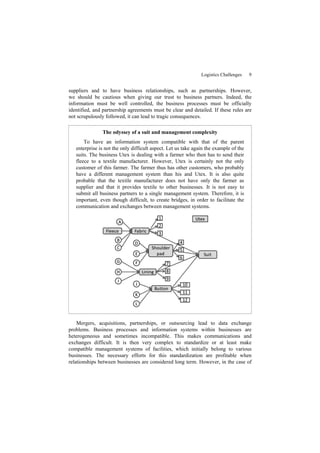
![10 Sustainable Reverse Logistics Network
partnerships or outsourcing, this relationship can only be taken short or mid term.
The time necessary to standardize systems can be equivalent or even longer than the
duration of the partnership between the businesses. When this is about managing
facilities that belong to the same “big” business, it would seem easier that these
facilities follow the example of the parent enterprise. However, in some cases, this
consists of business groupings, whose structure enables a certain form of operational
independence. Businesses often prefer to continue with their own operating system
rather than adapting to that of the parent enterprise. Bridges must be built.
The more facilities and larger business volume businesses have, the more they
gather the production of similar products in the same place. This enables them to
specialize facility operations and significantly increase their performances. The
development of specialization brings businesses to focus on their core competency
and on their expertise. They use outsourcing to seek specialists. And then again we
face the same heterogeneity problem of the used computer systems and the
management complexity. For example, while some customers want to order via
emails, some suppliers are not even equipped with fax machines. This technological
discrepancy is harmful to trade.
Some businesses even subcontract all their activities. Therefore, all the functions
usually carried out by a department of the business are then carried out by
businesses specialized in this specific field. For example, marketing, consumer
needs studies, and even advertising campaigns are outsourced. The same thing goes
for material transportation and delivery throughout the supply chain. When a
business uses so much outsourcing, it can be described as a virtual organization
[POU 94].
Knowingly choosing outsourcing on a small or large scale requires an in-depth
analysis of the selection criteria that have a significant impact on the quality of the
outsourced operations. As mentioned previously, language can be a source of bad
communication of customer specifications and requirements. Delays resulting from
transport must be taken into account while planning operations. Will components
and modules be there on time? There are many risks during transport. The quality of
the products can be affected by vibrations and bumps.
As seen in this section, it is more and more difficult to identify the “country” of
origin of consumer goods and the “business” in charge of the product quality. Who
will provide parts for a defective product, if we wish to replace them? How will we
be able to identify the necessary parts? If there are several suppliers for a single part
and if there are quality problems with this part, will we be able to trace it back to the
right supplier? Will product traceability imply an identification of each part, even if
they all come from different businesses? This traceability is indeed more difficult,](https://image.slidesharecdn.com/2156416-250607161010-c2cf23cd/85/Sustainable-Reverse-Logistics-Network-Engineering-And-Management-Daoud-Aitkadi-28-320.jpg)
![Logistics Challenges 15
sometimes even not recyclable at all. Many studies remain to be done on
chemical and mechanical processes. Some types require too costly facilities
and are not profitable in regions where the consumption is not sufficiently
concentrated. Whether they are recyclable or not, plastics always end up
sooner or later being incinerated or landfilled.
In order to compensate for the problem of plastics needing several years
to decompose, biodegradable plastics have been put on the market. However,
some are rather bio-fragmentable, which means that even if the bag or the
unit load is not visible anymore, it is still present but in the form of very
small fragments! We should thus be wary of so-called biodegradable bags
and unit loads. Thus, it seems preferable to avoid plastics when more
ecological alternatives are available [EKO 10], [REC 08a].
In the perspective of lean production and logistics, businesses seek to minimize
several sources of wasting: overproduction, important stocks, waiting time,
unnecessary material handling and transport, unnecessary movements, defective
production, and oversized process [LIK 06]. This hunt for wasting is mainly carried
out to reduce costs, for example reducing the number of non-compliant products,
reducing packaging costs, and maximizing the use of reusable material handling
packaging. Reducing waste is even extended to the reuse of postconsumer raw
materials, if they reduce operations’ costs. The most profitable recyclable material is
aluminum. Indeed, it costs up to 95% less energy to resmelt aluminum and make
bars again, which will be used for various products, than making aluminum bars
from raw materials [CHE 10, FRA 10]. It is also profitable to recycle several metals;
but for all metals, including aluminum, the metal homogeneity influences the quality
of the recycled materials. Because of this lack of homogeneity, recyclers sometimes
refuse some material unit loads needing to be recycled. Some transformed materials,
such as products derived from oil to make plastic products, are reusable. To recover
as much raw material as possible, plastic must be separated by type for recycling,
because each type of plastic has different properties.
Concerning products, the manufacturer’s responsibility stops during the sale to
the customer, except for after-sale service. If the product turns out to be defective,
with reverse logistics processes that are not yet implemented, it is currently often
cheaper for the business to throw away the product and replace it than taking it back,
repairing it, and returning it to the consumer. There is then no proper disposal of the
product thrown away, and this happens throughout the supply chain. Everyone](https://image.slidesharecdn.com/2156416-250607161010-c2cf23cd/85/Sustainable-Reverse-Logistics-Network-Engineering-And-Management-Daoud-Aitkadi-33-320.jpg)
![16 Sustainable Reverse Logistics Network
wants perfect products and what is not perfect becomes scrap that we need to get rid
of. Even when a product has reached its useful end-of-life in the consumers’ eyes, in
several parts of the world, consumers are the ones with the responsibility to dispose
of the products. Still, a very significant percentage of domestic waste goes toward
landfills or incinerators.
1.4.2. Unit loads and packaging
Finished goods are not the only ones drawing the attention of businesses. They
seek to avoid any form of waste of the various unit loads or supports used in
delivery. In this section, unit loads are pallets, boxes, bottles, or any form of items
that enable the handling, support, and transportation of goods. It is not limited to
ship unit loads, as those mentioned in the section 1.3.4. Wood pallets were not very
robust and were sometimes used as firewood or were disassembled for shavings.
Nowadays, they are, however, repaired more and more and maintained in order
to extend their lifetime. Other materials are used, such as composite material,
metal, aluminum, cardboard, and plastic [RIO 08]. Some pallet models have
been created in order to provide more solid and durable pallets with specific
characteristics, such as being washable and with constant tares. These are notably
used when exchanges with the sender are regular, as in the case of deliveries to
distribution centers.
Customized supports are particularly interesting in the case of parts with
irregular forms, such as the hull or seats of a jet ski. They are designed in order to
facilitate material handling and transport. However, this leads to an additional
management complexity. We thus have to plan unit load return. Who will be in
charge of these returns? Moreover, unit loads occupy quite a significant space
during their return, while they do not support anything. We should thus consider
some solutions to reduce the impact of the empty transport of these unit loads.
Return of containers (drinks)
According to RECYC-QUÉBEC (a Québec business of collection and
recycling created in 1990 by the government of Québec) in 2005, more than
4.7 billion drink containers have been sold to Québec: containers of beer,
wine, spirits, cider, soft drinks, juice, bottled water, etc. These containers are
in glass, plastic, metal (aluminum for cans) or in multiple coating cardboard.
In Québec, glass containers are collected via two complementary systems:
consignment and separate collection. Consignment is a money incentive
encouraging consumers to adopt environmental practices.](https://image.slidesharecdn.com/2156416-250607161010-c2cf23cd/85/Sustainable-Reverse-Logistics-Network-Engineering-And-Management-Daoud-Aitkadi-34-320.jpg)
![Logistics Challenges 17
Consignment in Québec can be divided in two categories: private and
public consignment. This is not funded by the State, but rather by the industry
and polluting consumers who do not bring back their containers.
Private consignment has been implemented by brewers to collect the
refillable containers that they use to bottle their products. It is entirely
administered by brewing businesses and mainly aims at the typical brown
beer bottles of standard size (341 ml, 500 ml and 750 ml). These bottles can
be reused 10 to 20 times depending on their format before being discarded.
This consignment consists of creating a money reward so that consumers
bring back their intact containers, so that they can then be sterilized and
available for reuse by brewers.
Public consignment consists of the collection of non-refillable containers
to recycle them. This is possible for all the bottles identified “CONSIGNÉE
QUÉBEC”. This consignment is administrated by RECYC-QUÉBEC and by
the organization Boissons Gazeuses Environnement. This a not-for-profit
organization, which was created by the Québec industry of soft drinks, in
order to administrate the consignment system of the non-refillable containers
of soft drinks and to ensure the compliance to the law and regulations. It was
established in 1984 to transport deposited containers after use towards
recycling plants.
For other non-refillable containers, which are not managed by private or
public systems, consumers do not give any consignment money and thus do
not receive any money back for the return of the containers, such as water or
juice bottles, etc. These empty containers are put in recycling bins or bags for
separate collection, so that they are transported to waste sorting units.
[ABQ 08a], [ABQ 08b], [REC 04], [REC 05], [REC 07], [REC 08a],
[REC 08b], [REC 10a], [REC 10b], [REC 10c].
Food is wrapped again and again in single serving, which creates even more waste.
Plastic materials are more and more frequently used for packaging, but they are not
often recyclable. The same goes for polystyrene foam packaging, which ensures
product stability. Product packaging in stock also causes a lot of problems. For
example, what happens to a product whose packaging has been damaged during
transport, handling, or, simply, when it was on the edge of an alley and was then
bumped into and damaged? The same problem happens when a product is returned
by the consumer because it was not suitable, and is still like new. If the product is
edible or if there is a contamination risk because of an open packaging, the product is
generally irrecoverable. If there is no contamination risk, for example, for toys,
clothes, and electrical devices, resale options can be considered. However, there is no
replacement packaging by retailers. Will the product have to go back to the distributor](https://image.slidesharecdn.com/2156416-250607161010-c2cf23cd/85/Sustainable-Reverse-Logistics-Network-Engineering-And-Management-Daoud-Aitkadi-35-320.jpg)
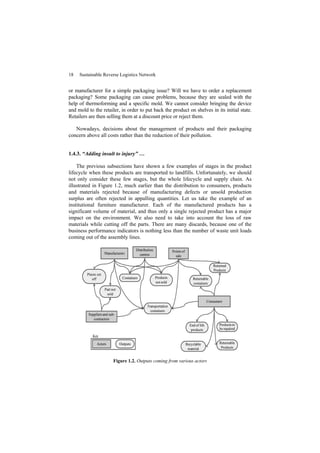
![Logistics Challenges 19
Distribution centers and retailers are also generating a lot of waste. Their
purchase management is sometimes blind and does not take into account the impact
of the quantity of waste on inventory management. Therefore, businesses are left
with bulk-buying surplus, in order to favor an economy of scale. Distribution
centers, retailers, as well as manufacturers often buy more materials and products
than necessary, because of the attractive discounts granted by suppliers if they order
an entire unit load of the product in question. This sometimes leads to aberrations
because these quantities correspond to the equivalent long-term production or sales
needs. Obsolescence and breakings during warehousing are only a few examples
that once more lead to materials and products going to landfills. Therefore, not only
are there end-of-life products and domestic wastes, but there are also all the
industrial wastes that are lost and are not recycled or collected.
With all the wastes generated by the supply chain and its components, it is easy
to link it to the significant ecological problems they cause. The situation has become
worse. For several years, environmentalists have blown the whistle [GRE 10]. Some
solutions are slowly emerging to answer the problems presented in this section.
There is still a long way to go before Mother Nature claims its rights.
1.5. Nothing goes well anymore
Facing the previously presented problems, this section discusses the problems
and breaches of logistics. First, it describes the main environmental concerns and
then the main social concerns. But how did we get there? The last two subsections
try to answer this crucial question. One of the subsections discusses output
management and the other discusses product design.
1.5.1. Environmental concerns
The consumer society and how various outputs are at the disposal of everybody
have a major impact on the environment. The used resources are called renewable,
such as electricity when it comes from a hydroelectric source, wood, and solar
energy. Other resources are non-renewable and become exhausted at a frenzied pace.
The excessive use of natural resources leads to a possible resource shortage among
other things. In order to compensate for these shortages and for the pollution due to
our consumer society, the last decade has been marked by more active research in the
field of natural resource recycling, whether they are renewable or not. However, this
recycling needs much effort and has some consequences on the environment, because
collected materials are rarely homogeneous, and mechanical or chemical disassembly
processes are often required. Some of these processes cast toxic gases into the
atmosphere. Among the most frequently recovered materials, we can note some types](https://image.slidesharecdn.com/2156416-250607161010-c2cf23cd/85/Sustainable-Reverse-Logistics-Network-Engineering-And-Management-Daoud-Aitkadi-37-320.jpg)
![20 Sustainable Reverse Logistics Network
of metals and fibrous materials, such as paper and cardboard. The proportion of
metals of each type sometimes leads recyclers not to carry out the recycling of a
specific batch. What happens then with these metals? Where do they go?
Paper is often printed. We then need to carry out deinking, which requires many
chemical products. They also cause some pollution if they are not properly collected
during the process. Moreover, many inks and printing processes make the deinking
process and the collection of “clean” fibers more difficult.
Moreover, wood fibers cannot be indefinitely recycled. Indeed, they break and
shorten during re-pulp or deinking. The production of paper and other derivatives of
wood fibers require a contribution of new fibers to ensure the sought-after solidity
characteristics.
The massive production of fast-growing trees, such as eucalyptus, draws
nutrients from the ground faster than they can regenerate. How long can the ground
survive this massive production? What is the impact of a production non-indigenous
to the initial ecosystem on ecosystems?
Other resources, such as oil, are transformed into materials. Some of the forms of
these materials are very small or not at all reusable or recyclable, and they are
moreover non-biodegradable. They pile up for decades, or even sometimes more
than a hundred years. Non-biodegradable waste is piling up in huge quantities which
means that countries have to export their waste.
Some forms of exportation are indirect. For example, industrialized countries
generously sell at a low price or even give to underdeveloped countries second-hand
computers. The very short useful life of these computers then generates incredibly
quickly gigantic piles of electronic wastes [AGE 10, DEL 09b]. However, the
burden of computers at the end of their life is left to underdeveloped countries. And
yet, they do not have the infrastructures and facilities to properly dispose of them.
The products end up in landfills and contaminate the surrounding ground and rivers.
Using oceans as landfills is another common practice to get rid of wastes, however
dubious it might be.
All these wastes generate toxic materials. Throughout the world, computers are
used and each computer contains at least 38% of metals (not including aluminum),
14% of aluminum, 25% of glass, and 23% of plastic [GRO 02]. One of the problems
encountered by computer recyclers is the lack of identification of plastic parts, in
order to properly sort them out [HAL 09]. Evidently, pollution by waste has
consequences on natural habitats, as well as on inhabitants. For example, wastes
rejected in oceans generate plastic microfragments, which can then be found in
fish, and this, without considering all the toxic products such as mercury](https://image.slidesharecdn.com/2156416-250607161010-c2cf23cd/85/Sustainable-Reverse-Logistics-Network-Engineering-And-Management-Daoud-Aitkadi-38-320.jpg)
![Logistics Challenges 21
[DEL 09a, DUP 10, SAC 10]. The quantity of waste is such that floating masses of
plastic products can be found in oceans. Not only does the pollution affect the sea,
the oceans, and the ground, but it also affects the air we breathe. The phenomenal
growth in the use of transport generates air pollutants that have worldwide
consequences. The ozone layer is getting thinner and global warming is accelerating.
Several species of animals and plants are now endangered. Glaciers are visibly
melting, deserts are growing, and rivers are drying up. And all these consequences
come up because of our mode of consumption.
North Pacific Garbage Patch
The pollution of oceans is formed by several sources of plastic materials,
the main one being its use as a dump by many countries. Ocean currents are
forming “islands” of plastic piles floating in the water, with a very high
density. Evidently, they are not compact, but are becoming more and more
extensive. Although they are not visible on satellite pictures, they are visible
from ship decks. The biggest is located in the Pacific Ocean and would cover
the same surface area as France.
Plastic waste is disintegrating over time into micro-fragments. They are
mistaken for plankton by the aquatic fauna and parents give it to their
offspring! Studies on the quantities of plastic particles around islands have
established disastrous statistics: plastic particles can be found there in
quantities sometimes six times larger than plankton, which is the basis of the
food chain!
[DEL 09a], [DUP 10], [SAC 10]
1.5.2. Social concerns
Although resources are recycled, their quantities are not sufficient enough for the
current needs for consumption. For example, copper is rarest in its natural state but
is still necessary in several parts, which increases its value. Some will thus even
steal products containing copper because this market is very lucrative [BEL 10,
CAR 07]. From a sociological point of view, anything encouraging theft promotes
corruption and is thus detrimental to a healthy social environment.
All the outputs transported in landfills generate an incredible number of
pollutants, which not only cause problems on biodiversity and ecosystems, but also
cause significant health issues to the populations living close by. “Dump” countries
are mostly affected by mountains of piled up products [BUR 06, PNU 07]. Some of
these mountains are exclusively made up of electronic products, and children are](https://image.slidesharecdn.com/2156416-250607161010-c2cf23cd/85/Sustainable-Reverse-Logistics-Network-Engineering-And-Management-Daoud-Aitkadi-39-320.jpg)
![Logistics Challenges 23
waste from rich to poor countries. To give a simple overview of the extent
of waste throughout the world, here are some figures. The quantity of
dangerous waste and of other waste produced in 2000 and 2001 has been
estimated to more than 300 millions tons by the secretariat of the Basel
Convention. But it has only a restricted access to data. OECD estimates rather
at 4 billion tons of waste produced by the 25 member countries of the
Organization in 2001! At least 8.5 millions tons are moved between countries
each year according to a report presented to the secretariat of the Basel
Convention. Although most of it is welcomed as source of economic activity,
some countries are complaining that they are receiving waste that they cannot
properly process.
[SEC 01], [SEC 08], (www.basel.int)
Why did we have to wait until so many people blew their whistle? How did we
manage to reach this significant number of various diseases? How did we get there?
1.5.3. Bad output management
As it has been described and illustrated in section 1.4.1, all the stages in the
supply chain generate outputs, which are for the most, discards. They are considered
undesirable, which are easier to ignore, forget, or hide, rather than to process. They
are considered a source of additional costs that we should try to reduce as much as
possible. It is, however, utopian to think that they can be reduced to nothing. Not
taking these discards into account during supply chain design is like adopting an
ostrich approach. From the simple discard coming from the surplus during good
production, to a product at the end of its useful life, a very important number of
discards are found in landfills. One of the main reasons is that distribution channels
are not optimized for a counterclockwise circulation and that it is easier to throw
away everything.
Because of the emerging social consciousness, more and more solutions are
suggested. Separate collection networks aiming at facilitating the collection of
recyclable materials and products are expanding. They are now available in several
countries and regions of the world, but, often, they only concern domestic waste or
some office waste. The first collection efforts were aimed at recovering newspapers
and cardboards to recycle them into paper and cardboard. Nowadays, separate
collection enables us to avoid sending to landfills a wide variety of materials, such
as steel (engine parts, structures, tins, etc.), aluminum (cans, plates, etc.), plastic
(bags, containers, etc.), and glass (bottles). Other materials are collected via
retailers: for example, recycled rubber comes from tires given to retailers. Retailers](https://image.slidesharecdn.com/2156416-250607161010-c2cf23cd/85/Sustainable-Reverse-Logistics-Network-Engineering-And-Management-Daoud-Aitkadi-41-320.jpg)
![24 Sustainable Reverse Logistics Network
then transport them to rubber recyclers. Some cities even collect organic waste to
make compost, but this collection is not significantly developed yet.
Separate collection
Separate collection has been established since 1996 in Victoriaville,
Québec. About six years ago, inhabitants were given a “brown” box for
composting for discards from ground maintenance (cut grass, cut trees, etc.),
as well as organic waste (what was little developed beforehand). Two years
ago, households were offered a “brown” kitchen box. The following slogan is
written on the box: “I make compost all year long”. Thus, households are
encouraged to put a maximum of organic waste in their boxes. To thank
households, the city offers compost bags each spring.
[BEL 08], [CYR 07]
If collection networks are well established for homogeneous composition
products, this is not the case for products at the end of their useful life which are
made up of several materials. Unless users disassemble the product into separate
various materials, this product will not be treated by separate collection system.
Indeed, facilities receiving products only do sorting. Specialized disassembly
facilities are needed. And yet, these products come from various geographical
locations, and it is thus not profitable for a business to go collect these products
individually and then disassemble them. Users must bring them to specialized
collection sites.
Another category of outputs presented in section 1.4.2 are those products that
the owner does not want anymore, but still have a useful life. As most outputs of
the supply options to dispose of these products are not really known, except for
domestic landfill, people do not use it much, because it requires an additional
transport effort. Drop-off centers, bazaars, flea markets, and garage sales are some
of the most known options. However, too specialized options, such as places for the
deposit of electronic equipment, are often neglected.
Some retailers or businesses propose to collect old equipments when they
deliver the new ones. And yet, only few delivery trucks in the USA are designed
with multiple openings to remove and add items. For example, during furniture
deliveries, trucks have often only one opening in the back or on the side. The truck
is filled for its delivery when it leaves the warehouse. When arrived at the
destination for its first delivery, the furniture is taken out of the truck. But where
would they put the old furniture collected? If there is only one opening, this implies
taking it out for all subsequent deliveries, which is not very practical and wastes a
lot of time.](https://image.slidesharecdn.com/2156416-250607161010-c2cf23cd/85/Sustainable-Reverse-Logistics-Network-Engineering-And-Management-Daoud-Aitkadi-42-320.jpg)
![Logistics Challenges 25
There are thus some options for the disposal of products at the end of their use
and their life, but these remain isolated initiatives. Too few of these options are
known and exploited. Much progress remains to be done on this matter.
Recovery of power-consuming fridges
Hydro-Québec has launched in April 2008, for all Québec citizens, a
collection program of power-consuming fridges of more than 10 years old
with the only condition that they were still operational. If your fridge was
more than 10 years old, Hydro-Québec came to pick it up and gave you $60.
The objective of this program was to favor the reduction of power
consumption. A national electricity business has ensured a clean removal of
household appliances instead of manufacturers or town councils. This
program helped to avoid putting to landfill 230,000 old fridges. This is a
commendable effort, but our other non-operational appliances still remain in
our basements, and will most probably end up in landfill. America is still
quite far from the European standards.
[LAU 08] (http://www.recycfrigo.com)
1.5.4. Product design in a one-way direction
The initiatives mentioned in section 1.5.3 mainly refer to material recycling. To
reduce the quantity of discards, research seeks to maximize the quantity of recycled
material. Some solutions are then proposed, such as identifying the type of plastic
on each part, in order to facilitate sorting after disassembly. However, very few
products are currently designed to be easily disassembled. A lot still remains to be
done in terms of product design.
Recycling is promoted under an ecological brand. It is quite normal to get rid of
a product when it is not operational, hoping that it will be recycled. However, this is
no more normal when the non-functionality is caused by the impossibility to obtain
replacement parts. This results in a huge waste because customers are thus not able
to take advantage of all what can be offered by a product.
Victim of the consumer society!
I quite like new technologies and I keep them for a long time. I bought a
Palm organizer when it was first introduced on the Québec market. I have
learned to work with it and to love it. The investment has been quite
significant. I cannot afford to buy all the new models with additional
functionalities. I am careful with my possessions and I use them for](https://image.slidesharecdn.com/2156416-250607161010-c2cf23cd/85/Sustainable-Reverse-Logistics-Network-Engineering-And-Management-Daoud-Aitkadi-43-320.jpg)
![28 Sustainable Reverse Logistics Network
There are several ways to collect and reuse products, but we are still not using
this process sufficiently. There is an urgent need for tools and solutions in order to
respect the environment, while optimizing customer satisfaction. Chapters 2, 3, and
4 provide such solutions. First, Chapter 2 presents the concept of reverse logistics.
Problems become opportunities. Ideas for solution are offered to create value from
outputs of the logistic networks and transform expenses into incomes. This is a
difficult challenge and the money incentive will have to be quite attractive,
otherwise, everyone will go on using landfills on a large scale.
The necessary tools should not be limited to the maximization of the quantity
of recycled material. Product design is at the basis of a better management and use of
the resources in all their forms, at the level of raw materials as well as on the
workforce level. We need to think about products differently. These are the ecodesign
tools that are presented in Chapter 3. Chapter 4 presents the tools to develop reverse
logistics and the concept of sustainable development in a network context.
1.7. Bibliography
[ABQ 08a] ASSOCIATION DES BRASSEURS DU QUÉBEC, “La consigne: une nécessité pour une
gestion optimale des matières résiduelles”, 2008, http://www.brasseurs.qc.ca/MEDIA/
HOME/PDF/010023.MediaPDF.pdf.
[ABQ 08b] ASSOCIATION DES BRASSEURS DU QUÉBEC, “Mémoire de l’association des
brasseurs du Québec”, 2008, http://www.bibliotheque.assnat.qc.ca/01/mono/2008/02/
961767.pdf.
[AGE 10] AGENCE-FRANCE-PRESSE, “Les ‘montagnes’ de déchets électroniques inquiètent”,
2010, http://www.cyberpresse.ca/environnement/201002/22/01-954018-les-montagnes-
de-dechets-electroniques-inquietent-lonu.php.
[AND 99] ANDRIESSE F.G., “Successful implementation of reverse logistics at Philip Morris”,
in VAN GOOR A.R., FLAPPER S.D.P., CLEMENT C. (eds), Handbook Reverse Logistics, B.V.
Kluwer, Deventer, the Netherlands, 1999.
[BÉL 08] BÉLIVEAU R., “Performance municipale en gestion des matières résiduelles −
Ville de Victoriaville”, June 2008, http://www.ecoentreprises.qc.ca/_site/EEQ/documents/
fiche_5-journee_tech_victoriaville-vf-web.pdf (page consulted on 8 July 2010).
[BEL 10] BELGA, “Deux vols de cuivre par jour en mai sur le réseau ferroviaire”,
23 June 2010, http://www.rtbf.be/info/societe/faits-divers/deux-vols-de-cuivre-par-jour-
en-mai-sur-le-reseau-ferroviaire-230088 (page consulted on 8 July 2010).
[BLA 07] BLANCHARD D., Supply Chain Management: Best Practices, John Wiley and Sons,
Hoboken, 2007.
[BUR 06] BURKINA-NTIC, “Ordinateur de seconde main, l’Afrique, un dépotoir”,
5 December 2006, http://burkina-ntic.net/Ordinateur-de-seconde-main-l.html.](https://image.slidesharecdn.com/2156416-250607161010-c2cf23cd/85/Sustainable-Reverse-Logistics-Network-Engineering-And-Management-Daoud-Aitkadi-46-320.jpg)
![Logistics Challenges 29
[CAR 98] CARTER C.R., ELLRAM L.M., “Reverse logistics: a review of the literature and
framework for future investigation”, Journal of Business Logistics − Council of Logistics
Management, vol. 19, no. 1, pp. 85–102, 1998.
[CAR 07] CARON O., “Opération policière visant des groupes impliqués dans le vol de cuivre:
48 personnes arrêtées”, 7 November 2007, http://www.matin.qc.ca/articles/2007110714
2357/operation_policiere_visant_des_groupes_impliquees_dans_vol_cuivre_personnes_ar
retees.html (page consulted on 8 July 2010).
[CEI 01] CEIA, L’infrastructure de recyclage des ordinateurs au Canada, p. 27, 2001.
[CHE 10] CHEVALIER P., “Aluminium”, 2010, http://www.thecanadianencyclopedia.com/
index.cfm?PgNm=TCE&Params=F1ARTF0000169 (page consulted on 8 July 2010).
[CHO 07] CHOUINARD M., Modélisation et conception de boucles d’approvisionnement:
contexte multi-produit, multi-état et multi-alternative de traitement − application à un
service dans le domaine de la santé, PhD Thesis, Laval University, Quebec, Canada,
2007.
[COC 08] COCA-COLA, “Responsabilité corporative”, http://www.cocacola.ca/fr/corporate_
responsibility.htm, 2008.
[COE 00] COENAN J., Commercial Returns Closed-Loop Supply Chains: Commercial Returns
of Sun-Protection Products, Erasmus University, Rotterdam, the Netherlands, 2000.
[COS 06] COSTE G., “IX − Les feuillus et l’eucalyptus au service des papetiers”,
14 September 2006, http://cerig.efpg.inpg.fr/histoire-metiers/fibre-pate/page09.htm (page
consulted on 8 July 2010).
[CYR 07] CYR S., “Fiche 5, Ville de Victoriaville”, 2007, http://www.ecoentreprises.qc.ca/
_site/documents/fiche_5-journee_tech_victoriaville-vf-web.pdf (page consulted on 8 July
2010).
[DAV 95] DAVIS S., GERSTNER E., HAGERTY M., “Money back guarantees in retailing:
matching products to consumers tastes”, Journal of Retailing, vol. 71, no. 1, pp. 7–22,
1995.
[DEB 04] DE BRITO M.P., Managing reverse logistics or reversing logistics management,
PhD Thesis, ERIM PhD Series Research in Management, Erasmus University, Rotterdam,
the Netherlands, 2004.
[DEL 09a] DELBECQ D., “La ‘Pêche fantôme’ inquiète l’ONU”, 2009, http://mondedur
able.science-et-vie.com/2009/05/la-%C2%ABpeche-fantome%C2%BB-inquietelonu/ (page
consulted on 8 July 2010).
[DEL 09b] DELL, “Enquête recyclage Dell”, 2009, http://www.euro.dell.com/content/
topics/topic.aspx/emea/corporate/pressoffice/2009/fr/fr/2009_05_25_par_000?c=fr&l=fr
(page consulted the 8 July 2010).
[DUP 10] DUPONT G., “Un ‘continent’ de déchets plastiques a été découvert dans l’Atlantique
nord”, 6 March 2010 http://www.lemonde.fr/planete/article/2010/03/05/un-continent-
de-dechets-plastiques-a-ete-decouvert-dans-l-atlantiquenord_1314831_3244.html (page
consulted on 8 July 2010).](https://image.slidesharecdn.com/2156416-250607161010-c2cf23cd/85/Sustainable-Reverse-Logistics-Network-Engineering-And-Management-Daoud-Aitkadi-47-320.jpg)
![30 Sustainable Reverse Logistics Network
[EKO 10] EKOPÉDIA, “Matières plastiques”, 31 May 2010, http://fr.ekopedia.org/
Mati%C3%A8res_plastiques (page consulted on 8 July 2010).
[ENV 02] ENVIRONNEMENT-CANADA, “Information Technology (IT) and Telecommunications
(Telecom) Waste in Canada”, 2000, http://www.eiatrack.org/docs/caittelereport.pdf
[ENV 05] ENVIRONNEMENT-CANADA, “La gazette du Canada”, 2005, http://www.ec.gc.ca/
registrelcpe/documents/regs/g2-13911_r1.pdf.
[ENV 06] ENVIRONNEMENT-CANADA, “Gestion des déchets: initiatives relatives aux déchets
de technologie de l’information et de telecommunications”, 2006, http://www.ec.gc.ca/
wmd-dgd/default.asp?lang=Fr&n=F3852FB1-1.
[ENV 07] ENVIRONNEMENT-CANADA, “Déchets solides, recyclage et deviation”, 2007,
http://www.infrastructure.gc.ca/research-recherche/result/studies-rapports/rs16-figure6-2-
3_f.shtml.
[FRA 10] FRANCE-ALUMINIUM-RECYCLAGE, “Avantages du recyclage de l’aluminium”, 2010,
http://www.france-alu-recyclage.com/V2/fr/tri-recyclage-aluminium.htm (page consulted
on 8 July 2010).
[GEL 75] GELLER E.S., CHAFFE J.L., INGRAM R.E., “Promoting paper recycling on a
university campus”, Journal of Environmental Systems, vol. 5, no. 1, pp. 39–57, 1975.
[GIN 78] GINTER P.M., STARLING J.M., “Reverse distribution channels for recycling”,
California Management Review, vol. 20, no. 3, pp. 72–82, 1978.
[GRE 10] GREENPEACE-INTERNATIONAL, “Greenpeace”, 2010, http://www.greenpeace.org/
international.
[GRO 02] GROUPE-NORD, “Rapport sur la ‘fin de vie’ des ordinateurs”, 2002, http://isf.
etu.inpg.fr/archive/rapport/rapport_ordi.pdf.
[GUI 74] GUILTINAN J., NWOKOYE N., “Reverse channels for recycling: an analysis for
alternatives and public policy implications, new marketing for social and economic
progress”, Combined Proceedings, American Marketing Association, 1974.
[HAL 09] HALLÉ M.E., La logistique inverse d’un ordinateur: une étude terrain des
entreprises québécoises, Master in business administration, Management and Technology
Master Thesis, Ecole des sciences de la gestion, University of Quebec, Montreal, Canada,
2009.
[HER 08] HERAGU S.S., Facilities Design, 3rd
edition, CRC Press, Boca Raton, 2008.
[KAU 96] KAUFMANN J.C., La méthode en sociologie, Nathan, Paris, 1996.
[KOD 08] KODAK, [Title], 2008, http://www.kodak.com/eknec/PageQuerier.jhtml?pq-locale=
fr_CA&pq-path=4198.
[KOP 93] KOPICKY R.J., BERG M.J., LEGG L., DASAPPA V., MAGGIONI C., Reuse and
Recycling: Reverse Logistics Opportunities, Council of Logistics Management, 1993.
[KRI 98] KRIKKE H., Recovery strategies and reverse logistics network design, Thesis,
Twente University, Enschede, the Netherlands, 1998.](https://image.slidesharecdn.com/2156416-250607161010-c2cf23cd/85/Sustainable-Reverse-Logistics-Network-Engineering-And-Management-Daoud-Aitkadi-48-320.jpg)
![Logistics Challenges 31
[KRO 95] KROON L., VRIJENS G., “Returnable containers: an example of reverse logistics”,
International Journal of Physical Distribution & Logistics Management, vol. 25, no. 2,
pp. 56–68, 1995.
[LAM 81] LAMBERT D.M., STOCK J.R., Strategical Physical Distribution Management,
Homewood, Chicago, IL, 1981.
[LAM 03] LAMBERT S., RIOPEL D., “Logistique inverse: revue de littérature”, Les Cahiers du
GERAD, no. G-2003-61, p. 45, 2003.
[LEE 93] LEE H.L., BILLINGTON C., “Material management in decentralized supply chain”,
Operation Research, vol. 41, no. 5, pp. 835–847, 1993.
[LEF 06] LEFÈVRE-HASEGAWA K., Etat de l’art sur la gestion des déchets bureaucratiques et
informatiques, Institut de mathématiques de Jussieu, p. 7, 2006.
[LIK 06] LIKER J.K., Le modèle Toyota: 14 principes qui feront la réussite de votre
entreprise, Village Mondial, Paris, 2006.
[LUY 79] LUYBEN P.D., BAILEY J.S., “Newspaper recycling, the effect of rewards and
proximity of containers”, Environment and Behavior, vol. 11, no. 4, pp. 539–557, 1979.
[MER 07] MERCIER N., [Title], 2007, http://www.cybersciences.com/cyber/fr/magazine/
octobre_2007/reportages/mon_ordinateur_au_recyclage_.html.
[MUR 89] MURPHY P.R., POIST R.F., “Management of logistical retromovements:
an empirical analysis of literature suggestions”, Transportation Research Forum,
pp. 177–184, 1989.
[OSK 94] OSKAMP S., WILLIAMS R., UNIPAN J., STEERS N., MAINIERI T., KURLAND G.,
“Psychological factors affecting paper recycling by business”, Environment and Behavior,
vol. 26, no. 4, pp. 477–503, 1994.
[PAL 03] PALO A., “Record number of HP LaserJet print cartridges recycled in 2002”, 2003,
http://www.hp.com/hpinfo/newsroom/press/2003/030422c.html.
[PCP 08] PCPROCHAIN.COM, “TIC et implications énergétiques”, 2008, http://pcprochain.
com/TIC-et-implications-energetiques.html.
[PNU 07] PNUE, “Les dépotoirs en Afrique: une menace pour les enfants et l’environnement”,
2007, http://www.unep.org/Documents.Multilingual/Default.asp?DocumentID=519&Article
ID=5679&l=fr.
[POU 94] POULIN D., MONTREUIL B., GAUVIN S., L’entreprise réseau: bâtir aujourd’hui
l’organisation de demain, Publi-Relais., Montreal, Canada, 1994.
[PUC 99] PUCHNIAK T., FREED J., GELBART A., TÉLÉ-QUÉBEC., GALAFILM INC., RADIO-
CANADA. S., L’Odyssée d’un complet, Galafilm, Canadian Broadcasting Corporation,
Montreal, Toronto, Canada, 1999.
[REC 08] RECYC-FRIGO, “Hydro-Québec lance le programme Recyc-Frigo ENVIRONNEMENT
md Dévoreurs d’énergie recherchés!”, 26 March 2008, http://www.recyc-frigo.com/fr/media/
Communique_Recyc-Frigo.pdf (page consulted 8 July 2010).](https://image.slidesharecdn.com/2156416-250607161010-c2cf23cd/85/Sustainable-Reverse-Logistics-Network-Engineering-And-Management-Daoud-Aitkadi-49-320.jpg)
![32 Sustainable Reverse Logistics Network
[REC 02] RECYC-QUÉBEC., “Bilan 2002, RECYC-QUÉBEC”, 2002, http://www.recyc-
quebec.gouv.qc.ca/upload/Publications/zzBilan2557.pdf.
[REC 04] RECYC-QUÉBEC, “Les technologies de l’information et de la communication (TIC)”,
2004, http://www.recyc-quebec.gouv.qc.ca/Upload/Publications/Fiche-tic.pdf.
[REC 05] RECYC-QUÉBEC, “La gestion des contenants de boissons au Québec: Evaluation du
marché et analyse des options de recuperation”, 2005, http://www.recycquebec.gouv.
qc.ca/upload/publications/consigne/EtudeContBoissons.pdf.
[REC 07] RECYC-QUÉBEC, “Le système de consignation”, 2007, http://www.recyc-quebec.
gouv.qc.ca/upload/Publications/Fiche-consigne.pdf.
[REC 08a] RECYC-QUÉBEC, “Les contenants de boissons”, 2008, http://www.recyc-
quebec.gouv.qc.ca/upload/Publications/Fiche-contenants-boissons.pdf.
[REC 08b] RECYC-QUÉBEC, “Mise en marché et récupération des contenants de boissons
au Québec”, 2008, http://lexcellenceaunprix.org/wp-content/uploads/Gestion-contenants-
boissons2007-RECYC-Qu%C3%.
[REC 10a] RECYC-QUÉBEC, “Le Programme de consignation”, 2010, http://www.recyc-
quebec.gouv.qc.ca/client/fr/programmes-services/consignation/fonction.asp.
[REC 10b] RECYC-QUÉBEC, “Le verre”, 2010, http://www.recyc-quebec.gouv.qc.ca/Upload/
Publications/Fiche-verre.pdf.
[REC 10c] RECYC-QUÉBEC, “Nos programmes et services”, 2010, http://www.recyc-quebec.
gouv.qc.ca/.
[RIO 08] RIOPEL D., CROTEAU C., Dictionnaire illustré des activités de l’entreprise: français-
anglais: industrie, techniques et gestion, Presses Internationales Polytechnique, Montreal,
Canada, 2008.
[ROD 01] RODRIGUE J.P., SLACK B., COMPTOIS C., Green logistics: The Handbook of
Logistics and Supply-Chain Management, Pergamon/Elsevier, London, 2001.
[ROG 99] ROGERS D.S., TIBBEN-LEMBKE R.S., Going Backwards: Reverse Logistics Trends
and Practices, Reverse Logistics Executive Council, Pittsburgh, 1999.
[ROG 01] ROGERS D.S., TIBBEN-LEMBKE R.S., “An examination of reverse logistics
practices”, Journal of Business Logistics, vol. 22, no. 2, pp. 129–148, 2001.
[RON 10] RONA, “Historique”, 2010, http://www.rona.ca/contenu/historique-rona_profil_
relations-investisseurs.
[SAC 10] SACRAAL, “Océans de plastique”, 4 February 2010, http://www.lemonde.fr/planete/
article/2010/03/05/un-continent-de-dechets-plastiques-a-ete-decouvert-dans-latlantique-
nord_1314831_3244.html.
[SEC 01] SECRÉTARIAT-DE-LA-CONVENTION-DE-BÂLE, Coup d’oeil sur la Convention de Bâle,
Secrétariat de la Conventions de Bâle (ed.), Basel, Switzerland, 2001.](https://image.slidesharecdn.com/2156416-250607161010-c2cf23cd/85/Sustainable-Reverse-Logistics-Network-Engineering-And-Management-Daoud-Aitkadi-50-320.jpg)
![Logistics Challenges 33
[SEC 08] SECRÉTARIAT-DE-LA-CONVENTION-DE-BÂLE, Convention de Bâle sur le contrôle des
mouvements transfrontières de déchets dangereux et de leur élimination, Secrétariat de la
Conventions de Bâle (ed.), Basel, Switzerland, p. 49, 2008.
[SIL 04] SILICON-VALLEY-TOXICS-COALITION, “Poison PCs and toxic TVs: Sillicon Valley
Toxics Coalition, Poison PCs and Toxic TVs: E-waste Tsunami to roll across the US”,
2004, http://svtc.igc.org/cleancc/pubs/poisonpc2004.htm.
[SIM 08] SIMCHI-LEVI D., KAMINSKY P., SIMCHI-LEVI E., Designing and Managing the Supply
Chain: Concepts, Strategies, and Case Studies, 3rd
edition, McGraw-Hill/Irwin, Boston,
2008.
[SOT 05] SOTO J.P., “Reverse logistics in the editorial sector: an exploratory study”, Social
Science Research, 2005.
[STO 01] STOCK J.R., LAMBERT D.M., Strategic Logistics Management, 4th
edition, McGraw-
Hill/Irwin, Boston, 2001.
[SUL 09] SULE D.R., Manufacturing Facilities: Location, Planning, and Design, 3rd
edition,
CRC Press, Boca Raton, 2009.
[TOM 03] TOMPKINS J.A., Facilities Planning, 3rd
edition, John Wiley and Sons, Hoboken,
NJ, 2003.
[WU 95] WU H.J., DUNN S.C., “Environmentally responsible logistics systems”, International
Journal of Physical Distribution & Logistics Management, vol. 25, no. 2, pp. 20–38,
1995.
[ZIK 91] ZIKMUND W.G., STANTON W.J., “Recycling solid wastes: a channels-of-distribution
problem”, Journal of Marketing, vol. 35, pp. 34–39, 1991.](https://image.slidesharecdn.com/2156416-250607161010-c2cf23cd/85/Sustainable-Reverse-Logistics-Network-Engineering-And-Management-Daoud-Aitkadi-51-320.jpg)
![36 Sustainable Reverse Logistics Network
options. The implementation of these processes could be spread out over time. Some
of these processes could be changed if the concepts presented in Chapter 3 are
adopted.
2.2. Definition
In the literature, various terms were used to refer basically to the same concept.
We have, for example, reverse logistics and reverse distribution. Other authors have
even introduced the concepts of green distribution and green logistics.
Byrne and Deeb [BYR 93] use the expressions of reverse logistics, reverse
distribution, and green logistics as synonyms. The first concerns about reverse
logistics and sustainable development date back to the end of the 1970s [GIN 78,
HAY 78]. From the first apparition of these concerns to a validated formalism,
several contributions can be underlined. Some of them are presented in the
following subsections.
2.2.1. Reverse distribution
Lambert and Stock [LAM 81] define reverse distribution as “going the wrong
way on a one way street because the great majority of product shipments flow in one
direction”.
Carter and Ellram [CAR 98] present reverse distribution as “the return, upstream
movement of a good or material resulting from reuse, recycling or disposal. This
upstream movement can be associated with environmental as well as quality and
wear-dating issues, and it is often performed by new, auxiliary channel members”.
2.2.2. Reverse logistics
Thierry et al. [THI 95] tackle reverse logistics under the expression product
recovery management as being:
the management of all used or discarded products, components
and materials that fall under the responsibility of a manufacturing
company. The objective of product recovery management is to recover
as much of the economic (and ecological) value as reasonably
possible, thereby reducing the ultimate quantities of waste.
One of the main features of reverse logistics results from this definition. Indeed,
although we have as yet exposed only a single definition, all the authors discussing](https://image.slidesharecdn.com/2156416-250607161010-c2cf23cd/85/Sustainable-Reverse-Logistics-Network-Engineering-And-Management-Daoud-Aitkadi-53-320.jpg)
![Reverse Logistics Engineering 37
reverse logistics agree on the fact that it is a field concerning product recovery
management, in order to extract some value, all the while seeking to reintroduce
products onto a market. These definitions are quite interesting because they relate
reverse logistics to environment and value, or “added value”. However, these
definitions are not really helpful to comprehend the extent of the implied activities,
and therefore, to determine the related material and information flows.
Other authors have tried to broaden the definition of reverse logistics by relying
on definitions describing the forward supply chain. Rogers and Tibben-Lembke
[ROG 99] describe the field of reverse logistics by adapting the definition proposed
by the “Council of Logistics Management”, as being:
The process of planning, implementing, and controlling the efficient,
cost effective flow of raw materials, in-process inventory, finished
goods and related information from the point of consumption to the
point of origin for the purpose of recapturing value or proper disposal.
Fleischmann [FLE 01a] has analyzed various definitions of reverse logistics
taken from the literature, including that of Rogers and Tibben-Lembke [ROG 99], in
order to define it as:
the process of planning, implementing, and controlling the efficient,
effective inbound flow and storage of secondary goods and related
information opposite to the traditional supply chain direction for the
purpose of recovering value or proper disposal.
The last two definitions copy the forward supply chain model, but in a reverse
manner. However, the supply chain has originally been presented for the distribution
of products in a single direction, from suppliers to producers and then to consumers.
By complying with this model, these definitions lead us to believe that reverse
logistics is only a one-way management of material and information flows, even if
this is not actually the case. Moreover, although these definitions are relatively
thorough and show that several decision-making processes are involved, on the
operational, tactical, and strategic level, as well as for an efficient management of
the reverse product flow (circulation of the materials resulting from recovery and
processing activities of the recovered products), they still remain quite complicated.
The definition proposed within the framework of this book is as follows:
Process of planning, implementation, and controlling which aims at
maximizing the creation of value and the clean disposal of reverse
product flows, by efficiently managing raw materials, in-process
inventory and the finished goods and the relevant information, from
the consumption point to the point of origin.](https://image.slidesharecdn.com/2156416-250607161010-c2cf23cd/85/Sustainable-Reverse-Logistics-Network-Engineering-And-Management-Daoud-Aitkadi-54-320.jpg)