Sustainable operability:
Keeping complex
linguistic resources alive

Menzo Windhouwer
Alexis Dimitriadis
Sustainability of text resources
   All electronic resources are accessed with the mediation
    of appropriate software.
   Text editors, and web browsers, are generic: they can
    be used, with satisfactory results, with any document in a
    supported format.
   Documents are (more or less) portable across software
    that supports their storage format.

   Sustainability can be safeguarded by relying on
    documented, standard formats for their encoding.


                                               CLIN 20 - February 5, 2010
The problem with databases
   Databases are not portable in the sense that text
    documents are:
   The data and relational structure of databases can be
    stored in (semi-)standard SQL format, or exported to
    other formats.
   But databases are typically accessed through a custom-
    made user interface. Preserving the data, therefore,
    does not preserve the complete resource.
   In this talk, we focus on (typological) databases.


                                               CLIN 20 - February 5, 2010
Operability of complex resources
   The general problem: Complex resources depend on
    custom software. Without the software, the resource is
    not usable and hence not truly preserved.
   We will call a resource operable if suitable access or
    management software (operating software) exists for it.
   While all electronic resources depend on software for
    their operability, complex resources are particularly
    vulnerable because they lack an economy of scale.


                                              CLIN 20 - February 5, 2010
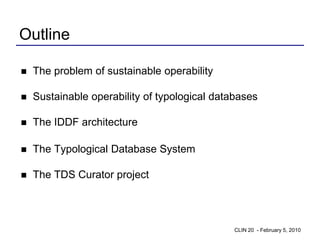
Outline

   The problem of sustainable operability

   Sustainable operability of typological databases

   The IDDF architecture

   The Typological Database System

   The TDS Curator project


                                               CLIN 20 - February 5, 2010
Next

   The problem of sustainable operability

   Sustainable operability of typological databases

   The Typological Database System

   The IDDF architecture

   The TDS Curator project


                                               CLIN 20 - February 5, 2010
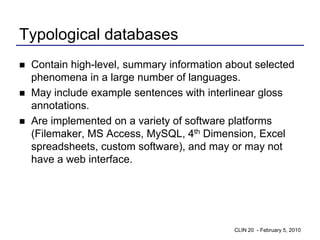
Typological databases
   Contain high-level, summary information about selected
    phenomena in a large number of languages.
   May include example sentences with interlinear gloss
    annotations.
   Are implemented on a variety of software platforms
    (Filemaker, MS Access, MySQL, 4th Dimension, Excel
    spreadsheets, custom software), and may or may not
    have a web interface.


                                             CLIN 20 - February 5, 2010
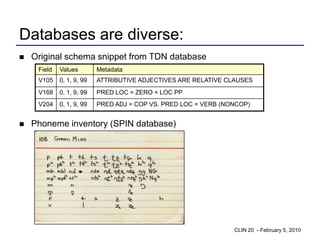
Databases are diverse:
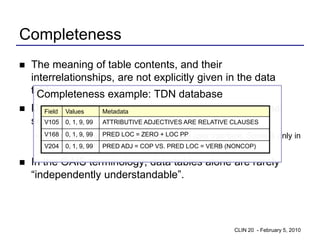
   Original schema snippet from TDN database
     Field   Values        Metadata
     V105    0, 1, 9, 99   ATTRIBUTIVE ADJECTIVES ARE RELATIVE CLAUSES
     V168    0, 1, 9, 99   PRED LOC = ZERO + LOC PP
     V204    0, 1, 9, 99   PRED ADJ = COP VS. PRED LOC = VERB (NONCOP)


   Phoneme inventory (SPIN database)


                                                                 CLIN 20 - February 5, 2010
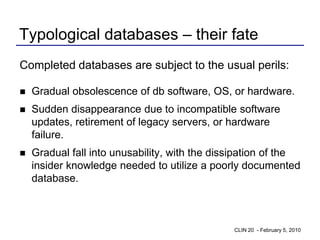
Databases are diverse:
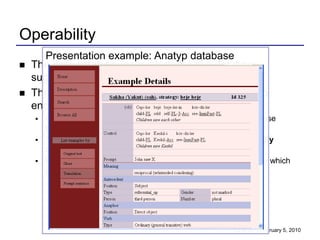
   User interface snippet for the Anatyp database


                                                     CLIN 20 - February 5, 2010
Typological databases – their fate
Completed databases are subject to the usual perils:

   Gradual obsolescence of db software, OS, or hardware.
   Sudden disappearance due to incompatible software
    updates, retirement of legacy servers, or hardware
    failure.
   Gradual fall into unusability, with the dissipation of the
    insider knowledge needed to utilize a poorly documented
    database.


                                               CLIN 20 - February 5, 2010
A data dump is insufficient
   Why not just export a database’s tables in some
    standard format (tab-separated Unicode text, or even a
    dump in “standard” SQL)?

   This would still be deficient in
    1. Completeness of content and documentation
    2. Operability


                                             CLIN 20 - February 5, 2010
Completeness
   The meaning of table contents, and their
    interrelationships, are not explicitly given in the data
    tables.
      Completeness example: TDN database
   DocumentationMetadata normally stored in the relational
      Field Values   is not
    schema 1, 9, 99 ATTRIBUTIVE ADJECTIVES ARE RELATIVE CLAUSES
      V105 0,

     V168 0, 1, 9, 99 PRED LOC = ZERO + LOC PP
      Often, documentation is embedded in the     user interface. Some is only in
       V204heads9, 99 creators. = COP VS. PRED LOC = VERB (NONCOP)
       the 0, 1, of its PRED ADJ

   In the OAIS terminology, data tables alone are rarely
    “independently understandable”.


                                                             CLIN 20 - February 5, 2010
Operability
       Presentation example: Anatyp database
   The presentation (user interface) of a database
    suggests how its content is to be interpreted.
   The navigation structure and application logic also
    encode information about the data.
     While there are general-purpose browsers for relational database
      tables, they are a very poor way to view a complex database:
     They allow viewing one table at a time, but do not automatically
      select, project or join tables appropriately into views.
     Even with foreign key information, there is no way to determine which
      joins or projections are “appropriate”.


                                                           CLIN 20 - February 5, 2010
Our approach to sustainable operability
1.   Map resources to a sufficiently rich format at time of
     archiving.
2.   Maintain generic software that can provide browsing
     and query access to all archived resources in an
     application domain.


                                               CLIN 20 - February 5, 2010
Next

   The problem of sustainable operability

   Sustainable operability of typological databases

   The IDDF architecture

   The Typological Database System

   The TDS Curator project


                                               CLIN 20 - February 5, 2010
The Integrated Data and Documentation Format

   Data, structuring information and documentation are
    combined into an integrated, XML-based standardized
    format, the Integrated Data and Document Format
    (IDDF).
   Software is provided that can manage IDDF-encoded
    resources in a generic way, just as a text editor or
    corpus tool can manage arbitrary conforming resources.
   New generations of management software can be
    provided in the future, utilizing the self-describing nature
    of the IDDF and an economy of scale.


                                                  CLIN 20 - February 5, 2010
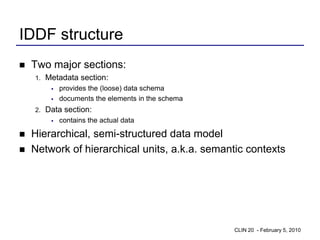
IDDF structure
   Two major sections:
    1.   Metadata section:
             provides the (loose) data schema
             documents the elements in the schema
    2.   Data section:
             contains the actual data

   Hierarchical, semi-structured data model
   Network of hierarchical units, a.k.a. semantic contexts


                                                     CLIN 20 - February 5, 2010
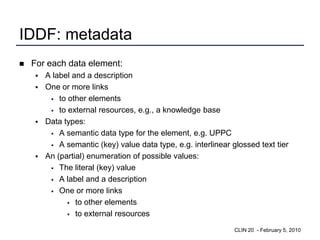
IDDF: metadata
   For each data element:
     A label and a description
     One or more links
        to other elements

        to external resources, e.g., a knowledge base

     Data types:
        A semantic data type for the element, e.g. UPPC

        A semantic (key) value data type, e.g. interlinear glossed text tier

     An (partial) enumeration of possible values:
        The literal (key) value

        A label and a description

        One or more links

             to other elements

             to external resources


                                                             CLIN 20 - February 5, 2010
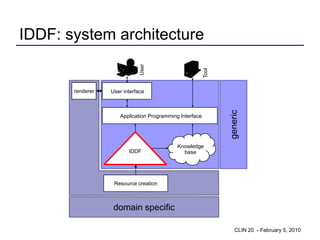
IDDF: system architecture


                              User


                                                         Tool
       renderer   User interface


                                                                generic
                     Application Programming Interface


                                            Knowledge
                         IDDF                 base


                   Resource creation


                   domain specific

                                                                   CLIN 20 - February 5, 2010
Next

   The problem of sustainability operability

   Sustainable operability of typological databases

   The IDDF architecture

   The Typological Database System

   The TDS Curator project


                                                CLIN 20 - February 5, 2010
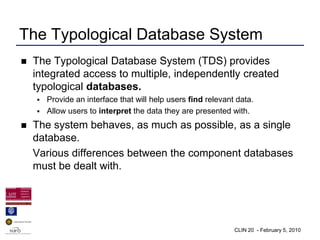
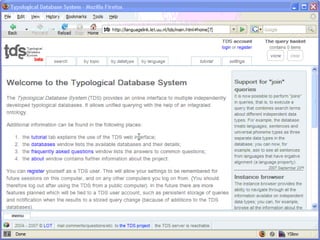
The Typological Database System
   The Typological Database System (TDS) provides
    integrated access to multiple, independently created
    typological databases.
     Provide an interface that will help users find relevant data.
     Allow users to interpret the data they are presented with.

   The system behaves, as much as possible, as a single
    database.
    Various differences between the component databases
    must be dealt with.


                                                             CLIN 20 - February 5, 2010
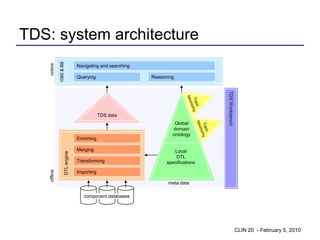
TDS: system architecture
              1060 & BB
    online

                                       Navigating and searching

                                       Querying                   Reasoning


                                                                                         TDS Workbench
                                                   TDS data
                                                                           Global
                                                                          domain
                                                                          ontology
                                       Enriching

                                       Merging                             Local
                          DTL engine


                                                                            DTL
                                       Transforming                     specifications
    offline


                                       Importing

                                                                        meta data

                                          component databases


                                                                                                         CLIN 20 - February 5, 2010
Next

   The problem of sustainable operability

   Sustainable operability of typological databases

   The IDDF architecture

   The Typological Database System

   The TDS Curator project


                                               CLIN 20 - February 5, 2010
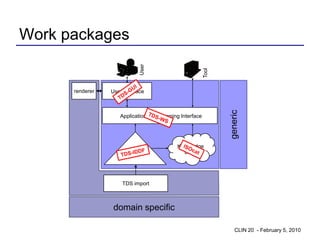
The TDS-Curator project
   CLARIN-NL Call 1 project
   “TDS Curator will make the TDS into a sustainable service that conforms to
    CLARIN infrastructural requirements.”
   Partners:
      Utrecht University
      DANS
      Max-Planck-Institute for Psycholinguistics
   May – November, 2010


                                                            CLIN 20 - February 5, 2010
Work packages


                             User


                                                        Tool
      renderer   User interface


                                                               generic
                    Application Programming Interface


                                           Knowledge
                        IDDF                 base


                  Resource creation
                    TDS import


                  domain specific

                                                                  CLIN 20 - February 5, 2010
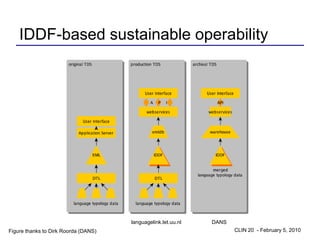
IDDF-based sustainable operability


                                      languagelink.let.uu.nl   DANS
Figure thanks to Dirk Roorda (DANS)                                   CLIN 20 - February 5, 2010
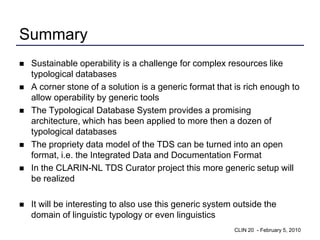
Summary
   Sustainable operability is a challenge for complex resources like
    typological databases
   A corner stone of a solution is a generic format that is rich enough to
    allow operability by generic tools
   The Typological Database System provides a promising
    architecture, which has been applied to more then a dozen of
    typological databases
   The propriety data model of the TDS can be turned into an open
    format, i.e. the Integrated Data and Documentation Format
   In the CLARIN-NL TDS Curator project this more generic setup will
    be realized

   It will be interesting to also use this generic system outside the
    domain of linguistic typology or even linguistics
                                                          CLIN 20 - February 5, 2010
http://languagelink.let.uu.nl/tds/


       Thanks for your attention!


                                 CLIN 20 - February 5, 2010
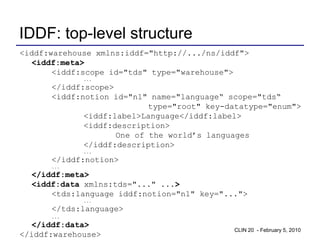
IDDF: top-level structure
<iddf:warehouse xmlns:iddf="http://.../ns/iddf">
  <iddf:meta>
       <iddf:scope id="tds" type="warehouse">
             ...
      </iddf:scope>
      <iddf:notion id="n1" name="language“ scope="tds“
                           type="root" key-datatype="enum">
             <iddf:label>Language</iddf:label>
             <iddf:description>
                    One of the world’s languages
             </iddf:description>
             ...
      </iddf:notion>
      ...
  </iddf:meta>
  <iddf:data xmlns:tds="..." ...>
      <tds:language iddf:notion="n1" key="...">
             ...
      </tds:language>
      ...

  </iddf:data>
                                            CLIN 20 - February 5, 2010
</iddf:warehouse>
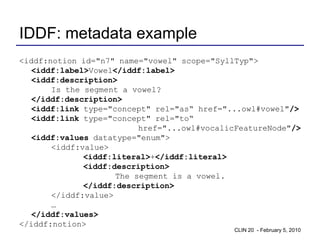
IDDF: metadata example
<iddf:notion id="n7" name="vowel" scope="SyllTyp">
   <iddf:label>Vowel</iddf:label>
   <iddf:description>
       Is the segment a vowel?
   </iddf:description>
   <iddf:link type="concept" rel="as“ href="...owl#vowel"/>
   <iddf:link type="concept" rel="to“
                          href="...owl#vocalicFeatureNode"/>
   <iddf:values datatype="enum">
       <iddf:value>
              <iddf:literal>+</iddf:literal>
              <iddf:description>
                     The segment is a vowel.
              </iddf:description>
       </iddf:value>
       …
   </iddf:values>
</iddf:notion>
                                             CLIN 20 - February 5, 2010
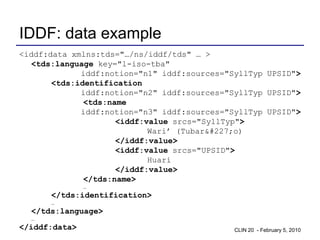
IDDF: data example
<iddf:data xmlns:tds="…/ns/iddf/tds" … >
   <tds:language key="l-iso-tba"
             iddf:notion="n1" iddf:sources="SyllTyp UPSID">
       <tds:identification
             iddf:notion="n2" iddf:sources="SyllTyp UPSID">
              <tds:name
             iddf:notion="n3" iddf:sources="SyllTyp UPSID">
                     <iddf:value srcs="SyllTyp">
                            Wari’ (Tubar&#227;o)
                     </iddf:value>
                     <iddf:value srcs="UPSID">
                            Huari
                     </iddf:value>
              </tds:name>
               …
      </tds:identification>
      …
  </tds:language>
  …
</iddf:data>                                 CLIN 20 - February 5, 2010
CLIN 20 - February 5, 2010

Sustainable operability: Keeping complex linguistic resources alive.

  • 1.
    Sustainable operability: Keeping complex linguisticresources alive Menzo Windhouwer Alexis Dimitriadis
  • 2.
    Sustainability of textresources  All electronic resources are accessed with the mediation of appropriate software.  Text editors, and web browsers, are generic: they can be used, with satisfactory results, with any document in a supported format.  Documents are (more or less) portable across software that supports their storage format.  Sustainability can be safeguarded by relying on documented, standard formats for their encoding. CLIN 20 - February 5, 2010
  • 3.
    The problem withdatabases  Databases are not portable in the sense that text documents are:  The data and relational structure of databases can be stored in (semi-)standard SQL format, or exported to other formats.  But databases are typically accessed through a custom- made user interface. Preserving the data, therefore, does not preserve the complete resource.  In this talk, we focus on (typological) databases. CLIN 20 - February 5, 2010
  • 4.
    Operability of complexresources  The general problem: Complex resources depend on custom software. Without the software, the resource is not usable and hence not truly preserved.  We will call a resource operable if suitable access or management software (operating software) exists for it.  While all electronic resources depend on software for their operability, complex resources are particularly vulnerable because they lack an economy of scale. CLIN 20 - February 5, 2010
  • 5.
    Outline  The problem of sustainable operability  Sustainable operability of typological databases  The IDDF architecture  The Typological Database System  The TDS Curator project CLIN 20 - February 5, 2010
  • 6.
    Next  The problem of sustainable operability  Sustainable operability of typological databases  The Typological Database System  The IDDF architecture  The TDS Curator project CLIN 20 - February 5, 2010
  • 7.
    Typological databases  Contain high-level, summary information about selected phenomena in a large number of languages.  May include example sentences with interlinear gloss annotations.  Are implemented on a variety of software platforms (Filemaker, MS Access, MySQL, 4th Dimension, Excel spreadsheets, custom software), and may or may not have a web interface. CLIN 20 - February 5, 2010
  • 8.
    Databases are diverse:  Original schema snippet from TDN database Field Values Metadata V105 0, 1, 9, 99 ATTRIBUTIVE ADJECTIVES ARE RELATIVE CLAUSES V168 0, 1, 9, 99 PRED LOC = ZERO + LOC PP V204 0, 1, 9, 99 PRED ADJ = COP VS. PRED LOC = VERB (NONCOP)  Phoneme inventory (SPIN database) CLIN 20 - February 5, 2010
  • 9.
    Databases are diverse:  User interface snippet for the Anatyp database CLIN 20 - February 5, 2010
  • 10.
    Typological databases –their fate Completed databases are subject to the usual perils:  Gradual obsolescence of db software, OS, or hardware.  Sudden disappearance due to incompatible software updates, retirement of legacy servers, or hardware failure.  Gradual fall into unusability, with the dissipation of the insider knowledge needed to utilize a poorly documented database. CLIN 20 - February 5, 2010
  • 11.
    A data dumpis insufficient  Why not just export a database’s tables in some standard format (tab-separated Unicode text, or even a dump in “standard” SQL)?  This would still be deficient in 1. Completeness of content and documentation 2. Operability CLIN 20 - February 5, 2010
  • 12.
    Completeness  The meaning of table contents, and their interrelationships, are not explicitly given in the data tables. Completeness example: TDN database  DocumentationMetadata normally stored in the relational Field Values is not schema 1, 9, 99 ATTRIBUTIVE ADJECTIVES ARE RELATIVE CLAUSES V105 0,  V168 0, 1, 9, 99 PRED LOC = ZERO + LOC PP Often, documentation is embedded in the user interface. Some is only in V204heads9, 99 creators. = COP VS. PRED LOC = VERB (NONCOP) the 0, 1, of its PRED ADJ  In the OAIS terminology, data tables alone are rarely “independently understandable”. CLIN 20 - February 5, 2010
  • 13.
    Operability Presentation example: Anatyp database  The presentation (user interface) of a database suggests how its content is to be interpreted.  The navigation structure and application logic also encode information about the data.  While there are general-purpose browsers for relational database tables, they are a very poor way to view a complex database:  They allow viewing one table at a time, but do not automatically select, project or join tables appropriately into views.  Even with foreign key information, there is no way to determine which joins or projections are “appropriate”. CLIN 20 - February 5, 2010
  • 14.
    Our approach tosustainable operability 1. Map resources to a sufficiently rich format at time of archiving. 2. Maintain generic software that can provide browsing and query access to all archived resources in an application domain. CLIN 20 - February 5, 2010
  • 15.
    Next  The problem of sustainable operability  Sustainable operability of typological databases  The IDDF architecture  The Typological Database System  The TDS Curator project CLIN 20 - February 5, 2010
  • 16.
    The Integrated Dataand Documentation Format  Data, structuring information and documentation are combined into an integrated, XML-based standardized format, the Integrated Data and Document Format (IDDF).  Software is provided that can manage IDDF-encoded resources in a generic way, just as a text editor or corpus tool can manage arbitrary conforming resources.  New generations of management software can be provided in the future, utilizing the self-describing nature of the IDDF and an economy of scale. CLIN 20 - February 5, 2010
  • 17.
    IDDF structure  Two major sections: 1. Metadata section:  provides the (loose) data schema  documents the elements in the schema 2. Data section:  contains the actual data  Hierarchical, semi-structured data model  Network of hierarchical units, a.k.a. semantic contexts CLIN 20 - February 5, 2010
  • 18.
    IDDF: metadata  For each data element:  A label and a description  One or more links  to other elements  to external resources, e.g., a knowledge base  Data types:  A semantic data type for the element, e.g. UPPC  A semantic (key) value data type, e.g. interlinear glossed text tier  An (partial) enumeration of possible values:  The literal (key) value  A label and a description  One or more links  to other elements  to external resources CLIN 20 - February 5, 2010
  • 19.
    IDDF: system architecture User Tool renderer User interface generic Application Programming Interface Knowledge IDDF base Resource creation domain specific CLIN 20 - February 5, 2010
  • 20.
    Next  The problem of sustainability operability  Sustainable operability of typological databases  The IDDF architecture  The Typological Database System  The TDS Curator project CLIN 20 - February 5, 2010
  • 21.
    The Typological DatabaseSystem  The Typological Database System (TDS) provides integrated access to multiple, independently created typological databases.  Provide an interface that will help users find relevant data.  Allow users to interpret the data they are presented with.  The system behaves, as much as possible, as a single database. Various differences between the component databases must be dealt with. CLIN 20 - February 5, 2010
  • 22.
    TDS: system architecture 1060 & BB online Navigating and searching Querying Reasoning TDS Workbench TDS data Global domain ontology Enriching Merging Local DTL engine DTL Transforming specifications offline Importing meta data component databases CLIN 20 - February 5, 2010
  • 23.
    Next  The problem of sustainable operability  Sustainable operability of typological databases  The IDDF architecture  The Typological Database System  The TDS Curator project CLIN 20 - February 5, 2010
  • 24.
    The TDS-Curator project  CLARIN-NL Call 1 project  “TDS Curator will make the TDS into a sustainable service that conforms to CLARIN infrastructural requirements.”  Partners:  Utrecht University  DANS  Max-Planck-Institute for Psycholinguistics  May – November, 2010 CLIN 20 - February 5, 2010
  • 25.
    Work packages User Tool renderer User interface generic Application Programming Interface Knowledge IDDF base Resource creation TDS import domain specific CLIN 20 - February 5, 2010
  • 26.
    IDDF-based sustainable operability languagelink.let.uu.nl DANS Figure thanks to Dirk Roorda (DANS) CLIN 20 - February 5, 2010
  • 27.
    Summary  Sustainable operability is a challenge for complex resources like typological databases  A corner stone of a solution is a generic format that is rich enough to allow operability by generic tools  The Typological Database System provides a promising architecture, which has been applied to more then a dozen of typological databases  The propriety data model of the TDS can be turned into an open format, i.e. the Integrated Data and Documentation Format  In the CLARIN-NL TDS Curator project this more generic setup will be realized  It will be interesting to also use this generic system outside the domain of linguistic typology or even linguistics CLIN 20 - February 5, 2010
  • 28.
    http://languagelink.let.uu.nl/tds/ Thanks for your attention! CLIN 20 - February 5, 2010
  • 29.
    IDDF: top-level structure <iddf:warehousexmlns:iddf="http://.../ns/iddf"> <iddf:meta> <iddf:scope id="tds" type="warehouse"> ... </iddf:scope> <iddf:notion id="n1" name="language“ scope="tds“ type="root" key-datatype="enum"> <iddf:label>Language</iddf:label> <iddf:description> One of the world’s languages </iddf:description> ... </iddf:notion> ... </iddf:meta> <iddf:data xmlns:tds="..." ...> <tds:language iddf:notion="n1" key="..."> ... </tds:language> ... </iddf:data> CLIN 20 - February 5, 2010 </iddf:warehouse>
  • 30.
    IDDF: metadata example <iddf:notionid="n7" name="vowel" scope="SyllTyp"> <iddf:label>Vowel</iddf:label> <iddf:description> Is the segment a vowel? </iddf:description> <iddf:link type="concept" rel="as“ href="...owl#vowel"/> <iddf:link type="concept" rel="to“ href="...owl#vocalicFeatureNode"/> <iddf:values datatype="enum"> <iddf:value> <iddf:literal>+</iddf:literal> <iddf:description> The segment is a vowel. </iddf:description> </iddf:value> … </iddf:values> </iddf:notion> CLIN 20 - February 5, 2010
  • 31.
    IDDF: data example <iddf:dataxmlns:tds="…/ns/iddf/tds" … > <tds:language key="l-iso-tba" iddf:notion="n1" iddf:sources="SyllTyp UPSID"> <tds:identification iddf:notion="n2" iddf:sources="SyllTyp UPSID"> <tds:name iddf:notion="n3" iddf:sources="SyllTyp UPSID"> <iddf:value srcs="SyllTyp"> Wari’ (Tubar&#227;o) </iddf:value> <iddf:value srcs="UPSID"> Huari </iddf:value> </tds:name> … </tds:identification> … </tds:language> … </iddf:data> CLIN 20 - February 5, 2010
  • 32.
    CLIN 20 -February 5, 2010