Dennis Beck
Associate Professor
University of Arkansas
Leonel Morgado
Full Professor
Universidade Aberta & INESC TEC
Can it be
done?
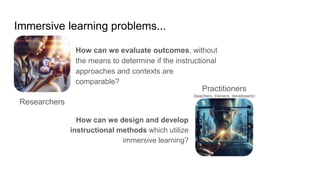
Immersive learning problems...
How can we evaluate outcomes, without
the means to determine if the instructional
approaches and contexts are
comparable?
Researchers
How can we design and develop
instructional methods which utilize
immersive learning?
Practitioners
(teachers, trainers, developers)
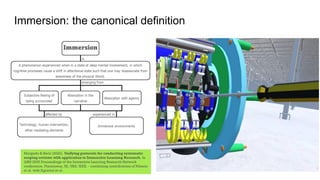
Immersion: the canonical definition
Morgado & Beck (2020). Unifying protocols for conducting systematic
scoping reviews with application to Immersive Learning Research. In
iLRN 2020 Proceedings of the Immersive Learning Research Network
conference. Piscataway, NJ, USA: IEEE. - combining contributions of Nilsson
et al. with Agrawal et al.
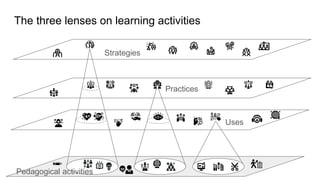
The three lenses on learning activities
Strategies
Practices
Uses
Pedagogical activities
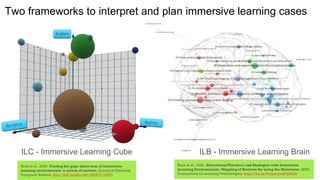
Two frameworks to interpret and plan immersive learning cases
Beck et al., 2024. Educational Practices and Strategies with Immersive
Learning Environments: Mapping of Reviews for using the Metaverse, IEEE
Transactions on Learning Technologies, https://bit.ly/ImmersiveEduStrat
Beck et al., 2020. Finding the gaps about uses of immersive
learning environments: a survey of surveys, Journal of Universal
Computer Science, http://hdl.handle.net/10400.2/10070
ILC - Immersive Learning Cube ILB - Immersive Learning Brain
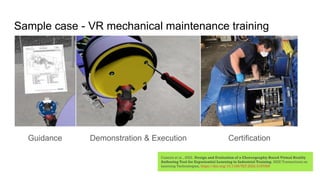
Sample case - VR mechanical maintenance training
Guidance Demonstration & Execution Certification
Cassola et al., 2022. Design and Evaluation of a Choreography-Based Virtual Reality
Authoring Tool for Experiential Learning in Industrial Training, IEEE Transactions on
Learning Technologies, https://doi.org/10.1109/TLT.2022.3157065
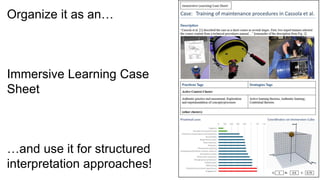
Organize it as an…
Immersive Learning Case
Sheet
…and use it for structured
interpretation approaches!
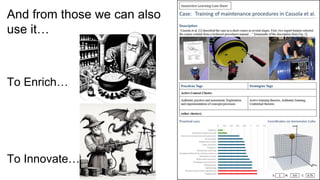
And from those we can also
use it…
To Enrich…
To Innovate…
Our step-by-step method to interpret a case with the ILB:
1. Develop a full description of your case. This description should include as much
information as possible about how immersive learning was employed and not just outcomes.
2. Ask which ILB cluster seems the most relevant to your case. If, for example, the
case involves significant collaboration, then it would be likely to look first at the Collaboration cluster for
relevant practices and strategies.
3. Compare the case description with the definitions of practices and strategies from the
Immersive Learning Brain and determine which apply to the case.
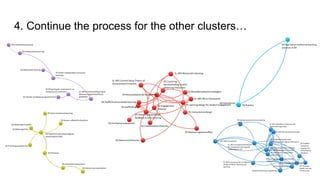
4. Continue to the next most relevant cluster and repeat the process. This process
should result in the list of strategies and practices used in your case.
5. Finally, rewrite your initial case description, making sure that you provide enough
information to account for the presence of those strategies and practices in case you neglected to provide
1. Develop a full description of your case.
Cassola et al. [10] described the case as a short course in several stages. First, two expert trainers selected the
course content from a technical procedures’ manual (Fig. 1, left), and recorded their own execution of the
technical procedures in the immersive environment (Fig. 1, center). Then there were independent training
sessions with the trainees using virtual reality headsets, with the following structure: a) a visual demonstration of
the environment and its affordances; b) a free interaction period for adaptation; c) execution of the procedures by
the trainees within the immersive environment, using as references both the manual in-world (Fig. 1, left) and the
prerecorded trainer demonstrations, and then interacting directly with the three-dimensional models (Fig. 1,
center); d) a certification test, where participants executed the trained tasks upon a physical wind turbine (Fig. 1,
right). The execution of the procedures was done individually by the trainees, and the system would only allow
correct actions to be taken. Other than consulting the documentation and watching the pre-recorded actions
demonstrated by the expert trainers, no coaching or other support took place.
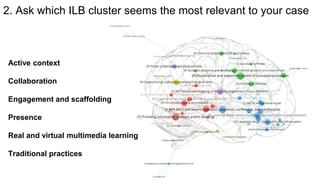
2. Ask which ILB cluster seems the most relevant to your case
Active context
Collaboration
Engagement and scaffolding
Presence
Real and virtual multimedia learning
Traditional practices
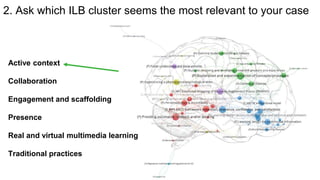
2. Ask which ILB cluster seems the most relevant to your case
Active context
Collaboration
Engagement and scaffolding
Presence
Real and virtual multimedia learning
Traditional practices
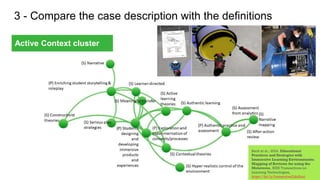
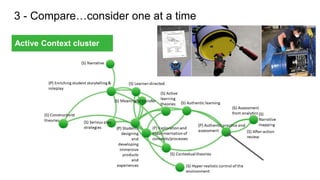
3 - Compare the case description with the definitions
Active Context cluster
Beck et al., 2024. Educational
Practices and Strategies with
Immersive Learning Environments:
Mapping of Reviews for using the
Metaverse, IEEE Transactions on
Learning Technologies,
https://bit.ly/ImmersiveEduStrat
3 - Compare…consider one at a time
Active Context cluster
Description
Definition:
Authentic
Practice and
Assessment
Cassola et al. [10] described the case as a short course in several stages. First, two expert trainers selected the course content from a technical
procedures’ manual (Fig. 1, left), and recorded their own execution of the technical procedures in the immersive environment (Fig. 1, center). Then
there were independent training sessions with the trainees using virtual reality headsets, with the following structure: a) a visual demonstration of the
environment and its affordances; b) a free interaction period for adaptation; c) execution of the procedures by the trainees within the immersive
environment, using as references both the manual in-world (Fig. 1, left) and the prerecorded trainer demonstrations, and then interacting directly with
the three-dimensional models (Fig. 1, center); d) a certification test, where participants executed
the trained tasks upon a physical wind turbine (Fig. 1, right). The execution of the
procedures was done individually by the trainees, and the system would only allow correct actions to be taken. Other than consulting the
documentation and watching the pre-recorded actions demonstrated by the expert trainers, no coaching or other support took place.
Practices which aimed
to make connections
between real-world
problems, tasks, and
outcomes, as well as
assessments based on
those practices
3 - Compare…consider one at a time
4. Continue the process for the other clusters…
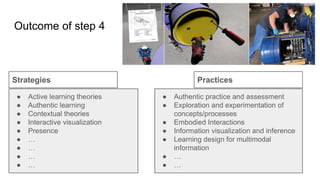
Outcome of step 4
● Active learning theories
● Authentic learning
● Contextual theories
● Interactive visualization
● Presence
● …
● …
● …
● …
Strategies
● Authentic practice and assessment
● Exploration and experimentation of
concepts/processes
● Embodied Interactions
● Information visualization and inference
● Learning design for multimodal
information
● …
● …
Practices
5. Finally, rewrite your initial case description
Cassola et al. [10] described the case as a short course in several stages. First, two expert trainers selected the course content from a technical procedures’ manual (Fig. 1, left), and
recorded their own execution of the technical procedures in the immersive environment (Fig. 1, center). Then there were independent training sessions with the trainees using virtual
reality headsets, with the following structure: a) a visual demonstration of the environment and its affordances; b) a free interaction period for adaptation; c) execution of the procedures
by the trainees within the immersive environment, using as references both the manual in-world (Fig. 1, left) and the prerecorded trainer demonstrations, and then interacting directly
with the three-dimensional models (Fig. 1, center); d) a certification test, where participants executed the trained
tasks upon a physical wind turbine in a real-world environment (Authentic practice and
assessment) (Fig. 1, right). The execution of the procedures was done individually by the trainees, and the system would only allow correct actions to be
taken. Other than consulting the documentation and watching the pre-recorded actions demonstrated by the expert trainers, no coaching or other support took place.
Outcome of step 5
“Cassola et al. [1] described the case as a short course in several stages. First, two expert trainers selected the
course content from a technical procedures’ manual (Fig. 1, left), and recorded their own execution of the
technical procedures in the immersive environment (Fig. 1, center), designing the activity to provide both aspects
(Learning design for multimodal information). The content and procedures reflected the context of an actual
maintenance shop in which a physical wind turbine would be worked on (Authentic learning, Contextual
theories). Then there were independent training sessions with the trainees using virtual reality headsets, with the
following structure: a) a visual demonstration of the environment and its affordances; b) a free interaction period
for adaptation, where trainees were allowed to explore and experiment (Exploration and experimentation of
concepts/processes), actively interpreting the VR model and environment in its context (Information visualization
and inference); c) execution of the procedures by the trainees within the immersive environment, experimenting
how to perform them on the turbine (Active learning theories, Exploration and experimentation of
concepts/processes), using as references both the manual in-world (Fig. 1, left) and the prerecorded trainer
demonstrations, therefore an information-diverse experience (Learning design for multimodal information). After
this, trainees interacted directly with the three-dimensional models (Fig. 1, center), using their own hand
movements, and walking around (Embodied Interactions), present in this technology-based environment
(Presence); d) a certification test, where participants executed the trained tasks upon a physical wind turbine in a
real-world environment (Authentic learning, Authentic practice and assessment) (Fig. 1, right). The execution of
the procedures was done individually by the trainees (Active Learning theories), and the system would only allow
correct actions to be taken. Other than consulting the documentation and watching the pre-recorded actions
demonstrated by the expert trainers, no coaching or other support took place.”
red text - added text
blue text (within parentheses) - tags for practices & strategies
Our step-by-step method to interpret a case with the ILC:
1. Develop a full description of your case that involves individuals feeling present amidst its
setting (system immersion); the story, diegetic space, and characters (narrative immersion); and
intervention possibilities (agency immersion). (Focus on essential aspects to the nature of the case.)
2. Evaluate how much the case relies on each immersion dimension considering
the aspects from step 1 (on a scale of 0 to 1: 0 for no reliance of that type of immersion, and 1 for full
reliance on being immersed in that kind of immersion).
3. Map the case into the conceptual space of the Immersion Cube by assigning the
coordinates established in step 2.
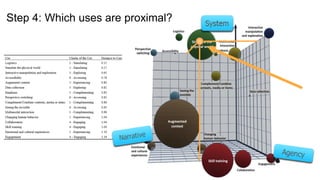
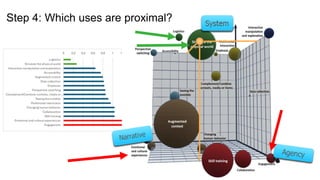
4. Identify which of the 16 known uses mapped in the cube are proximal to it, by
measuring the Euclidean distance to them in the cube.
5. Check if your case matches any of the proximal uses. If not, this process is complete.
But if so, rewrite your initial case description, making sure that you provide enough information to account
for the occurrence of those uses, in case you neglected to provide that in the first draft.
Step 1 - We already have a good description
“Cassola et al. [1] described the case as a short course in several stages. First, two expert trainers selected the
course content from a technical procedures’ manual (Fig. 1, left), and recorded their own execution of the
technical procedures in the immersive environment (Fig. 1, center), designing the activity to provide both aspects
(Learning design for multimodal information). The content and procedures reflected the context of an actual
maintenance shop in which a physical wind turbine would be worked on (Authentic learning, Contextual
theories). Then there w- visual setting providing the context of a maintenance shop and a wind turbine.
ere independent training sessions with the trainees using virtual reality headsets, with the following structure: a)
a visual demonstration of the environment and its affordances; b) a free interaction period for adaptation, where
trainees were allowed to explore and experiment (Exploration and experimentation of concepts/processes),
actively interpreting the VR model and environment in its context (Information visualization and inference); c)
execution of the procedures by the trainees within the immersive environment, experimenting how to perform
them on the turbine (Active learning theories, Exploration and experimentation of concepts/processes), using as
references both the manual in-world (Fig. 1, left) and the prerecorded trainer demonstrations, therefore an
information-diverse experience (Learning design for multimodal information). After this, trainees interacted
directly with the three-dimensional models (Fig. 1, center), using their own hand movements, and walking around
(Embodied Interactions), present in this technology-based environment (Presence); d) a certification test, where
participants executed the trained tasks upon a physical wind turbine in a real-world environment (Authentic
learning, Authentic practice and assessment) (Fig. 1, right). The execution of the procedures was done
individually by the trainees (Active Learning theories), and the system would only allow correct actions to be
taken. Other than consulting the documentation and watching the pre-recorded actions demonstrated by the
Tutorial: Time to try this yourself!!
● Get in groups of 3 or 4 if you are in person
● Online groups will be randomly assigned
● Once you are in your groups, either use a paper-based version of the case
study sheet OR scan this QR code for a digital version:
● Complete the sheet all the way up until “Proximal Uses” (Do not do that part
or below).
https://od07xk.s.cld.pt
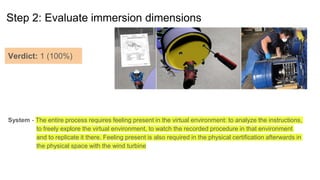
Step 2: Evaluate immersion dimensions
System - The entire process requires feeling present in the virtual environment: to analyze the instructions,
to freely explore the virtual environment, to watch the recorded procedure in that environment
and to replicate it there. Feeling present is also required in the physical certification afterwards in
the physical space with the wind turbine
Verdict: 1 (100%)
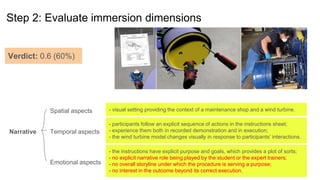
Step 2: Evaluate immersion dimensions
Narrative
Spatial aspects
Temporal aspects
Emotional aspects
- visual setting providing the context of a maintenance shop and a wind turbine.
- participants follow an explicit sequence of actions in the instructions sheet;
- experience them both in recorded demonstration and in execution;
- the wind turbine model changes visually in response to participants’ interactions.
- the instructions have explicit purpose and goals, which provides a plot of sorts;
- no explicit narrative role being played by the student or the expert trainers;
- no overall storyline under which the procedure is serving a purpose;
- no interest in the outcome beyond its correct execution.
Verdict: 0.6 (60%)
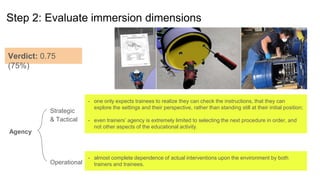
Step 2: Evaluate immersion dimensions
Agency
Strategic
& Tactical
Operational
- one only expects trainees to realize they can check the instructions, that they can
explore the settings and their perspective, rather than standing still at their initial position;
- even trainers’ agency is extremely limited to selecting the next procedure in order, and
not other aspects of the educational activity.
- almost complete dependence of actual interventions upon the environment by both
trainers and trainees.
Verdict: 0.75
(75%)
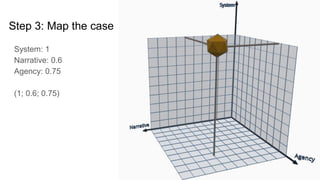
System: 1
Narrative: 0.6
Agency: 0.75
(1; 0.6; 0.75)
Step 3: Map the case
Step 4: Which uses are proximal?
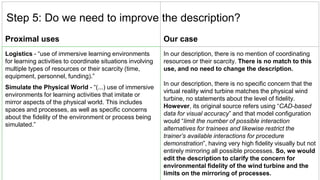
Proximal uses Our case
Logistics - “use of immersive learning environments
for learning activities to coordinate situations involving
multiple types of resources or their scarcity (time,
equipment, personnel, funding).”
Simulate the Physical World - “(...) use of immersive
environments for learning activities that imitate or
mirror aspects of the physical world. This includes
spaces and processes, as well as specific concerns
about the fidelity of the environment or process being
simulated.”
In our description, there is no mention of coordinating
resources or their scarcity. There is no match to this
use, and no need to change the description.
In our description, there is no specific concern that the
virtual reality wind turbine matches the physical wind
turbine, no statements about the level of fidelity.
However, its original source refers using “CAD-based
data for visual accuracy” and that model configuration
would “limit the number of possible interaction
alternatives for trainees and likewise restrict the
trainer’s available interactions for procedure
demonstration”, having very high fidelity visually but not
entirely mirroring all possible processes. So, we would
edit the description to clarify the concern for
environmental fidelity of the wind turbine and the
limits on the mirroring of processes.
Step 5: Do we need to improve the description?
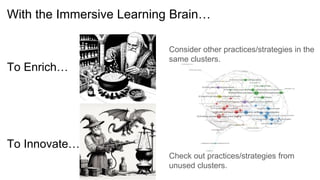
With the Immersive Learning Brain…
To Enrich…
To Innovate…
Consider other practices/strategies in the
same clusters.
Check out practices/strategies from
unused clusters.
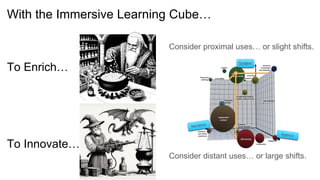
With the Immersive Learning Cube…
To Enrich…
To Innovate…
Consider proximal uses… or slight shifts.
Consider distant uses… or large shifts.
Tutorial: Time to try this yourself!!
● Get in your groups again!
● The online moderator will reassign you to the same groups. Please let them
know if your partners have left the session and we can reassign you.
● Complete the rest of the Case Study sheet either as a hard copy or digitally.
See your QR code.
● Please note that we don’t expect you to be a great artist… just do your best at
determining the number of proximal uses and their positions on the immersion
cube.
Questions?
Use it?
Improve it?
Dennis Beck
Associate Professor
University of Arkansas
Leonel Morgado
Full Professor
Universidade Aberta & INESC TEC

Sustainable Innovation with Immersive Learning

  • 1.
    Dennis Beck Associate Professor Universityof Arkansas Leonel Morgado Full Professor Universidade Aberta & INESC TEC Can it be done?
  • 2.
    Immersive learning problems... Howcan we evaluate outcomes, without the means to determine if the instructional approaches and contexts are comparable? Researchers How can we design and develop instructional methods which utilize immersive learning? Practitioners (teachers, trainers, developers)
  • 3.
    Immersion: the canonicaldefinition Morgado & Beck (2020). Unifying protocols for conducting systematic scoping reviews with application to Immersive Learning Research. In iLRN 2020 Proceedings of the Immersive Learning Research Network conference. Piscataway, NJ, USA: IEEE. - combining contributions of Nilsson et al. with Agrawal et al.
  • 4.
    The three lenseson learning activities Strategies Practices Uses Pedagogical activities
  • 5.
    Two frameworks tointerpret and plan immersive learning cases Beck et al., 2024. Educational Practices and Strategies with Immersive Learning Environments: Mapping of Reviews for using the Metaverse, IEEE Transactions on Learning Technologies, https://bit.ly/ImmersiveEduStrat Beck et al., 2020. Finding the gaps about uses of immersive learning environments: a survey of surveys, Journal of Universal Computer Science, http://hdl.handle.net/10400.2/10070 ILC - Immersive Learning Cube ILB - Immersive Learning Brain
  • 6.
    Sample case -VR mechanical maintenance training Guidance Demonstration & Execution Certification Cassola et al., 2022. Design and Evaluation of a Choreography-Based Virtual Reality Authoring Tool for Experiential Learning in Industrial Training, IEEE Transactions on Learning Technologies, https://doi.org/10.1109/TLT.2022.3157065
  • 7.
    Organize it asan… Immersive Learning Case Sheet …and use it for structured interpretation approaches!
  • 8.
    And from thosewe can also use it… To Enrich… To Innovate…
  • 9.
    Our step-by-step methodto interpret a case with the ILB: 1. Develop a full description of your case. This description should include as much information as possible about how immersive learning was employed and not just outcomes. 2. Ask which ILB cluster seems the most relevant to your case. If, for example, the case involves significant collaboration, then it would be likely to look first at the Collaboration cluster for relevant practices and strategies. 3. Compare the case description with the definitions of practices and strategies from the Immersive Learning Brain and determine which apply to the case. 4. Continue to the next most relevant cluster and repeat the process. This process should result in the list of strategies and practices used in your case. 5. Finally, rewrite your initial case description, making sure that you provide enough information to account for the presence of those strategies and practices in case you neglected to provide
  • 10.
    1. Develop afull description of your case. Cassola et al. [10] described the case as a short course in several stages. First, two expert trainers selected the course content from a technical procedures’ manual (Fig. 1, left), and recorded their own execution of the technical procedures in the immersive environment (Fig. 1, center). Then there were independent training sessions with the trainees using virtual reality headsets, with the following structure: a) a visual demonstration of the environment and its affordances; b) a free interaction period for adaptation; c) execution of the procedures by the trainees within the immersive environment, using as references both the manual in-world (Fig. 1, left) and the prerecorded trainer demonstrations, and then interacting directly with the three-dimensional models (Fig. 1, center); d) a certification test, where participants executed the trained tasks upon a physical wind turbine (Fig. 1, right). The execution of the procedures was done individually by the trainees, and the system would only allow correct actions to be taken. Other than consulting the documentation and watching the pre-recorded actions demonstrated by the expert trainers, no coaching or other support took place.
  • 11.
    2. Ask whichILB cluster seems the most relevant to your case Active context Collaboration Engagement and scaffolding Presence Real and virtual multimedia learning Traditional practices
  • 12.
    2. Ask whichILB cluster seems the most relevant to your case Active context Collaboration Engagement and scaffolding Presence Real and virtual multimedia learning Traditional practices
  • 13.
    3 - Comparethe case description with the definitions Active Context cluster Beck et al., 2024. Educational Practices and Strategies with Immersive Learning Environments: Mapping of Reviews for using the Metaverse, IEEE Transactions on Learning Technologies, https://bit.ly/ImmersiveEduStrat
  • 14.
    3 - Compare…considerone at a time Active Context cluster
  • 15.
    Description Definition: Authentic Practice and Assessment Cassola etal. [10] described the case as a short course in several stages. First, two expert trainers selected the course content from a technical procedures’ manual (Fig. 1, left), and recorded their own execution of the technical procedures in the immersive environment (Fig. 1, center). Then there were independent training sessions with the trainees using virtual reality headsets, with the following structure: a) a visual demonstration of the environment and its affordances; b) a free interaction period for adaptation; c) execution of the procedures by the trainees within the immersive environment, using as references both the manual in-world (Fig. 1, left) and the prerecorded trainer demonstrations, and then interacting directly with the three-dimensional models (Fig. 1, center); d) a certification test, where participants executed the trained tasks upon a physical wind turbine (Fig. 1, right). The execution of the procedures was done individually by the trainees, and the system would only allow correct actions to be taken. Other than consulting the documentation and watching the pre-recorded actions demonstrated by the expert trainers, no coaching or other support took place. Practices which aimed to make connections between real-world problems, tasks, and outcomes, as well as assessments based on those practices 3 - Compare…consider one at a time
  • 16.
    4. Continue theprocess for the other clusters…
  • 17.
    Outcome of step4 ● Active learning theories ● Authentic learning ● Contextual theories ● Interactive visualization ● Presence ● … ● … ● … ● … Strategies ● Authentic practice and assessment ● Exploration and experimentation of concepts/processes ● Embodied Interactions ● Information visualization and inference ● Learning design for multimodal information ● … ● … Practices
  • 18.
    5. Finally, rewriteyour initial case description Cassola et al. [10] described the case as a short course in several stages. First, two expert trainers selected the course content from a technical procedures’ manual (Fig. 1, left), and recorded their own execution of the technical procedures in the immersive environment (Fig. 1, center). Then there were independent training sessions with the trainees using virtual reality headsets, with the following structure: a) a visual demonstration of the environment and its affordances; b) a free interaction period for adaptation; c) execution of the procedures by the trainees within the immersive environment, using as references both the manual in-world (Fig. 1, left) and the prerecorded trainer demonstrations, and then interacting directly with the three-dimensional models (Fig. 1, center); d) a certification test, where participants executed the trained tasks upon a physical wind turbine in a real-world environment (Authentic practice and assessment) (Fig. 1, right). The execution of the procedures was done individually by the trainees, and the system would only allow correct actions to be taken. Other than consulting the documentation and watching the pre-recorded actions demonstrated by the expert trainers, no coaching or other support took place.
  • 19.
    Outcome of step5 “Cassola et al. [1] described the case as a short course in several stages. First, two expert trainers selected the course content from a technical procedures’ manual (Fig. 1, left), and recorded their own execution of the technical procedures in the immersive environment (Fig. 1, center), designing the activity to provide both aspects (Learning design for multimodal information). The content and procedures reflected the context of an actual maintenance shop in which a physical wind turbine would be worked on (Authentic learning, Contextual theories). Then there were independent training sessions with the trainees using virtual reality headsets, with the following structure: a) a visual demonstration of the environment and its affordances; b) a free interaction period for adaptation, where trainees were allowed to explore and experiment (Exploration and experimentation of concepts/processes), actively interpreting the VR model and environment in its context (Information visualization and inference); c) execution of the procedures by the trainees within the immersive environment, experimenting how to perform them on the turbine (Active learning theories, Exploration and experimentation of concepts/processes), using as references both the manual in-world (Fig. 1, left) and the prerecorded trainer demonstrations, therefore an information-diverse experience (Learning design for multimodal information). After this, trainees interacted directly with the three-dimensional models (Fig. 1, center), using their own hand movements, and walking around (Embodied Interactions), present in this technology-based environment (Presence); d) a certification test, where participants executed the trained tasks upon a physical wind turbine in a real-world environment (Authentic learning, Authentic practice and assessment) (Fig. 1, right). The execution of the procedures was done individually by the trainees (Active Learning theories), and the system would only allow correct actions to be taken. Other than consulting the documentation and watching the pre-recorded actions demonstrated by the expert trainers, no coaching or other support took place.” red text - added text blue text (within parentheses) - tags for practices & strategies
  • 20.
    Our step-by-step methodto interpret a case with the ILC: 1. Develop a full description of your case that involves individuals feeling present amidst its setting (system immersion); the story, diegetic space, and characters (narrative immersion); and intervention possibilities (agency immersion). (Focus on essential aspects to the nature of the case.) 2. Evaluate how much the case relies on each immersion dimension considering the aspects from step 1 (on a scale of 0 to 1: 0 for no reliance of that type of immersion, and 1 for full reliance on being immersed in that kind of immersion). 3. Map the case into the conceptual space of the Immersion Cube by assigning the coordinates established in step 2. 4. Identify which of the 16 known uses mapped in the cube are proximal to it, by measuring the Euclidean distance to them in the cube. 5. Check if your case matches any of the proximal uses. If not, this process is complete. But if so, rewrite your initial case description, making sure that you provide enough information to account for the occurrence of those uses, in case you neglected to provide that in the first draft.
  • 21.
    Step 1 -We already have a good description “Cassola et al. [1] described the case as a short course in several stages. First, two expert trainers selected the course content from a technical procedures’ manual (Fig. 1, left), and recorded their own execution of the technical procedures in the immersive environment (Fig. 1, center), designing the activity to provide both aspects (Learning design for multimodal information). The content and procedures reflected the context of an actual maintenance shop in which a physical wind turbine would be worked on (Authentic learning, Contextual theories). Then there w- visual setting providing the context of a maintenance shop and a wind turbine. ere independent training sessions with the trainees using virtual reality headsets, with the following structure: a) a visual demonstration of the environment and its affordances; b) a free interaction period for adaptation, where trainees were allowed to explore and experiment (Exploration and experimentation of concepts/processes), actively interpreting the VR model and environment in its context (Information visualization and inference); c) execution of the procedures by the trainees within the immersive environment, experimenting how to perform them on the turbine (Active learning theories, Exploration and experimentation of concepts/processes), using as references both the manual in-world (Fig. 1, left) and the prerecorded trainer demonstrations, therefore an information-diverse experience (Learning design for multimodal information). After this, trainees interacted directly with the three-dimensional models (Fig. 1, center), using their own hand movements, and walking around (Embodied Interactions), present in this technology-based environment (Presence); d) a certification test, where participants executed the trained tasks upon a physical wind turbine in a real-world environment (Authentic learning, Authentic practice and assessment) (Fig. 1, right). The execution of the procedures was done individually by the trainees (Active Learning theories), and the system would only allow correct actions to be taken. Other than consulting the documentation and watching the pre-recorded actions demonstrated by the
  • 22.
    Tutorial: Time totry this yourself!! ● Get in groups of 3 or 4 if you are in person ● Online groups will be randomly assigned ● Once you are in your groups, either use a paper-based version of the case study sheet OR scan this QR code for a digital version: ● Complete the sheet all the way up until “Proximal Uses” (Do not do that part or below). https://od07xk.s.cld.pt
  • 23.
    Step 2: Evaluateimmersion dimensions System - The entire process requires feeling present in the virtual environment: to analyze the instructions, to freely explore the virtual environment, to watch the recorded procedure in that environment and to replicate it there. Feeling present is also required in the physical certification afterwards in the physical space with the wind turbine Verdict: 1 (100%)
  • 24.
    Step 2: Evaluateimmersion dimensions Narrative Spatial aspects Temporal aspects Emotional aspects - visual setting providing the context of a maintenance shop and a wind turbine. - participants follow an explicit sequence of actions in the instructions sheet; - experience them both in recorded demonstration and in execution; - the wind turbine model changes visually in response to participants’ interactions. - the instructions have explicit purpose and goals, which provides a plot of sorts; - no explicit narrative role being played by the student or the expert trainers; - no overall storyline under which the procedure is serving a purpose; - no interest in the outcome beyond its correct execution. Verdict: 0.6 (60%)
  • 25.
    Step 2: Evaluateimmersion dimensions Agency Strategic & Tactical Operational - one only expects trainees to realize they can check the instructions, that they can explore the settings and their perspective, rather than standing still at their initial position; - even trainers’ agency is extremely limited to selecting the next procedure in order, and not other aspects of the educational activity. - almost complete dependence of actual interventions upon the environment by both trainers and trainees. Verdict: 0.75 (75%)
  • 26.
    System: 1 Narrative: 0.6 Agency:0.75 (1; 0.6; 0.75) Step 3: Map the case
  • 27.
    Step 4: Whichuses are proximal?
  • 28.
    Step 4: Whichuses are proximal?
  • 29.
    Proximal uses Ourcase Logistics - “use of immersive learning environments for learning activities to coordinate situations involving multiple types of resources or their scarcity (time, equipment, personnel, funding).” Simulate the Physical World - “(...) use of immersive environments for learning activities that imitate or mirror aspects of the physical world. This includes spaces and processes, as well as specific concerns about the fidelity of the environment or process being simulated.” In our description, there is no mention of coordinating resources or their scarcity. There is no match to this use, and no need to change the description. In our description, there is no specific concern that the virtual reality wind turbine matches the physical wind turbine, no statements about the level of fidelity. However, its original source refers using “CAD-based data for visual accuracy” and that model configuration would “limit the number of possible interaction alternatives for trainees and likewise restrict the trainer’s available interactions for procedure demonstration”, having very high fidelity visually but not entirely mirroring all possible processes. So, we would edit the description to clarify the concern for environmental fidelity of the wind turbine and the limits on the mirroring of processes. Step 5: Do we need to improve the description?
  • 30.
    With the ImmersiveLearning Brain… To Enrich… To Innovate… Consider other practices/strategies in the same clusters. Check out practices/strategies from unused clusters.
  • 31.
    With the ImmersiveLearning Cube… To Enrich… To Innovate… Consider proximal uses… or slight shifts. Consider distant uses… or large shifts.
  • 32.
    Tutorial: Time totry this yourself!! ● Get in your groups again! ● The online moderator will reassign you to the same groups. Please let them know if your partners have left the session and we can reassign you. ● Complete the rest of the Case Study sheet either as a hard copy or digitally. See your QR code. ● Please note that we don’t expect you to be a great artist… just do your best at determining the number of proximal uses and their positions on the immersion cube.
  • 33.
    Questions? Use it? Improve it? DennisBeck Associate Professor University of Arkansas Leonel Morgado Full Professor Universidade Aberta & INESC TEC