International Research Journal of Engineering and Technology (IRJET) e-ISSN: 2395-0056
Volume: 09 Issue: 06 | Jun 2022 www.irjet.net p-ISSN: 2395-0072
© 2022, IRJET | Impact Factor value: 7.529 | ISO 9001:2008 Certified Journal | Page 2886
Sustainable Development using Green Programming
Adarsh Sawant1, Prashant Trivedi2, Dr. Shivkumar Goel3
1Student, Vivekanand Education Society’s Institute Of Technology, Collector Colony, Chembur ,Mumbai-
400074,India
2Student, Vivekanand Education Society’s Institute Of Technology, Collector Colony, Chembur ,Mumbai-
400074,India
3Associate Professor/HOD, Vivekanand Education Society’s Institute Of Technology, Collector Colony, Chembur ,
Mumbai- 400074,India
---------------------------------------------------------------------***---------------------------------------------------------------------
Abstract - Programmersanddevelopersreceiveprofessional
training on programming languages and Methodologies but
rarely about software energy consumption. Modern
technologies such as mobile applicationsandcloudcomputing
require increased awareness about software energy
consumption. Generally, mobile device computations are
limited by battery life. Is the programmer knowledgeable
enough about software energy consumption and methods to
minimize energy consumption? Programmers have limited
knowledge about energy efficiency, lack knowledge about the
best practices to reduce the energy consumption of software,
and are often unsure about how software consumes energy.
Education about the importance of energy-effective software
will benefit the programmers and minimize energy
consumption.
Key Words: Developers, Energy Consumption, Energy
Efficiency, Energy effective software.
1. INTRODUCTION
The non-functional requirement of minimizing software
energy consumption becomes a concern for software
systems and software developers. In mobile device-based
applications, energy consumption affects battery life and
limits device usage. For data centers, energy consumption
limits the number of machines that can be used and cooled
after usage. Energy consumption is also called power
consumption by consumers, as energy and power are
related. Energy is usually measured in Joules (J) and Power
is measured in watts (W), which is the rate of energy
conversion, transfer, or consumption. Electricity providers
charge users by their energy consumption measured
kilowatt-hours (kWh). The basic training of programmers
often focuses on methodologies such as object-oriented
programming, and non-functional requirements such as
performance. Performance optimization is often considered
a substitution of energy optimization since a faster system
likely consumes less energy. Although this step is in a
positive direction, it is not at all sufficient. For instance,
parallel processing might improve performancebyreducing
calculation time.
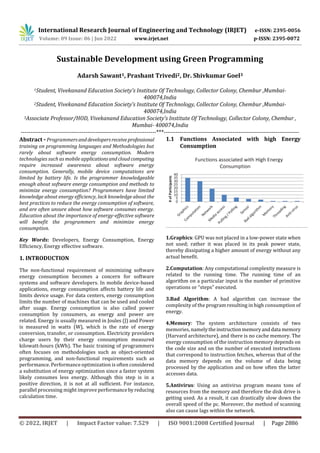
1.1 Functions Associated with high Energy
Consumption
1.Graphics: GPU was not placed in a low-power state when
not used; rather it was placed in its peak power state,
thereby dissipating a higher amount of energy without any
actual benefit.
2.Computation: Any computational complexity measure is
related to the running time. The running time of an
algorithm on a particular input is the number of primitive
operations or “steps” executed.
3.Bad Algorithm: A bad algorithm can increase the
complexity of the program resulting in high consumption of
energy.
4.Memory: The system architecture consists of two
memories, namelytheinstructionmemoryanddata memory
(Harvard architecture), and there is no cache memory. The
energy consumption of the instruction memory depends on
the code size and on the number of executed instructions
that correspond to instruction fetches, whereas that of the
data memory depends on the volume of data being
processed by the application and on how often the latter
accesses data.
5.Antivirus: Using an antivirus program means tons of
resources from the memory and therefore the disk drive is
getting used. As a result, it can drastically slow down the
overall speed of the pc. Moreover, the method of scanning
also can cause lags within the network.
International Research Journal of Engineering and Technology (IRJET) e-ISSN: 2395-0056
Volume: 09 Issue: 06 | Jun 2022 www.irjet.net p-ISSN: 2395-0072
© 2022, IRJET | Impact Factor value: 7.529 | ISO 9001:2008 Certified Journal | Page 2887
6.Network: A pair of researchers in California compiled
calculations and estimate that it takes between 170 and 307
Gigawatts of energy each year to support the socket power
and infrastructure needed to run the Internet. To put that
estimate in some perspective, even the lowest numberisthe
equivalent of powering several billion100wattincandescent
bulbs. While that number is considerable, even taking the
maximum number of that estimate, 307 Gigawatts
constitutes only 1.9% of the energy expended across
commercial, residential, industrial, and transportation
sectors.
7.Threading: With more threads, the codebecomesdifficult
to debug and maintain. Thread creation puts a load on the
system in terms of memory and CPU resources. We need to
do exception handling inside the worker method as any
unhandled exceptions can result in the program crashing.
8. Sensor: An additional parameter is the WSN operational
life, which strongly depends on the balance between power
consumption and energy storage. In particular, WSNs are
characterized by limited power storage, with possible
mitigation coming from power harvesting techniques.
Nevertheless, energy efficiency is a critical issue, to be
pursued both at node and network level. Typical
assumptions include considering the radio interface as the
main contributor to power consumption. As a consequence,
great attention has been given in the literature to protocol
optimization, aimed for instance at minimizing the amount
of data transmissions throughout the network, and the
maximization of node low-power residence time.
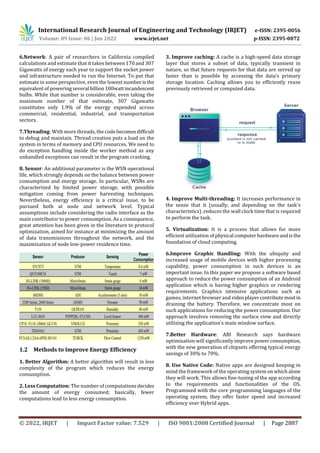
1.2 Methods to Improve Energy Efficiency
1. Better Algorithm: A better algorithm will result in less
complexity of the program which reduces the energy
consumption.
2. Less Computation: The number of computationsdecides
the amount of energy consumed; basically, fewer
computations lead to less energy consumption.
3. Improve caching: A cache is a high-speed data storage
layer that stores a subset of data, typically transient in
nature, so that future requests for that data are served up
faster than is possible by accessing the data’s primary
storage location. Caching allows you to efficiently reuse
previously retrieved or computed data.
4. Improve Multi-threading: It increases performance in
the sense that it (usually, and depending on the task's
characteristics) .reduces the wall clock time that is required
to perform the task.
5. Virtualization: It is a process that allows for more
efficient utilization of physical computerhardwareandisthe
foundation of cloud computing.
6.Improve Graphic Handling: With the ubiquity and
increased usage of mobile devices with higher processing
capability, power consumption in such devices is an
important issue. In this paper we propose a software based
approach to reduce the power consumption of an Android
application which is having higher graphics or rendering
requirements. Graphics intensive applications such as
games, internet browser and videoplayercontributemost in
draining the battery. Therefore, we concentrate most on
such applications for reducing the power consumption. Our
approach involves removing the surface view and directly
utilizing the application's main window surface.
7.Better Hardware: ABI Research says hardware
optimisation will significantly improve power consumption,
with the new generation of chipsets offering typical energy
savings of 30% to 70%.
8. Use Native Code: Native apps are designed keeping in
mind the framework of the operating system on whichalone
they will work. This allows fine-tuning of the app according
to the requirements and functionalities of the OS.
Programmed with the core programming languages of the
operating system, they offer faster speed and increased
efficiency over Hybrid apps.
International Research Journal of Engineering and Technology (IRJET) e-ISSN: 2395-0056
Volume: 09 Issue: 06 | Jun 2022 www.irjet.net p-ISSN: 2395-0072
© 2022, IRJET | Impact Factor value: 7.529 | ISO 9001:2008 Certified Journal | Page 2888
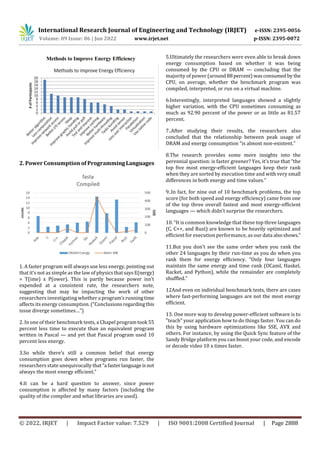
2. Power Consumption of ProgrammingLanguages
1. A faster program will always use less energy, pointing out
that it’s not as simple as the law of physicsthatsaysE(nergy)
= T(ime) x P(ower). This is partly because power isn’t
expended at a consistent rate, the researchers note,
suggesting that may be impacting the work of other
researchers investigating whether a program’srunningtime
affects its energy consumption. (“Conclusions regardingthis
issue diverge sometimes…”)
2. In one of their benchmark tests, a Chapel program took 55
percent less time to execute than an equivalent program
written in Pascal — and yet that Pascal program used 10
percent less energy.
3.So while there’s still a common belief that energy
consumption goes down when programs run faster, the
researchers state unequivocally that“a fasterlanguageisnot
always the most energy efficient.”
4.It can be a hard question to answer, since power
consumption is affected by many factors (including the
quality of the compiler and what libraries are used).
5.Ultimately the researchers were even able to break down
energy consumption based on whether it was being
consumed by the CPU or DRAM — concluding that the
majority of power (around88percent) wasconsumed by the
CPU, on average, whether the benchmark program was
compiled, interpreted, or run on a virtual machine.
6.Interestingly, interpreted languages showed a slightly
higher variation, with the CPU sometimes consuming as
much as 92.90 percent of the power or as little as 81.57
percent.
7..After studying their results, the researchers also
concluded that the relationship between peak usage of
DRAM and energy consumption “is almost non-existent.”
8.The research provides some more insights into the
perennial question: is faster greener? Yes, it’s true that “the
top five most energy-efficient languages keep their rank
when they are sorted by execution time and with very small
differences in both energy and time values.”
9..In fact, for nine out of 10 benchmark problems, the top
score (for both speed and energy efficiency) came from one
of the top three overall fastest and most energy-efficient
languages — which didn’t surprise the researchers.
10. “It is common knowledge that these top three languages
(C, C++, and Rust) are known to be heavily optimized and
efficient for execution performance, as our data alsoshows.”
11.But you don’t see the same order when you rank the
other 24 languages by their run-time as you do when you
rank them for energy efficiency. “Only four languages
maintain the same energy and time rank (OCaml, Haskel,
Racket, and Python), while the remainder are completely
shuffled.”
12And even on individual benchmark tests, there are cases
where fast-performing languages are not the most energy
efficient.
13. One more way to develop power-efficient software is to
"teach" your application how to do things faster. You can do
this by using hardware optimizations like SSE, AVX and
others. For instance, by using the Quick Sync feature of the
Sandy Bridge platform you can boost your code, and encode
or decode video 10 x times faster.
International Research Journal of Engineering and Technology (IRJET) e-ISSN: 2395-0056
Volume: 09 Issue: 06 | Jun 2022 www.irjet.net p-ISSN: 2395-0072
© 2022, IRJET | Impact Factor value: 7.529 | ISO 9001:2008 Certified Journal | Page 2889
3. Sustainable Development
Life spans, time to failure, and disposal of old hardware
should beconsidered.Hardwareshouldbeupdatedregularly.
The need for regular updating of hardware, both client
devices (such as desktop computers, laptops, and other
mobile devices such as mobile phones) and infrastructures
such as servers and networkequipment. Theelectricityused
by computers as well as the energy and resource used to
provide a suitable environment. Students can be unaware of
the large amount of energy needed to provide suitable
physical environments (temperature and humidity) for
server farms etc.
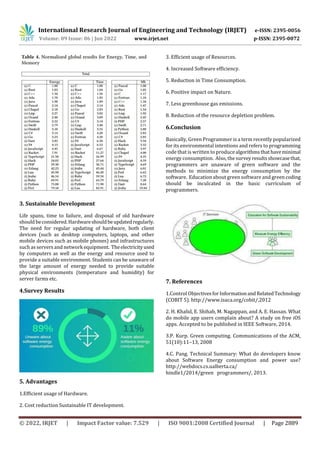
4.Survey Results
5. Advantages
1.Efficient usage of Hardware.
2. Cost reduction Sustainable IT development.
3. Efficient usage of Resources.
4. Increased Software efficiency.
5. Reduction in Time Consumption.
6. Positive impact on Nature.
7. Less greenhouse gas emissions.
8. Reduction of the resource depletion problem.
6.Conclusion
Basically, Green Programmer is a term recently popularized
for its environmental intentions and refers to programming
code that is written to producealgorithmsthathaveminimal
energy consumption. Also, the survey resultsshowcasethat,
programmers are unaware of green software and the
methods to minimize the energy consumption by the
software. Education about green software and green coding
should be inculcated in the basic curriculum of
programmers.
7. References
1.Control ObjectivesforInformationandRelatedTechnology
(COBIT 5). http://www.isaca.org/cobit/,2012
2. H. Khalid, E. Shihab, M. Nagappan, and A. E. Hassan. What
do mobile app users complain about? A study on free iOS
apps. Accepted to be published in IEEE Software, 2014.
3.P. Kurp. Green computing. Communications of the ACM,
51(10):11–13, 2008
4.C. Pang. Technical Summary: What do developers know
about Software Energy consumption and power use?
http://webdocs.cs.ualberta.ca/
hindle1/2014/green programmers/, 2013.

Sustainable Development using Green Programming

  • 1.
    International Research Journalof Engineering and Technology (IRJET) e-ISSN: 2395-0056 Volume: 09 Issue: 06 | Jun 2022 www.irjet.net p-ISSN: 2395-0072 © 2022, IRJET | Impact Factor value: 7.529 | ISO 9001:2008 Certified Journal | Page 2886 Sustainable Development using Green Programming Adarsh Sawant1, Prashant Trivedi2, Dr. Shivkumar Goel3 1Student, Vivekanand Education Society’s Institute Of Technology, Collector Colony, Chembur ,Mumbai- 400074,India 2Student, Vivekanand Education Society’s Institute Of Technology, Collector Colony, Chembur ,Mumbai- 400074,India 3Associate Professor/HOD, Vivekanand Education Society’s Institute Of Technology, Collector Colony, Chembur , Mumbai- 400074,India ---------------------------------------------------------------------***--------------------------------------------------------------------- Abstract - Programmersanddevelopersreceiveprofessional training on programming languages and Methodologies but rarely about software energy consumption. Modern technologies such as mobile applicationsandcloudcomputing require increased awareness about software energy consumption. Generally, mobile device computations are limited by battery life. Is the programmer knowledgeable enough about software energy consumption and methods to minimize energy consumption? Programmers have limited knowledge about energy efficiency, lack knowledge about the best practices to reduce the energy consumption of software, and are often unsure about how software consumes energy. Education about the importance of energy-effective software will benefit the programmers and minimize energy consumption. Key Words: Developers, Energy Consumption, Energy Efficiency, Energy effective software. 1. INTRODUCTION The non-functional requirement of minimizing software energy consumption becomes a concern for software systems and software developers. In mobile device-based applications, energy consumption affects battery life and limits device usage. For data centers, energy consumption limits the number of machines that can be used and cooled after usage. Energy consumption is also called power consumption by consumers, as energy and power are related. Energy is usually measured in Joules (J) and Power is measured in watts (W), which is the rate of energy conversion, transfer, or consumption. Electricity providers charge users by their energy consumption measured kilowatt-hours (kWh). The basic training of programmers often focuses on methodologies such as object-oriented programming, and non-functional requirements such as performance. Performance optimization is often considered a substitution of energy optimization since a faster system likely consumes less energy. Although this step is in a positive direction, it is not at all sufficient. For instance, parallel processing might improve performancebyreducing calculation time. 1.1 Functions Associated with high Energy Consumption 1.Graphics: GPU was not placed in a low-power state when not used; rather it was placed in its peak power state, thereby dissipating a higher amount of energy without any actual benefit. 2.Computation: Any computational complexity measure is related to the running time. The running time of an algorithm on a particular input is the number of primitive operations or “steps” executed. 3.Bad Algorithm: A bad algorithm can increase the complexity of the program resulting in high consumption of energy. 4.Memory: The system architecture consists of two memories, namelytheinstructionmemoryanddata memory (Harvard architecture), and there is no cache memory. The energy consumption of the instruction memory depends on the code size and on the number of executed instructions that correspond to instruction fetches, whereas that of the data memory depends on the volume of data being processed by the application and on how often the latter accesses data. 5.Antivirus: Using an antivirus program means tons of resources from the memory and therefore the disk drive is getting used. As a result, it can drastically slow down the overall speed of the pc. Moreover, the method of scanning also can cause lags within the network.
  • 2.
    International Research Journalof Engineering and Technology (IRJET) e-ISSN: 2395-0056 Volume: 09 Issue: 06 | Jun 2022 www.irjet.net p-ISSN: 2395-0072 © 2022, IRJET | Impact Factor value: 7.529 | ISO 9001:2008 Certified Journal | Page 2887 6.Network: A pair of researchers in California compiled calculations and estimate that it takes between 170 and 307 Gigawatts of energy each year to support the socket power and infrastructure needed to run the Internet. To put that estimate in some perspective, even the lowest numberisthe equivalent of powering several billion100wattincandescent bulbs. While that number is considerable, even taking the maximum number of that estimate, 307 Gigawatts constitutes only 1.9% of the energy expended across commercial, residential, industrial, and transportation sectors. 7.Threading: With more threads, the codebecomesdifficult to debug and maintain. Thread creation puts a load on the system in terms of memory and CPU resources. We need to do exception handling inside the worker method as any unhandled exceptions can result in the program crashing. 8. Sensor: An additional parameter is the WSN operational life, which strongly depends on the balance between power consumption and energy storage. In particular, WSNs are characterized by limited power storage, with possible mitigation coming from power harvesting techniques. Nevertheless, energy efficiency is a critical issue, to be pursued both at node and network level. Typical assumptions include considering the radio interface as the main contributor to power consumption. As a consequence, great attention has been given in the literature to protocol optimization, aimed for instance at minimizing the amount of data transmissions throughout the network, and the maximization of node low-power residence time. 1.2 Methods to Improve Energy Efficiency 1. Better Algorithm: A better algorithm will result in less complexity of the program which reduces the energy consumption. 2. Less Computation: The number of computationsdecides the amount of energy consumed; basically, fewer computations lead to less energy consumption. 3. Improve caching: A cache is a high-speed data storage layer that stores a subset of data, typically transient in nature, so that future requests for that data are served up faster than is possible by accessing the data’s primary storage location. Caching allows you to efficiently reuse previously retrieved or computed data. 4. Improve Multi-threading: It increases performance in the sense that it (usually, and depending on the task's characteristics) .reduces the wall clock time that is required to perform the task. 5. Virtualization: It is a process that allows for more efficient utilization of physical computerhardwareandisthe foundation of cloud computing. 6.Improve Graphic Handling: With the ubiquity and increased usage of mobile devices with higher processing capability, power consumption in such devices is an important issue. In this paper we propose a software based approach to reduce the power consumption of an Android application which is having higher graphics or rendering requirements. Graphics intensive applications such as games, internet browser and videoplayercontributemost in draining the battery. Therefore, we concentrate most on such applications for reducing the power consumption. Our approach involves removing the surface view and directly utilizing the application's main window surface. 7.Better Hardware: ABI Research says hardware optimisation will significantly improve power consumption, with the new generation of chipsets offering typical energy savings of 30% to 70%. 8. Use Native Code: Native apps are designed keeping in mind the framework of the operating system on whichalone they will work. This allows fine-tuning of the app according to the requirements and functionalities of the OS. Programmed with the core programming languages of the operating system, they offer faster speed and increased efficiency over Hybrid apps.
  • 3.
    International Research Journalof Engineering and Technology (IRJET) e-ISSN: 2395-0056 Volume: 09 Issue: 06 | Jun 2022 www.irjet.net p-ISSN: 2395-0072 © 2022, IRJET | Impact Factor value: 7.529 | ISO 9001:2008 Certified Journal | Page 2888 2. Power Consumption of ProgrammingLanguages 1. A faster program will always use less energy, pointing out that it’s not as simple as the law of physicsthatsaysE(nergy) = T(ime) x P(ower). This is partly because power isn’t expended at a consistent rate, the researchers note, suggesting that may be impacting the work of other researchers investigating whether a program’srunningtime affects its energy consumption. (“Conclusions regardingthis issue diverge sometimes…”) 2. In one of their benchmark tests, a Chapel program took 55 percent less time to execute than an equivalent program written in Pascal — and yet that Pascal program used 10 percent less energy. 3.So while there’s still a common belief that energy consumption goes down when programs run faster, the researchers state unequivocally that“a fasterlanguageisnot always the most energy efficient.” 4.It can be a hard question to answer, since power consumption is affected by many factors (including the quality of the compiler and what libraries are used). 5.Ultimately the researchers were even able to break down energy consumption based on whether it was being consumed by the CPU or DRAM — concluding that the majority of power (around88percent) wasconsumed by the CPU, on average, whether the benchmark program was compiled, interpreted, or run on a virtual machine. 6.Interestingly, interpreted languages showed a slightly higher variation, with the CPU sometimes consuming as much as 92.90 percent of the power or as little as 81.57 percent. 7..After studying their results, the researchers also concluded that the relationship between peak usage of DRAM and energy consumption “is almost non-existent.” 8.The research provides some more insights into the perennial question: is faster greener? Yes, it’s true that “the top five most energy-efficient languages keep their rank when they are sorted by execution time and with very small differences in both energy and time values.” 9..In fact, for nine out of 10 benchmark problems, the top score (for both speed and energy efficiency) came from one of the top three overall fastest and most energy-efficient languages — which didn’t surprise the researchers. 10. “It is common knowledge that these top three languages (C, C++, and Rust) are known to be heavily optimized and efficient for execution performance, as our data alsoshows.” 11.But you don’t see the same order when you rank the other 24 languages by their run-time as you do when you rank them for energy efficiency. “Only four languages maintain the same energy and time rank (OCaml, Haskel, Racket, and Python), while the remainder are completely shuffled.” 12And even on individual benchmark tests, there are cases where fast-performing languages are not the most energy efficient. 13. One more way to develop power-efficient software is to "teach" your application how to do things faster. You can do this by using hardware optimizations like SSE, AVX and others. For instance, by using the Quick Sync feature of the Sandy Bridge platform you can boost your code, and encode or decode video 10 x times faster.
  • 4.
    International Research Journalof Engineering and Technology (IRJET) e-ISSN: 2395-0056 Volume: 09 Issue: 06 | Jun 2022 www.irjet.net p-ISSN: 2395-0072 © 2022, IRJET | Impact Factor value: 7.529 | ISO 9001:2008 Certified Journal | Page 2889 3. Sustainable Development Life spans, time to failure, and disposal of old hardware should beconsidered.Hardwareshouldbeupdatedregularly. The need for regular updating of hardware, both client devices (such as desktop computers, laptops, and other mobile devices such as mobile phones) and infrastructures such as servers and networkequipment. Theelectricityused by computers as well as the energy and resource used to provide a suitable environment. Students can be unaware of the large amount of energy needed to provide suitable physical environments (temperature and humidity) for server farms etc. 4.Survey Results 5. Advantages 1.Efficient usage of Hardware. 2. Cost reduction Sustainable IT development. 3. Efficient usage of Resources. 4. Increased Software efficiency. 5. Reduction in Time Consumption. 6. Positive impact on Nature. 7. Less greenhouse gas emissions. 8. Reduction of the resource depletion problem. 6.Conclusion Basically, Green Programmer is a term recently popularized for its environmental intentions and refers to programming code that is written to producealgorithmsthathaveminimal energy consumption. Also, the survey resultsshowcasethat, programmers are unaware of green software and the methods to minimize the energy consumption by the software. Education about green software and green coding should be inculcated in the basic curriculum of programmers. 7. References 1.Control ObjectivesforInformationandRelatedTechnology (COBIT 5). http://www.isaca.org/cobit/,2012 2. H. Khalid, E. Shihab, M. Nagappan, and A. E. Hassan. What do mobile app users complain about? A study on free iOS apps. Accepted to be published in IEEE Software, 2014. 3.P. Kurp. Green computing. Communications of the ACM, 51(10):11–13, 2008 4.C. Pang. Technical Summary: What do developers know about Software Energy consumption and power use? http://webdocs.cs.ualberta.ca/ hindle1/2014/green programmers/, 2013.