Sustainability -
  Here to Stay


agneya
Sustainabiliy - Here to Stay                                                           agneya


   Sustainability
   – Here to Stay


Over the past decade, global business operations have witnessed a noticeable change in the
manner of business conduct. As the understandings of business impacts, risks and opportunities
evolved and matured, there has been a drive to enhance business performance by taking into
consideration multiple factors such as social, economic and environmental indicators. Uncertain
market conditions, declining natural resources, increasing cost of production and aggressive
competition, coupled with regulatory and policy changes have further added to the need for
rganizations to strengthen business foundations through sincere efforts at understanding and
implementing business sustainability.

At a macro level, there has been a general consensus that there is an urgent need to keep a
check on various systems, man-made or otherwise, to minimise negative impacts that could
cumulate into serious consequential global problems. The front runner in this issue is the threat
of runaway climate change which has also been the key driver towards sustainability from
the start. This concept now covers a wider aspect and has been adapted to allow application
to practically any system available including business operations.


                                                                                                    1
Sustainabiliy - Here to Stay                                                                 agneya


At micro level, organizations worldwide are beginning to see the benefits of sustainable
development. For example, being able to adapt to changing public policy agenda means that
Organizations are better positioned to protect the valuation of their business assets, both tangible
and intangible. Enhance stakeholder confidence improves credibility and allows organizations to
play a wider role in shaping public policy agenda alongside governments and societies. Moreover,
as concerns for energy security and global emissions are taking centre stage, organizations are
evaluating alternativ,e non-polluting, affordable energy sources to mitigate possible regulatory and
resource constrains in the future which could have disruptive implications on their businesses and
this provides the drive needed for R&D in the clean technology sector.

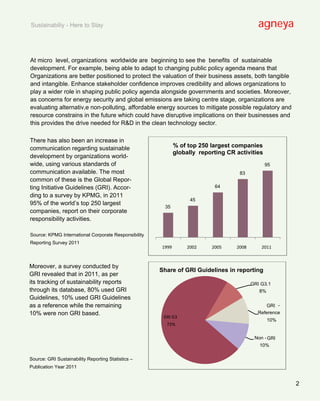
There has also been an increase in
communication regarding sustainable                          % of top 250 largest companies
                                                             globally reporting CR activities
development by organizations world-
wide, using various standards of                                                                95
communication available. The most                                                   83
common of these is the Global Repor-
ting Initiative Guidelines (GRI). Accor-                                   64
ding to a survey by KPMG, in 2011
                                                                   45
95% of the world’s top 250 largest
                                                       35
companies, report on their corporate
responsibility activities.

Source: KPMG International Corporate Responsibility
Reporting Survey 2011
                                                      1999        2002    2005     2008       2011


Moreover, a survey conducted by
                                                      Share of GRI Guidelines in reporting
GRI revealed that in 2011, as per
its tracking of sustainability reports                                                    GRI G3.1
through its database, 80% used GRI                                                           8%
Guidelines, 10% used GRI Guidelines
as a reference while the remaining                                                             GRI -
10% were non GRI based.                                                                     Reference
                                                       GRI G3
                                                                                                10%
                                                        72%

                                                                                           Non - GRI
                                                                                             10%

Source: GRI Sustainability Reporting Statistics –
Publication Year 2011


                                                                                                        2
Sustainabiliy - Here to Stay                                                             agneya

Current Trends in India
India is at a nascent stage of sustainability development. To date, most of the activities are
confined to voluntary initiatives and brand building exercises. However, even in this scenario,
companies that communicate sustainability development are able to access tremendous
amount of performance data that are otherwise not used in business as usual cases. This
provides them with new perspective on the overall impact of the company and not just on
business performance. This allows for analyses of threat beyond those commonly associated
with business practice and to devise means and ways of neutralising it.

Lately, there is a change in the overall outlook in the country. Being the third highest emitter
of greenhouse gases in the world already and with growing demand for energy from
burgeoning middle class, there will be increasing strain on existing energy sources which
will in turn result in increased GHG emissions. This means that India will experience
tremendous pressure from other countries to contribute to global sustainability through
sustainable energy mix, reduction in GHG emissions and through the proliferation of energy
efficiency. The winds of change are clearly visible. In the last decade, the Government of
India has taken numerous steps to incentivise businesses into moving to cleaner and more
sustainable development. The National Action Plan on Climate Change (NAPCC) has been
a major driver towards this end. India has rolled out several schemes for promoting clean
development such as the REC, RPO and PAT.

Recently, the Government has gone a step further and imposed addition measures for
ensuring that businesses report on sustainable development. The newly revised
Companies Bill 2011, containing provisions that mandate companies to spend 2% of their
average profits for 3 years on CSR activities, was approved by the Cabinet. Similarly, SEBI
has released a circular mandating the top 100 companies listed at BSE and NSE to submit
detailed reports on their Social, Environmental and Economic performance. Such mandates
are expected to drive more investments into sustainable development and corporate
responsibility and would be expanded over time.


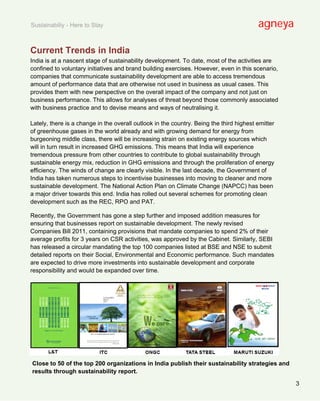
Close to 50 of the top 200 organizations in India publish their sustainability strategies and
results through sustainability report.

                                                                                                   3
Sustainabiliy - Here to Stay                                                          agneya

Bright Future Ahead
Pressure from regulators, investors and stakeholders is only expected to increase as they
become more aware of the global implications of unregulated business practices in highly
competitive environments. This will have wide implications on the way business is conducted.
Getting the competitive edge will no longer be dependent only on product and service
offerings but on the entire business model on which they are developed. Retaining talent
and maintaining a favourable outlook of stakeholders will require a more dedicated and
stakeholder centric approach while taking into account key business requirements for over-
all growth. The key winners will be companies that are most flexible and adaptive to the
ever changing environment in which they operate.


About GRI
The Global Reporting Initiative (GRI) is a non-profit organization
that works towards a sustainable global economy by providing
sustainability report guidance. GRI has pioneered and developed
a comprehensive Sustainability Reporting Framework that is widely
used around the world. The Framework enables all organizations
to measure and report their economic, environmental, social and
governance performance – the four key areas of sustainability.

Its global network includes more than 600 Organizational Stakeholders – core supporters –
and some 30,000 people representing different sectors and constituencies. GRI also enjoys
strategic partnerships with the United Nations Environment Programme, the UN Global Compact,
the Organisation for Economic Co-operation and Development, International Organization for
Standardization and many others.


About Business Responsibility Report
On August 13, 2012, SEBI issued a circular that mandates
listed companies to submit Business Responsibility Reports
(BRR), as part of their annual report. The BRR should describe
measures taken by companies along the key principles
enunciated in the ‘National Voluntary Guideline on Social
Environmental and Economic Responsibilities of Business’ framed by the Ministry of
Corporate affairs (MCA). The circular features a reporting framework which divided into five
sections - General information, Financial Details, Other Organizational Details, Business
Responsibility Details, and Principle-wise performance covering nine principles.


                                                                                               4
Sustainabiliy - Here to Stay                                                       agneya


______________________________________________________________________________________


    Agneya is focused consulting firm in the domain of Sustainability, Carbon and Renewable Energy.
    Founded in year 2010 by alumni of IIM Ahmedabad, Agneya has successfully established itself
    as a credible consulting partner in its chosen domains and is well trusted by clients.

    We serve clients in the areas of Sustainability, Carbon and Renewable Energy areas by providing
    analyses and insights for decision-making along with practical and feasible solutions to meet
    goals and objectives. Our services are especially relevant to companies investing in renewable
    energy generating assets, sourcing renewable power, commercializing renewable power and also
    those, that are directly or indirectly impacted by compliance - internal or external and have
    business requirements related to carbon management and sustainability.


______________________________________________________________________________________


    For further details contact us at

    indrajeet@agneya.in / +91 - 9028788430
    rahul@agneya.in / +91 8806070783

Sustainability Here to stay

  • 1.
    Sustainability - Here to Stay agneya
  • 2.
    Sustainabiliy - Hereto Stay agneya Sustainability – Here to Stay Over the past decade, global business operations have witnessed a noticeable change in the manner of business conduct. As the understandings of business impacts, risks and opportunities evolved and matured, there has been a drive to enhance business performance by taking into consideration multiple factors such as social, economic and environmental indicators. Uncertain market conditions, declining natural resources, increasing cost of production and aggressive competition, coupled with regulatory and policy changes have further added to the need for rganizations to strengthen business foundations through sincere efforts at understanding and implementing business sustainability. At a macro level, there has been a general consensus that there is an urgent need to keep a check on various systems, man-made or otherwise, to minimise negative impacts that could cumulate into serious consequential global problems. The front runner in this issue is the threat of runaway climate change which has also been the key driver towards sustainability from the start. This concept now covers a wider aspect and has been adapted to allow application to practically any system available including business operations. 1
  • 3.
    Sustainabiliy - Hereto Stay agneya At micro level, organizations worldwide are beginning to see the benefits of sustainable development. For example, being able to adapt to changing public policy agenda means that Organizations are better positioned to protect the valuation of their business assets, both tangible and intangible. Enhance stakeholder confidence improves credibility and allows organizations to play a wider role in shaping public policy agenda alongside governments and societies. Moreover, as concerns for energy security and global emissions are taking centre stage, organizations are evaluating alternativ,e non-polluting, affordable energy sources to mitigate possible regulatory and resource constrains in the future which could have disruptive implications on their businesses and this provides the drive needed for R&D in the clean technology sector. There has also been an increase in communication regarding sustainable % of top 250 largest companies globally reporting CR activities development by organizations world- wide, using various standards of 95 communication available. The most 83 common of these is the Global Repor- ting Initiative Guidelines (GRI). Accor- 64 ding to a survey by KPMG, in 2011 45 95% of the world’s top 250 largest 35 companies, report on their corporate responsibility activities. Source: KPMG International Corporate Responsibility Reporting Survey 2011 1999 2002 2005 2008 2011 Moreover, a survey conducted by Share of GRI Guidelines in reporting GRI revealed that in 2011, as per its tracking of sustainability reports GRI G3.1 through its database, 80% used GRI 8% Guidelines, 10% used GRI Guidelines as a reference while the remaining GRI - 10% were non GRI based. Reference GRI G3 10% 72% Non - GRI 10% Source: GRI Sustainability Reporting Statistics – Publication Year 2011 2
  • 4.
    Sustainabiliy - Hereto Stay agneya Current Trends in India India is at a nascent stage of sustainability development. To date, most of the activities are confined to voluntary initiatives and brand building exercises. However, even in this scenario, companies that communicate sustainability development are able to access tremendous amount of performance data that are otherwise not used in business as usual cases. This provides them with new perspective on the overall impact of the company and not just on business performance. This allows for analyses of threat beyond those commonly associated with business practice and to devise means and ways of neutralising it. Lately, there is a change in the overall outlook in the country. Being the third highest emitter of greenhouse gases in the world already and with growing demand for energy from burgeoning middle class, there will be increasing strain on existing energy sources which will in turn result in increased GHG emissions. This means that India will experience tremendous pressure from other countries to contribute to global sustainability through sustainable energy mix, reduction in GHG emissions and through the proliferation of energy efficiency. The winds of change are clearly visible. In the last decade, the Government of India has taken numerous steps to incentivise businesses into moving to cleaner and more sustainable development. The National Action Plan on Climate Change (NAPCC) has been a major driver towards this end. India has rolled out several schemes for promoting clean development such as the REC, RPO and PAT. Recently, the Government has gone a step further and imposed addition measures for ensuring that businesses report on sustainable development. The newly revised Companies Bill 2011, containing provisions that mandate companies to spend 2% of their average profits for 3 years on CSR activities, was approved by the Cabinet. Similarly, SEBI has released a circular mandating the top 100 companies listed at BSE and NSE to submit detailed reports on their Social, Environmental and Economic performance. Such mandates are expected to drive more investments into sustainable development and corporate responsibility and would be expanded over time. Close to 50 of the top 200 organizations in India publish their sustainability strategies and results through sustainability report. 3
  • 5.
    Sustainabiliy - Hereto Stay agneya Bright Future Ahead Pressure from regulators, investors and stakeholders is only expected to increase as they become more aware of the global implications of unregulated business practices in highly competitive environments. This will have wide implications on the way business is conducted. Getting the competitive edge will no longer be dependent only on product and service offerings but on the entire business model on which they are developed. Retaining talent and maintaining a favourable outlook of stakeholders will require a more dedicated and stakeholder centric approach while taking into account key business requirements for over- all growth. The key winners will be companies that are most flexible and adaptive to the ever changing environment in which they operate. About GRI The Global Reporting Initiative (GRI) is a non-profit organization that works towards a sustainable global economy by providing sustainability report guidance. GRI has pioneered and developed a comprehensive Sustainability Reporting Framework that is widely used around the world. The Framework enables all organizations to measure and report their economic, environmental, social and governance performance – the four key areas of sustainability. Its global network includes more than 600 Organizational Stakeholders – core supporters – and some 30,000 people representing different sectors and constituencies. GRI also enjoys strategic partnerships with the United Nations Environment Programme, the UN Global Compact, the Organisation for Economic Co-operation and Development, International Organization for Standardization and many others. About Business Responsibility Report On August 13, 2012, SEBI issued a circular that mandates listed companies to submit Business Responsibility Reports (BRR), as part of their annual report. The BRR should describe measures taken by companies along the key principles enunciated in the ‘National Voluntary Guideline on Social Environmental and Economic Responsibilities of Business’ framed by the Ministry of Corporate affairs (MCA). The circular features a reporting framework which divided into five sections - General information, Financial Details, Other Organizational Details, Business Responsibility Details, and Principle-wise performance covering nine principles. 4
  • 6.
    Sustainabiliy - Hereto Stay agneya ______________________________________________________________________________________ Agneya is focused consulting firm in the domain of Sustainability, Carbon and Renewable Energy. Founded in year 2010 by alumni of IIM Ahmedabad, Agneya has successfully established itself as a credible consulting partner in its chosen domains and is well trusted by clients. We serve clients in the areas of Sustainability, Carbon and Renewable Energy areas by providing analyses and insights for decision-making along with practical and feasible solutions to meet goals and objectives. Our services are especially relevant to companies investing in renewable energy generating assets, sourcing renewable power, commercializing renewable power and also those, that are directly or indirectly impacted by compliance - internal or external and have business requirements related to carbon management and sustainability. ______________________________________________________________________________________ For further details contact us at indrajeet@agneya.in / +91 - 9028788430 rahul@agneya.in / +91 8806070783