Sustainability as
risk management
Lennart Ohlsson,
SVP Sustainability and
Technology Development
© Metso www.metso.com
Metso - Sustainable technologies and services for
the process industries
• Customer industries include
mining, construction, pulp and
paper, power, oil and gas
• Global player with leading market
positions in its businesses
• Strong presence in the fast growing
and emerging markets
• Large installed base
• Strong focus on environmental
solutions and sustainable technologies
• Emphasis on implementing strategic
approach to sustainability
• Shares are listed on NASDAQ OMX
Helsinki Ltd.
2
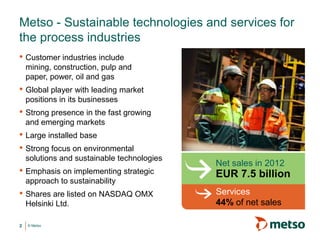
Net sales in 2012
EUR 7.5 billion
Services
44% of net sales
General presentation 2013
© Metso
Definition of risk and risk management
3 General presentation 2013
According to ISO 31000, risk is the
“effect of uncertainty on objectives”
and an effect can be a positive - as
well as a negative - deviation from
what is expected.
Risk can be tangible or
intangible, insurable or non-
insurable.
Risk management includes
identification, analysis, evaluation
and actions to alleviate risk.
© Metso4
Sustainability is company’s capacity
to prosper in a competitive and
changing global business
environment
by
anticipating and managing current
and future economic, environmental
and social opportunities and threats
by
focusing on quality, innovation and
productivity to create competitive
advantage and long-term value.
Definition of sustainability
*Source: RobecoSAM
© Metso
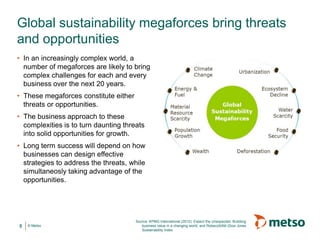
Global sustainability megaforces bring threats
and opportunities
5
Source: KPMG International (2012): Expect the Unexpected: Buildiing
business value in a changing world, and RobecoSAM (Dow Jones
Sustainability Index
• In an increasingly complex world, a
number of megaforces are likely to bring
complex challenges for each and every
business over the next 20 years.
• These megaforces constitute either
threats or opportunities.
• The business approach to these
complexities is to turn daunting threats
into solid opportunities for growth.
• Long term success will depend on how
businesses can design effective
strategies to address the threats, while
simultaneosly taking advantage of the
opportunities.
© Metso
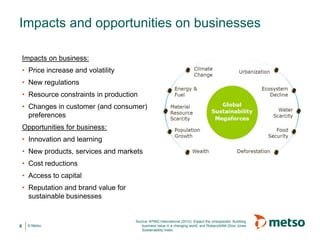
Impacts and opportunities on businesses
6
Source: KPMG International (2012): Expect the Unexpected: Buildiing
business value in a changing world, and RobecoSAM (Dow Jones
Sustainability Index
Impacts on business:
• Price increase and volatility
• New regulations
• Resource constraints in production
• Changes in customer (and consumer)
preferences
Opportunities for business:
• Innovation and learning
• New products, services and markets
• Cost reductions
• Access to capital
• Reputation and brand value for
sustainable businesses
© Metso7
• Strategic risks
- E.g. Climate change and environmental risks
• Financial risks
- E.g. Interest rate risks
• Operational risks
- E.g. Business interruption risks and compliance
and crime related risks
• Hazard risks
- E.g. Occupational health and safety
risks, environmental risks and natural events and
disasters
Risk categories and implications
© Metso8
• Managing sustainability risk is integrated into a multi-
disciplinary, company-wide risk management processes at
Metso.
• Systematic method for regularly assessing the probability
and impact of climate change and environment-related
risks at the Group-level and within each segments.
• The assessed risks are based on the risk map document
in which the company risks are listed on the headline
level.
• The potential risks related to sustainability typically arise
from
- the availability of sufficient competent resources
- the health and safety of our personnel,
- our ability to develop our product and technology
portfolio according to the changing needs of
customers
- the perception of our company as a responsible
citizen
- and the adequacy and pricing of financing both for us
and for our customers.
A strategic approach to sustainability improves
sustainability risk management
© Metso
Responsibilites and reporting processes
of sustainability risks
9
• Metso´s line management is operatively accountable for
managing risks as part of its daily activities.
• Sustainability risks are assessed once a year at the
Group-level by Metso´s Risk Management Team, based
upon individual business unit’ risk management
reports, consolidated at the company level.
• The results are annually reported to the Metso Group
Risk Management team, Metso Board and Metso Audit
Committee, and to the Metso Executive Team.
• Each Metso’ reporting segment annually assesses the
probability and impact of sustainability risks and defines
the need for and priority of the actions to
remove, mitigate, minimize, retain or utilize the risks by
using Metso’s risk map.
• The climate change and environment risk assessment
process includes the actions
needed, accountabilities, time frame and decisions to
treat the residual risk.
Metso’s risk
process promotes
opportunities
© Metso
Metso´s strategic approach to sustainability
10
Helps us to tackle the risks in all of our focus areas
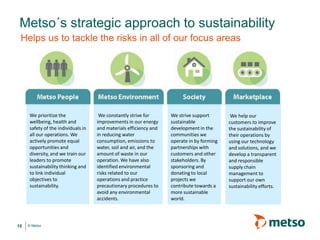
We prioritize the
wellbeing, health and
safety of the individuals in
all our operations. We
actively promote equal
opportunities and
diversity, and we train our
leaders to promote
sustainability thinking and
to link individual
objectives to
sustainability.
We constantly strive for
improvements in our energy
and materials efficiency and
in reducing water
consumption, emissions to
water, soil and air, and the
amount of waste in our
operation. We have also
identified environmental
risks related to our
operations and practice
precautionary procedures to
avoid any environmental
accidents.
We strive support
sustainable
development in the
communities we
operate in by forming
partnerships with
customers and other
stakeholders. By
sponsoring and
donating to local
projects we
contribute towards a
more sustainable
world.
We help our
customers to improve
the sustainability of
their operations by
using our technology
and solutions, and we
develop a transparent
and responsible
supply chain
management to
support our own
sustainability efforts.
© Metso
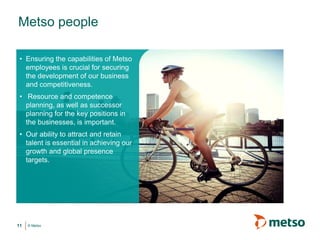
• Ensuring the capabilities of Metso
employees is crucial for securing
the development of our business
and competitiveness.
• Resource and competence
planning, as well as successor
planning for the key positions in
the businesses, is important.
• Our ability to attract and retain
talent is essential in achieving our
growth and global presence
targets.
11
Metso people
© Metso
Metso Environment
12
• CDP: highest score from a Nordic
company in the Industrials sector
- In 2012, Metso received its all-
time highest scores in the CDP
with 97 points out of 100.
- It was also included in the
Carbon Disclosure Leadership
Index for the first time.
- The results show that climate
change risk management is at
good level at Metso.
• We have also identified
environmental risks related to our
operations and practice
precautionary procedures to avoid
any environmental accidents.
© Metso
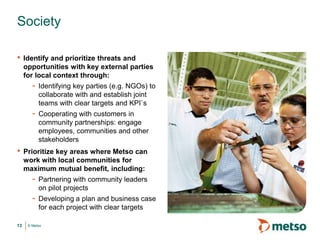
• Identify and prioritize threats and
opportunities with key external parties
for local context through:
- Identifying key parties (e.g. NGOs) to
collaborate with and establish joint
teams with clear targets and KPI`s
- Cooperating with customers in
community partnerships: engage
employees, communities and other
stakeholders
• Prioritize key areas where Metso can
work with local communities for
maximum mutual benefit, including:
- Partnering with community leaders
on pilot projects
- Developing a plan and business case
for each project with clear targets
13
Society
© Metso14
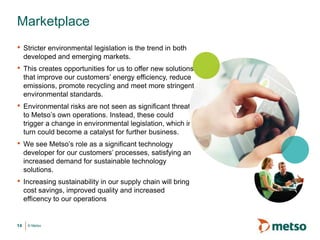
• Stricter environmental legislation is the trend in both
developed and emerging markets.
• This creates opportunities for us to offer new solutions
that improve our customers’ energy efficiency, reduce
emissions, promote recycling and meet more stringent
environmental standards.
• Environmental risks are not seen as significant threats
to Metso’s own operations. Instead, these could
trigger a change in environmental legislation, which in
turn could become a catalyst for further business.
• We see Metso’s role as a significant technology
developer for our customers’ processes, satisfying an
increased demand for sustainable technology
solutions.
• Increasing sustainability in our supply chain will bring
cost savings, improved quality and increased
efficency to our operations
Marketplace
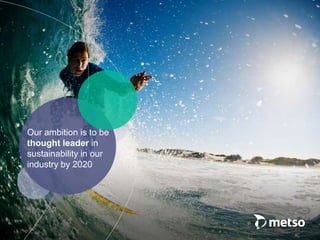
Our ambition is to be
thought leader in
sustainability in our
industry by 2020
© Metso
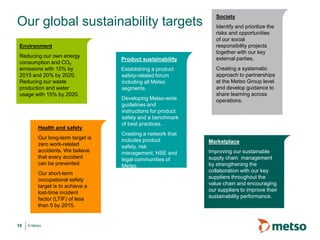
Our global sustainability targets
16
Health and safety
Our long-term target is
zero work-related
accidents. We believe
that every accident
can be prevented.
Our short-term
occupational safety
target is to achieve a
lost-time incident
factor (LTIF) of less
than 5 by 2015.
Environment
Reducing our own energy
consumption and CO2
emissions with 15% by
2015 and 20% by 2020.
Reducing our waste
production and water
usage with 15% by 2020.
Product sustainability
Establishing a product
safety-related forum
including all Metso
segments.
Developing Metso-wide
guidelines and
instructions for product
safety and a benchmark
of best practices.
Creating a network that
includes product
safety, risk
management, HSE and
legal communities of
Metso.
Marketplace
Improving our sustainable
supply chain management
by strengthening the
collaboration with our key
suppliers throughout the
value chain and encouraging
our suppliers to improve their
sustainability performance.
Society
Identify and prioritize the
risks and opportunities
of our social
responsibility projects
together with our key
external parties.
Creating a systematic
approach to partnerships
at the Metso Group level
and develop guidance to
share learning across
operations.
Sustainable
business is
also good
business!
www.metso.com/sustainability
www.metso.com/2012
LinkedIn:
www.linkedin.com/company/metso
Twitter:
www.twitter.com/metsogroup
www.twitter.com/metsoautomation
www.twitter.com/MetsoPulpPaper
Sustainable
business is
risk
management!
© Metso18
www.metso.com
This presentation can be downloaded from
www.slideshare.net/metsogroup

Sustainability as risk management

  • 1.
    Sustainability as risk management LennartOhlsson, SVP Sustainability and Technology Development
  • 2.
    © Metso www.metso.com Metso- Sustainable technologies and services for the process industries • Customer industries include mining, construction, pulp and paper, power, oil and gas • Global player with leading market positions in its businesses • Strong presence in the fast growing and emerging markets • Large installed base • Strong focus on environmental solutions and sustainable technologies • Emphasis on implementing strategic approach to sustainability • Shares are listed on NASDAQ OMX Helsinki Ltd. 2 Net sales in 2012 EUR 7.5 billion Services 44% of net sales General presentation 2013
  • 3.
    © Metso Definition ofrisk and risk management 3 General presentation 2013 According to ISO 31000, risk is the “effect of uncertainty on objectives” and an effect can be a positive - as well as a negative - deviation from what is expected. Risk can be tangible or intangible, insurable or non- insurable. Risk management includes identification, analysis, evaluation and actions to alleviate risk.
  • 4.
    © Metso4 Sustainability iscompany’s capacity to prosper in a competitive and changing global business environment by anticipating and managing current and future economic, environmental and social opportunities and threats by focusing on quality, innovation and productivity to create competitive advantage and long-term value. Definition of sustainability *Source: RobecoSAM
  • 5.
    © Metso Global sustainabilitymegaforces bring threats and opportunities 5 Source: KPMG International (2012): Expect the Unexpected: Buildiing business value in a changing world, and RobecoSAM (Dow Jones Sustainability Index • In an increasingly complex world, a number of megaforces are likely to bring complex challenges for each and every business over the next 20 years. • These megaforces constitute either threats or opportunities. • The business approach to these complexities is to turn daunting threats into solid opportunities for growth. • Long term success will depend on how businesses can design effective strategies to address the threats, while simultaneosly taking advantage of the opportunities.
  • 6.
    © Metso Impacts andopportunities on businesses 6 Source: KPMG International (2012): Expect the Unexpected: Buildiing business value in a changing world, and RobecoSAM (Dow Jones Sustainability Index Impacts on business: • Price increase and volatility • New regulations • Resource constraints in production • Changes in customer (and consumer) preferences Opportunities for business: • Innovation and learning • New products, services and markets • Cost reductions • Access to capital • Reputation and brand value for sustainable businesses
  • 7.
    © Metso7 • Strategicrisks - E.g. Climate change and environmental risks • Financial risks - E.g. Interest rate risks • Operational risks - E.g. Business interruption risks and compliance and crime related risks • Hazard risks - E.g. Occupational health and safety risks, environmental risks and natural events and disasters Risk categories and implications
  • 8.
    © Metso8 • Managingsustainability risk is integrated into a multi- disciplinary, company-wide risk management processes at Metso. • Systematic method for regularly assessing the probability and impact of climate change and environment-related risks at the Group-level and within each segments. • The assessed risks are based on the risk map document in which the company risks are listed on the headline level. • The potential risks related to sustainability typically arise from - the availability of sufficient competent resources - the health and safety of our personnel, - our ability to develop our product and technology portfolio according to the changing needs of customers - the perception of our company as a responsible citizen - and the adequacy and pricing of financing both for us and for our customers. A strategic approach to sustainability improves sustainability risk management
  • 9.
    © Metso Responsibilites andreporting processes of sustainability risks 9 • Metso´s line management is operatively accountable for managing risks as part of its daily activities. • Sustainability risks are assessed once a year at the Group-level by Metso´s Risk Management Team, based upon individual business unit’ risk management reports, consolidated at the company level. • The results are annually reported to the Metso Group Risk Management team, Metso Board and Metso Audit Committee, and to the Metso Executive Team. • Each Metso’ reporting segment annually assesses the probability and impact of sustainability risks and defines the need for and priority of the actions to remove, mitigate, minimize, retain or utilize the risks by using Metso’s risk map. • The climate change and environment risk assessment process includes the actions needed, accountabilities, time frame and decisions to treat the residual risk. Metso’s risk process promotes opportunities
  • 10.
    © Metso Metso´s strategicapproach to sustainability 10 Helps us to tackle the risks in all of our focus areas We prioritize the wellbeing, health and safety of the individuals in all our operations. We actively promote equal opportunities and diversity, and we train our leaders to promote sustainability thinking and to link individual objectives to sustainability. We constantly strive for improvements in our energy and materials efficiency and in reducing water consumption, emissions to water, soil and air, and the amount of waste in our operation. We have also identified environmental risks related to our operations and practice precautionary procedures to avoid any environmental accidents. We strive support sustainable development in the communities we operate in by forming partnerships with customers and other stakeholders. By sponsoring and donating to local projects we contribute towards a more sustainable world. We help our customers to improve the sustainability of their operations by using our technology and solutions, and we develop a transparent and responsible supply chain management to support our own sustainability efforts.
  • 11.
    © Metso • Ensuringthe capabilities of Metso employees is crucial for securing the development of our business and competitiveness. • Resource and competence planning, as well as successor planning for the key positions in the businesses, is important. • Our ability to attract and retain talent is essential in achieving our growth and global presence targets. 11 Metso people
  • 12.
    © Metso Metso Environment 12 •CDP: highest score from a Nordic company in the Industrials sector - In 2012, Metso received its all- time highest scores in the CDP with 97 points out of 100. - It was also included in the Carbon Disclosure Leadership Index for the first time. - The results show that climate change risk management is at good level at Metso. • We have also identified environmental risks related to our operations and practice precautionary procedures to avoid any environmental accidents.
  • 13.
    © Metso • Identifyand prioritize threats and opportunities with key external parties for local context through: - Identifying key parties (e.g. NGOs) to collaborate with and establish joint teams with clear targets and KPI`s - Cooperating with customers in community partnerships: engage employees, communities and other stakeholders • Prioritize key areas where Metso can work with local communities for maximum mutual benefit, including: - Partnering with community leaders on pilot projects - Developing a plan and business case for each project with clear targets 13 Society
  • 14.
    © Metso14 • Stricterenvironmental legislation is the trend in both developed and emerging markets. • This creates opportunities for us to offer new solutions that improve our customers’ energy efficiency, reduce emissions, promote recycling and meet more stringent environmental standards. • Environmental risks are not seen as significant threats to Metso’s own operations. Instead, these could trigger a change in environmental legislation, which in turn could become a catalyst for further business. • We see Metso’s role as a significant technology developer for our customers’ processes, satisfying an increased demand for sustainable technology solutions. • Increasing sustainability in our supply chain will bring cost savings, improved quality and increased efficency to our operations Marketplace
  • 15.
    Our ambition isto be thought leader in sustainability in our industry by 2020
  • 16.
    © Metso Our globalsustainability targets 16 Health and safety Our long-term target is zero work-related accidents. We believe that every accident can be prevented. Our short-term occupational safety target is to achieve a lost-time incident factor (LTIF) of less than 5 by 2015. Environment Reducing our own energy consumption and CO2 emissions with 15% by 2015 and 20% by 2020. Reducing our waste production and water usage with 15% by 2020. Product sustainability Establishing a product safety-related forum including all Metso segments. Developing Metso-wide guidelines and instructions for product safety and a benchmark of best practices. Creating a network that includes product safety, risk management, HSE and legal communities of Metso. Marketplace Improving our sustainable supply chain management by strengthening the collaboration with our key suppliers throughout the value chain and encouraging our suppliers to improve their sustainability performance. Society Identify and prioritize the risks and opportunities of our social responsibility projects together with our key external parties. Creating a systematic approach to partnerships at the Metso Group level and develop guidance to share learning across operations.
  • 17.
  • 18.
    © Metso18 www.metso.com This presentationcan be downloaded from www.slideshare.net/metsogroup