Key messages
 Global:
    World has made major progress during past two decades . . .
        . . . But this progress is increasingly threatened by
         unsustainable environment policies and practices
    Environmental sustainability and equity are closely linked
      Sustainability is about inter-generational equity . . .
        . . . But what about intra-generational equity?
        More equal societies have better development indicators
      “Double burden”: Many of the world’s poor bear
       environmental risks as well as income poverty,
    These issues will be taken up at UNCSD in Rio (June 2012)
 Regional:
    Transition economies of the former Soviet
     Union, Balkans, new EU member states compare well with
     other regions . . .
        . . . But there are causes for concern as well
    Concrete examples of how UNDP can help
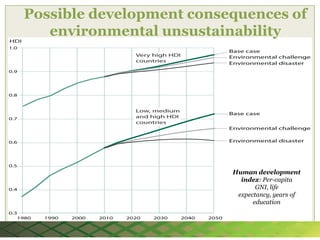
Possible development consequences of
   environmental unsustainability


                          Human development
                            index: Per-capita
                                 GNI, life
                           expectancy, years of
                                education
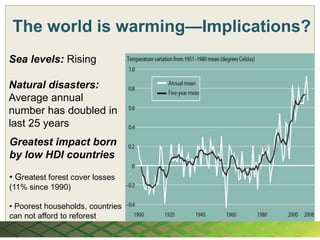
The world is warming—Implications?
Sea levels: Rising

Natural disasters:
Average annual
number has doubled in
last 25 years
Greatest impact born
by low HDI countries

• Greatest forest cover losses
(11% since 1990)

• Poorest households, countries
can not afford to reforest
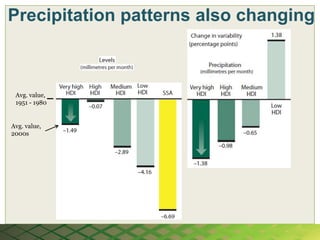
Precipitation patterns also changing


 Avg. value,
 1951 - 1980


Avg. value,
2000s
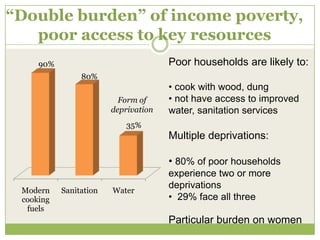
“Double burden” of income poverty,
   poor access to key resources
     90%                              Poor households are likely to:
                80%
                                      • cook with wood, dung
                          Form of     • not have access to improved
                        deprivation   water, sanitation services
                           35%
                                      Multiple deprivations:

                                      • 80% of poor households
                                      experience two or more
                                      deprivations
 Modern    Sanitation   Water
 cooking                              • 29% face all three
  fuels
                                      Particular burden on women
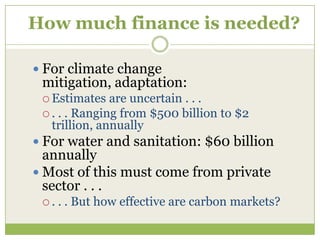
How much finance is needed?

 For climate change
 mitigation, adaptation:
  Estimates   are uncertain . . .
  . . . Ranging from $500 billion to $2
   trillion, annually
 For water and sanitation: $60 billion
  annually
 Most of this must come from private
  sector . . .
 .   . . But how effective are carbon markets?
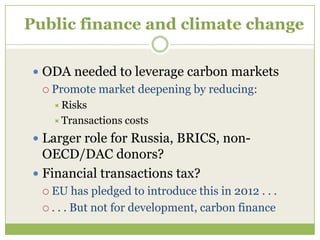
Public finance and climate change

  ODA needed to leverage carbon markets
   Promote   market deepening by reducing:
     Risks
     Transactions   costs
  Larger role for Russia, BRICS, non-
   OECD/DAC donors?
  Financial transactions tax?
   EU    has pledged to introduce this in 2012 . . .
   . . . But not for development, carbon finance
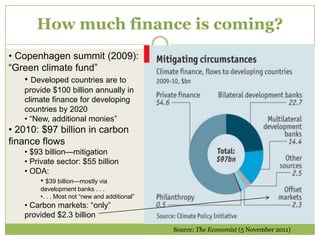
How much finance is coming?
• Copenhagen summit (2009):
“Green climate fund”
    • Developed countries are to
   provide $100 billion annually in
   climate finance for developing
   countries by 2020
   • “New, additional monies”
• 2010: $97 billion in carbon
finance flows
   • $93 billion—mitigation
   • Private sector: $55 billion
   • ODA:
        • $39 billion—mostly via
       development banks . . .
       •. . . Most not “new and additional”
   • Carbon markets: “only”
   provided $2.3 billion
                                              Source: The Economist (5 November 2011)
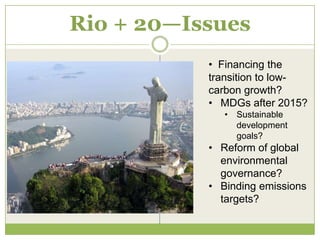
Rio + 20—Issues
           • Financing the
           transition to low-
           carbon growth?
           • MDGs after 2015?
              • Sustainable
                development
                goals?
           • Reform of global
             environmental
             governance?
           • Binding emissions
             targets?
Regional dimension

 Transition economies of the former
 Soviet Union, Balkans, new EU
 member states:
  Compare     well with other regions . . .
  . . . But there are causes for concern as well

 There are good examples to be
 replicated, scaled up
  Public   sector energy efficiency in Croatia
 UNDP can help with this
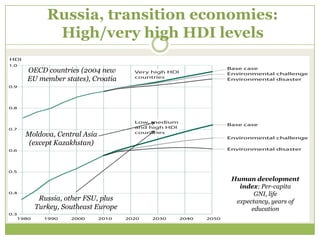
Russia, transition economies:
       High/very high HDI levels

OECD countries (2004 new
EU member states), Croatia


Moldova, Central Asia
 (except Kazakhstan)


                             Human development
                               index: Per-capita
                                    GNI, life
   Russia, other FSU, plus    expectancy, years of
  Turkey, Southeast Europe         education
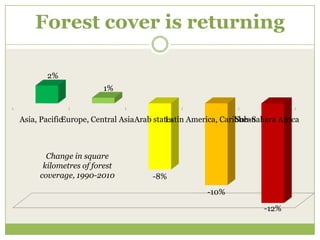
Forest cover is returning

       2%
                       1%


Asia, PacificEurope, Central AsiaArab states
                                          Latin America, Caribbean
                                                             Sub-Sahara Africa


       Change in square
      kilometres of forest
     coverage, 1990-2010             -8%
                                                    -10%

                                                                    -12%
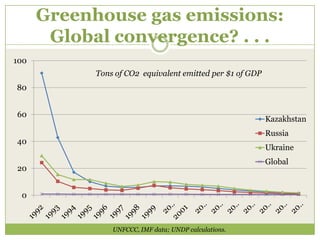
Greenhouse gas emissions:
       Global convergence? . . .
100
            Tons of CO2 equivalent emitted per $1 of GDP
80


60
                                                           Kazakhstan
                                                           Russia
40
                                                           Ukraine
                                                           Global
20


 0


                UNFCCC, IMF data; UNDP calculations.
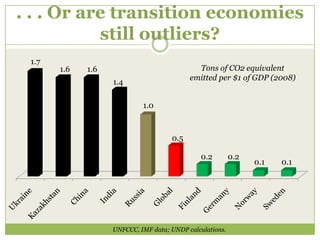
. . . Or are transition economies
           still outliers?
 1.7
       1.6   1.6                             Tons of CO2 equivalent
                                           emitted per $1 of GDP (2008)
                   1.4

                            1.0


                                     0.5

                                               0.2        0.2
                                                                0.1   0.1


                   UNFCCC, IMF data; UNDP calculations.
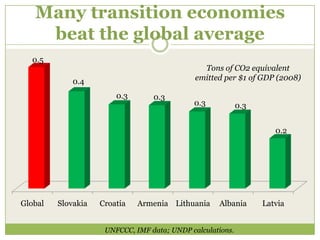
Many transition economies
    beat the global average
  0.5
                                                Tons of CO2 equivalent
             0.4                              emitted per $1 of GDP (2008)

                        0.3       0.3
                                             0.3            0.3


                                                                     0.2


Global   Slovakia   Croatia   Armenia Lithuania     Albania       Latvia


                     UNFCCC, IMF data; UNDP calculations.
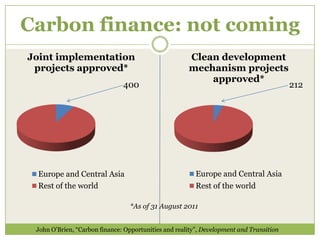
Carbon finance: not coming
Joint implementation                                  Clean development
 projects approved*                                   mechanism projects
                                                          approved*
                               400                                                       212


  Europe and Central Asia                               Europe and Central Asia
  Rest of the world                                     Rest of the world

                                 *As of 31 August 2011


 John O’Brien, “Carbon finance: Opportunities and reality”, Development and Transition
Carbon finance: What
              is to be done?
 Reduce high transactions
  costs for projects, by:
     Accelerating project approval
     Increasing project size
     “Bundling” projects together
 Capacity development for:
   Designated national
    authorities
   Private companies working in:
       Energy efficiency
       Renewables
     Project beneficiaries
UNDP can help—Croatia
 UNDP, Global Environmental Facility programme on
  public-sector energy efficiency
 Results (2006-2010):
    Energy systems in 5900 public buildings refitted
    Energy audits conducted in 1346 public buildings
    $18 million in initial annual public-sector energy savings
    Annual CO2 emissions reduced by 63,000 tons
    “Energy charter” signed by all 127 municipalities
    17 new companies, 150 energy efficiency expert jobs created
    $4 million in UNDP-GEF funding leveraged $30 million in
     additional investment

        Louisa Vinton, “Going green with Gašpar”, Development and Transition
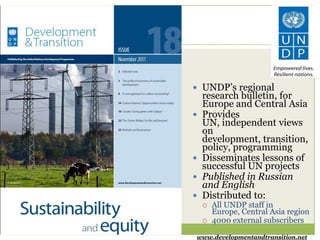
 UNDP’s regional
    research bulletin, for
    Europe and Central Asia
   Provides
    UN, independent views
    on
    development, transition,
    policy, programming
   Disseminates lessons of
    successful UN projects
   Published in Russian
    and English
   Distributed to:
       All UNDP staff in
        Europe, Central Asia region
       4000 external subscribers

www.developmentandtransition.net
We can make a difference
 Rio—Big
  picture: Need
  to make a push
  for sustainable
  development
 UNDP can
  make a
  difference on
  the
  ground, with
  local partners
  and
  governments

Sustainability and Equity: A better future for all

  • 2.
    Key messages  Global:  World has made major progress during past two decades . . .  . . . But this progress is increasingly threatened by unsustainable environment policies and practices  Environmental sustainability and equity are closely linked  Sustainability is about inter-generational equity . . .  . . . But what about intra-generational equity?  More equal societies have better development indicators  “Double burden”: Many of the world’s poor bear environmental risks as well as income poverty,  These issues will be taken up at UNCSD in Rio (June 2012)  Regional:  Transition economies of the former Soviet Union, Balkans, new EU member states compare well with other regions . . .  . . . But there are causes for concern as well  Concrete examples of how UNDP can help
  • 3.
    Possible development consequencesof environmental unsustainability Human development index: Per-capita GNI, life expectancy, years of education
  • 4.
    The world iswarming—Implications? Sea levels: Rising Natural disasters: Average annual number has doubled in last 25 years Greatest impact born by low HDI countries • Greatest forest cover losses (11% since 1990) • Poorest households, countries can not afford to reforest
  • 5.
    Precipitation patterns alsochanging Avg. value, 1951 - 1980 Avg. value, 2000s
  • 6.
    “Double burden” ofincome poverty, poor access to key resources 90% Poor households are likely to: 80% • cook with wood, dung Form of • not have access to improved deprivation water, sanitation services 35% Multiple deprivations: • 80% of poor households experience two or more deprivations Modern Sanitation Water cooking • 29% face all three fuels Particular burden on women
  • 7.
    How much financeis needed?  For climate change mitigation, adaptation:  Estimates are uncertain . . .  . . . Ranging from $500 billion to $2 trillion, annually  For water and sanitation: $60 billion annually  Most of this must come from private sector . . . . . . But how effective are carbon markets?
  • 8.
    Public finance andclimate change  ODA needed to leverage carbon markets  Promote market deepening by reducing:  Risks  Transactions costs  Larger role for Russia, BRICS, non- OECD/DAC donors?  Financial transactions tax?  EU has pledged to introduce this in 2012 . . .  . . . But not for development, carbon finance
  • 9.
    How much financeis coming? • Copenhagen summit (2009): “Green climate fund” • Developed countries are to provide $100 billion annually in climate finance for developing countries by 2020 • “New, additional monies” • 2010: $97 billion in carbon finance flows • $93 billion—mitigation • Private sector: $55 billion • ODA: • $39 billion—mostly via development banks . . . •. . . Most not “new and additional” • Carbon markets: “only” provided $2.3 billion Source: The Economist (5 November 2011)
  • 10.
    Rio + 20—Issues • Financing the transition to low- carbon growth? • MDGs after 2015? • Sustainable development goals? • Reform of global environmental governance? • Binding emissions targets?
  • 11.
    Regional dimension  Transitioneconomies of the former Soviet Union, Balkans, new EU member states:  Compare well with other regions . . .  . . . But there are causes for concern as well  There are good examples to be replicated, scaled up  Public sector energy efficiency in Croatia  UNDP can help with this
  • 12.
    Russia, transition economies: High/very high HDI levels OECD countries (2004 new EU member states), Croatia Moldova, Central Asia (except Kazakhstan) Human development index: Per-capita GNI, life Russia, other FSU, plus expectancy, years of Turkey, Southeast Europe education
  • 13.
    Forest cover isreturning 2% 1% Asia, PacificEurope, Central AsiaArab states Latin America, Caribbean Sub-Sahara Africa Change in square kilometres of forest coverage, 1990-2010 -8% -10% -12%
  • 14.
    Greenhouse gas emissions: Global convergence? . . . 100 Tons of CO2 equivalent emitted per $1 of GDP 80 60 Kazakhstan Russia 40 Ukraine Global 20 0 UNFCCC, IMF data; UNDP calculations.
  • 15.
    . . .Or are transition economies still outliers? 1.7 1.6 1.6 Tons of CO2 equivalent emitted per $1 of GDP (2008) 1.4 1.0 0.5 0.2 0.2 0.1 0.1 UNFCCC, IMF data; UNDP calculations.
  • 16.
    Many transition economies beat the global average 0.5 Tons of CO2 equivalent 0.4 emitted per $1 of GDP (2008) 0.3 0.3 0.3 0.3 0.2 Global Slovakia Croatia Armenia Lithuania Albania Latvia UNFCCC, IMF data; UNDP calculations.
  • 17.
    Carbon finance: notcoming Joint implementation Clean development projects approved* mechanism projects approved* 400 212 Europe and Central Asia Europe and Central Asia Rest of the world Rest of the world *As of 31 August 2011 John O’Brien, “Carbon finance: Opportunities and reality”, Development and Transition
  • 18.
    Carbon finance: What is to be done?  Reduce high transactions costs for projects, by:  Accelerating project approval  Increasing project size  “Bundling” projects together  Capacity development for:  Designated national authorities  Private companies working in:  Energy efficiency  Renewables  Project beneficiaries
  • 19.
    UNDP can help—Croatia UNDP, Global Environmental Facility programme on public-sector energy efficiency  Results (2006-2010):  Energy systems in 5900 public buildings refitted  Energy audits conducted in 1346 public buildings  $18 million in initial annual public-sector energy savings  Annual CO2 emissions reduced by 63,000 tons  “Energy charter” signed by all 127 municipalities  17 new companies, 150 energy efficiency expert jobs created  $4 million in UNDP-GEF funding leveraged $30 million in additional investment Louisa Vinton, “Going green with Gašpar”, Development and Transition
  • 20.
     UNDP’s regional research bulletin, for Europe and Central Asia  Provides UN, independent views on development, transition, policy, programming  Disseminates lessons of successful UN projects  Published in Russian and English  Distributed to:  All UNDP staff in Europe, Central Asia region  4000 external subscribers www.developmentandtransition.net
  • 21.
    We can makea difference  Rio—Big picture: Need to make a push for sustainable development  UNDP can make a difference on the ground, with local partners and governments

Editor's Notes

  • #4 By 2050, the global HDI would be:19% higher than it is today.Largest increase in developing countries (24%).44% for Sub-Saharan Africa and 36% for South Asia.8% lower in an environmental challenge scenario.12% for South Asia and Sub-Saharan Africa.15% lower in an environmental disaster scenario.Dramatic impact on developing countries24% for Sub-Saharan Africa and 22% for South Asia.