Survival Analysis in R
yuyi1227
于怡 yuyi1227
Ph.D. Candidate
Of Mathematical Statistics,
Fudan Univ.
Outline
 What is Survival Analysis
 An application using R: PBC Data
With Methods in Survival Analysis
Kaplan-Meier Estimator
Mantel-Haenzel Test (log-rank test)
Cox regression model (PH Model)
What is Survival Analysis
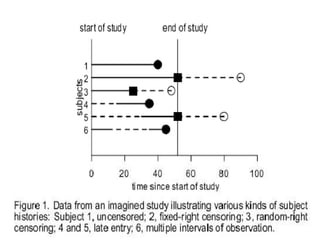
 Model time to event (esp. failure)
 Widely used in medicine, biology,
actuary, finance, engineering,
sociology, etc.
sociology, etc.
 Able to account for censoring
 Able to compare between 2+ groups
 Able to access relationship between
covariates and survival time
An application using R: PBC Data
Primary Biliary Cirrhosis
The data is from the Mayo Clinic trial in primary biliary cirrhosis
(PBC) of the liver conducted between 1974 and 1984. A total of
424 PBC patients, referred to Mayo Clinic during that ten-year
interval, met eligibility criteria for the randomized placebo
controlled trial of the drug D-penicillamine. The first 312 cases in
the data set participated in the randomized trial and contain
largely complete data. The additional 112 cases did not participate
in the clinical trial, but consented to have basic measurements
recorded and to be followed for survival. Six of those cases were
lost to follow-up shortly after diagnosis, so the data here are on an
additional 106 cases as well as the 312 randomized participants.
Missing data items are denoted by a period.
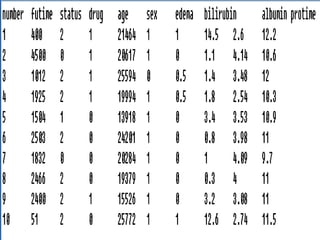
data(pbc, package = “survival)
Survival Analysis in R
 Package: survival
library (survival)
 Create a survival subject: Surv
Kaplan-Meier Estimator:
 Kaplan-Meier Estimator: survfit
 Mantel-Haenzel Test: survdiff
 Cox Model: coxph
Creating the survival object
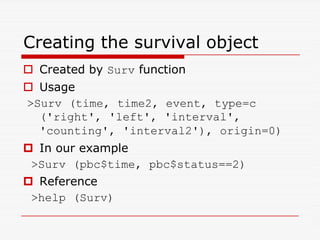
 Created by Surv function
 Usage
Surv (time, time2, event, type=c
('right', 'left', 'interval',
'counting', 'interval2'), origin=0)
 In our example
Surv (pbc$time, pbc$status==2)
 Reference
help (Surv)
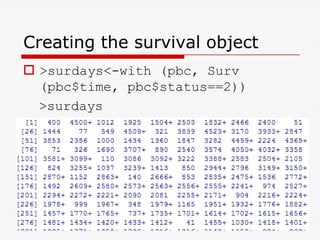
Creating the survival object
 surdays-with (pbc, Surv
(pbc$time, pbc$status==2))
surdays
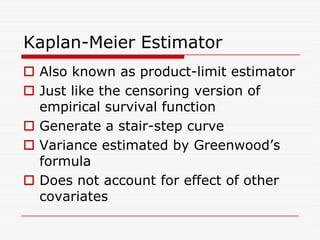
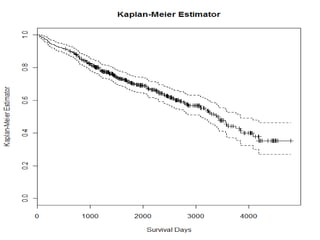
Kaplan-Meier Estimator
 Also known as product-limit estimator
 Just like the censoring version of
empirical survival function
 Generate a stair-step curve
 Generate a stair-step curve
 Variance estimated by Greenwood’s
formula
 Does not account for effect of other
covariates
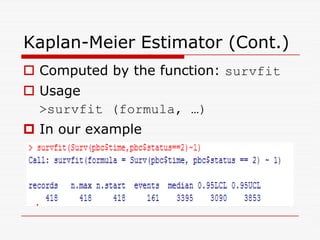
Kaplan-Meier Estimator (Cont.)
 Computed by the function: survfit
 Usage
survfit (formula, …)
 In our example
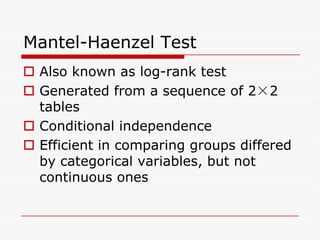
Mantel-Haenzel Test
 Also known as log-rank test
 Generated from a sequence of 2×2
tables
 Conditional independence
 Conditional independence
 Efficient in comparing groups differed
by categorical variables, but not
continuous ones
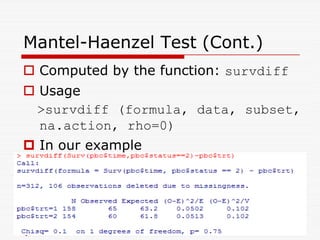
Mantel-Haenzel Test (Cont.)
 Computed by the function: survdiff
 Usage
survdiff (formula, data, subset,
na.action, rho=0)
na.action, rho=0)
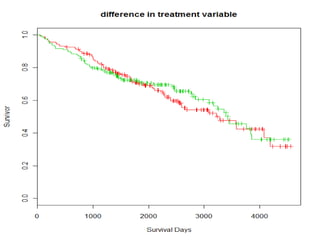
 In our example
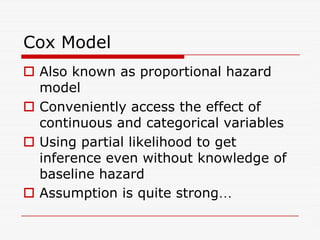
Cox Model
 Also known as proportional hazard
model
 Conveniently access the effect of
continuous and categorical variables
 Using partial likelihood to get
inference even without knowledge of
baseline hazard
 Assumption is quite strong…
Cox Model (Cont.)
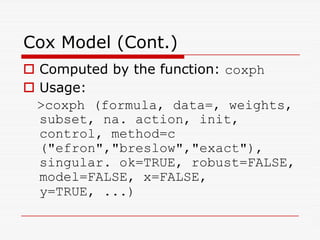
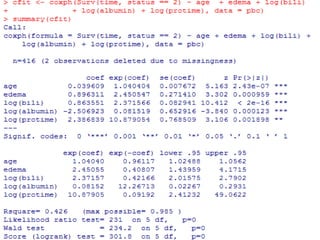
 Computed by the function: coxph
 Usage:
coxph (formula, data=, weights,
subset, na. action, init,
control, method=c
(efron,breslow,exact),
singular. ok=TRUE, robust=FALSE,
model=FALSE, x=FALSE,
y=TRUE, ...)
Cox Model (Cont.)
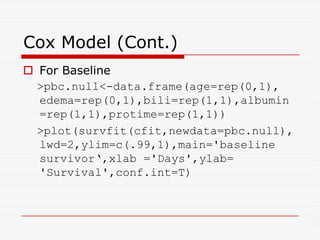
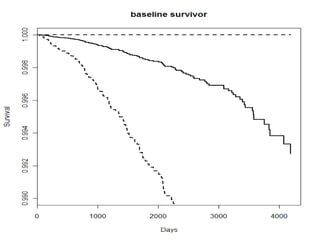
 For Baseline
pbc.null-data.frame(age=rep(0,1),
edema=rep(0,1),bili=rep(1,1),albumin
=rep(1,1),protime=rep(1,1))
plot(survfit(cfit,newdata=pbc.null),
lwd=2,ylim=c(.99,1),main='baseline
survivor‘,xlab ='Days',ylab=
'Survival',conf.int=T)
Cox Model (Cont.)
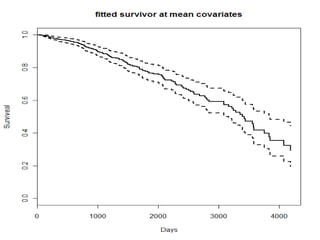
 For mean covariates
plot(survfit(cfit),lwd=2,main=
'fitted survival function at
mean covariates‘, xlab='Days',
ylab='Survival')
Diagnostic of Cox Model
 Cox model is amazing, but the
assumption is really strong
 Schoenfeld residuals
 etc,.
 etc,.
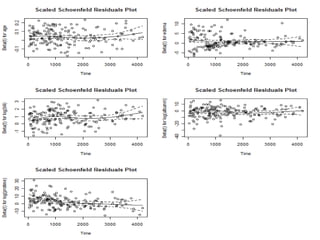
Schoenfeld residuals
 Residuals are used to investigate the lack of fit of a
model to a given subject.
 For Cox regression, there’s no easy analog to the
usual “observed minus predicted” residual of linear
regression
 residuals(object, type=c(martingale,
 residuals(object, type=c(martingale,
deviance, score, schoenfeld, dfbeta,
dfbetas, scaledsch, partial),
collapse=FALSE, weighted=FALSE, ...)
 Schoenfeld (1982) proposed the first set of residuals
for use with Cox regression packages
 Schoenfeld D. Residuals for the proportional hazards
regresssion model. Biometrika, 1982, 69(1):239-241.
Diagnostic of Cox Model (Cont.)
 Functions used here:
residuals (object, ...)
to calculate different type residuals
 cox.zph (fit, transform=km,
global=TRUE)
to test the proportional hazards
assumption for a Cox regression
model fit.
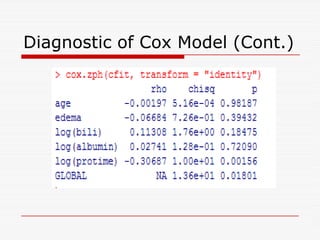
Diagnostic of Cox Model (Cont.)
Survival-Analysis-in-R notes for Survival Analysis in R.pdf

Survival-Analysis-in-R notes for Survival Analysis in R.pdf

  • 1.
    Survival Analysis inR yuyi1227 于怡 yuyi1227 Ph.D. Candidate Of Mathematical Statistics, Fudan Univ.
  • 2.
    Outline What isSurvival Analysis An application using R: PBC Data With Methods in Survival Analysis Kaplan-Meier Estimator Mantel-Haenzel Test (log-rank test) Cox regression model (PH Model)
  • 3.
    What is SurvivalAnalysis Model time to event (esp. failure) Widely used in medicine, biology, actuary, finance, engineering, sociology, etc. sociology, etc. Able to account for censoring Able to compare between 2+ groups Able to access relationship between covariates and survival time
  • 5.
    An application usingR: PBC Data Primary Biliary Cirrhosis The data is from the Mayo Clinic trial in primary biliary cirrhosis (PBC) of the liver conducted between 1974 and 1984. A total of 424 PBC patients, referred to Mayo Clinic during that ten-year interval, met eligibility criteria for the randomized placebo controlled trial of the drug D-penicillamine. The first 312 cases in the data set participated in the randomized trial and contain largely complete data. The additional 112 cases did not participate largely complete data. The additional 112 cases did not participate in the clinical trial, but consented to have basic measurements recorded and to be followed for survival. Six of those cases were lost to follow-up shortly after diagnosis, so the data here are on an additional 106 cases as well as the 312 randomized participants. Missing data items are denoted by a period. data(pbc, package = “survival)
  • 7.
    Survival Analysis inR Package: survival library (survival) Create a survival subject: Surv Kaplan-Meier Estimator: Kaplan-Meier Estimator: survfit Mantel-Haenzel Test: survdiff Cox Model: coxph
  • 8.
    Creating the survivalobject Created by Surv function Usage Surv (time, time2, event, type=c ('right', 'left', 'interval', ('right', 'left', 'interval', 'counting', 'interval2'), origin=0) In our example Surv (pbc$time, pbc$status==2) Reference help (Surv)
  • 9.
    Creating the survivalobject surdays-with (pbc, Surv (pbc$time, pbc$status==2)) surdays
  • 10.
    Kaplan-Meier Estimator Alsoknown as product-limit estimator Just like the censoring version of empirical survival function Generate a stair-step curve Generate a stair-step curve Variance estimated by Greenwood’s formula Does not account for effect of other covariates
  • 11.
    Kaplan-Meier Estimator (Cont.) Computed by the function: survfit Usage survfit (formula, …) In our example
  • 13.
    Mantel-Haenzel Test Alsoknown as log-rank test Generated from a sequence of 2×2 tables Conditional independence Conditional independence Efficient in comparing groups differed by categorical variables, but not continuous ones
  • 14.
    Mantel-Haenzel Test (Cont.) Computed by the function: survdiff Usage survdiff (formula, data, subset, na.action, rho=0) na.action, rho=0) In our example
  • 16.
    Cox Model Alsoknown as proportional hazard model Conveniently access the effect of continuous and categorical variables continuous and categorical variables Using partial likelihood to get inference even without knowledge of baseline hazard Assumption is quite strong…
  • 17.
    Cox Model (Cont.) Computed by the function: coxph Usage: coxph (formula, data=, weights, subset, na. action, init, subset, na. action, init, control, method=c (efron,breslow,exact), singular. ok=TRUE, robust=FALSE, model=FALSE, x=FALSE, y=TRUE, ...)
  • 19.
    Cox Model (Cont.) For Baseline pbc.null-data.frame(age=rep(0,1), edema=rep(0,1),bili=rep(1,1),albumin =rep(1,1),protime=rep(1,1)) =rep(1,1),protime=rep(1,1)) plot(survfit(cfit,newdata=pbc.null), lwd=2,ylim=c(.99,1),main='baseline survivor‘,xlab ='Days',ylab= 'Survival',conf.int=T)
  • 21.
    Cox Model (Cont.) For mean covariates plot(survfit(cfit),lwd=2,main= 'fitted survival function at mean covariates‘, xlab='Days', mean covariates‘, xlab='Days', ylab='Survival')
  • 23.
    Diagnostic of CoxModel Cox model is amazing, but the assumption is really strong Schoenfeld residuals etc,. etc,.
  • 24.
    Schoenfeld residuals Residualsare used to investigate the lack of fit of a model to a given subject. For Cox regression, there’s no easy analog to the usual “observed minus predicted” residual of linear regression residuals(object, type=c(martingale, residuals(object, type=c(martingale, deviance, score, schoenfeld, dfbeta, dfbetas, scaledsch, partial), collapse=FALSE, weighted=FALSE, ...) Schoenfeld (1982) proposed the first set of residuals for use with Cox regression packages Schoenfeld D. Residuals for the proportional hazards regresssion model. Biometrika, 1982, 69(1):239-241.
  • 25.
    Diagnostic of CoxModel (Cont.) Functions used here: residuals (object, ...) to calculate different type residuals cox.zph (fit, transform=km, global=TRUE) to test the proportional hazards assumption for a Cox regression model fit.
  • 26.
    Diagnostic of CoxModel (Cont.)