CLASSIFICATION OF SURVEYING
Mr. Kaviraj M S, Assistant Professor,
Department of Civil Engineering,
Adithya Institute of Technology,
Acdemic Year: 2021-2022
Levelling & Contouring
Definition, Principle, & Object of
Levelling
Definition:- Levelling is defined as“an art
of determining the relative height of
different points on, aboveorbelowthe
surface”.
Principle of
levelling
Principle:- The principle of levelling is to obtain
horizontal line of sight with respectto which
vertical distancesof the points aboveorbelow
this line of sight are found.
Object of levelling
Theobjective of levelling is to
1) Findthe elevation of given point with
respectto someassumedreferenceline called
datum.
2)T
oestablish point at requiredelevation
with respectto datum.
Definitions used in
levelling
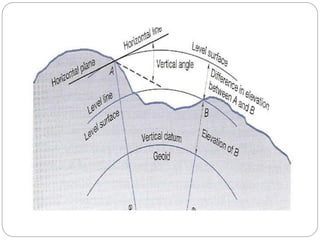
 Levelsurface:- It is the surfaceparallel to
the mean spheroidal surface of the earth
 Levelline:- Linelying onlevel surface.
 Horizontal plane:- Horizontal planethrough
apoint is aplane tangentialto level surface.
 Horizontal line:- It is astraight line
tangential to level line.
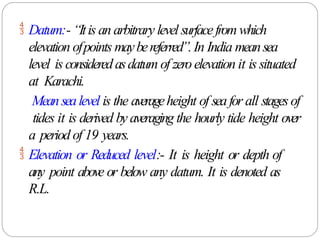
 Datum:- “Itis an arbitrary level surfacefromwhich
elevation ofpoints maybereferred”.In India meansea
level is consideredasdatum of zeroelevation it is situated
at Karachi.
Meansealevel is the averageheight of seafor all stagesof
tides it is derived by averaging the hourly tide height over
a period of 19 years.
 Elevation or Reduced level:- It is height or depth of
any point above or below any datum. It is denoted as
R.L.
 BenchMark(B.M.):- It is a fixed referencepoint of known
elevation with respectto datum.
 Line of collimation:- It is aline joining the intersection of
crosshairs of diaphragmto the optical centreof object
glass and its continuation. It is also knownasline of
sight.
 Height of instrument:- It is the elevation of line
of collimation with respectto datum
 Backsight:- It is astaff reading taken at a known
elevation. It is the first staff reading taken after setup
of instrument.
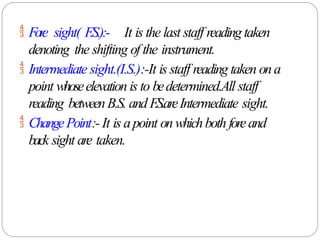
 For
e sight( F
.S.):- It is the last staff reading taken
denoting the shifting of the instrument.
 Intermediate sight.(I.S.):-It is staff reading taken ona
point whoseelevation is to bedetermined.All staff
reading betweenB.S. and F
.S.areIntermediate sight.
 ChangePoint:- It is apoint onwhichboth foreand
back sight are taken.
Instruments for
levelling
 The following instruments areessentially
required
 for levelling
 Level
 Levelling staff
Level and types of
level
 Level:- The instrument usedtofurnishhorizontal
line of sight forobservingstaff readingsand
determining R.L.s
 T
ypes
 Dumpy level
 Tilting level
 W
ye level
 Automatic level
The Dumpy level is a simple,
compact and stable
instrument. The telescopeis rigidly fixed to its supports.
Henceit c
a
n
n
o
tDb
eurmo
t
apt
e
dyalbeo
uvtehlo
r
i
z
o
n
t
a
l
axis.
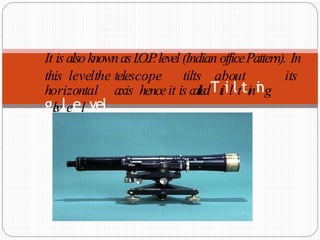
It is alsoknownasI.O.P
.level (Indian officePattern). In
this levelthe telescope tilts about its
horizontal axis henceit is calledTtiillttini
ng
gl
e
vleel vel
Wye
level
Theessential differencebetweenwyelevel andotherlevelsis
thatin wyelevel the telescopeis carried bytwovertical wye
supports.The telescopecanberotated, movedorevenraised
in wyes.
Automatic
level
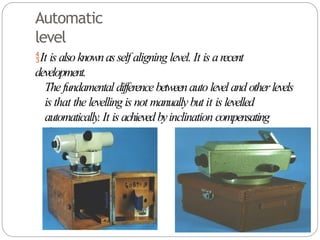
It is alsoknownasself aligning level. It is arecent
development.
Thefundamental differencebetweenauto level andotherlevels
is that the levelling is not manually but it is levelled
automatically. It is achievedbyinclination compensating
device.
Levelling
Staffs
 Levelling staffs arescalesonwhichthesedistances
are measured.
 Levelling staffs areof two types
 Self reading staff
 T
arget staff
Self reading
staff
 The self readingstaff canbereaddirectly bythe
level manlooking through the telescope.
 Commontypes of self reading staffs
 Ordinary staff
 Sopwith telescopic staff
 Folding Staff
Target
staff
 For very precise works and sight target staff are used.A
movable target is provided in this staff.A vernier is
provided on target to give precise reading. In target staff
level man directs the staff man to
move the target up and down until it bisects by
the line of sight.The staff man observe the staff
reading
Bench
Marks
 Benchmarkis apoint of known elevation
 Thereare4 kinds of bench marks
 GTS(Greattrigonometrically surveybench
mark)
 Permanentbench mark
 Arbitrary bench mark
 T
emporarybench mark
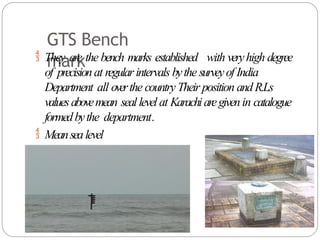
GTS Bench
mark
 They are the bench marks established with veryhigh degree
of precisionat regularintervals bythe surveyof India
Department all overthe country Their position andR.Ls
valuesabovemean seallevel at Karachiaregivenin catalogue
formedbythe department.
 Meansealevel
Permanent Bench
mark
Permanent bench marksare fixed in between GTS bench marks by
govt. agencies such as railways, PWD,etc. This bench marks are
written on permanent objects such as milestones, culverts,
bridges etc their value are clearly written and their position are
recorded forfuture reference.
Arbitrary benchmarks:- Thesearereferencepoints whose
R.L.s arearbitrarily assumed.They areusedin small
works suchbenchmarkmaybeassumedas100. or50 m
T
emporarybenchmarks:- They arethe referencepoints
established during the levelling operationswhenthere is
a breakin work,orat the endof day’
sworkthe value of
reducedlevels aremarkedonsomepermanent objects
such asstones, trees etc.
Temporary Adjustments of a
level
 Theseadjustments areperformedat everysetup
of instrument
 Setting up of level
 Levelling of telescope
 Focusingof the eye peace
 Focusingof object glass
 Setting up the level:- Thisincludes
 A)Fixing the instrument ontripod
 B)Levelling the instrument approximately byTripod
 Levelling:- LevellingLevelling is donewith the help of foot screws.
The purposeoflevelling is to makevertical axis truly vertical. It is
donewith the help of foot screws
 A)Placethe telescopeparallel to apair of foot screwthen hold
the foot screwsbetweenthumb andfirst finger andturn them
either inwardoroutwarduntil the longitudinal bubblecomesin
the centre.
 B)Turnthe telescopethrough 900 sothat it lies parallel to third foot
screw
,turn the screw until the bubble comes in the centre.
 Focusing the eye piece:- T
o focus the eye piece, hold a
white paper in front of object glass, and move the eye
piecein or out till the crosshair aredistinctly seen.
 Focusingof object glass:- Direct the telescopeto the
levelling staff and onlooking through the telescope,
turn the focusing screwtill the imageappearsclearand
sharp.
Classification of
levelling
 Simple levelling
 Differential leveling
 Fly levelling
 Check levelling
 Profile levelling
 Cross levelling
 Reciprocal levelling
 Precise levelling
 Trignometric levelling
 Barometric levelling
 Hypersometric
levelling
Simple levelling:- It is the simplest methodused, whenit is
requiredto find the difference in elevation between2
points.
Differential Levelling:- This methodis usedto find the
difference in the elevation betweenpoints if they aretoofar
apart orthe difference in elevation betweenthem is too
much.
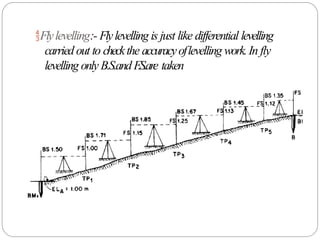
Flylevelling:- Flylevelling is just like differential levelling
carried out to checkthe accuracyoflevelling work.In fly
levelling only B.S.andF
.S.are taken
 Checklevelling:- This kind of levelling is carried out to
checkthe accuracyof work.It is doneat the end of the
days workin the formof fly levelling to connectthe
finishing point and starting point.
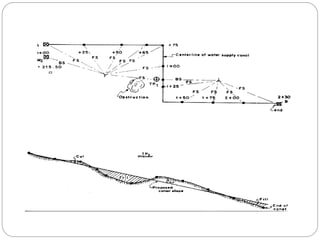
 Profile levelling orL-Section:-This method is usedfor
taking levels along the centreline of any alignment
like road, railwaycanal etc.The object is to determine
the undulations of the ground surfacealong the
alignment
 Cross-sectioning:- This operation is carried out
perpendicular to alignment at an interval of 10,
20 ,30, 40 m.The idea is to makean estimate of
earthwork.
 Preciselevelling:- It is usedforestablishing benchmarks
for future public use. It is carried out with high degreeof
accuracyusing advanced instruments
 Trignometriclevelling:- In this methodvertical
distances betweenpoints arecomputedbyobserving
horizontal distances and vertical angle between
points.
 Barometric levelling:- In this method the altitude difference
is determined bymeansof a barometer
.
 Hyposometric levelling:- The working of Hyposometry for
determining the elevation depends upon the fact that the
temperature at which water boils varies with the
atmospheric pressure. The boiling point of water reduces at
higher altitude thus knowing the boiling point of water
,
the atmospheric pressure can be calculated and knowing
the atmospheric pressure altitude or elevation can be
determined
Reciprocal
levelling
 Reciprocal levelling:-This method is adopted to accurately
determine the difference of level between two points which are far
apart. It is also used whenit is not possible to setup level in mid way
betweentwo points
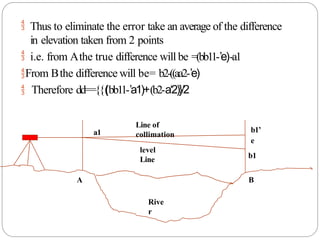
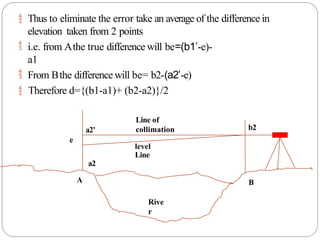
 Let A and B be the two points on opposite banks of a river. It is
required to find out the level difference between A&B
 Set up the level very near to Aand take the reading at Aand Blet
the reading be a1 and b1
 Shift the level and set up very near to B and observe Aand B to
get reading a2 and b2
 Let d is the true difference of level between Aand B, and e= error
due to curvature, refrection and imperfect adjustment.
b1’
e
b1
 Thus to eliminate the error take an average of the difference
in elevation taken from 2 points
 i.e. from Athe true difference will be =(bb11-’e)-a1
From Bthe difference will be= b2-((aa2-’e)
 Therefore dd=={{(bb11-’a1)+(b2-a‘2)}/2
a1
Line of
collimation
level
Line
A B
Rive
r
b2
e
a2’
Line of
collimation
level
Line
a2
A B
Rive
r
 Thus to eliminate the error take an average of the difference in
elevation taken from 2 points
 i.e. from Athe true difference will be=(b1’-e)-
a1
 From Bthe difference will be= b2-(a2’-e)
 Therefore d={(b1-a1)+ (b2-a2)}/2
Methods of Reducing
levels
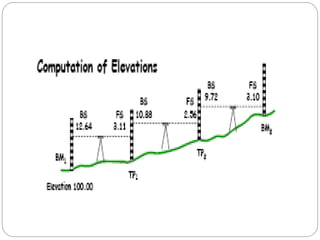
Height ofInstrumentMethod:-This methodconsist of
finding H.I. foreverysetup of instrument, and then
obtaining the R.L. of point of referencewith respectto
H.I
Station B.S I.S F
.S H.I R.L Remark
A 0.9 100.9 100.00 B.M
B 1.1 99.800
C 1.450 1.05 101.3 99.850 C.P
.
D 1.550 99.750
F.S=1.55
m
A100
m
I.S
B
9
91..
18m
m
F
.
S1.05m B.S 1.45m
C 99.85
m
D 99.750
m
B.S 0.9m
B.
M
100
M.
H
I
C .P
.
This methodconsist of determining the difference
of
level betweenconsecutivepoints bycomparingeach
point w
i
tRhiismem
e
dai
ant
edp
rfeac
eldli
nmg
peo
itnht
.o
d
Rise And Fall
Method
Station B.S I.S F
.S Rise Fall R.L Remark
A 0.9 100.00 B.M
B 1.1 0.2 99.800
C 1.450 1.05 0.05 99.850 C.P
.
D 1.550 0.1 99.750
F
.S
1.05m
B.S
1.45m
F.S=1.55
m
A100
m
I.S 1.1m
B
99.8m C 99.85
m
B.S 0.9m
B.
M
100
M. D 99.750
m
C .P
.
Exampl
e
The followingstaff readingswere observed successively with
a level the instrument is moved by third sixth and eighth
readings.
 : 2.228 :1.606 :0.988 :2.090 :2.864 :1.262 0.602 :1.982
:1.044 :2.684 m enter the reading in record book and
calculate R.L. if the first reading was taken at a B.M
of 432.383m
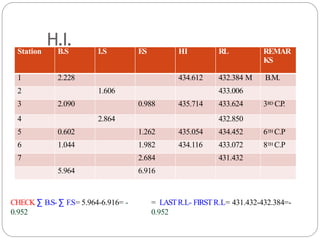
H.I.
Method
Station B.S I.S F
.S HI RL REMAR
KS
1 2.228 434.612 432.384 M B.M.
2 1.606 433.006
3 2.090 0.988 435.714 433.624 3RD C.P
.
4 2.864 432.850
5 0.602 1.262 435.054 434.452 6TH C.P
6 1.044 1.982 434.116 433.072 8TH C.P
7 2.684 431.432
5.964 6.916
CHECK ∑ B.S- ∑ F.S= 5.964-6.916= -
0.952
= LASTR.L- FIRSTR.L= 431.432-432.384=-
0.952
Rise and fall
method
Station B.S I.S F
.S Rise Fall RL REMARKS
1 2.228 432.384 M B.M.
2 1.606 0.622 433.006
3 2.090 0.988 0.618 433.624 3RD C.P
.
4 2.864 0.774 432.850
5 0.602 1.262 1.602 434.452 6TH C.P
6 1.044 1.982 1.38 433.072 8TH C.P
7 2.684 1.64 431.432
5.964 6.916
CHECK ∑ B.S- ∑ F.S= 5.964-6.916= -0.952 =
LASTR.L- FIRSTR.L= 431.432-432.384=-
0.952
∑RISE- ∑ FALL= 2.842-3.794=-0.952
Contou
r
100
105 110
120
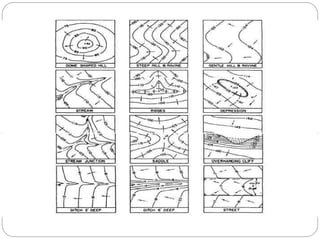
Acontour is animaginary line joining points of
equal elevation
Contour
Interval
The vertical distance betweenany twoconsecutive
contoursis knownascontour interval
Contour interval
Characteristics of contour
lines
 Aseriesof contourlines with higher value
inside indicate a hill
 Aseriesof contourlines with lowervalue inside the
loop alwaysindicate depression
 Closecontour linesindicate steep slope
 Widecontour linesindicate flatter slope
 Contourlines nevercrosseachother exceptin case
of overhanging cliff.
 All points ona contourlines haveequal elevation
Uses of
Contours
 Thenature of ground surfaceof aregion canbe
known
 Contourmaphelps in locating propersite for
bridges, dams,reservoirs etc.
 Capacity of areservoircanbecalculated with the
help of contour map
 The quantity of cutting and filling canbe
determined fromcontour maps.
 Routes forroads,railways,canalsetc canbe traced.
Errors in
Levelling
Thefollowingarethe different sourcesof Errors
 Personal Error
 The Instruments maynot be leveled
 The focusingof eyepieceand objectiveglassmaynot
be perfect
 Theparallax maynot be eliminated
 The position of staff mayhave changed
 Entry andrecordingin the field bookmaynot be
correct
 The staff maynot befully extended, maynot be
held vertical.
 Instrumental Error:
The Permanent adjustment of the instrument may
not be perfect. That is the line of collimation may
not be horizontal line
The internal arrangement of focusing tube may
not be correct
The graduation of the staff may not be perfect
 Errors due to Natural Causes:
TheCurvature of the Earth may affect the
staff readings when the distance of sight is long.
The effect of refraction may cause a wrong staff
reading
There are some errors in staff readings
due to high velocity wind.
Curvature
Correction
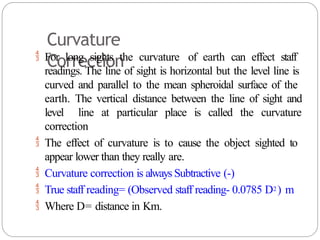
 For long sights the curvature of earth can effect staff
readings. The line of sight is horizontal but the level line is
curved and parallel to the mean spheroidal surface of the
earth. The vertical distance between the line of sight and
level line at particular place is called the curvature
correction
 The effect of curvature is to cause the object sighted to
appear lower than they really are.
 Curvature correction is always Subtractive (-)
 True staff reading= (Observed staff reading- 0.0785 D2) m
 Where D= distance in Km.
Curvature
Correction
(-)
Curvatur
e effect
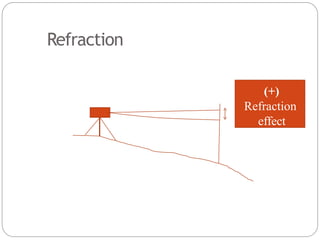
Refraction
 The ray of light pass through layers of air of different
densities and refract or bent down. The effect of refraction is
to make the object appear higher then they really are.
Refraction varies considerably with climate conditions.
 However it is taken as
Cr= 0.0112 D2m (+)
 Refraction is always additive
 True staff reading= Observed staff reading + Refraction
correction.
Refraction
(+)
Refraction
effect
GPS Surveying
GPS -- how it works
GPS -- Garmin 12
The Garmin 12
GPS
Change
windows
Get back to a point
Use to scroll and for keying
Confirm
TURN ON
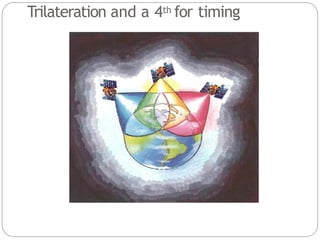
Trilateration and a 4th for timing
First page up….
4 important
pieces of data
The satillite
It’s signal
Nav
Error
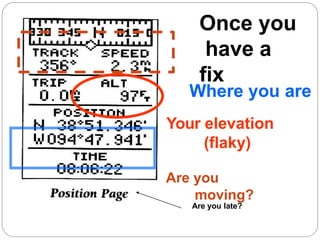
Once you
have a
fix
Are you late?
Where you are
Your elevation
(flaky)
Are you
moving?
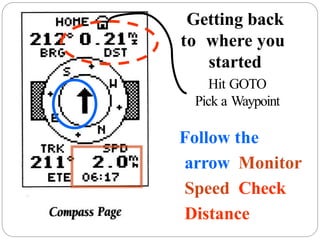
Getting back
to where you
started
Hit GOTO
Pick a Waypoint
Follow the
arrow Monitor
Speed Check
Distance
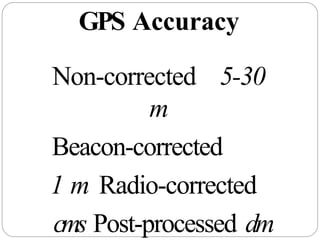
GPS Accuracy
Non-corrected 5-30
m
Beacon-corrected
1 m Radio-corrected
cms Post-processed dm
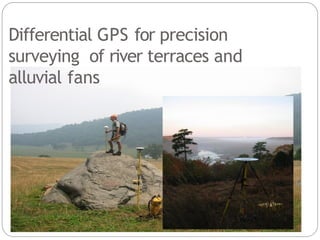
Differential GPS for precision
surveying of river terraces and
alluvial fans
Crash Course in Surveying With
an Auto Level:
:
(
(
1
First thing first: Gotta level the
it
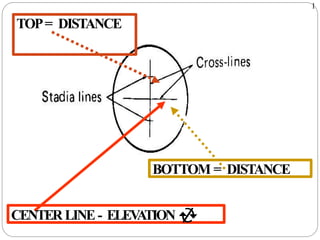
CENTERLINE - ELEV
ATION 
BOTTOM = DISTANCE
TOP= DISTANCE
1
1
The Auto
Level:
The
Instrument
And Tripod
The Stadia Rod
Or Surveyor’s
Staff
= l (m) * 100
(m)
How to read the Stadia
Rod:
11 meters on the
dot
10.8 meters on the
dot
Each Black
Rectangle
= 1 cm
Same for
Each
white one
So what’s
this height?
10.66 meters
What you’ll see through the
eyepiece:
Stadia
Lines
Height = 10.85
m
Top Stadia = 10.91
m
Bottom Stadia = 10.79
m
To Get Distance Away:
1) (Top - Bottom Stadia) = 0.12 m
2) Multiply difference by 100: Distance = 12 meters
1
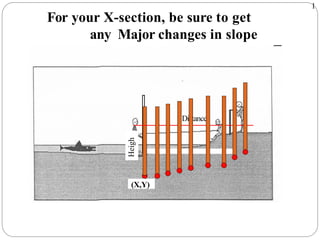
For your X-section, be sure to get
any Major changes in slope
Distance
Heigh
t
(X,Y)
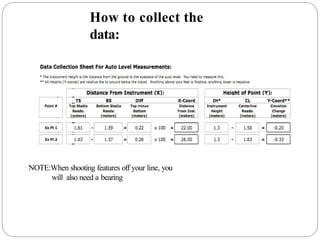
How to collect the
data:
NOTE:When shooting features off your line, you
will also need a bearing
?
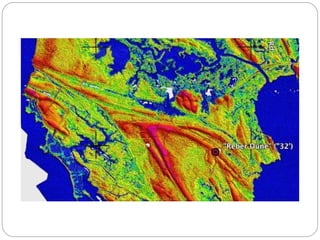
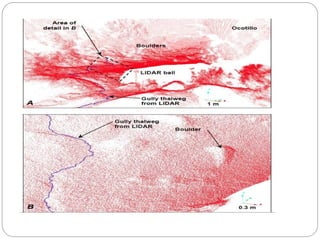
Side-Scan LiDAR:
GeoArcheology
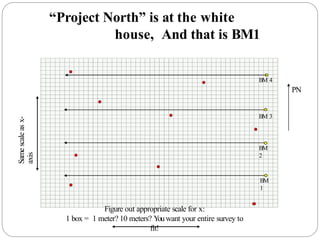
“Project North” is at the white
house, And that is BM1
Figure out appropriate scale for x:
1 box = 1 meter? 10 meters? Y
ouwant your entire survey to
fit!
Same
scale
as
x-
axis
BM
1
BM
2
BM 4
PN
BM 3

Surveying, types, classification PPT.pptx

  • 1.
    CLASSIFICATION OF SURVEYING Mr.Kaviraj M S, Assistant Professor, Department of Civil Engineering, Adithya Institute of Technology, Acdemic Year: 2021-2022
  • 36.
  • 37.
    Definition, Principle, &Object of Levelling Definition:- Levelling is defined as“an art of determining the relative height of different points on, aboveorbelowthe surface”.
  • 38.
    Principle of levelling Principle:- Theprinciple of levelling is to obtain horizontal line of sight with respectto which vertical distancesof the points aboveorbelow this line of sight are found.
  • 39.
    Object of levelling Theobjectiveof levelling is to 1) Findthe elevation of given point with respectto someassumedreferenceline called datum. 2)T oestablish point at requiredelevation with respectto datum.
  • 41.
    Definitions used in levelling Levelsurface:- It is the surfaceparallel to the mean spheroidal surface of the earth  Levelline:- Linelying onlevel surface.  Horizontal plane:- Horizontal planethrough apoint is aplane tangentialto level surface.  Horizontal line:- It is astraight line tangential to level line.
  • 42.
     Datum:- “Itisan arbitrary level surfacefromwhich elevation ofpoints maybereferred”.In India meansea level is consideredasdatum of zeroelevation it is situated at Karachi. Meansealevel is the averageheight of seafor all stagesof tides it is derived by averaging the hourly tide height over a period of 19 years.  Elevation or Reduced level:- It is height or depth of any point above or below any datum. It is denoted as R.L.
  • 43.
     BenchMark(B.M.):- Itis a fixed referencepoint of known elevation with respectto datum.  Line of collimation:- It is aline joining the intersection of crosshairs of diaphragmto the optical centreof object glass and its continuation. It is also knownasline of sight.  Height of instrument:- It is the elevation of line of collimation with respectto datum  Backsight:- It is astaff reading taken at a known elevation. It is the first staff reading taken after setup of instrument.
  • 44.
     For e sight(F .S.):- It is the last staff reading taken denoting the shifting of the instrument.  Intermediate sight.(I.S.):-It is staff reading taken ona point whoseelevation is to bedetermined.All staff reading betweenB.S. and F .S.areIntermediate sight.  ChangePoint:- It is apoint onwhichboth foreand back sight are taken.
  • 45.
    Instruments for levelling  Thefollowing instruments areessentially required  for levelling  Level  Levelling staff
  • 46.
    Level and typesof level  Level:- The instrument usedtofurnishhorizontal line of sight forobservingstaff readingsand determining R.L.s  T ypes  Dumpy level  Tilting level  W ye level  Automatic level
  • 47.
    The Dumpy levelis a simple, compact and stable instrument. The telescopeis rigidly fixed to its supports. Henceit c a n n o tDb eurmo t apt e dyalbeo uvtehlo r i z o n t a l axis.
  • 48.
    It is alsoknownasI.O.P .level(Indian officePattern). In this levelthe telescope tilts about its horizontal axis henceit is calledTtiillttini ng gl e vleel vel
  • 49.
    Wye level Theessential differencebetweenwyelevel andotherlevelsis thatinwyelevel the telescopeis carried bytwovertical wye supports.The telescopecanberotated, movedorevenraised in wyes.
  • 50.
    Automatic level It is alsoknownasselfaligning level. It is arecent development. Thefundamental differencebetweenauto level andotherlevels is that the levelling is not manually but it is levelled automatically. It is achievedbyinclination compensating device.
  • 52.
    Levelling Staffs  Levelling staffsarescalesonwhichthesedistances are measured.  Levelling staffs areof two types  Self reading staff  T arget staff
  • 53.
    Self reading staff  Theself readingstaff canbereaddirectly bythe level manlooking through the telescope.  Commontypes of self reading staffs  Ordinary staff  Sopwith telescopic staff  Folding Staff
  • 54.
    Target staff  For veryprecise works and sight target staff are used.A movable target is provided in this staff.A vernier is provided on target to give precise reading. In target staff level man directs the staff man to move the target up and down until it bisects by the line of sight.The staff man observe the staff reading
  • 56.
    Bench Marks  Benchmarkis apointof known elevation  Thereare4 kinds of bench marks  GTS(Greattrigonometrically surveybench mark)  Permanentbench mark  Arbitrary bench mark  T emporarybench mark
  • 57.
    GTS Bench mark  Theyare the bench marks established with veryhigh degree of precisionat regularintervals bythe surveyof India Department all overthe country Their position andR.Ls valuesabovemean seallevel at Karachiaregivenin catalogue formedbythe department.  Meansealevel
  • 58.
    Permanent Bench mark Permanent benchmarksare fixed in between GTS bench marks by govt. agencies such as railways, PWD,etc. This bench marks are written on permanent objects such as milestones, culverts, bridges etc their value are clearly written and their position are recorded forfuture reference.
  • 59.
    Arbitrary benchmarks:- Thesearereferencepointswhose R.L.s arearbitrarily assumed.They areusedin small works suchbenchmarkmaybeassumedas100. or50 m T emporarybenchmarks:- They arethe referencepoints established during the levelling operationswhenthere is a breakin work,orat the endof day’ sworkthe value of reducedlevels aremarkedonsomepermanent objects such asstones, trees etc.
  • 60.
    Temporary Adjustments ofa level  Theseadjustments areperformedat everysetup of instrument  Setting up of level  Levelling of telescope  Focusingof the eye peace  Focusingof object glass
  • 61.
     Setting upthe level:- Thisincludes  A)Fixing the instrument ontripod  B)Levelling the instrument approximately byTripod  Levelling:- LevellingLevelling is donewith the help of foot screws. The purposeoflevelling is to makevertical axis truly vertical. It is donewith the help of foot screws  A)Placethe telescopeparallel to apair of foot screwthen hold the foot screwsbetweenthumb andfirst finger andturn them either inwardoroutwarduntil the longitudinal bubblecomesin the centre.  B)Turnthe telescopethrough 900 sothat it lies parallel to third foot screw ,turn the screw until the bubble comes in the centre.
  • 62.
     Focusing theeye piece:- T o focus the eye piece, hold a white paper in front of object glass, and move the eye piecein or out till the crosshair aredistinctly seen.  Focusingof object glass:- Direct the telescopeto the levelling staff and onlooking through the telescope, turn the focusing screwtill the imageappearsclearand sharp.
  • 63.
    Classification of levelling  Simplelevelling  Differential leveling  Fly levelling  Check levelling  Profile levelling  Cross levelling  Reciprocal levelling  Precise levelling  Trignometric levelling  Barometric levelling  Hypersometric levelling
  • 64.
    Simple levelling:- Itis the simplest methodused, whenit is requiredto find the difference in elevation between2 points. Differential Levelling:- This methodis usedto find the difference in the elevation betweenpoints if they aretoofar apart orthe difference in elevation betweenthem is too much.
  • 66.
    Flylevelling:- Flylevelling isjust like differential levelling carried out to checkthe accuracyoflevelling work.In fly levelling only B.S.andF .S.are taken
  • 67.
     Checklevelling:- Thiskind of levelling is carried out to checkthe accuracyof work.It is doneat the end of the days workin the formof fly levelling to connectthe finishing point and starting point.  Profile levelling orL-Section:-This method is usedfor taking levels along the centreline of any alignment like road, railwaycanal etc.The object is to determine the undulations of the ground surfacealong the alignment
  • 69.
     Cross-sectioning:- Thisoperation is carried out perpendicular to alignment at an interval of 10, 20 ,30, 40 m.The idea is to makean estimate of earthwork.  Preciselevelling:- It is usedforestablishing benchmarks for future public use. It is carried out with high degreeof accuracyusing advanced instruments  Trignometriclevelling:- In this methodvertical distances betweenpoints arecomputedbyobserving horizontal distances and vertical angle between points.
  • 70.
     Barometric levelling:-In this method the altitude difference is determined bymeansof a barometer .  Hyposometric levelling:- The working of Hyposometry for determining the elevation depends upon the fact that the temperature at which water boils varies with the atmospheric pressure. The boiling point of water reduces at higher altitude thus knowing the boiling point of water , the atmospheric pressure can be calculated and knowing the atmospheric pressure altitude or elevation can be determined
  • 71.
    Reciprocal levelling  Reciprocal levelling:-Thismethod is adopted to accurately determine the difference of level between two points which are far apart. It is also used whenit is not possible to setup level in mid way betweentwo points  Let A and B be the two points on opposite banks of a river. It is required to find out the level difference between A&B  Set up the level very near to Aand take the reading at Aand Blet the reading be a1 and b1  Shift the level and set up very near to B and observe Aand B to get reading a2 and b2  Let d is the true difference of level between Aand B, and e= error due to curvature, refrection and imperfect adjustment.
  • 72.
    b1’ e b1  Thus toeliminate the error take an average of the difference in elevation taken from 2 points  i.e. from Athe true difference will be =(bb11-’e)-a1 From Bthe difference will be= b2-((aa2-’e)  Therefore dd=={{(bb11-’a1)+(b2-a‘2)}/2 a1 Line of collimation level Line A B Rive r
  • 73.
    b2 e a2’ Line of collimation level Line a2 A B Rive r Thus to eliminate the error take an average of the difference in elevation taken from 2 points  i.e. from Athe true difference will be=(b1’-e)- a1  From Bthe difference will be= b2-(a2’-e)  Therefore d={(b1-a1)+ (b2-a2)}/2
  • 74.
    Methods of Reducing levels HeightofInstrumentMethod:-This methodconsist of finding H.I. foreverysetup of instrument, and then obtaining the R.L. of point of referencewith respectto H.I
  • 75.
    Station B.S I.SF .S H.I R.L Remark A 0.9 100.9 100.00 B.M B 1.1 99.800 C 1.450 1.05 101.3 99.850 C.P . D 1.550 99.750 F.S=1.55 m A100 m I.S B 9 91.. 18m m F . S1.05m B.S 1.45m C 99.85 m D 99.750 m B.S 0.9m B. M 100 M. H I C .P .
  • 76.
    This methodconsist ofdetermining the difference of level betweenconsecutivepoints bycomparingeach point w i tRhiismem e dai ant edp rfeac eldli nmg peo itnht .o d
  • 77.
    Rise And Fall Method StationB.S I.S F .S Rise Fall R.L Remark A 0.9 100.00 B.M B 1.1 0.2 99.800 C 1.450 1.05 0.05 99.850 C.P . D 1.550 0.1 99.750 F .S 1.05m B.S 1.45m F.S=1.55 m A100 m I.S 1.1m B 99.8m C 99.85 m B.S 0.9m B. M 100 M. D 99.750 m C .P .
  • 78.
    Exampl e The followingstaff readingswereobserved successively with a level the instrument is moved by third sixth and eighth readings.  : 2.228 :1.606 :0.988 :2.090 :2.864 :1.262 0.602 :1.982 :1.044 :2.684 m enter the reading in record book and calculate R.L. if the first reading was taken at a B.M of 432.383m
  • 79.
    H.I. Method Station B.S I.SF .S HI RL REMAR KS 1 2.228 434.612 432.384 M B.M. 2 1.606 433.006 3 2.090 0.988 435.714 433.624 3RD C.P . 4 2.864 432.850 5 0.602 1.262 435.054 434.452 6TH C.P 6 1.044 1.982 434.116 433.072 8TH C.P 7 2.684 431.432 5.964 6.916 CHECK ∑ B.S- ∑ F.S= 5.964-6.916= - 0.952 = LASTR.L- FIRSTR.L= 431.432-432.384=- 0.952
  • 80.
    Rise and fall method StationB.S I.S F .S Rise Fall RL REMARKS 1 2.228 432.384 M B.M. 2 1.606 0.622 433.006 3 2.090 0.988 0.618 433.624 3RD C.P . 4 2.864 0.774 432.850 5 0.602 1.262 1.602 434.452 6TH C.P 6 1.044 1.982 1.38 433.072 8TH C.P 7 2.684 1.64 431.432 5.964 6.916 CHECK ∑ B.S- ∑ F.S= 5.964-6.916= -0.952 = LASTR.L- FIRSTR.L= 431.432-432.384=- 0.952 ∑RISE- ∑ FALL= 2.842-3.794=-0.952
  • 81.
    Contou r 100 105 110 120 Acontour isanimaginary line joining points of equal elevation
  • 82.
    Contour Interval The vertical distancebetweenany twoconsecutive contoursis knownascontour interval Contour interval
  • 83.
    Characteristics of contour lines Aseriesof contourlines with higher value inside indicate a hill  Aseriesof contourlines with lowervalue inside the loop alwaysindicate depression  Closecontour linesindicate steep slope  Widecontour linesindicate flatter slope  Contourlines nevercrosseachother exceptin case of overhanging cliff.  All points ona contourlines haveequal elevation
  • 85.
    Uses of Contours  Thenatureof ground surfaceof aregion canbe known  Contourmaphelps in locating propersite for bridges, dams,reservoirs etc.  Capacity of areservoircanbecalculated with the help of contour map  The quantity of cutting and filling canbe determined fromcontour maps.  Routes forroads,railways,canalsetc canbe traced.
  • 86.
    Errors in Levelling Thefollowingarethe differentsourcesof Errors  Personal Error  The Instruments maynot be leveled  The focusingof eyepieceand objectiveglassmaynot be perfect  Theparallax maynot be eliminated  The position of staff mayhave changed  Entry andrecordingin the field bookmaynot be correct  The staff maynot befully extended, maynot be held vertical.
  • 87.
     Instrumental Error: ThePermanent adjustment of the instrument may not be perfect. That is the line of collimation may not be horizontal line The internal arrangement of focusing tube may not be correct The graduation of the staff may not be perfect
  • 88.
     Errors dueto Natural Causes: TheCurvature of the Earth may affect the staff readings when the distance of sight is long. The effect of refraction may cause a wrong staff reading There are some errors in staff readings due to high velocity wind.
  • 89.
    Curvature Correction  For longsights the curvature of earth can effect staff readings. The line of sight is horizontal but the level line is curved and parallel to the mean spheroidal surface of the earth. The vertical distance between the line of sight and level line at particular place is called the curvature correction  The effect of curvature is to cause the object sighted to appear lower than they really are.  Curvature correction is always Subtractive (-)  True staff reading= (Observed staff reading- 0.0785 D2) m  Where D= distance in Km.
  • 90.
  • 91.
    Refraction  The rayof light pass through layers of air of different densities and refract or bent down. The effect of refraction is to make the object appear higher then they really are. Refraction varies considerably with climate conditions.  However it is taken as Cr= 0.0112 D2m (+)  Refraction is always additive  True staff reading= Observed staff reading + Refraction correction.
  • 92.
  • 93.
    GPS Surveying GPS --how it works GPS -- Garmin 12
  • 94.
    The Garmin 12 GPS Change windows Getback to a point Use to scroll and for keying Confirm TURN ON
  • 96.
    Trilateration and a4th for timing
  • 97.
    First page up…. 4important pieces of data The satillite It’s signal Nav Error
  • 98.
    Once you have a fix Areyou late? Where you are Your elevation (flaky) Are you moving?
  • 99.
    Getting back to whereyou started Hit GOTO Pick a Waypoint Follow the arrow Monitor Speed Check Distance
  • 100.
    GPS Accuracy Non-corrected 5-30 m Beacon-corrected 1m Radio-corrected cms Post-processed dm
  • 101.
    Differential GPS forprecision surveying of river terraces and alluvial fans
  • 102.
    Crash Course inSurveying With an Auto Level:
  • 103.
    : ( ( 1 First thing first:Gotta level the it
  • 104.
    CENTERLINE - ELEV ATION BOTTOM = DISTANCE TOP= DISTANCE 1
  • 105.
    1 The Auto Level: The Instrument And Tripod TheStadia Rod Or Surveyor’s Staff = l (m) * 100 (m)
  • 106.
    How to readthe Stadia Rod: 11 meters on the dot 10.8 meters on the dot Each Black Rectangle = 1 cm Same for Each white one So what’s this height? 10.66 meters
  • 107.
    What you’ll seethrough the eyepiece: Stadia Lines Height = 10.85 m Top Stadia = 10.91 m Bottom Stadia = 10.79 m To Get Distance Away: 1) (Top - Bottom Stadia) = 0.12 m 2) Multiply difference by 100: Distance = 12 meters
  • 108.
    1 For your X-section,be sure to get any Major changes in slope Distance Heigh t (X,Y)
  • 109.
    How to collectthe data: NOTE:When shooting features off your line, you will also need a bearing
  • 111.
  • 112.
  • 114.
    “Project North” isat the white house, And that is BM1 Figure out appropriate scale for x: 1 box = 1 meter? 10 meters? Y ouwant your entire survey to fit! Same scale as x- axis BM 1 BM 2 BM 4 PN BM 3