10
Measurement and geometry
Surface
area and
volume
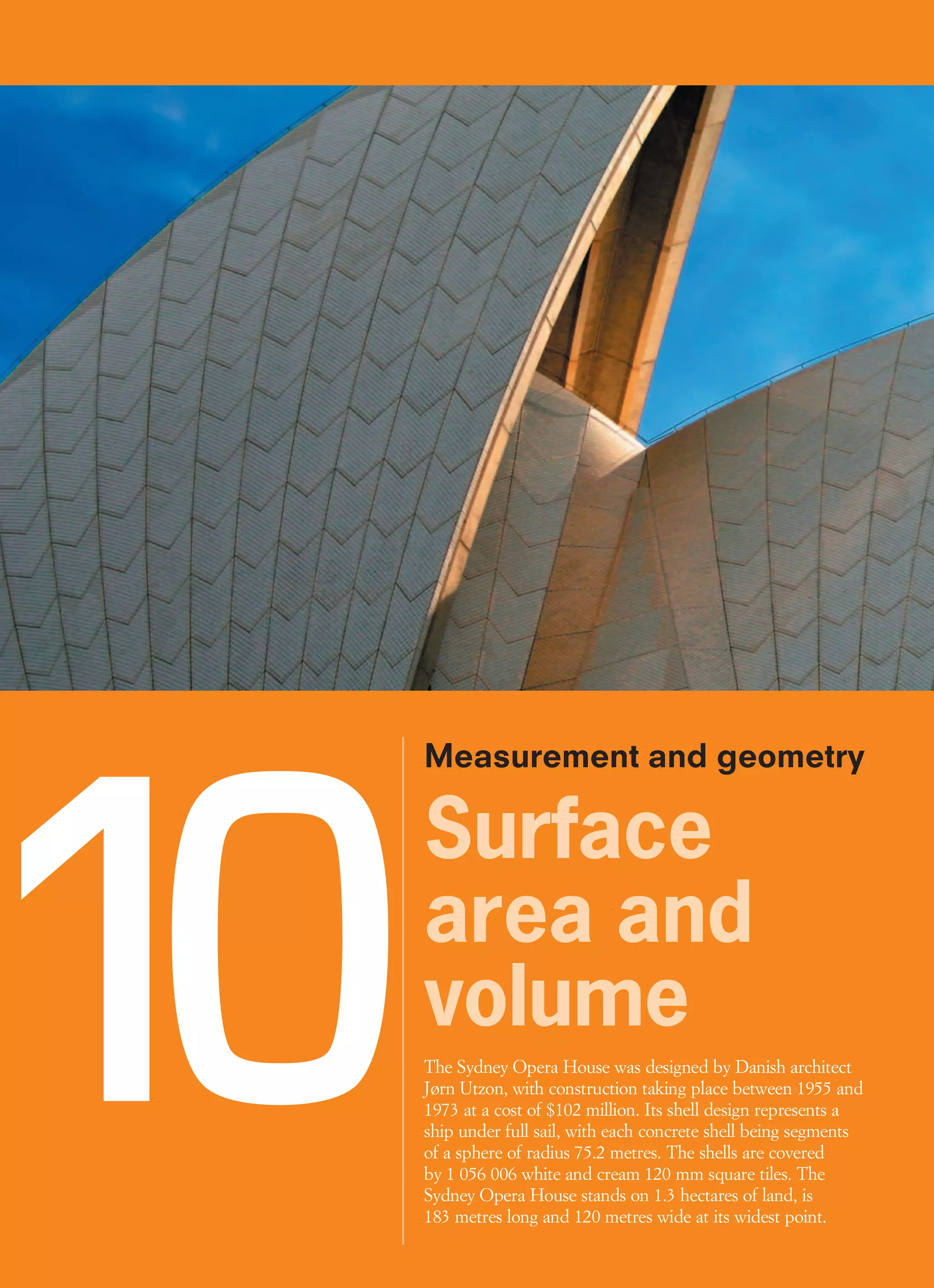
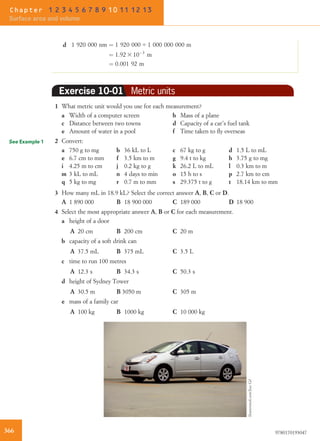
The Sydney Opera House was designed by Danish architect
Jørn Utzon, with construction taking place between 1955 and
1973 at a cost of $102 million. Its shell design represents a
ship under full sail, with each concrete shell being segments
of a sphere of radius 75.2 metres. The shells are covered
by 1 056 006 white and cream 120 mm square tiles. The
Sydney Opera House stands on 1.3 hectares of land, is
183 metres long and 120 metres wide at its widest point.
nChapter outline
Proficiency strands
10-01 Metric units U F R C
10-02 Limits of accuracy
of measuring
instruments U R C
10-03 Perimeters and areas
of composite shapes U F R
10-04 Areas of
quadrilaterals U F PS R
10-05 Circumferences and
areas of circular
shapes U F PS R
10-06 Surface area of a
prism U F PS R
10-07 Surface area of a
cylinder* U F PS R
10-08 Volumes of prisms
and cylinders U F PS R
*STAGE 5.2
nWordbank
capacity The amount of fluid (liquid or gas) in a container
cross-section A ‘slice’ of a solid, taken across the solid
rather than along it
limits of accuracy How accurate a measured value using a
measuring instrument can be, equal to half of a unit on the
instrument’s scale
mega- (abbreviated M) A metric prefix meaning one
million
micro- (abbreviated m) A metric prefix meaning one-
millionth
prism A solid shape with identical cross-sections and ends
with straight sides
sector A region of a circle cut off by two radii, shaped like
a slice of pizza
surface area The total area of all the faces of a solid shape
Shutterstock.com/col
9780170193047
N E W C E N T U R Y M AT H S
for the A u s t r a l i a n C u r r i c u l u m 9
nIn this chapter you will:
• investigate very small and very large time scales and intervals
• find perimeters and areas of parallelograms, trapeziums, rhombuses and kites
• solve problems involving the surface areas and volumes of right prisms
• (STAGE 5.2) calculate the surface areas of cylinders and solve related problems
• learn the metric prefixes for very small and very large units of measurement
• convert between units of digital memory, such as megabytes and gigabytes
• calculate the limits of accuracy of measuring instruments
• calculate the perimeters and areas of composite shapes, including circular shapes involving
sectors
• calculate volumes and capacities of right prisms and cylinders
SkillCheck
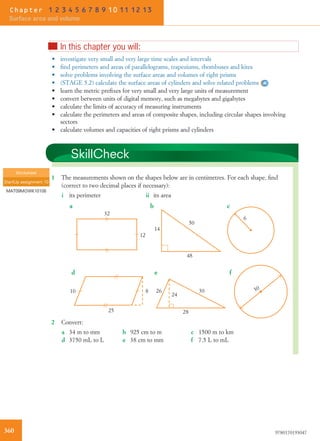
1 The measurements shown on the shapes below are in centimetres. For each shape, find
(correct to two decimal places if necessary):
i its perimeter ii its area
32
12
14
50
48
6
25
810
28
24
26 30
f
cba
ed
30
2 Convert:
a 34 m to mm b 925 cm to m c 1500 m to km
d 3750 mL to L e 38 cm to mm f 7.5 L to mL
Worksheet
StartUp assignment 10
MAT09MGWK10108
360 9780170193047
Chapter 1 2 3 4 5 6 7 8 9 10 11 12 13
Surface area and volume
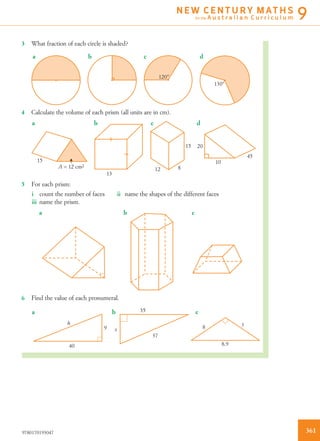
3 What fraction of each circle is shaded?
120°
a b c d
130°
4 Calculate the volume of each prism (all units are in cm).
15
A = 12 cm2
13
12 8
15 20
dcba
10
45
5 For each prism:
i count the number of faces ii name the shapes of the different faces
iii name the prism.
a b c
6 Find the value of each pronumeral.
y
8.9
8
h
40
a b c
x
37
35
9
3619780170193047
N E W C E N T U R Y M AT H S
for the A u s t r a l i a n C u r r i c u l u m 9
10-01 Metric units
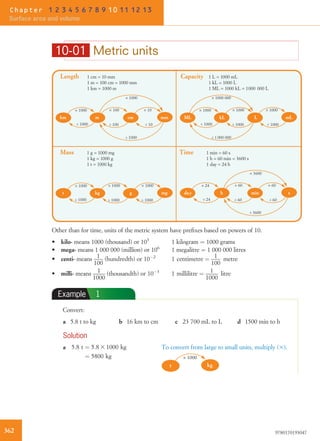
Length 1 cm = 10 mm
1 m = 100 cm = 1000 mm
1 km = 1000 m
Capacity 1 L = 1000 mL
1 kL = 1000 L
1 ML = 1000 kL = 1000 000 L
Mass 1 g = 1000 mg
1 kg = 1000 g
1 t = 1000 kg
Time 1 min = 60 s
1 h = 60 min = 3600 s
1 day = 24 h
m cm mmkm
× 1000
× 100 × 10× 1000
÷ 1000
÷ 100÷ 1000 ÷ 10
kL L mL
× 1000 × 1000× 1000
× 1000 000
÷ 1 000 000
÷ 1000÷ 1000 ÷ 1000
ML
kg g mgt
× 1000 × 1000× 1000
÷ 1000÷ 1000 ÷ 1000
h min sda y
× 3600
÷ 3600
× 60 × 60× 24
÷ 60÷ 24 ÷ 60
Other than for time, units of the metric system have prefixes based on powers of 10.
• kilo- means 1000 (thousand) or 103
1 kilogram ¼ 1000 grams
• mega- means 1 000 000 (million) or 106
1 megalitre ¼ 1 000 000 litres
• centi- means 1
100
(hundredth) or 10À2
1 centimetre ¼ 1
100
metre
• milli- means 1
1000
(thousandth) or 10À3
1 millilitre ¼ 1
1000
litre
Example 1
Convert:
a 5.8 t to kg b 16 km to cm c 23 700 mL to L d 1500 min to h
Solution
a 5:8 t ¼ 5:8 3 1000 kg
¼ 5800 kg
To convert from large to small units, multiply (3).
t kg
× 1000
362 9780170193047
Chapter 1 2 3 4 5 6 7 8 9 10 11 12 13
Surface area and volume
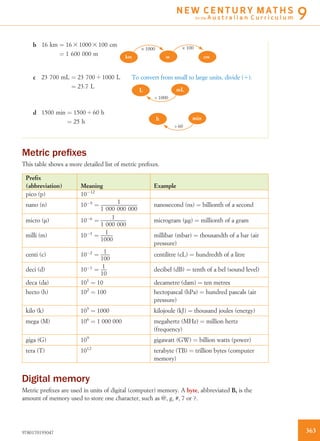
b 16 km ¼ 16 3 1000 3 100 cm
¼ 1 600 000 m
× 100
km m
× 1000
cm
c 23 700 mL ¼ 23 700 4 1000 L
¼ 23:7 L
To convert from small to large units, divide (4).
L mL
÷ 1000
d 1500 min ¼ 1500 4 60 h
¼ 25 h h min
÷ 60
Metric prefixes
This table shows a more detailed list of metric prefixes.
Prefix
(abbreviation) Meaning Example
pico (p) 10À12
nano (n) 10À9
¼ 1
1 000 000 000
nanosecond (ns) ¼ billionth of a second
micro (m) 10À6
¼ 1
1 000 000
microgram (mg) ¼ millionth of a gram
milli (m) 10À3
¼ 1
1000
millibar (mbar) ¼ thousandth of a bar (air
pressure)
centi (c) 10À2
¼ 1
100
centilitre (cL) ¼ hundredth of a litre
deci (d) 10À1
¼ 1
10
decibel (dB) ¼ tenth of a bel (sound level)
deca (da) 101
¼ 10 decametre (dam) ¼ ten metres
hecto (h) 102
¼ 100 hectopascal (hPa) ¼ hundred pascals (air
pressure)
kilo (k) 103
¼ 1000 kilojoule (kJ) ¼ thousand joules (energy)
mega (M) 106
¼ 1 000 000 megahertz (MHz) ¼ million hertz
(frequency)
giga (G) 109
gigawatt (GW) ¼ billion watts (power)
tera (T) 1012
terabyte (TB) ¼ trillion bytes (computer
memory)
Digital memory
Metric prefixes are used in units of digital (computer) memory. A byte, abbreviated B, is the
amount of memory used to store one character, such as @, g, #, 7 or ?.
3639780170193047
N E W C E N T U R Y M AT H S
for the A u s t r a l i a n C u r r i c u l u m 9
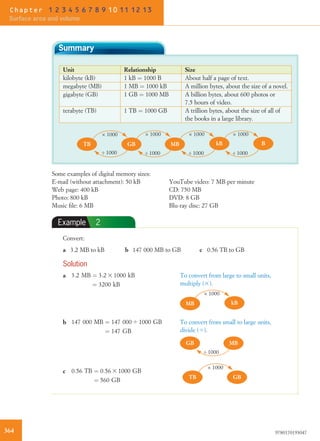
Summary
Unit Relationship Size
kilobyte (kB) 1 kB ¼ 1000 B About half a page of text.
megabyte (MB) 1 MB ¼ 1000 kB A million bytes, about the size of a novel.
gigabyte (GB) 1 GB ¼ 1000 MB A billion bytes, about 600 photos or
7.5 hours of video.
terabyte (TB) 1 TB ¼ 1000 GB A trillion bytes, about the size of all of
the books in a large library.
GB MB kBTB
× 1000 × 1000× 1000
÷ 1000÷ 1000 ÷ 1000
B
× 1000
÷ 1000
Some examples of digital memory sizes:
E-mail (without attachment): 50 kB
Web page: 400 kB
Photo: 800 kB
Music file: 6 MB
YouTube video: 7 MB per minute
CD: 750 MB
DVD: 8 GB
Blu-ray disc: 27 GB
Example 2
Convert:
a 3.2 MB to kB b 147 000 MB to GB c 0.56 TB to GB
Solution
a 3:2 MB ¼ 3:2 3 1000 kB
¼ 3200 kB
To convert from large to small units,
multiply (3).
MB kB
× 1000
b 147 000 MB ¼ 147 000 4 1000 GB
¼ 147 GB
To convert from small to large units,
divide (4).
GB MB
÷ 1000
c 0:56 TB ¼ 0:56 3 1000 GB
¼ 560 GB
GBTB
× 1000
364 9780170193047
Chapter 1 2 3 4 5 6 7 8 9 10 11 12 13
Surface area and volume
Very small and very large units
Some very small and very large units of length, distance and time also use metric prefixes.
Length and distance
• One nanometre (nm) ¼ 1
1 000 000 000
m: your fingernails grown 1 nm every second, the
diameter of a helium atom is 0.1 nm
• One micrometre (mm) ¼ 1
1 000 000
m: used to measure diameters of bacteria
• One megametre (Mm) ¼ 1 000 000 m or 1000 km: the distance between Sydney and Brisbane,
or the length of the Bathurst 1000 car race
• One gigametre (GM) ¼ 1 000 000 000 m: the diameter of the Sun is 1.4 GM
• One astronomical unit (AU) ¼ 149 597 871 km or 149.6 GM: the average distance between
the Earth and the Sun, used to measure distances between planets in our solar system
• One light year (ly) ¼ 9.46 3 1012
km: the distance light travels in a year, for measuring
distances between stars
• One parsec (pc) ¼ 3.09 3 1013
km or 3.26 ly: for measuring distances between stars, the
nearest star Proxima Centauri is 1.30 parsecs away
Time
• One nanosecond (ns) ¼ 1
1 000 000 000
s: the time it takes electricity to travel along a 30 cm wire
• One microsecond (ms) ¼ 1
1 000 000
s
• One millisecond (ms) ¼ 1
1000
s: the duration of the flash on a camera
• One decade ¼ 10 years
• One century ¼ 100 years
• One millennium ¼ 1000 years
• One mega-annum (Ma) ¼ 1 000 000 years: used in geology and paleontology, the
Tyrannosaurus Rex dinosaur lived 65 Ma ago
• One giga-annum (Ga) ¼ 1 000 000 000 years: the Earth was formed 4.57 Ga ago
Example 3
Convert:
a 0.73 s to ms b 25 610 000 km to AU
c 4.57 Ga to years d 1 920 000 nm to m
Solution
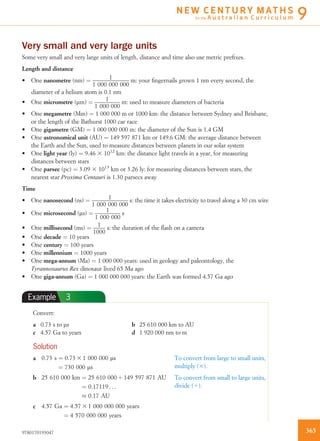
a 0:73 s ¼ 0:73 3 1 000 000 ls
¼ 730 000 ls
To convert from large to small units,
multiply (3).
b 25 610 000 km ¼ 25 610 000 4 149 597 871 AU
¼ 0:17119 . . .
% 0:17 AU
To convert from small to large units,
divide (4).
c 4:57 Ga ¼ 4:57 3 1 000 000 000 years
¼ 4 570 000 000 years
3659780170193047
N E W C E N T U R Y M AT H S
for the A u s t r a l i a n C u r r i c u l u m 9
d 1 920 000 nm ¼ 1 920 000 4 1 000 000 000 m
¼ 1:92 3 10À3
m
¼ 0:001 92 m
Exercise 10-01 Metric units
1 What metric unit would you use for each measurement?
a Width of a computer screen b Mass of a plane
c Distance between two towns d Capacity of a car’s fuel tank
e Amount of water in a pool f Time taken to fly overseas
2 Convert:
a 750 g to mg b 36 kL to L c 67 kg to g d 1.5 L to mL
e 6.7 cm to mm f 3.5 km to m g 9.4 t to kg h 3.75 g to mg
i 4.25 m to cm j 0.2 kg to g k 26.2 L to mL l 0.3 km to m
m 3 kL to mL n 4 days to min o 15 h to s p 2.7 km to cm
q 5 kg to mg r 0.7 m to mm s 29.375 t to g t 18.14 km to mm
3 How many mL in 18.9 kL? Select the correct answer A, B, C or D.
A 1 890 000 B 18 900 000 C 189 000 D 18 900
4 Select the most appropriate answer A, B or C for each measurement.
a height of a door
A 20 cm B 200 cm C 20 m
b capacity of a soft drink can
A 37.5 mL B 375 mL C 3.5 L
c time to run 100 metres
A 12.3 s B 34.3 s C 50.3 s
d height of Sydney Tower
A 30.5 m B 3050 m C 305 m
e mass of a family car
A 100 kg B 1000 kg C 10 000 kg
See Example 1
Shutterstock.com/JoseGil
366 9780170193047
Chapter 1 2 3 4 5 6 7 8 9 10 11 12 13
Surface area and volume
5 Convert:
a 8000 L to kL b 90 mm to cm c 180 s to min
d 240 min to h e 375 mL to L f 14 700 kg to t
g 8600 mg to g h 750 cm to m i 223 mm to cm
j 800 g to kg k 125 L to kL l 3.5 kg to t
m 17 000 000 mg to kg n 7200 min to days o 45 000 000 g to t
p 144 000 s to h q 86 400 s to days r 2500 cm to km
s 75 000 mL to kL t 34 700 mm to m
6 How many km in 408 m? Select the correct answer A, B, C or D.
A 4.08 B 0.408 C 0.0408 D 0.004 08
7 Convert:
a 4.8 MB to kB b 2.1 TB to GB c 8.5 GB to MB
d 10.8 MB to B e 2910 B to kB f 740 MB to GB
g 1050 kB to MB h 5900 GB to TB i 0.94 kB to MB
j 57 GB to MB k 0.43 GB to kB l 21 TB to GB
m 7.8 kB to B n 2180 MB to GB o 42 000 B to MB
p 940 MB to kB
8 Mala made a 3-minute phone call to her friend in Queensland using the Internet application
Skype at 1.2 MB per minute. How many kB did she use?
9 Calculate the number of MP3 files of average size 3.7 MB that can be stored on a 16 GB
MP3 player.
10 Convert, correct to two significant figures where necessary:
a 3.5 AU to km b 6000 ms to s c 7.5 centuries to years
d 12 000 000 nm to m e 0.64 GM to m f 2.1 ly to km
g 0.07 s to ms h 0.25 Ma to years i 4 800 000 ms to s
j 5 290 000 km to Mm k 0.2 pc to km l 6 mm to mm
m 0.94 Ma to millennia n 849 years to centuries o 8 3 1014
km to ly
p 0.000 008 cm to nm
Just for the record The metre
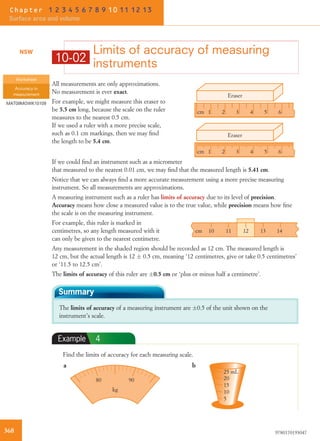
The metre is the standard or base unit of length in the International System of Units.
S
Distance from the
north pole to
the equator
N
Equator
It was originally defined in France in
1795 as 1
10 000 000
(ten-millionth) of the
distance between the North Pole and the
Equator along a meridian of longitude.
In 1889, it was redefined as the distance
between two lines marked on a platinum
bar used as the standard.
The current definition was made in 1983,
as the distance travelled by light in a
vacuum in 1
299 792 458
of a second.
Investigate the definition of a second.
See Example 2
Worked solutions
Metric units
MAT09MGWS10040
See Example 3
3679780170193047
N E W C E N T U R Y M AT H S
for the A u s t r a l i a n C u r r i c u l u m 9
10-02
Limits of accuracy of measuring
instruments
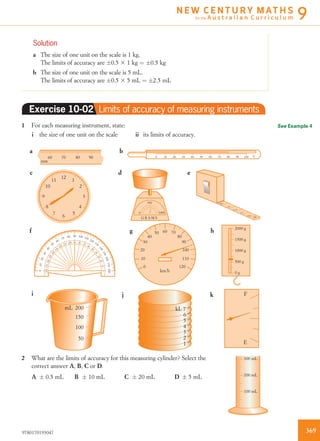
All measurements are only approximations.
No measurement is ever exact.
For example, we might measure this eraser to
be 5.5 cm long, because the scale on the ruler
measures to the nearest 0.5 cm.
cm 1 2 3 4 5 6
Eraser
If we used a ruler with a more precise scale,
such as 0.1 cm markings, then we may find
the length to be 5.4 cm.
cm 1 2 3 4 5 6
Eraser
If we could find an instrument such as a micrometer
that measured to the nearest 0.01 cm, we may find that the measured length is 5.41 cm.
Notice that we can always find a more accurate measurement using a more precise measuring
instrument. So all measurements are approximations.
A measuring instrument such as a ruler has limits of accuracy due to its level of precision.
Accuracy means how close a measured value is to the true value, while precision means how fine
the scale is on the measuring instrument.
For example, this ruler is marked in
centimetres, so any length measured with it
can only be given to the nearest centimetre.
10 11 12 13 14
{
cm
Any measurement in the shaded region should be recorded as 12 cm. The measured length is
12 cm, but the actual length is 12 Æ 0.5 cm, meaning ‘12 centimetres, give or take 0.5 centimetres’
or ‘11.5 to 12.5 cm’.
The limits of accuracy of this ruler are Æ0.5 cm or ‘plus or minus half a centimetre’.
Summary
The limits of accuracy of a measuring instrument are Æ0.5 of the unit shown on the
instrument’s scale.
Example 4
Find the limits of accuracy for each measuring scale.
kg
80 90
ba
25 mL
20
15
10
5
NSW
Worksheet
Accuracy in
measurement
MAT09MGWK10109
368 9780170193047
Chapter 1 2 3 4 5 6 7 8 9 10 11 12 13
Surface area and volume
Solution
a The size of one unit on the scale is 1 kg.
The limits of accuracy are Æ0.5 3 1 kg ¼ Æ0.5 kg
b The size of one unit on the scale is 5 mL.
The limits of accuracy are Æ0.5 3 5 mL ¼ Æ2.5 mL
Exercise 10-02 Limits of accuracy of measuring instruments
1 For each measuring instrument, state:
i the size of one unit on the scale ii its limits of accuracy.
G R A M S
10000
500
100
60
90
80
7050
40
30
20
10
0
110
120
km/h
088724
100
20 40 60 800 °C10010 30 50 70 90
ba
edc
hgf
60 70 80 90
90 100 110 120
130
140
150160170180
80
70
60
50
40
30
20
100
90 80 70
60
50
40
30
20100
100
110
120
130
140
150
160
170180
12
1
2
3
4
5
6
7
8
9
10
11
mm
2000 g
1500 g
1000 g
500 g
0 g
3
0
1
2
cm4
i j k F
E
kL 7
6
5
4
3
2
1
mL 200
150
100
50
2 What are the limits of accuracy for this measuring cylinder? Select the
correct answer A, B, C or D.
100 mL
200 mL
300 mL
A Æ 0.5 mL B Æ 10 mL C Æ 20 mL D Æ 5 mL
See Example 4
3699780170193047
N E W C E N T U R Y M AT H S
for the A u s t r a l i a n C u r r i c u l u m 9
3 Measuring with a ruler, Jade correctly gives a measurement as 26.5 to 27.5 cm.
a What is the size of a unit on the ruler?
b What are the limits of accuracy of this measurement?
c Using a ruler marked in millimetres, Marival gives the same measurement as 26.8 cm. What
are the limits of accuracy of this measurement?
d What is the range within which this measurement must lie?
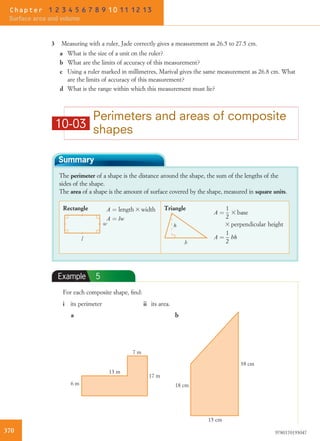
10-03
Perimeters and areas of composite
shapes
Summary
The perimeter of a shape is the distance around the shape, the sum of the lengths of the
sides of the shape.
The area of a shape is the amount of surface covered by the shape, measured in square units.
Rectangle
w
l
A ¼ length 3 width
A ¼ lw
Triangle
b
h
A ¼
1
2
3 base
3 perpendicular height
A ¼
1
2
bh
Example 5
For each composite shape, find:
i its perimeter ii its area.
ba
7 m
15 cm
13 m
38 cm
6 m 18 cm
17 m
370 9780170193047
Chapter 1 2 3 4 5 6 7 8 9 10 11 12 13
Surface area and volume
Solution
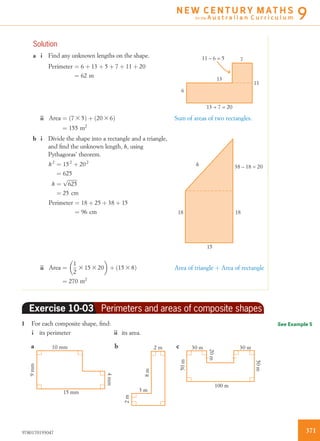
a i Find any unknown lengths on the shape.
Perimeter ¼ 6 þ 13 þ 5 þ 7 þ 11 þ 20
¼ 62 m
7
13
13 + 7 = 20
11 – 6 = 5
6
11
ii Area ¼ 7 3 5ð Þ þ 20 3 6ð Þ
¼ 155 m2
Sum of areas of two rectangles.
b i Divide the shape into a rectangle and a triangle,
and find the unknown length, h, using
Pythagoras’ theorem.
h2
¼ 152
þ 202
¼ 625
h ¼
ffiffiffiffiffiffiffiffi
625
p
¼ 25 cm
Perimeter ¼ 18 þ 25 þ 38 þ 15
¼ 96 cm
15
18
38 – 18 = 20
18
h
ii Area ¼
1
2
3 15 3 20
 
þ ð15 3 8Þ
¼ 270 m2
Area of triangle þ Area of rectangle
Exercise 10-03 Perimeters and areas of composite shapes
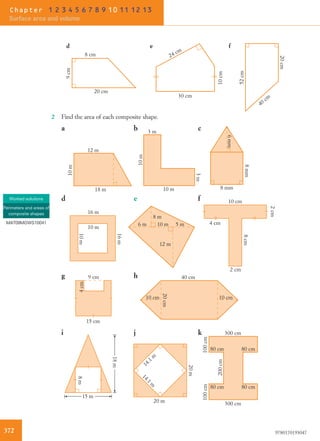
1 For each composite shape, find:
i its perimeter ii its area.
15 mm
10 mma b c
100 m
2 m 30 m 30 m
3 m
9mm
50m
8m
2m
4mm
50m
20m
See Example 5
3719780170193047
N E W C E N T U R Y M AT H S
for the A u s t r a l i a n C u r r i c u l u m 9
d e f
20cm
40 cm
52cm
8 cm
20 cm
30 cm
10cm
24 cm
9cm
2 Find the area of each composite shape.
12 m
10 m
8 m
6 m 5 m
12 m
18 m
10m
3 m
10 m
3m
10m
8 mm
8mm
6mm
16 m
10 m
10m
16m
10 cm
4 cm
2 cm 2cm
8cm
9 cm
15 cm
4cm
40 cm
20cm
10 cm 10 cm
8m
18m
15 m
20 m
14.1
m
14.1
m
20m
300 cmkji
hg
f
cb
e
a
d
80 cm
80 cm
80 cm
80 cm
300 cm
200cm
100cm100cm
Worked solutions
Perimeters and areas of
composite shapes
MAT09MGWS10041
372 9780170193047
Chapter 1 2 3 4 5 6 7 8 9 10 11 12 13
Surface area and volume
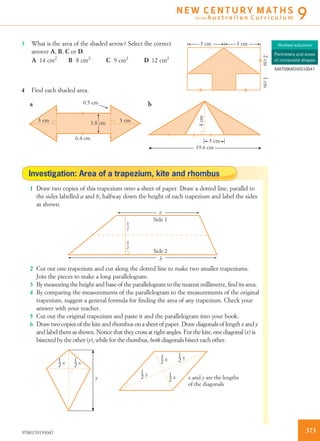
3 What is the area of the shaded arrow? Select the correct
answer A, B, C or D.
3 cm
2cm1cm
3 cm
A 14 cm2
B 8 cm2
C 9 cm2
D 12 cm2
4 Find each shaded area.
0.5 cm
3 cm
3 cm
19.6 cm
3 cm
a b
3.8 cm
6.4 cm
4cm
Investigation: Area of a trapezium, kite and rhombus
1 Draw two copies of this trapezium onto a sheet of paper. Draw a dotted line, parallel to
the sides labelled a and b, halfway down the height of each trapezium and label the sides
as shown.
h
2
h
2
a
b
Side 1
Side 2
2 Cut out one trapezium and cut along the dotted line to make two smaller trapeziums.
Join the pieces to make a long parallelogram.
3 By measuring the height and base of the parallelogram to the nearest millimetre, find its area.
4 By comparing the measurements of the parallelogram to the measurements of the original
trapezium, suggest a general formula for finding the area of any trapezium. Check your
answer with your teacher.
5 Cut out the original trapezium and paste it and the parallelogram into your book.
6 Draw two copies of the kite and rhombus on a sheet of paper. Draw diagonals of length x and y
and label them as shown. Notice that they cross at right angles. For the kite, one diagonal (x) is
bisected by the other (y), while for the rhombus, both diagonals bisect each other.
1
2 x 1
2 x
1
2 y
1
2 x
1
2 y
1
2 xy x and y are the lengths
of the diagonals
Worked solutions
Perimeters and areas
of composite shapes
MAT09MGWS10041
3739780170193047
N E W C E N T U R Y M AT H S
for the A u s t r a l i a n C u r r i c u l u m 9
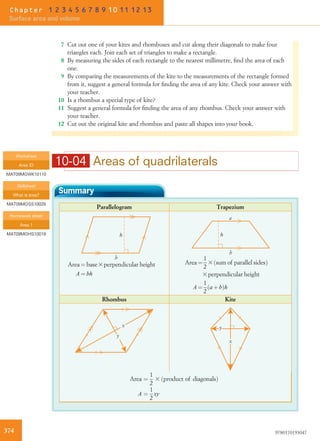
10-04 Areas of quadrilaterals
Summary
Parallelogram Trapezium
b
h
Area ¼ base3perpendicular height
A ¼ bh
h
a
b
Area ¼
1
2
3ðsum of parallel sidesÞ
3perpendicular height
A ¼
1
2
ðaþbÞh
Rhombus Kite
x
y
x
y
Area ¼
1
2
3 ðproduct of diagonalsÞ
A ¼
1
2
xy
7 Cut out one of your kites and rhombuses and cut along their diagonals to make four
triangles each. Join each set of triangles to make a rectangle.
8 By measuring the sides of each rectangle to the nearest millimetre, find the area of each
one.
9 By comparing the measurements of the kite to the measurements of the rectangle formed
from it, suggest a general formula for finding the area of any kite. Check your answer with
your teacher.
10 Is a rhombus a special type of kite?
11 Suggest a general formula for finding the area of any rhombus. Check your answer with
your teacher.
12 Cut out the original kite and rhombus and paste all shapes into your book.
Worksheet
Area ID
MAT09MGWK10110
Skillsheet
What is area?
MAT09MGSS10029
Homework sheet
Area 1
MAT09MGHS10019
374 9780170193047
Chapter 1 2 3 4 5 6 7 8 9 10 11 12 13
Surface area and volume
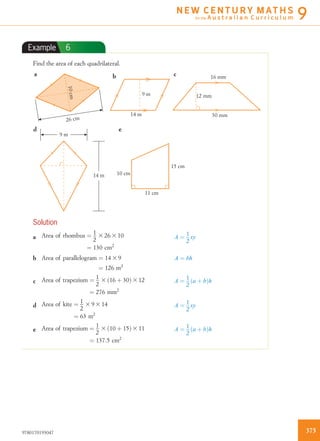
Example 6
Find the area of each quadrilateral.
26 cm
10cm
a 16 mm
12 mm
30 mm
10 cm
11 cm
15 cm
c
ed
14 m
9 m
14 m
9 m
b
Solution
a Area of rhombus ¼ 1
2
3 26 3 10
¼ 130 cm2
A ¼
1
2
xy
b Area of parallelogram ¼ 14 3 9
¼ 126 m2
A ¼ bh
c Area of trapezium ¼ 1
2
3 16 þ 30ð Þ 3 12
¼ 276 mm2
A ¼ 1
2
a þ bð Þh
d Area of kite ¼ 1
2
3 9 3 14
¼ 63 m2
A ¼ 1
2
xy
e Area of trapezium ¼ 1
2
3 10 þ 15ð Þ 3 11
¼ 137:5 cm2
A ¼ 1
2
a þ bð Þh
3759780170193047
N E W C E N T U R Y M AT H S
for the A u s t r a l i a n C u r r i c u l u m 9
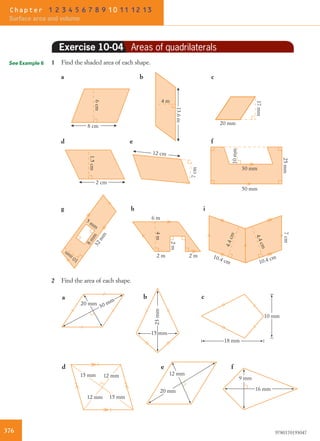
Exercise 10-04 Areas of quadrilaterals
1 Find the shaded area of each shape.
8 cm
6cm
4 m
13.6m
20 mm
17mm
2 cm
1.5cm
7cm
12 cm
25mm
30 mm
10mm
50 mm
8mm
32mm
10mm
5 mm
2 m2 m
6 m
g
f
cba
ed
h i
2m
4m
10.4 cm
4.4cm
4.4cm
10.4 cm
7cm2 Find the area of each shape.
e
23mm
15 mm
12 mm
20 mm
9 mm
16 mm
f
a b c
d
20 mm
30 mm
18 mm
10 mm
15 mm
15 mm
12 mm
12 mm
See Example 6
376 9780170193047
Chapter 1 2 3 4 5 6 7 8 9 10 11 12 13
Surface area and volume
19 mm 7mm
22 mm
15 mm 15 mm
12mm
8mm
8mm
7 mm 7 mm
g h i
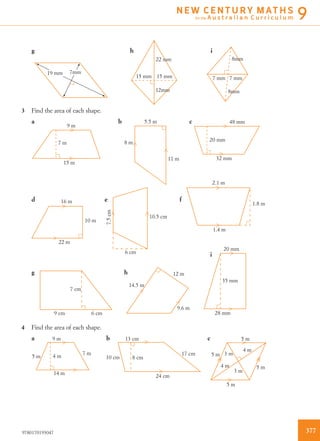
3 Find the area of each shape.
2.1 m
1.8 m
1.4 m
9 m
15 m
16 m
10 m
22 m
7 m
5.5 m
8 m
11 m
48 mm
32 mm
20 mm
7.5cm
10.5 cm
6 cm
7 cm
9 cm 6 cm
14.5 m
12 m
9.6 m
35 mm
20 mm
a b c
d e f
g h
i
28 mm
4 Find the area of each shape.
a b c13 cm
17 cm
10 cm 8 cm
24 cm
9 m
14 m
7 m
5 m 4 m
5 m
5 m
5 m
4 m
4 m
3 m
3 m
5 m
3779780170193047
N E W C E N T U R Y M AT H S
for the A u s t r a l i a n C u r r i c u l u m 9
d
e f
10.5 cm
6.6 m9.6 cm
5.5 m
8.8 m
10 cm10 cm
17 cm 17 cm15cm
6 cm
8 cm 8 cm
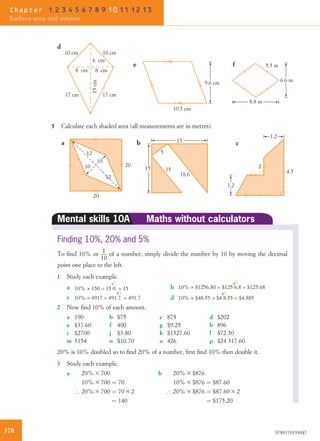
5 Calculate each shaded area (all measurements are in metres).
1.2
1.2
c
2
4.5
a
20
12
10
12
10
20
b
15
15
15
5
18.6
Mental skills 10A Maths without calculators
Finding 10%, 20% and 5%
To find 10% or 1
10
of a number, simply divide the number by 10 by moving the decimal
point one place to the left.
1 Study each example.
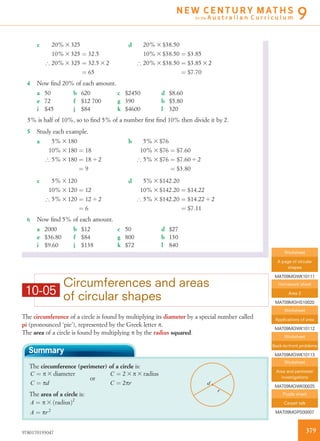
a 10% × 150 = 15 0. = 15 b 10% × $1256.80 = $125 6.8 = $125.68
c 10% × 4917 = 491 7. = 491.7 d 10% × $48.55 = $4 8.55 = $4.885
2 Now find 10% of each amount.
a 190 b $75 c 875 d $202
e $37.60 f 400 g $9.25 h 896
i $2700 j $3.80 k $1527.60 l $72.50
m 3154 n $10.70 o 426 p $24 317.60
20% is 10% doubled so to find 20% of a number, first find 10% then double it.
3 Study each example.
a 20% 3 700
10% 3 700 ¼ 70
) 20% 3 700 ¼ 70 3 2
¼ 140
b 20% 3 $876
10% 3 $876 ¼ $87:60
) 20% 3 $876 ¼ $87:60 3 2
¼ $175:20
378 9780170193047
Chapter 1 2 3 4 5 6 7 8 9 10 11 12 13
Surface area and volume
10-05
Circumferences and areas
of circular shapes
The circumference of a circle is found by multiplying its diameter by a special number called
pi (pronounced ‘pie’), represented by the Greek letter p.
The area of a circle is found by multiplying p by the radius squared.
Summary
The circumference (perimeter) of a circle is:
r
d
C ¼ p 3 diameter
C ¼ pd
or
C ¼ 2 3 p 3 radius
C ¼ 2pr
The area of a circle is:
A ¼ p 3 ðradiusÞ2
A ¼ pr2
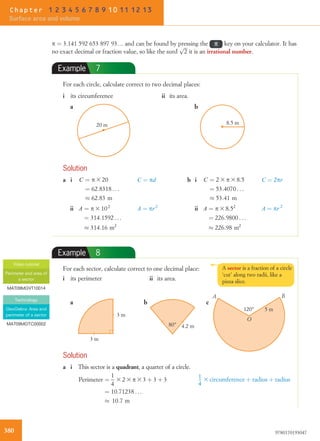
c 20% 3 325
10% 3 325 ¼ 32:5
) 20% 3 325 ¼ 32:5 3 2
¼ 65
d 20% 3 $38:50
10% 3 $38:50 ¼ $3:85
) 20% 3 $38:50 ¼ $3:85 3 2
¼ $7:70
4 Now find 20% of each amount.
a 50 b 620 c $2450 d $8.60
e 72 f $12 700 g 390 h $5.80
i $45 j $84 k $4600 l 320
5% is half of 10%, so to find 5% of a number first find 10% then divide it by 2.
5 Study each example.
a 5% 3 180
10% 3 180 ¼ 18
) 5% 3 180 ¼ 18 4 2
¼ 9
b 5% 3 $76
10% 3 $76 ¼ $7:60
) 5% 3 $76 ¼ $7:60 4 2
¼ $3:80
c 5% 3 120
10% 3 120 ¼ 12
) 5% 3 120 ¼ 12 4 2
¼ 6
d 5% 3 $142:20
10% 3 $142:20 ¼ $14:22
) 5% 3 $142:20 ¼ $14:22 4 2
¼ $7:11
6 Now find 5% of each amount.
a 2000 b $12 c 50 d $27
e $36.80 f $84 g 800 h 130
i $9.60 j $138 k $72 l 840
Worksheet
A page of circular
shapes
MAT09MGWK10111
Homework sheet
Area 2
MAT09MGHS10020
Worksheet
Applications of area
MAT09MGWK10112
Worksheet
Back-to-front problems
MAT09MGWK10113
Worksheet
Area and perimeter
investigations
MAT09MGWK00025
Puzzle sheet
Carpet talk
MAT09MGPS00007
3799780170193047
N E W C E N T U R Y M AT H S
for the A u s t r a l i a n C u r r i c u l u m 9
p ¼ 3.141 592 653 897 93… and can be found by pressing the π key on your calculator. It has
no exact decimal or fraction value, so like the surd
ffiffiffi
2
p
it is an irrational number.
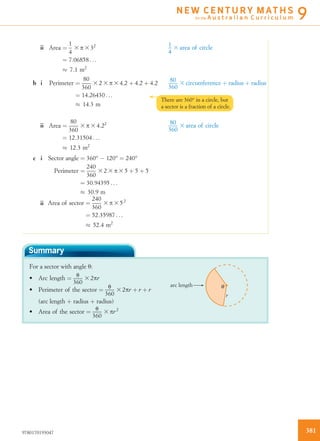
Example 7
For each circle, calculate correct to two decimal places:
i its circumference ii its area.
20 m 8.5 m
a b
Solution
a i C ¼ p 3 20
¼ 62:8318 . . .
% 62:83 m
C ¼ pd b i C ¼ 2 3 p 3 8:5
¼ 53:4070 . . .
% 53:41 m
C ¼ 2pr
ii A ¼ p 3 102
¼ 314:1592 . . .
% 314:16 m2
A ¼ pr2
ii A ¼ p 3 8:52
¼ 226:9800 . . .
% 226:98 m2
A ¼ pr 2
Example 8
For each sector, calculate correct to one decimal place:
i its perimeter ii its area.
A B
O
5 m120°
a b c
3 m
3 m
80° 4.2 m
Solution
a i This sector is a quadrant, a quarter of a circle.
Perimeter ¼
1
4
3 2 3 p 3 3 þ 3 þ 3
¼ 10:71238 . . .
% 10:7 m
1
4
3 circumference þ radius þ radius
Video tutorial
Perimeter and area of
a sector
MAT09MGVT10014
Technology
GeoGebra: Area and
perimeter of a sector
MAT09MGTC00002
A sector is a fraction of a circle
‘cut’ along two radii, like a
pizza slice.
380 9780170193047
Chapter 1 2 3 4 5 6 7 8 9 10 11 12 13
Surface area and volume
ii Area ¼
1
4
3 p 3 32
¼ 7:06858 . . .
% 7:1 m2
1
4
3 area of circle
b i Perimeter ¼
80
360
3 2 3 p 3 4:2 þ 4:2 þ 4:2
¼ 14:26430 . . .
% 14:3 m
80
360
3 circumference þ radius þ radius
ii Area ¼
80
360
3 p 3 4:22
¼ 12:31504 . . .
% 12:3 m2
80
360
3 area of circle
c i Sector angle ¼ 360° À 120° ¼ 240°
Perimeter ¼
240
360
3 2 3 p 3 5 þ 5 þ 5
¼ 30:94395 . . .
% 30:9 m
ii Area of sector ¼
240
360
3 p 3 52
¼ 52:35987 . . .
% 52:4 m2
Summary
For a sector with angle y:
• Arc length ¼
u
360
3 2pr
θ
r
arc length
• Perimeter of the sector ¼ u
360
3 2pr þ r þ r
(arc length þ radius þ radius)
• Area of the sector ¼ u
360
3 pr2
There are 360° in a circle, but
a sector is a fraction of a circle.
3819780170193047
N E W C E N T U R Y M AT H S
for the A u s t r a l i a n C u r r i c u l u m 9
Example 9
Find, correct to one decimal place, the area of each shape.
7 m
a b15
22 m
30 m
12 m
Solution
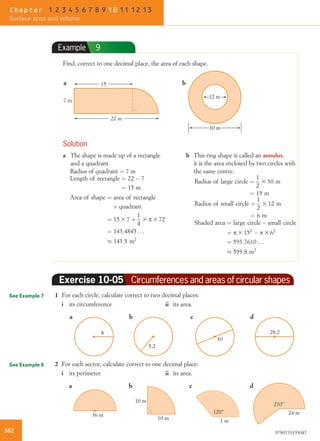
a The shape is made up of a rectangle
and a quadrant.
Radius of quadrant ¼ 7 m
Length of rectangle ¼ 22 À 7
¼ 15 m
Area of shape ¼ area of rectangle
þ quadrant
¼ 15 3 7 þ
1
4
3 p 3 72
¼ 143:4845 . . .
% 143:5 m2
b This ring shape is called an annulus,
it is the area enclosed by two circles with
the same centre.
Radius of large circle ¼
1
2
3 30 m
¼ 15 m
Radius of small circle ¼
1
2
3 12 m
¼ 6 m
Shaded area ¼ large circle À small circle
¼ p 3 152
À p 3 62
¼ 593:7610 . . .
% 593:8 m2
Exercise 10-05 Circumferences and areas of circular shapes
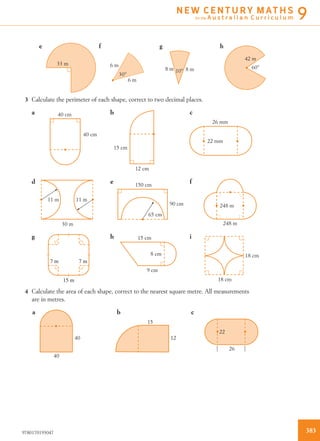
1 For each circle, calculate correct to two decimal places:
i its circumference ii its area.
8
5.2
30
28.2
a c db
2 For each sector, calculate correct to one decimal place:
i its perimeter ii its area.
36 m
10 m
10 m
120°
1 m
210°
24 m
a c db
See Example 7
See Example 8
382 9780170193047
Chapter 1 2 3 4 5 6 7 8 9 10 11 12 13
Surface area and volume
33 m
30°
6 m
6 m
10°8 m 8 m 60°
42 m
e f g h
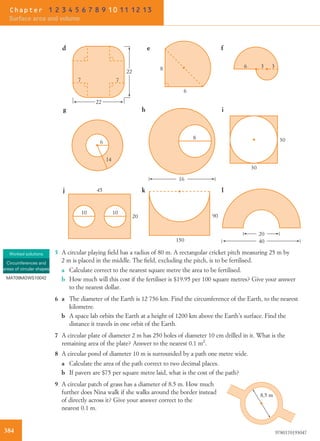
3 Calculate the perimeter of each shape, correct to two decimal places.
40 cm
40 cm
15 cm
12 cm
26 mm
22 mm
11 m
30 m
11 m
150 cm
65 cm
90 cm 248 m
248 m
15 cm
8 cm
9 cm
18 cm
18 cm
a b c
d e f
g h i
7 m 7 m
15 m
4 Calculate the area of each shape, correct to the nearest square metre. All measurements
are in metres.
40
40
15
12
22
26
a b c
3839780170193047
N E W C E N T U R Y M AT H S
for the A u s t r a l i a n C u r r i c u l u m 9
10 10
45
20
16
8
6
14
30
30
20
40
90
150
g h i
j k l
d e f
22
22
7 7
6
8 6 3 3
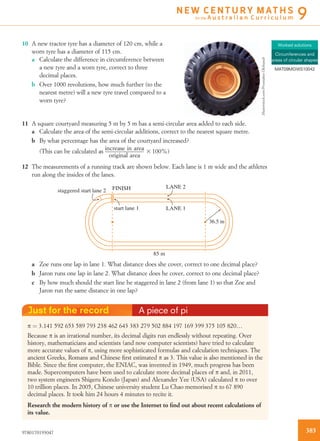
5 A circular playing field has a radius of 80 m. A rectangular cricket pitch measuring 25 m by
2 m is placed in the middle. The field, excluding the pitch, is to be fertilised.
a Calculate correct to the nearest square metre the area to be fertilised.
b How much will this cost if the fertiliser is $19.95 per 100 square metres? Give your answer
to the nearest dollar.
6 a The diameter of the Earth is 12 756 km. Find the circumference of the Earth, to the nearest
kilometre.
b A space lab orbits the Earth at a height of 1200 km above the Earth’s surface. Find the
distance it travels in one orbit of the Earth.
7 A circular plate of diameter 2 m has 250 holes of diameter 10 cm drilled in it. What is the
remaining area of the plate? Answer to the nearest 0.1 m2
.
8 A circular pond of diameter 10 m is surrounded by a path one metre wide.
a Calculate the area of the path correct to two decimal places.
b If pavers are $75 per square metre laid, what is the cost of the path?
9 A circular patch of grass has a diameter of 8.5 m. How much
further does Nina walk if she walks around the border instead
of directly across it? Give your answer correct to the
nearest 0.1 m.
8.5 m
Worked solutions
Circumferences and
areas of circular shapes
MAT09MGWS10042
384 9780170193047
Chapter 1 2 3 4 5 6 7 8 9 10 11 12 13
Surface area and volume
10 A new tractor tyre has a diameter of 120 cm, while a
worn tyre has a diameter of 115 cm.
a Calculate the difference in circumference between
a new tyre and a worn tyre, correct to three
decimal places.
b Over 1000 revolutions, how much further (to the
nearest metre) will a new tyre travel compared to a
worn tyre?
11 A square courtyard measuring 5 m by 5 m has a semi-circular area added to each side.
a Calculate the area of the semi-circular additions, correct to the nearest square metre.
b By what percentage has the area of the courtyard increased?
(This can be calculated as increase in area
original area
3 100%)
12 The measurements of a running track are shown below. Each lane is 1 m wide and the athletes
run along the insides of the lanes.
36.5 m
85 m
LANE 2
LANE 1start lane 1
staggered start lane 2 FINISH
a Zoe runs one lap in lane 1. What distance does she cover, correct to one decimal place?
b Jaron runs one lap in lane 2. What distance does he cover, correct to one decimal place?
c By how much should the start line be staggered in lane 2 (from lane 1) so that Zoe and
Jaron run the same distance in one lap?
Just for the record A piece of pi
p ¼ 3.141 592 653 589 793 238 462 643 383 279 502 884 197 169 399 375 105 820…
Because p is an irrational number, its decimal digits run endlessly without repeating. Over
history, mathematicians and scientists (and now computer scientists) have tried to calculate
more accurate values of p, using more sophisticated formulas and calculation techniques. The
ancient Greeks, Romans and Chinese first estimated p as 3. This value is also mentioned in the
Bible. Since the first computer, the ENIAC, was invented in 1949, much progress has been
made. Supercomputers have been used to calculate more decimal places of p and, in 2011,
two system engineers Shigeru Kondo (Japan) and Alexander Yee (USA) calculated p to over
10 trillion places. In 2005, Chinese university student Lu Chao memorised p to 67 890
decimal places. It took him 24 hours 4 minutes to recite it.
Research the modern history of p or use the Internet to find out about recent calculations of
its value.
Worked solutions
Circumferences and
areas of circular shapes
MAT09MGWS10042
Shutterstock.com/PresniakovOleksandr
3859780170193047
N E W C E N T U R Y M AT H S
for the A u s t r a l i a n C u r r i c u l u m 9
Investigation: Nets of prisms
You will need: 1 cm grid paper.
If a solid is cut along some of its edges, the faces can all be folded down flat. The flat shape
obtained is called the net of the solid.
Net of a cube
How many different nets of a cube can you make
(or draw)? Do not count reflections or rotations
because they are considered to be the same.
For example, these are two versions of the
same net.
1 Draw the possible nets of a cube on 1 cm grid
paper. Cut out the nets and fold them to see if
they each form a cube, then paste them into
your book.
2 If a cube has side length 1 cm, what is the area of one of its faces?
3 The surface area of a cube is the sum of the areas of all of its faces. What is the surface
area of the cube with side length 1 cm?
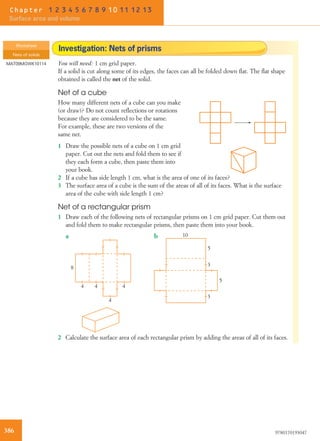
Net of a rectangular prism
1 Draw each of the following nets of rectangular prisms on 1 cm grid paper. Cut them out
and fold them to make rectangular prisms, then paste them into your book.
8
4 4 4
4
10
5
5
3
3
a b
2 Calculate the surface area of each rectangular prism by adding the areas of all of its faces.
Worksheet
Nets of solids
MAT09MGWK10114
386 9780170193047
Chapter 1 2 3 4 5 6 7 8 9 10 11 12 13
Surface area and volume
10-06 Surface area of a prism
Summary
The surface area of a solid is the total area of all the faces of the solid. To calculate the
surface area of a solid, find the area of each face and add the areas together.
Example 10
Calculate the surface area of each prism.
a cube
4 cm 4 cm
4cm
b rectangular prism
top
end
side
12 cm 5 cm
4 cm
c open rectangular prism
8 cm
12 cm
25 cm
Solution
a A cube has 6 identical faces in the shape of a square.
Surface area ¼ 6 3 42
¼ 96 cm2
6 3 area of a square
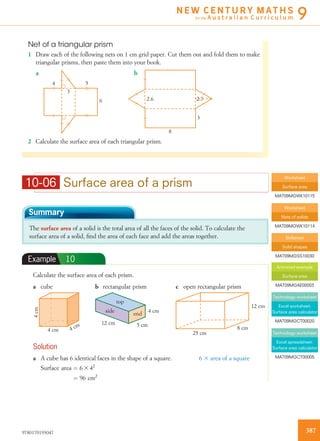
Net of a triangular prism
1 Draw each of the following nets on 1 cm grid paper. Cut them out and fold them to make
triangular prisms, then paste them into your book.
4 5
3
6
8
3
2.72.6
a b
2 Calculate the surface area of each triangular prism.
Worksheet
Surface area
MAT09MGWK10115
Worksheet
Nets of solids
MAT09MGWK10114
Skillsheet
Solid shapes
MAT09MGSS10030
Animated example
Surface area
MAT09MGAE00003
Technology worksheet
Excel worksheet:
Surface area calculator
MAT09MGCT00020
Technology worksheet
Excel spreadsheet:
Surface area calculator
MAT09MGCT00005
3879780170193047
N E W C E N T U R Y M AT H S
for the A u s t r a l i a n C u r r i c u l u m 9
b A rectangular prism has 6 faces that are not all the same. However, opposite faces
such as the top and bottom are the same.
Surface area ¼ 2 top and bottom faces þ 2 end faces þ 2 side faces
¼ 2 3 5 3 12ð Þ þ 2 3 5 3 4ð Þ þ 2 3 12 3 4ð Þ
¼ 256 cm2
c The open rectangular prism has no top so it has 5 faces that are not all the same.
Surface area ¼ Bottom face þ 2 front and back faces þ 2 side faces
¼ 25 3 8ð Þ þ 2 3 25 3 12ð Þ þ 2 3 8 3 12ð Þ
¼ 992 cm2
Example 11
Calculate the surface area of each triangular prism.
8 cm
10 cm
5 cm
3 cm 24 m
10 m
30 m
n m
a b
Solution
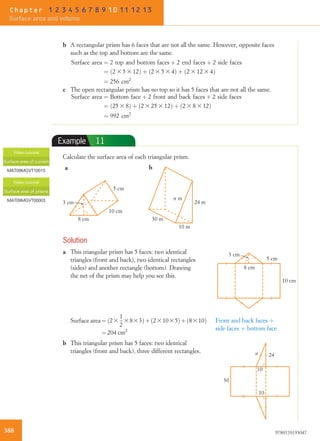
a This triangular prism has 5 faces: two identical
triangles (front and back), two identical rectangles
(sides) and another rectangle (bottom). Drawing
the net of the prism may help you see this.
8 cm
10 cm
5 cm
3 cm
Surface area ¼ ð23
1
2
3833Þþð231035Þþð8310Þ
¼ 204 cm2
Front and back faces þ
side faces þ bottom face
b This triangular prism has 5 faces: two identical
triangles (front and back), three different rectangles.
10
30
10
24n
Video tutorial
Surface area of a prism
MAT09MGVT10015
Video tutorial
Surface area of prisms
MAT09MGVT00003
388 9780170193047
Chapter 1 2 3 4 5 6 7 8 9 10 11 12 13
Surface area and volume
To calculate the area of the left face, we need to know the value of n, which can be
found using Pythagoras’ theorem.
n2
¼ 102
þ 262
¼ 676
n ¼
ffiffiffiffiffiffiffiffi
676
p
¼ 26
Surface area ¼ ð2 3
1
2
3 10 3 24Þ þ ð30 3 26Þ
þ ð30 3 10Þ þ ð30 3 24Þ
¼ 2040 m2
Front and back þ left þ
bottom þ right
Example 12
Calculate the surface area of this trapezoidal prism.
18 cm
13 cm
10 cm
12 cm
24 cm
15 cm
Solution
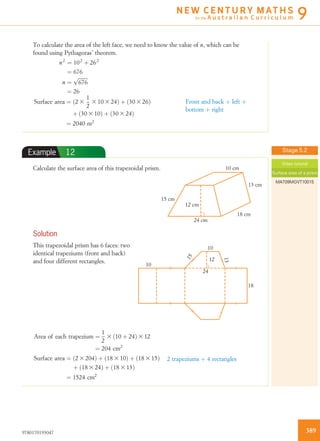
This trapezoidal prism has 6 faces: two
identical trapeziums (front and back)
and four different rectangles.
10
10
24
18
12
15
13
Area of each trapezium ¼
1
2
3 10 þ 24ð Þ 3 12
¼ 204 cm2
Surface area ¼ 2 3 204ð Þ þ 18 3 10ð Þ þ 18 3 15ð Þ
þ 18 3 24ð Þ þ 18 3 13ð Þ
¼ 1524 cm2
2 trapeziums þ 4 rectangles
Stage 5.2
Video tutorial
Surface area of a prism
MAT09MGVT10015
3899780170193047
N E W C E N T U R Y M AT H S
for the A u s t r a l i a n C u r r i c u l u m 9
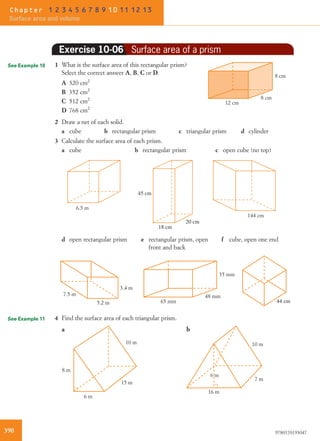
Exercise 10-06 Surface area of a prism
1 What is the surface area of this rectangular prism?
Select the correct answer A, B, C or D.
12 cm
8 cm
8 cm
A 320 cm2
B 352 cm2
C 512 cm2
D 768 cm2
2 Draw a net of each solid.
a cube b rectangular prism c triangular prism d cylinder
3 Calculate the surface area of each prism.
a cube b rectangular prism c open cube (no top)
6.5 m
144 cm
45 cm
18 cm
20 cm
d open rectangular prism e rectangular prism, open
front and back
f cube, open one end
7.5 m
5.2 m
3.4 m
65 mm
48 mm
35 mm
44 cm
4 Find the surface area of each triangular prism.
16 m
6 m
7 m
10 m
a b
6 m
15 m
10 m
8 m
See Example 10
See Example 11
390 9780170193047
Chapter 1 2 3 4 5 6 7 8 9 10 11 12 13
Surface area and volume
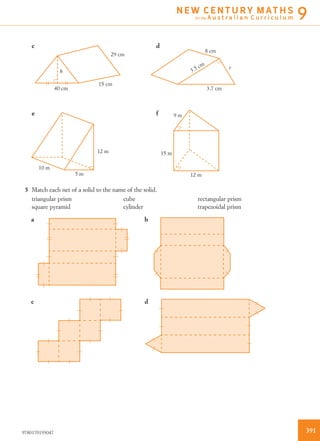
10 m
5 m
12 m
12 m
15 m
9 me f
c d
h
40 cm
15 cm
29 cm
8 cm
r
3.5 cm
3.7 cm
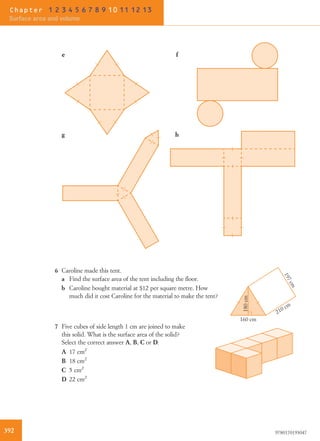
5 Match each net of a solid to the name of the solid.
triangular prism cube rectangular prism
square pyramid cylinder trapezoidal prism
a b
dc
3919780170193047
N E W C E N T U R Y M AT H S
for the A u s t r a l i a n C u r r i c u l u m 9
fe
hg
6 Caroline made this tent.
160 cm
197cm
210 cm
180cm
a Find the surface area of the tent including the floor.
b Caroline bought material at $12 per square metre. How
much did it cost Caroline for the material to make the tent?
7 Five cubes of side length 1 cm are joined to make
this solid. What is the surface area of the solid?
Select the correct answer A, B, C or D.
A 17 cm2
B 18 cm2
C 5 cm2
D 22 cm2
392 9780170193047
Chapter 1 2 3 4 5 6 7 8 9 10 11 12 13
Surface area and volume
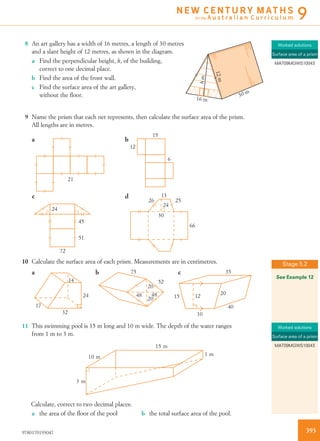
8 An art gallery has a width of 16 metres, a length of 30 metres
and a slant height of 12 metres, as shown in the diagram.
16 m
30 m
12m
hm
a Find the perpendicular height, h, of the building,
correct to one decimal place.
b Find the area of the front wall.
c Find the surface area of the art gallery,
without the floor.
9 Name the prism that each net represents, then calculate the surface area of the prism.
All lengths are in metres.
21
15
12
6
13
30
26 25
66
24
72
45
24
51
a b
c d
10 Calculate the surface area of each prism. Measurements are in centimetres.
24
32
17
14
a 75
52
48
20
20
48
b 35
20
40
10
1215
c
11 This swimming pool is 15 m long and 10 m wide. The depth of the water ranges
from 1 m to 3 m.
3 m
10 m
15 m
1 m
Calculate, correct to two decimal places:
a the area of the floor of the pool b the total surface area of the pool.
Worked solutions
Surface area of a prism
MAT09MGWS10043
Stage 5.2
See Example 12
Worked solutions
Surface area of a prism
MAT09MGWS10043
3939780170193047
N E W C E N T U R Y M AT H S
for the A u s t r a l i a n C u r r i c u l u m 9
10-07 Surface area of a cylinder
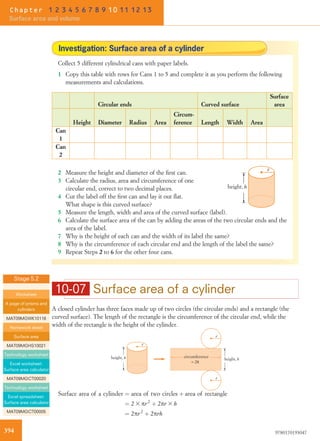
A closed cylinder has three faces made up of two circles (the circular ends) and a rectangle (the
curved surface). The length of the rectangle is the circumference of the circular end, while the
width of the rectangle is the height of the cylinder.
r
height, h
r
height, h
r
= 2
circumference
π
r
Surface area of a cylinder ¼ area of two circles þ area of rectangle
¼ 2 3 pr2
þ 2pr 3 h
¼ 2pr2
þ 2prh
Investigation: Surface area of a cylinder
Collect 5 different cylindrical cans with paper labels.
1 Copy this table with rows for Cans 1 to 5 and complete it as you perform the following
measurements and calculations.
Circular ends Curved surface
Surface
area
Height Diameter Radius Area
Circum-
ference Length Width Area
Can
1
Can
2
r
height, h
2 Measure the height and diameter of the first can.
3 Calculate the radius, area and circumference of one
circular end, correct to two decimal places.
4 Cut the label off the first can and lay it out flat.
What shape is this curved surface?
5 Measure the length, width and area of the curved surface (label).
6 Calculate the surface area of the can by adding the areas of the two circular ends and the
area of the label.
7 Why is the height of each can and the width of its label the same?
8 Why is the circumference of each circular end and the length of the label the same?
9 Repeat Steps 2 to 6 for the other four cans.
Stage 5.2
Worksheet
A page of prisms and
cylinders
MAT09MGWK10116
Homework sheet
Surface area
MAT09MGHS10021
Technology worksheet
Excel worksheet:
Surface area calculator
MAT09MGCT00020
Technology worksheet
Excel spreadsheet:
Surface area calculator
MAT09MGCT00005
394 9780170193047
Chapter 1 2 3 4 5 6 7 8 9 10 11 12 13
Surface area and volume
Summary
Surface area of a closed cylinder
A ¼ 2pr2
þ 2prh
where r ¼ radius of circular base and h ¼ perpendicular height
The area of the two circular ends ¼ 2pr2
and the area of the curved surface ¼ 2prh.
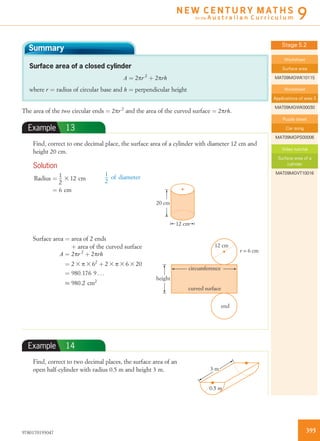
Example 13
Find, correct to one decimal place, the surface area of a cylinder with diameter 12 cm and
height 20 cm.
Solution
Radius ¼ 1
2
3 12 cm
¼ 6 cm
1
2
of diameter
20 cm
12 cm
Surface area ¼ area of 2 ends
þ area of the curved surface
A ¼ 2pr 2
þ 2prh
¼ 2 3 p 3 62
þ 2 3 p 3 6 3 20
¼ 980:176 9 . . .
% 980:2 cm2
r = 6 cm
height
12 cm
circumference
curved surface
end
Example 14
Find, correct to two decimal places, the surface area of an
open half-cylinder with radius 0.5 m and height 3 m.
0.5 m
3 m
Stage 5.2
Worksheet
Surface area
MAT09MGWK10115
Worksheet
Applications of area 3
MAT09MGWK00030
Puzzle sheet
Car song
MAT09MGPS00006
Video tutorial
Surface area of a
cylinder
MAT09MGVT10016
3959780170193047
N E W C E N T U R Y M AT H S
for the A u s t r a l i a n C u r r i c u l u m 9
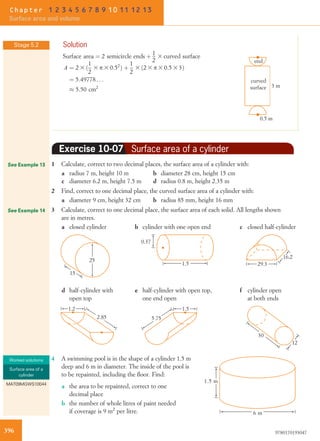
Solution
Surface area ¼ 2 semicircle ends þ 1
2
3 curved surface
A ¼ 2 3 ð
1
2
3 p 3 0:52
Þ þ
1
2
3 ð2 3 p 3 0:5 3 3Þ
¼ 5:49778 . . .
% 5:50 cm2
end
0.5 m
3 m
curved
surface
Exercise 10-07 Surface area of a cylinder
1 Calculate, correct to two decimal places, the surface area of a cylinder with:
a radius 7 m, height 10 m b diameter 28 cm, height 15 cm
c diameter 6.2 m, height 7.5 m d radius 0.8 m, height 2.35 m
2 Find, correct to one decimal place, the curved surface area of a cylinder with:
a diameter 9 cm, height 32 cm b radius 85 mm, height 16 mm
3 Calculate, correct to one decimal place, the surface area of each solid. All lengths shown
are in metres.
a closed cylinder
25
15
b cylinder with one open end
1.5
0.37
c closed half-cylinder
29.3
16.2
d half-cylinder with
open top
1.2
2.85
e half-cylinder with open top,
one end open
5.75
1.5
f cylinder open
at both ends
12
30
4 A swimming pool is in the shape of a cylinder 1.5 m
deep and 6 m in diameter. The inside of the pool is
to be repainted, including the floor. Find:
6 m
1.5 m
a the area to be repainted, correct to one
decimal place
b the number of whole litres of paint needed
if coverage is 9 m2
per litre.
Stage 5.2
See Example 13
See Example 14
Worked solutions
Surface area of a
cylinder
MAT09MGWS10044
396 9780170193047
Chapter 1 2 3 4 5 6 7 8 9 10 11 12 13
Surface area and volume
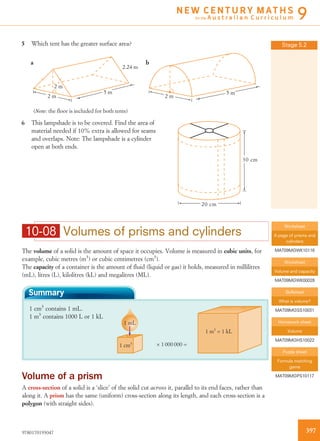
5 Which tent has the greater surface area?
2 m
2 m
(Note: the floor is included for both tents)
5 m
2.24 m
a b
2 m
5 m
6 This lampshade is to be covered. Find the area of
material needed if 10% extra is allowed for seams
and overlaps. Note: The lampshade is a cylinder
open at both ends.
20 cm
30 cm
10-08 Volumes of prisms and cylinders
The volume of a solid is the amount of space it occupies. Volume is measured in cubic units, for
example, cubic metres (m3
) or cubic centimetres (cm3
).
The capacity of a container is the amount of fluid (liquid or gas) it holds, measured in millilitres
(mL), litres (L), kilolitres (kL) and megalitres (ML).
Summary
1 cm3
contains 1 mL.
1 m3
contains 1000 L or 1 kL
1 m3
= 1 kL
1 mL
1 cm3 × 1 000 000 =
Volume of a prism
A cross-section of a solid is a ‘slice’ of the solid cut across it, parallel to its end faces, rather than
along it. A prism has the same (uniform) cross-section along its length, and each cross-section is a
polygon (with straight sides).
Stage 5.2
Worksheet
A page of prisms and
cylinders
MAT09MGWK10116
Worksheet
Volume and capacity
MAT09MGWK00028
Skillsheet
What is volume?
MAT09MGSS10031
Homework sheet
Volume
MAT09MGHS10022
Puzzle sheet
Formula matching
game
MAT09MGPS10117
3979780170193047
N E W C E N T U R Y M AT H S
for the A u s t r a l i a n C u r r i c u l u m 9
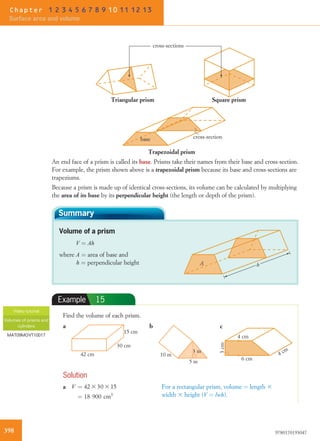
Trapezoidal prism
Triangular prism Square prism
cross-sectionbase
cross-sections
An end face of a prism is called its base. Prisms take their names from their base and cross-section.
For example, the prism shown above is a trapezoidal prism because its base and cross-sections are
trapeziums.
Because a prism is made up of identical cross-sections, its volume can be calculated by multiplying
the area of its base by its perpendicular height (the length or depth of the prism).
Summary
Volume of a prism
V ¼ Ah
where A ¼ area of base and
h ¼ perpendicular height A h
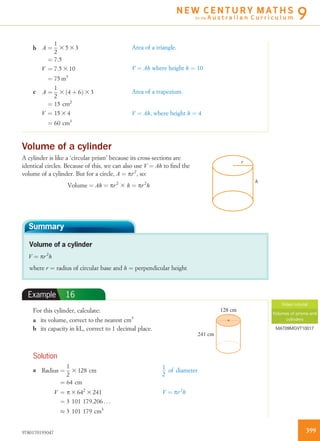
Example 15
Find the volume of each prism.
30 cm
42 cm
15 cm
a b
5 m
10 m
3 m
6 cm
3cm
4 cm
4 cm
c
Solution
a V ¼ 42 3 30 3 15
¼ 18 900 cm3
For a rectangular prism, volume ¼ length 3
width 3 height (V ¼ lwh).
Video tutorial
Volumes of prisms and
cylinders
MAT09MGVT10017
398 9780170193047
Chapter 1 2 3 4 5 6 7 8 9 10 11 12 13
Surface area and volume
b A ¼
1
2
3 5 3 3
¼ 7:5
V ¼ 7:5 3 10
¼ 75 m3
Area of a triangle.
V ¼ Ah where height h ¼ 10
c A ¼
1
2
3 4 þ 6ð Þ 3 3
¼ 15 cm2
V ¼ 15 3 4
¼ 60 cm3
Area of a trapezium.
V ¼ Ah, where height h ¼ 4
Volume of a cylinder
A cylinder is like a ‘circular prism’ because its cross-sections are
identical circles. Because of this, we can also use V ¼ Ah to find the
volume of a cylinder. But for a circle, A ¼ pr2
, so:
Volume ¼ Ah ¼ pr2
3 h ¼ pr2
h
r
h
Summary
Volume of a cylinder
V ¼ pr2
h
where r ¼ radius of circular base and h ¼ perpendicular height
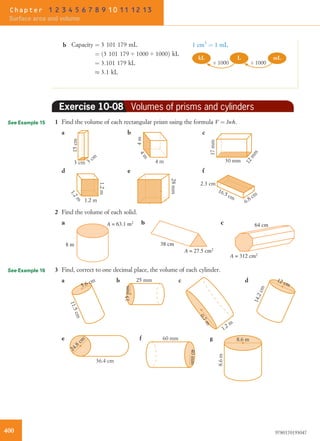
Example 16
For this cylinder, calculate: 128 cm
241 cm
a its volume, correct to the nearest cm3
b its capacity in kL, correct to 1 decimal place.
Solution
a Radius ¼
1
2
3 128 cm
¼ 64 cm
V ¼ p 3 642
3 241
¼ 3 101 179:206 . . .
% 3 101 179 cm3
1
2
of diameter
V ¼ pr2
h
Video tutorial
Volumes of prisms and
cylinders
MAT09MGVT10017
3999780170193047
N E W C E N T U R Y M AT H S
for the A u s t r a l i a n C u r r i c u l u m 9
b Capacity ¼ 3 101 179 mL
¼ 3 101 179 4 1000 4 1000ð Þ kL
¼ 3:101 179 kL
% 3:1 kL
1 cm3
¼ 1 mL
mLkL L
÷ 1000÷ 1000
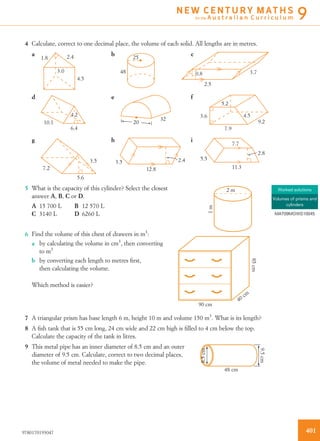
Exercise 10-08 Volumes of prisms and cylinders
1 Find the volume of each rectangular prism using the formula V ¼ lwh.
3 cm
3 cm
15cm
1.2m
28mm
2.3 cm
16.5 cm
6.8 cm
1.2 m
1.2m
4m
17mm
30 mm
12mm
4 m
4m
cba
fed
2 Find the volume of each solid.
cba
8 m
A = 63.1 m2
38 cm
A = 27.5 cm2
64 cm
A = 312 cm2
3 Find, correct to one decimal place, the volume of each cylinder.
5.6 cm
11.5cm
25 mm
15mm
1.2 m
0.7m
14.2cm
12 cm
a b c d
24.8
cm
36.4 cm
60 mm
40mm
8.6 m
8.6m
gfe
See Example 15
See Example 16
400 9780170193047
Chapter 1 2 3 4 5 6 7 8 9 10 11 12 13
Surface area and volume
4 Calculate, correct to one decimal place, the volume of each solid. All lengths are in metres.
cba
fed
ihg
4.5
3.0
1.8 2.4 25
48 0.8
2.5
3.7
4.2
10.1
6.4
32
20
5.2
3.6
7.9
4.5
9.2
7.2
3.5
12.8
5.6
3.5 2.4
2.8
5.5
11.3
7.7
5 What is the capacity of this cylinder? Select the closest
answer A, B, C or D.
2 m
1m
A 15 700 L B 12 570 L
C 3140 L D 6260 L
6 Find the volume of this chest of drawers in m3
:
90 cm
40 cm
85cm
a by calculating the volume in cm3
, then converting
to m3
b by converting each length to metres first,
then calculating the volume.
Which method is easier?
7 A triangular prism has base length 6 m, height 10 m and volume 150 m3
. What is its length?
8 A fish tank that is 55 cm long, 24 cm wide and 22 cm high is filled to 4 cm below the top.
Calculate the capacity of the tank in litres.
9 This metal pipe has an inner diameter of 8.5 cm and an outer
diameter of 9.5 cm. Calculate, correct to two decimal places,
the volume of metal needed to make the pipe.
48 cm
9.5cm
8.5cm
Worked solutions
Volumes of prisms and
cylinders
MAT09MGWS10045
4019780170193047
N E W C E N T U R Y M AT H S
for the A u s t r a l i a n C u r r i c u l u m 9
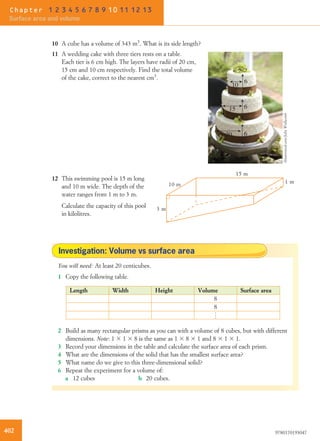
10 A cube has a volume of 343 m3
. What is its side length?
11 A wedding cake with three tiers rests on a table.
Each tier is 6 cm high. The layers have radii of 20 cm,
15 cm and 10 cm respectively. Find the total volume
of the cake, correct to the nearest cm3
.
6
10
15 6
620
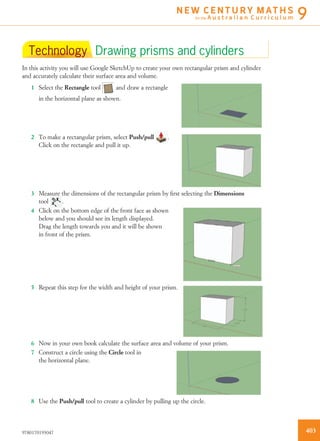
12 This swimming pool is 15 m long
and 10 m wide. The depth of the
water ranges from 1 m to 3 m.
3 m
10 m
15 m
1 m
Calculate the capacity of this pool
in kilolitres.
Investigation: Volume vs surface area
You will need: At least 20 centicubes.
1 Copy the following table.
Length Width Height Volume Surface area
8
8
..
.
2 Build as many rectangular prisms as you can with a volume of 8 cubes, but with different
dimensions. Note: 1 3 1 3 8 is the same as 1 3 8 3 1 and 8 3 1 3 1.
3 Record your dimensions in the table and calculate the surface area of each prism.
4 What are the dimensions of the solid that has the smallest surface area?
5 What name do we give to this three-dimensional solid?
6 Repeat the experiment for a volume of:
a 12 cubes b 20 cubes.
Shutterstock.com/JohnWollwerth
402 9780170193047
Chapter 1 2 3 4 5 6 7 8 9 10 11 12 13
Surface area and volume
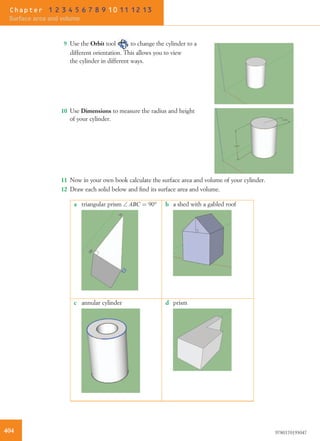
Technology Drawing prisms and cylinders
In this activity you will use Google SketchUp to create your own rectangular prism and cylinder
and accurately calculate their surface area and volume.
1 Select the Rectangle tool and draw a rectangle
in the horizontal plane as shown.
2 To make a rectangular prism, select Push/pull .
Click on the rectangle and pull it up.
3 Measure the dimensions of the rectangular prism by first selecting the Dimensions
tool .
4 Click on the bottom edge of the front face as shown
below and you should see its length displayed.
Drag the length towards you and it will be shown
in front of the prism.
5 Repeat this step for the width and height of your prism.
6 Now in your own book calculate the surface area and volume of your prism.
7 Construct a circle using the Circle tool in
the horizontal plane.
8 Use the Push/pull tool to create a cylinder by pulling up the circle.
4039780170193047
N E W C E N T U R Y M AT H S
for the A u s t r a l i a n C u r r i c u l u m 9
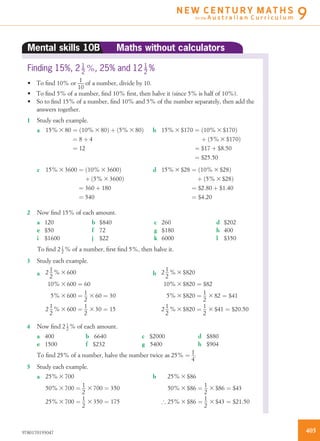
9 Use the Orbit tool to change the cylinder to a
different orientation. This allows you to view
the cylinder in different ways.
10 Use Dimensions to measure the radius and height
of your cylinder.
11 Now in your own book calculate the surface area and volume of your cylinder.
12 Draw each solid below and find its surface area and volume.
a triangular prism  ABC ¼ 90° b a shed with a gabled roof
c annular cylinder d prism
404 9780170193047
Chapter 1 2 3 4 5 6 7 8 9 10 11 12 13
Surface area and volume
Mental skills 10B Maths without calculators
Finding 15%, 2 1
2
%, 25% and 12 1
2
%
• To find 10% or 1
10
of a number, divide by 10.
• To find 5% of a number, find 10% first, then halve it (since 5% is half of 10%).
• So to find 15% of a number, find 10% and 5% of the number separately, then add the
answers together.
1 Study each example.
a 15% 3 80 ¼ 10% 3 80ð Þ þ 5% 3 80ð Þ
¼ 8 þ 4
¼ 12
b 15% 3 $170 ¼ 10% 3 $170ð Þ
þ 5% 3 $170ð Þ
¼ $17 þ $8:50
¼ $25:50
c 15% 3 3600 ¼ 10% 3 3600ð Þ
þ 5% 3 3600ð Þ
¼ 360 þ 180
¼ 540
d 15% 3 $28 ¼ 10% 3 $28ð Þ
þ 5% 3 $28ð Þ
¼ $2:80 þ $1:40
¼ $4:20
2 Now find 15% of each amount.
a 120 b $840 c 260 d $202
e $50 f 72 g $180 h 400
i $1600 j $22 k 6000 l $350
To find 2 1
2 % of a number, first find 5%, then halve it.
3 Study each example.
a 2 1
2
% 3 600
10% 3 600 ¼ 60
5% 3 600 ¼ 1
2
3 60 ¼ 30
2 1
2
% 3 600 ¼ 1
2
3 30 ¼ 15
b 2 1
2
% 3 $820
10% 3 $820 ¼ $82
5% 3 $820 ¼ 1
2
3 82 ¼ $41
2 1
2
% 3 $820 ¼ 1
2
3 $41 ¼ $20:50
4 Now find 2 1
2 % of each amount.
a 400 b 6640 c $2000 d $880
e 1500 f $232 g 5400 h $904
To find 25% of a number, halve the number twice as 25% ¼ 1
4
.
5 Study each example.
a 25% 3 700
50% 3 700 ¼ 1
2
3 700 ¼ 350
25% 3 700 ¼ 1
2
3 350 ¼ 175
b 25% 3 $86
50% 3 $86 ¼ 1
2
3 $86 ¼ $43
) 25% 3 $86 ¼ 1
2
3 $43 ¼ $21:50
4059780170193047
N E W C E N T U R Y M AT H S
for the A u s t r a l i a n C u r r i c u l u m 9
Power plus
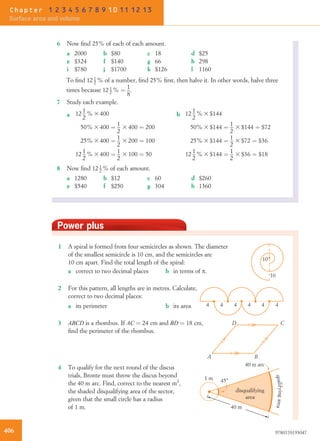
1 A spiral is formed from four semicircles as shown. The diameter
of the smallest semicircle is 10 cm, and the semicircles are
10 cm apart. Find the total length of the spiral:
10
10
a correct to two decimal places b in terms of p.
2 For this pattern, all lengths are in metres. Calculate,
correct to two decimal places:
4 4 4 4 4 4a its perimeter b its area
3 ABCD is a rhombus. If AC ¼ 24 cm and BD ¼ 18 cm,
find the perimeter of the rhombus.
A B
D C
4 To qualify for the next round of the discus
trials, Bronte must throw the discus beyond
the 40 m arc. Find, correct to the nearest m2
,
the shaded disqualifying area of the sector,
given that the small circle has a radius
of 1 m.
45°1 m
40 m arc
40 m
disqualifying
area
qualifyingarea
6 Now find 25% of each of each amount.
a 2000 b $80 c 18 d $25
e $324 f $140 g 66 h 298
i $780 j $1700 k $126 l 1160
To find 12 1
2 % of a number, find 25% first, then halve it. In other words, halve three
times because 12 1
2 % ¼ 1
8
.
7 Study each example.
a 12 1
2
% 3 400
50% 3 400 ¼ 1
2
3 400 ¼ 200
25% 3 400 ¼ 1
2
3 200 ¼ 100
12 1
2
% 3 400 ¼ 1
2
3 100 ¼ 50
b 12 1
2
% 3 $144
50% 3 $144 ¼ 1
2
3 $144 ¼ $72
25% 3 $144 ¼ 1
2
3 $72 ¼ $36
12 1
2
% 3 $144 ¼ 1
2
3 $36 ¼ $18
8 Now find 12 1
2 % of each amount.
a 1280 b $12 c 60 d $260
e $540 f $250 g 304 h 1360
406 9780170193047
Chapter 1 2 3 4 5 6 7 8 9 10 11 12 13
Surface area and volume
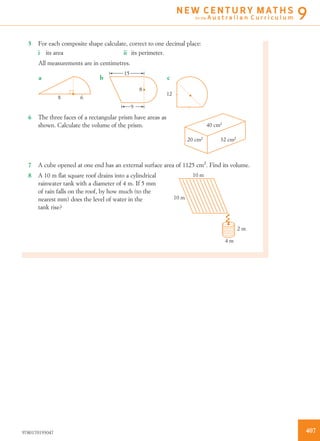
5 For each composite shape calculate, correct to one decimal place:
i its area ii its perimeter.
All measurements are in centimetres.
a
8 6
b
15
8
9
c
12
6 The three faces of a rectangular prism have areas as
shown. Calculate the volume of the prism. 40 cm2
32 cm2
20 cm2
7 A cube opened at one end has an external surface area of 1125 cm2
. Find its volume.
8 A 10 m flat square roof drains into a cylindrical
rainwater tank with a diameter of 4 m. If 5 mm
of rain falls on the roof, by how much (to the
nearest mm) does the level of water in the
tank rise?
10 m
10 m
4 m
2 m
4079780170193047
N E W C E N T U R Y M AT H S
for the A u s t r a l i a n C u r r i c u l u m 9
Chapter 10 review
nLanguage of maths
arc length base capacity circumference
cross-section curved surface diagonal diameter
giga- kilobyte limits of accuracy mega-
megabyte micro- (m) net perimeter
perpendicular height pi (p) prefix radius/radii
rectangular prism sector surface area triangular prism
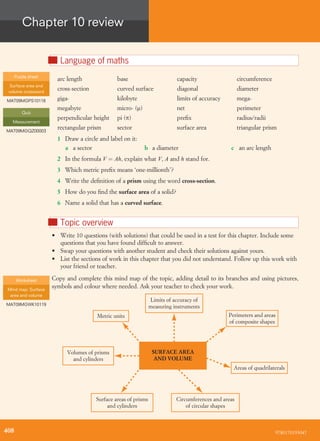
1 Draw a circle and label on it:
a a sector b a diameter c an arc length
2 In the formula V ¼ Ah, explain what V, A and h stand for.
3 Which metric prefix means ‘one-millionth’?
4 Write the definition of a prism using the word cross-section.
5 How do you find the surface area of a solid?
6 Name a solid that has a curved surface.
nTopic overview
• Write 10 questions (with solutions) that could be used in a test for this chapter. Include some
questions that you have found difficult to answer.
• Swap your questions with another student and check their solutions against yours.
• List the sections of work in this chapter that you did not understand. Follow up this work with
your friend or teacher.
Copy and complete this mind map of the topic, adding detail to its branches and using pictures,
symbols and colour where needed. Ask your teacher to check your work.
Circumferences and areas
of circular shapes
Limits of accuracy of
measuring instruments
Perimeters and areas
of composite shapes
Metric units
Surface areas of prisms
and cylinders
Volumes of prisms
and cylinders
Areas of quadrilaterals
SURFACE AREA
AND VOLUME
Puzzle sheet
Surface area and
volume crossword
MAT09MGPS10118
Quiz
Measurement
MAT09MGQZ00003
Worksheet
Mind map: Surface
area and volume
MAT09MGWK10119
9780170193047408
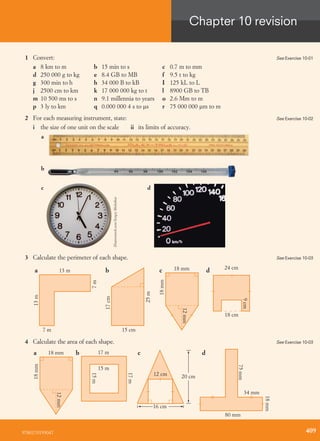
1 Convert:
a 8 km to m b 15 min to s c 0.7 m to mm
d 250 000 g to kg e 8.4 GB to MB f 9.5 t to kg
g 300 min to h h 34 000 B to kB I 125 kL to L
j 2500 cm to km k 17 000 000 kg to t l 8900 GB to TB
m 10 500 ms to s n 9.1 millennia to years o 2.6 Mm to m
p 3 ly to km q 0.000 000 4 s to ms r 75 000 000 mm to m
2 For each measuring instrument, state:
i the size of one unit on the scale ii its limits of accuracy.
a
b
dc
3 Calculate the perimeter of each shape.
7m
13 ma
13m
7 m
17cm
15 cm
b
25m
12mm
18mm
18 mmc
18 cm
24 cm
d
9cm
4 Calculate the area of each shape.
12mm
18mm
18 mma 17 mb
17m
15 m
15m
20 cm
c
8 m
16 cm
80 mm
d
34 mm
18mm
75mm
12 cm
See Exercise 10-01
See Exercise 10-02
Shutterstock.com/SergeyMelnikov
See Exercise 10-03
See Exercise 10-03
9780170193047
Chapter 10 revision
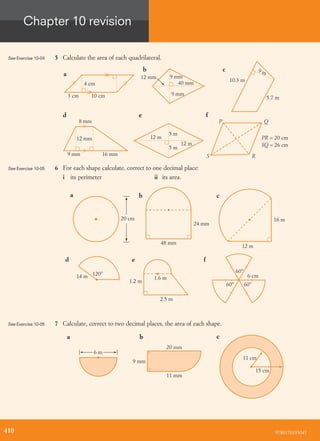
409
5 Calculate the area of each quadrilateral.
4 cm
3 cm 10 cm
ed
a
8 mm
9 mm
12 mm
16 mm
5 m
5 m
12 m
12 m
9 mm
9 mm
40 mm
12 mm
c
f
b 9 m
10.3 m
5.7 m
P
RS
Q
PR = 20 cm
SQ = 26 cm
6 For each shape calculate, correct to one decimal place:
i its perimeter ii its area.
b c
48 mm
20 cm
24 mm
12 m
16 m
a
e f
1.6 m
2.5 m
1.2 m
6 cm
60° 60°
60°
d
120°14 m
7 Calculate, correct to two decimal places, the area of each shape.
c
15 cm
11 cm
a
6 m
b
11 mm
9 mm
20 mm
See Exercise 10-04
See Exercise 10-05
See Exercise 10-05
9780170193047
Chapter 10 revision
410
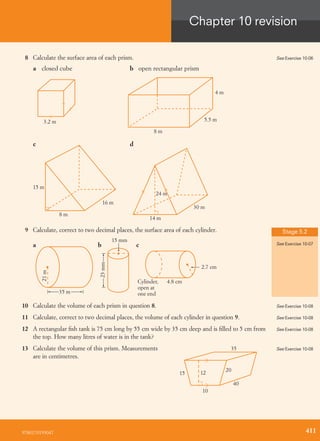
8 Calculate the surface area of each prism.
3.2 m
8 m
5.5 m
4 m
15 m
8 m
16 m
14 m
24 m
30 m
a closed cube
c
b open rectangular prism
d
9 Calculate, correct to two decimal places, the surface area of each cylinder.
23mm
15 mm
cba
4.8 cmCylinder,
open at
one end
2.7 cm
21m
35 m
10 Calculate the volume of each prism in question 8.
11 Calculate, correct to two decimal places, the volume of each cylinder in question 9.
12 A rectangular fish tank is 75 cm long by 55 cm wide by 35 cm deep and is filled to 5 cm from
the top. How many litres of water is in the tank?
13 Calculate the volume of this prism. Measurements
are in centimetres.
35
20
40
10
1215
See Exercise 10-06
Stage 5.2
See Exercise 10-07
See Exercise 10-08
See Exercise 10-08
See Exercise 10-08
See Exercise 10-08
9780170193047
Chapter 10 revision
411

surface area & volume

  • 1.
    10 Measurement and geometry Surface areaand volume The Sydney Opera House was designed by Danish architect Jørn Utzon, with construction taking place between 1955 and 1973 at a cost of $102 million. Its shell design represents a ship under full sail, with each concrete shell being segments of a sphere of radius 75.2 metres. The shells are covered by 1 056 006 white and cream 120 mm square tiles. The Sydney Opera House stands on 1.3 hectares of land, is 183 metres long and 120 metres wide at its widest point.
  • 2.
    nChapter outline Proficiency strands 10-01Metric units U F R C 10-02 Limits of accuracy of measuring instruments U R C 10-03 Perimeters and areas of composite shapes U F R 10-04 Areas of quadrilaterals U F PS R 10-05 Circumferences and areas of circular shapes U F PS R 10-06 Surface area of a prism U F PS R 10-07 Surface area of a cylinder* U F PS R 10-08 Volumes of prisms and cylinders U F PS R *STAGE 5.2 nWordbank capacity The amount of fluid (liquid or gas) in a container cross-section A ‘slice’ of a solid, taken across the solid rather than along it limits of accuracy How accurate a measured value using a measuring instrument can be, equal to half of a unit on the instrument’s scale mega- (abbreviated M) A metric prefix meaning one million micro- (abbreviated m) A metric prefix meaning one- millionth prism A solid shape with identical cross-sections and ends with straight sides sector A region of a circle cut off by two radii, shaped like a slice of pizza surface area The total area of all the faces of a solid shape Shutterstock.com/col 9780170193047 N E W C E N T U R Y M AT H S for the A u s t r a l i a n C u r r i c u l u m 9
  • 3.
    nIn this chapteryou will: • investigate very small and very large time scales and intervals • find perimeters and areas of parallelograms, trapeziums, rhombuses and kites • solve problems involving the surface areas and volumes of right prisms • (STAGE 5.2) calculate the surface areas of cylinders and solve related problems • learn the metric prefixes for very small and very large units of measurement • convert between units of digital memory, such as megabytes and gigabytes • calculate the limits of accuracy of measuring instruments • calculate the perimeters and areas of composite shapes, including circular shapes involving sectors • calculate volumes and capacities of right prisms and cylinders SkillCheck 1 The measurements shown on the shapes below are in centimetres. For each shape, find (correct to two decimal places if necessary): i its perimeter ii its area 32 12 14 50 48 6 25 810 28 24 26 30 f cba ed 30 2 Convert: a 34 m to mm b 925 cm to m c 1500 m to km d 3750 mL to L e 38 cm to mm f 7.5 L to mL Worksheet StartUp assignment 10 MAT09MGWK10108 360 9780170193047 Chapter 1 2 3 4 5 6 7 8 9 10 11 12 13 Surface area and volume
  • 4.
    3 What fractionof each circle is shaded? 120° a b c d 130° 4 Calculate the volume of each prism (all units are in cm). 15 A = 12 cm2 13 12 8 15 20 dcba 10 45 5 For each prism: i count the number of faces ii name the shapes of the different faces iii name the prism. a b c 6 Find the value of each pronumeral. y 8.9 8 h 40 a b c x 37 35 9 3619780170193047 N E W C E N T U R Y M AT H S for the A u s t r a l i a n C u r r i c u l u m 9
  • 5.
    10-01 Metric units Length1 cm = 10 mm 1 m = 100 cm = 1000 mm 1 km = 1000 m Capacity 1 L = 1000 mL 1 kL = 1000 L 1 ML = 1000 kL = 1000 000 L Mass 1 g = 1000 mg 1 kg = 1000 g 1 t = 1000 kg Time 1 min = 60 s 1 h = 60 min = 3600 s 1 day = 24 h m cm mmkm × 1000 × 100 × 10× 1000 ÷ 1000 ÷ 100÷ 1000 ÷ 10 kL L mL × 1000 × 1000× 1000 × 1000 000 ÷ 1 000 000 ÷ 1000÷ 1000 ÷ 1000 ML kg g mgt × 1000 × 1000× 1000 ÷ 1000÷ 1000 ÷ 1000 h min sda y × 3600 ÷ 3600 × 60 × 60× 24 ÷ 60÷ 24 ÷ 60 Other than for time, units of the metric system have prefixes based on powers of 10. • kilo- means 1000 (thousand) or 103 1 kilogram ¼ 1000 grams • mega- means 1 000 000 (million) or 106 1 megalitre ¼ 1 000 000 litres • centi- means 1 100 (hundredth) or 10À2 1 centimetre ¼ 1 100 metre • milli- means 1 1000 (thousandth) or 10À3 1 millilitre ¼ 1 1000 litre Example 1 Convert: a 5.8 t to kg b 16 km to cm c 23 700 mL to L d 1500 min to h Solution a 5:8 t ¼ 5:8 3 1000 kg ¼ 5800 kg To convert from large to small units, multiply (3). t kg × 1000 362 9780170193047 Chapter 1 2 3 4 5 6 7 8 9 10 11 12 13 Surface area and volume
  • 6.
    b 16 km¼ 16 3 1000 3 100 cm ¼ 1 600 000 m × 100 km m × 1000 cm c 23 700 mL ¼ 23 700 4 1000 L ¼ 23:7 L To convert from small to large units, divide (4). L mL ÷ 1000 d 1500 min ¼ 1500 4 60 h ¼ 25 h h min ÷ 60 Metric prefixes This table shows a more detailed list of metric prefixes. Prefix (abbreviation) Meaning Example pico (p) 10À12 nano (n) 10À9 ¼ 1 1 000 000 000 nanosecond (ns) ¼ billionth of a second micro (m) 10À6 ¼ 1 1 000 000 microgram (mg) ¼ millionth of a gram milli (m) 10À3 ¼ 1 1000 millibar (mbar) ¼ thousandth of a bar (air pressure) centi (c) 10À2 ¼ 1 100 centilitre (cL) ¼ hundredth of a litre deci (d) 10À1 ¼ 1 10 decibel (dB) ¼ tenth of a bel (sound level) deca (da) 101 ¼ 10 decametre (dam) ¼ ten metres hecto (h) 102 ¼ 100 hectopascal (hPa) ¼ hundred pascals (air pressure) kilo (k) 103 ¼ 1000 kilojoule (kJ) ¼ thousand joules (energy) mega (M) 106 ¼ 1 000 000 megahertz (MHz) ¼ million hertz (frequency) giga (G) 109 gigawatt (GW) ¼ billion watts (power) tera (T) 1012 terabyte (TB) ¼ trillion bytes (computer memory) Digital memory Metric prefixes are used in units of digital (computer) memory. A byte, abbreviated B, is the amount of memory used to store one character, such as @, g, #, 7 or ?. 3639780170193047 N E W C E N T U R Y M AT H S for the A u s t r a l i a n C u r r i c u l u m 9
  • 7.
    Summary Unit Relationship Size kilobyte(kB) 1 kB ¼ 1000 B About half a page of text. megabyte (MB) 1 MB ¼ 1000 kB A million bytes, about the size of a novel. gigabyte (GB) 1 GB ¼ 1000 MB A billion bytes, about 600 photos or 7.5 hours of video. terabyte (TB) 1 TB ¼ 1000 GB A trillion bytes, about the size of all of the books in a large library. GB MB kBTB × 1000 × 1000× 1000 ÷ 1000÷ 1000 ÷ 1000 B × 1000 ÷ 1000 Some examples of digital memory sizes: E-mail (without attachment): 50 kB Web page: 400 kB Photo: 800 kB Music file: 6 MB YouTube video: 7 MB per minute CD: 750 MB DVD: 8 GB Blu-ray disc: 27 GB Example 2 Convert: a 3.2 MB to kB b 147 000 MB to GB c 0.56 TB to GB Solution a 3:2 MB ¼ 3:2 3 1000 kB ¼ 3200 kB To convert from large to small units, multiply (3). MB kB × 1000 b 147 000 MB ¼ 147 000 4 1000 GB ¼ 147 GB To convert from small to large units, divide (4). GB MB ÷ 1000 c 0:56 TB ¼ 0:56 3 1000 GB ¼ 560 GB GBTB × 1000 364 9780170193047 Chapter 1 2 3 4 5 6 7 8 9 10 11 12 13 Surface area and volume
  • 8.
    Very small andvery large units Some very small and very large units of length, distance and time also use metric prefixes. Length and distance • One nanometre (nm) ¼ 1 1 000 000 000 m: your fingernails grown 1 nm every second, the diameter of a helium atom is 0.1 nm • One micrometre (mm) ¼ 1 1 000 000 m: used to measure diameters of bacteria • One megametre (Mm) ¼ 1 000 000 m or 1000 km: the distance between Sydney and Brisbane, or the length of the Bathurst 1000 car race • One gigametre (GM) ¼ 1 000 000 000 m: the diameter of the Sun is 1.4 GM • One astronomical unit (AU) ¼ 149 597 871 km or 149.6 GM: the average distance between the Earth and the Sun, used to measure distances between planets in our solar system • One light year (ly) ¼ 9.46 3 1012 km: the distance light travels in a year, for measuring distances between stars • One parsec (pc) ¼ 3.09 3 1013 km or 3.26 ly: for measuring distances between stars, the nearest star Proxima Centauri is 1.30 parsecs away Time • One nanosecond (ns) ¼ 1 1 000 000 000 s: the time it takes electricity to travel along a 30 cm wire • One microsecond (ms) ¼ 1 1 000 000 s • One millisecond (ms) ¼ 1 1000 s: the duration of the flash on a camera • One decade ¼ 10 years • One century ¼ 100 years • One millennium ¼ 1000 years • One mega-annum (Ma) ¼ 1 000 000 years: used in geology and paleontology, the Tyrannosaurus Rex dinosaur lived 65 Ma ago • One giga-annum (Ga) ¼ 1 000 000 000 years: the Earth was formed 4.57 Ga ago Example 3 Convert: a 0.73 s to ms b 25 610 000 km to AU c 4.57 Ga to years d 1 920 000 nm to m Solution a 0:73 s ¼ 0:73 3 1 000 000 ls ¼ 730 000 ls To convert from large to small units, multiply (3). b 25 610 000 km ¼ 25 610 000 4 149 597 871 AU ¼ 0:17119 . . . % 0:17 AU To convert from small to large units, divide (4). c 4:57 Ga ¼ 4:57 3 1 000 000 000 years ¼ 4 570 000 000 years 3659780170193047 N E W C E N T U R Y M AT H S for the A u s t r a l i a n C u r r i c u l u m 9
  • 9.
    d 1 920000 nm ¼ 1 920 000 4 1 000 000 000 m ¼ 1:92 3 10À3 m ¼ 0:001 92 m Exercise 10-01 Metric units 1 What metric unit would you use for each measurement? a Width of a computer screen b Mass of a plane c Distance between two towns d Capacity of a car’s fuel tank e Amount of water in a pool f Time taken to fly overseas 2 Convert: a 750 g to mg b 36 kL to L c 67 kg to g d 1.5 L to mL e 6.7 cm to mm f 3.5 km to m g 9.4 t to kg h 3.75 g to mg i 4.25 m to cm j 0.2 kg to g k 26.2 L to mL l 0.3 km to m m 3 kL to mL n 4 days to min o 15 h to s p 2.7 km to cm q 5 kg to mg r 0.7 m to mm s 29.375 t to g t 18.14 km to mm 3 How many mL in 18.9 kL? Select the correct answer A, B, C or D. A 1 890 000 B 18 900 000 C 189 000 D 18 900 4 Select the most appropriate answer A, B or C for each measurement. a height of a door A 20 cm B 200 cm C 20 m b capacity of a soft drink can A 37.5 mL B 375 mL C 3.5 L c time to run 100 metres A 12.3 s B 34.3 s C 50.3 s d height of Sydney Tower A 30.5 m B 3050 m C 305 m e mass of a family car A 100 kg B 1000 kg C 10 000 kg See Example 1 Shutterstock.com/JoseGil 366 9780170193047 Chapter 1 2 3 4 5 6 7 8 9 10 11 12 13 Surface area and volume
  • 10.
    5 Convert: a 8000L to kL b 90 mm to cm c 180 s to min d 240 min to h e 375 mL to L f 14 700 kg to t g 8600 mg to g h 750 cm to m i 223 mm to cm j 800 g to kg k 125 L to kL l 3.5 kg to t m 17 000 000 mg to kg n 7200 min to days o 45 000 000 g to t p 144 000 s to h q 86 400 s to days r 2500 cm to km s 75 000 mL to kL t 34 700 mm to m 6 How many km in 408 m? Select the correct answer A, B, C or D. A 4.08 B 0.408 C 0.0408 D 0.004 08 7 Convert: a 4.8 MB to kB b 2.1 TB to GB c 8.5 GB to MB d 10.8 MB to B e 2910 B to kB f 740 MB to GB g 1050 kB to MB h 5900 GB to TB i 0.94 kB to MB j 57 GB to MB k 0.43 GB to kB l 21 TB to GB m 7.8 kB to B n 2180 MB to GB o 42 000 B to MB p 940 MB to kB 8 Mala made a 3-minute phone call to her friend in Queensland using the Internet application Skype at 1.2 MB per minute. How many kB did she use? 9 Calculate the number of MP3 files of average size 3.7 MB that can be stored on a 16 GB MP3 player. 10 Convert, correct to two significant figures where necessary: a 3.5 AU to km b 6000 ms to s c 7.5 centuries to years d 12 000 000 nm to m e 0.64 GM to m f 2.1 ly to km g 0.07 s to ms h 0.25 Ma to years i 4 800 000 ms to s j 5 290 000 km to Mm k 0.2 pc to km l 6 mm to mm m 0.94 Ma to millennia n 849 years to centuries o 8 3 1014 km to ly p 0.000 008 cm to nm Just for the record The metre The metre is the standard or base unit of length in the International System of Units. S Distance from the north pole to the equator N Equator It was originally defined in France in 1795 as 1 10 000 000 (ten-millionth) of the distance between the North Pole and the Equator along a meridian of longitude. In 1889, it was redefined as the distance between two lines marked on a platinum bar used as the standard. The current definition was made in 1983, as the distance travelled by light in a vacuum in 1 299 792 458 of a second. Investigate the definition of a second. See Example 2 Worked solutions Metric units MAT09MGWS10040 See Example 3 3679780170193047 N E W C E N T U R Y M AT H S for the A u s t r a l i a n C u r r i c u l u m 9
  • 11.
    10-02 Limits of accuracyof measuring instruments All measurements are only approximations. No measurement is ever exact. For example, we might measure this eraser to be 5.5 cm long, because the scale on the ruler measures to the nearest 0.5 cm. cm 1 2 3 4 5 6 Eraser If we used a ruler with a more precise scale, such as 0.1 cm markings, then we may find the length to be 5.4 cm. cm 1 2 3 4 5 6 Eraser If we could find an instrument such as a micrometer that measured to the nearest 0.01 cm, we may find that the measured length is 5.41 cm. Notice that we can always find a more accurate measurement using a more precise measuring instrument. So all measurements are approximations. A measuring instrument such as a ruler has limits of accuracy due to its level of precision. Accuracy means how close a measured value is to the true value, while precision means how fine the scale is on the measuring instrument. For example, this ruler is marked in centimetres, so any length measured with it can only be given to the nearest centimetre. 10 11 12 13 14 { cm Any measurement in the shaded region should be recorded as 12 cm. The measured length is 12 cm, but the actual length is 12 Æ 0.5 cm, meaning ‘12 centimetres, give or take 0.5 centimetres’ or ‘11.5 to 12.5 cm’. The limits of accuracy of this ruler are Æ0.5 cm or ‘plus or minus half a centimetre’. Summary The limits of accuracy of a measuring instrument are Æ0.5 of the unit shown on the instrument’s scale. Example 4 Find the limits of accuracy for each measuring scale. kg 80 90 ba 25 mL 20 15 10 5 NSW Worksheet Accuracy in measurement MAT09MGWK10109 368 9780170193047 Chapter 1 2 3 4 5 6 7 8 9 10 11 12 13 Surface area and volume
  • 12.
    Solution a The sizeof one unit on the scale is 1 kg. The limits of accuracy are Æ0.5 3 1 kg ¼ Æ0.5 kg b The size of one unit on the scale is 5 mL. The limits of accuracy are Æ0.5 3 5 mL ¼ Æ2.5 mL Exercise 10-02 Limits of accuracy of measuring instruments 1 For each measuring instrument, state: i the size of one unit on the scale ii its limits of accuracy. G R A M S 10000 500 100 60 90 80 7050 40 30 20 10 0 110 120 km/h 088724 100 20 40 60 800 °C10010 30 50 70 90 ba edc hgf 60 70 80 90 90 100 110 120 130 140 150160170180 80 70 60 50 40 30 20 100 90 80 70 60 50 40 30 20100 100 110 120 130 140 150 160 170180 12 1 2 3 4 5 6 7 8 9 10 11 mm 2000 g 1500 g 1000 g 500 g 0 g 3 0 1 2 cm4 i j k F E kL 7 6 5 4 3 2 1 mL 200 150 100 50 2 What are the limits of accuracy for this measuring cylinder? Select the correct answer A, B, C or D. 100 mL 200 mL 300 mL A Æ 0.5 mL B Æ 10 mL C Æ 20 mL D Æ 5 mL See Example 4 3699780170193047 N E W C E N T U R Y M AT H S for the A u s t r a l i a n C u r r i c u l u m 9
  • 13.
    3 Measuring witha ruler, Jade correctly gives a measurement as 26.5 to 27.5 cm. a What is the size of a unit on the ruler? b What are the limits of accuracy of this measurement? c Using a ruler marked in millimetres, Marival gives the same measurement as 26.8 cm. What are the limits of accuracy of this measurement? d What is the range within which this measurement must lie? 10-03 Perimeters and areas of composite shapes Summary The perimeter of a shape is the distance around the shape, the sum of the lengths of the sides of the shape. The area of a shape is the amount of surface covered by the shape, measured in square units. Rectangle w l A ¼ length 3 width A ¼ lw Triangle b h A ¼ 1 2 3 base 3 perpendicular height A ¼ 1 2 bh Example 5 For each composite shape, find: i its perimeter ii its area. ba 7 m 15 cm 13 m 38 cm 6 m 18 cm 17 m 370 9780170193047 Chapter 1 2 3 4 5 6 7 8 9 10 11 12 13 Surface area and volume
  • 14.
    Solution a i Findany unknown lengths on the shape. Perimeter ¼ 6 þ 13 þ 5 þ 7 þ 11 þ 20 ¼ 62 m 7 13 13 + 7 = 20 11 – 6 = 5 6 11 ii Area ¼ 7 3 5ð Þ þ 20 3 6ð Þ ¼ 155 m2 Sum of areas of two rectangles. b i Divide the shape into a rectangle and a triangle, and find the unknown length, h, using Pythagoras’ theorem. h2 ¼ 152 þ 202 ¼ 625 h ¼ ffiffiffiffiffiffiffiffi 625 p ¼ 25 cm Perimeter ¼ 18 þ 25 þ 38 þ 15 ¼ 96 cm 15 18 38 – 18 = 20 18 h ii Area ¼ 1 2 3 15 3 20 þ ð15 3 8Þ ¼ 270 m2 Area of triangle þ Area of rectangle Exercise 10-03 Perimeters and areas of composite shapes 1 For each composite shape, find: i its perimeter ii its area. 15 mm 10 mma b c 100 m 2 m 30 m 30 m 3 m 9mm 50m 8m 2m 4mm 50m 20m See Example 5 3719780170193047 N E W C E N T U R Y M AT H S for the A u s t r a l i a n C u r r i c u l u m 9
  • 15.
    d e f 20cm 40cm 52cm 8 cm 20 cm 30 cm 10cm 24 cm 9cm 2 Find the area of each composite shape. 12 m 10 m 8 m 6 m 5 m 12 m 18 m 10m 3 m 10 m 3m 10m 8 mm 8mm 6mm 16 m 10 m 10m 16m 10 cm 4 cm 2 cm 2cm 8cm 9 cm 15 cm 4cm 40 cm 20cm 10 cm 10 cm 8m 18m 15 m 20 m 14.1 m 14.1 m 20m 300 cmkji hg f cb e a d 80 cm 80 cm 80 cm 80 cm 300 cm 200cm 100cm100cm Worked solutions Perimeters and areas of composite shapes MAT09MGWS10041 372 9780170193047 Chapter 1 2 3 4 5 6 7 8 9 10 11 12 13 Surface area and volume
  • 16.
    3 What isthe area of the shaded arrow? Select the correct answer A, B, C or D. 3 cm 2cm1cm 3 cm A 14 cm2 B 8 cm2 C 9 cm2 D 12 cm2 4 Find each shaded area. 0.5 cm 3 cm 3 cm 19.6 cm 3 cm a b 3.8 cm 6.4 cm 4cm Investigation: Area of a trapezium, kite and rhombus 1 Draw two copies of this trapezium onto a sheet of paper. Draw a dotted line, parallel to the sides labelled a and b, halfway down the height of each trapezium and label the sides as shown. h 2 h 2 a b Side 1 Side 2 2 Cut out one trapezium and cut along the dotted line to make two smaller trapeziums. Join the pieces to make a long parallelogram. 3 By measuring the height and base of the parallelogram to the nearest millimetre, find its area. 4 By comparing the measurements of the parallelogram to the measurements of the original trapezium, suggest a general formula for finding the area of any trapezium. Check your answer with your teacher. 5 Cut out the original trapezium and paste it and the parallelogram into your book. 6 Draw two copies of the kite and rhombus on a sheet of paper. Draw diagonals of length x and y and label them as shown. Notice that they cross at right angles. For the kite, one diagonal (x) is bisected by the other (y), while for the rhombus, both diagonals bisect each other. 1 2 x 1 2 x 1 2 y 1 2 x 1 2 y 1 2 xy x and y are the lengths of the diagonals Worked solutions Perimeters and areas of composite shapes MAT09MGWS10041 3739780170193047 N E W C E N T U R Y M AT H S for the A u s t r a l i a n C u r r i c u l u m 9
  • 17.
    10-04 Areas ofquadrilaterals Summary Parallelogram Trapezium b h Area ¼ base3perpendicular height A ¼ bh h a b Area ¼ 1 2 3ðsum of parallel sidesÞ 3perpendicular height A ¼ 1 2 ðaþbÞh Rhombus Kite x y x y Area ¼ 1 2 3 ðproduct of diagonalsÞ A ¼ 1 2 xy 7 Cut out one of your kites and rhombuses and cut along their diagonals to make four triangles each. Join each set of triangles to make a rectangle. 8 By measuring the sides of each rectangle to the nearest millimetre, find the area of each one. 9 By comparing the measurements of the kite to the measurements of the rectangle formed from it, suggest a general formula for finding the area of any kite. Check your answer with your teacher. 10 Is a rhombus a special type of kite? 11 Suggest a general formula for finding the area of any rhombus. Check your answer with your teacher. 12 Cut out the original kite and rhombus and paste all shapes into your book. Worksheet Area ID MAT09MGWK10110 Skillsheet What is area? MAT09MGSS10029 Homework sheet Area 1 MAT09MGHS10019 374 9780170193047 Chapter 1 2 3 4 5 6 7 8 9 10 11 12 13 Surface area and volume
  • 18.
    Example 6 Find thearea of each quadrilateral. 26 cm 10cm a 16 mm 12 mm 30 mm 10 cm 11 cm 15 cm c ed 14 m 9 m 14 m 9 m b Solution a Area of rhombus ¼ 1 2 3 26 3 10 ¼ 130 cm2 A ¼ 1 2 xy b Area of parallelogram ¼ 14 3 9 ¼ 126 m2 A ¼ bh c Area of trapezium ¼ 1 2 3 16 þ 30ð Þ 3 12 ¼ 276 mm2 A ¼ 1 2 a þ bð Þh d Area of kite ¼ 1 2 3 9 3 14 ¼ 63 m2 A ¼ 1 2 xy e Area of trapezium ¼ 1 2 3 10 þ 15ð Þ 3 11 ¼ 137:5 cm2 A ¼ 1 2 a þ bð Þh 3759780170193047 N E W C E N T U R Y M AT H S for the A u s t r a l i a n C u r r i c u l u m 9
  • 19.
    Exercise 10-04 Areasof quadrilaterals 1 Find the shaded area of each shape. 8 cm 6cm 4 m 13.6m 20 mm 17mm 2 cm 1.5cm 7cm 12 cm 25mm 30 mm 10mm 50 mm 8mm 32mm 10mm 5 mm 2 m2 m 6 m g f cba ed h i 2m 4m 10.4 cm 4.4cm 4.4cm 10.4 cm 7cm2 Find the area of each shape. e 23mm 15 mm 12 mm 20 mm 9 mm 16 mm f a b c d 20 mm 30 mm 18 mm 10 mm 15 mm 15 mm 12 mm 12 mm See Example 6 376 9780170193047 Chapter 1 2 3 4 5 6 7 8 9 10 11 12 13 Surface area and volume
  • 20.
    19 mm 7mm 22mm 15 mm 15 mm 12mm 8mm 8mm 7 mm 7 mm g h i 3 Find the area of each shape. 2.1 m 1.8 m 1.4 m 9 m 15 m 16 m 10 m 22 m 7 m 5.5 m 8 m 11 m 48 mm 32 mm 20 mm 7.5cm 10.5 cm 6 cm 7 cm 9 cm 6 cm 14.5 m 12 m 9.6 m 35 mm 20 mm a b c d e f g h i 28 mm 4 Find the area of each shape. a b c13 cm 17 cm 10 cm 8 cm 24 cm 9 m 14 m 7 m 5 m 4 m 5 m 5 m 5 m 4 m 4 m 3 m 3 m 5 m 3779780170193047 N E W C E N T U R Y M AT H S for the A u s t r a l i a n C u r r i c u l u m 9
  • 21.
    d e f 10.5 cm 6.6m9.6 cm 5.5 m 8.8 m 10 cm10 cm 17 cm 17 cm15cm 6 cm 8 cm 8 cm 5 Calculate each shaded area (all measurements are in metres). 1.2 1.2 c 2 4.5 a 20 12 10 12 10 20 b 15 15 15 5 18.6 Mental skills 10A Maths without calculators Finding 10%, 20% and 5% To find 10% or 1 10 of a number, simply divide the number by 10 by moving the decimal point one place to the left. 1 Study each example. a 10% × 150 = 15 0. = 15 b 10% × $1256.80 = $125 6.8 = $125.68 c 10% × 4917 = 491 7. = 491.7 d 10% × $48.55 = $4 8.55 = $4.885 2 Now find 10% of each amount. a 190 b $75 c 875 d $202 e $37.60 f 400 g $9.25 h 896 i $2700 j $3.80 k $1527.60 l $72.50 m 3154 n $10.70 o 426 p $24 317.60 20% is 10% doubled so to find 20% of a number, first find 10% then double it. 3 Study each example. a 20% 3 700 10% 3 700 ¼ 70 ) 20% 3 700 ¼ 70 3 2 ¼ 140 b 20% 3 $876 10% 3 $876 ¼ $87:60 ) 20% 3 $876 ¼ $87:60 3 2 ¼ $175:20 378 9780170193047 Chapter 1 2 3 4 5 6 7 8 9 10 11 12 13 Surface area and volume
  • 22.
    10-05 Circumferences and areas ofcircular shapes The circumference of a circle is found by multiplying its diameter by a special number called pi (pronounced ‘pie’), represented by the Greek letter p. The area of a circle is found by multiplying p by the radius squared. Summary The circumference (perimeter) of a circle is: r d C ¼ p 3 diameter C ¼ pd or C ¼ 2 3 p 3 radius C ¼ 2pr The area of a circle is: A ¼ p 3 ðradiusÞ2 A ¼ pr2 c 20% 3 325 10% 3 325 ¼ 32:5 ) 20% 3 325 ¼ 32:5 3 2 ¼ 65 d 20% 3 $38:50 10% 3 $38:50 ¼ $3:85 ) 20% 3 $38:50 ¼ $3:85 3 2 ¼ $7:70 4 Now find 20% of each amount. a 50 b 620 c $2450 d $8.60 e 72 f $12 700 g 390 h $5.80 i $45 j $84 k $4600 l 320 5% is half of 10%, so to find 5% of a number first find 10% then divide it by 2. 5 Study each example. a 5% 3 180 10% 3 180 ¼ 18 ) 5% 3 180 ¼ 18 4 2 ¼ 9 b 5% 3 $76 10% 3 $76 ¼ $7:60 ) 5% 3 $76 ¼ $7:60 4 2 ¼ $3:80 c 5% 3 120 10% 3 120 ¼ 12 ) 5% 3 120 ¼ 12 4 2 ¼ 6 d 5% 3 $142:20 10% 3 $142:20 ¼ $14:22 ) 5% 3 $142:20 ¼ $14:22 4 2 ¼ $7:11 6 Now find 5% of each amount. a 2000 b $12 c 50 d $27 e $36.80 f $84 g 800 h 130 i $9.60 j $138 k $72 l 840 Worksheet A page of circular shapes MAT09MGWK10111 Homework sheet Area 2 MAT09MGHS10020 Worksheet Applications of area MAT09MGWK10112 Worksheet Back-to-front problems MAT09MGWK10113 Worksheet Area and perimeter investigations MAT09MGWK00025 Puzzle sheet Carpet talk MAT09MGPS00007 3799780170193047 N E W C E N T U R Y M AT H S for the A u s t r a l i a n C u r r i c u l u m 9
  • 23.
    p ¼ 3.141592 653 897 93… and can be found by pressing the π key on your calculator. It has no exact decimal or fraction value, so like the surd ffiffiffi 2 p it is an irrational number. Example 7 For each circle, calculate correct to two decimal places: i its circumference ii its area. 20 m 8.5 m a b Solution a i C ¼ p 3 20 ¼ 62:8318 . . . % 62:83 m C ¼ pd b i C ¼ 2 3 p 3 8:5 ¼ 53:4070 . . . % 53:41 m C ¼ 2pr ii A ¼ p 3 102 ¼ 314:1592 . . . % 314:16 m2 A ¼ pr2 ii A ¼ p 3 8:52 ¼ 226:9800 . . . % 226:98 m2 A ¼ pr 2 Example 8 For each sector, calculate correct to one decimal place: i its perimeter ii its area. A B O 5 m120° a b c 3 m 3 m 80° 4.2 m Solution a i This sector is a quadrant, a quarter of a circle. Perimeter ¼ 1 4 3 2 3 p 3 3 þ 3 þ 3 ¼ 10:71238 . . . % 10:7 m 1 4 3 circumference þ radius þ radius Video tutorial Perimeter and area of a sector MAT09MGVT10014 Technology GeoGebra: Area and perimeter of a sector MAT09MGTC00002 A sector is a fraction of a circle ‘cut’ along two radii, like a pizza slice. 380 9780170193047 Chapter 1 2 3 4 5 6 7 8 9 10 11 12 13 Surface area and volume
  • 24.
    ii Area ¼ 1 4 3p 3 32 ¼ 7:06858 . . . % 7:1 m2 1 4 3 area of circle b i Perimeter ¼ 80 360 3 2 3 p 3 4:2 þ 4:2 þ 4:2 ¼ 14:26430 . . . % 14:3 m 80 360 3 circumference þ radius þ radius ii Area ¼ 80 360 3 p 3 4:22 ¼ 12:31504 . . . % 12:3 m2 80 360 3 area of circle c i Sector angle ¼ 360° À 120° ¼ 240° Perimeter ¼ 240 360 3 2 3 p 3 5 þ 5 þ 5 ¼ 30:94395 . . . % 30:9 m ii Area of sector ¼ 240 360 3 p 3 52 ¼ 52:35987 . . . % 52:4 m2 Summary For a sector with angle y: • Arc length ¼ u 360 3 2pr θ r arc length • Perimeter of the sector ¼ u 360 3 2pr þ r þ r (arc length þ radius þ radius) • Area of the sector ¼ u 360 3 pr2 There are 360° in a circle, but a sector is a fraction of a circle. 3819780170193047 N E W C E N T U R Y M AT H S for the A u s t r a l i a n C u r r i c u l u m 9
  • 25.
    Example 9 Find, correctto one decimal place, the area of each shape. 7 m a b15 22 m 30 m 12 m Solution a The shape is made up of a rectangle and a quadrant. Radius of quadrant ¼ 7 m Length of rectangle ¼ 22 À 7 ¼ 15 m Area of shape ¼ area of rectangle þ quadrant ¼ 15 3 7 þ 1 4 3 p 3 72 ¼ 143:4845 . . . % 143:5 m2 b This ring shape is called an annulus, it is the area enclosed by two circles with the same centre. Radius of large circle ¼ 1 2 3 30 m ¼ 15 m Radius of small circle ¼ 1 2 3 12 m ¼ 6 m Shaded area ¼ large circle À small circle ¼ p 3 152 À p 3 62 ¼ 593:7610 . . . % 593:8 m2 Exercise 10-05 Circumferences and areas of circular shapes 1 For each circle, calculate correct to two decimal places: i its circumference ii its area. 8 5.2 30 28.2 a c db 2 For each sector, calculate correct to one decimal place: i its perimeter ii its area. 36 m 10 m 10 m 120° 1 m 210° 24 m a c db See Example 7 See Example 8 382 9780170193047 Chapter 1 2 3 4 5 6 7 8 9 10 11 12 13 Surface area and volume
  • 26.
    33 m 30° 6 m 6m 10°8 m 8 m 60° 42 m e f g h 3 Calculate the perimeter of each shape, correct to two decimal places. 40 cm 40 cm 15 cm 12 cm 26 mm 22 mm 11 m 30 m 11 m 150 cm 65 cm 90 cm 248 m 248 m 15 cm 8 cm 9 cm 18 cm 18 cm a b c d e f g h i 7 m 7 m 15 m 4 Calculate the area of each shape, correct to the nearest square metre. All measurements are in metres. 40 40 15 12 22 26 a b c 3839780170193047 N E W C E N T U R Y M AT H S for the A u s t r a l i a n C u r r i c u l u m 9
  • 27.
    10 10 45 20 16 8 6 14 30 30 20 40 90 150 g hi j k l d e f 22 22 7 7 6 8 6 3 3 5 A circular playing field has a radius of 80 m. A rectangular cricket pitch measuring 25 m by 2 m is placed in the middle. The field, excluding the pitch, is to be fertilised. a Calculate correct to the nearest square metre the area to be fertilised. b How much will this cost if the fertiliser is $19.95 per 100 square metres? Give your answer to the nearest dollar. 6 a The diameter of the Earth is 12 756 km. Find the circumference of the Earth, to the nearest kilometre. b A space lab orbits the Earth at a height of 1200 km above the Earth’s surface. Find the distance it travels in one orbit of the Earth. 7 A circular plate of diameter 2 m has 250 holes of diameter 10 cm drilled in it. What is the remaining area of the plate? Answer to the nearest 0.1 m2 . 8 A circular pond of diameter 10 m is surrounded by a path one metre wide. a Calculate the area of the path correct to two decimal places. b If pavers are $75 per square metre laid, what is the cost of the path? 9 A circular patch of grass has a diameter of 8.5 m. How much further does Nina walk if she walks around the border instead of directly across it? Give your answer correct to the nearest 0.1 m. 8.5 m Worked solutions Circumferences and areas of circular shapes MAT09MGWS10042 384 9780170193047 Chapter 1 2 3 4 5 6 7 8 9 10 11 12 13 Surface area and volume
  • 28.
    10 A newtractor tyre has a diameter of 120 cm, while a worn tyre has a diameter of 115 cm. a Calculate the difference in circumference between a new tyre and a worn tyre, correct to three decimal places. b Over 1000 revolutions, how much further (to the nearest metre) will a new tyre travel compared to a worn tyre? 11 A square courtyard measuring 5 m by 5 m has a semi-circular area added to each side. a Calculate the area of the semi-circular additions, correct to the nearest square metre. b By what percentage has the area of the courtyard increased? (This can be calculated as increase in area original area 3 100%) 12 The measurements of a running track are shown below. Each lane is 1 m wide and the athletes run along the insides of the lanes. 36.5 m 85 m LANE 2 LANE 1start lane 1 staggered start lane 2 FINISH a Zoe runs one lap in lane 1. What distance does she cover, correct to one decimal place? b Jaron runs one lap in lane 2. What distance does he cover, correct to one decimal place? c By how much should the start line be staggered in lane 2 (from lane 1) so that Zoe and Jaron run the same distance in one lap? Just for the record A piece of pi p ¼ 3.141 592 653 589 793 238 462 643 383 279 502 884 197 169 399 375 105 820… Because p is an irrational number, its decimal digits run endlessly without repeating. Over history, mathematicians and scientists (and now computer scientists) have tried to calculate more accurate values of p, using more sophisticated formulas and calculation techniques. The ancient Greeks, Romans and Chinese first estimated p as 3. This value is also mentioned in the Bible. Since the first computer, the ENIAC, was invented in 1949, much progress has been made. Supercomputers have been used to calculate more decimal places of p and, in 2011, two system engineers Shigeru Kondo (Japan) and Alexander Yee (USA) calculated p to over 10 trillion places. In 2005, Chinese university student Lu Chao memorised p to 67 890 decimal places. It took him 24 hours 4 minutes to recite it. Research the modern history of p or use the Internet to find out about recent calculations of its value. Worked solutions Circumferences and areas of circular shapes MAT09MGWS10042 Shutterstock.com/PresniakovOleksandr 3859780170193047 N E W C E N T U R Y M AT H S for the A u s t r a l i a n C u r r i c u l u m 9
  • 29.
    Investigation: Nets ofprisms You will need: 1 cm grid paper. If a solid is cut along some of its edges, the faces can all be folded down flat. The flat shape obtained is called the net of the solid. Net of a cube How many different nets of a cube can you make (or draw)? Do not count reflections or rotations because they are considered to be the same. For example, these are two versions of the same net. 1 Draw the possible nets of a cube on 1 cm grid paper. Cut out the nets and fold them to see if they each form a cube, then paste them into your book. 2 If a cube has side length 1 cm, what is the area of one of its faces? 3 The surface area of a cube is the sum of the areas of all of its faces. What is the surface area of the cube with side length 1 cm? Net of a rectangular prism 1 Draw each of the following nets of rectangular prisms on 1 cm grid paper. Cut them out and fold them to make rectangular prisms, then paste them into your book. 8 4 4 4 4 10 5 5 3 3 a b 2 Calculate the surface area of each rectangular prism by adding the areas of all of its faces. Worksheet Nets of solids MAT09MGWK10114 386 9780170193047 Chapter 1 2 3 4 5 6 7 8 9 10 11 12 13 Surface area and volume
  • 30.
    10-06 Surface areaof a prism Summary The surface area of a solid is the total area of all the faces of the solid. To calculate the surface area of a solid, find the area of each face and add the areas together. Example 10 Calculate the surface area of each prism. a cube 4 cm 4 cm 4cm b rectangular prism top end side 12 cm 5 cm 4 cm c open rectangular prism 8 cm 12 cm 25 cm Solution a A cube has 6 identical faces in the shape of a square. Surface area ¼ 6 3 42 ¼ 96 cm2 6 3 area of a square Net of a triangular prism 1 Draw each of the following nets on 1 cm grid paper. Cut them out and fold them to make triangular prisms, then paste them into your book. 4 5 3 6 8 3 2.72.6 a b 2 Calculate the surface area of each triangular prism. Worksheet Surface area MAT09MGWK10115 Worksheet Nets of solids MAT09MGWK10114 Skillsheet Solid shapes MAT09MGSS10030 Animated example Surface area MAT09MGAE00003 Technology worksheet Excel worksheet: Surface area calculator MAT09MGCT00020 Technology worksheet Excel spreadsheet: Surface area calculator MAT09MGCT00005 3879780170193047 N E W C E N T U R Y M AT H S for the A u s t r a l i a n C u r r i c u l u m 9
  • 31.
    b A rectangularprism has 6 faces that are not all the same. However, opposite faces such as the top and bottom are the same. Surface area ¼ 2 top and bottom faces þ 2 end faces þ 2 side faces ¼ 2 3 5 3 12ð Þ þ 2 3 5 3 4ð Þ þ 2 3 12 3 4ð Þ ¼ 256 cm2 c The open rectangular prism has no top so it has 5 faces that are not all the same. Surface area ¼ Bottom face þ 2 front and back faces þ 2 side faces ¼ 25 3 8ð Þ þ 2 3 25 3 12ð Þ þ 2 3 8 3 12ð Þ ¼ 992 cm2 Example 11 Calculate the surface area of each triangular prism. 8 cm 10 cm 5 cm 3 cm 24 m 10 m 30 m n m a b Solution a This triangular prism has 5 faces: two identical triangles (front and back), two identical rectangles (sides) and another rectangle (bottom). Drawing the net of the prism may help you see this. 8 cm 10 cm 5 cm 3 cm Surface area ¼ ð23 1 2 3833Þþð231035Þþð8310Þ ¼ 204 cm2 Front and back faces þ side faces þ bottom face b This triangular prism has 5 faces: two identical triangles (front and back), three different rectangles. 10 30 10 24n Video tutorial Surface area of a prism MAT09MGVT10015 Video tutorial Surface area of prisms MAT09MGVT00003 388 9780170193047 Chapter 1 2 3 4 5 6 7 8 9 10 11 12 13 Surface area and volume
  • 32.
    To calculate thearea of the left face, we need to know the value of n, which can be found using Pythagoras’ theorem. n2 ¼ 102 þ 262 ¼ 676 n ¼ ffiffiffiffiffiffiffiffi 676 p ¼ 26 Surface area ¼ ð2 3 1 2 3 10 3 24Þ þ ð30 3 26Þ þ ð30 3 10Þ þ ð30 3 24Þ ¼ 2040 m2 Front and back þ left þ bottom þ right Example 12 Calculate the surface area of this trapezoidal prism. 18 cm 13 cm 10 cm 12 cm 24 cm 15 cm Solution This trapezoidal prism has 6 faces: two identical trapeziums (front and back) and four different rectangles. 10 10 24 18 12 15 13 Area of each trapezium ¼ 1 2 3 10 þ 24ð Þ 3 12 ¼ 204 cm2 Surface area ¼ 2 3 204ð Þ þ 18 3 10ð Þ þ 18 3 15ð Þ þ 18 3 24ð Þ þ 18 3 13ð Þ ¼ 1524 cm2 2 trapeziums þ 4 rectangles Stage 5.2 Video tutorial Surface area of a prism MAT09MGVT10015 3899780170193047 N E W C E N T U R Y M AT H S for the A u s t r a l i a n C u r r i c u l u m 9
  • 33.
    Exercise 10-06 Surfacearea of a prism 1 What is the surface area of this rectangular prism? Select the correct answer A, B, C or D. 12 cm 8 cm 8 cm A 320 cm2 B 352 cm2 C 512 cm2 D 768 cm2 2 Draw a net of each solid. a cube b rectangular prism c triangular prism d cylinder 3 Calculate the surface area of each prism. a cube b rectangular prism c open cube (no top) 6.5 m 144 cm 45 cm 18 cm 20 cm d open rectangular prism e rectangular prism, open front and back f cube, open one end 7.5 m 5.2 m 3.4 m 65 mm 48 mm 35 mm 44 cm 4 Find the surface area of each triangular prism. 16 m 6 m 7 m 10 m a b 6 m 15 m 10 m 8 m See Example 10 See Example 11 390 9780170193047 Chapter 1 2 3 4 5 6 7 8 9 10 11 12 13 Surface area and volume
  • 34.
    10 m 5 m 12m 12 m 15 m 9 me f c d h 40 cm 15 cm 29 cm 8 cm r 3.5 cm 3.7 cm 5 Match each net of a solid to the name of the solid. triangular prism cube rectangular prism square pyramid cylinder trapezoidal prism a b dc 3919780170193047 N E W C E N T U R Y M AT H S for the A u s t r a l i a n C u r r i c u l u m 9
  • 35.
    fe hg 6 Caroline madethis tent. 160 cm 197cm 210 cm 180cm a Find the surface area of the tent including the floor. b Caroline bought material at $12 per square metre. How much did it cost Caroline for the material to make the tent? 7 Five cubes of side length 1 cm are joined to make this solid. What is the surface area of the solid? Select the correct answer A, B, C or D. A 17 cm2 B 18 cm2 C 5 cm2 D 22 cm2 392 9780170193047 Chapter 1 2 3 4 5 6 7 8 9 10 11 12 13 Surface area and volume
  • 36.
    8 An artgallery has a width of 16 metres, a length of 30 metres and a slant height of 12 metres, as shown in the diagram. 16 m 30 m 12m hm a Find the perpendicular height, h, of the building, correct to one decimal place. b Find the area of the front wall. c Find the surface area of the art gallery, without the floor. 9 Name the prism that each net represents, then calculate the surface area of the prism. All lengths are in metres. 21 15 12 6 13 30 26 25 66 24 72 45 24 51 a b c d 10 Calculate the surface area of each prism. Measurements are in centimetres. 24 32 17 14 a 75 52 48 20 20 48 b 35 20 40 10 1215 c 11 This swimming pool is 15 m long and 10 m wide. The depth of the water ranges from 1 m to 3 m. 3 m 10 m 15 m 1 m Calculate, correct to two decimal places: a the area of the floor of the pool b the total surface area of the pool. Worked solutions Surface area of a prism MAT09MGWS10043 Stage 5.2 See Example 12 Worked solutions Surface area of a prism MAT09MGWS10043 3939780170193047 N E W C E N T U R Y M AT H S for the A u s t r a l i a n C u r r i c u l u m 9
  • 37.
    10-07 Surface areaof a cylinder A closed cylinder has three faces made up of two circles (the circular ends) and a rectangle (the curved surface). The length of the rectangle is the circumference of the circular end, while the width of the rectangle is the height of the cylinder. r height, h r height, h r = 2 circumference π r Surface area of a cylinder ¼ area of two circles þ area of rectangle ¼ 2 3 pr2 þ 2pr 3 h ¼ 2pr2 þ 2prh Investigation: Surface area of a cylinder Collect 5 different cylindrical cans with paper labels. 1 Copy this table with rows for Cans 1 to 5 and complete it as you perform the following measurements and calculations. Circular ends Curved surface Surface area Height Diameter Radius Area Circum- ference Length Width Area Can 1 Can 2 r height, h 2 Measure the height and diameter of the first can. 3 Calculate the radius, area and circumference of one circular end, correct to two decimal places. 4 Cut the label off the first can and lay it out flat. What shape is this curved surface? 5 Measure the length, width and area of the curved surface (label). 6 Calculate the surface area of the can by adding the areas of the two circular ends and the area of the label. 7 Why is the height of each can and the width of its label the same? 8 Why is the circumference of each circular end and the length of the label the same? 9 Repeat Steps 2 to 6 for the other four cans. Stage 5.2 Worksheet A page of prisms and cylinders MAT09MGWK10116 Homework sheet Surface area MAT09MGHS10021 Technology worksheet Excel worksheet: Surface area calculator MAT09MGCT00020 Technology worksheet Excel spreadsheet: Surface area calculator MAT09MGCT00005 394 9780170193047 Chapter 1 2 3 4 5 6 7 8 9 10 11 12 13 Surface area and volume
  • 38.
    Summary Surface area ofa closed cylinder A ¼ 2pr2 þ 2prh where r ¼ radius of circular base and h ¼ perpendicular height The area of the two circular ends ¼ 2pr2 and the area of the curved surface ¼ 2prh. Example 13 Find, correct to one decimal place, the surface area of a cylinder with diameter 12 cm and height 20 cm. Solution Radius ¼ 1 2 3 12 cm ¼ 6 cm 1 2 of diameter 20 cm 12 cm Surface area ¼ area of 2 ends þ area of the curved surface A ¼ 2pr 2 þ 2prh ¼ 2 3 p 3 62 þ 2 3 p 3 6 3 20 ¼ 980:176 9 . . . % 980:2 cm2 r = 6 cm height 12 cm circumference curved surface end Example 14 Find, correct to two decimal places, the surface area of an open half-cylinder with radius 0.5 m and height 3 m. 0.5 m 3 m Stage 5.2 Worksheet Surface area MAT09MGWK10115 Worksheet Applications of area 3 MAT09MGWK00030 Puzzle sheet Car song MAT09MGPS00006 Video tutorial Surface area of a cylinder MAT09MGVT10016 3959780170193047 N E W C E N T U R Y M AT H S for the A u s t r a l i a n C u r r i c u l u m 9
  • 39.
    Solution Surface area ¼2 semicircle ends þ 1 2 3 curved surface A ¼ 2 3 ð 1 2 3 p 3 0:52 Þ þ 1 2 3 ð2 3 p 3 0:5 3 3Þ ¼ 5:49778 . . . % 5:50 cm2 end 0.5 m 3 m curved surface Exercise 10-07 Surface area of a cylinder 1 Calculate, correct to two decimal places, the surface area of a cylinder with: a radius 7 m, height 10 m b diameter 28 cm, height 15 cm c diameter 6.2 m, height 7.5 m d radius 0.8 m, height 2.35 m 2 Find, correct to one decimal place, the curved surface area of a cylinder with: a diameter 9 cm, height 32 cm b radius 85 mm, height 16 mm 3 Calculate, correct to one decimal place, the surface area of each solid. All lengths shown are in metres. a closed cylinder 25 15 b cylinder with one open end 1.5 0.37 c closed half-cylinder 29.3 16.2 d half-cylinder with open top 1.2 2.85 e half-cylinder with open top, one end open 5.75 1.5 f cylinder open at both ends 12 30 4 A swimming pool is in the shape of a cylinder 1.5 m deep and 6 m in diameter. The inside of the pool is to be repainted, including the floor. Find: 6 m 1.5 m a the area to be repainted, correct to one decimal place b the number of whole litres of paint needed if coverage is 9 m2 per litre. Stage 5.2 See Example 13 See Example 14 Worked solutions Surface area of a cylinder MAT09MGWS10044 396 9780170193047 Chapter 1 2 3 4 5 6 7 8 9 10 11 12 13 Surface area and volume
  • 40.
    5 Which tenthas the greater surface area? 2 m 2 m (Note: the floor is included for both tents) 5 m 2.24 m a b 2 m 5 m 6 This lampshade is to be covered. Find the area of material needed if 10% extra is allowed for seams and overlaps. Note: The lampshade is a cylinder open at both ends. 20 cm 30 cm 10-08 Volumes of prisms and cylinders The volume of a solid is the amount of space it occupies. Volume is measured in cubic units, for example, cubic metres (m3 ) or cubic centimetres (cm3 ). The capacity of a container is the amount of fluid (liquid or gas) it holds, measured in millilitres (mL), litres (L), kilolitres (kL) and megalitres (ML). Summary 1 cm3 contains 1 mL. 1 m3 contains 1000 L or 1 kL 1 m3 = 1 kL 1 mL 1 cm3 × 1 000 000 = Volume of a prism A cross-section of a solid is a ‘slice’ of the solid cut across it, parallel to its end faces, rather than along it. A prism has the same (uniform) cross-section along its length, and each cross-section is a polygon (with straight sides). Stage 5.2 Worksheet A page of prisms and cylinders MAT09MGWK10116 Worksheet Volume and capacity MAT09MGWK00028 Skillsheet What is volume? MAT09MGSS10031 Homework sheet Volume MAT09MGHS10022 Puzzle sheet Formula matching game MAT09MGPS10117 3979780170193047 N E W C E N T U R Y M AT H S for the A u s t r a l i a n C u r r i c u l u m 9
  • 41.
    Trapezoidal prism Triangular prismSquare prism cross-sectionbase cross-sections An end face of a prism is called its base. Prisms take their names from their base and cross-section. For example, the prism shown above is a trapezoidal prism because its base and cross-sections are trapeziums. Because a prism is made up of identical cross-sections, its volume can be calculated by multiplying the area of its base by its perpendicular height (the length or depth of the prism). Summary Volume of a prism V ¼ Ah where A ¼ area of base and h ¼ perpendicular height A h Example 15 Find the volume of each prism. 30 cm 42 cm 15 cm a b 5 m 10 m 3 m 6 cm 3cm 4 cm 4 cm c Solution a V ¼ 42 3 30 3 15 ¼ 18 900 cm3 For a rectangular prism, volume ¼ length 3 width 3 height (V ¼ lwh). Video tutorial Volumes of prisms and cylinders MAT09MGVT10017 398 9780170193047 Chapter 1 2 3 4 5 6 7 8 9 10 11 12 13 Surface area and volume
  • 42.
    b A ¼ 1 2 35 3 3 ¼ 7:5 V ¼ 7:5 3 10 ¼ 75 m3 Area of a triangle. V ¼ Ah where height h ¼ 10 c A ¼ 1 2 3 4 þ 6ð Þ 3 3 ¼ 15 cm2 V ¼ 15 3 4 ¼ 60 cm3 Area of a trapezium. V ¼ Ah, where height h ¼ 4 Volume of a cylinder A cylinder is like a ‘circular prism’ because its cross-sections are identical circles. Because of this, we can also use V ¼ Ah to find the volume of a cylinder. But for a circle, A ¼ pr2 , so: Volume ¼ Ah ¼ pr2 3 h ¼ pr2 h r h Summary Volume of a cylinder V ¼ pr2 h where r ¼ radius of circular base and h ¼ perpendicular height Example 16 For this cylinder, calculate: 128 cm 241 cm a its volume, correct to the nearest cm3 b its capacity in kL, correct to 1 decimal place. Solution a Radius ¼ 1 2 3 128 cm ¼ 64 cm V ¼ p 3 642 3 241 ¼ 3 101 179:206 . . . % 3 101 179 cm3 1 2 of diameter V ¼ pr2 h Video tutorial Volumes of prisms and cylinders MAT09MGVT10017 3999780170193047 N E W C E N T U R Y M AT H S for the A u s t r a l i a n C u r r i c u l u m 9
  • 43.
    b Capacity ¼3 101 179 mL ¼ 3 101 179 4 1000 4 1000ð Þ kL ¼ 3:101 179 kL % 3:1 kL 1 cm3 ¼ 1 mL mLkL L ÷ 1000÷ 1000 Exercise 10-08 Volumes of prisms and cylinders 1 Find the volume of each rectangular prism using the formula V ¼ lwh. 3 cm 3 cm 15cm 1.2m 28mm 2.3 cm 16.5 cm 6.8 cm 1.2 m 1.2m 4m 17mm 30 mm 12mm 4 m 4m cba fed 2 Find the volume of each solid. cba 8 m A = 63.1 m2 38 cm A = 27.5 cm2 64 cm A = 312 cm2 3 Find, correct to one decimal place, the volume of each cylinder. 5.6 cm 11.5cm 25 mm 15mm 1.2 m 0.7m 14.2cm 12 cm a b c d 24.8 cm 36.4 cm 60 mm 40mm 8.6 m 8.6m gfe See Example 15 See Example 16 400 9780170193047 Chapter 1 2 3 4 5 6 7 8 9 10 11 12 13 Surface area and volume
  • 44.
    4 Calculate, correctto one decimal place, the volume of each solid. All lengths are in metres. cba fed ihg 4.5 3.0 1.8 2.4 25 48 0.8 2.5 3.7 4.2 10.1 6.4 32 20 5.2 3.6 7.9 4.5 9.2 7.2 3.5 12.8 5.6 3.5 2.4 2.8 5.5 11.3 7.7 5 What is the capacity of this cylinder? Select the closest answer A, B, C or D. 2 m 1m A 15 700 L B 12 570 L C 3140 L D 6260 L 6 Find the volume of this chest of drawers in m3 : 90 cm 40 cm 85cm a by calculating the volume in cm3 , then converting to m3 b by converting each length to metres first, then calculating the volume. Which method is easier? 7 A triangular prism has base length 6 m, height 10 m and volume 150 m3 . What is its length? 8 A fish tank that is 55 cm long, 24 cm wide and 22 cm high is filled to 4 cm below the top. Calculate the capacity of the tank in litres. 9 This metal pipe has an inner diameter of 8.5 cm and an outer diameter of 9.5 cm. Calculate, correct to two decimal places, the volume of metal needed to make the pipe. 48 cm 9.5cm 8.5cm Worked solutions Volumes of prisms and cylinders MAT09MGWS10045 4019780170193047 N E W C E N T U R Y M AT H S for the A u s t r a l i a n C u r r i c u l u m 9
  • 45.
    10 A cubehas a volume of 343 m3 . What is its side length? 11 A wedding cake with three tiers rests on a table. Each tier is 6 cm high. The layers have radii of 20 cm, 15 cm and 10 cm respectively. Find the total volume of the cake, correct to the nearest cm3 . 6 10 15 6 620 12 This swimming pool is 15 m long and 10 m wide. The depth of the water ranges from 1 m to 3 m. 3 m 10 m 15 m 1 m Calculate the capacity of this pool in kilolitres. Investigation: Volume vs surface area You will need: At least 20 centicubes. 1 Copy the following table. Length Width Height Volume Surface area 8 8 .. . 2 Build as many rectangular prisms as you can with a volume of 8 cubes, but with different dimensions. Note: 1 3 1 3 8 is the same as 1 3 8 3 1 and 8 3 1 3 1. 3 Record your dimensions in the table and calculate the surface area of each prism. 4 What are the dimensions of the solid that has the smallest surface area? 5 What name do we give to this three-dimensional solid? 6 Repeat the experiment for a volume of: a 12 cubes b 20 cubes. Shutterstock.com/JohnWollwerth 402 9780170193047 Chapter 1 2 3 4 5 6 7 8 9 10 11 12 13 Surface area and volume
  • 46.
    Technology Drawing prismsand cylinders In this activity you will use Google SketchUp to create your own rectangular prism and cylinder and accurately calculate their surface area and volume. 1 Select the Rectangle tool and draw a rectangle in the horizontal plane as shown. 2 To make a rectangular prism, select Push/pull . Click on the rectangle and pull it up. 3 Measure the dimensions of the rectangular prism by first selecting the Dimensions tool . 4 Click on the bottom edge of the front face as shown below and you should see its length displayed. Drag the length towards you and it will be shown in front of the prism. 5 Repeat this step for the width and height of your prism. 6 Now in your own book calculate the surface area and volume of your prism. 7 Construct a circle using the Circle tool in the horizontal plane. 8 Use the Push/pull tool to create a cylinder by pulling up the circle. 4039780170193047 N E W C E N T U R Y M AT H S for the A u s t r a l i a n C u r r i c u l u m 9
  • 47.
    9 Use theOrbit tool to change the cylinder to a different orientation. This allows you to view the cylinder in different ways. 10 Use Dimensions to measure the radius and height of your cylinder. 11 Now in your own book calculate the surface area and volume of your cylinder. 12 Draw each solid below and find its surface area and volume. a triangular prism ABC ¼ 90° b a shed with a gabled roof c annular cylinder d prism 404 9780170193047 Chapter 1 2 3 4 5 6 7 8 9 10 11 12 13 Surface area and volume
  • 48.
    Mental skills 10BMaths without calculators Finding 15%, 2 1 2 %, 25% and 12 1 2 % • To find 10% or 1 10 of a number, divide by 10. • To find 5% of a number, find 10% first, then halve it (since 5% is half of 10%). • So to find 15% of a number, find 10% and 5% of the number separately, then add the answers together. 1 Study each example. a 15% 3 80 ¼ 10% 3 80ð Þ þ 5% 3 80ð Þ ¼ 8 þ 4 ¼ 12 b 15% 3 $170 ¼ 10% 3 $170ð Þ þ 5% 3 $170ð Þ ¼ $17 þ $8:50 ¼ $25:50 c 15% 3 3600 ¼ 10% 3 3600ð Þ þ 5% 3 3600ð Þ ¼ 360 þ 180 ¼ 540 d 15% 3 $28 ¼ 10% 3 $28ð Þ þ 5% 3 $28ð Þ ¼ $2:80 þ $1:40 ¼ $4:20 2 Now find 15% of each amount. a 120 b $840 c 260 d $202 e $50 f 72 g $180 h 400 i $1600 j $22 k 6000 l $350 To find 2 1 2 % of a number, first find 5%, then halve it. 3 Study each example. a 2 1 2 % 3 600 10% 3 600 ¼ 60 5% 3 600 ¼ 1 2 3 60 ¼ 30 2 1 2 % 3 600 ¼ 1 2 3 30 ¼ 15 b 2 1 2 % 3 $820 10% 3 $820 ¼ $82 5% 3 $820 ¼ 1 2 3 82 ¼ $41 2 1 2 % 3 $820 ¼ 1 2 3 $41 ¼ $20:50 4 Now find 2 1 2 % of each amount. a 400 b 6640 c $2000 d $880 e 1500 f $232 g 5400 h $904 To find 25% of a number, halve the number twice as 25% ¼ 1 4 . 5 Study each example. a 25% 3 700 50% 3 700 ¼ 1 2 3 700 ¼ 350 25% 3 700 ¼ 1 2 3 350 ¼ 175 b 25% 3 $86 50% 3 $86 ¼ 1 2 3 $86 ¼ $43 ) 25% 3 $86 ¼ 1 2 3 $43 ¼ $21:50 4059780170193047 N E W C E N T U R Y M AT H S for the A u s t r a l i a n C u r r i c u l u m 9
  • 49.
    Power plus 1 Aspiral is formed from four semicircles as shown. The diameter of the smallest semicircle is 10 cm, and the semicircles are 10 cm apart. Find the total length of the spiral: 10 10 a correct to two decimal places b in terms of p. 2 For this pattern, all lengths are in metres. Calculate, correct to two decimal places: 4 4 4 4 4 4a its perimeter b its area 3 ABCD is a rhombus. If AC ¼ 24 cm and BD ¼ 18 cm, find the perimeter of the rhombus. A B D C 4 To qualify for the next round of the discus trials, Bronte must throw the discus beyond the 40 m arc. Find, correct to the nearest m2 , the shaded disqualifying area of the sector, given that the small circle has a radius of 1 m. 45°1 m 40 m arc 40 m disqualifying area qualifyingarea 6 Now find 25% of each of each amount. a 2000 b $80 c 18 d $25 e $324 f $140 g 66 h 298 i $780 j $1700 k $126 l 1160 To find 12 1 2 % of a number, find 25% first, then halve it. In other words, halve three times because 12 1 2 % ¼ 1 8 . 7 Study each example. a 12 1 2 % 3 400 50% 3 400 ¼ 1 2 3 400 ¼ 200 25% 3 400 ¼ 1 2 3 200 ¼ 100 12 1 2 % 3 400 ¼ 1 2 3 100 ¼ 50 b 12 1 2 % 3 $144 50% 3 $144 ¼ 1 2 3 $144 ¼ $72 25% 3 $144 ¼ 1 2 3 $72 ¼ $36 12 1 2 % 3 $144 ¼ 1 2 3 $36 ¼ $18 8 Now find 12 1 2 % of each amount. a 1280 b $12 c 60 d $260 e $540 f $250 g 304 h 1360 406 9780170193047 Chapter 1 2 3 4 5 6 7 8 9 10 11 12 13 Surface area and volume
  • 50.
    5 For eachcomposite shape calculate, correct to one decimal place: i its area ii its perimeter. All measurements are in centimetres. a 8 6 b 15 8 9 c 12 6 The three faces of a rectangular prism have areas as shown. Calculate the volume of the prism. 40 cm2 32 cm2 20 cm2 7 A cube opened at one end has an external surface area of 1125 cm2 . Find its volume. 8 A 10 m flat square roof drains into a cylindrical rainwater tank with a diameter of 4 m. If 5 mm of rain falls on the roof, by how much (to the nearest mm) does the level of water in the tank rise? 10 m 10 m 4 m 2 m 4079780170193047 N E W C E N T U R Y M AT H S for the A u s t r a l i a n C u r r i c u l u m 9
  • 51.
    Chapter 10 review nLanguageof maths arc length base capacity circumference cross-section curved surface diagonal diameter giga- kilobyte limits of accuracy mega- megabyte micro- (m) net perimeter perpendicular height pi (p) prefix radius/radii rectangular prism sector surface area triangular prism 1 Draw a circle and label on it: a a sector b a diameter c an arc length 2 In the formula V ¼ Ah, explain what V, A and h stand for. 3 Which metric prefix means ‘one-millionth’? 4 Write the definition of a prism using the word cross-section. 5 How do you find the surface area of a solid? 6 Name a solid that has a curved surface. nTopic overview • Write 10 questions (with solutions) that could be used in a test for this chapter. Include some questions that you have found difficult to answer. • Swap your questions with another student and check their solutions against yours. • List the sections of work in this chapter that you did not understand. Follow up this work with your friend or teacher. Copy and complete this mind map of the topic, adding detail to its branches and using pictures, symbols and colour where needed. Ask your teacher to check your work. Circumferences and areas of circular shapes Limits of accuracy of measuring instruments Perimeters and areas of composite shapes Metric units Surface areas of prisms and cylinders Volumes of prisms and cylinders Areas of quadrilaterals SURFACE AREA AND VOLUME Puzzle sheet Surface area and volume crossword MAT09MGPS10118 Quiz Measurement MAT09MGQZ00003 Worksheet Mind map: Surface area and volume MAT09MGWK10119 9780170193047408
  • 52.
    1 Convert: a 8km to m b 15 min to s c 0.7 m to mm d 250 000 g to kg e 8.4 GB to MB f 9.5 t to kg g 300 min to h h 34 000 B to kB I 125 kL to L j 2500 cm to km k 17 000 000 kg to t l 8900 GB to TB m 10 500 ms to s n 9.1 millennia to years o 2.6 Mm to m p 3 ly to km q 0.000 000 4 s to ms r 75 000 000 mm to m 2 For each measuring instrument, state: i the size of one unit on the scale ii its limits of accuracy. a b dc 3 Calculate the perimeter of each shape. 7m 13 ma 13m 7 m 17cm 15 cm b 25m 12mm 18mm 18 mmc 18 cm 24 cm d 9cm 4 Calculate the area of each shape. 12mm 18mm 18 mma 17 mb 17m 15 m 15m 20 cm c 8 m 16 cm 80 mm d 34 mm 18mm 75mm 12 cm See Exercise 10-01 See Exercise 10-02 Shutterstock.com/SergeyMelnikov See Exercise 10-03 See Exercise 10-03 9780170193047 Chapter 10 revision 409
  • 53.
    5 Calculate thearea of each quadrilateral. 4 cm 3 cm 10 cm ed a 8 mm 9 mm 12 mm 16 mm 5 m 5 m 12 m 12 m 9 mm 9 mm 40 mm 12 mm c f b 9 m 10.3 m 5.7 m P RS Q PR = 20 cm SQ = 26 cm 6 For each shape calculate, correct to one decimal place: i its perimeter ii its area. b c 48 mm 20 cm 24 mm 12 m 16 m a e f 1.6 m 2.5 m 1.2 m 6 cm 60° 60° 60° d 120°14 m 7 Calculate, correct to two decimal places, the area of each shape. c 15 cm 11 cm a 6 m b 11 mm 9 mm 20 mm See Exercise 10-04 See Exercise 10-05 See Exercise 10-05 9780170193047 Chapter 10 revision 410
  • 54.
    8 Calculate thesurface area of each prism. 3.2 m 8 m 5.5 m 4 m 15 m 8 m 16 m 14 m 24 m 30 m a closed cube c b open rectangular prism d 9 Calculate, correct to two decimal places, the surface area of each cylinder. 23mm 15 mm cba 4.8 cmCylinder, open at one end 2.7 cm 21m 35 m 10 Calculate the volume of each prism in question 8. 11 Calculate, correct to two decimal places, the volume of each cylinder in question 9. 12 A rectangular fish tank is 75 cm long by 55 cm wide by 35 cm deep and is filled to 5 cm from the top. How many litres of water is in the tank? 13 Calculate the volume of this prism. Measurements are in centimetres. 35 20 40 10 1215 See Exercise 10-06 Stage 5.2 See Exercise 10-07 See Exercise 10-08 See Exercise 10-08 See Exercise 10-08 See Exercise 10-08 9780170193047 Chapter 10 revision 411