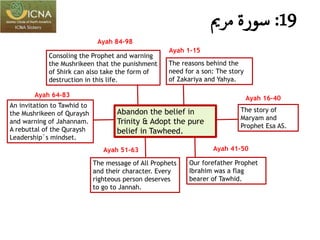
:19‫سورة‬‫مرمي‬
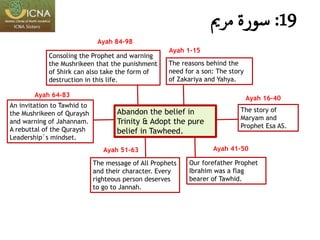
Abandon the belief in
Trinity & Adopt the pure
belief in Tawheed.
The reasons behind the
need for a son: The story
of Zakariya and Yahya.
Ayah 1-15
The story of
Maryam and
Prophet Esa AS.
Ayah 16-40
Our forefather Prophet
Ibrahim was a flag
bearer of Tawhid.
Ayah 41-50
The message of All Prophets
and their character. Every
righteous person deserves
to go to Jannah.
Ayah 51-63
An invitation to Tawhid to
the Mushrikeen of Quraysh
and warning of Jahannam.
A rebuttal of the Quraysh
Leadership`s mindset.
Ayah 64-83
Consoling the Prophet and warning
the Mushrikeen that the punishment
of Shirk can also take the form of
destruction in this life.
Ayah 84-98
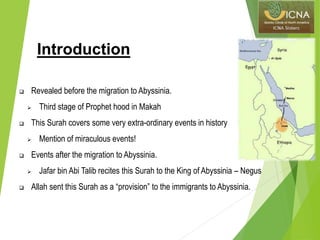
Introduction
 Revealed before the migration to Abyssinia.
 Third stage of Prophet hood in Makah
 This Surah covers some very extra-ordinary events in history
 Mention of miraculous events!
 Events after the migration to Abyssinia.
 Jafar bin Abi Talib recites this Surah to the King of Abyssinia – Negus
 Allah sent this Surah as a “provision” to the immigrants to Abyssinia.
Ruku 1
 Lessons from the story of Zakariya (AS)
 Allah is Able and Willing to answer duas, even when there is no means.
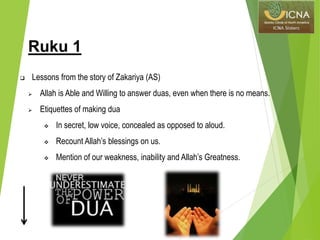
 Etiquettes of making dua
 In secret, low voice, concealed as opposed to aloud.
 Recount Allah’s blessings on us.
 Mention of our weakness, inability and Allah’s Greatness.
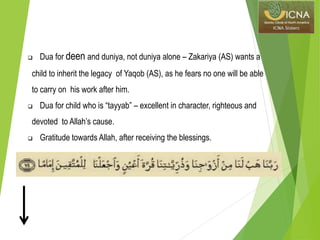
 Dua for deen and duniya, not duniya alone – Zakariya (AS) wants a
child to inherit the legacy of Yaqob (AS), as he fears no one will be able
to carry on his work after him.
 Dua for child who is “tayyab” – excellent in character, righteous and
devoted to Allah’s cause.
 Gratitude towards Allah, after receiving the blessings.
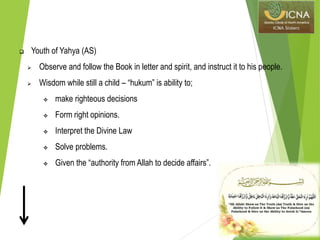
 Youth of Yahya (AS)
 Observe and follow the Book in letter and spirit, and instruct it to his people.
 Wisdom while still a child – “hukum” is ability to;
 make righteous decisions
 Form right opinions.
 Interpret the Divine Law
 Solve problems.
 Given the “authority from Allah to decide affairs”.
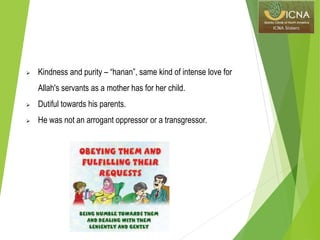
 Kindness and purity – “hanan”, same kind of intense love for
Allah's servants as a mother has for her child.
 Dutiful towards his parents.
 He was not an arrogant oppressor or a transgressor.
Ruku 2
 Purpose of story of Maryam (AS) and birth of Isa (AS)
 Trials bring one closer to Allah.
 Transition from story of Zakariya (AS) to birth of Isa (AS) – Allah has
the ability to do anything. He need only say: “Be” and it is.
 Miracles of Isa (AS)
Birth without a father. Talking in the cradle.
Design a bird of clay and blow life into it, with Allah’s permission.
Bring sight to a person who was born blind. Heal the leper.
 “Sirat al Mustaqeem” – Addresses to both Jews and Christians, as
both have opposite extreme views about Isa (AS)
 Miracles were given to Isa (AS) to strengthen the “Doctrine of
Tauhid” and reject shirk.
Ruku 3
 Mention of Ibrahim (AS) and his trials.
 Addressing the Quraish directly
 They also revere him as their leader and forefather.
 They forced their relatives to stop worshipping Allah or migrate
from the land, like Ibrahim (AS).
 Etiquette for dawah to a superior.
 Show respect and love for the person.
 Present logical evidence.
 Speak in courteous and mannerly fashion.
 Convey your earnest intention for reform.
 Tarbiyah for emigrants to Abyssinia.
 Need for migration when times are tough.
 Develop moral courage to continue practicing their faith and do dawah too.
 Learn etiquette for dawah to Negus.
 Comfort to them that they will be blessed and honored like Ibrahim (AS).
Ruku 4
 Mention of other Prophets
 Learn and follow their Seerah.
 Sunnah of all Prophets;
 Establish Salah and give Zakah.
 Direct the family to do the same – “save yourself and your families from Fire”
(Surah Tahreem:6).
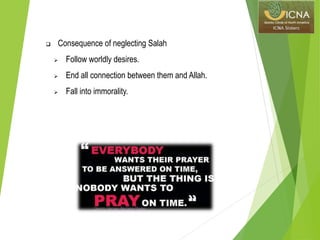
 Consequence of neglecting Salah
 Follow worldly desires.
 End all connection between them and Allah.
 Fall into immorality.
Ruku 5
 Addressing the people who reject Hereafter.
 Each and every person has to pass over the Fire.
 The disbelievers will be made to sit around the Fire on their knees.
 Dispel the idea that worldly affluence does not imply Allah’s Grace on the
disbelievers.
 Many prosperous and rich nations crumbled to dust and vanished
without leaving a trace.
 Allah gives respite to those who choose to disbelieve.
 Allah increases guidance to those who believe.
 ‫ت‬ ٰ‫ح‬ِ‫ل‬ّٰ‫الص‬ ُ‫ت‬ٰ‫ي‬ِ‫ق‬ٰ‫ب‬ۡ‫ال‬ – Everlasting good deeds are better in the sight of
Allah.
Ruku 6
 Doctrine of Tauhid is reinforced.
 Rejection of attributing a “son to god”.
 Monstrous falsehood – the Heavens might crack, the earth might split apart
and the mountains might crumble to pieces!
 Quran has been made easy.
 Sent in the language of the Arabs, as they were the first addressees.
 Best language selected to present evidences and arguments.
 Full of parables and stories, for those who want to ponder.
 Allah’s Grace and Mercy is the central theme of the Surah.
 Mention of “Rahman” –16 times.
 Mention of “Rahmat” – 4 times.
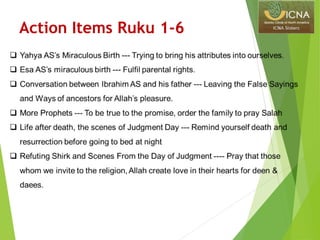
Action Items Ruku 1-6
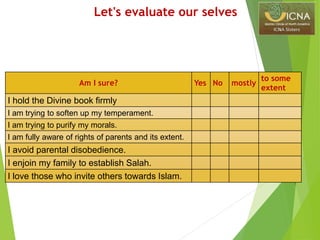
Let's evaluate our selves
Am I sure? Yes No mostly
to some
extent
I hold the Divine book firmly
I am trying to soften up my temperament.
I am trying to purify my morals.
I am fully aware of rights of parents and its extent.
I avoid parental disobedience.
I enjoin my family to establish Salah.
I love those who invite others towards Islam.
:19‫سورة‬‫مرمي‬
Abandon the belief in
Trinity & Adopt the pure
belief in Tawheed.
The reasons behind the
need for a son: The story
of Zakariya and Yahya.
Ayah 1-15
The story of
Maryam and
Prophet Esa AS.
Ayah 16-40
Our forefather Prophet
Ibrahim was a flag
bearer of Tawhid.
Ayah 41-50
The message of All Prophets
and their character. Every
righteous person deserves
to go to Jannah.
Ayah 51-63
An invitation to Tawhid to
the Mushrikeen of Quraysh
and warning of Jahannam.
A rebuttal of the Quraysh
Leadership`s mindset.
Ayah 64-83
Consoling the Prophet and warning
the Mushrikeen that the punishment
of Shirk can also take the form of
destruction in this life.
Ayah 84-98

Surah maryam New PPT

  • 2.
    :19‫سورة‬‫مرمي‬ Abandon the beliefin Trinity & Adopt the pure belief in Tawheed. The reasons behind the need for a son: The story of Zakariya and Yahya. Ayah 1-15 The story of Maryam and Prophet Esa AS. Ayah 16-40 Our forefather Prophet Ibrahim was a flag bearer of Tawhid. Ayah 41-50 The message of All Prophets and their character. Every righteous person deserves to go to Jannah. Ayah 51-63 An invitation to Tawhid to the Mushrikeen of Quraysh and warning of Jahannam. A rebuttal of the Quraysh Leadership`s mindset. Ayah 64-83 Consoling the Prophet and warning the Mushrikeen that the punishment of Shirk can also take the form of destruction in this life. Ayah 84-98
  • 4.
    Introduction  Revealed beforethe migration to Abyssinia.  Third stage of Prophet hood in Makah  This Surah covers some very extra-ordinary events in history  Mention of miraculous events!  Events after the migration to Abyssinia.  Jafar bin Abi Talib recites this Surah to the King of Abyssinia – Negus  Allah sent this Surah as a “provision” to the immigrants to Abyssinia.
  • 5.
    Ruku 1  Lessonsfrom the story of Zakariya (AS)  Allah is Able and Willing to answer duas, even when there is no means.  Etiquettes of making dua  In secret, low voice, concealed as opposed to aloud.  Recount Allah’s blessings on us.  Mention of our weakness, inability and Allah’s Greatness.
  • 6.
     Dua fordeen and duniya, not duniya alone – Zakariya (AS) wants a child to inherit the legacy of Yaqob (AS), as he fears no one will be able to carry on his work after him.  Dua for child who is “tayyab” – excellent in character, righteous and devoted to Allah’s cause.  Gratitude towards Allah, after receiving the blessings.
  • 7.
     Youth ofYahya (AS)  Observe and follow the Book in letter and spirit, and instruct it to his people.  Wisdom while still a child – “hukum” is ability to;  make righteous decisions  Form right opinions.  Interpret the Divine Law  Solve problems.  Given the “authority from Allah to decide affairs”.
  • 8.
     Kindness andpurity – “hanan”, same kind of intense love for Allah's servants as a mother has for her child.  Dutiful towards his parents.  He was not an arrogant oppressor or a transgressor.
  • 9.
    Ruku 2  Purposeof story of Maryam (AS) and birth of Isa (AS)  Trials bring one closer to Allah.  Transition from story of Zakariya (AS) to birth of Isa (AS) – Allah has the ability to do anything. He need only say: “Be” and it is.  Miracles of Isa (AS) Birth without a father. Talking in the cradle. Design a bird of clay and blow life into it, with Allah’s permission. Bring sight to a person who was born blind. Heal the leper.
  • 10.
     “Sirat alMustaqeem” – Addresses to both Jews and Christians, as both have opposite extreme views about Isa (AS)  Miracles were given to Isa (AS) to strengthen the “Doctrine of Tauhid” and reject shirk.
  • 11.
    Ruku 3  Mentionof Ibrahim (AS) and his trials.  Addressing the Quraish directly  They also revere him as their leader and forefather.  They forced their relatives to stop worshipping Allah or migrate from the land, like Ibrahim (AS).  Etiquette for dawah to a superior.  Show respect and love for the person.  Present logical evidence.  Speak in courteous and mannerly fashion.  Convey your earnest intention for reform.
  • 12.
     Tarbiyah foremigrants to Abyssinia.  Need for migration when times are tough.  Develop moral courage to continue practicing their faith and do dawah too.  Learn etiquette for dawah to Negus.  Comfort to them that they will be blessed and honored like Ibrahim (AS).
  • 13.
    Ruku 4  Mentionof other Prophets  Learn and follow their Seerah.  Sunnah of all Prophets;  Establish Salah and give Zakah.  Direct the family to do the same – “save yourself and your families from Fire” (Surah Tahreem:6).
  • 14.
     Consequence ofneglecting Salah  Follow worldly desires.  End all connection between them and Allah.  Fall into immorality.
  • 15.
    Ruku 5  Addressingthe people who reject Hereafter.  Each and every person has to pass over the Fire.  The disbelievers will be made to sit around the Fire on their knees.  Dispel the idea that worldly affluence does not imply Allah’s Grace on the disbelievers.
  • 16.
     Many prosperousand rich nations crumbled to dust and vanished without leaving a trace.  Allah gives respite to those who choose to disbelieve.  Allah increases guidance to those who believe.  ‫ت‬ ٰ‫ح‬ِ‫ل‬ّٰ‫الص‬ ُ‫ت‬ٰ‫ي‬ِ‫ق‬ٰ‫ب‬ۡ‫ال‬ – Everlasting good deeds are better in the sight of Allah.
  • 17.
    Ruku 6  Doctrineof Tauhid is reinforced.  Rejection of attributing a “son to god”.  Monstrous falsehood – the Heavens might crack, the earth might split apart and the mountains might crumble to pieces!  Quran has been made easy.  Sent in the language of the Arabs, as they were the first addressees.  Best language selected to present evidences and arguments.  Full of parables and stories, for those who want to ponder.
  • 18.
     Allah’s Graceand Mercy is the central theme of the Surah.  Mention of “Rahman” –16 times.  Mention of “Rahmat” – 4 times.
  • 19.
  • 20.
    Let's evaluate ourselves Am I sure? Yes No mostly to some extent I hold the Divine book firmly I am trying to soften up my temperament. I am trying to purify my morals. I am fully aware of rights of parents and its extent. I avoid parental disobedience. I enjoin my family to establish Salah. I love those who invite others towards Islam.
  • 21.
    :19‫سورة‬‫مرمي‬ Abandon the beliefin Trinity & Adopt the pure belief in Tawheed. The reasons behind the need for a son: The story of Zakariya and Yahya. Ayah 1-15 The story of Maryam and Prophet Esa AS. Ayah 16-40 Our forefather Prophet Ibrahim was a flag bearer of Tawhid. Ayah 41-50 The message of All Prophets and their character. Every righteous person deserves to go to Jannah. Ayah 51-63 An invitation to Tawhid to the Mushrikeen of Quraysh and warning of Jahannam. A rebuttal of the Quraysh Leadership`s mindset. Ayah 64-83 Consoling the Prophet and warning the Mushrikeen that the punishment of Shirk can also take the form of destruction in this life. Ayah 84-98