o September 2, 1945
The Allied Powers
had defeated the Axis Powers.
US
UK USSR
Germany Japan
o Two countries emerged from WWII as international powers.
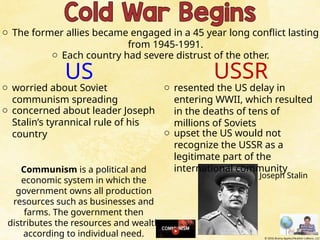
US USSR
WHY? HOW?
Both had:
o independent economies
o strong militaries
o capability to produce
nuclear weapons
o remained largely
undamaged from the
destruction of war
o The former allies became engaged in a 45 year long conflict lasting
from 1945-1991.
o Each country had severe distrust of the other.
US USSR
o worried about Soviet
communism spreading
o concerned about leader Joseph
Stalin’s tyrannical rule of his
country
o resented the US delay in
entering WWII, which resulted
in the deaths of tens of
millions of Soviets
Joseph Stalin
Communism is a political and
economic system in which the
government owns all production
resources such as businesses and
farms. The government then
distributes the resources and wealth
according to individual need.
o upset the US would not
recognize the USSR as a
legitimate part of the
international community
Germany was divided into 4 zones.
o Each of the Allies occupied, or
controlled, one zone.
o The capital of Berlin was deep in USSR
controlled territory.
o But it was still divided into 4 zones,
with the Allies each occupying one
zone.
o Germany was devastated by WWII and lacked a stable
government.
o The Allies knew Germany needed help.
o After WWII, the US and USSR knew that Europe would struggle to
rebuild itself.
o But US President Harry Truman and Soviet dictator Stalin
disagreed on how to help Europe.
The US favored democracy.
The USSR favored communism.
o Western European countries,
including West Germany & West
Berlin, had democratic
governments.
o The communist countries,
including East Germany & East
Berlin, became the Eastern Bloc.
o The democratic countries,
including the US, became the
Western Bloc.
o The USSR instilled communist
governments in these countries.
o The USSR occupied several east
European countries after WWII.
o The leaders of the Western Bloc were
fearful that communism would spread.
o They wanted to contain, or prevent the
spread, of communism.
o Former UK Prime Minister Winston Churchill referred to the line
that divided the Western and Eastern Blocs as the Iron Curtain.
o Tensions increased between the US and
USSR.
o By the start of 1946, Stalin placed the Eastern Bloc under tight
restrictions.
o Citizens could no longer move or travel freely.
o Stalin did not want Soviet controlled
countries to have open contact with the
West and non-Soviet controlled
countries.
o The US used the policy of containment to prevent the spread of
communism.
o offer aid and troops to
countries that were in danger
of falling to communism
The US did: The US did NOT:
o fight communism where it
already existed
Both the US and USSR competed to
be the stronger country and expand
global influence.
e Race
Sputnik I
Arms
Race
US nuclear missile rising
from the ocean.
Proxy Wars
US troops in Vietnam.
o The US and USSR wanted to increase their stockpile of nuclear
weapons.
o They wanted to outdo the other.
However, neither country wanted to use its nuclear weapons.
o They knew a direct war with nuclear weapons could destroy the
earth.
o Both countries detonated nuclear weapons to show the other its
strength.
Instead, they fought each other
through proxy wars.
o The US and USSR battled each other indirectly.
o Each supported an opposing side involved in a war.
o They provided aid and troops.
o The US and USSR wanted to further their own agenda.
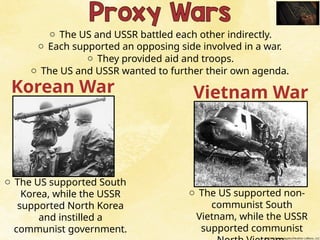
Korean War
o The US supported South
Korea, while the USSR
supported North Korea
and instilled a
communist government.
Vietnam War
o The US supported non-
communist South
Vietnam, while the USSR
supported communist
o Not only did the US and USSR compete with one another for the
most powerful nuclear weapons, they also competed for the best
space exploration and technology.
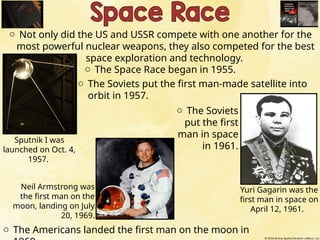
o The Space Race began in 1955.
o The Soviets put the first man-made satellite into
orbit in 1957.
Sputnik I was
launched on Oct. 4,
1957.
o The Soviets
put the first
man in space
in 1961.
Yuri Gagarin was the
first man in space on
April 12, 1961.
o The Americans landed the first man on the moon in
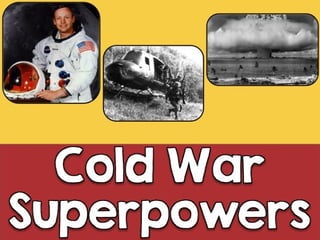
Neil Armstrong was
the first man on the
moon, landing on July
20, 1969.
o The Cold War came to an end on December, 24, 1991, when the
USSR dissolved.
o Its economy and government were struggling, and its people were
unhappy.
o 15 independent and separate countries emerged, with Russia
being the largest.
With the collapse of the USSR, the Cold War
came to an end.
Fonts, Photos, & Clipart
KG Fonts
www.teacherspayteachers.com/Store/Kimberly-Geswein-Fonts
www.commons.wikimedia.org
© 2016 2 Brainy Apples/Heather LeBlanc, LLC

Superpowers: A Cold War Presentation 9-12

  • 2.
    o September 2,1945 The Allied Powers had defeated the Axis Powers. US UK USSR Germany Japan
  • 3.
    o Two countriesemerged from WWII as international powers. US USSR WHY? HOW? Both had: o independent economies o strong militaries o capability to produce nuclear weapons o remained largely undamaged from the destruction of war
  • 4.
    o The formerallies became engaged in a 45 year long conflict lasting from 1945-1991. o Each country had severe distrust of the other. US USSR o worried about Soviet communism spreading o concerned about leader Joseph Stalin’s tyrannical rule of his country o resented the US delay in entering WWII, which resulted in the deaths of tens of millions of Soviets Joseph Stalin Communism is a political and economic system in which the government owns all production resources such as businesses and farms. The government then distributes the resources and wealth according to individual need. o upset the US would not recognize the USSR as a legitimate part of the international community
  • 5.
    Germany was dividedinto 4 zones. o Each of the Allies occupied, or controlled, one zone. o The capital of Berlin was deep in USSR controlled territory. o But it was still divided into 4 zones, with the Allies each occupying one zone. o Germany was devastated by WWII and lacked a stable government. o The Allies knew Germany needed help.
  • 6.
    o After WWII,the US and USSR knew that Europe would struggle to rebuild itself. o But US President Harry Truman and Soviet dictator Stalin disagreed on how to help Europe. The US favored democracy. The USSR favored communism. o Western European countries, including West Germany & West Berlin, had democratic governments. o The communist countries, including East Germany & East Berlin, became the Eastern Bloc. o The democratic countries, including the US, became the Western Bloc. o The USSR instilled communist governments in these countries. o The USSR occupied several east European countries after WWII.
  • 7.
    o The leadersof the Western Bloc were fearful that communism would spread. o They wanted to contain, or prevent the spread, of communism. o Former UK Prime Minister Winston Churchill referred to the line that divided the Western and Eastern Blocs as the Iron Curtain. o Tensions increased between the US and USSR. o By the start of 1946, Stalin placed the Eastern Bloc under tight restrictions. o Citizens could no longer move or travel freely. o Stalin did not want Soviet controlled countries to have open contact with the West and non-Soviet controlled countries.
  • 8.
    o The USused the policy of containment to prevent the spread of communism. o offer aid and troops to countries that were in danger of falling to communism The US did: The US did NOT: o fight communism where it already existed Both the US and USSR competed to be the stronger country and expand global influence. e Race Sputnik I Arms Race US nuclear missile rising from the ocean. Proxy Wars US troops in Vietnam.
  • 9.
    o The USand USSR wanted to increase their stockpile of nuclear weapons. o They wanted to outdo the other. However, neither country wanted to use its nuclear weapons. o They knew a direct war with nuclear weapons could destroy the earth. o Both countries detonated nuclear weapons to show the other its strength. Instead, they fought each other through proxy wars.
  • 10.
    o The USand USSR battled each other indirectly. o Each supported an opposing side involved in a war. o They provided aid and troops. o The US and USSR wanted to further their own agenda. Korean War o The US supported South Korea, while the USSR supported North Korea and instilled a communist government. Vietnam War o The US supported non- communist South Vietnam, while the USSR supported communist
  • 11.
    o Not onlydid the US and USSR compete with one another for the most powerful nuclear weapons, they also competed for the best space exploration and technology. o The Space Race began in 1955. o The Soviets put the first man-made satellite into orbit in 1957. Sputnik I was launched on Oct. 4, 1957. o The Soviets put the first man in space in 1961. Yuri Gagarin was the first man in space on April 12, 1961. o The Americans landed the first man on the moon in Neil Armstrong was the first man on the moon, landing on July 20, 1969.
  • 12.
    o The ColdWar came to an end on December, 24, 1991, when the USSR dissolved. o Its economy and government were struggling, and its people were unhappy. o 15 independent and separate countries emerged, with Russia being the largest. With the collapse of the USSR, the Cold War came to an end.
  • 13.
    Fonts, Photos, &Clipart KG Fonts www.teacherspayteachers.com/Store/Kimberly-Geswein-Fonts www.commons.wikimedia.org © 2016 2 Brainy Apples/Heather LeBlanc, LLC

Editor's Notes

  • #3 *Click on the video. The video is a link to Kahn Academy at https://www.khanacademy.org/humanities/us-history/postwarera/postwar-era/v/origins-of-the-cold-war The video is about the origins of the Cold War. It is about 12 minutes long.
  • #4 *Click on the video, The video is a link to Kahn Academy at https://www.khanacademy.org/humanities/world-history/euro-hist/cold-war/v/communism The video is an overview of communism. It is about 15 minutes long. *Click on the video. The video is a link to Kahn Academy at https://www.khanacademy.org/partner-content/crash-course1/crash-course-world-history/nationalism-imperialism-globalization/v/crash-course-world-history-39 The video is the crash course about the Cold War. It is about 12 minutes long.
  • #6 Neutral countries are designated by the gray shading. These countries were not part of either Bloc.
  • #7 *Click on the photo. The photo is a link to an audio at the History Channel at http://www.history.com/topics/british-history/winston-churchill/videos/churchills-iron-curtain-speech It is about 20 seconds long, and it is of Former UK Prime Minister Winston Churchill addressing the Iron Curtain.
  • #9 *Click on the video. The video is a link to a page with several video clips of nuclear weapons being detonated at http://io9.gizmodo.com/these-videos-of-nuclear-weapon-tests-are-terrifying-but-1706320127
  • #10 *Click on the video. The video is a link to the History Channel at http://www.history.com/topics/vietnam-war/vietnam-war-history/videos/the-road-to-war The video is an overview of the Vietnam War. The video is about 3 minutes long.
  • #11 *Click on the video. The video is a link to the History Channel at http://www.history.com/topics/space-race/videos/the-space-race The video is about the Space Race. It is about 3 minutes. *Click on the video. The video is a link to the History Channel at http://www.history.com/topics/space-race/videos/space-race-cold-war-front?m=528e394da93ae&s=undefined&f=1&free=false The video is about the Space Race. It is about 4 minutes long.
  • #12 *Click on the video. The video is a link to the History Channel at http://www.history.com/topics/cold-war/fall-of-soviet-union/videos/the-fall-of-the-soviet-union The video is an overview of how the USSR dissolved. It is about 3 minutes.