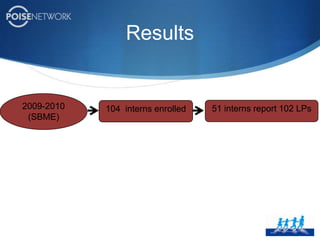
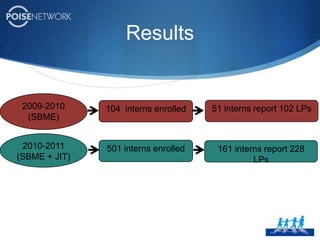

Impact of a Simulation-Based Just-In-Time Refresher Training for Interns on Their Clinical Success Rate with Infant Lumbar PunctureDavid Kessler, MD, MScAssistant Professor of Clinical PediatricsDirector of Clinical OperationsDivision of Pediatric Emergency MedicineCo-director of the POISE research networkDaniel Fein, Todd Chang, DeweshAgrawal, Jennifer Reid, Joshua Rocker, Martin Pusic, Laura Haubner, Marc Auerbachon behalf of the POISE Investigators
Conflict of InterestOn behalf of myself (and any co-presenters of the papers I am responsible for), I declare to my knowledge, there are no conflicts of interest that would prevent me from presenting this work at the IPSSW2011.The POISE Network is funded by a grant by
BackgroundSimulation is effective for skills training
The ideal timing and duration of training needed to     make a clinical impact are largely unknown
BackgroundSimulation based mastery education (SBME) is a method of training to a predefined endpointBackgroundSimulation based mastery education (SBME) is a method of training to a predefined endpoint
Metanalysis of SBME using deliberate practice vs traditional clinical education
Inclusion: SBME intervention, comparison group, skill outcome
3742 articles screened, 14 included
Effect size: 0.71 (95% confidence interval, 0.65–0.76; P  .001)McGaghie W, Issenberg B, Cohen E, Barsuk J, Wayne D.  Does Simulation-Based Medical Education With Deliberate Practice Yield Better Results Than Traditional Clinical Education? A Meta-Analytic Comparative Review of The Evidence. Acad Med. 2011;86:706–711
BackgroundJust-in-time (JIT) training is a refresher session that occurs temporally close to the actual clinical encounter / skill being performedBackgroundJust-in-time (JIT) training is a refresher session that occurs temporally close to the actual clinical encounter / skill being performed
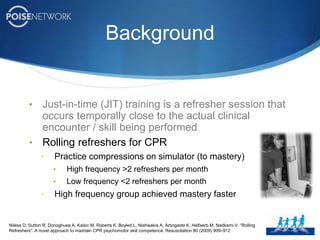
Rolling refreshers for CPR
Practice compressions on simulator (to mastery)
High frequency >2 refreshers per month
Low frequency <2 refreshers per month
High frequency group achieved mastery fasterNilesa D, Sutton R, Donoghuea A, Kalsic M, Roberts K, Boyled L, Nishisakia A, Arbogaste K, Helfaerb M, Nadkarni V. “Rolling Refreshers”: A novel approach to maintain CPR psychomotor skill competence. Resuscitation 80 (2009) 909–912
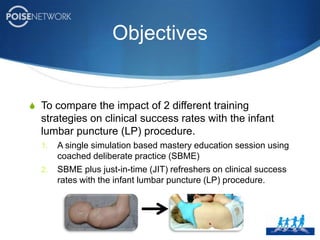
ObjectivesTo compare the impact of 2 different training strategies on clinical success rates with the infant lumbar puncture (LP) procedure.Asingle simulation based mastery education session using coached deliberate practice (SBME) SBME plus just-in-time (JIT) refreshers on clinical success rates with the infant lumbar puncture (LP) procedure.
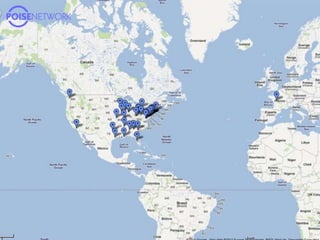
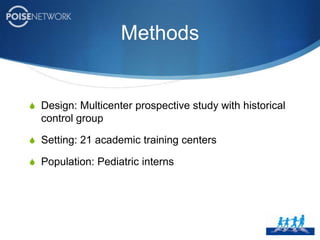
MethodsDesign: Multicenter prospective study with historical control groupSetting: 21 academic training centersPopulation: Pediatric interns
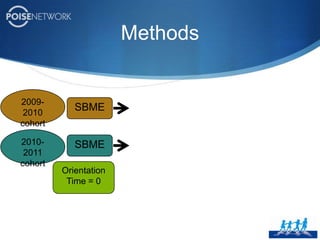
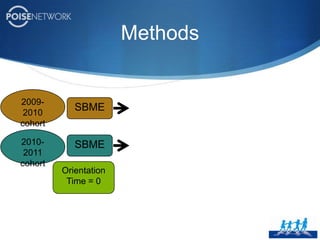
Methods2009-2010 cohort SBME2010-2011 cohort SBMEOrientationTime = 0
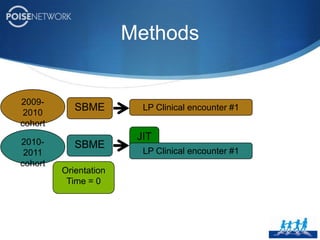
Methods2009-2010 cohort SBMELP Clinical encounter #1JIT2010-2011 cohort SBMELP Clinical encounter #1OrientationTime = 0
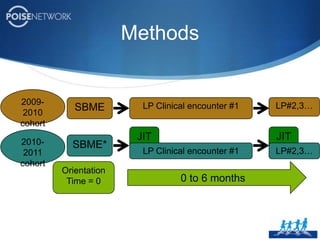
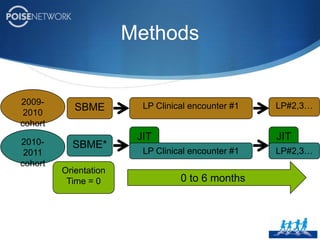
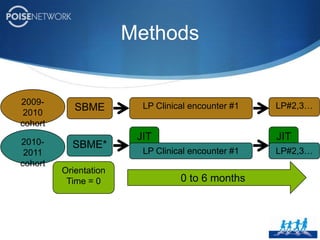
Methods2009-2010 cohort SBMELP Clinical encounter #1LP#2,3…JITJIT 2010-2011 cohort SBME*LP#2,3…LP Clinical encounter #1OrientationTime = 00 to 6 months
Primary outcome: atraumatic infant LP (<1000 rbcs/hpf)

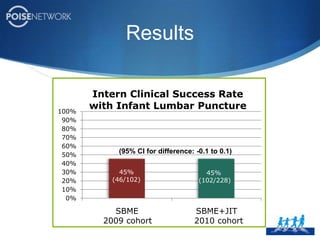
IPSSW Impact on LP Success

  • 1.
    Impact of aSimulation-Based Just-In-Time Refresher Training for Interns on Their Clinical Success Rate with Infant Lumbar PunctureDavid Kessler, MD, MScAssistant Professor of Clinical PediatricsDirector of Clinical OperationsDivision of Pediatric Emergency MedicineCo-director of the POISE research networkDaniel Fein, Todd Chang, DeweshAgrawal, Jennifer Reid, Joshua Rocker, Martin Pusic, Laura Haubner, Marc Auerbachon behalf of the POISE Investigators
  • 3.
    Conflict of InterestOnbehalf of myself (and any co-presenters of the papers I am responsible for), I declare to my knowledge, there are no conflicts of interest that would prevent me from presenting this work at the IPSSW2011.The POISE Network is funded by a grant by
  • 4.
  • 5.
    The ideal timingand duration of training needed to make a clinical impact are largely unknown
  • 6.
    BackgroundSimulation based masteryeducation (SBME) is a method of training to a predefined endpointBackgroundSimulation based mastery education (SBME) is a method of training to a predefined endpoint
  • 7.
    Metanalysis of SBMEusing deliberate practice vs traditional clinical education
  • 8.
    Inclusion: SBME intervention,comparison group, skill outcome
  • 9.
  • 10.
    Effect size: 0.71(95% confidence interval, 0.65–0.76; P .001)McGaghie W, Issenberg B, Cohen E, Barsuk J, Wayne D. Does Simulation-Based Medical Education With Deliberate Practice Yield Better Results Than Traditional Clinical Education? A Meta-Analytic Comparative Review of The Evidence. Acad Med. 2011;86:706–711
  • 11.
    BackgroundJust-in-time (JIT) trainingis a refresher session that occurs temporally close to the actual clinical encounter / skill being performedBackgroundJust-in-time (JIT) training is a refresher session that occurs temporally close to the actual clinical encounter / skill being performed
  • 12.
  • 13.
    Practice compressions onsimulator (to mastery)
  • 14.
    High frequency >2refreshers per month
  • 15.
    Low frequency <2refreshers per month
  • 16.
    High frequency groupachieved mastery fasterNilesa D, Sutton R, Donoghuea A, Kalsic M, Roberts K, Boyled L, Nishisakia A, Arbogaste K, Helfaerb M, Nadkarni V. “Rolling Refreshers”: A novel approach to maintain CPR psychomotor skill competence. Resuscitation 80 (2009) 909–912
  • 17.
    ObjectivesTo compare theimpact of 2 different training strategies on clinical success rates with the infant lumbar puncture (LP) procedure.Asingle simulation based mastery education session using coached deliberate practice (SBME) SBME plus just-in-time (JIT) refreshers on clinical success rates with the infant lumbar puncture (LP) procedure.
  • 18.
    MethodsDesign: Multicenter prospectivestudy with historical control groupSetting: 21 academic training centersPopulation: Pediatric interns
  • 19.
    Methods2009-2010 cohort SBME2010-2011cohort SBMEOrientationTime = 0
  • 20.
    Methods2009-2010 cohort SBME2010-2011cohort SBMEOrientationTime = 0
  • 21.
    Methods2009-2010 cohort SBMELPClinical encounter #1JIT2010-2011 cohort SBMELP Clinical encounter #1OrientationTime = 0
  • 22.
    Methods2009-2010 cohort SBMELPClinical encounter #1LP#2,3…JITJIT 2010-2011 cohort SBME*LP#2,3…LP Clinical encounter #1OrientationTime = 00 to 6 months
  • 23.
    Methods2009-2010 cohort SBMELPClinical encounter #1LP#2,3…JITJIT 2010-2011 cohort SBME*LP#2,3…LP Clinical encounter #1OrientationTime = 00 to 6 months
  • 24.
    Methods2009-2010 cohort SBMELPClinical encounter #1LP#2,3…JITJIT 2010-2011 cohort SBME*LP#2,3…LP Clinical encounter #1OrientationTime = 00 to 6 months
  • 25.
    Primary outcome: atraumaticinfant LP (<1000 rbcs/hpf)

Editor's Notes

  • #2 Congress center PierreBaudis. 10 minute talk. 5 minute Q&amp;ALook at notes on each slide.
  • #3 35 hospitalsPoitiers??
  • #5 SHOULD I HAVE LP BACKGROUND?
  • #6 Endpoint or minimum passing scoreUsing deliberate practice1990 to 2010
  • #7 Using deliberate practice- define?1990 to 2010
  • #8 Add picture of JIT?
  • #9 Add picture of JIT?DELETE SLIDE- or use example of kicker warming up…Or talk about distributed practice…then move on to JIT
  • #10 CHANGE TEARDROP(that occur before clinical LP attempts)
  • #11 INTERNS with almost no prior infant LP procedure experienceAnd low skill levels
  • #12 Describe SBME using checklist for mastery (add pic?) instructors trained with web based module.All watched audiovisual presentation
  • #18 ADD copyrite logo
  • #21 Consider adding to previous slide instead…Mention interns suck normally (45%)