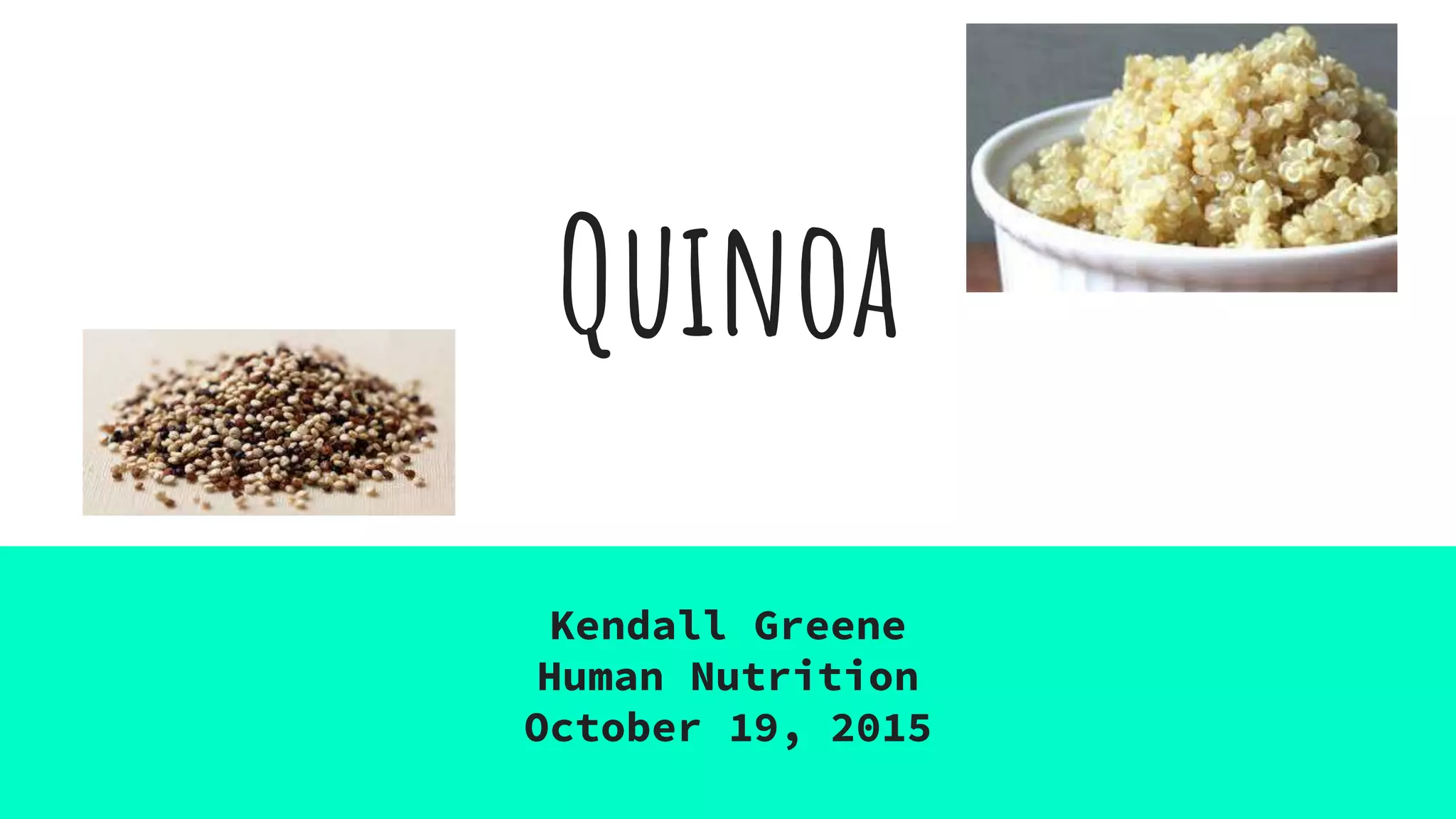
Quinoa
Kendall Greene
Human Nutrition
October 19, 2015
Introduction to quinoa
Quinoa is one of the oldest crops in the American continent. It is native to the
Andean regions of South America. Quinoa can grow in a variety of conditions. It is
technically a pseudocereal, but is considered a grain. Many people describe it as a
seed as well. It is gaining popularity because of its many health benefits that are
being recognized by many including vegans and vegetarians. Vegans and
Vegetarians are searching for complete proteins to supplement their diet with, and
quinoa is a great source of complete protein. 2013 was named the International
Year of Quinoa by the United Nations Food and Agriculture Organization. Quinoa
is also considered an ancient grain. Sales of ancient grains rose steeply in the 52
weeks ending July 13, 2014.
Nutritional value of quinoa
Nutrient Profile:
● Fiber:17-27g per cup
● Contains quercetin and kaempferol
● Protein: 8g per cup of cooked quinoa
● High in all the essential amino acids
● Low glycemic index
Nutritional value Continued
Health benefits:
● Fiber: Quinoa includes soluble and insoluble fiber. Soluble fiber helps to reduce blood sugar.
● The two flavonoids have been shown to have anti-inflammatory, antiviral, anti-cancer, and anti-
depressant effects.
● Protein helps in many body processes such as growth and development of new cells.
● By being high in all the essential amino acids, it means that quinoa is a complete protein.
● Having a low glycemic index allows for quinot to keep you feeling fuller longer.
Other health benefits of quinoa
● Reduces blood sugar
● Reduces insulin levels
● Reduces triglyceride levels
● Neutralizes free radicals
● Fights against diseases and aging
Health benefits continued
● Low in calories- 1C.=22 calories
● Increases metabolism
● Low glycemic index- helps to prevent type 2 diabetes
● Reduced risk of cardiovascular disease, high blood pressure, colon cancer,
and obesity
research study 1
In this study, scientists were looking at the effect of quinoa seeds on the lipid profiles, protein metabolism,
and selected essential elements in Wistar male rats. There were four groups of rats. There were two groups
that were given standard fodder that consisted of cornstarch. One of the standard groups also had fructose
added to it. The third group was given quinoa seeds instead of corn starch. The fourth group was given
just fructose. The rats were studied for five weeks. At the end of the five weeks, their blood was sampled to
look at their lipid profiles. This is where the most significant changes were seen.
Research Study 1 Continued
Quinoa seeds significantly decreased the total cholesterol in all the rats. High fructose intake did not
influence total cholesterol in any of the groups. LDL decreased in the rats that consumed quinoa seeds in
comparison to the control group. Fructose decreased the HDL level in the control group but when quinoa
seeds were added into the diet the decrease of HDL was not observed. Triglycerides levels decreased when
quinoa seeds were added to the diet. In all fructose fed groups, triglycerides increased. Fructose
consumption increased the uric concentrations regardless of the quinoa being added. It was found that
quinoa exerts many advantageous biochemical effects and can serve as a promising component of
functional foods. These findings can be translated into how quinoa effects humans as well.
research study 2
In this study, patients that have been diagnosed with celiac disease were asked to consume consume 50g of quinoa daily for
six weeks. They used in-vitro data taken during the study to decide if quinoa could be added to the recommended gluten free
diet that all celiac patients follow. Since quinoa has many nutritious properties and benefits, it was the researchers hope that
these patients would respond well to the quinoa and could add it into their diet. In most cases the intestinal health of the
patients remained normal and even increased in some ways. LDL decreased for most patients. Median values for all of the
blood tests remained in the normal range. It was concluded that adding quinoa into celiac patients diets was well tolerated
and did not exacerbate their conditions. This means that quinoa can be added into the diet of celiac patients without adverse
effects.
research study 3
In this study, 35 women who had been in menopause for at least two years without hormone therapy were
asked to consume 25g of either quinoa flakes or corn flakes daily. This was a double blind study and took
place over four consecutive weeks. Anthropometric samples as well as blood samples were taken at the
beginning and end of the four week study. The researchers were investigating the effect of quinoa on the
concentrations of glucose, total cholesterol, and on oxidative stress markers in these women. In the groups
that were given quinoa flakes, there was a significant increase of fiber, carbohydrate, and protein intake.
There was also a significant decrease in the total cholesterol as well as vitamin E concentration. The
results showed that the daily intake of quinoa did not change the anthropometric parameters, but it did
improve their lipid profiles. This helped the researches show that there is a beneficial effect of quinoa
intake for menopausal women.
Recommendations for quinoa consumption
Since quinoa is considered both a grain but also a source of protein, it depends on
what you are counting it as to decide how much you should eat of it. Adults should
eat six grams of grain a day with three being whole grains. Adult women should
eat approximately 46 grams a day, while men should eat 56 grams a day. Quinoa
can be eaten as porridge for breakfast. It can also be ground into flour to use for
any baked goods. You can boil it like rice and replace it in rice or pasta dishes. It is
also good added into salads. Some granola bars contain uncooked quinoa as well.
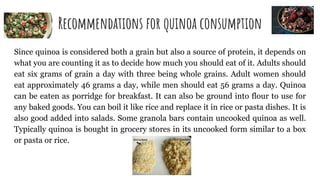
Typically quinoa is bought in grocery stores in its uncooked form similar to a box
or pasta or rice.
references
De Carvalho, F. G., Ovídio, P. P., Padovan, G. J., Jordão Junior, A. A., Marchini, J. S., & Navarro, A. M. (2014). Metabolic
parameters of postmenopausal women after quinoa or corn flakes intake - a prospective and double-blind study.
International Journal Of Food Sciences & Nutrition, 65(3), 380-385.
Gunner, K. (2014). 11 Proven Health Benefits of Quinoa. Authority Nutrition.
http://authoritynutrition.com/11-proven-benefits-of-quinoa/
Jancurova, M., Minarovicova L., Dandar A. (2009). Quinoa - a Review. Czech J. Food Sci.
http://www.agriculturejournals.cz/publicFiles/06732.pdf
Paśko, P., Zagrodzki, P., Bartoń, H., Chłopicka, J., & Gorinstein, S. (2010). Effect of
Quinoa Seeds ( Chenopodium quinoa) in Diet on some Biochemical Parameters and Essential Elements in Blood of
High Fructose-Fed Rats. Plant Foods For Human Nutrition, 65(4), 333-338. doi:10.1007/s11130-010-0197-x
References continued
Ruiz, K., Biondi, S., Oses, R., Acuna-Rodriguez, I., Antognoni, F., Martinez-Mosqueira,
E., Coulibaly, A., Canahua-Murillo, A., Pinto, M., Zurita-Saliva, A., Bazile, D.,
Jacobsen, S., Molina-Montenegro, M. (2013). Quinoa Biodiversity and
Sustainability for Food Security Under Climate Change. INRA.
http://www.researchgate.net/publication/258796109_Quinoa_biodiversity_and_sustainability_for_food_security_
under_climate_change._A_review
Zevallos, V. F., Herencia, L. I., Chang, F., Donnelly, S., Ellis, H. J., & Ciclitira, P. J.
(2014). Gastrointestinal effects of eating quinoa (Chenopodium quinoa Willd.) in celiac patients. The American
Journal Of Gastroenterology, 109(2), 270-278. doi:10.1038/ajg.2013.431
(2015). Superfood Quinoa. All About Quinoa Blog. https://allaboutquinoa.wordpress.com/

Superfood presentation

  • 1.
  • 2.
    Introduction to quinoa Quinoais one of the oldest crops in the American continent. It is native to the Andean regions of South America. Quinoa can grow in a variety of conditions. It is technically a pseudocereal, but is considered a grain. Many people describe it as a seed as well. It is gaining popularity because of its many health benefits that are being recognized by many including vegans and vegetarians. Vegans and Vegetarians are searching for complete proteins to supplement their diet with, and quinoa is a great source of complete protein. 2013 was named the International Year of Quinoa by the United Nations Food and Agriculture Organization. Quinoa is also considered an ancient grain. Sales of ancient grains rose steeply in the 52 weeks ending July 13, 2014.
  • 3.
    Nutritional value ofquinoa Nutrient Profile: ● Fiber:17-27g per cup ● Contains quercetin and kaempferol ● Protein: 8g per cup of cooked quinoa ● High in all the essential amino acids ● Low glycemic index
  • 4.
    Nutritional value Continued Healthbenefits: ● Fiber: Quinoa includes soluble and insoluble fiber. Soluble fiber helps to reduce blood sugar. ● The two flavonoids have been shown to have anti-inflammatory, antiviral, anti-cancer, and anti- depressant effects. ● Protein helps in many body processes such as growth and development of new cells. ● By being high in all the essential amino acids, it means that quinoa is a complete protein. ● Having a low glycemic index allows for quinot to keep you feeling fuller longer.
  • 5.
    Other health benefitsof quinoa ● Reduces blood sugar ● Reduces insulin levels ● Reduces triglyceride levels ● Neutralizes free radicals ● Fights against diseases and aging
  • 6.
    Health benefits continued ●Low in calories- 1C.=22 calories ● Increases metabolism ● Low glycemic index- helps to prevent type 2 diabetes ● Reduced risk of cardiovascular disease, high blood pressure, colon cancer, and obesity
  • 7.
    research study 1 Inthis study, scientists were looking at the effect of quinoa seeds on the lipid profiles, protein metabolism, and selected essential elements in Wistar male rats. There were four groups of rats. There were two groups that were given standard fodder that consisted of cornstarch. One of the standard groups also had fructose added to it. The third group was given quinoa seeds instead of corn starch. The fourth group was given just fructose. The rats were studied for five weeks. At the end of the five weeks, their blood was sampled to look at their lipid profiles. This is where the most significant changes were seen.
  • 8.
    Research Study 1Continued Quinoa seeds significantly decreased the total cholesterol in all the rats. High fructose intake did not influence total cholesterol in any of the groups. LDL decreased in the rats that consumed quinoa seeds in comparison to the control group. Fructose decreased the HDL level in the control group but when quinoa seeds were added into the diet the decrease of HDL was not observed. Triglycerides levels decreased when quinoa seeds were added to the diet. In all fructose fed groups, triglycerides increased. Fructose consumption increased the uric concentrations regardless of the quinoa being added. It was found that quinoa exerts many advantageous biochemical effects and can serve as a promising component of functional foods. These findings can be translated into how quinoa effects humans as well.
  • 9.
    research study 2 Inthis study, patients that have been diagnosed with celiac disease were asked to consume consume 50g of quinoa daily for six weeks. They used in-vitro data taken during the study to decide if quinoa could be added to the recommended gluten free diet that all celiac patients follow. Since quinoa has many nutritious properties and benefits, it was the researchers hope that these patients would respond well to the quinoa and could add it into their diet. In most cases the intestinal health of the patients remained normal and even increased in some ways. LDL decreased for most patients. Median values for all of the blood tests remained in the normal range. It was concluded that adding quinoa into celiac patients diets was well tolerated and did not exacerbate their conditions. This means that quinoa can be added into the diet of celiac patients without adverse effects.
  • 10.
    research study 3 Inthis study, 35 women who had been in menopause for at least two years without hormone therapy were asked to consume 25g of either quinoa flakes or corn flakes daily. This was a double blind study and took place over four consecutive weeks. Anthropometric samples as well as blood samples were taken at the beginning and end of the four week study. The researchers were investigating the effect of quinoa on the concentrations of glucose, total cholesterol, and on oxidative stress markers in these women. In the groups that were given quinoa flakes, there was a significant increase of fiber, carbohydrate, and protein intake. There was also a significant decrease in the total cholesterol as well as vitamin E concentration. The results showed that the daily intake of quinoa did not change the anthropometric parameters, but it did improve their lipid profiles. This helped the researches show that there is a beneficial effect of quinoa intake for menopausal women.
  • 11.
    Recommendations for quinoaconsumption Since quinoa is considered both a grain but also a source of protein, it depends on what you are counting it as to decide how much you should eat of it. Adults should eat six grams of grain a day with three being whole grains. Adult women should eat approximately 46 grams a day, while men should eat 56 grams a day. Quinoa can be eaten as porridge for breakfast. It can also be ground into flour to use for any baked goods. You can boil it like rice and replace it in rice or pasta dishes. It is also good added into salads. Some granola bars contain uncooked quinoa as well. Typically quinoa is bought in grocery stores in its uncooked form similar to a box or pasta or rice.
  • 12.
    references De Carvalho, F.G., Ovídio, P. P., Padovan, G. J., Jordão Junior, A. A., Marchini, J. S., & Navarro, A. M. (2014). Metabolic parameters of postmenopausal women after quinoa or corn flakes intake - a prospective and double-blind study. International Journal Of Food Sciences & Nutrition, 65(3), 380-385. Gunner, K. (2014). 11 Proven Health Benefits of Quinoa. Authority Nutrition. http://authoritynutrition.com/11-proven-benefits-of-quinoa/ Jancurova, M., Minarovicova L., Dandar A. (2009). Quinoa - a Review. Czech J. Food Sci. http://www.agriculturejournals.cz/publicFiles/06732.pdf Paśko, P., Zagrodzki, P., Bartoń, H., Chłopicka, J., & Gorinstein, S. (2010). Effect of Quinoa Seeds ( Chenopodium quinoa) in Diet on some Biochemical Parameters and Essential Elements in Blood of High Fructose-Fed Rats. Plant Foods For Human Nutrition, 65(4), 333-338. doi:10.1007/s11130-010-0197-x
  • 13.
    References continued Ruiz, K.,Biondi, S., Oses, R., Acuna-Rodriguez, I., Antognoni, F., Martinez-Mosqueira, E., Coulibaly, A., Canahua-Murillo, A., Pinto, M., Zurita-Saliva, A., Bazile, D., Jacobsen, S., Molina-Montenegro, M. (2013). Quinoa Biodiversity and Sustainability for Food Security Under Climate Change. INRA. http://www.researchgate.net/publication/258796109_Quinoa_biodiversity_and_sustainability_for_food_security_ under_climate_change._A_review Zevallos, V. F., Herencia, L. I., Chang, F., Donnelly, S., Ellis, H. J., & Ciclitira, P. J. (2014). Gastrointestinal effects of eating quinoa (Chenopodium quinoa Willd.) in celiac patients. The American Journal Of Gastroenterology, 109(2), 270-278. doi:10.1038/ajg.2013.431 (2015). Superfood Quinoa. All About Quinoa Blog. https://allaboutquinoa.wordpress.com/