Prospective Cargo for NSR Transport
: From Korean Perspective
March 12th 2015, President hotel, Moscow
Transport & Logistics in Arctic - 2015
Professor Sungwon Hong
Director, Institute of Arctic Logistics
Youngsan University, Busan, Korea
Contents
1. Introduction of IAL(Institute of Arctic Logistics)
2. Market Condition for NSR Transit
3. Evaluations on Korea-related NSR Transport
4. Potential Cargo Base from/to Korea
5. Stakeholders’ Position in Korea regarding NSR
6. Conclusion
2
Research project by IAL
Year Subject Funded by
2014 Sustainable use of NSR (ongoing)
Ministry of Maritime and
Fisheries, Korea
2013
Arctic resource development
and transportation to Asian market
Korea Gas Corporation(KOGAS)
2012 Study on the Guideline regarding NSR shipping
Korean Shipowners’Association
2011 Cargo transportation via Northern Sea Route
Hanjin Shipping
: Yanghyun Foundation
2010 Management system of Northern Sea Route Korea Research Foundation
3Institute of Arctic Logistics
Seminars organized by IAL
Year Subjects Hosted by / Venue
2014.11.27 The 3rd International Arctic Shipping Seminar
Ministry of Oceans and Fisheries,
and organized by IAL, Ulsan
2013.11 The 2nd International Arctic Shipping Seminar
Ministry of Oceans and Fisheries
and organized by IAL, Busan
2011.11 The 1st International Arctic Shipping Seminar
co-hosted by IAL & Ministry of
Oceans and Fisheries, Busan
2011.11
The 5th Memorial Seminar for the Late Hanjin Shipping
Chairman, Cho Sooho
organized by IAL, Seoul
2011.6 Preventive Measures against Piracy Seminar
co-hosted by IAL & Busan Coast
Guard, Busan)
2010.11 Seminar for the Commercial Operation on the NSR
co-hosted by IAL & Hanjin
Shipping Co., Busan
4Institute of Arctic Logistics
2014 The 3rd
International Arctic Shipping Seminar, Ulsan
5Institute of Arctic Logistics
2. Market condition for NSR transit
 Driving Factors
1) Global oil prices falling
2) Asian LNG market
3) Decline of China’s economic growth expected
4) Russian Arctic resource development hindered by US/EU Sanctions
to Russia
5) Is NSR an alternative route to Suez canal?
6Institute of Arctic Logistics
2. Market condition for NSR transit
1) Current situation
 One way transportation
 Uncertain profitability, necessity to secure return cargo
 Major pattern of NSR traffic
 Liquid bulk transportation by price differences
 Liquid bulk cargo market is currently too dynamic
 Competition between Middle east oil & U.S. shale gas
 Impact to price of naphtha & condensate by Shale & oil sand
production
 Cargo owner Novatek’s spot business to Asian market sharply
decreased
7Institute of Arctic Logistics
Market condition for NSR transit
2) Mid term prospect
 Increase of Arctic hydrocarbon resources transportation
(Yamal LNG Project: 16.5mil tons)
 Increase of Russian domestic supply & intra trade along NSR
8[Source: James Henderson(2014), Skolkovo Energy Centre (2013)]
"Comparison of Russian gas Projects to Asian market with other global gas project"
Market condition for NSR transit
3) Long term prospect
 Need to find routine cargoes for sustainable use of the NSR
① Arctic hydrocarbon resources  Destinational transportation
: Liquid bulk transportation on spot market will be supplementary
② Need to find routine cargo via the NSR
: Necessity to develop general cargo transportation by container
shipping
9Institute of Arctic Logistics
3. Evaluations on Korea-related NSR Transportation
NSR Transit Results (Data: 2011-2013, Russian coastal trade excluded)
RussiaNorway
France
Japan
China
Korea
Thai
Singapore
Finland
Taiwan
North
Korea
Netherland
Denmark
Poland
Vietnam
Remarks: Cargo traffic in Asia(China, Korea & Japan), Two way transportation(Korea),Test shipping by vessel type
10Institute of Arctic Logistics
2013 NSR Transit
11
Transit type Vessel amount Cargo volume
Total 71 times 1,355,897tons
Russian intra trade & supply 43 times 237,861tons
International transit 28 times 1,118,036tons
- International transit(Laden voyage) on the NSR
19 times
* Bulk cargo: 17vessels
* General cargo: 2 vessels
1,118,036tons
(82%)
- International transit between Europe and Asia 10 times(5 times: Korea)
757,373tons
(56%)
- Ballast & Repositioning 9 times
[Source: IAL, Rosatomflot]
Institute of Arctic Logistics
Korea-related NSR Transport (2012-13)
 One way transportation
 Two way transportation
 3 times in 2012 (Palva, Marika, Stena Poseidon)
 1 time in 2013 (Propontis)
 Pilot shipping on the NSR by Hyundai Glovis
 Naphtha, 44 thousand tons (by Stena Polaris)
12
 Gas condensate
 Naphtha
 Jet oil
 Gas oil
Korea-related
eastbound cargo on NSR
Korea-related
westbound cargo on NSR
Institute of Arctic Logistics
Korea-related cargo traffic on NSR (2013)
Vessel
name
Shipowner
Ice
class/
Type
Cargo owner
Cargo/
Qty(mt)
Departure Arrival
Entry to
NSR
Exit from
NSR
Average
speed
(Knots)
Marinor
Marinvest Shipping
AB
Arc4/
tanker
JSC Novatek
Gas condens/
58,721
Murmansk Daesan
2013.08.15
16:00
2013.08.28
12:00
12.8
Propontis
Taskos Columbia
Shipmanagement
Arc4/
tanker
JSC Novatek
Gasoil/
108,945
Ulsan Rotterdam
2013.10.06
06:00
2013.09.25
11:45
10.8
Stena
Polaris
Stena Bulk AB
Arc4/
tanker
JSC Novatek
Naphtha/
43,854
Ust-Luga Yeosu 2013.09.28
17:20
2013.10.11
11:30
12.8
Zaliv
Amurskiy
PRISCO
Ice2/
tanker
JSC Novatek
Gasoil/
95,988
Onsan Rotterdam
2013.10.13
06:00
2013.09.30
17:25
12.5
Viktor
Bakaev
SCF Novoship
Technical Manag-t
Ice2/
tanker
Mansel oil
Kerosene/
88,024
Yeosu Rotterdam
2013.10.28
11:20
2013.10.14
09:00
14.1
Zalvi Baikal PRISCO
Ice2/
tanker
JSC Novatek
Naphtha/
79,580
Ust-Luga Yeosu
2013.10.14
15:30
2013.10.30
01:00
15.4
HHL Hong
Kong
Hansa Heavy lift
Arc4/
heavy lift
JSC “SMM” Cranes/
1,742
Ust-Luga Rajin
(N.Korea)
2013.10.25
09:30
- -
Atmoda Laskardis Shipping
Arc4/
reefer
- Ballast Busan Iceland 2013.08.14
02:50
2013.07.26
16:30
18.4
Arctic
Aurora
Fareastern shipping
Acr4/
LNG
- Ballast Ulsan Hammerfest 2013.08.18
18:30
2013.08.06
23:30
11..8
[Source : Rosatomflot 2013]
13Institute of Arctic Logistics
 Considerably influenced by Cargo owners (esp. Novatek)
 Naphtha & condensate import will be decreasing (not profitable)
 Need to find potential cargo on long term contract bases
 Accumulation of ice navigation experience needed for
Korean shipping company through pilot shipping on NSR
14
Evaluation of Korea-related NSR transit
2013: 182 thousand tons, 3times
2012: 365 thousand tons, 7 times
2011: 119 thousand tons, 2 times
 2013: 293 thousand tons, 3times
 2012: 198 thousand tons, 3 times
 2011: 64 thousand tons, 1 time
Import of Naphtha & gas
condensate
Export of Korean jet oil & Gas
oil to Europe
Institute of Arctic Logistics
Pilot shipping on the NSR
by Hyundai Glovis (Stena Polaris)
Ust-Luga
Entry to NSR
Exit from NSR
NSR Section
Yeosu
Pilot shipping
on the NSR
 Sep 16
(1 days)
Ust-Luga Russia
 Sep 20
(4 days)
Schou
Bunkering
 Sep 25
(9 days)
Kirkenes Ice
pilot on board
Sep 28
(12 days)
Entry to NSR
Oct 11
(25 days)
Bering strait
Oct 21
(35 days)
Yeosu
15Institute of Arctic Logistics
4. Potential Cargo Base from/to Korea
- Need to seek the most
promising routine cargoes ?
- Necessity of Analysis
for outbound cargo
- Long term contract
: Reliability of delivery
(Arctic Resource)
- Spot Biz : Occasionally
- Any off-season cargo?
Outbound cargo from Korea Inbound cargo to Korea
16Institute of Arctic Logistics
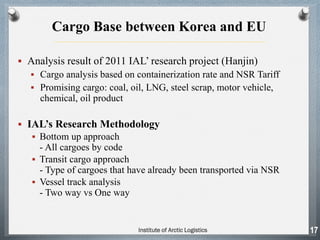
Cargo Base between Korea and EU
 Analysis result of 2011 IAL’ research project (Hanjin)
 Cargo analysis based on containerization rate and NSR Tariff
 Promising cargo: coal, oil, LNG, steel scrap, motor vehicle,
chemical, oil product
 IAL’s Research Methodology
 Bottom up approach
- All cargoes by code
 Transit cargo approach
- Type of cargoes that have already been transported via NSR
 Vessel track analysis
- Two way vs One way
17Institute of Arctic Logistics
1) Bottom up approach
 Top 10 cargoes
between EU and Korea
Motor Vehicle
Electric equipment
Boiler & Machinery
Fuel Oil & Energy
Iron, Steel & Plastic
 Cargo base analysis by
HS or SITC code
KoreaEU
Motor Vehicle
Electric Equipment, TV, VTR
Machinery
Vessel
Optical, Medical, Inspection Tool
Plastic & Plastic products
Fuel, Energy
Iron & Steel
Rubber & Rubber products
Organic Chemical
Machinery
Fuel, Energy
Electric Equipment, TV, VTR
Motor Vehicle
Optical, Medical, Inspection Tool
Medical Products
Iron & Steel
Organic Chemical
Inorganic Chemical
Plastic & Plastic Products
18Institute of Arctic Logistics
Top 10 imports from EU
(2013, over 200 thousand tons)
 Passenger car 180thousand tons
 60% of Korea imports
 Pork 114 thousand tons
 39% of Korean imports
 Main imports are natural
resources
 Food such as wheat, corn &
pork are imported
 Each cargo will be analyzed
[Source: trass.kctdi.or.kr]
Name Amount(thou $) Weight(ton)
Naphtha 2,841,859 3,038,531
Crude oil 2,395,032 2,835,388
Wheat 208,934 735,519
Corn 222,782 647,885
Lumber 257,064 380,224
Organic compound 1,546,671 280,582
Coal 43,274 252,822
Scrap 177,041 239,284
Other chemical products 1,343,835 226,654
Other plastic 931,875 226,516
Other textiles 294,030 213,539
Gas 175,592 206,461
19Institute of Arctic Logistics
Top 10 Exports to EU
(2013, over 200 thousand tons)
[Source: trass.kctdi.or.kr]
Name Amount(thou $) Weight(ton)
Other oil products 2,503,904 2,531,192
Vessel 5,739,850 1,774,723
Light oil 844,430 923,067
Alloy steel plate 948,971 877,980
Synthetic plastic & its products 1,640,098 637,080
Passenger car 5,736,779 578,572
Auto parts 3,616,008 439,833
Other general machineries 3,738,525 410,394
Organic & inorganic
compound
874,125 336,599
Polyester 434,929 279,287
Steel plate 195,329 260,019
Synthetic fiber 338,756 209,028
 Polyethylene 190thousand tons
 Steel product (steel bar/section
steel) 180 thousand tons
 Rubber tire & tube 160thousand
tons
 Passenger car, truck, tire and
auto parts are over 1.2 million
tons
 Various oil and chemical
products are exported
 Each cargo will be analyzed
20Institute of Arctic Logistics
2) Transit cargo approach
21
 Naphtha
: ‘Negative’ in the long term
(production increase in Korea)
 Gas condensate
: ‘Negative’ (supply from U.S.)
 LNG
: ‘Positive’(Mid term/long term)
 Jet fuel
: maintaining present level
(difficult to increase)
 Metal Scrap
: Negative
(Supply and demand sufficient in
East Asia)
 Iron ore
: ‘Negative’ (short term)
(Lower iron ore price)
 General cargo
: ‘Positive’ (carrier’s pilot test)
Liquid Bulk Dry Bulk & General cargo
Institute of Arctic Logistics
3) Vessel Track Analysis
 Analysis of navigation routes of ice class vessels
 Economic feasibility of ice class vessel operation
 Cargo type, vessel type, market demand & supply
22
Nordic Odyssey(Bulk Carrier)
 Singapore 9/12
 10/18 Daesan 10/23
 10/26 Taiwan 10/28
 12/28 Thames 12/29
 01/07 Ust Luga 01/16
 Mailiao
 03/07 Ulsan
Arctic Aurora(LNG Carrier)
 Melkoya 09/17
 10/5 Brazil 10/08
 10/31 Melkoya 11/02
 11/27 Turkey 11/28
 12/16 Melkoya 12/18
 12/23 Lituania 12/25
 12/31 Melkoya 01/02
 01/23 Brazil 01/26
 02/02 Point Fortin 02/03
 02/28 Quintero 03/01
 Going to Las palmas
 09/29 Netherland 10/02
 10/07 Ust Luga 10/09
 10/14 Denmark 10/17
 10/21 Kokkola 10/23
 10/24 Port Talbot 10/24
 12/04 Canada 12/22
 01/07 Barcelnona 01/15
 01/29 Kamsar 01/30
 Going to Canada
Institute of Arctic Logistics
Propontis(Tanker)
Arctic Aurora(LNG carrier)
Destinational transportation from Norway to Brazil, Turkey, Lituania
23
Melkoya 9/17
10/05 Brazil 10/08
10/31 Melkoya 11/02
11/27 Turkey 11/28
12/16 Melkoya 12/18
12/23 Lituania 12/25
12/31 Melkoya 01/02
1
2
3
4
5
6
7
Institute of Arctic Logistics
 Melkoya 09/17
 10/5 Brazil 10/08
 10/31 Melkoya 11/02
 11/27 Turkey 11/28
 12/16 Melkoya 12/18
 12/23 Lituania 12/25
 12/31 Melkoya 01/02
 01/23 Brazil 01/26
 02/02 Point Fortin 02/03
 02/28 Quintero 03/01
 Going to Las palmas
01/23 Brazil 01/268
02/02 Point Fortin 02/039
02/28 Quintero 03/0110
Potential cargo of Korea in Arctic Trade
Incheon
Daesan
Ulsan
Yeosu
Busan
Promising cargo
Seoul
Pohang
 Iron ore(Pohang),
coal, steel
scrap(Incheon),
chemical products,
fertilizer
Import
 Steel products
(Pohang), finished
vehicle (Ulsan), heavy
cargo
Export
24Institute of Arctic Logistics
Oil trading (Ulsan Port : Tank Terminals)
Name of the Terminal Storage Capacity
(10,000 bbl)
Jeongil Stolthaven Ulsan 748.8
Vopak Terminals Korea 172.8
Taeyoung Industry 157.8
Odfjell Terminals Korea 197.4
Horizon Taeyoung Korea Terminals 146.2
North East Tank Terminal 125.2
Hyosung Onsan Tank Terminal 15.7
Onsan Tank Terminal 61.6
G-Hub(SK Gas) 308.3
Hyundai Oil Terminal 163.6
TOTAL 2,097
[Independent Tank Terminals]
The Port of Ulsan has several world-famous petroleum companies
25Institute of Arctic Logistics
Potential industry/cargo through NSR
Shipbuilding
• Ice class vessel
• Offshore plants
Heavy cargo
• Marine equipment,
offshore plant facilities
etc.
Marine service
Articles for ship,
Bunkering, ship repair
Automotive industry
• Transportation of finished
vehicle to European market
Resources
• Import: Gas condensate,
Naphtha, iron ore, LNG, coal
• Export: Jet oil, diesel oil
26Institute of Arctic Logistics
Yamal Arctic LNG Carrier by DSME
Package Section Vessel type Remark
Package I Asia~N/Europe SPB Megaline
Package II N/Europe~Yamal Site
Icebreaking
SPB
New
shipbuilding
Package I
• 8 vessels fixed
Package II
• Year round navigable vessels, (2 vessels fixed)
 Package by route of Project transportation
Heavy cargo transportation by Megaline
(Yamal LNG Plant)
28
 Arc-7 Class carrier for special cargo
Ice class vessel for Heavy cargo transportation
(Megaline)
29
Case 1. Departure from Korea via Bering Sea
: Vladivostok (T/S Customs) → Yamburg Port or Novy Port (T/S Operation to River Barge)
→ River Jetty → Trailer → Pavlodar
Vladivostok
Yamburg Port
Novy Port
Novosibirsk
Omsk
Pavlodar
Busan
Deep Sea
Legend
River
Heavy Cargo Transportation by Unico
Logistics
30Institute of Arctic Logistics
5. Stakeholders’ Position in Korea
Government’s Strong
Support
Logistics Company’s
Viewpoint
(Shippers’ Approval)
Shippers’ Viewpoint
(On time Delivery,
Safety)
Ship owners’
Viewpoint
(Difficulty of securing
cargo)
Limitation to Active Use of NSR
31Institute of Arctic Logistics
Prospective cargoes of Korean stakeholders
32
Oil Product
Petrochemicals
Marine
Plant
Gas
Condensate
Machinery
(electronic
goods)
Cargo owners/Logistics companies
Petrochemicals
Marine Plant
Gas
Condensate
Steel
Automobile
Automobile
components
Ship owners
Cargo owners interested in machinery transport (ex. electronic goods)
vs. ship owners interested in steel products & car transport
Institute of Arctic Logistics
Reasons why shipowners/cargo owners
avoid navigation on the NSR
33
Safety of
Vessel
Navigation
Difficulty
of On-time
Delivery
Uncertain
Profitability
High Tariff
&
Insurance
Difficulty of
Routine
Navigation
Cargo owners
Uncertain
Profitability
Difficulty of
routine
Navigation
Securing
Vessel
Space/Cargo
owners’
Refusals
Shipowners
Cargo owners : Safety of navigation
Shipowners : Uncertain profitability & securing vessel space
Institute of Arctic Logistics
2) Stakeholders’ Position in Korea
Korean Government’s plan (Dec, 2013)
(Maritime Logistics part)
 Port incentive
 50% exemption of domestic port dues for the vessels via NSR (Jan, 2014)
 Partnership between shipper and shipowner
 Organization of consultative body to share NSR information and build
cooperative relationship among government, shippers, shipowners and
research institutions
 Crew training for Arctic shipping
 Strengthening of cooperation withArctic coastal countries
34Institute of Arctic Logistics
35
 Economic feasibility of NSR
shipping(Return cargo)
 Securing routine cargo
(Lack of cargo information)
 Safety of Navigation
(Sea ice condition, ice chart)
 Prior preparation
(destinational shipping, NSR information)
Korean Shipowners’
Position
 Concern for on-time delivery
 Reduction of logistics cost
 Safety and risk management on
the NSR
 Wait and see attitude
Korean Shippers’
Position
Institute of Arctic Logistics
Logistics company & Shipbuilder
 Interest in NSR shipping, need for more information on NSR
 Profitability of NSR uncertain compared to Suez & TSR
36
 The steel cutting ceremony for Hull
No. 2418, DSME’s first LNG carrier
in the Yamal project (Sep 29 2014)
 This vessel is the world’s first
icebreaking LNG carrier
DSME’s first LNG carrier in the Yamal project
Institute of Arctic Logistics
6. Conclusion
 One way transportation
 Liquid bulk transportation by price differences(arbitrage)
 Cargo owners’ profitability?
 Liquid bulk cargo market too dynamic
37
 Hydrocarbon resource(liquid bulk), mineral resource from Arctic region
 Securing of routine cargo on the NSR
(e.g.: destinational transport/Yamal, general cargo by container ship)
 Economic feasibility analysis
 Joint cooperation between ship owners & cargo owners for invigorating NSR
 Increase of cargo traffic on NSR will be good for all the stakeholders
1. Market condition for NSR transportation
2. Cargo analysis
Institute of Arctic Logistics
Challenges
38
1) Shipping company/Shipper
 Profitability still uncertain
 Securing routine cargo for NSR shipping
 On-time delivery and safety of NSR shipping
 Exact information regarding NSR shipping & Arctic trading
2) Government
 Cooperation between shippers and shipowners
 Crew training for Arctic shipping
 Ship financing for preparing ice class vessel
3) IAL-CHNL Joint research
 Bilateral efforts to invigorate usages of the NSR through the sharing of
information and experiences in the maritime transportation via the NSR
 Assessment of economic feasibility regarding NSR shipping
Korean stakeholders
Institute of Arctic Logistics
Challenges
39
 Maritime transport to facilitate the Northern Sea Route
- Joint efforts for sharing information and experiences in the maritime
transportation via the NSR
: Arctic business opportunities, Ice class vessel chartering, NSR operation
experience, sea ice condition, icebreaker capability, tariff, etc
 Organizing seminars, conferences & workshops
 Strengthening cooperation to establish maritime infrastructures to facilitate
commercial shipping on the NSR
International cooperation
Institute of Arctic Logistics
Thank you

Sungwon Hong,Institute of Arctic Logistics (IAL)

  • 1.
    Prospective Cargo forNSR Transport : From Korean Perspective March 12th 2015, President hotel, Moscow Transport & Logistics in Arctic - 2015 Professor Sungwon Hong Director, Institute of Arctic Logistics Youngsan University, Busan, Korea
  • 2.
    Contents 1. Introduction ofIAL(Institute of Arctic Logistics) 2. Market Condition for NSR Transit 3. Evaluations on Korea-related NSR Transport 4. Potential Cargo Base from/to Korea 5. Stakeholders’ Position in Korea regarding NSR 6. Conclusion 2
  • 3.
    Research project byIAL Year Subject Funded by 2014 Sustainable use of NSR (ongoing) Ministry of Maritime and Fisheries, Korea 2013 Arctic resource development and transportation to Asian market Korea Gas Corporation(KOGAS) 2012 Study on the Guideline regarding NSR shipping Korean Shipowners’Association 2011 Cargo transportation via Northern Sea Route Hanjin Shipping : Yanghyun Foundation 2010 Management system of Northern Sea Route Korea Research Foundation 3Institute of Arctic Logistics
  • 4.
    Seminars organized byIAL Year Subjects Hosted by / Venue 2014.11.27 The 3rd International Arctic Shipping Seminar Ministry of Oceans and Fisheries, and organized by IAL, Ulsan 2013.11 The 2nd International Arctic Shipping Seminar Ministry of Oceans and Fisheries and organized by IAL, Busan 2011.11 The 1st International Arctic Shipping Seminar co-hosted by IAL & Ministry of Oceans and Fisheries, Busan 2011.11 The 5th Memorial Seminar for the Late Hanjin Shipping Chairman, Cho Sooho organized by IAL, Seoul 2011.6 Preventive Measures against Piracy Seminar co-hosted by IAL & Busan Coast Guard, Busan) 2010.11 Seminar for the Commercial Operation on the NSR co-hosted by IAL & Hanjin Shipping Co., Busan 4Institute of Arctic Logistics
  • 5.
    2014 The 3rd InternationalArctic Shipping Seminar, Ulsan 5Institute of Arctic Logistics
  • 6.
    2. Market conditionfor NSR transit  Driving Factors 1) Global oil prices falling 2) Asian LNG market 3) Decline of China’s economic growth expected 4) Russian Arctic resource development hindered by US/EU Sanctions to Russia 5) Is NSR an alternative route to Suez canal? 6Institute of Arctic Logistics
  • 7.
    2. Market conditionfor NSR transit 1) Current situation  One way transportation  Uncertain profitability, necessity to secure return cargo  Major pattern of NSR traffic  Liquid bulk transportation by price differences  Liquid bulk cargo market is currently too dynamic  Competition between Middle east oil & U.S. shale gas  Impact to price of naphtha & condensate by Shale & oil sand production  Cargo owner Novatek’s spot business to Asian market sharply decreased 7Institute of Arctic Logistics
  • 8.
    Market condition forNSR transit 2) Mid term prospect  Increase of Arctic hydrocarbon resources transportation (Yamal LNG Project: 16.5mil tons)  Increase of Russian domestic supply & intra trade along NSR 8[Source: James Henderson(2014), Skolkovo Energy Centre (2013)] "Comparison of Russian gas Projects to Asian market with other global gas project"
  • 9.
    Market condition forNSR transit 3) Long term prospect  Need to find routine cargoes for sustainable use of the NSR ① Arctic hydrocarbon resources  Destinational transportation : Liquid bulk transportation on spot market will be supplementary ② Need to find routine cargo via the NSR : Necessity to develop general cargo transportation by container shipping 9Institute of Arctic Logistics
  • 10.
    3. Evaluations onKorea-related NSR Transportation NSR Transit Results (Data: 2011-2013, Russian coastal trade excluded) RussiaNorway France Japan China Korea Thai Singapore Finland Taiwan North Korea Netherland Denmark Poland Vietnam Remarks: Cargo traffic in Asia(China, Korea & Japan), Two way transportation(Korea),Test shipping by vessel type 10Institute of Arctic Logistics
  • 11.
    2013 NSR Transit 11 Transittype Vessel amount Cargo volume Total 71 times 1,355,897tons Russian intra trade & supply 43 times 237,861tons International transit 28 times 1,118,036tons - International transit(Laden voyage) on the NSR 19 times * Bulk cargo: 17vessels * General cargo: 2 vessels 1,118,036tons (82%) - International transit between Europe and Asia 10 times(5 times: Korea) 757,373tons (56%) - Ballast & Repositioning 9 times [Source: IAL, Rosatomflot] Institute of Arctic Logistics
  • 12.
    Korea-related NSR Transport(2012-13)  One way transportation  Two way transportation  3 times in 2012 (Palva, Marika, Stena Poseidon)  1 time in 2013 (Propontis)  Pilot shipping on the NSR by Hyundai Glovis  Naphtha, 44 thousand tons (by Stena Polaris) 12  Gas condensate  Naphtha  Jet oil  Gas oil Korea-related eastbound cargo on NSR Korea-related westbound cargo on NSR Institute of Arctic Logistics
  • 13.
    Korea-related cargo trafficon NSR (2013) Vessel name Shipowner Ice class/ Type Cargo owner Cargo/ Qty(mt) Departure Arrival Entry to NSR Exit from NSR Average speed (Knots) Marinor Marinvest Shipping AB Arc4/ tanker JSC Novatek Gas condens/ 58,721 Murmansk Daesan 2013.08.15 16:00 2013.08.28 12:00 12.8 Propontis Taskos Columbia Shipmanagement Arc4/ tanker JSC Novatek Gasoil/ 108,945 Ulsan Rotterdam 2013.10.06 06:00 2013.09.25 11:45 10.8 Stena Polaris Stena Bulk AB Arc4/ tanker JSC Novatek Naphtha/ 43,854 Ust-Luga Yeosu 2013.09.28 17:20 2013.10.11 11:30 12.8 Zaliv Amurskiy PRISCO Ice2/ tanker JSC Novatek Gasoil/ 95,988 Onsan Rotterdam 2013.10.13 06:00 2013.09.30 17:25 12.5 Viktor Bakaev SCF Novoship Technical Manag-t Ice2/ tanker Mansel oil Kerosene/ 88,024 Yeosu Rotterdam 2013.10.28 11:20 2013.10.14 09:00 14.1 Zalvi Baikal PRISCO Ice2/ tanker JSC Novatek Naphtha/ 79,580 Ust-Luga Yeosu 2013.10.14 15:30 2013.10.30 01:00 15.4 HHL Hong Kong Hansa Heavy lift Arc4/ heavy lift JSC “SMM” Cranes/ 1,742 Ust-Luga Rajin (N.Korea) 2013.10.25 09:30 - - Atmoda Laskardis Shipping Arc4/ reefer - Ballast Busan Iceland 2013.08.14 02:50 2013.07.26 16:30 18.4 Arctic Aurora Fareastern shipping Acr4/ LNG - Ballast Ulsan Hammerfest 2013.08.18 18:30 2013.08.06 23:30 11..8 [Source : Rosatomflot 2013] 13Institute of Arctic Logistics
  • 14.
     Considerably influencedby Cargo owners (esp. Novatek)  Naphtha & condensate import will be decreasing (not profitable)  Need to find potential cargo on long term contract bases  Accumulation of ice navigation experience needed for Korean shipping company through pilot shipping on NSR 14 Evaluation of Korea-related NSR transit 2013: 182 thousand tons, 3times 2012: 365 thousand tons, 7 times 2011: 119 thousand tons, 2 times  2013: 293 thousand tons, 3times  2012: 198 thousand tons, 3 times  2011: 64 thousand tons, 1 time Import of Naphtha & gas condensate Export of Korean jet oil & Gas oil to Europe Institute of Arctic Logistics
  • 15.
    Pilot shipping onthe NSR by Hyundai Glovis (Stena Polaris) Ust-Luga Entry to NSR Exit from NSR NSR Section Yeosu Pilot shipping on the NSR  Sep 16 (1 days) Ust-Luga Russia  Sep 20 (4 days) Schou Bunkering  Sep 25 (9 days) Kirkenes Ice pilot on board Sep 28 (12 days) Entry to NSR Oct 11 (25 days) Bering strait Oct 21 (35 days) Yeosu 15Institute of Arctic Logistics
  • 16.
    4. Potential CargoBase from/to Korea - Need to seek the most promising routine cargoes ? - Necessity of Analysis for outbound cargo - Long term contract : Reliability of delivery (Arctic Resource) - Spot Biz : Occasionally - Any off-season cargo? Outbound cargo from Korea Inbound cargo to Korea 16Institute of Arctic Logistics
  • 17.
    Cargo Base betweenKorea and EU  Analysis result of 2011 IAL’ research project (Hanjin)  Cargo analysis based on containerization rate and NSR Tariff  Promising cargo: coal, oil, LNG, steel scrap, motor vehicle, chemical, oil product  IAL’s Research Methodology  Bottom up approach - All cargoes by code  Transit cargo approach - Type of cargoes that have already been transported via NSR  Vessel track analysis - Two way vs One way 17Institute of Arctic Logistics
  • 18.
    1) Bottom upapproach  Top 10 cargoes between EU and Korea Motor Vehicle Electric equipment Boiler & Machinery Fuel Oil & Energy Iron, Steel & Plastic  Cargo base analysis by HS or SITC code KoreaEU Motor Vehicle Electric Equipment, TV, VTR Machinery Vessel Optical, Medical, Inspection Tool Plastic & Plastic products Fuel, Energy Iron & Steel Rubber & Rubber products Organic Chemical Machinery Fuel, Energy Electric Equipment, TV, VTR Motor Vehicle Optical, Medical, Inspection Tool Medical Products Iron & Steel Organic Chemical Inorganic Chemical Plastic & Plastic Products 18Institute of Arctic Logistics
  • 19.
    Top 10 importsfrom EU (2013, over 200 thousand tons)  Passenger car 180thousand tons  60% of Korea imports  Pork 114 thousand tons  39% of Korean imports  Main imports are natural resources  Food such as wheat, corn & pork are imported  Each cargo will be analyzed [Source: trass.kctdi.or.kr] Name Amount(thou $) Weight(ton) Naphtha 2,841,859 3,038,531 Crude oil 2,395,032 2,835,388 Wheat 208,934 735,519 Corn 222,782 647,885 Lumber 257,064 380,224 Organic compound 1,546,671 280,582 Coal 43,274 252,822 Scrap 177,041 239,284 Other chemical products 1,343,835 226,654 Other plastic 931,875 226,516 Other textiles 294,030 213,539 Gas 175,592 206,461 19Institute of Arctic Logistics
  • 20.
    Top 10 Exportsto EU (2013, over 200 thousand tons) [Source: trass.kctdi.or.kr] Name Amount(thou $) Weight(ton) Other oil products 2,503,904 2,531,192 Vessel 5,739,850 1,774,723 Light oil 844,430 923,067 Alloy steel plate 948,971 877,980 Synthetic plastic & its products 1,640,098 637,080 Passenger car 5,736,779 578,572 Auto parts 3,616,008 439,833 Other general machineries 3,738,525 410,394 Organic & inorganic compound 874,125 336,599 Polyester 434,929 279,287 Steel plate 195,329 260,019 Synthetic fiber 338,756 209,028  Polyethylene 190thousand tons  Steel product (steel bar/section steel) 180 thousand tons  Rubber tire & tube 160thousand tons  Passenger car, truck, tire and auto parts are over 1.2 million tons  Various oil and chemical products are exported  Each cargo will be analyzed 20Institute of Arctic Logistics
  • 21.
    2) Transit cargoapproach 21  Naphtha : ‘Negative’ in the long term (production increase in Korea)  Gas condensate : ‘Negative’ (supply from U.S.)  LNG : ‘Positive’(Mid term/long term)  Jet fuel : maintaining present level (difficult to increase)  Metal Scrap : Negative (Supply and demand sufficient in East Asia)  Iron ore : ‘Negative’ (short term) (Lower iron ore price)  General cargo : ‘Positive’ (carrier’s pilot test) Liquid Bulk Dry Bulk & General cargo Institute of Arctic Logistics
  • 22.
    3) Vessel TrackAnalysis  Analysis of navigation routes of ice class vessels  Economic feasibility of ice class vessel operation  Cargo type, vessel type, market demand & supply 22 Nordic Odyssey(Bulk Carrier)  Singapore 9/12  10/18 Daesan 10/23  10/26 Taiwan 10/28  12/28 Thames 12/29  01/07 Ust Luga 01/16  Mailiao  03/07 Ulsan Arctic Aurora(LNG Carrier)  Melkoya 09/17  10/5 Brazil 10/08  10/31 Melkoya 11/02  11/27 Turkey 11/28  12/16 Melkoya 12/18  12/23 Lituania 12/25  12/31 Melkoya 01/02  01/23 Brazil 01/26  02/02 Point Fortin 02/03  02/28 Quintero 03/01  Going to Las palmas  09/29 Netherland 10/02  10/07 Ust Luga 10/09  10/14 Denmark 10/17  10/21 Kokkola 10/23  10/24 Port Talbot 10/24  12/04 Canada 12/22  01/07 Barcelnona 01/15  01/29 Kamsar 01/30  Going to Canada Institute of Arctic Logistics Propontis(Tanker)
  • 23.
    Arctic Aurora(LNG carrier) Destinationaltransportation from Norway to Brazil, Turkey, Lituania 23 Melkoya 9/17 10/05 Brazil 10/08 10/31 Melkoya 11/02 11/27 Turkey 11/28 12/16 Melkoya 12/18 12/23 Lituania 12/25 12/31 Melkoya 01/02 1 2 3 4 5 6 7 Institute of Arctic Logistics  Melkoya 09/17  10/5 Brazil 10/08  10/31 Melkoya 11/02  11/27 Turkey 11/28  12/16 Melkoya 12/18  12/23 Lituania 12/25  12/31 Melkoya 01/02  01/23 Brazil 01/26  02/02 Point Fortin 02/03  02/28 Quintero 03/01  Going to Las palmas 01/23 Brazil 01/268 02/02 Point Fortin 02/039 02/28 Quintero 03/0110
  • 24.
    Potential cargo ofKorea in Arctic Trade Incheon Daesan Ulsan Yeosu Busan Promising cargo Seoul Pohang  Iron ore(Pohang), coal, steel scrap(Incheon), chemical products, fertilizer Import  Steel products (Pohang), finished vehicle (Ulsan), heavy cargo Export 24Institute of Arctic Logistics
  • 25.
    Oil trading (UlsanPort : Tank Terminals) Name of the Terminal Storage Capacity (10,000 bbl) Jeongil Stolthaven Ulsan 748.8 Vopak Terminals Korea 172.8 Taeyoung Industry 157.8 Odfjell Terminals Korea 197.4 Horizon Taeyoung Korea Terminals 146.2 North East Tank Terminal 125.2 Hyosung Onsan Tank Terminal 15.7 Onsan Tank Terminal 61.6 G-Hub(SK Gas) 308.3 Hyundai Oil Terminal 163.6 TOTAL 2,097 [Independent Tank Terminals] The Port of Ulsan has several world-famous petroleum companies 25Institute of Arctic Logistics
  • 26.
    Potential industry/cargo throughNSR Shipbuilding • Ice class vessel • Offshore plants Heavy cargo • Marine equipment, offshore plant facilities etc. Marine service Articles for ship, Bunkering, ship repair Automotive industry • Transportation of finished vehicle to European market Resources • Import: Gas condensate, Naphtha, iron ore, LNG, coal • Export: Jet oil, diesel oil 26Institute of Arctic Logistics
  • 27.
    Yamal Arctic LNGCarrier by DSME
  • 28.
    Package Section Vesseltype Remark Package I Asia~N/Europe SPB Megaline Package II N/Europe~Yamal Site Icebreaking SPB New shipbuilding Package I • 8 vessels fixed Package II • Year round navigable vessels, (2 vessels fixed)  Package by route of Project transportation Heavy cargo transportation by Megaline (Yamal LNG Plant) 28
  • 29.
     Arc-7 Classcarrier for special cargo Ice class vessel for Heavy cargo transportation (Megaline) 29
  • 30.
    Case 1. Departurefrom Korea via Bering Sea : Vladivostok (T/S Customs) → Yamburg Port or Novy Port (T/S Operation to River Barge) → River Jetty → Trailer → Pavlodar Vladivostok Yamburg Port Novy Port Novosibirsk Omsk Pavlodar Busan Deep Sea Legend River Heavy Cargo Transportation by Unico Logistics 30Institute of Arctic Logistics
  • 31.
    5. Stakeholders’ Positionin Korea Government’s Strong Support Logistics Company’s Viewpoint (Shippers’ Approval) Shippers’ Viewpoint (On time Delivery, Safety) Ship owners’ Viewpoint (Difficulty of securing cargo) Limitation to Active Use of NSR 31Institute of Arctic Logistics
  • 32.
    Prospective cargoes ofKorean stakeholders 32 Oil Product Petrochemicals Marine Plant Gas Condensate Machinery (electronic goods) Cargo owners/Logistics companies Petrochemicals Marine Plant Gas Condensate Steel Automobile Automobile components Ship owners Cargo owners interested in machinery transport (ex. electronic goods) vs. ship owners interested in steel products & car transport Institute of Arctic Logistics
  • 33.
    Reasons why shipowners/cargoowners avoid navigation on the NSR 33 Safety of Vessel Navigation Difficulty of On-time Delivery Uncertain Profitability High Tariff & Insurance Difficulty of Routine Navigation Cargo owners Uncertain Profitability Difficulty of routine Navigation Securing Vessel Space/Cargo owners’ Refusals Shipowners Cargo owners : Safety of navigation Shipowners : Uncertain profitability & securing vessel space Institute of Arctic Logistics
  • 34.
    2) Stakeholders’ Positionin Korea Korean Government’s plan (Dec, 2013) (Maritime Logistics part)  Port incentive  50% exemption of domestic port dues for the vessels via NSR (Jan, 2014)  Partnership between shipper and shipowner  Organization of consultative body to share NSR information and build cooperative relationship among government, shippers, shipowners and research institutions  Crew training for Arctic shipping  Strengthening of cooperation withArctic coastal countries 34Institute of Arctic Logistics
  • 35.
    35  Economic feasibilityof NSR shipping(Return cargo)  Securing routine cargo (Lack of cargo information)  Safety of Navigation (Sea ice condition, ice chart)  Prior preparation (destinational shipping, NSR information) Korean Shipowners’ Position  Concern for on-time delivery  Reduction of logistics cost  Safety and risk management on the NSR  Wait and see attitude Korean Shippers’ Position Institute of Arctic Logistics
  • 36.
    Logistics company &Shipbuilder  Interest in NSR shipping, need for more information on NSR  Profitability of NSR uncertain compared to Suez & TSR 36  The steel cutting ceremony for Hull No. 2418, DSME’s first LNG carrier in the Yamal project (Sep 29 2014)  This vessel is the world’s first icebreaking LNG carrier DSME’s first LNG carrier in the Yamal project Institute of Arctic Logistics
  • 37.
    6. Conclusion  Oneway transportation  Liquid bulk transportation by price differences(arbitrage)  Cargo owners’ profitability?  Liquid bulk cargo market too dynamic 37  Hydrocarbon resource(liquid bulk), mineral resource from Arctic region  Securing of routine cargo on the NSR (e.g.: destinational transport/Yamal, general cargo by container ship)  Economic feasibility analysis  Joint cooperation between ship owners & cargo owners for invigorating NSR  Increase of cargo traffic on NSR will be good for all the stakeholders 1. Market condition for NSR transportation 2. Cargo analysis Institute of Arctic Logistics
  • 38.
    Challenges 38 1) Shipping company/Shipper Profitability still uncertain  Securing routine cargo for NSR shipping  On-time delivery and safety of NSR shipping  Exact information regarding NSR shipping & Arctic trading 2) Government  Cooperation between shippers and shipowners  Crew training for Arctic shipping  Ship financing for preparing ice class vessel 3) IAL-CHNL Joint research  Bilateral efforts to invigorate usages of the NSR through the sharing of information and experiences in the maritime transportation via the NSR  Assessment of economic feasibility regarding NSR shipping Korean stakeholders Institute of Arctic Logistics
  • 39.
    Challenges 39  Maritime transportto facilitate the Northern Sea Route - Joint efforts for sharing information and experiences in the maritime transportation via the NSR : Arctic business opportunities, Ice class vessel chartering, NSR operation experience, sea ice condition, icebreaker capability, tariff, etc  Organizing seminars, conferences & workshops  Strengthening cooperation to establish maritime infrastructures to facilitate commercial shipping on the NSR International cooperation Institute of Arctic Logistics
  • 40.