Issuecrawler 1.0 and
    Social Media
   Digital Methods Advanced Projects Program, 9 August 2010
            Anne Helmond - anne@digitalmethods.net
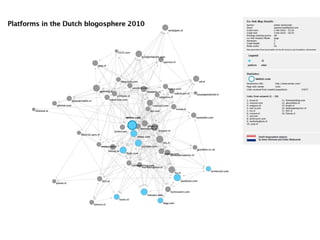
How Web 1.0 is the IssueCrawler?


“The 2.0 denotes an ‘improved’ or progressional version
of the web that builds upon and develops Web 1.0. [...]
Implicitly rooted in this vision of the web is a sense of
teleological progress, of purposeful and directed
development, of continual and designed improvement.”
(Beer 2010: 986)
in Web 1.0 hyperlinks mainly link
to static pages and objects and in
 Web 2.0 the hyperlink links to
   dynamic pages and objects
“In general terms, Web 2.0 is a concept that
forms part of the lexicon of a range of emerging
accounts that commentate on a large-scale shift
toward a ‘participatory’ and ‘collaborative’
version of the web, where users are able to get
involved and create content.” (Beer 2010: 986)
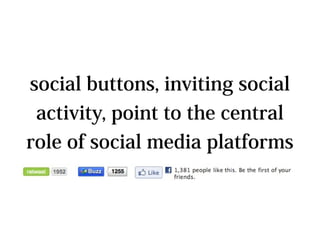
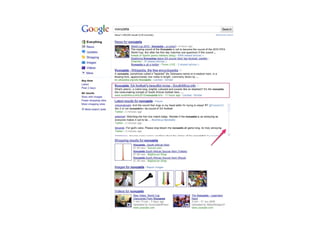
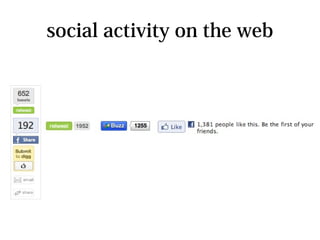
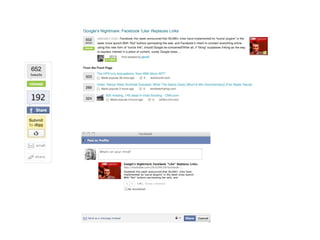
social buttons, inviting social
 activity, point to the central
role of social media platforms
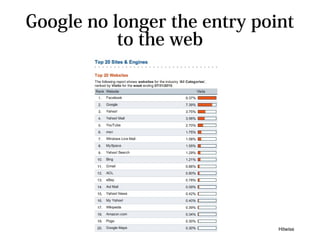
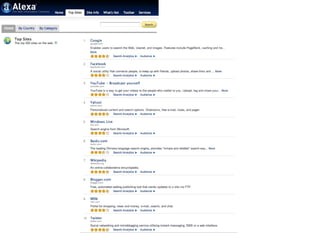
Google no longer the entry point
           to the web


                              Hitwise
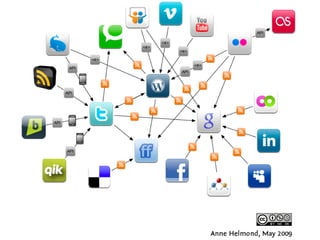
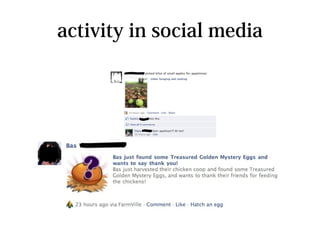
activity in social media
social activity on the web
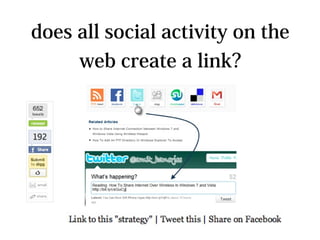
does all social activity on the
     web create a link?
What types of associations are on display
in hyperlinks (‘reading between the links’),
and what could be the shapes of spaces
demarcated by link associations? (Rogers 2009)
links as the currency of the web
                vs
likes as the currency of the web
The volatility of methods
●   Internet methods are incessantly volatile due to the
    update culture of the Internet itself.
●   Digital methods may be volatile if we build tools
    (scrapers, crawlers, plugins) on top of devices that
    change.
●   Changing APIs and changing interfaces
●   API calls are the new scarcity online
Types of links
●   What new types of hyperlinks are created by
    platforms?
●   What new types of associations of hyperlinks are
    created by social media?
●   How do devices handle these new acts of
    associations?
●   How have the outlink and inlink changed with the
    advent of sharing, liking and recommending?
IssueCrawler 2.0
●   How are networks formed in 2.0? One could argue
    that a network is formed through liking, sharing
    and saving in addition to linking.
●   What are the web native objects and characteristics
    that form networks in the 2.0?
●   What is the role of platforms in the formation of
    networks in 2.0?
Types of links
●   What new types of hyperlinks are created by
    platforms?
●   What new types of associations of hyperlinks are
    created by social media?
●   How have the outlink and inlink changed with the
    advent of sharing, liking and recommending?
●   How do devices handle these new types of 'links' in
    demarcating spheres and recommendation?
Platform dependency
●   What is the platform dependency of issues?
●   Which platforms are returned for which issues?
●   Which platforms are 'liked' by search engines?
●   What new types of hyperlinks are created by
    platforms?
Cross-platform syndication
●   How does content fow in the network? The end of
    the page, the birth of the stream.
●   Considering the politics of platforms, are some
    platforms more central than others?
●   How open or closed are these platforms and how
    does this afect mapping?
Platform dependency
●   What is the platform dependency of issues?
●   Which platforms are returned for which issues?
●   Which platforms do search engine 'like'?
●   What new types of hyperlinks are created by
    platforms?

Summerschool

  • 1.
    Issuecrawler 1.0 and Social Media Digital Methods Advanced Projects Program, 9 August 2010 Anne Helmond - anne@digitalmethods.net
  • 2.
    How Web 1.0is the IssueCrawler? “The 2.0 denotes an ‘improved’ or progressional version of the web that builds upon and develops Web 1.0. [...] Implicitly rooted in this vision of the web is a sense of teleological progress, of purposeful and directed development, of continual and designed improvement.” (Beer 2010: 986)
  • 3.
    in Web 1.0hyperlinks mainly link to static pages and objects and in Web 2.0 the hyperlink links to dynamic pages and objects
  • 4.
    “In general terms,Web 2.0 is a concept that forms part of the lexicon of a range of emerging accounts that commentate on a large-scale shift toward a ‘participatory’ and ‘collaborative’ version of the web, where users are able to get involved and create content.” (Beer 2010: 986)
  • 5.
    social buttons, invitingsocial activity, point to the central role of social media platforms
  • 6.
    Google no longerthe entry point to the web Hitwise
  • 11.
  • 12.
  • 13.
    does all socialactivity on the web create a link?
  • 15.
    What types ofassociations are on display in hyperlinks (‘reading between the links’), and what could be the shapes of spaces demarcated by link associations? (Rogers 2009)
  • 16.
    links as thecurrency of the web vs likes as the currency of the web
  • 17.
    The volatility ofmethods ● Internet methods are incessantly volatile due to the update culture of the Internet itself. ● Digital methods may be volatile if we build tools (scrapers, crawlers, plugins) on top of devices that change. ● Changing APIs and changing interfaces ● API calls are the new scarcity online
  • 18.
    Types of links ● What new types of hyperlinks are created by platforms? ● What new types of associations of hyperlinks are created by social media? ● How do devices handle these new acts of associations? ● How have the outlink and inlink changed with the advent of sharing, liking and recommending?
  • 19.
    IssueCrawler 2.0 ● How are networks formed in 2.0? One could argue that a network is formed through liking, sharing and saving in addition to linking. ● What are the web native objects and characteristics that form networks in the 2.0? ● What is the role of platforms in the formation of networks in 2.0?
  • 20.
    Types of links ● What new types of hyperlinks are created by platforms? ● What new types of associations of hyperlinks are created by social media? ● How have the outlink and inlink changed with the advent of sharing, liking and recommending? ● How do devices handle these new types of 'links' in demarcating spheres and recommendation?
  • 21.
    Platform dependency ● What is the platform dependency of issues? ● Which platforms are returned for which issues? ● Which platforms are 'liked' by search engines? ● What new types of hyperlinks are created by platforms?
  • 22.
    Cross-platform syndication ● How does content fow in the network? The end of the page, the birth of the stream. ● Considering the politics of platforms, are some platforms more central than others? ● How open or closed are these platforms and how does this afect mapping?
  • 23.
    Platform dependency ● What is the platform dependency of issues? ● Which platforms are returned for which issues? ● Which platforms do search engine 'like'? ● What new types of hyperlinks are created by platforms?