Non-Profit Organization
U.S. Postage
P A I D
New Brunswick,
New Jersey 08901
Permit No. 175
Rutgers, The State University of New Jersey
536 George Street
New Brunswick, NJ 08901
Visit us on the web:
socialwork.rutgers.edu
Email us at:
alumni@ssw.rutgers.edu
Like us on Facebook:
RutgersSSW
Visit us on Twitter:
@RutgersSSW
Watch our YouTube videos:
/RutgersSSW
Connect on LinkedIn:
Rutgers School of Social Work
Alumni Network
School of Social Work
PARTNERING CHANGE
A P U B L I C A T I O N O F R U T G E R S S C H O O L O F S O C I A L W O R K
for
I N C O M E I N E Q U A L I T Y :
U N D E R S T A N D I N G T H E I M P A C T O F T H E C L A S S D I V I D E
R U T G E R S , T H E S T A T E U N I V E R S I T Y O F N E W J E R S E Y
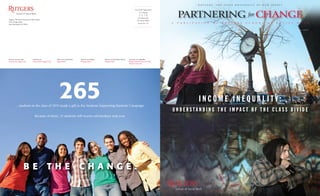
265
B E T H E C H A N G E .
...students in the class of 2015 made a gift to the Students Supporting Students Campaign.
Because of them, 13 students will receive scholarships next year.
School of Social Work
S U M M E R 2 0 1 5
R U T G E R S S C H O O L O F S O C I A L W O R K / PA R T N E R I N G f o r C H A N G E 1
M E S S A G E F R O M T H E D E A N
AT RUTGERS SCHOOL OF SOCIAL WORK, our faculty and students study the social
policies that reinforce poverty and make the economic divide unbridgeable for many of
today’s middle and lower income individuals and families. We, along with the National
Association of Social Workers (NASW), are concerned about “growing inequality, stagnant
wages, and high unemployment in the U.S.” Joblessness and economic insecurity
contribute to the incidence of mental illness, family violence, suicide, substance abuse,
crime, and diminished capacity for health, family, and community functioning. In our
cover story, called, “Income Inequality: Understanding the Impact of the Class Divide,”
we examine the impact of the socioeconomic gap on Americans.
I hope this issue will spur discussion among students, faculty and alumni about the role
of social workers in advocating for economic justice and social policy reform. The NASW
recommends that social workers support the following:
n Funding and support of Temporary Assistance to Needy Families (TANF).
n Funding and support of the Supplemental Nutrition Assistance Program (SNAP).
n Support of legislative and administrative strategies that address pay equity.
n Support of the Patient Protection and Affordable Care Act.
n Advocating for legislation, policies, and regulations that affect those who may not
be able to advocate for themselves.
We know that these programs and initiatives are just the beginning, for surely meaningful,
living-wage work for all its citizens is what lifts a nation out of instability. If our country is
to thrive, we must find a way forward toward a socially just economic environment.
In other news, it was my pleasure to visit with many alumni at several spring events,
including Rutgers Day, the School of Social Work Career Fair on the Newark Campus, and
the NASW-NJ conference. Rutgers School of Social Work educates more social workers than
any other college or university in the state, and our graduates can be found in prestigious
roles across New Jersey, the country and around the globe. We also strive to assist our
graduates in finding satisfying employment or to make a career change. This year’s Career
Fair was attended by numerous agencies and businesses, all with active openings.
I encourage recent graduates and alumni to check our website for ongoing job postings.
Many of you attended the awards ceremony to honor Bill Waldman with the 2015 NASW-
NJ Lifetime Achievement Award. Bill has elevated the field of social work and enhanced
the lives of New Jersey’s families. He inspires our students to new heights of service and
success. The entire school congratulates him on this prestigious award for a career of
service to others, and I encourage those of you who know him to do the same.
Cathryn C. Potter, MSW, Ph.D.
D E A N A N D D I S T I N G U I S H E D P R O F E S S O R
R U T G E R S S C H O O L O F S O C I A L W O R K
“The causes which
destroyed the ancient
republics were numerous;
but in Rome, one principal
cause was the vast
inequality of fortunes.”
— Noah Webster, American editor and writer
Greetings Alumni and Friends,
Published by the Office of
Development and Alumni Relations,
School of Social Work, and the
Office of Communications
Rutgers, The State University of
New Jersey
536 George Street
New Brunswick, NJ 08901
848-932-7520
DEAN
AND EDITOR-IN-CHIEF
Cathryn C. Potter, MSW, Ph.D.
DIRECTOR OF COMMUNICATIONS
AND EDITOR
Beth Salamon
CONTRIBUTING WRITER
Anna Batt
PUBLICATION DESIGN
Eric Miller + Associates
PRINTING
Garrison Printing Company
We welcome your comments
and suggestions. Please email us
with your feedback or ideas at
alumni@ssw.rutgers.edu.
PARTNERING CHANGE
S U M M E R 2 0 1 5
for
t h o u g h t s
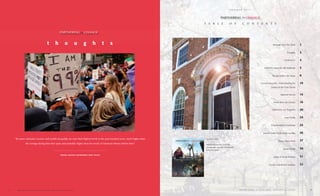
“By some estimates, income and wealth inequality are near their highest levels in the past hundred years, much higher than
the average during that time span and probably higher than for much of American history before then.”
FEDERAL RESERVE CHAIRWOMAN JANET YELLEN
T A B L E O F C O N T E N T S
1
2
4
5
6
10
14
16
20
24
25
26
27
30
31
32
ON THE COVER
representing income inequality:
photography above by Ed Kashi/VII
below by iStock
PARTNERING CHANGEfor
R U T G E R S S C H O O L O F S O C I A L W O R K / PA R T N E R I N G f o r C H A N G E 32 R U T G E R S S C H O O L O F S O C I A L W O R K / PA R T N E R I N G f o r C H A N G E
S U M M E R 2 0 1 5
Message from the Dean
Thoughts
Generous U
NASW-NJ Award for Bill Waldman
Faculty/Staff in the News
Income Inequality: Understanding the
Impact of the Class Divide
National Service
News from our Centers
News from our Programs
Grad Profile
Congratulations Graduates
Former Foster Child Helps Families
Donor Honor Role
Donor Profile
Safety of Social Workers
Council and Alumni Updates
The NASW-NJ 2015 Lifetime
Achievement Award recognizes
an individual who demon-
strates the best in social work
values and professional
accomplishments over the
social worker’s entire career.
This year the award was
presented to William
Waldman, professor of
professional practice and
Executive in Residence.
A Rutgers School of Social
Work grad, he began his
distinguished career as a case-
worker with the Essex County
Welfare Board. He soon was
appointed the County’s
administrator for Food Stamp
and Employment & Training
programs, and became director
of the Department of Human
Services in Middlesex County.
In 1982, he was named NASW-
NJ’s Social Worker of the Year.
Governor Thomas H.
Kean appointed Waldman as
Acting Commissioner of the
New Jersey Department of
Human Services in 1989.
Governor James J. Florio
appointed him as Commis-
sioner in 1992 and Governor
Christine Todd Whitman
reappointed him as
Commissioner in 1994. As
DHS Commissioner, Waldman
transformed services in health
care, child welfare, mental
illness, and developmental
disabilities.
He managed a $7 billion
budget and led a workforce of
19,000 in expanding services to
more than one million New
Jersey citizens. His skill in
reaching out to others made it
possible for him to successfully
implement Governor Christine
Todd Whitman’s WorkFirst New
Jersey welfare reform effort.
This effort resulted in a drop in
New Jersey’s welfare caseload
by more than 50 percent, as
record numbers of recipients
joined the workforce. In
another arena, he oversaw the
New Jersey Kid Care program,
which expanded eligibility for
Medicaid and provided high
quality health care for
thousands of children in lower
and moderate-income families.
Today, he inspires social
work students as a faculty
member and mentor at
Rutgers. His lectures draw
consistent praise from students
who view his vast experience
and his ability to connect with
others as an essential element
in their educational experience.
Throughout his career, Bill
Waldman has been a vigorous
voice for the voiceless and has
provided hope, opportunity,
and a better life for the most
vulnerable among us. n
NASW-NJ Lifetime Achievement
Award for Bill Waldman
R U T G E R S S C H O O L O F S O C I A L W O R K / PA R T N E R I N G f o r C H A N G E 5
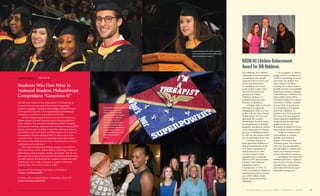
The Sillerman Center for the Advancement of Philanthropy at
Brandeis University announced that Students Supporting
Students Campaign Committee within Rutgers School of Social
Work has taken top prize in the national student philanthropy
competition, Generous U, and will receive $10,000.
Students Supporting Students is a student led initiative at
Rutgers School of Social Work that aims to eliminate debt for
future students. The campaign committee members “recognize
the financial hardships associated with working towards an MSW
degree, and are active in trying to fight that, and trying to lessen
that burden,” says Sarah Brois, an online student who serves on
the committee. Kareim Oliphant, SSW’15 and co-chair of the
committee adds, “If we can do everything we can do to reduce
the debt load for MSW students, that’s something that everyone,
nationwide, can benefit from.”
The Students Supporting Students program was started in
2012 and aims to reduce student debt by cultivating a culture of
philanthropy among students, alumni, and faculty. Over the last
three years, the program has provided scholarships that benefited
30 MSW students and increased the number of graduating MSW
students who now make a donation to support continuing
students from 1% in 2011 to 58% in 2014.
You can view the winning video entry on YouTube at
youtube.com/RutgersSSW.
To make a gift to support student scholarships, please visit
socialwork.rutgers.edu/GIVE.
4 R U T G E R S S C H O O L O F S O C I A L W O R K / PA R T N E R I N G f o r C H A N G E
PARTNERING CHANGEfor
Congratulations to this year’s graduates,
and to convocation speaker Ashley Blazer
Biden. Read more on page 25
Scholarships and fellowships
reflect the generosity of
families and friends who
stand alongside our students
and help them to succeed.
On May 18, 2015, we
celebrated the meaningful
support provided by our
donors and the achievements
of our student recipients at
the Scholarship Recognition
Reception (see photos
below).
Students Win First Prize in
National Student Philanthropy
Competition “Generous U”
Darcy Clay Siebert, associate
professor, became the first Rutgers
faculty member to be named a
fellow of the Society for Social
Work and Research. She was one
of 27 inducted in 2015, joining an
existing group of only 45 other
researchers across North America.
Dr. Siebert’s substantive work
focuses primarily on the occupa-
tional and behavioral health issues
of helping professionals, utilizing
identity theories and employing
specialized research methods
tailored to the collection of
sensitive data from cautious partici-
pants. She is currently analyzing
data she collected from nurses,
physicians, dentists, lawyers, and
social workers. Her methodological
work focuses on psychometrics and
advanced statistical methods. She
and her husband, Dr. Carl Siebert,
offered multiple statistical work-
shops and faculty development
institutes at national conferences
the past few years, and they will
have a nonparametrics book
published in early 2016. Dr. Siebert
also has specialized expertise and
interest in curriculum development,
and from 2010 to 2013, she created
and implemented the Addiction
Counselor Training (ACT) certificate
program with colleague Dr. Nancy
Violette from the Center of Alcohol
Studies with a $3.4 million grant
from the NJ Division of Mental
Health and Addictions Services.
Previous accomplishments also
include directing a Doctoral
Program and spearheading the
complete revision of its curriculum;
presenting and publishing dozens
of papers; and being primary
investigatoror or co-PI on
numerous research grants.
Stephen Crystal, Board of
Governors professor and
associate director for
Health Services Research
at the Institute for Health,
Health Care Policy and
Aging Research, is the
principal investigator of
an award totaling
$1,290,034 over three
years. The project, titled
Improving Medication
Safety in Nursing Home
Dementia Care, is being
supported by the Agency
for Healthcare Research
and Quality and will bring
together nursing facility
state regulators and
quality improvement
organizations to track the
medication safety progress
of each state.
Dr. Crystal's work,
which has resulted in
more than 250
publications, includes
many widely cited books
and research articles on
old-age policy and
services for the elderly; on
the use and outcomes of
psychotropic medications
and other mental health
treatments; on HIV/AIDS
care; and on numerous
other health care and
social policy topics. He
has also been an
important contributor to
research on long-term care
and mental health among
the elderly. His work on
mental health services has
contributed significantly
to understanding
problems of healthcare
access, quality and
disparities in large usual
care populations,
particularly those served
by Medicare and
Medicaid.
Chien-Chung Huang, professor
and director of the Huamin
Research Center, published a
study on migrant children in
China. The study found that
millions of migrant children
and those left behind in
China’s poor rural provinces
by parents working in factory
towns face greater
psychological and behavioral
problems. “Family migration
negatively affects children,
leaving them with more social
skills problems and mental
health issues,” says Huang.
Stephen Crystal
FACULTY/STAFF IN THE NEWS
PARTNERING CHANGEfor
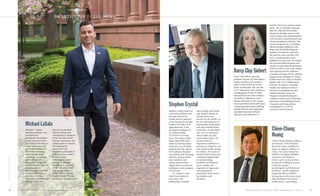
Michael C. LaSala,
associate professor, was
funded by the
Archimedes Foundation
of the European Union
and Tallinn University to
teach solution-focused
and family therapy for
five weeks in Estonia,
where he also taught
workshops on working
with Lesbian, Gay,
Bisexual & Transgender
(LGBT) families and was
a discussant at an
international conference
entitled: LGBT Rights in
the Baltics at Tallinn
University of Technology.
During his stay in
Estonia, he provided
clinical training and
consultation to members
of the Estonian Family
Therapy Association and
collaborated on research
investigating the
perspectives and
assessment principals of
child protective workers
in that country.
Following his stay in
Estonia, LaSala gave
workshops to members
of the Lutheran Family
Counseling Centers in
Turku Finland and the
Swedish Family Therapy
Association in Stockholm.
6 R U T G E R S S C H O O L O F S O C I A L W O R K / PA R T N E R I N G f o r C H A N G E
PHOTOGRAPHBYPETERBYRON
Chien-Chung
Huang
Michael LaSala
R U T G E R S S C H O O L O F S O C I A L W O R K / PA R T N E R I N G f o r C H A N G E 7
Darcy Clay Siebert
Karen Zurlo, assistant professor,
was one of nine members of the
Gerontological Society of America
invited to represent the Society
and to present a paper at the
International Symposium on
Public Policy Challenges in an
Aging Society at the Institute of
Public Policy and Governance,
Shanghai University of Finance
and Economics, Shanghai, China
in June 2015.
In addition to Zurlo's
research on global aging issues,
she has a keen interest in the
broad area of retirement security,
which includes factors that
influence financial well-being
(such as social policies and
health related factors) and the
effects of financial strains (such
as debt or insufficient health
insurance coverage) on mental
health. Zurlo also brings a unique
perspective to social work
because of her training as an
MBA in her early career, and now
as an MSW and PhD in her
academic role. She is a faculty
member in the Management and
Policy (MAP) concentration at the
SSW, and teaches Macro Practice,
Social Welfare Policy, Research
Methods, and International Social
Work.
Karen Zurlo
FACULTY/STAFF IN THE NEWS
8 R U T G E R S S C H O O L O F S O C I A L W O R K / PA R T N E R I N G f o r C H A N G E R U T G E R S S C H O O L O F S O C I A L W O R K / PA R T N E R I N G f o r C H A N G E 9
FACULTY/NEW MEMBERS
Chancellor’s Scholar for Child Wellbeing
Welcome New Faculty Members
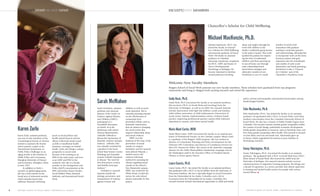
Michael MacKenzie, Ph.D., has
joined the faculty as Chancel-
lor's Scholar for Child Wellbeing
and associate professor of Social
Work. Previously an associate
professor at Columbia
University, MacKenzie completed
his Ph.D., MSW and Master of
Arts in Developmental
Psychology at Michigan. He
became interested in develop-
mental pathways involving
abuse and neglect through his
work with children in his
family’s residential group homes
in his native Canada. That work
sparked his passion for improv-
ing the lives of maltreated
children and those growing up
in out-of-home care through
early relationship-based
intervention strategies and
alternative models of care.
MacKenzie is one of a small
number of social work
researchers with graduate
training in molecular genetics
and endocrinology, allowing him
to incorporate work on the stress
hormone system and gene
expression into his transdiscipli-
nary studies of early social
deprivation and harsh parenting.
MacKenzie is also a “Chancel-
lor’s Scholar,” part of the
Chancellor's Excellence Fund.
Rutgers School of Social Work presents our new faculty members. These scholars have graduated from top programs
nationwide and bring to Rutgers both exciting research and varied life experience.
Michael MacKenzie, Ph.D.
Sarah McMahon, assistant
professor and associate
director of the Center on
Violence Against Women
and Children (VAWC),
participated in a
roundtable discussion
on March 18 at the
Statehouse with retired
Arizona Representative
Gabrielle Giffords to
discuss the intersection of
domestic violence and gun
violence. Giffords, who
was critically wounded by
a gunshot to the head,
joined State Senator Loretta
Weinberg and Assembly-
woman Gabriela Mosquera
to discuss "the need for
laws that protect women
and families from gun
violence.”
McMahon's research
interests include the
etiology, prevention, and
measurement of violence
against women and
children as well as social
work education. She is
currently pursuing research
on the effectiveness of
community-level
prevention efforts, such as
bystander intervention,
that are aimed at changing
the social norms that
support relationship abuse
and sexual violence.
VAWC is at the
forefront of the issue of the
prevention of sexual
assault on campus.
McMahon and her research
team piloted #iSpeak, a
student survey and
evidence-informed
method for assessing the
climate regarding sexual
assault on the school's
New Brunswick campus.
VAWC was invited by the
White House to pilot the
survey, the only school
chosen nationally for this
project.
Sarah McMahon
policy; poverty and inequality; and parental incarceration among
disadvantaged families.
Felix Muchomba, Ph.D.
Felix Muchomba, Ph.D., has joined the faculty as an assistant
professor. He graduated with a Ph.D. in Social Policy and Policy
Analysis concentration from the Columbia University School of
Social Work. He also has a Master of Public Health Degree from
Columbia. His research interests include gender inequalities within
the context of social change, particularly economic development;
family gender inequalities in resources, such as farmland, time; and
how these gender inequalities affect health. This research is focused
on East Africa and East and South Asia. Muchomba grew up
in Kenya, which engendered his interest in poor families in
developing countries.
Emmy Tiderington, Ph.D.
Emmy Tiderington, Ph.D., has joined the faculty as an assistant
professor. She graduated with a Ph.D. in Social Work from NYU’s
Silver School of Social Work. She received her MSW from the
University of Michigan. Her research interests include recovery-
oriented practices in supportive housing programs. She brings over
a decade of experience as a service provider and clinical supervisor
in housing and mental health services for people with serious
mental illness. n
Emily Bosk, Ph.D.
Emily Bosk, Ph.D.,has joined the faculty as an assistant professor.
She received a Ph.D. in Social Work and Sociology from the
University of Michigan, as well as an MSW. Her research interests
include intervention with high-risk children, youth and families;
child welfare; prevention of child maltreatment; intersection of
social service systems; implementation science; evidence-based
practice; improving professional practice; parent-child relational
disturbances; trauma; and infant mental health.
Marla Blunt Carter, MSW
Marla Blunt-Carter, MSW, has joined the faculty as an assistant pro-
fessor of Professional Practice on the Camden campus. Blunt-Carter
is a graduate of the Rutgers’ MSW program. She has worked as
director of Community Planning and Policy Development for the
Delaware HIV Consortium and director of Constituent Services for
then U.S. Senator Joe Biden. She served as the statewide campaign
director for the 2008 Obama/Biden Presidential campaign and on
the Washington staff in the Executive Office of President Barack
Obama as senior agency liaison.
Laura Cuesta, Ph.D.
Laura Cuesta, Ph.D., has joined the faculty as an assistant professor.
She graduated with a Ph.D. in Social Welfare from the University of
Wisconsin-Madison. She has a Specialist degree in Social Economics
from the Universidad de los Andes, Colombia, and a MA in
Economics from the Universidad de los Andes, Colombia. Her
research interests include international approaches to child and family
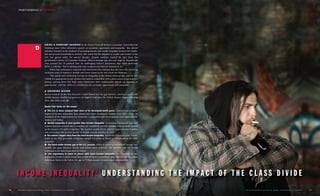
URING A FEBRUARY HEARING by the House Financial Services Committee, Federal Reserve
Chairman Janet Yellen delivered a speech on economic opportunity and inequality. She offered
extensive research on the evidence of increasing income and wealth inequality between the wealth-
iest and poorest households in America. She noted that the disparity in wealth and income in the
U.S. has grown wider for several decades. Despite evidence backed by data from the
government’s Survey of Consumer Finances, Yellen’s message was met with anger by Republicans
who accused her of political bias. In challenging Yellen's discussion, Rep. Mick Mulvaney
(R-S.C.), told her, “You're sticking your nose in places you have no business to be.”
Yellen has continued to respond with statements that indicate that she views the declining
economic state of America’s middle and lower classes to be very much her business.
“The extent and continuing increase in inequality in the United States greatly concern me.
I think it is appropriate to ask whether this trend is compatible with values rooted in our nation’s
history, among them the high value Americans have traditionally placed on equality of
opportunity,” said Ms. Yellen at a conference on economic opportunity and inequality.
A GROWING DIVIDE
Recent research by the Pew Research Center found that the gap between America’s upper and
middle-income families has grown to its highest level since the Federal Reserve began collecting
these data thirty years ago.
Some fast facts on the issue:
n The U.S. is more unequal than most of its developed-world peers. America has a higher
degree of income inequality than almost any other developed country. Only three of the 34
members of the Organization for Economic Cooperation and Development rank higher: Chile,
Mexico and Turkey.
n Wealth inequality is even greater than income inequality. Economists Emmanuel Saez and
Gabriel Zucman showed that in America the wealthiest 160,000 families own as much wealth
as the poorest 145 million families. The median wealth of the nation’s upper-income families
was seven times the median wealth of middle-income families in 2013.
n The nation’s largest cities have the most income inequality. Across the 50 largest cities, house-
holds in the 95th percentile of income earned 11.6 times as much as households as the 20th
percentile.
n The black-white income gap in the U.S. persists. When it comes to household income and
wealth, the gaps between blacks and whites have widened. The poverty rate for blacks
continues to be three times that of whites.
n Life expectancy is lower in places with more income inequality. New research by the
Population Health Institute found that people living in a community with high income inequality
were more likely to die before the age of 75 than people in more equal communities.
R U T G E R S S C H O O L O F S O C I A L W O R K / PA R T N E R I N G f o r C H A N G E 11
I N C O M E I N E Q U A L I T Y : U N D E R S T A N D I N G T H E I M P A C T O F T H E C L A S S D I V I D E
10 R U T G E R S S C H O O L O F S O C I A L W O R K / PA R T N E R I N G f o r C H A N G E
D
PARTNERING CHANGEfor
RUTGERS SSW FACULTY EXAMINE THE ISSUE
Associate professor Lenna Nepomnyaschy has extensively studied the
effect of income inequity in America. Her research interests are focused
on how poverty and inequality impact child and family health and well-
being. She examines the impact of social policies, particularly related to
fathers and child support, on the well-being of families and children.
“The latest research shows the U.S to have the highest inequality of
income of all developed countries. The effects of inequality are increasing,
especially in the areas of health care, access to education and wellbeing
outcomes. Families with young children are the most likely to be poor,
with 20 percent of families with children reporting food insecurity in the
home,” says Nepomnyaschy.
She describes a picture of poor children falling behind from birth.
Babies from lower income mothers are more likely to be born prematurely
and with low birthweight. By the time they begin kindergarten, they are
already behind their higher-income peers because they are more likely to
live in unhealthy and unsafe neighborhoods, have much less access to
high quality child care and preschools, and have poor nutrition. These
gaps continue and actually increase as children progress through school
because they are more likely to attend low-performing schools, their par-
ents have fewer resources for enrichment activities, and they are more
likely to have unaddressed health problems, such as asthma, obesity, and
dental decay than their higher-income peers. At all points in the life cycle,
high income families have the advantage.
Another area of concern is access to affordable health care. The poor
are frequently one medical emergency away from financial ruin. Medical
bills are the biggest cause of U.S. bankruptcies, according to a 2013 study
by NerdWallet Health, which used data from the U.S. Census and Centers
for Disease Control.
“We will see if the Affordable Care Act will close this huge gap in
access to health care. When a medical emergency arises, the first thing the
uninsured do is use up what little savings they have to pay for it,” says
Nepomnyaschy.
Access to higher education also separates the rich from the poor,
with low income students having much less access to college. The federal
Pell Grant program, which is designed to help college students from low-
income families afford college costs, now covers less than one-third of
the cost of attendance at public four-year university, the lowest in its his-
tory. The cost of obtaining a college degree has increased 1,120 percent in
three decades.
“Lack of access results in so much wasted talent, and it is so ineffi-
cient economically. Even when disadvantaged students have the skills and
credentials to be accepted to elite colleges, they are much less likely to
apply because they are not aware of these opportunities, and once
accepted, they are far less likely to attend, because of the perceived cost.
At the same time, evidence suggests that low-income students have the
most to gain from attendance at elite universities,” says Nepomnyaschy.
Poor children with access to high quality child care do better across
the board than those without. Associate Professor Myungkook Joo reports
that child care assistance has a huge effect on a poor parent’s ability to
earn more income. In his study of flexibility in child care subsidy program
rules, including eligibility requirements, subsidy payment methods, and
co-payment rates, Joo found that variations in the availability and in the
generosity of child care subsidy had a significant impact on low-income
mothers' hours of work.
“The study found that the odds of the mothers who lived in gener-
ous states working full-time were 1.65 times higher than those who lived
in stringent states working full-time. Levels of subsidy encourage recipient
mothers to work longer and help to close income gaps,“ says Joo.
As the gap widens between the richest and poorest Americans, and the
middle class declines, older adults also become more economically vul-
nerable. Many older adults experience psychological and financial stress,
which interferes with aging comfortably. Assistant professor Karen Zurlo
found in her research that unsecured debt, one form of financial stress,
frequently has a detrimental effect on the mental health of older individ-
uals. In middle-aged and older Americans, unsecured debt — which in-
cludes debt from credit cards, student loans, medical bills, and child
support — was found to have negative effects on mental health because
of the associated depressive symptoms and reports of decreased psycho-
logical well-being. Secured debt, like a mortage, is backed by collateral to
reduce risk, unlike unsecured debt.
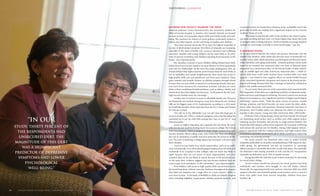
“In our study, thirty percent of the respondents had unsecured debt.
The magnitude of this debt was a significant predictor of depressive symp-
toms and lower psychological well-being. Perceived control over personal
financial circumstances was a significant predictor of higher psychological
well-being,” reports Zurlo. “Until the main sources of income, namely
savings, pensions, and Social Security, are more secure for older adults,
many older Americans will experience financial insecurity and stress in
retirement. And if public policy can attenuate the effects of income in-
equality in this country, young and older Americans, alike, will benefit.”
Professor Chien-Chung Huang, whose previous research has focused
on examining social policy, such as welfare and child support policy,
reducing income inequality and poverty in single-parent families, has
found that child support enforcement improves the economic well-being
and reduces the poverty rate for families. Strong child support enforce-
ment is associated with low welfare utilization, and high women labor
participation and father involvement, all of which contribute to improving
well-being and reducing poverty.
His recent research has examined other ways to reduce income
inequality, particularly on tax policy and philanthropy. With respect to char-
itable giving, the government can use tax incentives to encourage
affluent people to voluntarily share their wealth with others. The charitable
tax deduction varies among countries as well, and the U.S. has generous
charitable tax deduction, up to 50% of taxable income.
Huang describes the role that social workers must play in advocating
for social policy change.
“Social workers should be advocates for social policies that help
individuals and families who struggle to not fall further behind
financially. By supporting family leave policies, universal child care, child
support collection and charitable giving, social workers can be a voice for
those who suffer most from income inequality, children from poor
families.” n
R U T G E R S S C H O O L O F S O C I A L W O R K / PA R T N E R I N G f o r C H A N G E 1312 R U T G E R S S C H O O L O F S O C I A L W O R K / PA R T N E R I N G f o r C H A N G E
PARTNERING CHANGEfor
“in our
Study, thirty percent of
the respondents had
unsecured debt. The
magnitude of this debt
was a significant
predictor of depressive
symptoms and lower
psychological
well-being.”
PHOTOGRAPHBYPETERBYRON
A GROWING DIVIDE
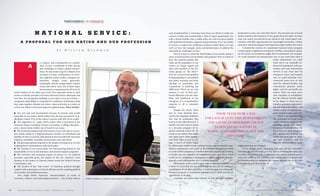
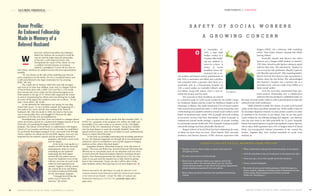
s a nation, and consequently as a profes-
sion, we face a multitude of risks, threats
and challenges in today’s global environ-
ment. No day seems to go by without news
accounts of some combination of terror-
ism, regional armed conflict, resurgent na-
tionalism, refugee crises, genocides,
catastrophic climate change driven weather
events and others. Each one of these issues
has enormous consequences for all of us. As
social workers we are often part of the first responder teams to such
events as well the providers of trauma informed services afterwards and
over time. Yet, the greatest challenge to our nation is not any of these —
our greatest vulnerability is comprised of a confluence of domestic trends
that, taken together, threaten our vision, values and unity as a nation as
well as our ability to lead and respond to global issues. These include:
n The vast and well documented increase in income and wealth
inequality in our nation which reflects that the top one percent of in-
dividuals control 25% of the nation’s income and 40% of its wealth;
n The stagnation of wages which makes what is perceived as the
American dream consisting of home ownership, a college education ,
and a decent home further out of reach for so many;
n The continued and growing intersection of race and class in our na-
tion which results in a disproportionate number of individuals and
families of color in poverty with attendant less favorable life outcomes
related to morbidity, mortality, incarceration rates and others;
n The growing national response to the deaths of young men of color
resulting from confrontations with local police;
n The fraying of our social safety net with growing threats to the
sustainability of our social insurance and income support programs;
n The corrosive and escalating impact of money on our political
processes especially given the impact of the U.S. Supreme Court
decision in the matter of Citizens United versus the Federal Election
Commission; and;
n The erosion of the “vital center” of American political thought
coupled with polarization of elected officials and the resulting gridlock
of our policy and political processes.
One might define American “exceptionalism” in terms of
economic, military and technological prowess — but if there truly is
A
William Waldman is a lecturer and executive in residence at Rutgers School of Social Work.
PHOTOGRAPHBYPETERBYRON
A P R O P O S A L F O R O U R N AT I O N A N D O U R P R O F E S S I O N
B Y W I L L I A M W A L D M A N
such exceptionalism, it emanates more from our efforts to make our
country socially and economically a land of equal opportunity; one
with a vibrant middle class, a viable safety net, and one that is replete
with individual freedoms, supports and protections. If we are unable
to reverse or redirect the confluence of factors noted above, we may
well not have the strength, unity, and perseverance to address the
extraordinary challenges we face.
How is it that we mend the frayed fabric of our society, restore a
sense of national inter-connectedness and purpose? How is it that we
have the majority groups that
make up the population of our
Nation no longer regard and
deal with members of the mi-
nority groups as “the other”?
How do we move from gridlock
to bipartisanship in our political
and policy domains and from
ideology to practicality and
compromise in resolving our
differences? There are no easy
answers to any of these pro-
found dilemmas and the feasi-
bility and likelihood of the
emergence of a comprehensive
response to all is extremely
limited.
Despite the above, there
may be some relatively incre-
mental but important initiatives
that may be undertaken that
lead us in the right direction. A
specific one that comes to mind
is a two-year program of re-
quired national service for all
youth in our nation that might
take place upon either gradua-
tion from high school or col-
lege. A choice of venue might
be offered that would include military service, environmental reme-
diation, construction and repair of the nation’s infrastructure, work
in social welfare programs to benefit vulnerable populations, working
in health care and education in underserved areas and others. There
would be no exceptions or exemptions so that youth from all back-
grounds could join together for a common purpose.
There needs to be a way for each of us to take responsibility and
a sense of ownership for our nation and do our part by making a
contribution of our time and effort. A well-managed and adequately
financed program of mandatory national service could provide an
opportunity to do that.
Currently, our youth often embark on very different pathways
predicated on class, race and other factors. The pervasive use of social
media reinforces the isolation of one group from the other. In some
ways our nation has devolved into physical and virtual gated com-
munities with little opportunities for meaningful interaction. Online
education and technological developments might further that trend.
Certainly the creation of a mandatory national service program
would require a significant investment of dollars and political capital,
yet the return on investment might also be substantial. For example,
we could maintain our infrastructure now or pay more later when it
needs replacement; we could
reach out to our medically un-
derserved population with pre-
vention and early intervention
services or pay more later for
emergency room and hospital
care; we could remediate envi-
ronmental issues now or wait
until the affected families and
communities generate much
higher costs for our health care
system. There are many more
such examples of possibilities,
but the ultimate benefit might
be the degree to which such an
initiative generates understand-
ing and respect for others; and,
creates a sense of national pur-
pose, common cause and unity.
There is no question that
the profession of social work
could contribute much to the
planning, design and imple-
mentation of such an effort. We
know how to create programs
that support and develop our
youth, we know how to man-
age such initiatives and we
have the clinical skills to assist
those youth that are troubled.
As the Beatles classic song goes “you may call me a dreamer”
but some dreams are worth pursuing and maintaining the status quo
over time may prove to be a nightmare. Mandatory national service
is not the solution, but could be a key component in a broad scale
revitalization effort to reconnect our nation, through our youth, with
both its roots and its promise. n
R U T G E R S S C H O O L O F S O C I A L W O R K / PA R T N E R I N G f o r C H A N G E 1514 R U T G E R S S C H O O L O F S O C I A L W O R K / PA R T N E R I N G f o r C H A N G E
PARTNERING CHANGEfor
N A T I O N A L S E R V I C E :
THERE NEEDS TO BE A WAY
FOR EACH OF US TO TAKE RESPONSIBILITY
AND A SENSE OF OWNERSHIP FOR OUR
NATION AND DO OUR PART BY
MAKING A CONTRIBUTION OF OUR TIME
AND EFFORT.
PHOTOGRAPHBYPETERBYRON
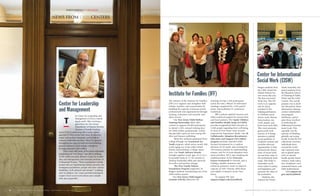
he Center for Leadership and
Management (CLM) is extend-
ing its reach. After receiving a
grant from the New Jersey
Department of Human Services,
Division of Family Develop-
ment, CLM is partnering with county welfare
agencies (CWAs) across New Jersey to discover,
assess, and analyze programs, and to help to
enhance leadership practices. These 21 agencies
throughout the state provide services including
general assistance, food stamps, emergency
housing assistance and welfare.
“They work with some of the most vulnerable
populations in New Jersey,” says Bert Goldberg,
ACSW, MSW, executive director, Center for Leader-
ship and Management, and associate professor of
Professional Practice. “These populations include
people who are experiencing extreme poverty, new
immigrant populations, people who have various
disabilities, both physical and mental,” Goldberg
said. In addition, the Center provides training for
master’s level social work interns and consults
with area nonprofits.”
NEWS FROM OUR CENTERS
PARTNERING CHANGEfor
T
R U T G E R S S C H O O L O F S O C I A L W O R K / PA R T N E R I N G f o r C H A N G E 1716 R U T G E R S S C H O O L O F S O C I A L W O R K / PA R T N E R I N G f o r C H A N G E
The mission of the Institute for Families
(IFF) is to support and strengthen indi-
viduals, families, and communities by
building the capacity of human service
professionals and organizations through
training, evaluation and research, and
direct service.
Our New Jersey Child Welfare
Training Partnership offers 100+
courses to support 20,000 participants
to attend 1,250+ annual training days
for child welfare professionals, includ-
ing specialty topics on very young chil-
dren and human trafficking.
Thirty-five students graduated from
college through our Transitions for
Youth program, which serves nearly 400
youth aging out of the child welfare
system and pursuing a college educa-
tion. Our Youth Advisory Boards
brought together youth ages 14-22 on a
bi-monthly basis in 15 NJ counties to
develop leadership skills and advocate
for policy and practice change.
The Price Family Fellows
Foundation Program supported 20
Rutgers students transitioning out of the
child welfare system.
Our New Jersey Child Support
Institute (NJCSI) delivered 136
trainings serving 1,490 participants
across the state, offered 16 web-based
trainings completed by 2,054 partici-
pants, and facilitated 21 conference
workshops.
IFF conducts applied research and
offers technical support for several State
and local partners. The Sandy Children
and Families Health Study (S-CAFH)
provides longitudinal field research on
1,300 people regarding their well-being
in areas of New Jersey most severely
impacted by Superstorm Sandy. Our NJ
Collaborative Adoption Recruitment,
Education and Support (NJ CARES)
program provides intensive child
focused recruitment for a random
selection of 20 youth, plus training for
150 resource parents in understanding
trauma, and for 50 post-adoption treat-
ment providers. IFF is also studying the
implementation of the Protective
Factors Framework in Newark, and is
leading a quality assurance and
technical assistance center to improve
capacity of 200+ forensic child abuse
and neglect evaluators across New
Jersey.
To support IFF, visit
support.rutgers.edu/SocialWork.
PHOTOGRAPHBYPETERBYRON
Center for Leadership
and Management
Rutgers students from
the CISW visited the
United Nations for
two events this year.
The first was Social
Work Day. This UN
event is an opportu-
nity for those
involved in the
helping professions
to celebrate social
service work, discuss
best practices, net-
work, inspire, and
learn from each other.
This event promotes
good social work
practice as it brings
attention to global
social problems in
localized contexts and
provides advocacy
opportunities. It also
promotes the impor-
tance of social work-
ers and their value in
the professional land-
scape. This helps to
internalize social
work values in policy
and legislation and
promote the value of
the profession.
Students also
enjoyed the Winter
Youth Assembly and
joined students from
the Bloustein School
of Planning & Public
Policy and the GAIA
Centers. The overall
purpose was to facili-
tate discussion, foster
information sharing,
connect stakeholders
and program
facilitators, and in-
spire those involved
in furthering the
Millennium Develop-
ment Goals. This
assembly was the
epitome of thinking
globally and acting
locally in that the UN
collectively convenes
individuals from
around the world
who represent inter-
ests in global issues
such as: mental
health, gender based
violence, basic educa-
tion, healthcare, envi-
ronmental issues, and
child maltreatment.
Visit support.rut-
gers.edu/SocialWork.
Center for International
Social Work (CISW)
Institute for Families (IFF)
18 R U T G E R S S C H O O L O F S O C I A L W O R K / PA R T N E R I N G f o r C H A N G E R U T G E R S S C H O O L O F S O C I A L W O R K / PA R T N E R I N G f o r C H A N G E 19
NEWS FROM OUR CENTERS
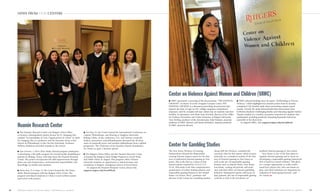
n VAWC sponsored a screening of the documentary, “THE HUNTING
GROUND” on March 10 at the Douglass Campus Center. THE
HUNTING GROUND is a discussion-provoking documentary that
exposes the issue of rape on U.S. college campuses, institutional
responses, and the complex toll rape culture has on students and their
families. In attendance were Ruth Anne Koenick, director of the Office
for Violence Prevention and Victim Assistance at Rutgers University,
Amy Zierling, producer of the documentary, Judy Postmus, associate
professor & VAWC director, and Sarah McMahon, assistant professor
& VAWC associate director.
n VAWC released findings from its report, “SCREAMing to Prevent
Violence,” which highlights key research points from its recently
completed CDC-funded study about preventing campus sexual
assault. Overall, the study demonstrated that intervention from
SCREAM (Students Challenging Reality and Educating Against Myths)
Theater resulted in a number of positive outcomes for students who
participated, including positively impacting bystander behaviors,
especially in the short term.
To support VAWC, visit support.rutgers.edu/SocialWork.
Center on Violence Against Women and Children (VAWC)
The New Jersey Division of Gaming
Enforcement released the Responsible
Gaming Internet impact report for the first
year of authorized Internet gaming in New
Jersey. This is the first in a series of four
annual reports required by N.J.S.A 5:12-
95.18. This study is the first comprehensive
examination of online betting patterns and
responsible gaming features in the United
States. Lia Nower, Ph.D., professor and
director of the Center for Gambling Studies,
along with the Division, compiled the
necessary data for this report, which focuses
primarily on a statistical analysis of the first
year of Internet gaming in New Jersey as
well as the use of responsible gaming
features such as deposit limits, time limits,
loss limits, cooling off periods, self-exclu-
sion and their effect on Internet gambling
behavior. Subsequent reports will focus on
play patterns, the use of responsible gaming
controls as well as the prevalence of
problem Internet gaming in New Jersey.
“New Jersey is one of the first states to
regulate Internet gaming and to focus on
developing a responsible gaming framework
that is based on actual evidence. This gives
us a unique opportunity to really under-
stand how players bet, who sets limits on
play, and what indicators are important for
reduction of harm going forward,” said
Dr. Nower. n
Center for Gambling Studies
n The Huamin Research Center and Rutgers China Office
co-hosted a distinguished scholar lecture by Dr. Jiangang Zhu
entitled “Accountability of Civic Organizations in China” in April.
Dr. Jiangang Zhu is a professor and the Executive Dean of the
School of Philanthropy at Sun Yat-Sen University. Professor
William Waldman provided remarks to the lecture.
n Lisa Lawson, a 2014 China Study Abroad program participant,
is developing a life skills program for mental health rehabilitation
patients in Beijing, China, with help from the Huamin Research
Center. The project incorporates life skill improvement through
plant care and maintenance, environmental responsibility, and
knowledge on health and nutrition.
n From May 21 to June 17, the Center hosted the 5th China
Study Abroad program with the Rutgers GAIA Center. The
program introduced students to China’s social welfare system
and social work practice.
n On May 29, the Center hosted the International Conference on
Capital, Philanthropy, and Sharing at Tsinghua University,
Beijing, China. At the conference, U.S. and Chinese nonprofit
leaders, researchers, and philanthropists discussed the develop-
ment of nonprofit sector and modern philanthropy from a global
perspective. The Chairman of the Huamin Charity Foundation,
Dr. Dezhi Lu, gave a keynote speech.
n The Rutgers China Office and the Huamin Research Center
co-hosted the Rutgers-China Bridge Program in Social Work
and Public Policy in August. This program offers Chinese
university students an opportunity to attend lectures and
workshops at Rutgers’ prestigious School of Social Work.
To support the Huamin Research Center, please visit,
support.rutgers.edu/SocialWork.
Huamin Research Center
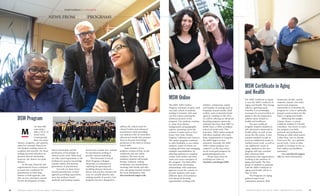
ore than fifty
universities
offer a Ph.D. in
social work.
Consequently,
there are many
choices, programs, and opportu-
nities for Licensed Clinical So-
cial Workers seeking careers in
academe and research. For those
seeking doctoral education to
develop clinical scholarship,
however, the choices are quite
limited.
In the past, financial and
organizational forces combined
to create the conditions for
practitioners to hold long
tenures at field agencies, and
this, in turn, provided contexts
for the development of field-
based scholarship and the
production of knowledge in
clinical social work. These lead-
ers often used supervision as the
medium for practice knowledge
transfer within and between
generations of practitioners.
Not only are there fewer
tenured practitioners at field
agencies providing supervision
now, but evidence-based
methods and funding require-
ments have created new contexts
for practitioners seeking to
provide clinical leadership.
The Doctorate in Social
Work Program at Rutgers
University is committed to
exploring the growing and
troubling distance between
theory and practice, between the
ways we actually practice and
existing models of practice. Our
program has been designed to
address the critical need for
clinical leaders and advanced
practitioners while providing
our students with an innovative
educational model that prepares
them to become knowledge
producers in the field of clinical
social work.
Each semester of our
program consists of four on-site
residencies and one online
residency. The four on-site
residency sessions will include
lectures, seminars, writing
workshops, case presentations,
meetings with faculty and advi-
sors, and group research sessions.
For more information, visit
dsw.socialwork.rutgers.edu.
The MSW 100% Online
Program continues to grow, with
our sixth cohort of students
starting in Summer 2015 and
our first cohort entering the
advanced portion of the
program. Our students continue
to come from diverse
backgrounds and geographic
regions, spanning across the
country in states such as New
Jersey, New York, Florida,
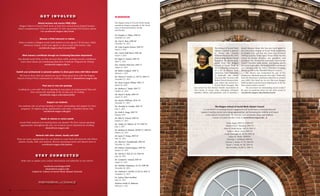
Virginia, California and Arizona.
The online program continues
to offer flexibility to our online
students, many of whom are
working full time and managing
multiple responsibilities, by
allowing students to complete
course work online and field
work over seven semesters of
the program. Our field office
has been busy developing
relationships with numerous
agencies across the country to
provide students with many
different types of foundation
and advanced learning
opportunities working with
children, adolescents, adults,
and families in settings such as
hospitals, mental health, child
welfare, and community-based
agencies. Starting in Fall 2015,
we will be offering an Advanced
Standing program option for
students who have their BSW or
BASW from a CSWE accredited
school of social work. This
part-time, 100% online program
will allow students who meet
these requirements to complete
the MSW degree in four
semesters. Recently, the MSW
100% Online program was
ranked #1 as the top online
social work grad program by
graduateprograms.com.
Please learn more by
watching our video at
YouTube.com/RutgersSSW.
The MSW Certificate in Aging
is now the MSW Certificate in
Aging and Health. This change
reflects a growing trend,
whereby it is increasingly
necessary for social workers in
aging to also be prepared to
address issues related to
health and healthcare.
The new certificate
program requires students to
take advanced coursework in
health policy, as well as loss
across the life course. It also
requires students to take at
least one additional course in
medical social work, as well as
one additional course in
aging. Students in the new
program will also complete
their advanced field
placements with organizations
working at the interface of
aging and health. The first
group of students to graduate
with the MSW Certificate in
Aging and Health will be in
May of 2016.
The Programs on Aging
gathered input from
community partners, field
instructors, faculty, current
students, alumni, and other
social work programs
nationwide to re-develop the
program in a way to optimally
prepare social workers for the
future of aging and health.
Reflecting this insight,
Latanya Hayes, a current
certificate student in Newark,
remarked, “My choice to enter
the program was both
personal and professional.
Having an older adult parent,
I often hear ‘you've already
lived your life.’ As a geriatric
social work, I want to help
people to continue to live to
their fullest and healthiest
potentials.”
Visit socialwork.rutgers.
edu for more information.
MSW Certificate in Aging
and Health
20 R U T G E R S S C H O O L O F S O C I A L W O R K / PA R T N E R I N G f o r C H A N G E
MSW Online
DSW Program
NEWS FROM OUR PROGRAMS
R U T G E R S S C H O O L O F S O C I A L W O R K / PA R T N E R I N G f o r C H A N G E 21
MM
PARTNERING CHANGEfor
PHOTOGRAPHSBYPETERBYRON
Congratulations to these Ph.D. students
who we look to become leaders in the field:
n Ph.D. student Louis Donnelly accepted a
postdoctoral research associate position at
the Center for Research on Child Wellbeing
(CRCW), affiliated with the Woodrow
Wilson School and the Office of Population
Research at Princeton University.
n Ph.D. graduate Jamey Lister accepted a
position as an assistant professor at the
Wayne State University School of Social
Work in Detroit. Lister was previously a re-
search associate at the Center for Gambling
Studies with faculty mentor Lia Nower. He
was also the recipient of a Fulbright
Research Fellowship in Canada where he
conducted research on decision-making in a
virtual gaming lab.
n Ph.D. graduate Cory Morton accepted a
position as an assistant professor at the
University of New Hampshire, Department
of Social Work. Morton was a research
associate at Rutgers School of Social Work
with faculty mentor Andrew Peterson.
n Ph.D. graduate Kerrie Ocasio has
accepted a position as an assistant professor
of research at Rutgers School of Social Work.
n Congratulations to Samantha Winter for
receiving two fellowships with Boren and
PEO Chapter AK, as she begins dissertation
data collection in Africa.
n Finally, congratulations to Anasuya Ray
who is completing a post-doctoral
Congressional Fellowship in the office
of Senator Bernie Sanders.
The School of Social Work, in
conjunction with the Graduate School-New
Brunswick, offers a doctoral program that
prepares students for careers in higher
education, research and advanced positions
in social policy and administration. Our
Ph.D. program is ranked 3rd nationally in
faculty productivity by Academic Analytics.
We will welcome our next cohort of
Ph.D. students in fall 2015. Applications
are due January 15, 2016. Information is
available on the social work website
socialwork.rutgers.edu/Academics/phd or
by contacting program director Allison
Zippay at zippay@ssw.rutgers.edu.
22 R U T G E R S S C H O O L O F S O C I A L W O R K / PA R T N E R I N G f o r C H A N G E R U T G E R S S C H O O L O F S O C I A L W O R K / PA R T N E R I N G f o r C H A N G E 23
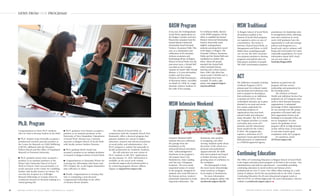
Intensive Weekend MSW
students this year celebrated
the passage from the
foundation to the
advanced/clinical curriculum
with "acknowledgement"
luncheons at the program’s
off-campus Jersey City,
Bordentown, Mays Landing
and, last year, Parsippany
locations. The year round,
sequential nature of courses
in the program, designed for
students who work full time in
the human services, makes it
particularly important to mark
important milestones. The
luncheons were positive,
re-energizing, and often
moving. Students spoke about
the power of the cohort as a
personal and professional
support network, the skills
they had acquired and hoped
to further develop and their
growing sense of confidence in
the workplace.
The photograph is from
the most recent Acknowledge-
ment Luncheon at Rutgers
EcoComplex in Bordentown.
For more information
about the program, please visit
socialwork.rutgers.edu/IW.
Ph.D. Program
BASW Program
MSW Intensive Weekend
The Addiction Counselor Training
Certificate Program’s (ACT)
primary goal is to educate master
and doctorate-level clinicians who
wish to prepare for licensing in
their profession as an Addictions
Counselor (LCADC). Dual
credentialed clinicians are in great
demand in our state and across
the country, particularly for
leadership positions in
organizations that treat both
mental health and substance
abuse disorders. The ACT Certifi-
cate Program provides a 6-course
curriculum that covers all 5
domains and the educational
hours needed for the CADC/
LCADC. The program also
requires a minimum of 675
experience hours gained through
field placement or employment
at a DMHAS-approved agency.
Students accepted into the
program will also receive
mentorship and preparation for
the licensing exams.
The Division of Mental
Health and Addiction Services has
marketed our ACT program exten-
sively to their licensed treatment
organizations. A substantial
percentage of these organizations
do not currently have the proper
proportion of licensed staff, and
their organization license (and
funding) is in jeopardy if they are
not in compliance. For this
reason, the graduates of our
program will be in high demand,
as they will be close, if not ready,
to earn their license upon
completion of the ACT program.
For questions, email
ACT@ssw.rutgers.edu.
ACT
Continuing Education
MSW Traditional
Every year, the Undergraduate
Social Work organizations on
the Rutgers Camden and New
Brunswick campuses host the
Krystal Skinner Memorial
Scholarship Fund Domestic
Violence Awareness Walk. This
year, as a culmination and
celebration of the domestic
violence awareness and
fundraising efforts of Rutgers
School of Social Work over the
past seven years, a Krystal Ball
was held on the Camden
campus on March 28th. Krystal
Skinner, a 22-year-old student,
mother, and New Jersey
Division of Child Permanency
& Placement intern, was killed
on March 26, 2008, in a tragic
domestic violence incident. In
the wake of her passing,
Dr. DuWayne Battle, director
of the BASW program, led the
effort to establish the Krystal
Skinner Memorial Scholarship
Fund to financially assist
eligible undergraduate
students pursuing their social
work degree at Rutgers. The
Domestic Violence Awareness
Walks and the Krystal Ball were
established to further this
effort. About 80 people
attended the Krystal Ball,
which included dinner,
dancing and a silent auction.
Since 2009, this effort has
raised nearly $110,000 and 11
scholarships have been
awarded. To make a gift,
please visit support.rutgers.
edu/SocialWork
At Rutgers School of Social Work,
all students enrolled in the
Masters of Social Work program
are required to select an area of
concentration. The choice is
between Clinical Social Work, or
Management and Policy, or MAP.
Rather than counseling people
one on one, the MAP concentra-
tion prepares students to develop
programs and policies that can
help greater numbers of people.
The MAP concentration prepares
practitioners for leadership roles
in management policy, planning
and other endeavors in social
work. MAP graduates have the
opportunity to craft and manage
policies and programs on a
broad scale, and to enhance well-
being and social justice for many
vulnerable populations. For more
information about MAP, check
out our new video at
YouTube/RutgersSSW.
NEWS FROM OUR PROGRAMS
PHOTOGRAPHBYPETERBYRON
The Office of Continuing Education at Rutgers School of Social Work
is the largest university-based program of its kind in the country. Our
administration and staff are experienced — successfully providing
continuing education to social workers and human service
professionals for over 35 years. Our Office offers training on a wide
variety of subjects, led by the top professionals in the field. Contact
Continuing Education for all your educational program needs at
848-932-8758, or ce@ssw.rutgers.edu. For more information, visit our
website at socialwork.rutgers.edu/ce. n
PARTNERING CHANGEfor
Congratulations
Graduates!
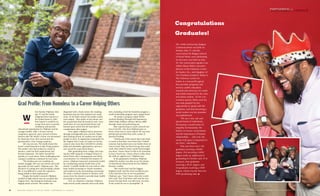
hen Kareim Oliphant, then
age 15, and his family
emigrated from Jamaica to
the United States in 2007,
they hoped it would be an
escape from poor economic
conditions and provide
educational opportunity for Oliphant and his
younger brother. After a 10-year wait for
emigration approval, and a period of home-
lessness after the family’s home was devastated
by Hurricane Ivan, they moved into his
grandmother’s East Orange residence.
Life was not easy. The family shared the
home’s small basement as their living quarters.
His mother, who had worked at a bank in
Jamaica, could not find employment and
became depressed. His father traveled fre-
quently as a truck driver. These challenging and
cramped conditions continued for four years.
“The hardest part was watching my
mother struggle. She was very driven and work-
ing made her feel useful,” Oliphant says. “She
dreamed of coming here and providing a better
life. It was difficult to watch her sadness at
being unable to find employment.”
Despite the family’s turmoil, Oliphant
excelled in high school and was accepted into
Virginia Tech. But during his freshman year,
tragedy struck at home. His mother was
diagnosed with a brain tumor; the crushing
headaches that she had endured now made
sense. As his finals neared, his mother under-
went surgery. They spoke on the phone and
she assured him that all would be well. A few
weeks later, he was summoned home and
learned upon arrival that she had died of
complications after surgery.
Once again, Oliphant had to persevere
through unimaginable pain and loss. Rather
than turning inward, he reached out to help
people in need. As regimental commander for
the Virginia Tech Corps of Cadets, he led the
corps to raise more than $20,000 for scholar-
ships and charitable organizations, and set a
new record for corps blood drives.
After graduating from college and enter-
ing the MSW program at Rutgers School of
Social Work with a Management and Policy
concentration, he continued his mission of
service. Oliphant improved community health
by coordinating annual health fairs at his
church. A mobile health van was used to offer
basic health screenings to church members
and residents in the surrounding community.
He made a medical mission to Jamaica with
nurses from his church to provide basic health
screenings in rural towns.
Now an ordained a minister, Oliphant
leads several youth outreach and social initia-
tives, including a feed the homeless program, a
youth mentorship program and a gospel band.
He started a program called ARTSE
(Actively Reading Through Self Expression),
which helps children enhance literacy skills
through visual and performing arts.
After experiencing so much turmoil and
loss in his life, why does Oliphant give so
freely of his time to serve others? He says that
giving back provides him with a sense of
personal healing.
“I think part of the reason that I give back
so much is that there were times that I wished
someone had reached out to my family when we
were in need. They say that if you go into social
work, there must be some wound that brought
you there. I know what it is like to be homeless,
to lose a loved one. I know what it is like when
the odds are against you,” Oliphant says.
At the graduation ceremony, Oliphant
wished his mother was alive to see her dream
of educational advancement for her children
become a reality.
“She would have had the biggest,
brightest smile and the most wondrous eyes
if she had been here to see me graduate,”
Oliphant says. “And I know what she would
have said: That I had done well and she was
proud, but that there was still more out there
in the world for me to accomplish.” .
Grad Profile: From Homeless to a Career Helping Others
WW
24 R U T G E R S S C H O O L O F S O C I A L W O R K / PA R T N E R I N G f o r C H A N G E
The 249th Anniversary Rutgers
Commencement was held on
Sunday, May 17, and the
convocation for Rutgers School
of Social Work, now celebrating
its 61st year, was held on May
18. The convocation speaker was
Ashley Blazer Biden, executive
director of the Delaware Center
for Justice, Inc., and daughter of
Vice President Joseph R. Biden Jr.
The Delaware Center for
Justice is a non-profit agency
that provides programs and
services, public education,
research and advocacy for youth
and adults impacted by the crim-
inal justice system. In her con-
vocation speech, Biden said she
was truly grateful for the
opportunity to speak with the
graduates, and that becoming a
social worker was her proudest
accomplishment.
“We are a very rare and
special breed of individuals.
We possess a sacred sense of
empathy for humanity. We
believe in service, social justice
and the importance of human
relationships. . . Like you, the
social work gene is imprinted in
my DNA,” said Biden.
This year there were 148
graduates receiving a BASW
degree, 494 receiving a MSW
degree (with an additional 61
graduating in October and 19 in
January), four graduates
receiving a Ph.D. degree, and
20 graduates receiving a DSW
degree, which was the first ever
DSW graduating class. n
R U T G E R S S C H O O L O F S O C I A L W O R K / PA R T N E R I N G f o r C H A N G E 25
PHOTOGRAPHBYPETERBYRON
A L U M N I P R O F I L E
Greater than $25,000
Dr. Joan G. Axelrod, Ph.D
Casey Family Programs
Gerontological Society of America
Huamin Charity Foundation
Mental Health Association in
New Jersey
Price Family Foundation, Inc.
$10,000 to $24,999
American Cancer Society
Brandeis University
Mr. Allen B. Cohen
Dr. Richard L. Edwards
Ms. Madonna F. Falk
Ms. Kathleen T. Kovach-Orr
Ms. Dianna Soll
Dr. Joseph Twanmoh, M.D.
Vanguard Charitable Endowment
Program
Ms. Suzanne Zimmer
$5,000 to $9,999
Jewish Federation of Greater
MetroWest NJ
Lifecare Inc.
The New York Community Trust
Dr. Cathryn Potter
Prudential Financial
Ms. Nellie R. Purefoy
The Lois and Samuel Silberman
Fund, Inc.
Ms. Catherine M. Twanmoh
Johnson & Johnson Family of
Companies
$1,000 to $4,999
Advanced Health and Education
LLC
Aetna Life & Casualty Insurance Co.
The Ayco Charitable Foundation
Ms. Jean P. Barnes
Mr. Joel Cartun
Cigna Health and Life Insurance
Company
Mr. Robert E. Coughlin
Ms. Susan Kinsley Darien
FEI Behavioral Health
Dr. Chien-Chung Huang
Johnson & Johnson
Mr. Robert B. Nolan
NR Pennsylvania Associates, LLC
Schwab Fund for Charitable Giving
Ms. Alison Schwartz
The Reverend Donald J. Stager
Dr. Donna M. Van Alst
Mr. William Waldman
Mrs. Laurice C. Walker
Mr. Carl R. Woodward, III, Esq.
Ms. Silai Yi
$500 to $999
Mr. Michael D. Browne
Carrier Clinic
Dr. James E. Cone, M.D., M.P.H.
Mr. Christopher Edel
Friends of Krystal Skinner
Ms. Francyne Furman
Ms. Stephanie Giordano
HARP Palm Beach, LLC
Mr. Maury L. Lieberman
Livengrin Foundation Inc.
Ms. Joan T. Mallonee
Dr. Raymond Sanchez Mayers
Ms. Mary Frances McFadden
Mr. Robert M. Robertson, Jr.
Ms. Susan E. Van Vleet
Ms. Judith P. Zenowich
$100 to $499
Ms. Kathryn R. Adamiak
Ms. Anne Z. Allen
Dr. John T. Ash, III, Ph.D.
Ms. Mary D. Aun
Ms. La Verne E. Austin
Mrs. Ronne E. Bassman-Agins
Dr. V. DuWayne Battle
Mrs. Barbara B. Baumecker
Mr. Edwin W.B. Be
Ms. Rebecca W. Benjamin
Ms. Cheryl Bennett
Ms. Cynthia D. Boyd
Ms. Joan Brabander
Ms. Gail Bresnahan
Dr. Leonard N. Brown
Mrs. Lillie Mosby Brown
Mr. Robert H. Burnett, Jr.
Mrs. Lisa K. Butler
Ms. Nancy L. Caffrey
Mr. Thomas W. Callahan
Mr. Robert J. Clark
Dr. Martin Cordon
Ms. Kathryn A. Cortese
Ms. Anita I. Costello
Ms. Catherine M. Crill
Dr. Rebecca T. Davis
Ms. Lynn D. Dean
Mr. Andrew L. Dory
Ms. Sonja C. Douglas
Ms. Judith L. Evanko
Ms. Joanne R. Fadool
Diane S. Falk, Ph.D.
Fidelity Charitable Gift Fund
Ms. Mary Ellen F. Ford
Ms. Margaret A. Forrester
Mrs. Marsha Frankel
Mr. Bruce A. Fredrickson
Mr. Elliot Freidenreich, M.B.A.,
C.P.A.
Ms. Kathleen E. Gallagher
Ms. Deborah Geismer
Ms. Charlotte P. Gelfand
Ms. Elia F. Gold
Ms. Gail M. Goldfinger
Ms. Sarah C. Griffith
Ms. Barbara W. Hale
Ms. Janet Halpern
Ms. Elaine H. Handleman
Ms. Louella F. Haynes
Ms. Beverly G. Hays
Dr. Lynne M. Healy
Mr. Crista D. Herman
Ms. Diane J. Hess
Mr. David P. Hoff
Dr. Langdon L. Holloway
Ms. Betty Ann Honig
Ms. Phyllis M. Hughes
Mr. Fakhruddin Hussain
Ms. Theresa E. Johnson
Mr. Philip R. Kagan
Ms. Arlene A. Kahn
Ms. Johnna L. Keen
Mr. John Joseph Kelaher
Mr. Michael J. Klinger
Mr. Michael M. Knox
Dr. Jeanne M. Koller
Mr. Harry F. Kuhn, III
Ms. Michelle L. Lamar, Esq.
Mr. Thomas Larson
Dr. Michael C. LaSala, Ph.D.
Ms. Lisa M. Lawson
Ms. Brittney M. Lee
Ms. Anne E. Leegan-Quinn
Ms. Marion B. Linkh
Mr. Robert P. Lloyd
Mr. Lawrence A. Luxenberg
Ms. Patricia Mallory-Miah
Dr. James Albert Malone
Ms. Marie J. Mason
Dr. Bethellen S. McGuire
Ms. Gail E. McHugh
Mrs. Edith W. McIntyre
Dr. Sarah E. McMahon, Ph.D.
Ms. G. Sue McMunn
Mr. Daniel M. Meyers
Ms. Lynn Ferrante Miller
Ms. Ina E. Mitchell
Ms. Carol T. Mostrom
Ms. Beth I. Mucatel
Mr. D. Garry Munson
Ms. Karen M. Nevalsky
Ms. Judith A. Oakes
Mrs. Bineke P. Oort
Ms. Miraida L. Oquendo
Ms. Ariaceliz Ortiz
Ms. Peggy J. Palys
Ms. Marie E. Parent-Ganthier
Ms. Barbara J. Parenti
The Reverend Raymond David Patch
Ms. Anne DeSola Paust
Dr. N. Andrew Peterson
Ms. Glenda L. Phipps
Mr. Montes Piard
Dr. Dorothy M. Pietrucha, M.D.
Ms. Donna M. Pincavage
Mr. Keith Pishna
Ms. Megan Rahaman
Ms. Patricia Reynolds, M.S.W.
Ms. Micki G. Riddick
Ms. Evalynne Bronell Rinsky
Mrs. Stephanie Rodriguez
Ms. Tiina K. Ruubas
Ms. Diane R. Salandra
Mr. Yordak Salermo
Ms. La'Tesha Elaine Sampson
Mitchell A. Schley, Esq.
Ms. Bonnie Jean Schwebel
Mr. John Seccafico
Mrs. Selma Patt Shure
Ms. Janice Siegel
Ms. Erin C. Smith
Ms. Dawn Sponheimer
Ms. Constance Z. Stober, DCSW, RN
Ms. Sharon Brannan Stockwell
Mr. Robert Edward Stone
Ms. Janice Svizeny
Ms. Theresa K. Tally
Ms. Kathleen Taylor
The Staff at Joseph's House
Ms. Nancy B. Till
Mr. Walter C. Tombs
Ms. Paula S. Tsarides
Mr. Michael J. Vaillancourt
Ms. Ruth Z. Valentine
Mary Patricia Van Hook, Ph.D.
Ms. Karen E. VanOrden
Ms. Nellie R. Vitale
Ms. Andrea Watson
Ms. Nancy M. Weber-Hunn
Ms. Amy L. Wechsler, Esq.
Dr. Daniel Weisman
Mrs. Mary Lodge Wells
Ms. Barbara S. Wiley
Ms. Kristin M. Will
Ms. Annie Williams
Mr. Peter C. Winkler
Mr. James J. Zanzucchi
Mrs. Milbrey T. Zelley
Dr. Allison L. Zippay
Up to $99
Ms. Soveyra Acosta
Ms. Jacqueline Y. Adams
Dr. John A. Agostino, R.Ph.
Mr. O'Brien U. Agwanihu
Ms. Ayana Ainyette
Ms. Belinda Akamelon
Ayse Akincigil, Ph.D.
Mr. Jonas Akpassa
Ms. Carol Ann Albanese
Ms. Hillary S. Albert
Mr. Martin Alboum
Dr. Edward J. Alessi
Ms. Edna Ibis Alex
Ms. Claudia M. Alfonso
Ms. Mary Beth Ali
Ms. Florencia B. Allegretti
Ms. Crystal L. Allen
Ms. Verona V. Allen
Ms. Maureen M. Almeida
Ms. Carmen E. Almonte
Mr. Roberto N. Alvarez
Ms. Alyssa Amabile
Ms. Nilsa L. Ambert
Ms. Karen J. Apostola
Ms. Lauren R. Arlen
Ms. Irene Armah
Ms. Amanda F. Arroyo
Ms. Katherine R. Arzig
Ms. Sally Attia
Mr. Thomas J. Bailey
Mr. Bryan Balaban
Ms. Nancy B. Baldwin
Ms. Manoucheka Baltazar
Ms. Ashley Bardi
Ms. Lucille Gaston Barker
Ms. Nicole G. Barnes
Ms. Tiffany D. Barthelemy
Ms. Asia M. Bash
Ms. Gail A. Bates
Ms. Colleen M. Beach
Ms. Brenda S. Beacham
Mr. Robert M. Beggan
Mr. Douglas E. Behan
Ms. Suzanne M. Bell
Benevity
Mr. Ricardo I. Benitez
Ms. Joan R. Berns
Ms. Alexis R. Biedermann
Ms. Susan H. Birnbaum
Ms. Shena A. Bishop
Mr. Aaron Lionel Black
Ms. Veronica Bledsoe-Epps
Ms. Marla K. Blunt-Carter
Mr. Jerome W. Bobrowski
Mr. Joseph R. Boiler
Ms. Diana Borova
Ms. Katherine Bowden
Ms. Benedicta A. Braimah
Ms. Channah R. Brandeis
Ms. Rena S. Brandeis
Ms. Diana I. Bravo
Ms. Kelly M. Bravo
Dr. Peter J. Bridge
Ms. Virginia L. Brodie
Ms. Tova E. Brody
Ms. Jacqueline P. Brousse
Mr. Joel D. Brown
Ms. Lanae Brown
26 R U T G E R S S C H O O L O F S O C I A L W O R K / PA R T N E R I N G f o r C H A N G E R U T G E R S S C H O O L O F S O C I A L W O R K / PA R T N E R I N G f o r C H A N G E 27
DONOR HONOR ROLE
GIFTS AND PLEDGE PAYMENTS FROM JULY 1, 2014 – JUNE 30, 2015
PARTNERING CHANGEfor
fter Maria Hernandez and her two siblings were
removed from their home because of suspected
child abuse, she passed through a series of foster
homes. When she was finally available for adop-
tion and a family wanted her to join their home,
Hernandez’s biological mother kept reappearing
with the promise of changed behavior and reunion.
By age 9, living in a group home, Hernandez spoke with her mother
one final time. Her mother told her, “I love you. I will come back
for you.” That was the last time they ever saw each other, and
Hernandez was eventually adopted by a new family.
“My mother was just not able to follow through on the testing
and procedures she needed to do to get us back. After my adoption
the records were sealed and we never spoke again,” she relates. It was
a difficult loss for a young child, but she did benefit greatly from a
new and stable family.
Now, years later and having grown into adulthood, Hernandez
graduated with an MSW in May through her participation in Rutgers
School of Social Work’s Intensive Weekend Program. She is the
recipient of the Lynne Witkin/CPFA Scholarship, which helped her to
complete her studies and pay down her student loan. Hernandez
works at a nonprofit adoption agency in Fairlawn, NJ, helping to
counsel and assist women who find themselves with an unplanned
pregnancy and few resources as they search for adoptive families.
Through her work, she is helping to positively affect the lives
of children who, like herself, will become part of a loving,
nonbiological family.
“It takes a tremendous amount of sacrifice and love to place a
child for adoption. With today’s more open adoptions, it is great for
the mother to know how their child is growing and developing and
for the child to retain knowledge about his or her origins. It is an
amazing thing to help these families. It is a redemptive story,” says
Hernandez.
Hernandez helps to create adoption plans, interview prospec-
tive families, and assists mothers with the grieving process of placing
a child. She also works with older children going from foster care to
adoptive homes, who are experiencing a transition to which she
can keenly relate.
“When I was first adopted, I went through a honeymoon phase
of excitement to have my own family. That moved to a testing period,
when I did some acting out. I prayed a lot as a kid and read my Bible
and had a deep sense that my story mattered, and that I was loved
despite my brokenness. I experienced great healing from God and
realized that I didn’t want my hurt to hurt others,” says Hernandez.
In adulthood, she was able to find and connect with one of her
siblings through LinkedIn, and set up their first meeting in 15 years of
separation. Her brother was able to fill in some missing pieces about
the past that Hernandez did not remember and the conversation
resulted in “a whole new level of healing for both of us.”
Hernandez credits the Intensive Weekend program with
providing her with an opportunity to earn her degree while working
and completing an internship. One of her long-term goals is to
create a residential program to counsel and support foster children
transitioning into society.
With older foster children, who have experienced trauma and
pain, Hernandez has had the joy of watching them begin to bond
with a new family.
“I see the children finally letting people into their little hearts. I
share that pain with them and can help them to experience healing,”
she said. n
Former Foster Child
Helps Families Looking
to Adopt
A L U M N I P R O F I L E
AA
One of her long-term Goals is to create a residential program to
counsel and support foster children transitioning into society.
28 R U T G E R S S C H O O L O F S O C I A L W O R K / PA R T N E R I N G f o r C H A N G E R U T G E R S S C H O O L O F S O C I A L W O R K / PA R T N E R I N G f o r C H A N G E 29
DONOR HONOR ROLE
Ms. Nikiemma Brown
Ms. Sherie N. Brown
Mrs. Victoria Williams Brown
Ms. Maria S. Bucco
Ms. Kathleen Burbage
Ms. Nicola O. Burnett
Ms. Adela Bustamante
Ms. Elizabeth K. Buttaci
Ms. Teresa R. Buxton
Ms. Sharyl A. Byank
Mr. Michael D. Calderon
Dr. Germaine M. Camishion
Ms. Joyce E. Campbell
Ms. Rosalind Campbell
Ms. Breanna Cannetti
Ms. Carol Cantrella
Ms. Jillian Caprio
Ms. Susan A. Caputo
Ms. Norma C. Cardona
Ms. Justine M. Carnevale
Mr. John P. Caronia
Ms. Jennyfer L. Carrasco
Ms. Thalia A. Carrera
Ms. Barbara K. Carroll
Ms. Ellen M. Carter
Ms. Sandra A. Casperson
Ms. Olga J. Castro
Ms. Jackie L. Cataulin
Ms. Deborah M. Chainey
Mr. Michael Chambers
Ms. Ashley M. Champion
Ms. Eileen C. Chapel
Ms. Jessica Checo
Ms. Kaman Cheong-Lau
Ms. Kimberly Chidiac
Mr. Samuel J. Chidiac
Ms. Danielle E. Chirico
Ms. Ruslana Church
Ms. Heather Ciociola
Ms. Clarisa Claeyssen
Ms. Morgan Clark
Ms. Tracy A. Clough
Ms. Christine N. Cocchia
Mrs. Merle B. Cohen
Ms. Robin S. Cohen, L.C.S.W.
Ms. Jennifer K. Colangelo
Dr. Brian L. Coleman, Ph.D.
Ms. Janet Brown Collins
Ms. Laurie Colon
Ms. Janet L. Coon
Mrs. Marilyn L. Cortright
Ms. Lauren Cosentino
Ms. Melanie M. Costa
Ms. Ashley N. Craig
Ms. Elfreta Craker
Mr. Onaje Crawford
Dr. Robin Creswick Fenley
Ms. Shonn Y. Crowe
Ms. Kathleen M. Cupano
Ms. Lois A. Currie
Ms. Sylwia Czarnocka
Ms. Sarah L. Damon
Ms. Sarah Darish
Ms. Sonia Carnaval DaSilva
Ms. Jean E. Davis
Ms. Dolores De Giacomo
Mr. Brian De Oliveira
Mr. Enrico DeGironimo
Dr. Ericka E. Deglau
Ms. Bette Feather DeGraw
Ms. Kaitlin Deignan
Ms. Nancy B. DeLeon
Ms. Alexandra L. D'Emidio
Ms. Monique L. Dent
Ms. Jessica D. Deutsch
Ms. Angela Di Dolce
Ms. Dana Di Stefano
Ms. Fiorella D. Diaz
Ms. Marian R. Diksies
Ms. Shakayla Dingle
Ms. Mary M. Ditzler
Ms. Judy Z. Dixon
Ms. Debra L. Domke
Mr. Opoku Donkor
Mr. Reginald S. Dorsey
Mr. Peter E. Dougherty
Ms. Samantha A. Dowgin
Ms. Amy F. Dresnack-Kravitz
Ms. Angela G. Duque-Howitt
Ms. Yokasta M. Duran
Ms. Imani T. Edwards
Ms. Joann E. Ellsworth
Ms. Mary E. Elwood
Mr. Edson Elysee
Ms. Rachel V. Emanuelson
Ms. Stephanie Enriquez
Ms. Felisha L. Estes
Ms. Anne Lee Everette
Mr. Nicholas J. Fall
Mr. Christopher Famiglietti
Families In Harmony
Ms. Suzanne M. Fanuele
Ms. Rubeena N. Farooqui
Mr. Ryan A. Farr
Ms. Stephani Faust
Ms. Judith Platt Felder
Dr. Philip B. Feldman
Ms. Christine Y. Ferguson
Ms. Maria C. Ferreira
Ms. Rosalind M. Fields Redd
Dr. Patricia A. Findley
Ms. Amy Florence
Ms. Cindy E. Flynn
Ms. Arline K. Forman
Ms. Brenda Formanek
Ms. Joe Anne Forney
Mr. David Foster
Ms. Florence A. Francis
Ms. Catherine R. Fries
Ms. Lauren E. Frisch
Ms. Erica Fritz
Mr. Javier O. Galindo, Jr.
Ms. Mary Beth L. Gallimore
Mrs. Ruth E. Gandek
Ms. Adelina Garabet
Mr. Avi S. Gardenswartz
Ms. Jasmine L. Gardner
Ms. Abigail L. Garner
Ms. Wyndolyn D. Garrett
Ms. Anne Germain
Ms. Brittany L. Gilbert
Ms. Suzanne E. Gilbride
Ms. Kathleen M. Gilligan-Greer
Ms. Kimberly Gilroy
Mrs. Julie Goetz
Mr. Bert Goldberg
Ms. Norma S. Goldberg
Ms. Shaina Goldberg
Ms. Adrienne M. Goldsboro
Mr. Charles Goldstein
Ms. Yolanda Gonzalez
Ms. Kirsten Goodwin
Ms. Kamilah Gorrell
Ms. Jenny Gragg
Mr. Gerardo Grasso
Ms. Susan C. Graves
Ms. Malve Gray
Dr. Clay T. Graybeal
Dr. Emily Greenfield
Ms. Christine Greenwood
Ms. Kelly Grew
Ms. Jessica D. Grollman
Ms. Samira L. Gross
Dr. Caroline M. Grossmann,
Ph.D., LCSW
Ms. Amanda L. Grube
Ms. Alicia N. Guajardo
Mr. Luis A. Guillen
Ms. Angela Gulla
Ms. Lauren M. Guzzo
Ms. Diane L. Haley
Ms. Anayiah M. Hall
Ms. A. Heather Halperin
Ms. Colleen J. Harding
Mrs. Marjorie A. Haring
Mr. Sean P. Hart, Esq.
Ms. Emily L. Head
Mr. Evan Heckler
Mr. Richard E. Hekemian
Ms. Carli J. Hench
Mr. Prince C. Hendrix, Jr.
Ms. Cristina P. Hernandez
Ms. Jelysa Hernandez
Mr. Lorenzo T. Hernandez
Ms. Naomie Hernandez
Ms. Marybel Hernandez-Kelly
Mr. Edward A. Heron
Mr. John R. Heydt
Ms. Colleen M. Hickey
Ms. Samantha Hicks
Mrs. Susan D. Higgins
Ms. Taniecia N. Higgins
Ms. Simone N. Hinds
Mr. Bernardo Hiraldo
Mr. Daniel P. Hohman
Ms. Shuey M. Horowitz
Mr. Alan S. Horwitz
Ms. Ellen W. Hosley
Ms. Cheyenne R. Howard
Ms. Lorraine Y. Howard
Ms. Tawanda L. Hubbard
B. Junahli Hunter, Ph.D.
Ms. Heather L. Ilconich
Dr. Michael Ippolito, Jr.
Ms. Aneesah Jackson
Ms. Nicole Jackson
Ms. Miriam G. Jaffe-Foger, Ph.D.
Ms. Odessa Heggins James
Jan L. Coon LCSW Counseling
& Therapy
Mrs. Maxine E. Jennings
Ms. Yomaira Jimenez
Mr. Elfin Johanson
Mr. Hasan M. Johnson
Ms. Laura Johnson
Ms. Nichola Johnson
Ms. Abigail K. Johnston
Mrs. Chinarie Jones
Dr. MyungKook, Joo
Mr. Claudel Joseph
Miss Elizabeth Jurczak
Ms. Raquel M. Kapcala
Ms. Linda Kardos
Ms. Carol R. Kasabach
Mr. Kenneth M. Kasian
Mr. Michael J. Katz
Ms. Rebecca Kelberg
Mrs. Lorraine Kell
The Honorable Teresa A. Kelly
Ms. Christineann Kemp
Ms. Jacqueline W. Kemp
Ms. Lauren R. Kennedy
Ms. Thanita Z. Kennedy
Ms. Kristin Kerg
Ms. Bonnie G. Kerness
Ms. Shari Kerr
Ms. Jacklyn A. Kerwin
Ms. Renata Kestelboim-Hadis
Ms. Shashi Khanna
Ms. Jennifer Kildea
Dr. Jeounghee Kim
Mr. Arlington D. King, Jr.
Ms. Ellen Kipnis
Mr. John M. Klein
Dr. Joseph M. Kling
Ms. S. Beth Smith Knight
Ms. Erica N. Kolton
Ms. Christina M. Kubica
Ms. Emily F. Kuhn
Ms. Rozana Ladeh-Ahlidza
Ms. Lisa L. Lagrande
Ms. Jiayu Lan
Ms. Laura Landau
Mr. Leonard Lauer
Mr. Andrew Lavayen
Ms. Shelby M. Leder
Ms. Kristina M. Lee
Mr. Joseph F. Leibrandt
Ms. April I. Leshick
Ms. Diane Lia
Ms. Jennifer A. Lieberman
Dr. Barton M. Lilenfield
Ms. Linda M. Kardos L.C.S.W.
Ms. Nicole L. Litland
Ms. Alghashiya B. Lockery
Ms. Joann K. Lockhart
Mrs. Nancy J. Lombreglia
Ms. Lynda Longley
Ms. Stephanie M. Lopes
Mr. Jose L. Lopez Jr
Mr. Lewis K. Lopez
Ms. Victoria Lopez
Ms. Zul Lopez
Ms. Lisa Ludwig
Mrs. Deborah L. Lukens
Ms. Stacey Lukowiak
Miss Dorothy L. Lupo
Ms. Maryjean V. Lush
Ms. Angela Maceda
Mr. Peter Maden
Ms. Christina Maggio
Ms. Susan B. Maines
Ms. Kathleen E. Manalio,
M.S.W., L.S.W.
Ms. Lindsey Mandell
Ms. Neshama L. Marcus
Ms. Felisa Mark
Ms. Barbara Maronski
Ms. Cathy A. Marshall
Ms. Shadae R. Martin
Mr. Benedict J. Martorana
Ms. Charlotte E. Mason
Ms. Linda C. Mass
Ms. Laura Matias
Ms. Rosaria Matos
Mrs. Patricia C. Maurillo
Ms. Audrey J. Mayer
Mr. Matthew R. Mayo
Ms. Roseann Mazzeo
Mr. Matthew McBride
Ms. Telaria McClain
Ms. Chantelle E. McCormick
Dr. Judith L. McCoyd
Ms. Kathleen McGrann
Mr. Martin J. McHale
Mr. G. Arthur McKay
Mr. O'Niel W. McLeod
Ms. Samantha E McManus
Ms. Arlene M. Mehlman
Ms. Katelyn Meier
Ms. Judith E. Mejia
Mrs. Mary Meldrim
Ms. Rebecca Y. Menda
Ms. Michele E. Mendenhall
Mr. Joseph M. Mendola
Ms. Amber Merefield
Ms. Tova D. Messer
Ms. Dana L. Migliaccio
Mr. Tyrone M. Miles
Ms. Judith F. Millman
Ms. Sylvia A. Misbin
Ms. Jazmyne N. Mitchell
Ms. LaDean L. Mitchell
Mr. Andre Monday
Ms. Laura A. Moni
Ms. Julienne Montalvo-Mojica
Mr. LeKeith W. Moore
Mr. David B. Moorehead
Ms. Christine M. Morales
Ms. Leila D. Morgan
Mr. Kyle Morris
Ms. Christen L. Morrison
Mr. Albert J. Mrozik, Jr.
Ms. Rachel L. Muentener
Ms. Margaret L. Muller
Ms. Cara N. Mullin
Ms. Karen A. Mulvey
Dr. Shari L. Munch
Ms. Ann Marie Murphy
Ms. Terri Murphy
Ms. Nancy Nasr
Mrs. Jeanne Basile Nelson
Ms. Megan Nelson
Mrs. Mary Eileen Nemeth
Dr. Lenna Nepomnyaschy, Ph.D.
Ms. Keesha Niblack
Ms. Maria E. Nicodemo
Ms. Gabriela L. Nieves
Mr. Jose Nieves
Mrs. Carolyn D. Nix
Ms. Barbara M. Norris
Ms. Ida O. Novack
Mr. Bradley Nussbaum
Ms. Amanda N. Olexion
Mr. Kareim S. Oliphant
Ms. Jessica Olivera
Ms. Joseph Marie N. Oscar
Ms. Joan R. O'Toole
Ms. Ashley Ottinger
Ms. Sandra Lee Owens
Mr. Michael Ozaki
Mr. Thomas E. Pacia
Ms. Brittany D. Pacifico
Mr. Brian Padilla
Dr. Ivan L. Page
Ms. Ruth K. Paik
Ms. Diane S. Palmer
Ms. Andrea Palys
Ms. Jennifer M. Pantaleo
Dr. Thomas V. Papathomas
Ms. Lilyvette Pardo
Ms. Jamie E. Parkin
Ms. Juana R. Parraga-Vidaurre
Ms. Ami Patel
Ms. Silquia S. Patel
Ms. Vanessa Patino
Ms. Megan S. Patterson
Ms. Sarah D. Perkins
Ms. Jessica L. Perlaza
Professor Michael L. Perlin
Mr. John M. Pernal
Ms. Nadira Persaud
Ms. Nemildra J. Persol-Brown
Ms. Janice Pesco
Ms. Deborah Ann Petoskey
Ms. Patricia A. Petro
Ms. Erin M. Pfister
Ms. Dai G. Phan
Mrs. Jacquline Applewhite Phillips
The Philmore Associates
Ms. Breuana M. Pinckney
Mr. Michael A. Pino
Ms. Christina A. Porcelli
Ms. Natalie Portis
Ms. Mary R. Potter
Ms. Kristen G. Powell
Ms. Carla R. Powers
Ms. Christina R. Pruden
Ms. Nicole Purwin
Dr. Ronald L. Quincy
Ms. Dina E. Rabhan
Mrs. Carol Ann L. Raff
Mrs. Elida H. Ramberger
Ms. Imaan Ramjan
Ms. Lisette Marilyn Ramos
Ms. Cynthia M. Ramsey
Ms. Margaret A. Ramsey
Ms. Ethling D. Rapalo
Mr. William C. Readel, Jr.
Mr. Andrew M. Rees
Ms. Katie M. Regan
Ms. Shirley Reingewertz
Ms. Janis M.C. Reino
Ms. Claire C. Renwick
Ms. Liza A. Restifo
Ms. Elyse J. Revere
Ms. Ana Maria Rexach
Ms. Christol A. Reynolds
Ms. Rosemary Richiez
Dr. Joseph M. Rimmer
Mr. Robert M. Ring
Ms. Hilary M. Rives
Ms. Danielle Robinson
Ms. Tanisha Robinson
Ms. Claudia M. Rodriguez
Ms. Rosa Rodriguez
Mr. Wilfredo Rodriguez
Ms. Kaleena P. Rogers
Ms. Katelyn M. Rogers
Ms. Jocelyn Romano
Mr. Paul Lindsay Rose
Ms. Ashley R. Roselli
Mr. Maurice J. Rosenbleeth
Dr. Marguerite Rosenthal
Ms. Crystal D. Roskell
Ms. Evelyn K. Ross
Ms. Jillian L. Roth
Ms. Lindsay M. Rubel
Ms. Jacqueline J. Ruff
Ms. Melissa M. Rullo
Ms. R. Ellen Runyon
Ms. Paula K. Ruszel
Ms. Paula M. Ryan
Ms. Lana S. Sacks
Ms. Amy G. Sadeghi
Ms. Taufika Sakhawat
Ms. Rosa Salgado-Rodriguez
Ms. Hilda Luz Santiago
Ms. Jadira Santiago
Ms. Maria Santiago
Ms. Beth F. Sapiro
Mr. Prince Sarpong
Mr. David E. Sasso
Ms. Lisa A. Saunders
Mr. Christopher E. Scacco
Ms. Maureen Braun Scalera
Sr. Julia Dowling Scanlan
Ms. Molly R. Scarbonia
Mr. John H. Schafhauser
Ms. Ashley E. Schiraldi
Dr. Elfriede Schlesinger, Ph.D.
Ms. Rachel H. Schwartz
Mr. Frederick Schwarzenbach
Ms. Cheryl E. Scriven
Mr. Richard Seaton
Ms. Fatemeh Sedighi
Ms. Alexis B. Sellas
Ms. Kara Sellix
Ms. Christine Serrano
Mr. William J. Shalhoub
Ms. Shirley H. Shapiro
Ms. Margaret H. Sharkey
Ms. Gina L. Sharpe
Ms. Kathleen A. Shelley
Ms. Diane A. Sheppard
Ms. Janette J. Sheppard
SHI Headquarters
Ms. Taisha J. Shockley
Mr. Michael Z. Shohfi-Katen
Ms. Robyn N. Shores-Foster
Ms. Rhoda Ann Silver
Ms. Sharon Silverman
Ms. Jean A. Singleton
Mr. Thomas R. Sirolli
Sisters of Charity of St. Elizabeth
Mr. Robert L. Sistler, Jr.
Mrs. Shirley W. Slayton
Ms. Chelsea L. Slusarczyk
Ms. Henrietta Small
Ms. Susan B. Small
Mr. Kyle Smiddie
Ms. Gwendolyn H. Smith
Ms. Vera Smith-Bey Owens
Dr. Shirley A. Smoyak
Mr. Sidney C. Snead, M.S.W.
Ms. Debe Spinks, L.C.S.W.
Ms. Brenda L. Sprigman
Ms. Holly Sragow
Mr. Richard A. Stagliano
Ms. Casandra L. Stahlman
Ms. Jackie Stanmyre
Mr. Louis P. Starkweather, Jr.
Ms. Teresa Staten
Ms. Yanela G. Stephenson
Ms. Joan R. Stevenson
Mr. Alan G. Stowers
Ms. Amy Strickler
Ms. Katherine A. Stubbs
Mr. William C. Sullivan
Mr. Di Sun
Mrs. Marcella R. Supnick
Ms. Paula Susan
Mr. Jacob A. Suskewicz
Ms. Annette M. Sussman
Mr. James Donald Svihra
Ms. Izabella H. Szast
Dr. William G. Szymczak
Ms. Jennifer K. Tagliaferro
Ms. MaryAnne D. Tamm
Ms. Aliza M. Tammam
Ms. Janet Tammam
Ms. Flor L. Tapia
Ms. Julieta Tapia
Ms. Hira Tariq
Ms. Angela Y. Terry
Ms. Karen A. Testa
Ms. Daphne Thiberge
Ms. Adrian R. Thompson
Ms. Andrea N. Thompson
Ms. Helen Thompson
Ms. Jamie L. Thurber
Ms. Stephanie A. Tibaldo
Ms. Amy M. Tiedmann
Ms. Erin M. Tinkel
Ms. Lavona A. Toplyn
Ms. Cynthia D. Toro
Ms. Carole A. Trakimas
Mr. Ronald Bruce Trautz
Ms. Jennifer L. Trendler
Ms. Lydia Trojanowski
Ms. Ashley M. Trotter
Ms. Carol M. Trovato, Esq.
Ms. Shalanda M. Tudor
Ms. Laquanda K. Turner
Ms. Laura A. Tyson
Ms. Susan G. Uhl
Ms. Denee Vadell
Mr. Michael J. Vail, Jr.
Ms. Judith Valdez
Ms. Kayla J. Varga
Mr. Mario Vargas
Mr. Steven Vaz
Ms. Danielle V. Vazquez
Ms. Jennifer Vazquez
Dr. Judith Velez
Mr. Thomas Viola
Mr. John E. Wagner
Professor Theodore Walden
Ms. Sharon Marie Walker
Ms. Barbara P. Wallace
Mrs. Phyllis A. Walsh
Ms. Yushi Wang
Ms. Marlo O. Washington
Ms. Robin Lynn Watson
Mrs. Miriam L. Waxenbaum
Ms. Judith L. Weinberg
Mrs. Sandi Weisenfeld
Ms. Geraldyne P. Weiser
Mr. Scott E. Wellborn
Wellspring Counseling Center, Inc.
Ms. Sandra Wesley
Mr. David N. Wholley
Ms. Joanne S. Wiedman
Mr. Booker T. Wilkins
Mr. Antoine Williams
Ms. Nicole Williams
Mr. Patrick Williams
Ms. Kathleen Louise Win
Ms. Rachel Witt
Ms. Lauren Wolf
Dr. Isabel Wolock, Ph.D.
Ms. Oi Kwan Wong
Sister Patricia M. Wormann, O.P.
Ms. Angela Wrigley
Mr. Jiang Wu
Ms. Rachel Yarin
Ms. Olivia Yearns
Ms. Kaye Yoon
Mr. Daniel D. Yutzy
Ms. Cecilia M. Zalkind, Esq.
Mr. Richard Alan Zaugg
Ms. Kathleen M. Zavila
Mr. Saul Zeichner
Ms. Jamie L. Ziegelhofer
Ms. Devon Zienkiewicz
Ms. Susan Zienkiewicz
Ms. Marjolein H. Zijdel
Ms. Marie Zofrea
Dr. Karen A. Zurlo
Corporate Matching Gifts
Aetna Foundation, Inc.
Apple Computer, Inc.
Colgate-Palmolive Company
The Robert Wood Johnson
Foundation
General Atlantic Service Co. LLC
Goodrich Foundation
Gifts in Memory
Ms. Lenora Battle
Professor William N. Brown
Mr. Edward J. Costello
Mrs. Irene T. Costello
Professor Ludwig L. Geismar
Ms. Sara Holiner, Esq.
Mrs. Krystal M. Skinner
Gifts in Honor
Mr. Royal Parker
Phi Alpha Honor Society
Dr. Kathleen mJ. Pottick
Ms. Kristen Selix
Dr. Karun Singh
30 R U T G E R S S C H O O L O F S O C I A L W O R K / PA R T N E R I N G f o r C H A N G E
Students interested in this dual degree can apply for admission to the
Graduate School of Social Work and to either the School of Law-Camden
or the School of Law-Newark. Contact The Office of Graduate and
Professional Admissions at 732-932-7711, gradstudy.rutgers.edu to
apply online.
n November 17,
2014, a state child
welfare worker at a
Camden office build-
ing was stabbed 21
times by a client. A
review of recent
headlines shows the
increased risk to so-
cial workers and human services professionals. In
July 2014 a caseworker was killed and a psychia-
trist wounded when a gunman shot them on a
psychiatric unit at a Pennsylvania hospital. In
2011 a social worker on Gabrielle Gifford’s staff
was killed, along with others, when a man at-
tacked the senator and her team.
The concerns in these headlines are echoed
in a national study of 5,000 social workers by the NASW Center
for Workforce Studies and the Center for Workforce Studies at the
University at Albany. This study found that 47% of social workers
had concerns about personal safety. A 2004 survey found that rates
of threatening and assaultive behavior toward social workers varied
based on treatment type; nearly 39% of people surveyed working
in protective services had been threatened. A third of people in
institutional mental health settings, a quarter of people working
in community mental health and 23% of people working in public
non-profit settings had been physically threatened.
Rutgers School of Social Work has been addressing the topic
of safety for more than ten years. Shari Munch, PhD, associate
professor, and Patricia Spencer, LCSW, clinician supervisor with
Rutgers UBHC, led a February 18th workshop
called “Your Safety Matters: Staying Safe While
Serving Others.”
Ironically, Munch and Spencer met when
Spencer was a Rutgers MSW student in Munch’s
1999 class. Munch recalls Spencer asking to speak
with her after class. She told Munch, “Maybe I’m
not cut out for this profession. Should I quit my
job? Should I quit school?” After inquiring further,
Munch learned that Spencer had encountered a
violent client the day before. She acknowledged
that Spencer’s reaction was a normal one to a
traumatic event, and not a sign of her ability as a
future social worker.
Over the years they transformed their pro-
fessor-student relationship into a collaborative
endeavor that has produced a published article on
the topic of social worker safety, as well as presentations at state and
national social work conferences.
“Until relatively recently the culture of social work focused
solely on the client and client-centered care. Yet the reality is that we
do encounter situations wherein we must protect ourselves in order
to continue to be of service to our clients. And, we can lose good
social workers by not offering training and support,” says Spencer,
who has now been in the field post-MSW for 15 years. Annually,
Munch has invited Spencer to speak in her graduate courses. Spencer,
who is also a field supervisor and a PTL in Rutgers School of Social
Work, has incorporated violence prevention in the courses she
teaches. Together they have reached hundreds of social work
students. n
S A F E T Y O F S O C I A L W O R K E R S
A G R O W I N G C O N C E R N
O
Pat Spencer
• Create a culture where safety is openly discussed by
all agency levels.
• Be alert and aware of surroundings.
• Know how to get help within your agency and in the
community. Know the address where you are, and the
correct phone number to call. Have local police department
phone numbers programed into your phone.
• Have others around if meeting with possibly threatening
clients.
• Wear comfortable clothing that allows freedom of movement.
• Lock all valuables in the car trunk prior to leaving for the visit.
• Trust your gut, if you feel unsafe leave the situation.
• Carry a small flashlight.
• Be aware of your social media presence. Avoid having your
phone number, address or family’s contact information on any
social media. Avoid posting your location on social
media (no“checking in”).
S A F E T Y T I P S F O R S O C I A L W O R K E R S F R O M T H E S S W
R U T G E R S S C H O O L O F S O C I A L W O R K / PA R T N E R I N G f o r C H A N G E 31
PARTNERING CHANGEfor
hen Joan Axelrod remembers her husband,
Robert Jay Axelrod, she is proud to recall the
way he used his larger-than-life personality
to become a well-respected lawyer who
championed the causes of his clients. He was
a certified civil trial attorney at Levinson
Axelrod, a prestigious 75-year-old law firm in
New Jersey, and those he assisted received the best representation
possible.
“He was always on the side of the underdog and showed
such compassion for his clients. He was a wonderful lawyer and
is still remembered in the legal community for his amazing
skills,” she says.
The couple met in Trenton while they were still teenagers
and went on to have four children. Joan, who is a Rutgers School
of Social Work alum with a MSW (’81) and Ph.D. (’91) recalls
how nervous she was to return for her doctoral program as an
older student at the age of 50. Robert fully supported her return
to school, championing her efforts and even driving her at night
for some of the papers she needed to print out at school. “It was
truly a team effort,” she recalls.
As she defended her dissertation one spring, he was diag-
nosed with cancer. It was a terrible contrast, the beginning of a
new path in her career and the slow ending of her beloved
husband’s life. After his death in 2000, she tried to find some
way to memorialize him, and struggled to find just the right
expression of his life and accomplishments.
Serendipitously, years later, Joan was invited to a Rutgers dinner
where she heard a speech by a student from Rutgers School of Social
Work who was pursuing his degree in the MSW/J.D.
program. The School of Social Work, in collaboration with Rutgers
School of Law-Camden and School of Law-Newark, has established
an accelerated dual-degree program in law and social work through
which a student can obtain the JD and MSW degrees. Joan was very
impressed by the student’s speech and the powerful potential of
graduates with both a social work
and law degree.
At the event, Joan spoke to a
number of SSW faculty and staff,
expressing her desire to create
something for her husband.
Supporting this dual degree
seemed like the perfect way to
honor her husband’s love of law
with her own love of social work,
which he had supported and
assisted. Together with the school,
she created the Joan and Robert
Jay Axelrod Endowed Fellowship
for the dual degree program.
“I thought this felt like the
perfect way to honor his
memory,” she relates.
Joan has since been able to speak with Kyle Smiddie (SSW ‘11,
NLAW’11), a graduate of the program who utilizes the skills and
knowledge in his career today as an attorney at the Civil Rights
Division of the U.S. Department of Justice. Seeing how Smiddie
uses his dual degrees to assist the mentally disabled, those with
special needs in prison, and a host of others in need, reaffirmed her
choice to endow this fellowship.
“It has been an incredibly interesting and rewarding experience
for me. My husband supported me through all of my professional
endeavors, and it is wonderful to now provide support to Rutgers
students as they achieve this dual degree.”
Jacqueline Johnson, fellowship recipient, wrote this letter of
thanks: “The Joan and Robert Jay Axelrod Endowed Fellowship has
allowed me to concentrate more on my education and not worry
as much about the financial burdens related to pursuing advance
degrees. Your financial generosity has allowed me to be one step
closer to my goal and has inspired me to help others by giving
back to the community. I hope one day I will be able to help
other students achieve their goal just as you have helped me.” n
Donor Profile:
An Endowed Fellowship
Made in Memory of a
Beloved Husband
WW
A L U M N I P R O F I L E
Attend lectures and receive FREE CEUs
Rutgers School of Social Work hosts at least four annual donor-funded lectures
where complimentary CEUs are provided! To view upcoming CEU lectures, please
visit socialwork.rutgers.edu/events
Become a Field Instructor or Liaison
Want to mentor a Rutgers social work student at your agency? To become a field
instructor, liaison, or for your agency to have social work interns, visit
socialwork.rutgers.edu/Current/Field
Work toward a certificate through our Continuing Education department
You already need CEUs, so why not earn them while working toward a certificate?
Learn more about our Continuing Education Certificate Programs by visiting
socialwork.rutgers.edu/ce
Submit your professional or personal updates to share good news with fellow alumni
We love to hear what our alumni are up to! Share good news with the Rutgers
School of Social Work community by sending an email to alumni@ssw.rutgers.edu
Post and/or view job openings
Looking for a new job? Have an opening at your place of employment? Post and
view current job openings in the tri-state area by visiting
socialwork.rutgers.edu/alumni/jobs
Support our students
Our students rely on private funding to receive scholarships and support for their
programs. To explore giving opportunities and make a donation please visit
socialwork.rutgers.edu/give
Speak at classes or career panels
Social Work students love hearing from our alumni! We have various speaking
opportunities throughout the year. Let us know you’re interested by emailing
alumni@ssw.rutgers.edu
Network with other alumni, faculty and staff
There are many opportunities for our alumni to come back and network with fellow
alumni, faculty, staff, and students. Browse upcoming events and alumni news at
socialwork.rutgers.edu/alumni
Make sure to update your contact information and subscribe to our eNews!
facebook.com/RutgersSSW
alumni@ssw.rutgers.edu
Linked In: School of Social Work Alumni Network
G E T I N V O LV E D
S TAY C O N N E C T E D
Dr. Douglas A. Whyte, SSW'61
November 26, 2014
Ms. Ann K. Renz, SSW'66
December 30, 2014
Mr. Louis Eugene Armour, SSW'67
March 9, 2015
Mrs. Nancy Hall Marzi, SSW'68
March 9, 2015
Mr. Roger G. Sartori, SSW'70
April 11, 2014
Mrs. Dorothy Weld Avis, SSW'71
August 22, 2013
Mr. Robert Lindgren, SSW'71
February 1, 2015
Mr. Harvey F. Guerin, Jr., ED'51, SSW'72
December 29, 2014
Ms. Mary Gregory Willow, SSW'75
March 10, 2014
Ms. Barbara S. Taylor, SSW'77
October 12, 2014
Ms. Hazel T. Butler, SSW'78
March 19, 2015
Ms. Marion Williams, UCN'78
December 27, 2014
Ms. Hermine R. Graylin, SSW'79
May 5, 2015
Ms. Ruth E. Stagg, SSW'79
January, 2015
Mr. John R. Vincent, SSW'81
January 17, 2013
Ms. Audrey M. Roberts, LC'79, SSW'81
May 5, 2015
Ms. Barbara B. Bennett, UCNB'77, SSW'84
January 24, 2015
Mr. James P. Young, SSW'87
June 26, 2013
Ms. Theresa J. Kwiatkowski, SSW'89
December 12, 2014
Ms. Dolores Genetti Ragusa, SSW'89
January 19, 2015
Ms. Harriet J. Fish, LC'93, SSW'94
May 18, 2014
Mr. Leonard S. Lomash, SSW'95
August 21, 2013
Mr. Nicholas Degennaro, LC'07, SSW'08
December 28, 2014
Ms. Deborah A. McDill, CCAS'10, SSW'11
November 17, 2014
Dr. Audrey Olsen Faulkner
May 20, 2015
Professor Estelle R. Robinson
February 6, 2015
IN MEMORIUM
The Rutgers School of Social Work family
extends its deepest sympathy to the loved
ones of deceased alumni, faculty
and friends.
32 R U T G E R S S C H O O L O F S O C I A L W O R K / PA R T N E R I N G f o r C H A N G E
PARTNERING CHANGEfor
The School of Social Work
Alumni Council is pleased
to honor Ms. Victoria
Williams Brown as the 2015
Outstanding Alumni Award
Recipient. Ms. Brown grad-
uated from the Rutgers
School of Social Work in
1976, following completion
of a BA in History from
Tennessee State University
in Nashville. She retired
this year after 38 years with
Robert Wood Johnson Rah-
way, where she served as a
Social Work Manager. She
has served for the Mental Health Association in
New Jersey in many roles, including volunteer
member, officer, and president, and is currently a
Board Member there. She has also been active in
the New Jersey chapter of Social Work Leadership
in Health Care, and has also been very involved
with her sorority, Delta Sigma Theta, where she has
served as charter member, vice president, and
president. Ms. Brown has previously received the
NAACP Freedom Fund Award, and staying true to
her social work values, she is active in the community
as a volunteer with the YMCA Plainfield Homeless
Shelter as well as the Plainfield Shut-In Council.
Ms. Brown was nominated by one of her
employees, Elizabeth Jurczak, who said, “Vickie has
been the best boss I could have asked for as a brand
new MSW. She hired me for my first post Rutgers
MSW position and has been inspiring me to be the
best social worker I can be.”
Do you know an outstanding social worker?
Be sure to nominate them for the 2016 award at
socialwork.rutgers.edu/alumni/award.
The Rutgers School of Social Work Alumni Council
is committed to increasing alumni engagement and involvement, increasing financial
support, building alumni networking opportunities, and increasing the visibility and impact
of the School of Social Work. We welcome your comments, ideas, and feedback.
Contact a Council member today at alumni@ssw.rutgers.edu. n
Dawn Apgar, SSW’93, GSBN’02
Harriet (Pat) T. Bamdad, SSW’74
Alexis R. Biedermann, SAS’10, SSW’11
Marla K. Blunt Carter, SSW’03
Frank Greenagel, Jr., RC’01, SSW’06
Lynne M. Healy, GSNB’85
Tawanda L. Hubbard, SSW’05
Daveen L. Mann, LC’95, SSW’09
Susan L. Parish, RC’88, SSW’94
Kyle Smiddie, NLAW’11, SSW’11

summer_2015_magazine

  • 1.
    Non-Profit Organization U.S. Postage PA I D New Brunswick, New Jersey 08901 Permit No. 175 Rutgers, The State University of New Jersey 536 George Street New Brunswick, NJ 08901 Visit us on the web: socialwork.rutgers.edu Email us at: alumni@ssw.rutgers.edu Like us on Facebook: RutgersSSW Visit us on Twitter: @RutgersSSW Watch our YouTube videos: /RutgersSSW Connect on LinkedIn: Rutgers School of Social Work Alumni Network School of Social Work PARTNERING CHANGE A P U B L I C A T I O N O F R U T G E R S S C H O O L O F S O C I A L W O R K for I N C O M E I N E Q U A L I T Y : U N D E R S T A N D I N G T H E I M P A C T O F T H E C L A S S D I V I D E R U T G E R S , T H E S T A T E U N I V E R S I T Y O F N E W J E R S E Y 265 B E T H E C H A N G E . ...students in the class of 2015 made a gift to the Students Supporting Students Campaign. Because of them, 13 students will receive scholarships next year. School of Social Work S U M M E R 2 0 1 5
  • 2.
    R U TG E R S S C H O O L O F S O C I A L W O R K / PA R T N E R I N G f o r C H A N G E 1 M E S S A G E F R O M T H E D E A N AT RUTGERS SCHOOL OF SOCIAL WORK, our faculty and students study the social policies that reinforce poverty and make the economic divide unbridgeable for many of today’s middle and lower income individuals and families. We, along with the National Association of Social Workers (NASW), are concerned about “growing inequality, stagnant wages, and high unemployment in the U.S.” Joblessness and economic insecurity contribute to the incidence of mental illness, family violence, suicide, substance abuse, crime, and diminished capacity for health, family, and community functioning. In our cover story, called, “Income Inequality: Understanding the Impact of the Class Divide,” we examine the impact of the socioeconomic gap on Americans. I hope this issue will spur discussion among students, faculty and alumni about the role of social workers in advocating for economic justice and social policy reform. The NASW recommends that social workers support the following: n Funding and support of Temporary Assistance to Needy Families (TANF). n Funding and support of the Supplemental Nutrition Assistance Program (SNAP). n Support of legislative and administrative strategies that address pay equity. n Support of the Patient Protection and Affordable Care Act. n Advocating for legislation, policies, and regulations that affect those who may not be able to advocate for themselves. We know that these programs and initiatives are just the beginning, for surely meaningful, living-wage work for all its citizens is what lifts a nation out of instability. If our country is to thrive, we must find a way forward toward a socially just economic environment. In other news, it was my pleasure to visit with many alumni at several spring events, including Rutgers Day, the School of Social Work Career Fair on the Newark Campus, and the NASW-NJ conference. Rutgers School of Social Work educates more social workers than any other college or university in the state, and our graduates can be found in prestigious roles across New Jersey, the country and around the globe. We also strive to assist our graduates in finding satisfying employment or to make a career change. This year’s Career Fair was attended by numerous agencies and businesses, all with active openings. I encourage recent graduates and alumni to check our website for ongoing job postings. Many of you attended the awards ceremony to honor Bill Waldman with the 2015 NASW- NJ Lifetime Achievement Award. Bill has elevated the field of social work and enhanced the lives of New Jersey’s families. He inspires our students to new heights of service and success. The entire school congratulates him on this prestigious award for a career of service to others, and I encourage those of you who know him to do the same. Cathryn C. Potter, MSW, Ph.D. D E A N A N D D I S T I N G U I S H E D P R O F E S S O R R U T G E R S S C H O O L O F S O C I A L W O R K “The causes which destroyed the ancient republics were numerous; but in Rome, one principal cause was the vast inequality of fortunes.” — Noah Webster, American editor and writer Greetings Alumni and Friends, Published by the Office of Development and Alumni Relations, School of Social Work, and the Office of Communications Rutgers, The State University of New Jersey 536 George Street New Brunswick, NJ 08901 848-932-7520 DEAN AND EDITOR-IN-CHIEF Cathryn C. Potter, MSW, Ph.D. DIRECTOR OF COMMUNICATIONS AND EDITOR Beth Salamon CONTRIBUTING WRITER Anna Batt PUBLICATION DESIGN Eric Miller + Associates PRINTING Garrison Printing Company We welcome your comments and suggestions. Please email us with your feedback or ideas at alumni@ssw.rutgers.edu. PARTNERING CHANGE S U M M E R 2 0 1 5 for
  • 3.
    t h ou g h t s “By some estimates, income and wealth inequality are near their highest levels in the past hundred years, much higher than the average during that time span and probably higher than for much of American history before then.” FEDERAL RESERVE CHAIRWOMAN JANET YELLEN T A B L E O F C O N T E N T S 1 2 4 5 6 10 14 16 20 24 25 26 27 30 31 32 ON THE COVER representing income inequality: photography above by Ed Kashi/VII below by iStock PARTNERING CHANGEfor PARTNERING CHANGEfor R U T G E R S S C H O O L O F S O C I A L W O R K / PA R T N E R I N G f o r C H A N G E 32 R U T G E R S S C H O O L O F S O C I A L W O R K / PA R T N E R I N G f o r C H A N G E S U M M E R 2 0 1 5 Message from the Dean Thoughts Generous U NASW-NJ Award for Bill Waldman Faculty/Staff in the News Income Inequality: Understanding the Impact of the Class Divide National Service News from our Centers News from our Programs Grad Profile Congratulations Graduates Former Foster Child Helps Families Donor Honor Role Donor Profile Safety of Social Workers Council and Alumni Updates
  • 4.
    The NASW-NJ 2015Lifetime Achievement Award recognizes an individual who demon- strates the best in social work values and professional accomplishments over the social worker’s entire career. This year the award was presented to William Waldman, professor of professional practice and Executive in Residence. A Rutgers School of Social Work grad, he began his distinguished career as a case- worker with the Essex County Welfare Board. He soon was appointed the County’s administrator for Food Stamp and Employment & Training programs, and became director of the Department of Human Services in Middlesex County. In 1982, he was named NASW- NJ’s Social Worker of the Year. Governor Thomas H. Kean appointed Waldman as Acting Commissioner of the New Jersey Department of Human Services in 1989. Governor James J. Florio appointed him as Commis- sioner in 1992 and Governor Christine Todd Whitman reappointed him as Commissioner in 1994. As DHS Commissioner, Waldman transformed services in health care, child welfare, mental illness, and developmental disabilities. He managed a $7 billion budget and led a workforce of 19,000 in expanding services to more than one million New Jersey citizens. His skill in reaching out to others made it possible for him to successfully implement Governor Christine Todd Whitman’s WorkFirst New Jersey welfare reform effort. This effort resulted in a drop in New Jersey’s welfare caseload by more than 50 percent, as record numbers of recipients joined the workforce. In another arena, he oversaw the New Jersey Kid Care program, which expanded eligibility for Medicaid and provided high quality health care for thousands of children in lower and moderate-income families. Today, he inspires social work students as a faculty member and mentor at Rutgers. His lectures draw consistent praise from students who view his vast experience and his ability to connect with others as an essential element in their educational experience. Throughout his career, Bill Waldman has been a vigorous voice for the voiceless and has provided hope, opportunity, and a better life for the most vulnerable among us. n NASW-NJ Lifetime Achievement Award for Bill Waldman R U T G E R S S C H O O L O F S O C I A L W O R K / PA R T N E R I N G f o r C H A N G E 5 The Sillerman Center for the Advancement of Philanthropy at Brandeis University announced that Students Supporting Students Campaign Committee within Rutgers School of Social Work has taken top prize in the national student philanthropy competition, Generous U, and will receive $10,000. Students Supporting Students is a student led initiative at Rutgers School of Social Work that aims to eliminate debt for future students. The campaign committee members “recognize the financial hardships associated with working towards an MSW degree, and are active in trying to fight that, and trying to lessen that burden,” says Sarah Brois, an online student who serves on the committee. Kareim Oliphant, SSW’15 and co-chair of the committee adds, “If we can do everything we can do to reduce the debt load for MSW students, that’s something that everyone, nationwide, can benefit from.” The Students Supporting Students program was started in 2012 and aims to reduce student debt by cultivating a culture of philanthropy among students, alumni, and faculty. Over the last three years, the program has provided scholarships that benefited 30 MSW students and increased the number of graduating MSW students who now make a donation to support continuing students from 1% in 2011 to 58% in 2014. You can view the winning video entry on YouTube at youtube.com/RutgersSSW. To make a gift to support student scholarships, please visit socialwork.rutgers.edu/GIVE. 4 R U T G E R S S C H O O L O F S O C I A L W O R K / PA R T N E R I N G f o r C H A N G E PARTNERING CHANGEfor Congratulations to this year’s graduates, and to convocation speaker Ashley Blazer Biden. Read more on page 25 Scholarships and fellowships reflect the generosity of families and friends who stand alongside our students and help them to succeed. On May 18, 2015, we celebrated the meaningful support provided by our donors and the achievements of our student recipients at the Scholarship Recognition Reception (see photos below). Students Win First Prize in National Student Philanthropy Competition “Generous U”
  • 5.
    Darcy Clay Siebert,associate professor, became the first Rutgers faculty member to be named a fellow of the Society for Social Work and Research. She was one of 27 inducted in 2015, joining an existing group of only 45 other researchers across North America. Dr. Siebert’s substantive work focuses primarily on the occupa- tional and behavioral health issues of helping professionals, utilizing identity theories and employing specialized research methods tailored to the collection of sensitive data from cautious partici- pants. She is currently analyzing data she collected from nurses, physicians, dentists, lawyers, and social workers. Her methodological work focuses on psychometrics and advanced statistical methods. She and her husband, Dr. Carl Siebert, offered multiple statistical work- shops and faculty development institutes at national conferences the past few years, and they will have a nonparametrics book published in early 2016. Dr. Siebert also has specialized expertise and interest in curriculum development, and from 2010 to 2013, she created and implemented the Addiction Counselor Training (ACT) certificate program with colleague Dr. Nancy Violette from the Center of Alcohol Studies with a $3.4 million grant from the NJ Division of Mental Health and Addictions Services. Previous accomplishments also include directing a Doctoral Program and spearheading the complete revision of its curriculum; presenting and publishing dozens of papers; and being primary investigatoror or co-PI on numerous research grants. Stephen Crystal, Board of Governors professor and associate director for Health Services Research at the Institute for Health, Health Care Policy and Aging Research, is the principal investigator of an award totaling $1,290,034 over three years. The project, titled Improving Medication Safety in Nursing Home Dementia Care, is being supported by the Agency for Healthcare Research and Quality and will bring together nursing facility state regulators and quality improvement organizations to track the medication safety progress of each state. Dr. Crystal's work, which has resulted in more than 250 publications, includes many widely cited books and research articles on old-age policy and services for the elderly; on the use and outcomes of psychotropic medications and other mental health treatments; on HIV/AIDS care; and on numerous other health care and social policy topics. He has also been an important contributor to research on long-term care and mental health among the elderly. His work on mental health services has contributed significantly to understanding problems of healthcare access, quality and disparities in large usual care populations, particularly those served by Medicare and Medicaid. Chien-Chung Huang, professor and director of the Huamin Research Center, published a study on migrant children in China. The study found that millions of migrant children and those left behind in China’s poor rural provinces by parents working in factory towns face greater psychological and behavioral problems. “Family migration negatively affects children, leaving them with more social skills problems and mental health issues,” says Huang. Stephen Crystal FACULTY/STAFF IN THE NEWS PARTNERING CHANGEfor Michael C. LaSala, associate professor, was funded by the Archimedes Foundation of the European Union and Tallinn University to teach solution-focused and family therapy for five weeks in Estonia, where he also taught workshops on working with Lesbian, Gay, Bisexual & Transgender (LGBT) families and was a discussant at an international conference entitled: LGBT Rights in the Baltics at Tallinn University of Technology. During his stay in Estonia, he provided clinical training and consultation to members of the Estonian Family Therapy Association and collaborated on research investigating the perspectives and assessment principals of child protective workers in that country. Following his stay in Estonia, LaSala gave workshops to members of the Lutheran Family Counseling Centers in Turku Finland and the Swedish Family Therapy Association in Stockholm. 6 R U T G E R S S C H O O L O F S O C I A L W O R K / PA R T N E R I N G f o r C H A N G E PHOTOGRAPHBYPETERBYRON Chien-Chung Huang Michael LaSala R U T G E R S S C H O O L O F S O C I A L W O R K / PA R T N E R I N G f o r C H A N G E 7 Darcy Clay Siebert
  • 6.
    Karen Zurlo, assistantprofessor, was one of nine members of the Gerontological Society of America invited to represent the Society and to present a paper at the International Symposium on Public Policy Challenges in an Aging Society at the Institute of Public Policy and Governance, Shanghai University of Finance and Economics, Shanghai, China in June 2015. In addition to Zurlo's research on global aging issues, she has a keen interest in the broad area of retirement security, which includes factors that influence financial well-being (such as social policies and health related factors) and the effects of financial strains (such as debt or insufficient health insurance coverage) on mental health. Zurlo also brings a unique perspective to social work because of her training as an MBA in her early career, and now as an MSW and PhD in her academic role. She is a faculty member in the Management and Policy (MAP) concentration at the SSW, and teaches Macro Practice, Social Welfare Policy, Research Methods, and International Social Work. Karen Zurlo FACULTY/STAFF IN THE NEWS 8 R U T G E R S S C H O O L O F S O C I A L W O R K / PA R T N E R I N G f o r C H A N G E R U T G E R S S C H O O L O F S O C I A L W O R K / PA R T N E R I N G f o r C H A N G E 9 FACULTY/NEW MEMBERS Chancellor’s Scholar for Child Wellbeing Welcome New Faculty Members Michael MacKenzie, Ph.D., has joined the faculty as Chancel- lor's Scholar for Child Wellbeing and associate professor of Social Work. Previously an associate professor at Columbia University, MacKenzie completed his Ph.D., MSW and Master of Arts in Developmental Psychology at Michigan. He became interested in develop- mental pathways involving abuse and neglect through his work with children in his family’s residential group homes in his native Canada. That work sparked his passion for improv- ing the lives of maltreated children and those growing up in out-of-home care through early relationship-based intervention strategies and alternative models of care. MacKenzie is one of a small number of social work researchers with graduate training in molecular genetics and endocrinology, allowing him to incorporate work on the stress hormone system and gene expression into his transdiscipli- nary studies of early social deprivation and harsh parenting. MacKenzie is also a “Chancel- lor’s Scholar,” part of the Chancellor's Excellence Fund. Rutgers School of Social Work presents our new faculty members. These scholars have graduated from top programs nationwide and bring to Rutgers both exciting research and varied life experience. Michael MacKenzie, Ph.D. Sarah McMahon, assistant professor and associate director of the Center on Violence Against Women and Children (VAWC), participated in a roundtable discussion on March 18 at the Statehouse with retired Arizona Representative Gabrielle Giffords to discuss the intersection of domestic violence and gun violence. Giffords, who was critically wounded by a gunshot to the head, joined State Senator Loretta Weinberg and Assembly- woman Gabriela Mosquera to discuss "the need for laws that protect women and families from gun violence.” McMahon's research interests include the etiology, prevention, and measurement of violence against women and children as well as social work education. She is currently pursuing research on the effectiveness of community-level prevention efforts, such as bystander intervention, that are aimed at changing the social norms that support relationship abuse and sexual violence. VAWC is at the forefront of the issue of the prevention of sexual assault on campus. McMahon and her research team piloted #iSpeak, a student survey and evidence-informed method for assessing the climate regarding sexual assault on the school's New Brunswick campus. VAWC was invited by the White House to pilot the survey, the only school chosen nationally for this project. Sarah McMahon policy; poverty and inequality; and parental incarceration among disadvantaged families. Felix Muchomba, Ph.D. Felix Muchomba, Ph.D., has joined the faculty as an assistant professor. He graduated with a Ph.D. in Social Policy and Policy Analysis concentration from the Columbia University School of Social Work. He also has a Master of Public Health Degree from Columbia. His research interests include gender inequalities within the context of social change, particularly economic development; family gender inequalities in resources, such as farmland, time; and how these gender inequalities affect health. This research is focused on East Africa and East and South Asia. Muchomba grew up in Kenya, which engendered his interest in poor families in developing countries. Emmy Tiderington, Ph.D. Emmy Tiderington, Ph.D., has joined the faculty as an assistant professor. She graduated with a Ph.D. in Social Work from NYU’s Silver School of Social Work. She received her MSW from the University of Michigan. Her research interests include recovery- oriented practices in supportive housing programs. She brings over a decade of experience as a service provider and clinical supervisor in housing and mental health services for people with serious mental illness. n Emily Bosk, Ph.D. Emily Bosk, Ph.D.,has joined the faculty as an assistant professor. She received a Ph.D. in Social Work and Sociology from the University of Michigan, as well as an MSW. Her research interests include intervention with high-risk children, youth and families; child welfare; prevention of child maltreatment; intersection of social service systems; implementation science; evidence-based practice; improving professional practice; parent-child relational disturbances; trauma; and infant mental health. Marla Blunt Carter, MSW Marla Blunt-Carter, MSW, has joined the faculty as an assistant pro- fessor of Professional Practice on the Camden campus. Blunt-Carter is a graduate of the Rutgers’ MSW program. She has worked as director of Community Planning and Policy Development for the Delaware HIV Consortium and director of Constituent Services for then U.S. Senator Joe Biden. She served as the statewide campaign director for the 2008 Obama/Biden Presidential campaign and on the Washington staff in the Executive Office of President Barack Obama as senior agency liaison. Laura Cuesta, Ph.D. Laura Cuesta, Ph.D., has joined the faculty as an assistant professor. She graduated with a Ph.D. in Social Welfare from the University of Wisconsin-Madison. She has a Specialist degree in Social Economics from the Universidad de los Andes, Colombia, and a MA in Economics from the Universidad de los Andes, Colombia. Her research interests include international approaches to child and family
  • 7.
    URING A FEBRUARYHEARING by the House Financial Services Committee, Federal Reserve Chairman Janet Yellen delivered a speech on economic opportunity and inequality. She offered extensive research on the evidence of increasing income and wealth inequality between the wealth- iest and poorest households in America. She noted that the disparity in wealth and income in the U.S. has grown wider for several decades. Despite evidence backed by data from the government’s Survey of Consumer Finances, Yellen’s message was met with anger by Republicans who accused her of political bias. In challenging Yellen's discussion, Rep. Mick Mulvaney (R-S.C.), told her, “You're sticking your nose in places you have no business to be.” Yellen has continued to respond with statements that indicate that she views the declining economic state of America’s middle and lower classes to be very much her business. “The extent and continuing increase in inequality in the United States greatly concern me. I think it is appropriate to ask whether this trend is compatible with values rooted in our nation’s history, among them the high value Americans have traditionally placed on equality of opportunity,” said Ms. Yellen at a conference on economic opportunity and inequality. A GROWING DIVIDE Recent research by the Pew Research Center found that the gap between America’s upper and middle-income families has grown to its highest level since the Federal Reserve began collecting these data thirty years ago. Some fast facts on the issue: n The U.S. is more unequal than most of its developed-world peers. America has a higher degree of income inequality than almost any other developed country. Only three of the 34 members of the Organization for Economic Cooperation and Development rank higher: Chile, Mexico and Turkey. n Wealth inequality is even greater than income inequality. Economists Emmanuel Saez and Gabriel Zucman showed that in America the wealthiest 160,000 families own as much wealth as the poorest 145 million families. The median wealth of the nation’s upper-income families was seven times the median wealth of middle-income families in 2013. n The nation’s largest cities have the most income inequality. Across the 50 largest cities, house- holds in the 95th percentile of income earned 11.6 times as much as households as the 20th percentile. n The black-white income gap in the U.S. persists. When it comes to household income and wealth, the gaps between blacks and whites have widened. The poverty rate for blacks continues to be three times that of whites. n Life expectancy is lower in places with more income inequality. New research by the Population Health Institute found that people living in a community with high income inequality were more likely to die before the age of 75 than people in more equal communities. R U T G E R S S C H O O L O F S O C I A L W O R K / PA R T N E R I N G f o r C H A N G E 11 I N C O M E I N E Q U A L I T Y : U N D E R S T A N D I N G T H E I M P A C T O F T H E C L A S S D I V I D E 10 R U T G E R S S C H O O L O F S O C I A L W O R K / PA R T N E R I N G f o r C H A N G E D PARTNERING CHANGEfor
  • 8.
    RUTGERS SSW FACULTYEXAMINE THE ISSUE Associate professor Lenna Nepomnyaschy has extensively studied the effect of income inequity in America. Her research interests are focused on how poverty and inequality impact child and family health and well- being. She examines the impact of social policies, particularly related to fathers and child support, on the well-being of families and children. “The latest research shows the U.S to have the highest inequality of income of all developed countries. The effects of inequality are increasing, especially in the areas of health care, access to education and wellbeing outcomes. Families with young children are the most likely to be poor, with 20 percent of families with children reporting food insecurity in the home,” says Nepomnyaschy. She describes a picture of poor children falling behind from birth. Babies from lower income mothers are more likely to be born prematurely and with low birthweight. By the time they begin kindergarten, they are already behind their higher-income peers because they are more likely to live in unhealthy and unsafe neighborhoods, have much less access to high quality child care and preschools, and have poor nutrition. These gaps continue and actually increase as children progress through school because they are more likely to attend low-performing schools, their par- ents have fewer resources for enrichment activities, and they are more likely to have unaddressed health problems, such as asthma, obesity, and dental decay than their higher-income peers. At all points in the life cycle, high income families have the advantage. Another area of concern is access to affordable health care. The poor are frequently one medical emergency away from financial ruin. Medical bills are the biggest cause of U.S. bankruptcies, according to a 2013 study by NerdWallet Health, which used data from the U.S. Census and Centers for Disease Control. “We will see if the Affordable Care Act will close this huge gap in access to health care. When a medical emergency arises, the first thing the uninsured do is use up what little savings they have to pay for it,” says Nepomnyaschy. Access to higher education also separates the rich from the poor, with low income students having much less access to college. The federal Pell Grant program, which is designed to help college students from low- income families afford college costs, now covers less than one-third of the cost of attendance at public four-year university, the lowest in its his- tory. The cost of obtaining a college degree has increased 1,120 percent in three decades. “Lack of access results in so much wasted talent, and it is so ineffi- cient economically. Even when disadvantaged students have the skills and credentials to be accepted to elite colleges, they are much less likely to apply because they are not aware of these opportunities, and once accepted, they are far less likely to attend, because of the perceived cost. At the same time, evidence suggests that low-income students have the most to gain from attendance at elite universities,” says Nepomnyaschy. Poor children with access to high quality child care do better across the board than those without. Associate Professor Myungkook Joo reports that child care assistance has a huge effect on a poor parent’s ability to earn more income. In his study of flexibility in child care subsidy program rules, including eligibility requirements, subsidy payment methods, and co-payment rates, Joo found that variations in the availability and in the generosity of child care subsidy had a significant impact on low-income mothers' hours of work. “The study found that the odds of the mothers who lived in gener- ous states working full-time were 1.65 times higher than those who lived in stringent states working full-time. Levels of subsidy encourage recipient mothers to work longer and help to close income gaps,“ says Joo. As the gap widens between the richest and poorest Americans, and the middle class declines, older adults also become more economically vul- nerable. Many older adults experience psychological and financial stress, which interferes with aging comfortably. Assistant professor Karen Zurlo found in her research that unsecured debt, one form of financial stress, frequently has a detrimental effect on the mental health of older individ- uals. In middle-aged and older Americans, unsecured debt — which in- cludes debt from credit cards, student loans, medical bills, and child support — was found to have negative effects on mental health because of the associated depressive symptoms and reports of decreased psycho- logical well-being. Secured debt, like a mortage, is backed by collateral to reduce risk, unlike unsecured debt. “In our study, thirty percent of the respondents had unsecured debt. The magnitude of this debt was a significant predictor of depressive symp- toms and lower psychological well-being. Perceived control over personal financial circumstances was a significant predictor of higher psychological well-being,” reports Zurlo. “Until the main sources of income, namely savings, pensions, and Social Security, are more secure for older adults, many older Americans will experience financial insecurity and stress in retirement. And if public policy can attenuate the effects of income in- equality in this country, young and older Americans, alike, will benefit.” Professor Chien-Chung Huang, whose previous research has focused on examining social policy, such as welfare and child support policy, reducing income inequality and poverty in single-parent families, has found that child support enforcement improves the economic well-being and reduces the poverty rate for families. Strong child support enforce- ment is associated with low welfare utilization, and high women labor participation and father involvement, all of which contribute to improving well-being and reducing poverty. His recent research has examined other ways to reduce income inequality, particularly on tax policy and philanthropy. With respect to char- itable giving, the government can use tax incentives to encourage affluent people to voluntarily share their wealth with others. The charitable tax deduction varies among countries as well, and the U.S. has generous charitable tax deduction, up to 50% of taxable income. Huang describes the role that social workers must play in advocating for social policy change. “Social workers should be advocates for social policies that help individuals and families who struggle to not fall further behind financially. By supporting family leave policies, universal child care, child support collection and charitable giving, social workers can be a voice for those who suffer most from income inequality, children from poor families.” n R U T G E R S S C H O O L O F S O C I A L W O R K / PA R T N E R I N G f o r C H A N G E 1312 R U T G E R S S C H O O L O F S O C I A L W O R K / PA R T N E R I N G f o r C H A N G E PARTNERING CHANGEfor “in our Study, thirty percent of the respondents had unsecured debt. The magnitude of this debt was a significant predictor of depressive symptoms and lower psychological well-being.” PHOTOGRAPHBYPETERBYRON A GROWING DIVIDE
  • 9.
    s a nation,and consequently as a profes- sion, we face a multitude of risks, threats and challenges in today’s global environ- ment. No day seems to go by without news accounts of some combination of terror- ism, regional armed conflict, resurgent na- tionalism, refugee crises, genocides, catastrophic climate change driven weather events and others. Each one of these issues has enormous consequences for all of us. As social workers we are often part of the first responder teams to such events as well the providers of trauma informed services afterwards and over time. Yet, the greatest challenge to our nation is not any of these — our greatest vulnerability is comprised of a confluence of domestic trends that, taken together, threaten our vision, values and unity as a nation as well as our ability to lead and respond to global issues. These include: n The vast and well documented increase in income and wealth inequality in our nation which reflects that the top one percent of in- dividuals control 25% of the nation’s income and 40% of its wealth; n The stagnation of wages which makes what is perceived as the American dream consisting of home ownership, a college education , and a decent home further out of reach for so many; n The continued and growing intersection of race and class in our na- tion which results in a disproportionate number of individuals and families of color in poverty with attendant less favorable life outcomes related to morbidity, mortality, incarceration rates and others; n The growing national response to the deaths of young men of color resulting from confrontations with local police; n The fraying of our social safety net with growing threats to the sustainability of our social insurance and income support programs; n The corrosive and escalating impact of money on our political processes especially given the impact of the U.S. Supreme Court decision in the matter of Citizens United versus the Federal Election Commission; and; n The erosion of the “vital center” of American political thought coupled with polarization of elected officials and the resulting gridlock of our policy and political processes. One might define American “exceptionalism” in terms of economic, military and technological prowess — but if there truly is A William Waldman is a lecturer and executive in residence at Rutgers School of Social Work. PHOTOGRAPHBYPETERBYRON A P R O P O S A L F O R O U R N AT I O N A N D O U R P R O F E S S I O N B Y W I L L I A M W A L D M A N such exceptionalism, it emanates more from our efforts to make our country socially and economically a land of equal opportunity; one with a vibrant middle class, a viable safety net, and one that is replete with individual freedoms, supports and protections. If we are unable to reverse or redirect the confluence of factors noted above, we may well not have the strength, unity, and perseverance to address the extraordinary challenges we face. How is it that we mend the frayed fabric of our society, restore a sense of national inter-connectedness and purpose? How is it that we have the majority groups that make up the population of our Nation no longer regard and deal with members of the mi- nority groups as “the other”? How do we move from gridlock to bipartisanship in our political and policy domains and from ideology to practicality and compromise in resolving our differences? There are no easy answers to any of these pro- found dilemmas and the feasi- bility and likelihood of the emergence of a comprehensive response to all is extremely limited. Despite the above, there may be some relatively incre- mental but important initiatives that may be undertaken that lead us in the right direction. A specific one that comes to mind is a two-year program of re- quired national service for all youth in our nation that might take place upon either gradua- tion from high school or col- lege. A choice of venue might be offered that would include military service, environmental reme- diation, construction and repair of the nation’s infrastructure, work in social welfare programs to benefit vulnerable populations, working in health care and education in underserved areas and others. There would be no exceptions or exemptions so that youth from all back- grounds could join together for a common purpose. There needs to be a way for each of us to take responsibility and a sense of ownership for our nation and do our part by making a contribution of our time and effort. A well-managed and adequately financed program of mandatory national service could provide an opportunity to do that. Currently, our youth often embark on very different pathways predicated on class, race and other factors. The pervasive use of social media reinforces the isolation of one group from the other. In some ways our nation has devolved into physical and virtual gated com- munities with little opportunities for meaningful interaction. Online education and technological developments might further that trend. Certainly the creation of a mandatory national service program would require a significant investment of dollars and political capital, yet the return on investment might also be substantial. For example, we could maintain our infrastructure now or pay more later when it needs replacement; we could reach out to our medically un- derserved population with pre- vention and early intervention services or pay more later for emergency room and hospital care; we could remediate envi- ronmental issues now or wait until the affected families and communities generate much higher costs for our health care system. There are many more such examples of possibilities, but the ultimate benefit might be the degree to which such an initiative generates understand- ing and respect for others; and, creates a sense of national pur- pose, common cause and unity. There is no question that the profession of social work could contribute much to the planning, design and imple- mentation of such an effort. We know how to create programs that support and develop our youth, we know how to man- age such initiatives and we have the clinical skills to assist those youth that are troubled. As the Beatles classic song goes “you may call me a dreamer” but some dreams are worth pursuing and maintaining the status quo over time may prove to be a nightmare. Mandatory national service is not the solution, but could be a key component in a broad scale revitalization effort to reconnect our nation, through our youth, with both its roots and its promise. n R U T G E R S S C H O O L O F S O C I A L W O R K / PA R T N E R I N G f o r C H A N G E 1514 R U T G E R S S C H O O L O F S O C I A L W O R K / PA R T N E R I N G f o r C H A N G E PARTNERING CHANGEfor N A T I O N A L S E R V I C E : THERE NEEDS TO BE A WAY FOR EACH OF US TO TAKE RESPONSIBILITY AND A SENSE OF OWNERSHIP FOR OUR NATION AND DO OUR PART BY MAKING A CONTRIBUTION OF OUR TIME AND EFFORT. PHOTOGRAPHBYPETERBYRON
  • 10.
    he Center forLeadership and Management (CLM) is extend- ing its reach. After receiving a grant from the New Jersey Department of Human Services, Division of Family Develop- ment, CLM is partnering with county welfare agencies (CWAs) across New Jersey to discover, assess, and analyze programs, and to help to enhance leadership practices. These 21 agencies throughout the state provide services including general assistance, food stamps, emergency housing assistance and welfare. “They work with some of the most vulnerable populations in New Jersey,” says Bert Goldberg, ACSW, MSW, executive director, Center for Leader- ship and Management, and associate professor of Professional Practice. “These populations include people who are experiencing extreme poverty, new immigrant populations, people who have various disabilities, both physical and mental,” Goldberg said. In addition, the Center provides training for master’s level social work interns and consults with area nonprofits.” NEWS FROM OUR CENTERS PARTNERING CHANGEfor T R U T G E R S S C H O O L O F S O C I A L W O R K / PA R T N E R I N G f o r C H A N G E 1716 R U T G E R S S C H O O L O F S O C I A L W O R K / PA R T N E R I N G f o r C H A N G E The mission of the Institute for Families (IFF) is to support and strengthen indi- viduals, families, and communities by building the capacity of human service professionals and organizations through training, evaluation and research, and direct service. Our New Jersey Child Welfare Training Partnership offers 100+ courses to support 20,000 participants to attend 1,250+ annual training days for child welfare professionals, includ- ing specialty topics on very young chil- dren and human trafficking. Thirty-five students graduated from college through our Transitions for Youth program, which serves nearly 400 youth aging out of the child welfare system and pursuing a college educa- tion. Our Youth Advisory Boards brought together youth ages 14-22 on a bi-monthly basis in 15 NJ counties to develop leadership skills and advocate for policy and practice change. The Price Family Fellows Foundation Program supported 20 Rutgers students transitioning out of the child welfare system. Our New Jersey Child Support Institute (NJCSI) delivered 136 trainings serving 1,490 participants across the state, offered 16 web-based trainings completed by 2,054 partici- pants, and facilitated 21 conference workshops. IFF conducts applied research and offers technical support for several State and local partners. The Sandy Children and Families Health Study (S-CAFH) provides longitudinal field research on 1,300 people regarding their well-being in areas of New Jersey most severely impacted by Superstorm Sandy. Our NJ Collaborative Adoption Recruitment, Education and Support (NJ CARES) program provides intensive child focused recruitment for a random selection of 20 youth, plus training for 150 resource parents in understanding trauma, and for 50 post-adoption treat- ment providers. IFF is also studying the implementation of the Protective Factors Framework in Newark, and is leading a quality assurance and technical assistance center to improve capacity of 200+ forensic child abuse and neglect evaluators across New Jersey. To support IFF, visit support.rutgers.edu/SocialWork. PHOTOGRAPHBYPETERBYRON Center for Leadership and Management Rutgers students from the CISW visited the United Nations for two events this year. The first was Social Work Day. This UN event is an opportu- nity for those involved in the helping professions to celebrate social service work, discuss best practices, net- work, inspire, and learn from each other. This event promotes good social work practice as it brings attention to global social problems in localized contexts and provides advocacy opportunities. It also promotes the impor- tance of social work- ers and their value in the professional land- scape. This helps to internalize social work values in policy and legislation and promote the value of the profession. Students also enjoyed the Winter Youth Assembly and joined students from the Bloustein School of Planning & Public Policy and the GAIA Centers. The overall purpose was to facili- tate discussion, foster information sharing, connect stakeholders and program facilitators, and in- spire those involved in furthering the Millennium Develop- ment Goals. This assembly was the epitome of thinking globally and acting locally in that the UN collectively convenes individuals from around the world who represent inter- ests in global issues such as: mental health, gender based violence, basic educa- tion, healthcare, envi- ronmental issues, and child maltreatment. Visit support.rut- gers.edu/SocialWork. Center for International Social Work (CISW) Institute for Families (IFF)
  • 11.
    18 R UT G E R S S C H O O L O F S O C I A L W O R K / PA R T N E R I N G f o r C H A N G E R U T G E R S S C H O O L O F S O C I A L W O R K / PA R T N E R I N G f o r C H A N G E 19 NEWS FROM OUR CENTERS n VAWC sponsored a screening of the documentary, “THE HUNTING GROUND” on March 10 at the Douglass Campus Center. THE HUNTING GROUND is a discussion-provoking documentary that exposes the issue of rape on U.S. college campuses, institutional responses, and the complex toll rape culture has on students and their families. In attendance were Ruth Anne Koenick, director of the Office for Violence Prevention and Victim Assistance at Rutgers University, Amy Zierling, producer of the documentary, Judy Postmus, associate professor & VAWC director, and Sarah McMahon, assistant professor & VAWC associate director. n VAWC released findings from its report, “SCREAMing to Prevent Violence,” which highlights key research points from its recently completed CDC-funded study about preventing campus sexual assault. Overall, the study demonstrated that intervention from SCREAM (Students Challenging Reality and Educating Against Myths) Theater resulted in a number of positive outcomes for students who participated, including positively impacting bystander behaviors, especially in the short term. To support VAWC, visit support.rutgers.edu/SocialWork. Center on Violence Against Women and Children (VAWC) The New Jersey Division of Gaming Enforcement released the Responsible Gaming Internet impact report for the first year of authorized Internet gaming in New Jersey. This is the first in a series of four annual reports required by N.J.S.A 5:12- 95.18. This study is the first comprehensive examination of online betting patterns and responsible gaming features in the United States. Lia Nower, Ph.D., professor and director of the Center for Gambling Studies, along with the Division, compiled the necessary data for this report, which focuses primarily on a statistical analysis of the first year of Internet gaming in New Jersey as well as the use of responsible gaming features such as deposit limits, time limits, loss limits, cooling off periods, self-exclu- sion and their effect on Internet gambling behavior. Subsequent reports will focus on play patterns, the use of responsible gaming controls as well as the prevalence of problem Internet gaming in New Jersey. “New Jersey is one of the first states to regulate Internet gaming and to focus on developing a responsible gaming framework that is based on actual evidence. This gives us a unique opportunity to really under- stand how players bet, who sets limits on play, and what indicators are important for reduction of harm going forward,” said Dr. Nower. n Center for Gambling Studies n The Huamin Research Center and Rutgers China Office co-hosted a distinguished scholar lecture by Dr. Jiangang Zhu entitled “Accountability of Civic Organizations in China” in April. Dr. Jiangang Zhu is a professor and the Executive Dean of the School of Philanthropy at Sun Yat-Sen University. Professor William Waldman provided remarks to the lecture. n Lisa Lawson, a 2014 China Study Abroad program participant, is developing a life skills program for mental health rehabilitation patients in Beijing, China, with help from the Huamin Research Center. The project incorporates life skill improvement through plant care and maintenance, environmental responsibility, and knowledge on health and nutrition. n From May 21 to June 17, the Center hosted the 5th China Study Abroad program with the Rutgers GAIA Center. The program introduced students to China’s social welfare system and social work practice. n On May 29, the Center hosted the International Conference on Capital, Philanthropy, and Sharing at Tsinghua University, Beijing, China. At the conference, U.S. and Chinese nonprofit leaders, researchers, and philanthropists discussed the develop- ment of nonprofit sector and modern philanthropy from a global perspective. The Chairman of the Huamin Charity Foundation, Dr. Dezhi Lu, gave a keynote speech. n The Rutgers China Office and the Huamin Research Center co-hosted the Rutgers-China Bridge Program in Social Work and Public Policy in August. This program offers Chinese university students an opportunity to attend lectures and workshops at Rutgers’ prestigious School of Social Work. To support the Huamin Research Center, please visit, support.rutgers.edu/SocialWork. Huamin Research Center
  • 12.
    ore than fifty universities offera Ph.D. in social work. Consequently, there are many choices, programs, and opportu- nities for Licensed Clinical So- cial Workers seeking careers in academe and research. For those seeking doctoral education to develop clinical scholarship, however, the choices are quite limited. In the past, financial and organizational forces combined to create the conditions for practitioners to hold long tenures at field agencies, and this, in turn, provided contexts for the development of field- based scholarship and the production of knowledge in clinical social work. These lead- ers often used supervision as the medium for practice knowledge transfer within and between generations of practitioners. Not only are there fewer tenured practitioners at field agencies providing supervision now, but evidence-based methods and funding require- ments have created new contexts for practitioners seeking to provide clinical leadership. The Doctorate in Social Work Program at Rutgers University is committed to exploring the growing and troubling distance between theory and practice, between the ways we actually practice and existing models of practice. Our program has been designed to address the critical need for clinical leaders and advanced practitioners while providing our students with an innovative educational model that prepares them to become knowledge producers in the field of clinical social work. Each semester of our program consists of four on-site residencies and one online residency. The four on-site residency sessions will include lectures, seminars, writing workshops, case presentations, meetings with faculty and advi- sors, and group research sessions. For more information, visit dsw.socialwork.rutgers.edu. The MSW 100% Online Program continues to grow, with our sixth cohort of students starting in Summer 2015 and our first cohort entering the advanced portion of the program. Our students continue to come from diverse backgrounds and geographic regions, spanning across the country in states such as New Jersey, New York, Florida, Virginia, California and Arizona. The online program continues to offer flexibility to our online students, many of whom are working full time and managing multiple responsibilities, by allowing students to complete course work online and field work over seven semesters of the program. Our field office has been busy developing relationships with numerous agencies across the country to provide students with many different types of foundation and advanced learning opportunities working with children, adolescents, adults, and families in settings such as hospitals, mental health, child welfare, and community-based agencies. Starting in Fall 2015, we will be offering an Advanced Standing program option for students who have their BSW or BASW from a CSWE accredited school of social work. This part-time, 100% online program will allow students who meet these requirements to complete the MSW degree in four semesters. Recently, the MSW 100% Online program was ranked #1 as the top online social work grad program by graduateprograms.com. Please learn more by watching our video at YouTube.com/RutgersSSW. The MSW Certificate in Aging is now the MSW Certificate in Aging and Health. This change reflects a growing trend, whereby it is increasingly necessary for social workers in aging to also be prepared to address issues related to health and healthcare. The new certificate program requires students to take advanced coursework in health policy, as well as loss across the life course. It also requires students to take at least one additional course in medical social work, as well as one additional course in aging. Students in the new program will also complete their advanced field placements with organizations working at the interface of aging and health. The first group of students to graduate with the MSW Certificate in Aging and Health will be in May of 2016. The Programs on Aging gathered input from community partners, field instructors, faculty, current students, alumni, and other social work programs nationwide to re-develop the program in a way to optimally prepare social workers for the future of aging and health. Reflecting this insight, Latanya Hayes, a current certificate student in Newark, remarked, “My choice to enter the program was both personal and professional. Having an older adult parent, I often hear ‘you've already lived your life.’ As a geriatric social work, I want to help people to continue to live to their fullest and healthiest potentials.” Visit socialwork.rutgers. edu for more information. MSW Certificate in Aging and Health 20 R U T G E R S S C H O O L O F S O C I A L W O R K / PA R T N E R I N G f o r C H A N G E MSW Online DSW Program NEWS FROM OUR PROGRAMS R U T G E R S S C H O O L O F S O C I A L W O R K / PA R T N E R I N G f o r C H A N G E 21 MM PARTNERING CHANGEfor PHOTOGRAPHSBYPETERBYRON
  • 13.
    Congratulations to thesePh.D. students who we look to become leaders in the field: n Ph.D. student Louis Donnelly accepted a postdoctoral research associate position at the Center for Research on Child Wellbeing (CRCW), affiliated with the Woodrow Wilson School and the Office of Population Research at Princeton University. n Ph.D. graduate Jamey Lister accepted a position as an assistant professor at the Wayne State University School of Social Work in Detroit. Lister was previously a re- search associate at the Center for Gambling Studies with faculty mentor Lia Nower. He was also the recipient of a Fulbright Research Fellowship in Canada where he conducted research on decision-making in a virtual gaming lab. n Ph.D. graduate Cory Morton accepted a position as an assistant professor at the University of New Hampshire, Department of Social Work. Morton was a research associate at Rutgers School of Social Work with faculty mentor Andrew Peterson. n Ph.D. graduate Kerrie Ocasio has accepted a position as an assistant professor of research at Rutgers School of Social Work. n Congratulations to Samantha Winter for receiving two fellowships with Boren and PEO Chapter AK, as she begins dissertation data collection in Africa. n Finally, congratulations to Anasuya Ray who is completing a post-doctoral Congressional Fellowship in the office of Senator Bernie Sanders. The School of Social Work, in conjunction with the Graduate School-New Brunswick, offers a doctoral program that prepares students for careers in higher education, research and advanced positions in social policy and administration. Our Ph.D. program is ranked 3rd nationally in faculty productivity by Academic Analytics. We will welcome our next cohort of Ph.D. students in fall 2015. Applications are due January 15, 2016. Information is available on the social work website socialwork.rutgers.edu/Academics/phd or by contacting program director Allison Zippay at zippay@ssw.rutgers.edu. 22 R U T G E R S S C H O O L O F S O C I A L W O R K / PA R T N E R I N G f o r C H A N G E R U T G E R S S C H O O L O F S O C I A L W O R K / PA R T N E R I N G f o r C H A N G E 23 Intensive Weekend MSW students this year celebrated the passage from the foundation to the advanced/clinical curriculum with "acknowledgement" luncheons at the program’s off-campus Jersey City, Bordentown, Mays Landing and, last year, Parsippany locations. The year round, sequential nature of courses in the program, designed for students who work full time in the human services, makes it particularly important to mark important milestones. The luncheons were positive, re-energizing, and often moving. Students spoke about the power of the cohort as a personal and professional support network, the skills they had acquired and hoped to further develop and their growing sense of confidence in the workplace. The photograph is from the most recent Acknowledge- ment Luncheon at Rutgers EcoComplex in Bordentown. For more information about the program, please visit socialwork.rutgers.edu/IW. Ph.D. Program BASW Program MSW Intensive Weekend The Addiction Counselor Training Certificate Program’s (ACT) primary goal is to educate master and doctorate-level clinicians who wish to prepare for licensing in their profession as an Addictions Counselor (LCADC). Dual credentialed clinicians are in great demand in our state and across the country, particularly for leadership positions in organizations that treat both mental health and substance abuse disorders. The ACT Certifi- cate Program provides a 6-course curriculum that covers all 5 domains and the educational hours needed for the CADC/ LCADC. The program also requires a minimum of 675 experience hours gained through field placement or employment at a DMHAS-approved agency. Students accepted into the program will also receive mentorship and preparation for the licensing exams. The Division of Mental Health and Addiction Services has marketed our ACT program exten- sively to their licensed treatment organizations. A substantial percentage of these organizations do not currently have the proper proportion of licensed staff, and their organization license (and funding) is in jeopardy if they are not in compliance. For this reason, the graduates of our program will be in high demand, as they will be close, if not ready, to earn their license upon completion of the ACT program. For questions, email ACT@ssw.rutgers.edu. ACT Continuing Education MSW Traditional Every year, the Undergraduate Social Work organizations on the Rutgers Camden and New Brunswick campuses host the Krystal Skinner Memorial Scholarship Fund Domestic Violence Awareness Walk. This year, as a culmination and celebration of the domestic violence awareness and fundraising efforts of Rutgers School of Social Work over the past seven years, a Krystal Ball was held on the Camden campus on March 28th. Krystal Skinner, a 22-year-old student, mother, and New Jersey Division of Child Permanency & Placement intern, was killed on March 26, 2008, in a tragic domestic violence incident. In the wake of her passing, Dr. DuWayne Battle, director of the BASW program, led the effort to establish the Krystal Skinner Memorial Scholarship Fund to financially assist eligible undergraduate students pursuing their social work degree at Rutgers. The Domestic Violence Awareness Walks and the Krystal Ball were established to further this effort. About 80 people attended the Krystal Ball, which included dinner, dancing and a silent auction. Since 2009, this effort has raised nearly $110,000 and 11 scholarships have been awarded. To make a gift, please visit support.rutgers. edu/SocialWork At Rutgers School of Social Work, all students enrolled in the Masters of Social Work program are required to select an area of concentration. The choice is between Clinical Social Work, or Management and Policy, or MAP. Rather than counseling people one on one, the MAP concentra- tion prepares students to develop programs and policies that can help greater numbers of people. The MAP concentration prepares practitioners for leadership roles in management policy, planning and other endeavors in social work. MAP graduates have the opportunity to craft and manage policies and programs on a broad scale, and to enhance well- being and social justice for many vulnerable populations. For more information about MAP, check out our new video at YouTube/RutgersSSW. NEWS FROM OUR PROGRAMS PHOTOGRAPHBYPETERBYRON The Office of Continuing Education at Rutgers School of Social Work is the largest university-based program of its kind in the country. Our administration and staff are experienced — successfully providing continuing education to social workers and human service professionals for over 35 years. Our Office offers training on a wide variety of subjects, led by the top professionals in the field. Contact Continuing Education for all your educational program needs at 848-932-8758, or ce@ssw.rutgers.edu. For more information, visit our website at socialwork.rutgers.edu/ce. n
  • 14.
    PARTNERING CHANGEfor Congratulations Graduates! hen KareimOliphant, then age 15, and his family emigrated from Jamaica to the United States in 2007, they hoped it would be an escape from poor economic conditions and provide educational opportunity for Oliphant and his younger brother. After a 10-year wait for emigration approval, and a period of home- lessness after the family’s home was devastated by Hurricane Ivan, they moved into his grandmother’s East Orange residence. Life was not easy. The family shared the home’s small basement as their living quarters. His mother, who had worked at a bank in Jamaica, could not find employment and became depressed. His father traveled fre- quently as a truck driver. These challenging and cramped conditions continued for four years. “The hardest part was watching my mother struggle. She was very driven and work- ing made her feel useful,” Oliphant says. “She dreamed of coming here and providing a better life. It was difficult to watch her sadness at being unable to find employment.” Despite the family’s turmoil, Oliphant excelled in high school and was accepted into Virginia Tech. But during his freshman year, tragedy struck at home. His mother was diagnosed with a brain tumor; the crushing headaches that she had endured now made sense. As his finals neared, his mother under- went surgery. They spoke on the phone and she assured him that all would be well. A few weeks later, he was summoned home and learned upon arrival that she had died of complications after surgery. Once again, Oliphant had to persevere through unimaginable pain and loss. Rather than turning inward, he reached out to help people in need. As regimental commander for the Virginia Tech Corps of Cadets, he led the corps to raise more than $20,000 for scholar- ships and charitable organizations, and set a new record for corps blood drives. After graduating from college and enter- ing the MSW program at Rutgers School of Social Work with a Management and Policy concentration, he continued his mission of service. Oliphant improved community health by coordinating annual health fairs at his church. A mobile health van was used to offer basic health screenings to church members and residents in the surrounding community. He made a medical mission to Jamaica with nurses from his church to provide basic health screenings in rural towns. Now an ordained a minister, Oliphant leads several youth outreach and social initia- tives, including a feed the homeless program, a youth mentorship program and a gospel band. He started a program called ARTSE (Actively Reading Through Self Expression), which helps children enhance literacy skills through visual and performing arts. After experiencing so much turmoil and loss in his life, why does Oliphant give so freely of his time to serve others? He says that giving back provides him with a sense of personal healing. “I think part of the reason that I give back so much is that there were times that I wished someone had reached out to my family when we were in need. They say that if you go into social work, there must be some wound that brought you there. I know what it is like to be homeless, to lose a loved one. I know what it is like when the odds are against you,” Oliphant says. At the graduation ceremony, Oliphant wished his mother was alive to see her dream of educational advancement for her children become a reality. “She would have had the biggest, brightest smile and the most wondrous eyes if she had been here to see me graduate,” Oliphant says. “And I know what she would have said: That I had done well and she was proud, but that there was still more out there in the world for me to accomplish.” . Grad Profile: From Homeless to a Career Helping Others WW 24 R U T G E R S S C H O O L O F S O C I A L W O R K / PA R T N E R I N G f o r C H A N G E The 249th Anniversary Rutgers Commencement was held on Sunday, May 17, and the convocation for Rutgers School of Social Work, now celebrating its 61st year, was held on May 18. The convocation speaker was Ashley Blazer Biden, executive director of the Delaware Center for Justice, Inc., and daughter of Vice President Joseph R. Biden Jr. The Delaware Center for Justice is a non-profit agency that provides programs and services, public education, research and advocacy for youth and adults impacted by the crim- inal justice system. In her con- vocation speech, Biden said she was truly grateful for the opportunity to speak with the graduates, and that becoming a social worker was her proudest accomplishment. “We are a very rare and special breed of individuals. We possess a sacred sense of empathy for humanity. We believe in service, social justice and the importance of human relationships. . . Like you, the social work gene is imprinted in my DNA,” said Biden. This year there were 148 graduates receiving a BASW degree, 494 receiving a MSW degree (with an additional 61 graduating in October and 19 in January), four graduates receiving a Ph.D. degree, and 20 graduates receiving a DSW degree, which was the first ever DSW graduating class. n R U T G E R S S C H O O L O F S O C I A L W O R K / PA R T N E R I N G f o r C H A N G E 25 PHOTOGRAPHBYPETERBYRON A L U M N I P R O F I L E
  • 15.
    Greater than $25,000 Dr.Joan G. Axelrod, Ph.D Casey Family Programs Gerontological Society of America Huamin Charity Foundation Mental Health Association in New Jersey Price Family Foundation, Inc. $10,000 to $24,999 American Cancer Society Brandeis University Mr. Allen B. Cohen Dr. Richard L. Edwards Ms. Madonna F. Falk Ms. Kathleen T. Kovach-Orr Ms. Dianna Soll Dr. Joseph Twanmoh, M.D. Vanguard Charitable Endowment Program Ms. Suzanne Zimmer $5,000 to $9,999 Jewish Federation of Greater MetroWest NJ Lifecare Inc. The New York Community Trust Dr. Cathryn Potter Prudential Financial Ms. Nellie R. Purefoy The Lois and Samuel Silberman Fund, Inc. Ms. Catherine M. Twanmoh Johnson & Johnson Family of Companies $1,000 to $4,999 Advanced Health and Education LLC Aetna Life & Casualty Insurance Co. The Ayco Charitable Foundation Ms. Jean P. Barnes Mr. Joel Cartun Cigna Health and Life Insurance Company Mr. Robert E. Coughlin Ms. Susan Kinsley Darien FEI Behavioral Health Dr. Chien-Chung Huang Johnson & Johnson Mr. Robert B. Nolan NR Pennsylvania Associates, LLC Schwab Fund for Charitable Giving Ms. Alison Schwartz The Reverend Donald J. Stager Dr. Donna M. Van Alst Mr. William Waldman Mrs. Laurice C. Walker Mr. Carl R. Woodward, III, Esq. Ms. Silai Yi $500 to $999 Mr. Michael D. Browne Carrier Clinic Dr. James E. Cone, M.D., M.P.H. Mr. Christopher Edel Friends of Krystal Skinner Ms. Francyne Furman Ms. Stephanie Giordano HARP Palm Beach, LLC Mr. Maury L. Lieberman Livengrin Foundation Inc. Ms. Joan T. Mallonee Dr. Raymond Sanchez Mayers Ms. Mary Frances McFadden Mr. Robert M. Robertson, Jr. Ms. Susan E. Van Vleet Ms. Judith P. Zenowich $100 to $499 Ms. Kathryn R. Adamiak Ms. Anne Z. Allen Dr. John T. Ash, III, Ph.D. Ms. Mary D. Aun Ms. La Verne E. Austin Mrs. Ronne E. Bassman-Agins Dr. V. DuWayne Battle Mrs. Barbara B. Baumecker Mr. Edwin W.B. Be Ms. Rebecca W. Benjamin Ms. Cheryl Bennett Ms. Cynthia D. Boyd Ms. Joan Brabander Ms. Gail Bresnahan Dr. Leonard N. Brown Mrs. Lillie Mosby Brown Mr. Robert H. Burnett, Jr. Mrs. Lisa K. Butler Ms. Nancy L. Caffrey Mr. Thomas W. Callahan Mr. Robert J. Clark Dr. Martin Cordon Ms. Kathryn A. Cortese Ms. Anita I. Costello Ms. Catherine M. Crill Dr. Rebecca T. Davis Ms. Lynn D. Dean Mr. Andrew L. Dory Ms. Sonja C. Douglas Ms. Judith L. Evanko Ms. Joanne R. Fadool Diane S. Falk, Ph.D. Fidelity Charitable Gift Fund Ms. Mary Ellen F. Ford Ms. Margaret A. Forrester Mrs. Marsha Frankel Mr. Bruce A. Fredrickson Mr. Elliot Freidenreich, M.B.A., C.P.A. Ms. Kathleen E. Gallagher Ms. Deborah Geismer Ms. Charlotte P. Gelfand Ms. Elia F. Gold Ms. Gail M. Goldfinger Ms. Sarah C. Griffith Ms. Barbara W. Hale Ms. Janet Halpern Ms. Elaine H. Handleman Ms. Louella F. Haynes Ms. Beverly G. Hays Dr. Lynne M. Healy Mr. Crista D. Herman Ms. Diane J. Hess Mr. David P. Hoff Dr. Langdon L. Holloway Ms. Betty Ann Honig Ms. Phyllis M. Hughes Mr. Fakhruddin Hussain Ms. Theresa E. Johnson Mr. Philip R. Kagan Ms. Arlene A. Kahn Ms. Johnna L. Keen Mr. John Joseph Kelaher Mr. Michael J. Klinger Mr. Michael M. Knox Dr. Jeanne M. Koller Mr. Harry F. Kuhn, III Ms. Michelle L. Lamar, Esq. Mr. Thomas Larson Dr. Michael C. LaSala, Ph.D. Ms. Lisa M. Lawson Ms. Brittney M. Lee Ms. Anne E. Leegan-Quinn Ms. Marion B. Linkh Mr. Robert P. Lloyd Mr. Lawrence A. Luxenberg Ms. Patricia Mallory-Miah Dr. James Albert Malone Ms. Marie J. Mason Dr. Bethellen S. McGuire Ms. Gail E. McHugh Mrs. Edith W. McIntyre Dr. Sarah E. McMahon, Ph.D. Ms. G. Sue McMunn Mr. Daniel M. Meyers Ms. Lynn Ferrante Miller Ms. Ina E. Mitchell Ms. Carol T. Mostrom Ms. Beth I. Mucatel Mr. D. Garry Munson Ms. Karen M. Nevalsky Ms. Judith A. Oakes Mrs. Bineke P. Oort Ms. Miraida L. Oquendo Ms. Ariaceliz Ortiz Ms. Peggy J. Palys Ms. Marie E. Parent-Ganthier Ms. Barbara J. Parenti The Reverend Raymond David Patch Ms. Anne DeSola Paust Dr. N. Andrew Peterson Ms. Glenda L. Phipps Mr. Montes Piard Dr. Dorothy M. Pietrucha, M.D. Ms. Donna M. Pincavage Mr. Keith Pishna Ms. Megan Rahaman Ms. Patricia Reynolds, M.S.W. Ms. Micki G. Riddick Ms. Evalynne Bronell Rinsky Mrs. Stephanie Rodriguez Ms. Tiina K. Ruubas Ms. Diane R. Salandra Mr. Yordak Salermo Ms. La'Tesha Elaine Sampson Mitchell A. Schley, Esq. Ms. Bonnie Jean Schwebel Mr. John Seccafico Mrs. Selma Patt Shure Ms. Janice Siegel Ms. Erin C. Smith Ms. Dawn Sponheimer Ms. Constance Z. Stober, DCSW, RN Ms. Sharon Brannan Stockwell Mr. Robert Edward Stone Ms. Janice Svizeny Ms. Theresa K. Tally Ms. Kathleen Taylor The Staff at Joseph's House Ms. Nancy B. Till Mr. Walter C. Tombs Ms. Paula S. Tsarides Mr. Michael J. Vaillancourt Ms. Ruth Z. Valentine Mary Patricia Van Hook, Ph.D. Ms. Karen E. VanOrden Ms. Nellie R. Vitale Ms. Andrea Watson Ms. Nancy M. Weber-Hunn Ms. Amy L. Wechsler, Esq. Dr. Daniel Weisman Mrs. Mary Lodge Wells Ms. Barbara S. Wiley Ms. Kristin M. Will Ms. Annie Williams Mr. Peter C. Winkler Mr. James J. Zanzucchi Mrs. Milbrey T. Zelley Dr. Allison L. Zippay Up to $99 Ms. Soveyra Acosta Ms. Jacqueline Y. Adams Dr. John A. Agostino, R.Ph. Mr. O'Brien U. Agwanihu Ms. Ayana Ainyette Ms. Belinda Akamelon Ayse Akincigil, Ph.D. Mr. Jonas Akpassa Ms. Carol Ann Albanese Ms. Hillary S. Albert Mr. Martin Alboum Dr. Edward J. Alessi Ms. Edna Ibis Alex Ms. Claudia M. Alfonso Ms. Mary Beth Ali Ms. Florencia B. Allegretti Ms. Crystal L. Allen Ms. Verona V. Allen Ms. Maureen M. Almeida Ms. Carmen E. Almonte Mr. Roberto N. Alvarez Ms. Alyssa Amabile Ms. Nilsa L. Ambert Ms. Karen J. Apostola Ms. Lauren R. Arlen Ms. Irene Armah Ms. Amanda F. Arroyo Ms. Katherine R. Arzig Ms. Sally Attia Mr. Thomas J. Bailey Mr. Bryan Balaban Ms. Nancy B. Baldwin Ms. Manoucheka Baltazar Ms. Ashley Bardi Ms. Lucille Gaston Barker Ms. Nicole G. Barnes Ms. Tiffany D. Barthelemy Ms. Asia M. Bash Ms. Gail A. Bates Ms. Colleen M. Beach Ms. Brenda S. Beacham Mr. Robert M. Beggan Mr. Douglas E. Behan Ms. Suzanne M. Bell Benevity Mr. Ricardo I. Benitez Ms. Joan R. Berns Ms. Alexis R. Biedermann Ms. Susan H. Birnbaum Ms. Shena A. Bishop Mr. Aaron Lionel Black Ms. Veronica Bledsoe-Epps Ms. Marla K. Blunt-Carter Mr. Jerome W. Bobrowski Mr. Joseph R. Boiler Ms. Diana Borova Ms. Katherine Bowden Ms. Benedicta A. Braimah Ms. Channah R. Brandeis Ms. Rena S. Brandeis Ms. Diana I. Bravo Ms. Kelly M. Bravo Dr. Peter J. Bridge Ms. Virginia L. Brodie Ms. Tova E. Brody Ms. Jacqueline P. Brousse Mr. Joel D. Brown Ms. Lanae Brown 26 R U T G E R S S C H O O L O F S O C I A L W O R K / PA R T N E R I N G f o r C H A N G E R U T G E R S S C H O O L O F S O C I A L W O R K / PA R T N E R I N G f o r C H A N G E 27 DONOR HONOR ROLE GIFTS AND PLEDGE PAYMENTS FROM JULY 1, 2014 – JUNE 30, 2015 PARTNERING CHANGEfor fter Maria Hernandez and her two siblings were removed from their home because of suspected child abuse, she passed through a series of foster homes. When she was finally available for adop- tion and a family wanted her to join their home, Hernandez’s biological mother kept reappearing with the promise of changed behavior and reunion. By age 9, living in a group home, Hernandez spoke with her mother one final time. Her mother told her, “I love you. I will come back for you.” That was the last time they ever saw each other, and Hernandez was eventually adopted by a new family. “My mother was just not able to follow through on the testing and procedures she needed to do to get us back. After my adoption the records were sealed and we never spoke again,” she relates. It was a difficult loss for a young child, but she did benefit greatly from a new and stable family. Now, years later and having grown into adulthood, Hernandez graduated with an MSW in May through her participation in Rutgers School of Social Work’s Intensive Weekend Program. She is the recipient of the Lynne Witkin/CPFA Scholarship, which helped her to complete her studies and pay down her student loan. Hernandez works at a nonprofit adoption agency in Fairlawn, NJ, helping to counsel and assist women who find themselves with an unplanned pregnancy and few resources as they search for adoptive families. Through her work, she is helping to positively affect the lives of children who, like herself, will become part of a loving, nonbiological family. “It takes a tremendous amount of sacrifice and love to place a child for adoption. With today’s more open adoptions, it is great for the mother to know how their child is growing and developing and for the child to retain knowledge about his or her origins. It is an amazing thing to help these families. It is a redemptive story,” says Hernandez. Hernandez helps to create adoption plans, interview prospec- tive families, and assists mothers with the grieving process of placing a child. She also works with older children going from foster care to adoptive homes, who are experiencing a transition to which she can keenly relate. “When I was first adopted, I went through a honeymoon phase of excitement to have my own family. That moved to a testing period, when I did some acting out. I prayed a lot as a kid and read my Bible and had a deep sense that my story mattered, and that I was loved despite my brokenness. I experienced great healing from God and realized that I didn’t want my hurt to hurt others,” says Hernandez. In adulthood, she was able to find and connect with one of her siblings through LinkedIn, and set up their first meeting in 15 years of separation. Her brother was able to fill in some missing pieces about the past that Hernandez did not remember and the conversation resulted in “a whole new level of healing for both of us.” Hernandez credits the Intensive Weekend program with providing her with an opportunity to earn her degree while working and completing an internship. One of her long-term goals is to create a residential program to counsel and support foster children transitioning into society. With older foster children, who have experienced trauma and pain, Hernandez has had the joy of watching them begin to bond with a new family. “I see the children finally letting people into their little hearts. I share that pain with them and can help them to experience healing,” she said. n Former Foster Child Helps Families Looking to Adopt A L U M N I P R O F I L E AA One of her long-term Goals is to create a residential program to counsel and support foster children transitioning into society.
  • 16.
    28 R UT G E R S S C H O O L O F S O C I A L W O R K / PA R T N E R I N G f o r C H A N G E R U T G E R S S C H O O L O F S O C I A L W O R K / PA R T N E R I N G f o r C H A N G E 29 DONOR HONOR ROLE Ms. Nikiemma Brown Ms. Sherie N. Brown Mrs. Victoria Williams Brown Ms. Maria S. Bucco Ms. Kathleen Burbage Ms. Nicola O. Burnett Ms. Adela Bustamante Ms. Elizabeth K. Buttaci Ms. Teresa R. Buxton Ms. Sharyl A. Byank Mr. Michael D. Calderon Dr. Germaine M. Camishion Ms. Joyce E. Campbell Ms. Rosalind Campbell Ms. Breanna Cannetti Ms. Carol Cantrella Ms. Jillian Caprio Ms. Susan A. Caputo Ms. Norma C. Cardona Ms. Justine M. Carnevale Mr. John P. Caronia Ms. Jennyfer L. Carrasco Ms. Thalia A. Carrera Ms. Barbara K. Carroll Ms. Ellen M. Carter Ms. Sandra A. Casperson Ms. Olga J. Castro Ms. Jackie L. Cataulin Ms. Deborah M. Chainey Mr. Michael Chambers Ms. Ashley M. Champion Ms. Eileen C. Chapel Ms. Jessica Checo Ms. Kaman Cheong-Lau Ms. Kimberly Chidiac Mr. Samuel J. Chidiac Ms. Danielle E. Chirico Ms. Ruslana Church Ms. Heather Ciociola Ms. Clarisa Claeyssen Ms. Morgan Clark Ms. Tracy A. Clough Ms. Christine N. Cocchia Mrs. Merle B. Cohen Ms. Robin S. Cohen, L.C.S.W. Ms. Jennifer K. Colangelo Dr. Brian L. Coleman, Ph.D. Ms. Janet Brown Collins Ms. Laurie Colon Ms. Janet L. Coon Mrs. Marilyn L. Cortright Ms. Lauren Cosentino Ms. Melanie M. Costa Ms. Ashley N. Craig Ms. Elfreta Craker Mr. Onaje Crawford Dr. Robin Creswick Fenley Ms. Shonn Y. Crowe Ms. Kathleen M. Cupano Ms. Lois A. Currie Ms. Sylwia Czarnocka Ms. Sarah L. Damon Ms. Sarah Darish Ms. Sonia Carnaval DaSilva Ms. Jean E. Davis Ms. Dolores De Giacomo Mr. Brian De Oliveira Mr. Enrico DeGironimo Dr. Ericka E. Deglau Ms. Bette Feather DeGraw Ms. Kaitlin Deignan Ms. Nancy B. DeLeon Ms. Alexandra L. D'Emidio Ms. Monique L. Dent Ms. Jessica D. Deutsch Ms. Angela Di Dolce Ms. Dana Di Stefano Ms. Fiorella D. Diaz Ms. Marian R. Diksies Ms. Shakayla Dingle Ms. Mary M. Ditzler Ms. Judy Z. Dixon Ms. Debra L. Domke Mr. Opoku Donkor Mr. Reginald S. Dorsey Mr. Peter E. Dougherty Ms. Samantha A. Dowgin Ms. Amy F. Dresnack-Kravitz Ms. Angela G. Duque-Howitt Ms. Yokasta M. Duran Ms. Imani T. Edwards Ms. Joann E. Ellsworth Ms. Mary E. Elwood Mr. Edson Elysee Ms. Rachel V. Emanuelson Ms. Stephanie Enriquez Ms. Felisha L. Estes Ms. Anne Lee Everette Mr. Nicholas J. Fall Mr. Christopher Famiglietti Families In Harmony Ms. Suzanne M. Fanuele Ms. Rubeena N. Farooqui Mr. Ryan A. Farr Ms. Stephani Faust Ms. Judith Platt Felder Dr. Philip B. Feldman Ms. Christine Y. Ferguson Ms. Maria C. Ferreira Ms. Rosalind M. Fields Redd Dr. Patricia A. Findley Ms. Amy Florence Ms. Cindy E. Flynn Ms. Arline K. Forman Ms. Brenda Formanek Ms. Joe Anne Forney Mr. David Foster Ms. Florence A. Francis Ms. Catherine R. Fries Ms. Lauren E. Frisch Ms. Erica Fritz Mr. Javier O. Galindo, Jr. Ms. Mary Beth L. Gallimore Mrs. Ruth E. Gandek Ms. Adelina Garabet Mr. Avi S. Gardenswartz Ms. Jasmine L. Gardner Ms. Abigail L. Garner Ms. Wyndolyn D. Garrett Ms. Anne Germain Ms. Brittany L. Gilbert Ms. Suzanne E. Gilbride Ms. Kathleen M. Gilligan-Greer Ms. Kimberly Gilroy Mrs. Julie Goetz Mr. Bert Goldberg Ms. Norma S. Goldberg Ms. Shaina Goldberg Ms. Adrienne M. Goldsboro Mr. Charles Goldstein Ms. Yolanda Gonzalez Ms. Kirsten Goodwin Ms. Kamilah Gorrell Ms. Jenny Gragg Mr. Gerardo Grasso Ms. Susan C. Graves Ms. Malve Gray Dr. Clay T. Graybeal Dr. Emily Greenfield Ms. Christine Greenwood Ms. Kelly Grew Ms. Jessica D. Grollman Ms. Samira L. Gross Dr. Caroline M. Grossmann, Ph.D., LCSW Ms. Amanda L. Grube Ms. Alicia N. Guajardo Mr. Luis A. Guillen Ms. Angela Gulla Ms. Lauren M. Guzzo Ms. Diane L. Haley Ms. Anayiah M. Hall Ms. A. Heather Halperin Ms. Colleen J. Harding Mrs. Marjorie A. Haring Mr. Sean P. Hart, Esq. Ms. Emily L. Head Mr. Evan Heckler Mr. Richard E. Hekemian Ms. Carli J. Hench Mr. Prince C. Hendrix, Jr. Ms. Cristina P. Hernandez Ms. Jelysa Hernandez Mr. Lorenzo T. Hernandez Ms. Naomie Hernandez Ms. Marybel Hernandez-Kelly Mr. Edward A. Heron Mr. John R. Heydt Ms. Colleen M. Hickey Ms. Samantha Hicks Mrs. Susan D. Higgins Ms. Taniecia N. Higgins Ms. Simone N. Hinds Mr. Bernardo Hiraldo Mr. Daniel P. Hohman Ms. Shuey M. Horowitz Mr. Alan S. Horwitz Ms. Ellen W. Hosley Ms. Cheyenne R. Howard Ms. Lorraine Y. Howard Ms. Tawanda L. Hubbard B. Junahli Hunter, Ph.D. Ms. Heather L. Ilconich Dr. Michael Ippolito, Jr. Ms. Aneesah Jackson Ms. Nicole Jackson Ms. Miriam G. Jaffe-Foger, Ph.D. Ms. Odessa Heggins James Jan L. Coon LCSW Counseling & Therapy Mrs. Maxine E. Jennings Ms. Yomaira Jimenez Mr. Elfin Johanson Mr. Hasan M. Johnson Ms. Laura Johnson Ms. Nichola Johnson Ms. Abigail K. Johnston Mrs. Chinarie Jones Dr. MyungKook, Joo Mr. Claudel Joseph Miss Elizabeth Jurczak Ms. Raquel M. Kapcala Ms. Linda Kardos Ms. Carol R. Kasabach Mr. Kenneth M. Kasian Mr. Michael J. Katz Ms. Rebecca Kelberg Mrs. Lorraine Kell The Honorable Teresa A. Kelly Ms. Christineann Kemp Ms. Jacqueline W. Kemp Ms. Lauren R. Kennedy Ms. Thanita Z. Kennedy Ms. Kristin Kerg Ms. Bonnie G. Kerness Ms. Shari Kerr Ms. Jacklyn A. Kerwin Ms. Renata Kestelboim-Hadis Ms. Shashi Khanna Ms. Jennifer Kildea Dr. Jeounghee Kim Mr. Arlington D. King, Jr. Ms. Ellen Kipnis Mr. John M. Klein Dr. Joseph M. Kling Ms. S. Beth Smith Knight Ms. Erica N. Kolton Ms. Christina M. Kubica Ms. Emily F. Kuhn Ms. Rozana Ladeh-Ahlidza Ms. Lisa L. Lagrande Ms. Jiayu Lan Ms. Laura Landau Mr. Leonard Lauer Mr. Andrew Lavayen Ms. Shelby M. Leder Ms. Kristina M. Lee Mr. Joseph F. Leibrandt Ms. April I. Leshick Ms. Diane Lia Ms. Jennifer A. Lieberman Dr. Barton M. Lilenfield Ms. Linda M. Kardos L.C.S.W. Ms. Nicole L. Litland Ms. Alghashiya B. Lockery Ms. Joann K. Lockhart Mrs. Nancy J. Lombreglia Ms. Lynda Longley Ms. Stephanie M. Lopes Mr. Jose L. Lopez Jr Mr. Lewis K. Lopez Ms. Victoria Lopez Ms. Zul Lopez Ms. Lisa Ludwig Mrs. Deborah L. Lukens Ms. Stacey Lukowiak Miss Dorothy L. Lupo Ms. Maryjean V. Lush Ms. Angela Maceda Mr. Peter Maden Ms. Christina Maggio Ms. Susan B. Maines Ms. Kathleen E. Manalio, M.S.W., L.S.W. Ms. Lindsey Mandell Ms. Neshama L. Marcus Ms. Felisa Mark Ms. Barbara Maronski Ms. Cathy A. Marshall Ms. Shadae R. Martin Mr. Benedict J. Martorana Ms. Charlotte E. Mason Ms. Linda C. Mass Ms. Laura Matias Ms. Rosaria Matos Mrs. Patricia C. Maurillo Ms. Audrey J. Mayer Mr. Matthew R. Mayo Ms. Roseann Mazzeo Mr. Matthew McBride Ms. Telaria McClain Ms. Chantelle E. McCormick Dr. Judith L. McCoyd Ms. Kathleen McGrann Mr. Martin J. McHale Mr. G. Arthur McKay Mr. O'Niel W. McLeod Ms. Samantha E McManus Ms. Arlene M. Mehlman Ms. Katelyn Meier Ms. Judith E. Mejia Mrs. Mary Meldrim Ms. Rebecca Y. Menda Ms. Michele E. Mendenhall Mr. Joseph M. Mendola Ms. Amber Merefield Ms. Tova D. Messer Ms. Dana L. Migliaccio Mr. Tyrone M. Miles Ms. Judith F. Millman Ms. Sylvia A. Misbin Ms. Jazmyne N. Mitchell Ms. LaDean L. Mitchell Mr. Andre Monday Ms. Laura A. Moni Ms. Julienne Montalvo-Mojica Mr. LeKeith W. Moore Mr. David B. Moorehead Ms. Christine M. Morales Ms. Leila D. Morgan Mr. Kyle Morris Ms. Christen L. Morrison Mr. Albert J. Mrozik, Jr. Ms. Rachel L. Muentener Ms. Margaret L. Muller Ms. Cara N. Mullin Ms. Karen A. Mulvey Dr. Shari L. Munch Ms. Ann Marie Murphy Ms. Terri Murphy Ms. Nancy Nasr Mrs. Jeanne Basile Nelson Ms. Megan Nelson Mrs. Mary Eileen Nemeth Dr. Lenna Nepomnyaschy, Ph.D. Ms. Keesha Niblack Ms. Maria E. Nicodemo Ms. Gabriela L. Nieves Mr. Jose Nieves Mrs. Carolyn D. Nix Ms. Barbara M. Norris Ms. Ida O. Novack Mr. Bradley Nussbaum Ms. Amanda N. Olexion Mr. Kareim S. Oliphant Ms. Jessica Olivera Ms. Joseph Marie N. Oscar Ms. Joan R. O'Toole Ms. Ashley Ottinger Ms. Sandra Lee Owens Mr. Michael Ozaki Mr. Thomas E. Pacia Ms. Brittany D. Pacifico Mr. Brian Padilla Dr. Ivan L. Page Ms. Ruth K. Paik Ms. Diane S. Palmer Ms. Andrea Palys Ms. Jennifer M. Pantaleo Dr. Thomas V. Papathomas Ms. Lilyvette Pardo Ms. Jamie E. Parkin Ms. Juana R. Parraga-Vidaurre Ms. Ami Patel Ms. Silquia S. Patel Ms. Vanessa Patino Ms. Megan S. Patterson Ms. Sarah D. Perkins Ms. Jessica L. Perlaza Professor Michael L. Perlin Mr. John M. Pernal Ms. Nadira Persaud Ms. Nemildra J. Persol-Brown Ms. Janice Pesco Ms. Deborah Ann Petoskey Ms. Patricia A. Petro Ms. Erin M. Pfister Ms. Dai G. Phan Mrs. Jacquline Applewhite Phillips The Philmore Associates Ms. Breuana M. Pinckney Mr. Michael A. Pino Ms. Christina A. Porcelli Ms. Natalie Portis Ms. Mary R. Potter Ms. Kristen G. Powell Ms. Carla R. Powers Ms. Christina R. Pruden Ms. Nicole Purwin Dr. Ronald L. Quincy Ms. Dina E. Rabhan Mrs. Carol Ann L. Raff Mrs. Elida H. Ramberger Ms. Imaan Ramjan Ms. Lisette Marilyn Ramos Ms. Cynthia M. Ramsey Ms. Margaret A. Ramsey Ms. Ethling D. Rapalo Mr. William C. Readel, Jr. Mr. Andrew M. Rees Ms. Katie M. Regan Ms. Shirley Reingewertz Ms. Janis M.C. Reino Ms. Claire C. Renwick Ms. Liza A. Restifo Ms. Elyse J. Revere Ms. Ana Maria Rexach Ms. Christol A. Reynolds Ms. Rosemary Richiez Dr. Joseph M. Rimmer Mr. Robert M. Ring Ms. Hilary M. Rives Ms. Danielle Robinson Ms. Tanisha Robinson Ms. Claudia M. Rodriguez Ms. Rosa Rodriguez Mr. Wilfredo Rodriguez Ms. Kaleena P. Rogers Ms. Katelyn M. Rogers Ms. Jocelyn Romano Mr. Paul Lindsay Rose Ms. Ashley R. Roselli Mr. Maurice J. Rosenbleeth Dr. Marguerite Rosenthal Ms. Crystal D. Roskell Ms. Evelyn K. Ross Ms. Jillian L. Roth Ms. Lindsay M. Rubel Ms. Jacqueline J. Ruff Ms. Melissa M. Rullo Ms. R. Ellen Runyon Ms. Paula K. Ruszel Ms. Paula M. Ryan Ms. Lana S. Sacks Ms. Amy G. Sadeghi Ms. Taufika Sakhawat Ms. Rosa Salgado-Rodriguez Ms. Hilda Luz Santiago Ms. Jadira Santiago Ms. Maria Santiago Ms. Beth F. Sapiro Mr. Prince Sarpong Mr. David E. Sasso Ms. Lisa A. Saunders Mr. Christopher E. Scacco Ms. Maureen Braun Scalera Sr. Julia Dowling Scanlan Ms. Molly R. Scarbonia Mr. John H. Schafhauser Ms. Ashley E. Schiraldi Dr. Elfriede Schlesinger, Ph.D. Ms. Rachel H. Schwartz Mr. Frederick Schwarzenbach Ms. Cheryl E. Scriven Mr. Richard Seaton Ms. Fatemeh Sedighi Ms. Alexis B. Sellas Ms. Kara Sellix Ms. Christine Serrano Mr. William J. Shalhoub Ms. Shirley H. Shapiro Ms. Margaret H. Sharkey Ms. Gina L. Sharpe Ms. Kathleen A. Shelley Ms. Diane A. Sheppard Ms. Janette J. Sheppard SHI Headquarters Ms. Taisha J. Shockley Mr. Michael Z. Shohfi-Katen Ms. Robyn N. Shores-Foster Ms. Rhoda Ann Silver Ms. Sharon Silverman Ms. Jean A. Singleton Mr. Thomas R. Sirolli Sisters of Charity of St. Elizabeth Mr. Robert L. Sistler, Jr. Mrs. Shirley W. Slayton Ms. Chelsea L. Slusarczyk Ms. Henrietta Small Ms. Susan B. Small Mr. Kyle Smiddie Ms. Gwendolyn H. Smith Ms. Vera Smith-Bey Owens Dr. Shirley A. Smoyak Mr. Sidney C. Snead, M.S.W. Ms. Debe Spinks, L.C.S.W. Ms. Brenda L. Sprigman Ms. Holly Sragow Mr. Richard A. Stagliano Ms. Casandra L. Stahlman Ms. Jackie Stanmyre Mr. Louis P. Starkweather, Jr. Ms. Teresa Staten Ms. Yanela G. Stephenson Ms. Joan R. Stevenson Mr. Alan G. Stowers Ms. Amy Strickler Ms. Katherine A. Stubbs Mr. William C. Sullivan Mr. Di Sun Mrs. Marcella R. Supnick Ms. Paula Susan Mr. Jacob A. Suskewicz Ms. Annette M. Sussman Mr. James Donald Svihra Ms. Izabella H. Szast Dr. William G. Szymczak Ms. Jennifer K. Tagliaferro Ms. MaryAnne D. Tamm Ms. Aliza M. Tammam Ms. Janet Tammam Ms. Flor L. Tapia Ms. Julieta Tapia Ms. Hira Tariq Ms. Angela Y. Terry Ms. Karen A. Testa Ms. Daphne Thiberge Ms. Adrian R. Thompson Ms. Andrea N. Thompson Ms. Helen Thompson Ms. Jamie L. Thurber Ms. Stephanie A. Tibaldo Ms. Amy M. Tiedmann Ms. Erin M. Tinkel Ms. Lavona A. Toplyn Ms. Cynthia D. Toro Ms. Carole A. Trakimas Mr. Ronald Bruce Trautz Ms. Jennifer L. Trendler Ms. Lydia Trojanowski Ms. Ashley M. Trotter Ms. Carol M. Trovato, Esq. Ms. Shalanda M. Tudor Ms. Laquanda K. Turner Ms. Laura A. Tyson Ms. Susan G. Uhl Ms. Denee Vadell Mr. Michael J. Vail, Jr. Ms. Judith Valdez Ms. Kayla J. Varga Mr. Mario Vargas Mr. Steven Vaz Ms. Danielle V. Vazquez Ms. Jennifer Vazquez Dr. Judith Velez Mr. Thomas Viola Mr. John E. Wagner Professor Theodore Walden Ms. Sharon Marie Walker Ms. Barbara P. Wallace Mrs. Phyllis A. Walsh Ms. Yushi Wang Ms. Marlo O. Washington Ms. Robin Lynn Watson Mrs. Miriam L. Waxenbaum Ms. Judith L. Weinberg Mrs. Sandi Weisenfeld Ms. Geraldyne P. Weiser Mr. Scott E. Wellborn Wellspring Counseling Center, Inc. Ms. Sandra Wesley Mr. David N. Wholley Ms. Joanne S. Wiedman Mr. Booker T. Wilkins Mr. Antoine Williams Ms. Nicole Williams Mr. Patrick Williams Ms. Kathleen Louise Win Ms. Rachel Witt Ms. Lauren Wolf Dr. Isabel Wolock, Ph.D. Ms. Oi Kwan Wong Sister Patricia M. Wormann, O.P. Ms. Angela Wrigley Mr. Jiang Wu Ms. Rachel Yarin Ms. Olivia Yearns Ms. Kaye Yoon Mr. Daniel D. Yutzy Ms. Cecilia M. Zalkind, Esq. Mr. Richard Alan Zaugg Ms. Kathleen M. Zavila Mr. Saul Zeichner Ms. Jamie L. Ziegelhofer Ms. Devon Zienkiewicz Ms. Susan Zienkiewicz Ms. Marjolein H. Zijdel Ms. Marie Zofrea Dr. Karen A. Zurlo Corporate Matching Gifts Aetna Foundation, Inc. Apple Computer, Inc. Colgate-Palmolive Company The Robert Wood Johnson Foundation General Atlantic Service Co. LLC Goodrich Foundation Gifts in Memory Ms. Lenora Battle Professor William N. Brown Mr. Edward J. Costello Mrs. Irene T. Costello Professor Ludwig L. Geismar Ms. Sara Holiner, Esq. Mrs. Krystal M. Skinner Gifts in Honor Mr. Royal Parker Phi Alpha Honor Society Dr. Kathleen mJ. Pottick Ms. Kristen Selix Dr. Karun Singh
  • 17.
    30 R UT G E R S S C H O O L O F S O C I A L W O R K / PA R T N E R I N G f o r C H A N G E Students interested in this dual degree can apply for admission to the Graduate School of Social Work and to either the School of Law-Camden or the School of Law-Newark. Contact The Office of Graduate and Professional Admissions at 732-932-7711, gradstudy.rutgers.edu to apply online. n November 17, 2014, a state child welfare worker at a Camden office build- ing was stabbed 21 times by a client. A review of recent headlines shows the increased risk to so- cial workers and human services professionals. In July 2014 a caseworker was killed and a psychia- trist wounded when a gunman shot them on a psychiatric unit at a Pennsylvania hospital. In 2011 a social worker on Gabrielle Gifford’s staff was killed, along with others, when a man at- tacked the senator and her team. The concerns in these headlines are echoed in a national study of 5,000 social workers by the NASW Center for Workforce Studies and the Center for Workforce Studies at the University at Albany. This study found that 47% of social workers had concerns about personal safety. A 2004 survey found that rates of threatening and assaultive behavior toward social workers varied based on treatment type; nearly 39% of people surveyed working in protective services had been threatened. A third of people in institutional mental health settings, a quarter of people working in community mental health and 23% of people working in public non-profit settings had been physically threatened. Rutgers School of Social Work has been addressing the topic of safety for more than ten years. Shari Munch, PhD, associate professor, and Patricia Spencer, LCSW, clinician supervisor with Rutgers UBHC, led a February 18th workshop called “Your Safety Matters: Staying Safe While Serving Others.” Ironically, Munch and Spencer met when Spencer was a Rutgers MSW student in Munch’s 1999 class. Munch recalls Spencer asking to speak with her after class. She told Munch, “Maybe I’m not cut out for this profession. Should I quit my job? Should I quit school?” After inquiring further, Munch learned that Spencer had encountered a violent client the day before. She acknowledged that Spencer’s reaction was a normal one to a traumatic event, and not a sign of her ability as a future social worker. Over the years they transformed their pro- fessor-student relationship into a collaborative endeavor that has produced a published article on the topic of social worker safety, as well as presentations at state and national social work conferences. “Until relatively recently the culture of social work focused solely on the client and client-centered care. Yet the reality is that we do encounter situations wherein we must protect ourselves in order to continue to be of service to our clients. And, we can lose good social workers by not offering training and support,” says Spencer, who has now been in the field post-MSW for 15 years. Annually, Munch has invited Spencer to speak in her graduate courses. Spencer, who is also a field supervisor and a PTL in Rutgers School of Social Work, has incorporated violence prevention in the courses she teaches. Together they have reached hundreds of social work students. n S A F E T Y O F S O C I A L W O R K E R S A G R O W I N G C O N C E R N O Pat Spencer • Create a culture where safety is openly discussed by all agency levels. • Be alert and aware of surroundings. • Know how to get help within your agency and in the community. Know the address where you are, and the correct phone number to call. Have local police department phone numbers programed into your phone. • Have others around if meeting with possibly threatening clients. • Wear comfortable clothing that allows freedom of movement. • Lock all valuables in the car trunk prior to leaving for the visit. • Trust your gut, if you feel unsafe leave the situation. • Carry a small flashlight. • Be aware of your social media presence. Avoid having your phone number, address or family’s contact information on any social media. Avoid posting your location on social media (no“checking in”). S A F E T Y T I P S F O R S O C I A L W O R K E R S F R O M T H E S S W R U T G E R S S C H O O L O F S O C I A L W O R K / PA R T N E R I N G f o r C H A N G E 31 PARTNERING CHANGEfor hen Joan Axelrod remembers her husband, Robert Jay Axelrod, she is proud to recall the way he used his larger-than-life personality to become a well-respected lawyer who championed the causes of his clients. He was a certified civil trial attorney at Levinson Axelrod, a prestigious 75-year-old law firm in New Jersey, and those he assisted received the best representation possible. “He was always on the side of the underdog and showed such compassion for his clients. He was a wonderful lawyer and is still remembered in the legal community for his amazing skills,” she says. The couple met in Trenton while they were still teenagers and went on to have four children. Joan, who is a Rutgers School of Social Work alum with a MSW (’81) and Ph.D. (’91) recalls how nervous she was to return for her doctoral program as an older student at the age of 50. Robert fully supported her return to school, championing her efforts and even driving her at night for some of the papers she needed to print out at school. “It was truly a team effort,” she recalls. As she defended her dissertation one spring, he was diag- nosed with cancer. It was a terrible contrast, the beginning of a new path in her career and the slow ending of her beloved husband’s life. After his death in 2000, she tried to find some way to memorialize him, and struggled to find just the right expression of his life and accomplishments. Serendipitously, years later, Joan was invited to a Rutgers dinner where she heard a speech by a student from Rutgers School of Social Work who was pursuing his degree in the MSW/J.D. program. The School of Social Work, in collaboration with Rutgers School of Law-Camden and School of Law-Newark, has established an accelerated dual-degree program in law and social work through which a student can obtain the JD and MSW degrees. Joan was very impressed by the student’s speech and the powerful potential of graduates with both a social work and law degree. At the event, Joan spoke to a number of SSW faculty and staff, expressing her desire to create something for her husband. Supporting this dual degree seemed like the perfect way to honor her husband’s love of law with her own love of social work, which he had supported and assisted. Together with the school, she created the Joan and Robert Jay Axelrod Endowed Fellowship for the dual degree program. “I thought this felt like the perfect way to honor his memory,” she relates. Joan has since been able to speak with Kyle Smiddie (SSW ‘11, NLAW’11), a graduate of the program who utilizes the skills and knowledge in his career today as an attorney at the Civil Rights Division of the U.S. Department of Justice. Seeing how Smiddie uses his dual degrees to assist the mentally disabled, those with special needs in prison, and a host of others in need, reaffirmed her choice to endow this fellowship. “It has been an incredibly interesting and rewarding experience for me. My husband supported me through all of my professional endeavors, and it is wonderful to now provide support to Rutgers students as they achieve this dual degree.” Jacqueline Johnson, fellowship recipient, wrote this letter of thanks: “The Joan and Robert Jay Axelrod Endowed Fellowship has allowed me to concentrate more on my education and not worry as much about the financial burdens related to pursuing advance degrees. Your financial generosity has allowed me to be one step closer to my goal and has inspired me to help others by giving back to the community. I hope one day I will be able to help other students achieve their goal just as you have helped me.” n Donor Profile: An Endowed Fellowship Made in Memory of a Beloved Husband WW A L U M N I P R O F I L E
  • 18.
    Attend lectures andreceive FREE CEUs Rutgers School of Social Work hosts at least four annual donor-funded lectures where complimentary CEUs are provided! To view upcoming CEU lectures, please visit socialwork.rutgers.edu/events Become a Field Instructor or Liaison Want to mentor a Rutgers social work student at your agency? To become a field instructor, liaison, or for your agency to have social work interns, visit socialwork.rutgers.edu/Current/Field Work toward a certificate through our Continuing Education department You already need CEUs, so why not earn them while working toward a certificate? Learn more about our Continuing Education Certificate Programs by visiting socialwork.rutgers.edu/ce Submit your professional or personal updates to share good news with fellow alumni We love to hear what our alumni are up to! Share good news with the Rutgers School of Social Work community by sending an email to alumni@ssw.rutgers.edu Post and/or view job openings Looking for a new job? Have an opening at your place of employment? Post and view current job openings in the tri-state area by visiting socialwork.rutgers.edu/alumni/jobs Support our students Our students rely on private funding to receive scholarships and support for their programs. To explore giving opportunities and make a donation please visit socialwork.rutgers.edu/give Speak at classes or career panels Social Work students love hearing from our alumni! We have various speaking opportunities throughout the year. Let us know you’re interested by emailing alumni@ssw.rutgers.edu Network with other alumni, faculty and staff There are many opportunities for our alumni to come back and network with fellow alumni, faculty, staff, and students. Browse upcoming events and alumni news at socialwork.rutgers.edu/alumni Make sure to update your contact information and subscribe to our eNews! facebook.com/RutgersSSW alumni@ssw.rutgers.edu Linked In: School of Social Work Alumni Network G E T I N V O LV E D S TAY C O N N E C T E D Dr. Douglas A. Whyte, SSW'61 November 26, 2014 Ms. Ann K. Renz, SSW'66 December 30, 2014 Mr. Louis Eugene Armour, SSW'67 March 9, 2015 Mrs. Nancy Hall Marzi, SSW'68 March 9, 2015 Mr. Roger G. Sartori, SSW'70 April 11, 2014 Mrs. Dorothy Weld Avis, SSW'71 August 22, 2013 Mr. Robert Lindgren, SSW'71 February 1, 2015 Mr. Harvey F. Guerin, Jr., ED'51, SSW'72 December 29, 2014 Ms. Mary Gregory Willow, SSW'75 March 10, 2014 Ms. Barbara S. Taylor, SSW'77 October 12, 2014 Ms. Hazel T. Butler, SSW'78 March 19, 2015 Ms. Marion Williams, UCN'78 December 27, 2014 Ms. Hermine R. Graylin, SSW'79 May 5, 2015 Ms. Ruth E. Stagg, SSW'79 January, 2015 Mr. John R. Vincent, SSW'81 January 17, 2013 Ms. Audrey M. Roberts, LC'79, SSW'81 May 5, 2015 Ms. Barbara B. Bennett, UCNB'77, SSW'84 January 24, 2015 Mr. James P. Young, SSW'87 June 26, 2013 Ms. Theresa J. Kwiatkowski, SSW'89 December 12, 2014 Ms. Dolores Genetti Ragusa, SSW'89 January 19, 2015 Ms. Harriet J. Fish, LC'93, SSW'94 May 18, 2014 Mr. Leonard S. Lomash, SSW'95 August 21, 2013 Mr. Nicholas Degennaro, LC'07, SSW'08 December 28, 2014 Ms. Deborah A. McDill, CCAS'10, SSW'11 November 17, 2014 Dr. Audrey Olsen Faulkner May 20, 2015 Professor Estelle R. Robinson February 6, 2015 IN MEMORIUM The Rutgers School of Social Work family extends its deepest sympathy to the loved ones of deceased alumni, faculty and friends. 32 R U T G E R S S C H O O L O F S O C I A L W O R K / PA R T N E R I N G f o r C H A N G E PARTNERING CHANGEfor The School of Social Work Alumni Council is pleased to honor Ms. Victoria Williams Brown as the 2015 Outstanding Alumni Award Recipient. Ms. Brown grad- uated from the Rutgers School of Social Work in 1976, following completion of a BA in History from Tennessee State University in Nashville. She retired this year after 38 years with Robert Wood Johnson Rah- way, where she served as a Social Work Manager. She has served for the Mental Health Association in New Jersey in many roles, including volunteer member, officer, and president, and is currently a Board Member there. She has also been active in the New Jersey chapter of Social Work Leadership in Health Care, and has also been very involved with her sorority, Delta Sigma Theta, where she has served as charter member, vice president, and president. Ms. Brown has previously received the NAACP Freedom Fund Award, and staying true to her social work values, she is active in the community as a volunteer with the YMCA Plainfield Homeless Shelter as well as the Plainfield Shut-In Council. Ms. Brown was nominated by one of her employees, Elizabeth Jurczak, who said, “Vickie has been the best boss I could have asked for as a brand new MSW. She hired me for my first post Rutgers MSW position and has been inspiring me to be the best social worker I can be.” Do you know an outstanding social worker? Be sure to nominate them for the 2016 award at socialwork.rutgers.edu/alumni/award. The Rutgers School of Social Work Alumni Council is committed to increasing alumni engagement and involvement, increasing financial support, building alumni networking opportunities, and increasing the visibility and impact of the School of Social Work. We welcome your comments, ideas, and feedback. Contact a Council member today at alumni@ssw.rutgers.edu. n Dawn Apgar, SSW’93, GSBN’02 Harriet (Pat) T. Bamdad, SSW’74 Alexis R. Biedermann, SAS’10, SSW’11 Marla K. Blunt Carter, SSW’03 Frank Greenagel, Jr., RC’01, SSW’06 Lynne M. Healy, GSNB’85 Tawanda L. Hubbard, SSW’05 Daveen L. Mann, LC’95, SSW’09 Susan L. Parish, RC’88, SSW’94 Kyle Smiddie, NLAW’11, SSW’11