Summarize of chapter 2
=====================================================================
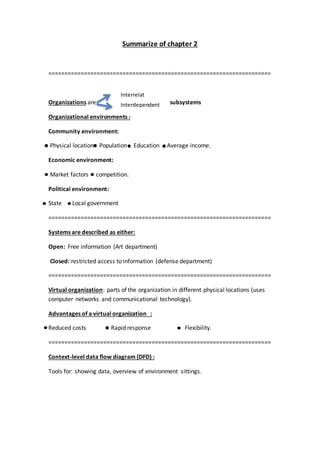
Organizations are subsystems
Organizational environments :
Community environment:
Physical location Population Education Average income.
Economic environment:
Market factors competition.
Political environment:
State Local government
=====================================================================
Systems are described as either:
Open: Free information (Art department)
Closed: restricted access to information (defense department)
=====================================================================
Virtual organization: parts of the organization in different physical locations (uses
computer networks and communicational technology).
Advantages of a virtual organization :
Reduced costs Rapid response Flexibility.
=====================================================================
Context-level data flow diagram (DFD) :
Tools for: showing data, overview of environment sittings.
Interrelat
edInterdependent
Context -level DFD symbols are:
 Entity ( person , group , department )
 Process ( represent the entire system)
 Data flow ( information that passes to and from the process , Noun )
=====================================================================
Entity relationship diagram (ER diagram):
 Helps the analyst understand the system.
Types of Relationships:
Many to many One to one. One to many.
Steps used to create E-R diagrams:
 List the entities.
 Choose key entities to narrow the scope of the problem.
 Identify the primary key.
 Confirm the results.
=====================================================================
The three levels of managerial control are:
 Operations management.
 Middle management
 Strategic management.
-----------------------------------------------------------------------------------------------------------------
Operations Management
 Make decisions using predetermined rules.
 Oversee the operating details.
 Dependent on internal information.
Middle Management
 Make short-term planning
 Decisions may be partly operational and partly strategic.
 Decisions are dependent on internal information (historical)
Strategic Management
 Look outward to the future
 Guide middle and operations managers.
 Define the organization as a whole.
 Make one-time decisions
=====================================================================
Each of the three levels of managements has:
 Leadership style
 Different organization structure.
 Organization culture
 Technological considerations.
==================================================================

summarize system analysis and design ch2

  • 1.
    Summarize of chapter2 ===================================================================== Organizations are subsystems Organizational environments : Community environment: Physical location Population Education Average income. Economic environment: Market factors competition. Political environment: State Local government ===================================================================== Systems are described as either: Open: Free information (Art department) Closed: restricted access to information (defense department) ===================================================================== Virtual organization: parts of the organization in different physical locations (uses computer networks and communicational technology). Advantages of a virtual organization : Reduced costs Rapid response Flexibility. ===================================================================== Context-level data flow diagram (DFD) : Tools for: showing data, overview of environment sittings. Interrelat edInterdependent
  • 2.
    Context -level DFDsymbols are:  Entity ( person , group , department )  Process ( represent the entire system)  Data flow ( information that passes to and from the process , Noun ) ===================================================================== Entity relationship diagram (ER diagram):  Helps the analyst understand the system. Types of Relationships: Many to many One to one. One to many. Steps used to create E-R diagrams:  List the entities.  Choose key entities to narrow the scope of the problem.  Identify the primary key.  Confirm the results. ===================================================================== The three levels of managerial control are:  Operations management.  Middle management  Strategic management. ----------------------------------------------------------------------------------------------------------------- Operations Management  Make decisions using predetermined rules.  Oversee the operating details.  Dependent on internal information. Middle Management  Make short-term planning  Decisions may be partly operational and partly strategic.  Decisions are dependent on internal information (historical)
  • 3.
    Strategic Management  Lookoutward to the future  Guide middle and operations managers.  Define the organization as a whole.  Make one-time decisions ===================================================================== Each of the three levels of managements has:  Leadership style  Different organization structure.  Organization culture  Technological considerations. ==================================================================