Death is inevitable
We continue to strive to live and
survive despite our limited faculties
Dying is usually out of our control
How can we explain when people choose to die?
SUICIDE
Suicide as adaptive…
 Tannaka and Kinney
commit suicide to reduce risk that individuals
will transmit infections to kin
 SisterY
person intentionally takes his or her life so that
members of his or her kin will have better chances
of survival
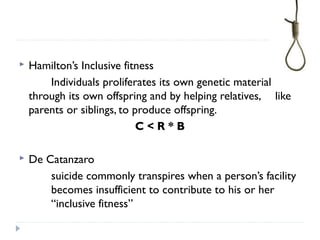
 Hamilton’s Inclusive fitness
Individuals proliferates its own genetic material
through its own offspring and by helping relatives, like
parents or siblings, to produce offspring.
C < R * B
 De Catanzaro
suicide commonly transpires when a person’s facility
becomes insufficient to contribute to his or her
“inclusive fitness”
 Buss
“if a person is a burden to his/her family,
the kin’s reproduction and person own fitness
might suffer as a result of his/her survival.”
Frost
 Suicide onYoung People
 Young Inuit think they are
useless in the society.
 Suicide on the Elderly
 Elderly Inuit who would
choose to end their lives so
as not to burden the younger
members of their band
especially their close relatives.
Suicide as non-adaptive
 Cognitions Involved
 Evolution’sVoyage:
3 elements used to assess genes value to gene pool
 Self-awareness
 Cultural Forces
 Self-esteem
 Escaping behavior
 Baumeister
suicide is mainly a means to escape from aversive
interpretations and awareness about the self.
 Chandler
suicide roots from a loss of one’s sense of self
 Cry for Help
 Last
suicide is a social red flag
Suicide in the genes
 Brent and Mann
suicide is highly familial.
 Fu, et. al
suicidal ideation has 36% heritability and 17%
heritability on suicide attempt among Americans
Suicide in animals
 Male Australian redback spiders (Latrodectus hasselti)
get cannibalized by sexually aggressive female redback
spiders while having sex
 Bumblebees (Bombus lucorum) leave their colony after
being infected by little conopid flies by injecting their
larva in the bees abdomen.
 controlled by the string of evolved behavioural algorithms
Statement of the Problem
1. What are respondents’ conceptions of why do people
die?
2. What are the underlying causes of young and elderly
people committing suicide?
3. What are the respondents’ attitudes towards the act of
committing suicide?
4. Who are the people perceived to most likely commit
suicide?
5. Is there a significant difference between males’ and
females’ attitudes towards suicide?
Methods
 Convenience Sampling
 Characteristics of Respondents
 Frequency and Percentage
Sex
Male 30
Female 33
Age (Mean) 19.21
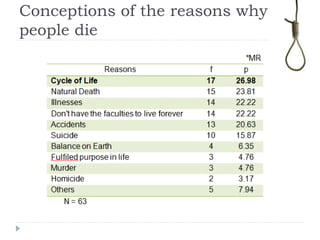
Conceptions of the reasons why
people die
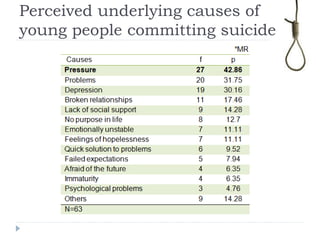
Perceived underlying causes of
young people committing suicide
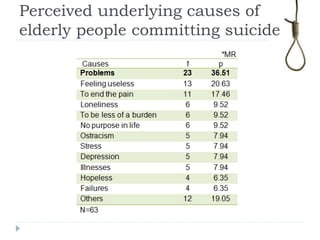
Perceived underlying causes of
elderly people committing suicide
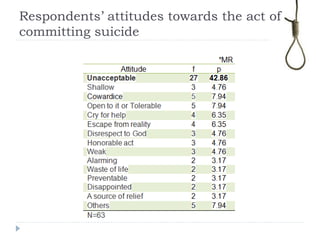
Respondents’ attitudes towards the act of
committing suicide
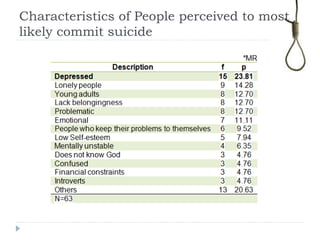
Characteristics of People perceived to most
likely commit suicide
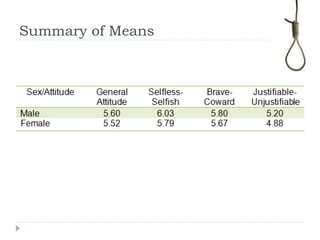
Summary of Means
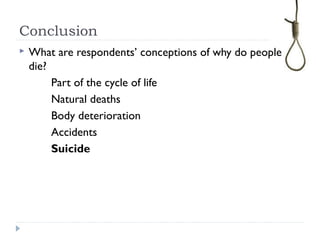
Conclusion
 What are respondents’ conceptions of why do people
die?
Part of the cycle of life
Natural deaths
Body deterioration
Accidents
Suicide
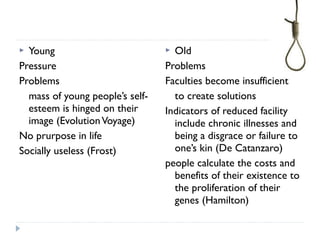
 Young
Pressure
Problems
mass of young people’s self-
esteem is hinged on their
image (EvolutionVoyage)
No prurpose in life
Socially useless (Frost)
 Old
Problems
Faculties become insufficient
to create solutions
Indicators of reduced facility
include chronic illnesses and
being a disgrace or failure to
one’s kin (De Catanzaro)
people calculate the costs and
benefits of their existence to
the proliferation of their
genes (Hamilton)
 Who are the people perceived to most likely commit
suicide?
Depressed
Lonely people
Young adults
Lack belongingness
Problematic
 Is there a significant difference between males’ and
females’ attitudes towards suicide?
Committing suicide is unacceptable.
Both sexes view suicide as a negative act.
Males rated it as being more selfish than women do.
Males view suicide as more unjustifiable than women
do.
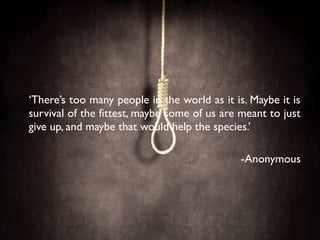
‘There’s too many people in the world as it is. Maybe it is
survival of the fittest, maybe some of us are meant to just
give up, and maybe that would help the species.’
-Anonymous

Suicide

  • 1.
    Death is inevitable Wecontinue to strive to live and survive despite our limited faculties Dying is usually out of our control How can we explain when people choose to die?
  • 2.
  • 3.
    Suicide as adaptive… Tannaka and Kinney commit suicide to reduce risk that individuals will transmit infections to kin  SisterY person intentionally takes his or her life so that members of his or her kin will have better chances of survival
  • 4.
     Hamilton’s Inclusivefitness Individuals proliferates its own genetic material through its own offspring and by helping relatives, like parents or siblings, to produce offspring. C < R * B  De Catanzaro suicide commonly transpires when a person’s facility becomes insufficient to contribute to his or her “inclusive fitness”
  • 5.
     Buss “if aperson is a burden to his/her family, the kin’s reproduction and person own fitness might suffer as a result of his/her survival.”
  • 6.
    Frost  Suicide onYoungPeople  Young Inuit think they are useless in the society.  Suicide on the Elderly  Elderly Inuit who would choose to end their lives so as not to burden the younger members of their band especially their close relatives.
  • 7.
    Suicide as non-adaptive Cognitions Involved  Evolution’sVoyage: 3 elements used to assess genes value to gene pool  Self-awareness  Cultural Forces  Self-esteem
  • 8.
     Escaping behavior Baumeister suicide is mainly a means to escape from aversive interpretations and awareness about the self.  Chandler suicide roots from a loss of one’s sense of self  Cry for Help  Last suicide is a social red flag
  • 9.
    Suicide in thegenes  Brent and Mann suicide is highly familial.  Fu, et. al suicidal ideation has 36% heritability and 17% heritability on suicide attempt among Americans
  • 10.
    Suicide in animals Male Australian redback spiders (Latrodectus hasselti) get cannibalized by sexually aggressive female redback spiders while having sex  Bumblebees (Bombus lucorum) leave their colony after being infected by little conopid flies by injecting their larva in the bees abdomen.  controlled by the string of evolved behavioural algorithms
  • 11.
    Statement of theProblem 1. What are respondents’ conceptions of why do people die? 2. What are the underlying causes of young and elderly people committing suicide? 3. What are the respondents’ attitudes towards the act of committing suicide? 4. Who are the people perceived to most likely commit suicide? 5. Is there a significant difference between males’ and females’ attitudes towards suicide?
  • 12.
    Methods  Convenience Sampling Characteristics of Respondents  Frequency and Percentage Sex Male 30 Female 33 Age (Mean) 19.21
  • 13.
    Conceptions of thereasons why people die
  • 14.
    Perceived underlying causesof young people committing suicide
  • 15.
    Perceived underlying causesof elderly people committing suicide
  • 16.
    Respondents’ attitudes towardsthe act of committing suicide
  • 17.
    Characteristics of Peopleperceived to most likely commit suicide
  • 18.
  • 19.
    Conclusion  What arerespondents’ conceptions of why do people die? Part of the cycle of life Natural deaths Body deterioration Accidents Suicide
  • 20.
     Young Pressure Problems mass ofyoung people’s self- esteem is hinged on their image (EvolutionVoyage) No prurpose in life Socially useless (Frost)  Old Problems Faculties become insufficient to create solutions Indicators of reduced facility include chronic illnesses and being a disgrace or failure to one’s kin (De Catanzaro) people calculate the costs and benefits of their existence to the proliferation of their genes (Hamilton)
  • 21.
     Who arethe people perceived to most likely commit suicide? Depressed Lonely people Young adults Lack belongingness Problematic
  • 22.
     Is therea significant difference between males’ and females’ attitudes towards suicide? Committing suicide is unacceptable. Both sexes view suicide as a negative act. Males rated it as being more selfish than women do. Males view suicide as more unjustifiable than women do.
  • 23.
    ‘There’s too manypeople in the world as it is. Maybe it is survival of the fittest, maybe some of us are meant to just give up, and maybe that would help the species.’ -Anonymous