Seminar
on
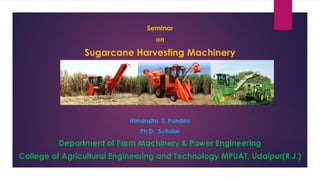
Sugarcane Harvesting Machinery
Himanshu S. Pandey
Ph.D. Scholar
Department of Farm Machinery & Power Engineering
College of Agricultural Engineering and Technology MPUAT, Udaipur(R.J.)
Introduction
 Sugarcane is the most important agro-industrial crop which is being cultivated in
around 4.50 million hectares area in India.
 The country has produced more than 355 million tonnes of cane at a national
average of 70 tonnes per hectare.
 In the present, required to produce more sugar per unit area, time and input in order
to keep pace with the population growth while preserving the soil and water
resources.
 By adopting the appropriate mechanical alternatives not only increasing the
productivity but also cost efficiency in sugarcane production system.
 Use of machinery for sugarcane cultivation facilitates timeliness of operation,
reducing human drudgery and improving overall production efficiency.
Sugar cane harvesting
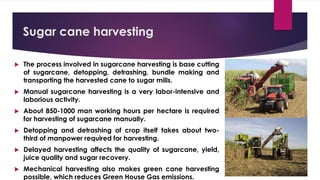
 The process involved in sugarcane harvesting is base cutting
of sugarcane, detopping, detrashing, bundle making and
transporting the harvested cane to sugar mills.
 Manual sugarcane harvesting is a very labor-intensive and
laborious activity.
 About 850-1000 man working hours per hectare is required
for harvesting of sugarcane manually.
 Detopping and detrashing of crop itself takes about two-
third of manpower required for harvesting.
 Delayed harvesting affects the quality of sugarcane, yield,
juice quality and sugar recovery.
 Mechanical harvesting also makes green cane harvesting
possible, which reduces Green House Gas emissions.
Method of Sugar cane harvesting
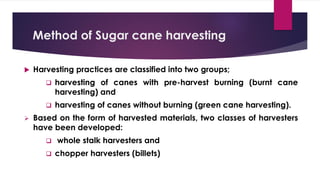
 Harvesting practices are classified into two groups;
❑ harvesting of canes with pre-harvest burning (burnt cane
harvesting) and
❑ harvesting of canes without burning (green cane harvesting).
➢ Based on the form of harvested materials, two classes of harvesters
have been developed:
❑ whole stalk harvesters and
❑ chopper harvesters (billets)
Burnt cane harvesting
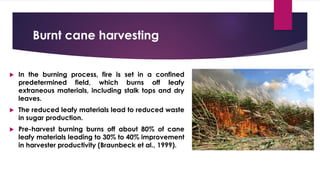
 In the burning process, fire is set in a confined
predetermined field, which burns off leafy
extraneous materials, including stalk tops and dry
leaves.
 The reduced leafy materials lead to reduced waste
in sugar production.
 Pre-harvest burning burns off about 80% of cane
leafy materials leading to 30% to 40% improvement
in harvester productivity (Braunbeck et al., 1999).
Limitations
 Pre-harvest burning has become one of the most sensitive
environmental issues faced by local communities and public
pressure against cane burning
 However, cane burning has various negative impacts on sugar
yield.
Green Cane Harvesting
 Particular mechanical device is then used to separate leafy materials and
discharge them into the field.
 From the perspective of soil nutrient balance and environmental effects, this
method may provide a more sustainable option for sugarcane harvesting
 The residues left in field could help to control weeds, reduce soil moisture loss,
and decrease soil erosion (Braunbeck et al., 1999).
 A major challenge for green cane harvesting practice is that the increased
amount of extraneous materials (such as tops and leafy materials) extensively
increases machine load.
Chopper Harvesting
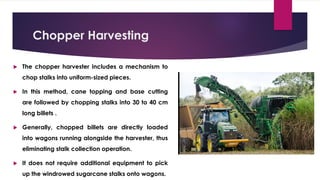
 The chopper harvester includes a mechanism to
chop stalks into uniform-sized pieces.
 In this method, cane topping and base cutting
are followed by chopping stalks into 30 to 40 cm
long billets .
 Generally, chopped billets are directly loaded
into wagons running alongside the harvester, thus
eliminating stalk collection operation.
 It does not require additional equipment to pick
up the windrowed sugarcane stalks onto wagons.
Cont..
➢ chopper harvester should be capable to perform the following sequence of
functions:
1- Gather and feed the cane toward the functional mechanisms
2- Cut the base of cane stalk.
3- Cut the green top of the cane stalk.
4- Feed cane stalks inside the machine.
5- Chop cane stalks into billets.
6- Blow out green tops and dry leaves.
7- Elevate chopped cane up to be loaded on a vehicle.
Components of a sugarcane chopper
harvest system
➢ The basic components of a sugarcane combine are:
(i) Gathering mechanism
(ii) Topping mechanism
(iii) Base cuter
(iv) Feed conveyor
(v) Chopper
(vi) Elevator
(vii) Cleaning by air blast
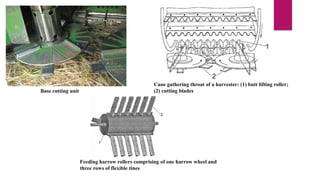
Base cutting unit
Cane gathering throat of a harvester: (1) butt lifting roller;
(2) cutting blades
Feeding harrow rollers comprising of one harrow wheel and
three rows of flexible tines
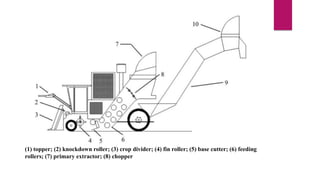
(1) topper; (2) knockdown roller; (3) crop divider; (4) fin roller; (5) base cutter; (6) feeding
rollers; (7) primary extractor; (8) chopper
Limitations
 The chopping process accelerates sugar deterioration
because of the easy access of bacteria through abrasion,
failure points, and cut surfaces in chopped billets.
 The harvested billets need to be milled as fast as possible.
 In addition, there also exists substantial juice loss during cutting
and chopping operations.
 Cane juice loss leads to the reduced sugar yield.
Whole stalk cane harvesters
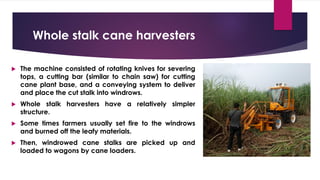
 The machine consisted of rotating knives for severing
tops, a cutting bar (similar to chain saw) for cutting
cane plant base, and a conveying system to deliver
and place the cut stalk into windrows.
 Whole stalk harvesters have a relatively simpler
structure.
 Some times farmers usually set fire to the windrows
and burned off the leafy materials.
 Then, windrowed cane stalks are picked up and
loaded to wagons by cane loaders.
Cont…
Whole cane harvester should be capable to perform the following
sequence of functions:
1- Dividers to gather the cane in the row being cut, and to separate it from
cane in adjoining rows.
2- Base-cutters to sever the cane at ground level.
3- A feeding device to take the cane from the base-cutters, and convey it
through the machine.
4- A cleaning device to remove and discard trash and tops.
5- A bin to accumulate cane,
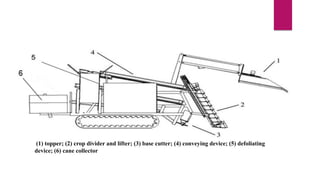
(1) topper; (2) crop divider and lifter; (3) base cutter; (4) conveying device; (5) defoliating
device; (6) cane collector
Limitations
 Since sugarcane plants can grow up to 5 m, it is challenging for whole stalk
harvesters to handle lodged/bent cane stalks.
 Harvesting bent canes also results in canes twisted into various directions.
Therefore, it is difficult to arrange windrowed stalks into compact bundles
needed for easy handling and transportation.
 Another disadvantage is that whole stalk harvesters have limitations in
dealing with high tonnage sugarcane.
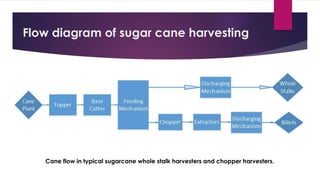
Cane flow in typical sugarcane whole stalk harvesters and chopper harvesters.
Flow diagram of sugar cane harvesting
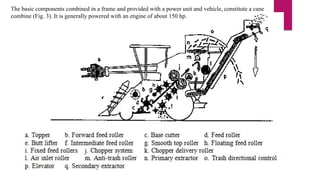
The basic components combined in a frame and provided with a power unit and vehicle, constitute a cane
combine (Fig. 3). It is generally powered with an engine of about 150 hp.
Push-rake system
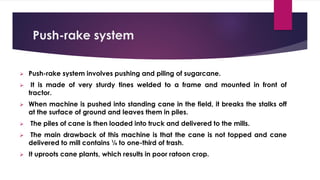
➢ Push-rake system involves pushing and piling of sugarcane.
➢ It is made of very sturdy tines welded to a frame and mounted in front of
tractor.
➢ When machine is pushed into standing cane in the field, it breaks the stalks off
at the surface of ground and leaves them in piles.
➢ The piles of cane is then loaded into truck and delivered to the mills.
➢ The main drawback of this machine is that the cane is not topped and cane
delivered to mill contains ¼ to one-third of trash.
➢ It uproots cane plants, which results in poor ratoon crop.
Windrow harvest system:
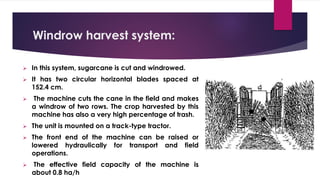
➢ In this system, sugarcane is cut and windrowed.
➢ It has two circular horizontal blades spaced at
152.4 cm.
➢ The machine cuts the cane in the field and makes
a windrow of two rows. The crop harvested by this
machine has also a very high percentage of trash.
➢ The unit is mounted on a track-type tractor.
➢ The front end of the machine can be raised or
lowered hydraulically for transport and field
operations.
➢ The effective field capacity of the machine is
about 0.8 ha/h
Soldier-type cane harvester
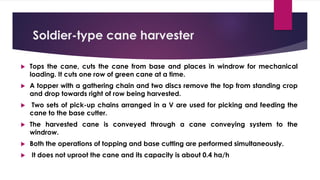
 Tops the cane, cuts the cane from base and places in windrow for mechanical
loading. It cuts one row of green cane at a time.
 A topper with a gathering chain and two discs remove the top from standing crop
and drop towards right of row being harvested.
 Two sets of pick-up chains arranged in a V are used for picking and feeding the
cane to the base cutter.
 The harvested cane is conveyed through a cane conveying system to the
windrow.
 Both the operations of topping and base cutting are performed simultaneously.
 It does not uproot the cane and its capacity is about 0.4 ha/h
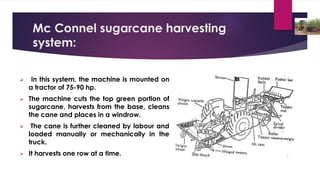
Mc Connel sugarcane harvesting
system:
➢ In this system, the machine is mounted on
a tractor of 75-90 hp.
➢ The machine cuts the top green portion of
sugarcane, harvests from the base, cleans
the cane and places in a windrow.
➢ The cane is further cleaned by labour and
loaded manually or mechanically in the
truck.
➢ It harvests one row at a time.
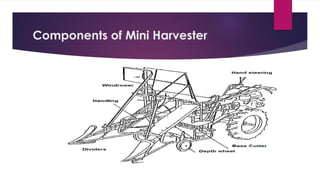
Mini Sugarcane Harvester
 Mini sugarcane harvester usually is
self-propel sugarcane harvester or
connected with tractors.
 It has functions of picking up fallen
sugarcane, cutting and paving the
stalk.
 Mini sugarcane harvester can adapt
to different land forms.
Components of Mini Harvester
Cont..
➢ It can reap and pave sugarcanes neatly in various nature state such as fallen
sugarcanes.
➢ Use advanced hydraulic control systems so that the machine can be adjusted
according to different field conditions.
➢ With small size, light weight which makes the machine more flexible on the field.
➢ The knife can cut deep into 20-30 mm soil layer, so the damaged rate is lower.
➢ With low oil consumption. The oil consumption of this machine is less than 0.15kg
per hour
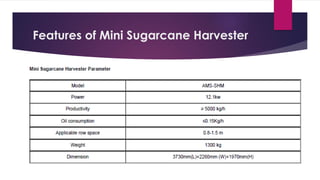
Features of Mini Sugarcane Harvester
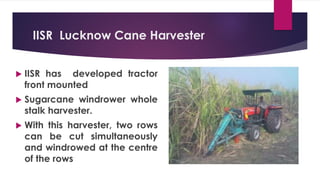
IISR Lucknow Cane Harvester
 IISR has developed tractor
front mounted
 Sugarcane windrower whole
stalk harvester.
 With this harvester, two rows
can be cut simultaneously
and windrowed at the centre
of the rows
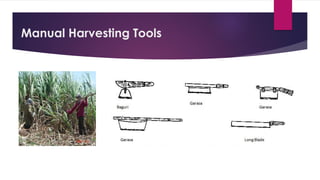
Manual Harvesting Tools
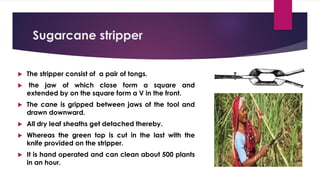
Sugarcane stripper
 The stripper consist of a pair of tongs.
 the jaw of which close form a square and
extended by on the square form a V in the front.
 The cane is gripped between jaws of the tool and
drawn downward.
 All dry leaf sheaths get detached thereby.
 Whereas the green top is cut in the last with the
knife provided on the stripper.
 It is hand operated and can clean about 500 plants
in an hour.
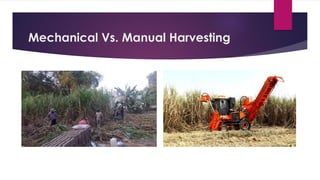
Mechanical Vs. Manual Harvesting
 Manual harvesting is done manually using various types of hand knives or hand axes.
 Among the several tools the cutting blade is usually heavier and facilitates easier and
efficient cutting of cane.
 Manual harvesting requires skilled labours as improper harvest of cane leads to loss of
cane & sugar yield, poor juice quality and problems in milling due to extraneous matter.
 Mechanical Harvesting labour is becoming scarce and costly in view of diversion of
labour to other remunerative work in industry, construction, business etc.
 Mill stoppages because of non-availability of canes are not uncommon owing to
shortage of harvesting labour.
 And, most of the new mills are of higher crushing capacity and many are expanding
their crushing capacities. Therefore daily requirement of cane is increasing and hence
greater demand for harvesting labour.
Disadvantages of Harvesting Method
MANUAL HARVESTING:
 Harvesting time will be more
 Efficient work is not done
 The cost will be more
 Shortage of labour
MECHANIZED HARVESTING:
➢ The cost of the machine is high
➢ The machine is meant for large scale farms
➢ Requires skilled labour to operate
References
 E-course,Farm Machinery and Equipment-II
 International Journal of Engineering Research and General Science Volume 3, Issue 4,
July-August, 2015
 Mechanization of Sugarcane Cultivation in India Singh, J., Singh, A.K., Sharma, M.P. et al.
Sugar Tech (2011) 13: 310. https://doi.org/10.1007/s12355-011-0101-5
 Principle of agricultural engineering Volume –I TP Ojha
 Sugarcane harvester technology: A critical overview, Applied engineering in agriculture ·
October 2014.
 www.google.com

Sugercane harvesting machinery

  • 1.
    Seminar on Sugarcane Harvesting Machinery HimanshuS. Pandey Ph.D. Scholar Department of Farm Machinery & Power Engineering College of Agricultural Engineering and Technology MPUAT, Udaipur(R.J.)
  • 2.
    Introduction  Sugarcane isthe most important agro-industrial crop which is being cultivated in around 4.50 million hectares area in India.  The country has produced more than 355 million tonnes of cane at a national average of 70 tonnes per hectare.  In the present, required to produce more sugar per unit area, time and input in order to keep pace with the population growth while preserving the soil and water resources.  By adopting the appropriate mechanical alternatives not only increasing the productivity but also cost efficiency in sugarcane production system.  Use of machinery for sugarcane cultivation facilitates timeliness of operation, reducing human drudgery and improving overall production efficiency.
  • 3.
    Sugar cane harvesting The process involved in sugarcane harvesting is base cutting of sugarcane, detopping, detrashing, bundle making and transporting the harvested cane to sugar mills.  Manual sugarcane harvesting is a very labor-intensive and laborious activity.  About 850-1000 man working hours per hectare is required for harvesting of sugarcane manually.  Detopping and detrashing of crop itself takes about two- third of manpower required for harvesting.  Delayed harvesting affects the quality of sugarcane, yield, juice quality and sugar recovery.  Mechanical harvesting also makes green cane harvesting possible, which reduces Green House Gas emissions.
  • 4.
    Method of Sugarcane harvesting  Harvesting practices are classified into two groups; ❑ harvesting of canes with pre-harvest burning (burnt cane harvesting) and ❑ harvesting of canes without burning (green cane harvesting). ➢ Based on the form of harvested materials, two classes of harvesters have been developed: ❑ whole stalk harvesters and ❑ chopper harvesters (billets)
  • 5.
    Burnt cane harvesting In the burning process, fire is set in a confined predetermined field, which burns off leafy extraneous materials, including stalk tops and dry leaves.  The reduced leafy materials lead to reduced waste in sugar production.  Pre-harvest burning burns off about 80% of cane leafy materials leading to 30% to 40% improvement in harvester productivity (Braunbeck et al., 1999).
  • 6.
    Limitations  Pre-harvest burninghas become one of the most sensitive environmental issues faced by local communities and public pressure against cane burning  However, cane burning has various negative impacts on sugar yield.
  • 7.
    Green Cane Harvesting Particular mechanical device is then used to separate leafy materials and discharge them into the field.  From the perspective of soil nutrient balance and environmental effects, this method may provide a more sustainable option for sugarcane harvesting  The residues left in field could help to control weeds, reduce soil moisture loss, and decrease soil erosion (Braunbeck et al., 1999).  A major challenge for green cane harvesting practice is that the increased amount of extraneous materials (such as tops and leafy materials) extensively increases machine load.
  • 8.
    Chopper Harvesting  Thechopper harvester includes a mechanism to chop stalks into uniform-sized pieces.  In this method, cane topping and base cutting are followed by chopping stalks into 30 to 40 cm long billets .  Generally, chopped billets are directly loaded into wagons running alongside the harvester, thus eliminating stalk collection operation.  It does not require additional equipment to pick up the windrowed sugarcane stalks onto wagons.
  • 9.
    Cont.. ➢ chopper harvestershould be capable to perform the following sequence of functions: 1- Gather and feed the cane toward the functional mechanisms 2- Cut the base of cane stalk. 3- Cut the green top of the cane stalk. 4- Feed cane stalks inside the machine. 5- Chop cane stalks into billets. 6- Blow out green tops and dry leaves. 7- Elevate chopped cane up to be loaded on a vehicle.
  • 10.
    Components of asugarcane chopper harvest system ➢ The basic components of a sugarcane combine are: (i) Gathering mechanism (ii) Topping mechanism (iii) Base cuter (iv) Feed conveyor (v) Chopper (vi) Elevator (vii) Cleaning by air blast
  • 11.
    Base cutting unit Canegathering throat of a harvester: (1) butt lifting roller; (2) cutting blades Feeding harrow rollers comprising of one harrow wheel and three rows of flexible tines
  • 12.
    (1) topper; (2)knockdown roller; (3) crop divider; (4) fin roller; (5) base cutter; (6) feeding rollers; (7) primary extractor; (8) chopper
  • 13.
    Limitations  The choppingprocess accelerates sugar deterioration because of the easy access of bacteria through abrasion, failure points, and cut surfaces in chopped billets.  The harvested billets need to be milled as fast as possible.  In addition, there also exists substantial juice loss during cutting and chopping operations.  Cane juice loss leads to the reduced sugar yield.
  • 14.
    Whole stalk caneharvesters  The machine consisted of rotating knives for severing tops, a cutting bar (similar to chain saw) for cutting cane plant base, and a conveying system to deliver and place the cut stalk into windrows.  Whole stalk harvesters have a relatively simpler structure.  Some times farmers usually set fire to the windrows and burned off the leafy materials.  Then, windrowed cane stalks are picked up and loaded to wagons by cane loaders.
  • 15.
    Cont… Whole cane harvestershould be capable to perform the following sequence of functions: 1- Dividers to gather the cane in the row being cut, and to separate it from cane in adjoining rows. 2- Base-cutters to sever the cane at ground level. 3- A feeding device to take the cane from the base-cutters, and convey it through the machine. 4- A cleaning device to remove and discard trash and tops. 5- A bin to accumulate cane,
  • 16.
    (1) topper; (2)crop divider and lifter; (3) base cutter; (4) conveying device; (5) defoliating device; (6) cane collector
  • 17.
    Limitations  Since sugarcaneplants can grow up to 5 m, it is challenging for whole stalk harvesters to handle lodged/bent cane stalks.  Harvesting bent canes also results in canes twisted into various directions. Therefore, it is difficult to arrange windrowed stalks into compact bundles needed for easy handling and transportation.  Another disadvantage is that whole stalk harvesters have limitations in dealing with high tonnage sugarcane.
  • 18.
    Cane flow intypical sugarcane whole stalk harvesters and chopper harvesters. Flow diagram of sugar cane harvesting
  • 19.
    The basic componentscombined in a frame and provided with a power unit and vehicle, constitute a cane combine (Fig. 3). It is generally powered with an engine of about 150 hp.
  • 20.
    Push-rake system ➢ Push-rakesystem involves pushing and piling of sugarcane. ➢ It is made of very sturdy tines welded to a frame and mounted in front of tractor. ➢ When machine is pushed into standing cane in the field, it breaks the stalks off at the surface of ground and leaves them in piles. ➢ The piles of cane is then loaded into truck and delivered to the mills. ➢ The main drawback of this machine is that the cane is not topped and cane delivered to mill contains ¼ to one-third of trash. ➢ It uproots cane plants, which results in poor ratoon crop.
  • 21.
    Windrow harvest system: ➢In this system, sugarcane is cut and windrowed. ➢ It has two circular horizontal blades spaced at 152.4 cm. ➢ The machine cuts the cane in the field and makes a windrow of two rows. The crop harvested by this machine has also a very high percentage of trash. ➢ The unit is mounted on a track-type tractor. ➢ The front end of the machine can be raised or lowered hydraulically for transport and field operations. ➢ The effective field capacity of the machine is about 0.8 ha/h
  • 22.
    Soldier-type cane harvester Tops the cane, cuts the cane from base and places in windrow for mechanical loading. It cuts one row of green cane at a time.  A topper with a gathering chain and two discs remove the top from standing crop and drop towards right of row being harvested.  Two sets of pick-up chains arranged in a V are used for picking and feeding the cane to the base cutter.  The harvested cane is conveyed through a cane conveying system to the windrow.  Both the operations of topping and base cutting are performed simultaneously.  It does not uproot the cane and its capacity is about 0.4 ha/h
  • 23.
    Mc Connel sugarcaneharvesting system: ➢ In this system, the machine is mounted on a tractor of 75-90 hp. ➢ The machine cuts the top green portion of sugarcane, harvests from the base, cleans the cane and places in a windrow. ➢ The cane is further cleaned by labour and loaded manually or mechanically in the truck. ➢ It harvests one row at a time.
  • 24.
    Mini Sugarcane Harvester Mini sugarcane harvester usually is self-propel sugarcane harvester or connected with tractors.  It has functions of picking up fallen sugarcane, cutting and paving the stalk.  Mini sugarcane harvester can adapt to different land forms.
  • 25.
  • 26.
    Cont.. ➢ It canreap and pave sugarcanes neatly in various nature state such as fallen sugarcanes. ➢ Use advanced hydraulic control systems so that the machine can be adjusted according to different field conditions. ➢ With small size, light weight which makes the machine more flexible on the field. ➢ The knife can cut deep into 20-30 mm soil layer, so the damaged rate is lower. ➢ With low oil consumption. The oil consumption of this machine is less than 0.15kg per hour
  • 27.
    Features of MiniSugarcane Harvester
  • 28.
    IISR Lucknow CaneHarvester  IISR has developed tractor front mounted  Sugarcane windrower whole stalk harvester.  With this harvester, two rows can be cut simultaneously and windrowed at the centre of the rows
  • 29.
  • 30.
    Sugarcane stripper  Thestripper consist of a pair of tongs.  the jaw of which close form a square and extended by on the square form a V in the front.  The cane is gripped between jaws of the tool and drawn downward.  All dry leaf sheaths get detached thereby.  Whereas the green top is cut in the last with the knife provided on the stripper.  It is hand operated and can clean about 500 plants in an hour.
  • 31.
  • 32.
    Mechanical Vs. ManualHarvesting  Manual harvesting is done manually using various types of hand knives or hand axes.  Among the several tools the cutting blade is usually heavier and facilitates easier and efficient cutting of cane.  Manual harvesting requires skilled labours as improper harvest of cane leads to loss of cane & sugar yield, poor juice quality and problems in milling due to extraneous matter.  Mechanical Harvesting labour is becoming scarce and costly in view of diversion of labour to other remunerative work in industry, construction, business etc.  Mill stoppages because of non-availability of canes are not uncommon owing to shortage of harvesting labour.  And, most of the new mills are of higher crushing capacity and many are expanding their crushing capacities. Therefore daily requirement of cane is increasing and hence greater demand for harvesting labour.
  • 33.
    Disadvantages of HarvestingMethod MANUAL HARVESTING:  Harvesting time will be more  Efficient work is not done  The cost will be more  Shortage of labour MECHANIZED HARVESTING: ➢ The cost of the machine is high ➢ The machine is meant for large scale farms ➢ Requires skilled labour to operate
  • 34.
    References  E-course,Farm Machineryand Equipment-II  International Journal of Engineering Research and General Science Volume 3, Issue 4, July-August, 2015  Mechanization of Sugarcane Cultivation in India Singh, J., Singh, A.K., Sharma, M.P. et al. Sugar Tech (2011) 13: 310. https://doi.org/10.1007/s12355-011-0101-5  Principle of agricultural engineering Volume –I TP Ojha  Sugarcane harvester technology: A critical overview, Applied engineering in agriculture · October 2014.  www.google.com