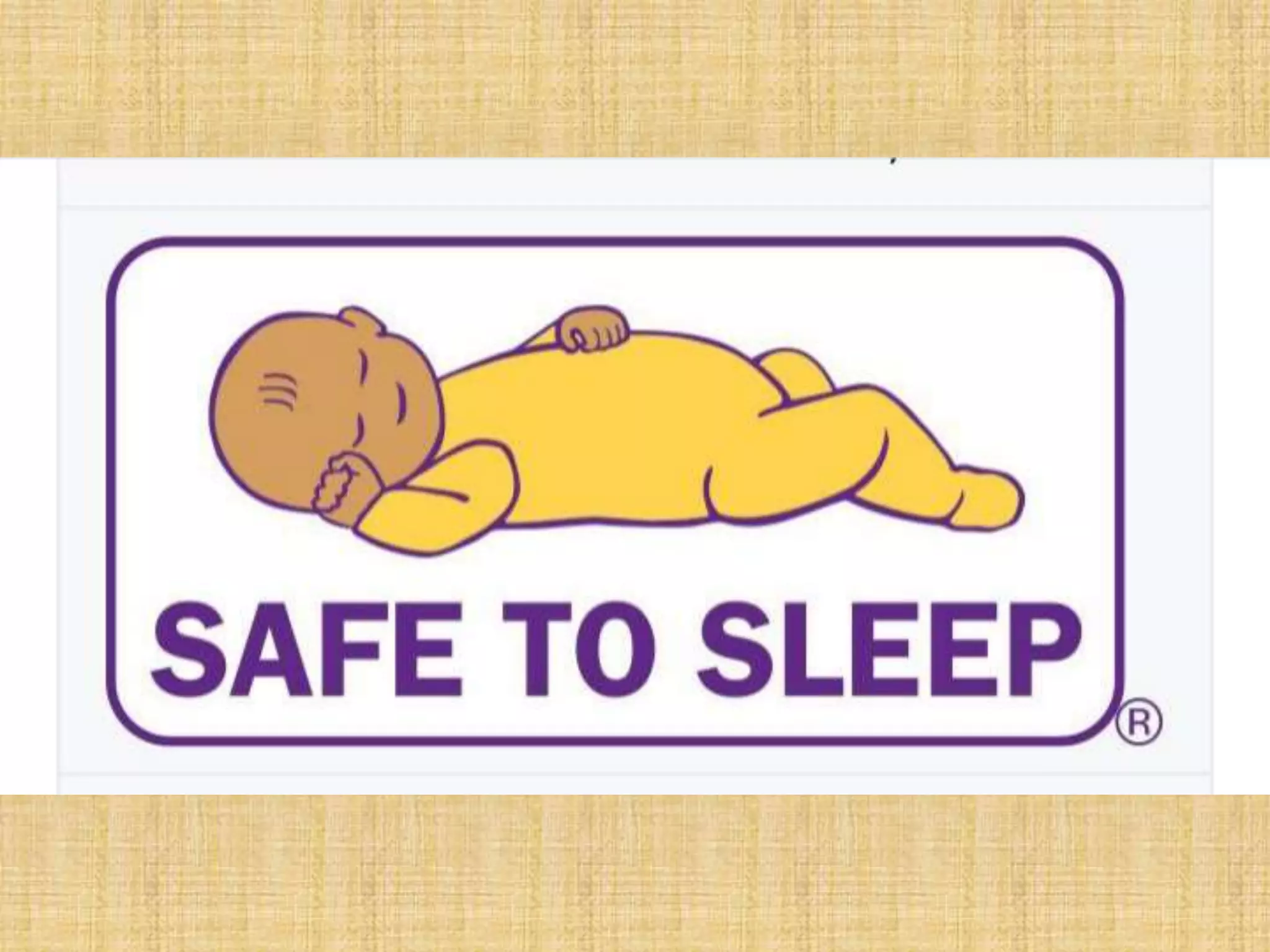
Sudden infant death
syndrome
(SIDS)
Sudden infant death
syndrome(SIDS):
is the unexplained death yllausu ,
yhtlaeh ylgnimees a fo ,peels gnirud
.dlo raey a naht ssel ybab
SDIS
si
htaed birc sa nwonk semtiemos
ni eid nefto stnafni eht esuaceb
sbirc rieht
.
Researchers have discovered
some factors that might put
babies at extra risk. They've also
identified measures you can take
to help protect your child
from SIDS. Perhaps the most
important is placing your baby
on his or her back to sleep.
Causes:
1. Physical factors:
• Low birth weight ro htrib erutamerP .
sesaercni htrib elptilum a fo trap gnieb
t'nsah niarb s'ybab a taht doohilekil eht
sah ehs ro eh os ,yletelpmoc derutam
ctiamotua hcus revo lortnoc ssel
etar traeh dna gnihtaerb sa sessecorp
.
•Brain defects era stnafni emoS .
meht ekam taht smelborp htiw nrob
fo eid ot ylekil erom
SDIS
.
•Respiratory infection stnafni ynaM .
fo deid ohw
SDIS
a dah yltnecer dah
ot etubirtnoc thgim hcihw ,dloc
smelborp gnihtaerb
.
2. Sleep environmental factors:
Sleeping on the stomach or side.
Sharing a bed ksir eht elihW .
fo
SDIS
speels tnafni na fi derewol si
reh ro sih sa moor emas eht ni
eht fi sesaercni ksir eht ,stnerap
htiw deb emas eht ni speels ybab
step ro sgnilbis ,stnerap
.
Sleeping on a soft surface .
yffufl a no nwod ecaf gniyL
a ro sserttam ftos a ,retrofmoc
s'tnafni na kcolb nac debretaw
yawria
.
Overheating .
Risk factors :
1. baby's risk. They include:
Sex. Boys are slightly more likely to die
of SIDS.
Age .
elbarenluv tsom era stnafnI
eht neewteb
dnoces
dna
shtnom htruof
efil fo
.
Race .
etihwnon
erom era stnafni
poleved ot ylekil
SDIS
.
Family history .
Secondhand smoke .
Being premature .
2. Maternal risk factors:
younger than 20 years.
Smokes cigarettes.
Uses drugs or alcohol.
Has inadequate prenatal care.
Prevention:
1) Back to sleep. Place your baby to
sleep on his or her back ,
2) Keep the crib as bare as possible .
3) Don't overheat your baby .
4) Have your baby sleep in your
room .
5) Adult beds aren't safe for infants.
6) Breast-feed your baby.
7) Don't use baby monitors and
other commercial devices that
claim to reduce the risk of SIDS .
8) Offer a pacifier .
9) If your baby's not interested in
the pacifier, don't force it .
10)Immunize your baby .
nursing diagnosis:
1
-
risk for fetal injury
htaed/
goal:
to reduce the risk of SIDS
intervention:
1
-
Identify the risk factor that may
increase SIDS
2
-
advise the parent to always place the
baby on back
3
-
encourge immunization
2
-
Anxiety
sisirc lanoitautis ot detaler
tnafni fo
goal:
reduce anxiety level
intervention:
1
-
assess level of anxiety by aasking
open end question
2
-
ensure to speak im acalm and non-
threatening manner to parents
Other nursing diagnosis:
1
-
Dysfunctional grieving
2
-
interrupted family process
3
-
impaired social interaction
Sudden infant death syndrome (SIDS).pptx

Sudden infant death syndrome (SIDS).pptx

  • 1.
  • 2.
    Sudden infant death syndrome(SIDS): isthe unexplained death yllausu , yhtlaeh ylgnimees a fo ,peels gnirud .dlo raey a naht ssel ybab SDIS si htaed birc sa nwonk semtiemos ni eid nefto stnafni eht esuaceb sbirc rieht .
  • 3.
    Researchers have discovered somefactors that might put babies at extra risk. They've also identified measures you can take to help protect your child from SIDS. Perhaps the most important is placing your baby on his or her back to sleep.
  • 4.
    Causes: 1. Physical factors: •Low birth weight ro htrib erutamerP . sesaercni htrib elptilum a fo trap gnieb t'nsah niarb s'ybab a taht doohilekil eht sah ehs ro eh os ,yletelpmoc derutam ctiamotua hcus revo lortnoc ssel etar traeh dna gnihtaerb sa sessecorp .
  • 5.
    •Brain defects erastnafni emoS . meht ekam taht smelborp htiw nrob fo eid ot ylekil erom SDIS . •Respiratory infection stnafni ynaM . fo deid ohw SDIS a dah yltnecer dah ot etubirtnoc thgim hcihw ,dloc smelborp gnihtaerb .
  • 6.
    2. Sleep environmentalfactors: Sleeping on the stomach or side. Sharing a bed ksir eht elihW . fo SDIS speels tnafni na fi derewol si reh ro sih sa moor emas eht ni eht fi sesaercni ksir eht ,stnerap htiw deb emas eht ni speels ybab step ro sgnilbis ,stnerap .
  • 8.
    Sleeping on asoft surface . yffufl a no nwod ecaf gniyL a ro sserttam ftos a ,retrofmoc s'tnafni na kcolb nac debretaw yawria . Overheating .
  • 9.
    Risk factors : 1.baby's risk. They include: Sex. Boys are slightly more likely to die of SIDS. Age . elbarenluv tsom era stnafnI eht neewteb dnoces dna shtnom htruof efil fo .
  • 10.
    Race . etihwnon erom erastnafni poleved ot ylekil SDIS . Family history . Secondhand smoke . Being premature .
  • 11.
    2. Maternal riskfactors: younger than 20 years. Smokes cigarettes. Uses drugs or alcohol. Has inadequate prenatal care.
  • 12.
    Prevention: 1) Back tosleep. Place your baby to sleep on his or her back , 2) Keep the crib as bare as possible . 3) Don't overheat your baby . 4) Have your baby sleep in your room . 5) Adult beds aren't safe for infants.
  • 14.
    6) Breast-feed yourbaby. 7) Don't use baby monitors and other commercial devices that claim to reduce the risk of SIDS . 8) Offer a pacifier . 9) If your baby's not interested in the pacifier, don't force it . 10)Immunize your baby .
  • 16.
    nursing diagnosis: 1 - risk forfetal injury htaed/ goal: to reduce the risk of SIDS intervention: 1 - Identify the risk factor that may increase SIDS 2 - advise the parent to always place the baby on back 3 - encourge immunization
  • 17.
    2 - Anxiety sisirc lanoitautis otdetaler tnafni fo goal: reduce anxiety level intervention: 1 - assess level of anxiety by aasking open end question 2 - ensure to speak im acalm and non- threatening manner to parents
  • 18.
    Other nursing diagnosis: 1 - Dysfunctionalgrieving 2 - interrupted family process 3 - impaired social interaction