Grade 1                                                                                     September 2010


                              The Action of Subtraction by Brian P. Cleary

State Standards:
2.2.A – Solve addition and subtraction using concrete objects with one and two digit numbers (no
regrouping)
2.2.B – Solve addition and subtraction in everyday situations with one and two digit numbers (no
regrouping)
2.2.G – Explain and describe the process of addition and subtraction

Content Summary:

Objective: Students will create subtraction songs based on the subtraction process after reading the book
“The Action of Subtraction” by Brian P. Cleary.

Materials:
The Action of Subtraction by Brian P. Cleary
Ralph’s World Rhyming Circus CD (or online resource)
Magic Beans
Elmo/Whiteboard
Construction Paper
Crayons
Markers
Oreos (if available)
Felt board (if available)

Introduction:
Use mental modeling to introduce the lesson (use white board or ELMO to show logical process):
Mental Modeling:
Last night I was baking a cake and some cookies for my party. I had a carton of 18 eggs, but when I took
the carton out of the refrigerator, I dropped the whole container! Twelve of the eggs broke; what a mess!
Then I had to figure out how many eggs I still had left and whether I could still make my cookies and my
cake. To bake my super-duper chocolate cake I needed 5 eggs. To bake my cookies I need 3. So, I
thought to myself. “Hm, if the container had 18 eggs, but 12 broke, that means I have 6 left. To bake my
cake I need five, plus three eggs for my cookies makes 8. I have 6 eggs left but I need 8 to bake all of my
desserts! My oh my, what to do!” So, I called up my good friend, (name a fellow teacher or students
name), and I asked if I could have 2 eggs. Thankfully, they had enough to share and I was able to make
my absolutely, scrumptiously delicious desserts!
*If possible you can bring in cake/cookies to share with the students
Ask students what mathematical equation you used to determine there were enough eggs to make your
dessert (subtraction). Tell students that today they will be learning about subtraction and at the end of the
lesson be creating their own poem or song about how you subtract.

Procedure:
Before reading the story, go over a few vocabulary words they will be seeing in the book:
Subtraction (-) – an action that will make your total less
Minus (-) – take away some number from the whole
“is” or “total” in math means equal (=)


Nichole	
  Kaercher	
  
Grade 1                                                                                     September 2010


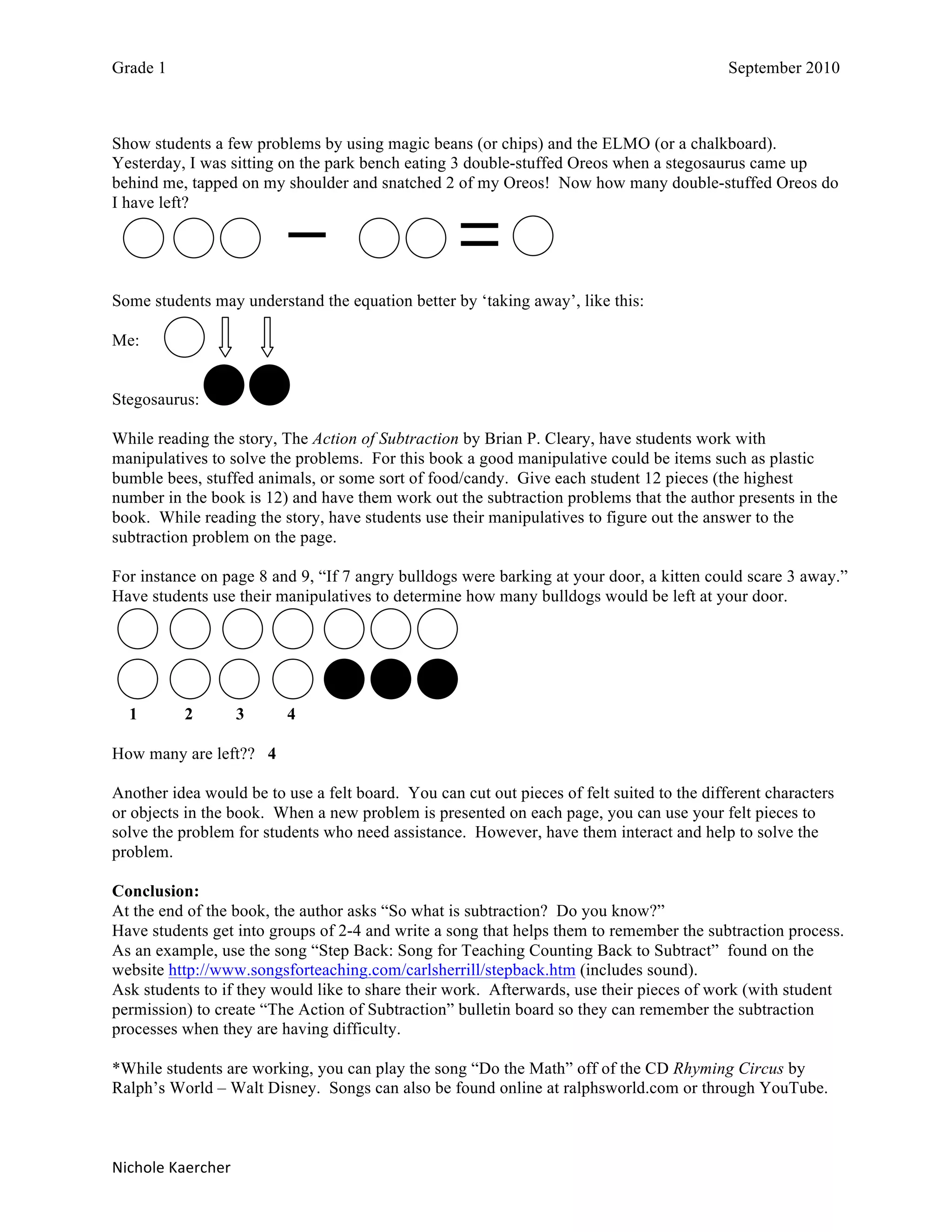
Show students a few problems by using magic beans (or chips) and the ELMO (or a chalkboard).
Yesterday, I was sitting on the park bench eating 3 double-stuffed Oreos when a stegosaurus came up
behind me, tapped on my shoulder and snatched 2 of my Oreos! Now how many double-stuffed Oreos do
I have left?


Some students may understand the equation better by ‘taking away’, like this:

Me:


Stegosaurus:

While reading the story, The Action of Subtraction by Brian P. Cleary, have students work with
manipulatives to solve the problems. For this book a good manipulative could be items such as plastic
bumble bees, stuffed animals, or some sort of food/candy. Give each student 12 pieces (the highest
number in the book is 12) and have them work out the subtraction problems that the author presents in the
book. While reading the story, have students use their manipulatives to figure out the answer to the
subtraction problem on the page.

For instance on page 8 and 9, “If 7 angry bulldogs were barking at your door, a kitten could scare 3 away.”
Have students use their manipulatives to determine how many bulldogs would be left at your door.


   1          2           3   4

How many are left?? 4

Another idea would be to use a felt board. You can cut out pieces of felt suited to the different characters
or objects in the book. When a new problem is presented on each page, you can use your felt pieces to
solve the problem for students who need assistance. However, have them interact and help to solve the
problem.

Conclusion:
At the end of the book, the author asks “So what is subtraction? Do you know?”
Have students get into groups of 2-4 and write a song that helps them to remember the subtraction process.
As an example, use the song “Step Back: Song for Teaching Counting Back to Subtract” found on the
website http://www.songsforteaching.com/carlsherrill/stepback.htm (includes sound).
Ask students to if they would like to share their work. Afterwards, use their pieces of work (with student
permission) to create “The Action of Subtraction” bulletin board so they can remember the subtraction
processes when they are having difficulty.

*While students are working, you can play the song “Do the Math” off of the CD Rhyming Circus by
Ralph’s World – Walt Disney. Songs can also be found online at ralphsworld.com or through YouTube.


Nichole	
  Kaercher	
  
Grade 1                                                                                     September 2010


Other songs on the CD include:
   The Rhyming Circus                        Bad Bug Ball
   Gotta Be Good                             Happy Not My Birthday
   Edward The Tap-Dancing Elephant           King Of The Alphabet
   Polka Dot Shirt                           Finger Is The Singer
   Abby’s Alphabet Soup                      Folsom Daycare Blues
   Do The Math                               Watch The World Go By
   Rodeo Peg


**If possible, use Oreos as your manipulative in the example. Some students learn better through seeing
the actual object that just a representation of it. After the lesson, they can eat the Oreos as ‘brain food’
while they work on their project.

Additional Resources:

          Author                                      Title                               Reading Level
Burmingham, John              The Shopping Basket                                             K-3
Carle, Eric                   Rooster’s Off to See the World                                   3.1
Christelow, Eileen            Five Little Monkeys Go Shopping                                  2.4
Leedy, Loreen                 Subtraction Action                                               1.7
Lopatina, Alexandra           Magic Mathematics, Addition and Subtraction in                   n/a
                              Stories, Poems, and Games
McGrath, Barbara              The M&M’s the Subtraction Book                                    2.3
Murphy, Stuart                Elevator Magic                                                    1.5
Murphy, Stuart                Safari Park                                                       2.6
Murphy, Stuart                Shark Swimathon                                                   3.0
Penner, Lucille Recht         Lights Out!                                                       2.2
Raffi                         Five Little Ducks                                                 1.5
Reiser, Lynn                  Hardworking Puppies                                               2.2
Ross, Kathy                   Kathy Ross Crafts Numbers                                       IL K-3
Schroeder, Jeff               Explore New Worlds CD                                             n/a
Wingard-Nelson, Rebecca       Subtraction Made Easy                                             3.2


Nichole	
  Kaercher	
  

Subtraction lesson plan2

  • 1.
    Grade 1 September 2010 The Action of Subtraction by Brian P. Cleary State Standards: 2.2.A – Solve addition and subtraction using concrete objects with one and two digit numbers (no regrouping) 2.2.B – Solve addition and subtraction in everyday situations with one and two digit numbers (no regrouping) 2.2.G – Explain and describe the process of addition and subtraction Content Summary: Objective: Students will create subtraction songs based on the subtraction process after reading the book “The Action of Subtraction” by Brian P. Cleary. Materials: The Action of Subtraction by Brian P. Cleary Ralph’s World Rhyming Circus CD (or online resource) Magic Beans Elmo/Whiteboard Construction Paper Crayons Markers Oreos (if available) Felt board (if available) Introduction: Use mental modeling to introduce the lesson (use white board or ELMO to show logical process): Mental Modeling: Last night I was baking a cake and some cookies for my party. I had a carton of 18 eggs, but when I took the carton out of the refrigerator, I dropped the whole container! Twelve of the eggs broke; what a mess! Then I had to figure out how many eggs I still had left and whether I could still make my cookies and my cake. To bake my super-duper chocolate cake I needed 5 eggs. To bake my cookies I need 3. So, I thought to myself. “Hm, if the container had 18 eggs, but 12 broke, that means I have 6 left. To bake my cake I need five, plus three eggs for my cookies makes 8. I have 6 eggs left but I need 8 to bake all of my desserts! My oh my, what to do!” So, I called up my good friend, (name a fellow teacher or students name), and I asked if I could have 2 eggs. Thankfully, they had enough to share and I was able to make my absolutely, scrumptiously delicious desserts! *If possible you can bring in cake/cookies to share with the students Ask students what mathematical equation you used to determine there were enough eggs to make your dessert (subtraction). Tell students that today they will be learning about subtraction and at the end of the lesson be creating their own poem or song about how you subtract. Procedure: Before reading the story, go over a few vocabulary words they will be seeing in the book: Subtraction (-) – an action that will make your total less Minus (-) – take away some number from the whole “is” or “total” in math means equal (=) Nichole  Kaercher  
  • 2.
    Grade 1 September 2010 Show students a few problems by using magic beans (or chips) and the ELMO (or a chalkboard). Yesterday, I was sitting on the park bench eating 3 double-stuffed Oreos when a stegosaurus came up behind me, tapped on my shoulder and snatched 2 of my Oreos! Now how many double-stuffed Oreos do I have left? Some students may understand the equation better by ‘taking away’, like this: Me: Stegosaurus: While reading the story, The Action of Subtraction by Brian P. Cleary, have students work with manipulatives to solve the problems. For this book a good manipulative could be items such as plastic bumble bees, stuffed animals, or some sort of food/candy. Give each student 12 pieces (the highest number in the book is 12) and have them work out the subtraction problems that the author presents in the book. While reading the story, have students use their manipulatives to figure out the answer to the subtraction problem on the page. For instance on page 8 and 9, “If 7 angry bulldogs were barking at your door, a kitten could scare 3 away.” Have students use their manipulatives to determine how many bulldogs would be left at your door.   1 2 3 4 How many are left?? 4 Another idea would be to use a felt board. You can cut out pieces of felt suited to the different characters or objects in the book. When a new problem is presented on each page, you can use your felt pieces to solve the problem for students who need assistance. However, have them interact and help to solve the problem. Conclusion: At the end of the book, the author asks “So what is subtraction? Do you know?” Have students get into groups of 2-4 and write a song that helps them to remember the subtraction process. As an example, use the song “Step Back: Song for Teaching Counting Back to Subtract” found on the website http://www.songsforteaching.com/carlsherrill/stepback.htm (includes sound). Ask students to if they would like to share their work. Afterwards, use their pieces of work (with student permission) to create “The Action of Subtraction” bulletin board so they can remember the subtraction processes when they are having difficulty. *While students are working, you can play the song “Do the Math” off of the CD Rhyming Circus by Ralph’s World – Walt Disney. Songs can also be found online at ralphsworld.com or through YouTube. Nichole  Kaercher  
  • 3.
    Grade 1 September 2010 Other songs on the CD include: The Rhyming Circus Bad Bug Ball Gotta Be Good Happy Not My Birthday Edward The Tap-Dancing Elephant King Of The Alphabet Polka Dot Shirt Finger Is The Singer Abby’s Alphabet Soup Folsom Daycare Blues Do The Math Watch The World Go By Rodeo Peg **If possible, use Oreos as your manipulative in the example. Some students learn better through seeing the actual object that just a representation of it. After the lesson, they can eat the Oreos as ‘brain food’ while they work on their project. Additional Resources: Author Title Reading Level Burmingham, John The Shopping Basket K-3 Carle, Eric Rooster’s Off to See the World 3.1 Christelow, Eileen Five Little Monkeys Go Shopping 2.4 Leedy, Loreen Subtraction Action 1.7 Lopatina, Alexandra Magic Mathematics, Addition and Subtraction in n/a Stories, Poems, and Games McGrath, Barbara The M&M’s the Subtraction Book 2.3 Murphy, Stuart Elevator Magic 1.5 Murphy, Stuart Safari Park 2.6 Murphy, Stuart Shark Swimathon 3.0 Penner, Lucille Recht Lights Out! 2.2 Raffi Five Little Ducks 1.5 Reiser, Lynn Hardworking Puppies 2.2 Ross, Kathy Kathy Ross Crafts Numbers IL K-3 Schroeder, Jeff Explore New Worlds CD n/a Wingard-Nelson, Rebecca Subtraction Made Easy 3.2 Nichole  Kaercher