Subsurface water Control methods
• Various methods are there-
-depends on the type of engineering work involved,
-site conditions
- the purpose for controlling the water.
• Control methods can be reasonably grouped into
four categories
(i) Barriers
(ii) Liners
(iii) Wells
(iv) Drains. 1
Subsurface water Control methods
• Barriers - reduce both quantity and velocity of
subsurface water
• liners - prevent the movement of subsurface
water
• drains - reduces the quantity of water and
direct its movement.
• Dewatering wells - elimination of subsurface
water, is accomplished through the use of
wells.
2
Barriers
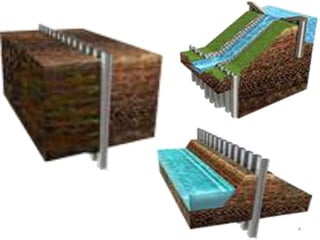
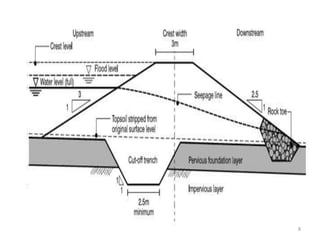
• Sheet pile cutoff walls, impervious cutoff
trenches and grouted or injected cutoff curtains -
common types of barriers.
• Example: earthen dams may incorporate a cutoff
wall or grout curtain in their foundation to reduce
the amount and speed of water flowing under the
structure.
• Type of barrier to use at a site is dictated as much
by subsurface conditions as by the type of
structure involved.
3
4
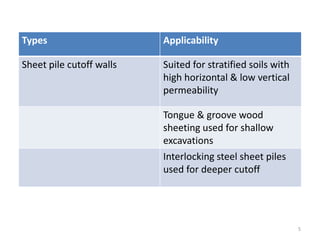
Types Applicability
Sheet pile cutoff walls Suited for stratified soils with
high horizontal & low vertical
permeability
Tongue & groove wood
sheeting used for shallow
excavations
Interlocking steel sheet piles
used for deeper cutoff
5
Sheet pile cutoff walls
6
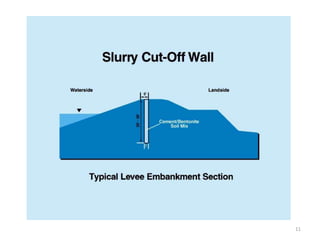
Slurry Cutoff trench
Types Applicability
Slurry Cutoff trench Suited for
construction of
impervious cutoff
trench below ground
water for stabilizing
trench excavation
7
8
9
Grouted or injected cutoff walls
Types Applicability
Grouted or injected cutoff
walls
Depth or character of
foundation materials make
sheet pile walls or cutoff
trench impractical.
Used in major hydraulic
structures
Used as a supplement below
cutoff sheeting or trenches.
10
11
12
Liners
• Liners are used to prevent the seepage.
• Prevent loss of water retained in a canal or
impoundment or keeping water out of an area
such as a waste disposal site to prevent
migration of contaminations.
• Bentonite and related clays are often favoured
as liners to prevent water from reaching
isolated waste.
13
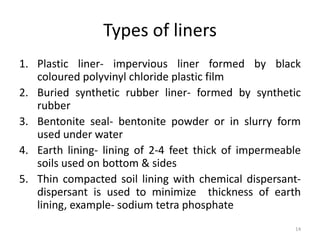
Types of liners
1. Plastic liner- impervious liner formed by black
coloured polyvinyl chloride plastic film
2. Buried synthetic rubber liner- formed by synthetic
rubber
3. Bentonite seal- bentonite powder or in slurry form
used under water
4. Earth lining- lining of 2-4 feet thick of impermeable
soils used on bottom & sides
5. Thin compacted soil lining with chemical dispersant-
dispersant is used to minimize thickness of earth
lining, example- sodium tetra phosphate
14
Drains
• Effective drains depends on the relative permeability of the
drain materials and the surrounding materials.
• Besides the selection of the drain material must be such that
it must retain the migration of the fine particles from the
surrounding.
• The relative sizing of drain materials is critical to proper
operation. It must have a sufficiently greater permeability
than the soil it is protecting in order to intercept the
subsurface flow.
• At the same time, it must not permit excessive passage of
the smaller particles in the adjacent materials to avoid piping
of the soil or clogging of the drain.
15
16
Wells
• Well points accomplish the same purpose by being drilled
to a shallow depth and attached to a suction pump to draw
out the water.
• Pumping wells are necessary to achieve dewatering to a
greater depth
• Pumping wells are drilled and equipped in a manner nearly
identical to a well being developed as a water source.
• Horizontal wells depends on gravity to move water through
them. These wells are effective in maintaining cut slope
stability and in stabilizing landslides
17

Subsurface water Control methods (1).pptx

  • 1.
    Subsurface water Controlmethods • Various methods are there- -depends on the type of engineering work involved, -site conditions - the purpose for controlling the water. • Control methods can be reasonably grouped into four categories (i) Barriers (ii) Liners (iii) Wells (iv) Drains. 1
  • 2.
    Subsurface water Controlmethods • Barriers - reduce both quantity and velocity of subsurface water • liners - prevent the movement of subsurface water • drains - reduces the quantity of water and direct its movement. • Dewatering wells - elimination of subsurface water, is accomplished through the use of wells. 2
  • 3.
    Barriers • Sheet pilecutoff walls, impervious cutoff trenches and grouted or injected cutoff curtains - common types of barriers. • Example: earthen dams may incorporate a cutoff wall or grout curtain in their foundation to reduce the amount and speed of water flowing under the structure. • Type of barrier to use at a site is dictated as much by subsurface conditions as by the type of structure involved. 3
  • 4.
  • 5.
    Types Applicability Sheet pilecutoff walls Suited for stratified soils with high horizontal & low vertical permeability Tongue & groove wood sheeting used for shallow excavations Interlocking steel sheet piles used for deeper cutoff 5
  • 6.
  • 7.
    Slurry Cutoff trench TypesApplicability Slurry Cutoff trench Suited for construction of impervious cutoff trench below ground water for stabilizing trench excavation 7
  • 8.
  • 9.
  • 10.
    Grouted or injectedcutoff walls Types Applicability Grouted or injected cutoff walls Depth or character of foundation materials make sheet pile walls or cutoff trench impractical. Used in major hydraulic structures Used as a supplement below cutoff sheeting or trenches. 10
  • 11.
  • 12.
  • 13.
    Liners • Liners areused to prevent the seepage. • Prevent loss of water retained in a canal or impoundment or keeping water out of an area such as a waste disposal site to prevent migration of contaminations. • Bentonite and related clays are often favoured as liners to prevent water from reaching isolated waste. 13
  • 14.
    Types of liners 1.Plastic liner- impervious liner formed by black coloured polyvinyl chloride plastic film 2. Buried synthetic rubber liner- formed by synthetic rubber 3. Bentonite seal- bentonite powder or in slurry form used under water 4. Earth lining- lining of 2-4 feet thick of impermeable soils used on bottom & sides 5. Thin compacted soil lining with chemical dispersant- dispersant is used to minimize thickness of earth lining, example- sodium tetra phosphate 14
  • 15.
    Drains • Effective drainsdepends on the relative permeability of the drain materials and the surrounding materials. • Besides the selection of the drain material must be such that it must retain the migration of the fine particles from the surrounding. • The relative sizing of drain materials is critical to proper operation. It must have a sufficiently greater permeability than the soil it is protecting in order to intercept the subsurface flow. • At the same time, it must not permit excessive passage of the smaller particles in the adjacent materials to avoid piping of the soil or clogging of the drain. 15
  • 16.
  • 17.
    Wells • Well pointsaccomplish the same purpose by being drilled to a shallow depth and attached to a suction pump to draw out the water. • Pumping wells are necessary to achieve dewatering to a greater depth • Pumping wells are drilled and equipped in a manner nearly identical to a well being developed as a water source. • Horizontal wells depends on gravity to move water through them. These wells are effective in maintaining cut slope stability and in stabilizing landslides 17