Subimal Bhattacharjee Country Head,  General Dynamics- India LO, New Delhi
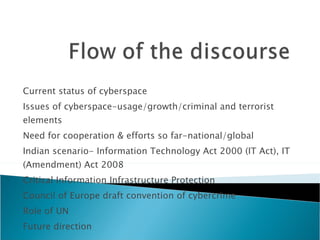
Current status of cyberspace Issues of cyberspace-usage/growth/criminal and terrorist elements Need for cooperation & efforts so far-national/global Indian scenario- Information Technology Act 2000 (IT Act), IT (Amendment) Act 2008 Critical Information Infrastructure Protection Council of Europe draft convention of cybercrime Role of UN Future direction
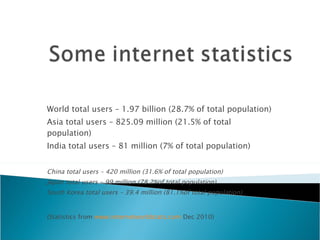
World total users – 1.97 billion (28.7% of total population) Asia total users – 825.09 million (21.5% of total population) India total users – 81 million (7% of total population) China total users – 420 million (31.6% of total population) Japan total users – 99 million (78.2%of total population) South Korea total users – 39.4 million (81.1%of total population) (Statistics from  www.internetworldstats.com  Dec 2010)
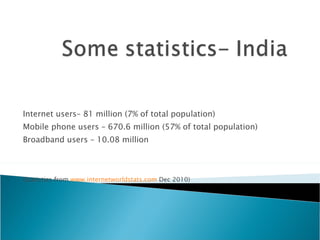
Internet users– 81 million (7% of total population) Mobile phone users – 670.6 million (57% of total population) Broadband users – 10.08 million (Statistics from  www.internetworldstats.com  Dec 2010)
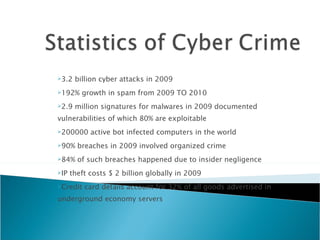
3.2 billion cyber attacks in 2009 192% growth in spam from 2009 TO 2010 2.9 million signatures for malwares in 2009 documented vulnerabilities of which 80% are exploitable 200000 active bot infected computers in the world 90% breaches in 2009 involved organized crime 84% of such breaches happened due to insider negligence IP theft costs $ 2 billion globally in 2009 Credit card details account for 32% of all goods advertised in underground economy servers
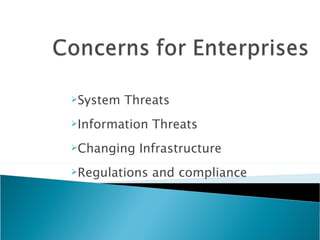
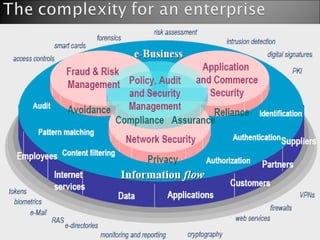
System Threats Information Threats Changing Infrastructure Regulations and compliance
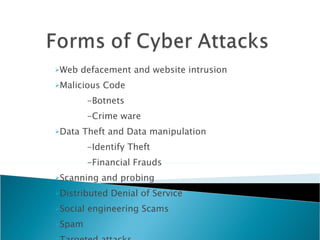
Web defacement and website intrusion Malicious Code -Botnets -Crime ware Data Theft and Data manipulation -Identify Theft -Financial Frauds Scanning and probing Distributed Denial of Service Social engineering Scams Spam Targeted attacks Offensive contents
London, 10 th  Sept 2009
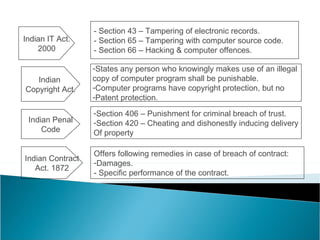
Indian IT Act. 2000 - Section 43 – Tampering of electronic records. - Section 65 – Tampering with computer source code. - Section 66 – Hacking & computer offences. Indian  Copyright Act. States any person who knowingly makes use of an illegal  copy of computer program shall be punishable. Computer programs have copyright protection, but no  Patent protection. Indian Penal Code Section 406 – Punishment for criminal breach of trust. Section 420 – Cheating and dishonestly inducing delivery Of property Indian Contract Act. 1872 Offers following remedies in case of breach of contract: Damages. - Specific performance of the contract.
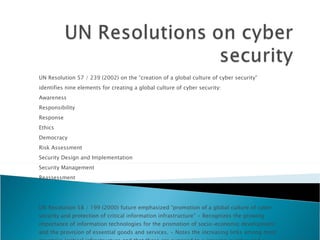
UN Resolution 57 / 239 (2002) on the “creation of a global culture of cyber security”  identifies nine elements for creating a global culture of cyber security:  Awareness  Responsibility  Response  Ethics  Democracy  Risk Assessment  Security Design and Implementation  Security Management  Reassessment  UN Resolution 58 / 199 (2000) future emphasized “promotion of a global culture of cyber security and protection of critical information infrastructure” • Recognizes the growing importance of information technologies for the promotion of socio-economic development and the provision of essential goods and services. • Notes the increasing links among most countries ‘critical infrastructure and that these are exposed to a growing number and a wider variety of threats and vulnerabilities that raise new security concerns.
[email_address] [email_address]

Subimal bhattarchajee

  • 1.
    Subimal Bhattacharjee CountryHead, General Dynamics- India LO, New Delhi
  • 2.
    Current status ofcyberspace Issues of cyberspace-usage/growth/criminal and terrorist elements Need for cooperation & efforts so far-national/global Indian scenario- Information Technology Act 2000 (IT Act), IT (Amendment) Act 2008 Critical Information Infrastructure Protection Council of Europe draft convention of cybercrime Role of UN Future direction
  • 3.
    World total users– 1.97 billion (28.7% of total population) Asia total users – 825.09 million (21.5% of total population) India total users – 81 million (7% of total population) China total users – 420 million (31.6% of total population) Japan total users – 99 million (78.2%of total population) South Korea total users – 39.4 million (81.1%of total population) (Statistics from www.internetworldstats.com Dec 2010)
  • 4.
    Internet users– 81million (7% of total population) Mobile phone users – 670.6 million (57% of total population) Broadband users – 10.08 million (Statistics from www.internetworldstats.com Dec 2010)
  • 5.
    3.2 billion cyberattacks in 2009 192% growth in spam from 2009 TO 2010 2.9 million signatures for malwares in 2009 documented vulnerabilities of which 80% are exploitable 200000 active bot infected computers in the world 90% breaches in 2009 involved organized crime 84% of such breaches happened due to insider negligence IP theft costs $ 2 billion globally in 2009 Credit card details account for 32% of all goods advertised in underground economy servers
  • 6.
    System Threats InformationThreats Changing Infrastructure Regulations and compliance
  • 7.
    Web defacement andwebsite intrusion Malicious Code -Botnets -Crime ware Data Theft and Data manipulation -Identify Theft -Financial Frauds Scanning and probing Distributed Denial of Service Social engineering Scams Spam Targeted attacks Offensive contents
  • 8.
    London, 10 th Sept 2009
  • 9.
    Indian IT Act.2000 - Section 43 – Tampering of electronic records. - Section 65 – Tampering with computer source code. - Section 66 – Hacking & computer offences. Indian Copyright Act. States any person who knowingly makes use of an illegal copy of computer program shall be punishable. Computer programs have copyright protection, but no Patent protection. Indian Penal Code Section 406 – Punishment for criminal breach of trust. Section 420 – Cheating and dishonestly inducing delivery Of property Indian Contract Act. 1872 Offers following remedies in case of breach of contract: Damages. - Specific performance of the contract.
  • 10.
    UN Resolution 57/ 239 (2002) on the “creation of a global culture of cyber security” identifies nine elements for creating a global culture of cyber security: Awareness Responsibility Response Ethics Democracy Risk Assessment Security Design and Implementation Security Management Reassessment UN Resolution 58 / 199 (2000) future emphasized “promotion of a global culture of cyber security and protection of critical information infrastructure” • Recognizes the growing importance of information technologies for the promotion of socio-economic development and the provision of essential goods and services. • Notes the increasing links among most countries ‘critical infrastructure and that these are exposed to a growing number and a wider variety of threats and vulnerabilities that raise new security concerns.
  • 11.