Studying Disability Multiple Theories and Responses 1st Edition Elizabeth G. Depoy
Studying Disability Multiple Theories and Responses 1st Edition Elizabeth G. Depoy
Studying Disability Multiple Theories and Responses 1st Edition Elizabeth G. Depoy
Studying Disability Multiple Theories and Responses 1st Edition Elizabeth G. Depoy
Studying Disability Multiple Theories and Responses 1st Edition Elizabeth G. Depoy
1.
Visit https://ebookultra.com todownload the full version and
explore more ebooks or textbooks
Studying Disability Multiple Theories and
Responses 1st Edition Elizabeth G. Depoy
_____ Click the link below to download _____
https://ebookultra.com/download/studying-disability-
multiple-theories-and-responses-1st-edition-elizabeth-g-
depoy/
Explore and download more ebooks or textbooks at ebookultra.com
2.
Here are somerecommended products that we believe you will be
interested in. You can click the link to download.
The Minority Body A Theory of Disability 1st Edition
Elizabeth Barnes
https://ebookultra.com/download/the-minority-body-a-theory-of-
disability-1st-edition-elizabeth-barnes/
Making Computers Accessible Disability Rights and Digital
Technology 1st Edition Elizabeth R. Petrick
https://ebookultra.com/download/making-computers-accessible-
disability-rights-and-digital-technology-1st-edition-elizabeth-r-
petrick/
Comprehensive Disability Management 1st Edition Henry G.
Harder
https://ebookultra.com/download/comprehensive-disability-
management-1st-edition-henry-g-harder/
Engaging Theories in Interpersonal Communication Multiple
Perspectives Second Edition Dawn O. Braithwaite
https://ebookultra.com/download/engaging-theories-in-interpersonal-
communication-multiple-perspectives-second-edition-dawn-o-braithwaite/
3.
The New LiteraciesMultiple Perspectives on Research and
Practice 1st Edition Elizabeth A. Baker (Ed.)
https://ebookultra.com/download/the-new-literacies-multiple-
perspectives-on-research-and-practice-1st-edition-elizabeth-a-baker-
ed/
Cardiovascular MRI 150 Multiple Choice Questions and
Answers 1st Edition Peter G. Danias
https://ebookultra.com/download/cardiovascular-mri-150-multiple-
choice-questions-and-answers-1st-edition-peter-g-danias/
Bioethics and Disability Toward a Disability Conscious
Bioethics Cambridge Disability Law and Policy Series 1st
Edition Alicia Ouellette
https://ebookultra.com/download/bioethics-and-disability-toward-a-
disability-conscious-bioethics-cambridge-disability-law-and-policy-
series-1st-edition-alicia-ouellette/
Making 20th Century Science How Theories Became Knowledge
1st Edition Stephen G. Brush
https://ebookultra.com/download/making-20th-century-science-how-
theories-became-knowledge-1st-edition-stephen-g-brush/
Multiple Comparisons and Multiple Tests Using SAS Second
Edition Ph.D.
https://ebookultra.com/download/multiple-comparisons-and-multiple-
tests-using-sas-second-edition-ph-d/
5.
Studying Disability MultipleTheories and Responses 1st
Edition Elizabeth G. Depoy Digital Instant Download
Author(s): Elizabeth G. DePoy; Stephen French Gilson
ISBN(s): 9781452215693, 1452215693
Edition: 1
File Details: PDF, 4.81 MB
Year: 2010
Language: english
Copyright 2011by SAGE Publications, Inc.
All rights reserved. No part of this book may be reproduced or utilized in any form or by
any means, electronic or mechanical, including photocopying, recording, or by any
information storage and retrieval system, without permission in writing from the publisher.
For information:
SAGE Publications, Inc. SAGE Publications India Pvt. Ltd.
2455 Teller Road B 1/I 1 Mohan Cooperative
Thousand Oaks, Industrial Area
California 91320 Mathura Road, New Delhi 110 044
E-mail: order@sagepub.com India
SAGE Publications Ltd. SAGE Publications
1 Oliver’s Yard Asia-Pacific Pte. Ltd.
55 City Road 33 Pekin Street #02-01
London EC1Y 1SP Far East Square
United Kingdom Singapore 048763
Printed in the United States of America
Library of Congress Cataloging-in-Publication Data
DePoy, Elizabeth.
Studying disability : multiple theories and responses / Elizabeth DePoy, Stephen
French Gilson.
p. cm.
Includes bibliographical references and index.
ISBN 978-1-4129-7576-6 (pbk.)
1. Disability studies. I. Gilson, Stephen French. II. Title.
HV1568.2.D467 2011
362.4—dc22 2010005923
This book is printed on acid-free paper.
10 11 12 13 14 10 9 8 7 6 5 4 3 2 1
Acquisitions Editor: Kassie Graves
Editorial Assistant: Veronica K. Novak
Production Editor: Libby Larson
Copy Editor: Heidi Crossman
Typesetter: C&M Digitals (P) Ltd.
Proofreader: Susan Schon
Indexer: Wendy Allex
Cover Designer: Candice Harman
Marketing Manager: Stephanie Adams
11.
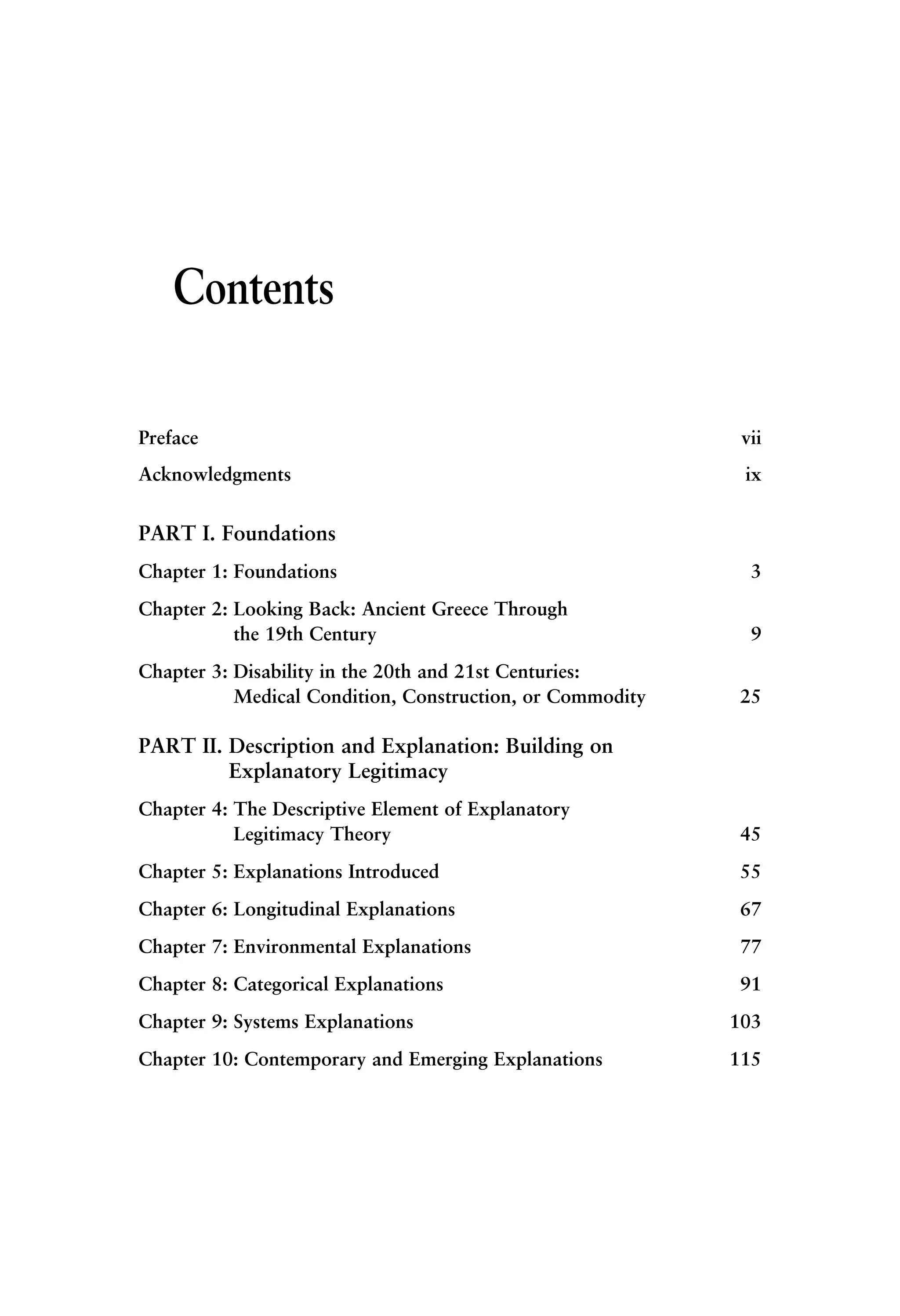
Contents
Preface vii
Acknowledgments ix
PARTI. Foundations
Chapter 1: Foundations 3
Chapter 2: Looking Back: Ancient Greece Through
the 19th Century 9
Chapter 3: Disability in the 20th and 21st Centuries:
Medical Condition, Construction, or Commodity 25
PART II. Description and Explanation: Building on
Explanatory Legitimacy
Chapter 4: The Descriptive Element of Explanatory
Legitimacy Theory 45
Chapter 5: Explanations Introduced 55
Chapter 6: Longitudinal Explanations 67
Chapter 7: Environmental Explanations 77
Chapter 8: Categorical Explanations 91
Chapter 9: Systems Explanations 103
Chapter 10: Contemporary and Emerging Explanations 115
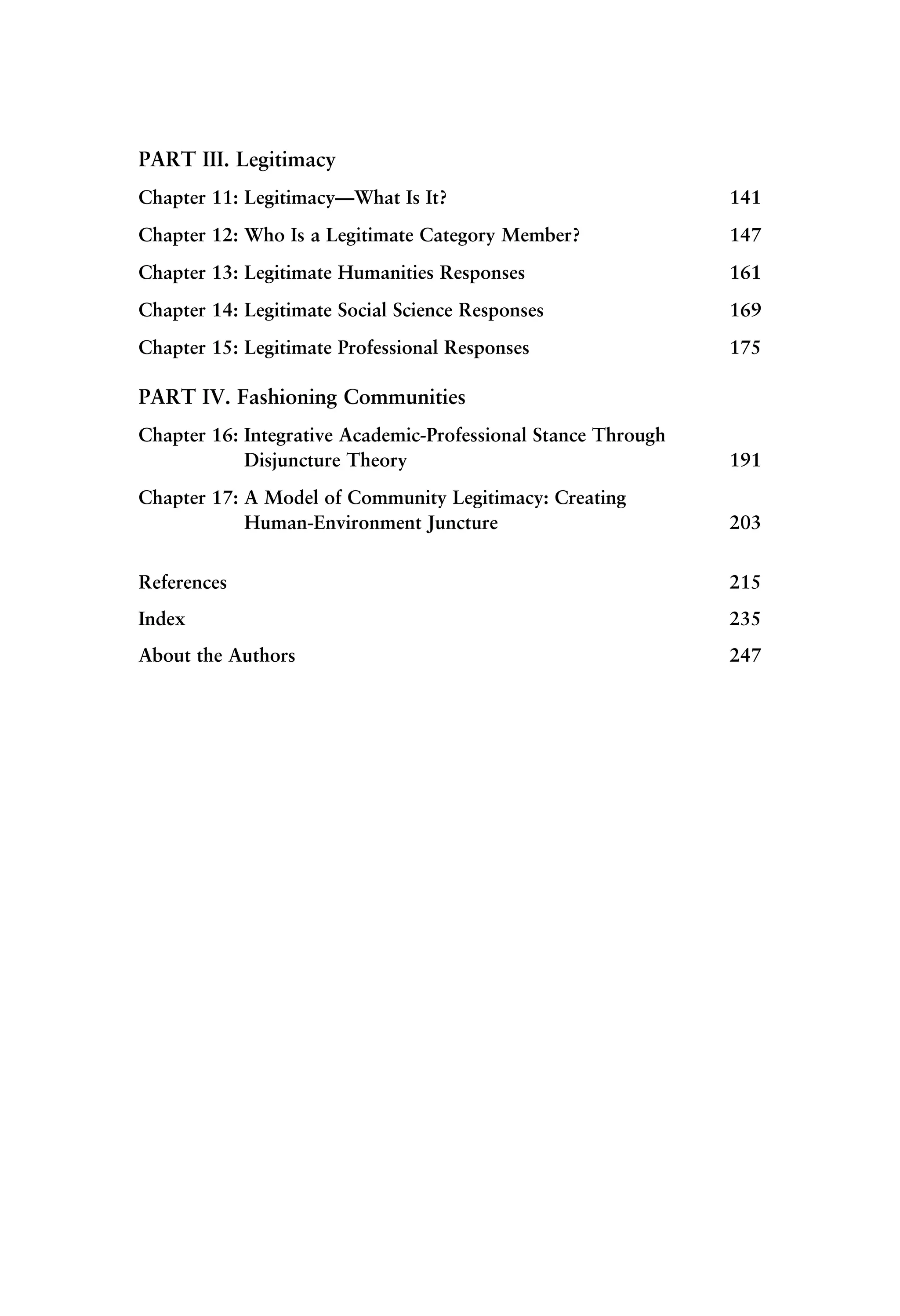
12.
PART III. Legitimacy
Chapter11: Legitimacy—What Is It? 141
Chapter 12: Who Is a Legitimate Category Member? 147
Chapter 13: Legitimate Humanities Responses 161
Chapter 14: Legitimate Social Science Responses 169
Chapter 15: Legitimate Professional Responses 175
PART IV. Fashioning Communities
Chapter 16: Integrative Academic-Professional Stance Through
Disjuncture Theory 191
Chapter 17: A Model of Community Legitimacy: Creating
Human-Environment Juncture 203
References 215
Index 235
About the Authors 247
13.
Preface
Writing this bookhas been a gift for us. Over the past five years, since
the publication of our last book on disability, Rethinking Disability,
we have read widely and have heard and had exchanges with many scholars
in Disability Studies and other fields that are relevant to the study of dis-
ability, and of course with our students. Our main purpose in writing this
book was to continue our commitment to building on the excellent work of
current scholars and to advancing well-informed, progressive theory of dis-
ability with an eye toward its application to human rights.
In this work, we have considered and integrated many viewpoints,
research studies, and epistemic and axiological positions. Looking backward
in history and broadly across the globe has brought us to the marriage of dis-
ciplines and ideas that, until now, have not been considered complimentary
or relevant to disability. For example, our reading in economics, business,
and commerce have stimulated us to consider the power of marketing and
branding as definitive of disability as well as a powerful change agent.
As we read, teach, inquire, and engage with colleagues, we experience
the paradox of thinking more broadly yet more sharply focused. In the
21st century context in which we are virtually connected and electronically
befriended, we would suggest that this seeming paradox is essential and
timely for the progressive thinking necessary to cull and bring diverse
knowledge to bear on redefining and responding to disability as part of the
larger context of human experience.
The book is organized into three major sections. The first part, Founda-
tions, provides a historical backdrop and explores the current contextual
trends that have been important in shaping perspectives of and responses
to disability. We reintroduce our conceptual framework, Explanatory
Legitimacy, in this section to provide the reader with a systematic, logical
structure through which to analyze the large body of knowledge that we
then tackle in the second section. Part II delves into theoretical descriptions
vii
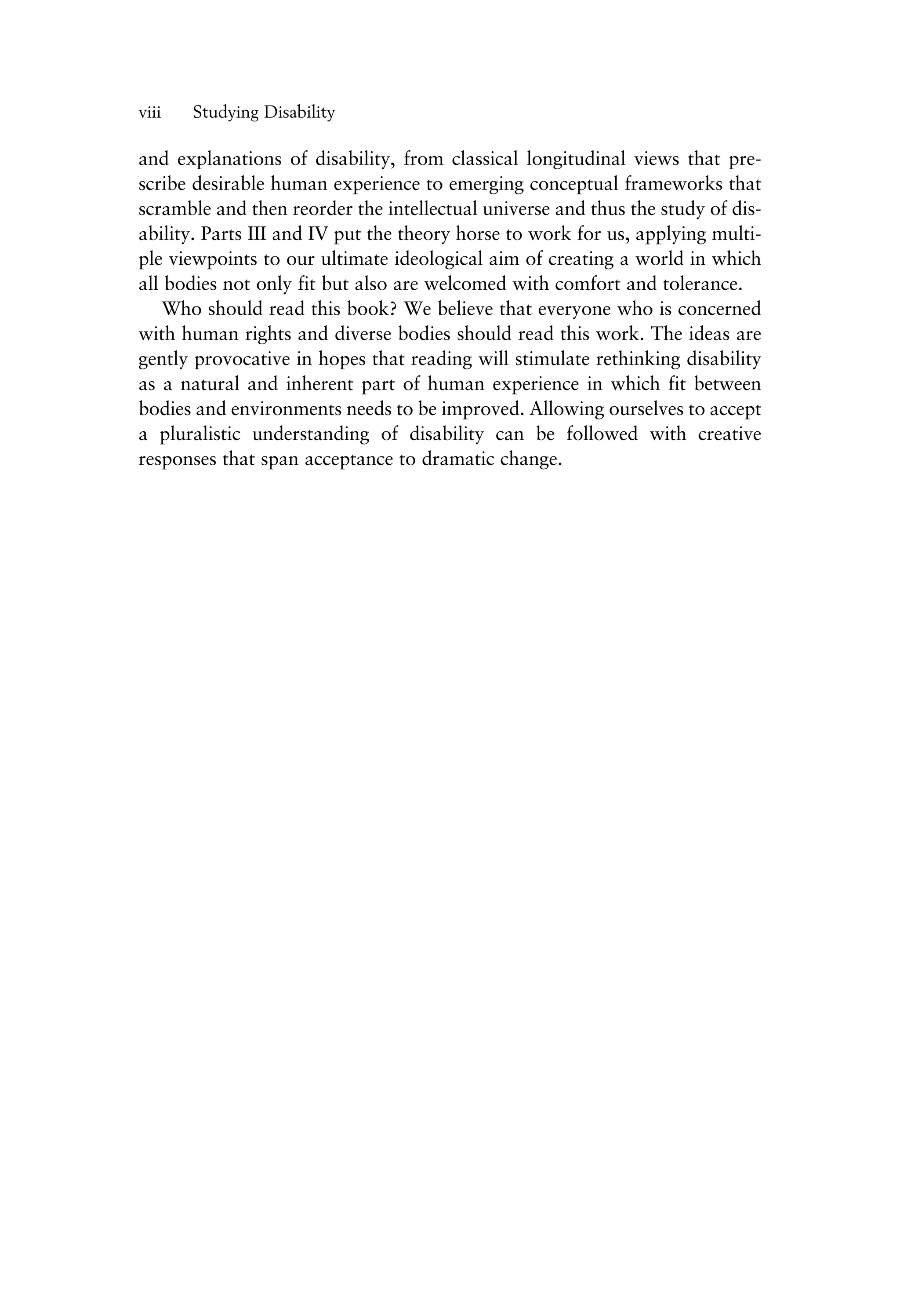
14.
and explanations ofdisability, from classical longitudinal views that pre-
scribe desirable human experience to emerging conceptual frameworks that
scramble and then reorder the intellectual universe and thus the study of dis-
ability. Parts III and IV put the theory horse to work for us, applying multi-
ple viewpoints to our ultimate ideological aim of creating a world in which
all bodies not only fit but also are welcomed with comfort and tolerance.
Who should read this book? We believe that everyone who is concerned
with human rights and diverse bodies should read this work. The ideas are
gently provocative in hopes that reading will stimulate rethinking disability
as a natural and inherent part of human experience in which fit between
bodies and environments needs to be improved. Allowing ourselves to accept
a pluralistic understanding of disability can be followed with creative
responses that span acceptance to dramatic change.
viii——Studying Disability
15.
Acknowledgments
We have manyto thank for supporting this work. First, we acknowl-
edge the students who have contributed to our thinking, those who
studied with us prior to this writing as well as to the students who read this
manuscript and offered critical and constructive feedback.
Of particular note are three of our colleagues who reviewed and provided
detailed and valued criticism: Allison Carey, Kristine Mulhorne, and Stephen
Marson. Family and friends as well as our colleagues around the world have
also been great supports to us.
Our involvement in scholarly organizations such as the Society for Disability
Studies, the Disability Section of the American Public Health Association, and
the Disability Studies Issues element of the Association on University Centers of
Excellence on Disabilities has provided the opportunity to present ideas as
works in progress and receive informed scholarly feedback from our colleagues.
Our dear colleague and friend, Noomi Katz, in providing the opportunity
for us to share our ideas in Israel, influenced us to make our work global and
accessible to other national and linguistic cultures.
Finally, Sandi Oliver has been a model for this book. Her dream, Someday
Farms, exists today in Hermon, Maine, and is the epitome of juncture. The
equine-human community that she creates at Someday Farms welcomes
diverse beings and bodies. Excellence and commitment not only are encour-
aged for some but also are expectations for all. Sandi has given us the gift of
seeing our vision in action.
Thank you.
SAGE gratefully acknowledges the contributions of the following reviewers:
Brenda Jo Brueggemann, Ohio State University
Allison C. Carrey, Shippensburg University
Denise De La Garza, University of Texas at Austin
Stephen M. Marson, University of North Carolina
Kristine A. Mulhorn, Drexel University
Nancy Hancock Sharby, Northeastern University
ix
1
Foundations
The Merriam-Webster OnlineDictionary (2010c) defines foundations as
structures, principles, tenets, or axioms on which to build. Because
strong foundations create sound scaffolding for the development of thinking
and theory, the chapters in Section 1 look back in history to provide a
chronological set of ideas and structures on which to ground current analy-
ses of disability. However, foundations are not static or monistic. The theo-
retical lenses through which we look back influence not only what we see
but also how we interpret and then use our observations to make sense of
knowledge and to guide how we apply learning to diverse contexts.
In this chapter, we briefly introduce you to the language and theory
through which we analyze disability past, present, and future: Explanatory
Legitimacy Theory. This theory is embedded within and builds on the genre
of legitimacy theories, which have a long, interdisciplinary history.
According to Morris Zelditch (2001), legitimacy theories can be traced as far
back as the writings of Thucydides in 423 BCE, in which questions were
posed and answered about the moral correctness of power and its muscled
acquisition. Although legitimacy theory was birthed by political theory,
questions of legitimation have been asked of numerous domains, including
but not limited to social norms and rules, distributive justice, and psychol-
ogy. And while there are differences in the application of legitimacy theories
to diverse substantive questions, what all have in common is their search for
credibility and normative acceptance. That is to say, legitimacy theory exam-
ines the basis on which a phenomenon is seen as genuine or authentic.
3
20.
Legitimacy theories haveposited a range of factors that determine the
authenticity or acceptability of laws, rules, or determinations. These ele-
ments can be explicit, such as public consensus about genuineness, or tacit,
such as efforts to obscure power brokering (Zelditch, 2001). Among legiti-
macy theorists, Weber (1958) is perhaps best recognized for his assertion
that social order inherent in values, norms, and beliefs cannot be maintained
without acceptance of this order as valid. Applied to group interaction, legit-
imacy theory has the potential to denude the normative beliefs that under-
pin hierarchies, power relationships, and categorization and to expose the
values that imbue category status and acceptable responses.
In the tradition of legitimacy theories, Explanatory Legitimacy Theory
seeks to analyze, detangle, and clarify categorization and response by focus-
ing on the source of authentification and valuation of explanations for cate-
gory membership. Rather than political power as its object and subject,
Explanatory Legitimacy Theory is concerned with the credibility, value, and
acceptance of causal theories which parse and assign humans into groups
and then fashion responses to group members.
Moreover, drawing on the work of Shilling (2008), Explanatory Legitimacy
synthesizes pragmatism within its foundation in legitimacy, providing the ana-
lytic framework for looking at purpose to frame how and why values are
applied to explanations and responses to specific groups.
Given the debates about the nature of disability, Explanatory Legitimacy
provokes thought and analysis of diverse perspectives and has the potential
to validate the use of each within different purposive contexts. Capitalizing
on the clarity of seminal legitimacy thinkers such as Habermas (2003) and
Parsons (1956), the Explanatory Legitimacy framework clarifies theory
types so that each can be compared to those similar in structure and subject.
As we will discuss in Chapters 2 and 3, numerous definitions and models
of disability have been advanced and published within the latter part of the
20th and early 21st centuries. The dynamic presence in which models and
approaches advance, recede, coexist, or conflict suggests the pluralistic
boundaries and influences on the term and its usage and response to it.
Explanatory Legitimacy lays bare the axiological context for each model,
critically evaluting each for use on its own or in concert with others.
Disability: Description, Explanation, Legitimacy
We present the key principles and language of Explanatory Legitimacy
Theory here only to frame our presentation of foundations. Once the foun-
dations have been explored through the lens of the theory, the chronological
4——Foundations
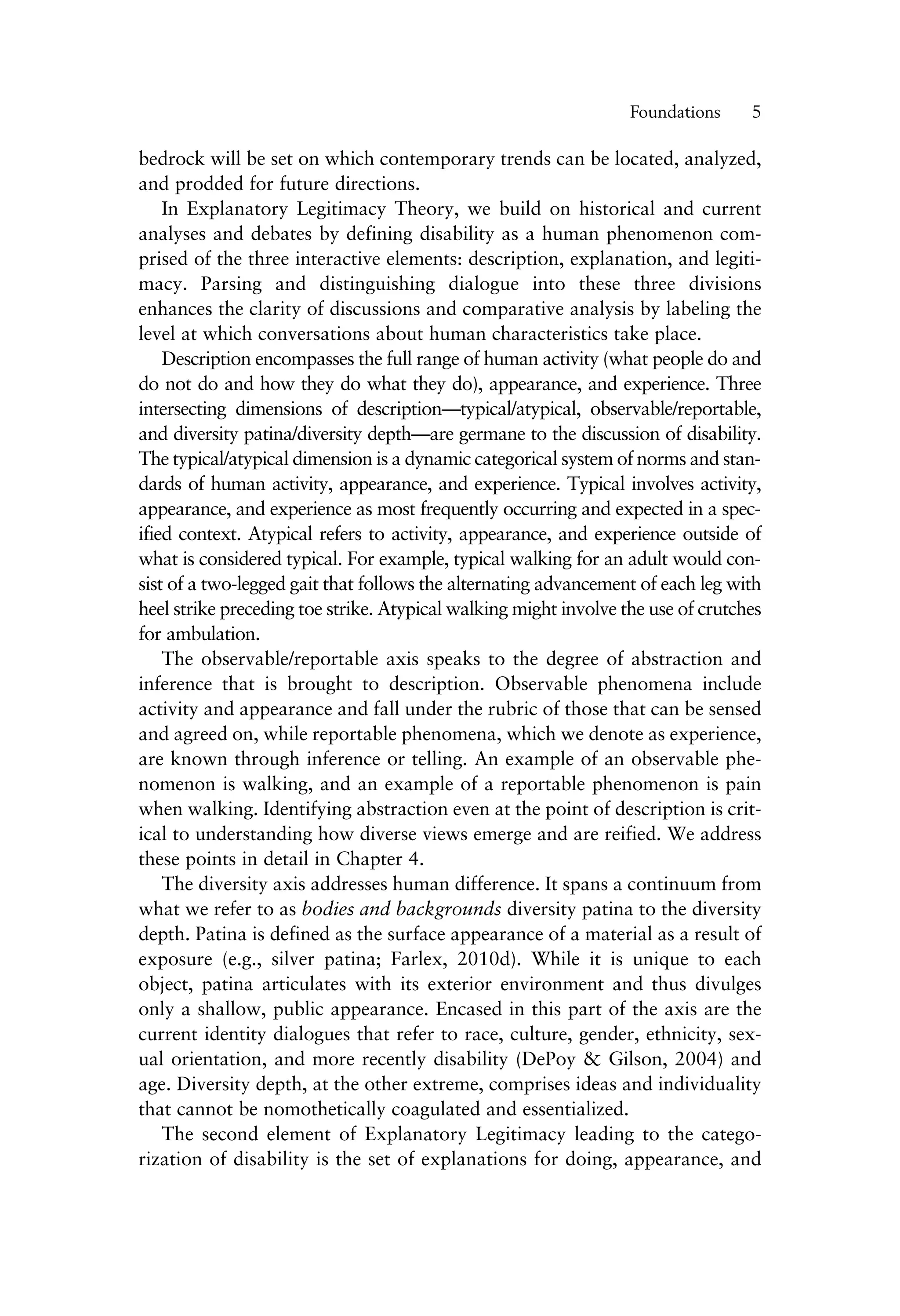
21.
bedrock will beset on which contemporary trends can be located, analyzed,
and prodded for future directions.
In Explanatory Legitimacy Theory, we build on historical and current
analyses and debates by defining disability as a human phenomenon com-
prised of the three interactive elements: description, explanation, and legiti-
macy. Parsing and distinguishing dialogue into these three divisions
enhances the clarity of discussions and comparative analysis by labeling the
level at which conversations about human characteristics take place.
Description encompasses the full range of human activity (what people do and
do not do and how they do what they do), appearance, and experience. Three
intersecting dimensions of description—typical/atypical, observable/reportable,
and diversity patina/diversity depth—are germane to the discussion of disability.
The typical/atypical dimension is a dynamic categorical system of norms and stan-
dards of human activity, appearance, and experience. Typical involves activity,
appearance, and experience as most frequently occurring and expected in a spec-
ified context. Atypical refers to activity, appearance, and experience outside of
what is considered typical. For example, typical walking for an adult would con-
sist of a two-legged gait that follows the alternating advancement of each leg with
heel strike preceding toe strike. Atypical walking might involve the use of crutches
for ambulation.
The observable/reportable axis speaks to the degree of abstraction and
inference that is brought to description. Observable phenomena include
activity and appearance and fall under the rubric of those that can be sensed
and agreed on, while reportable phenomena, which we denote as experience,
are known through inference or telling. An example of an observable phe-
nomenon is walking, and an example of a reportable phenomenon is pain
when walking. Identifying abstraction even at the point of description is crit-
ical to understanding how diverse views emerge and are reified. We address
these points in detail in Chapter 4.
The diversity axis addresses human difference. It spans a continuum from
what we refer to as bodies and backgrounds diversity patina to the diversity
depth. Patina is defined as the surface appearance of a material as a result of
exposure (e.g., silver patina; Farlex, 2010d). While it is unique to each
object, patina articulates with its exterior environment and thus divulges
only a shallow, public appearance. Encased in this part of the axis are the
current identity dialogues that refer to race, culture, gender, ethnicity, sex-
ual orientation, and more recently disability (DePoy & Gilson, 2004) and
age. Diversity depth, at the other extreme, comprises ideas and individuality
that cannot be nomothetically coagulated and essentialized.
The second element of Explanatory Legitimacy leading to the catego-
rization of disability is the set of explanations for doing, appearance, and
Foundations——5
22.
experience. Different fromdescription, which answers “what” questions,
explanation engages with the “whys” of human description. Following
with our example of walking, a medical explanation for pain in ambulation
might be the diagnosis of arthritis, while an explanation in the exterior
environment might be the presence of stairs as barriers that require ambu-
latory activity that causes pain.
The third definitional element of disability is legitimacy. It is not until this
element that humans are purposively situated in categories to which group
responses are attributed. Legitimacy is therefore divided into subelements:
judgment and response. Judgment refers to axiological assessment of groups
and/or individuals (sometimes competing) regarding whether what one does
(and thus what one does not do) throughout life, how one looks, and the
degree to which one’s experiences fit within what is typical and have valid
and acceptable explanations that authenticate group membership. Respon-
ses are the legitimate actions (both negative and positive) that are deemed
credible and appropriate by those rendering the value judgments about legiti-
macy of group membership. Legitimacy is embedded within a purposive
contextual backdrop.
We have selected the term legitimacy to explicate the primacy of judg-
ment about acceptability and worth in shaping differential definitions of
disability and in determining community, social, and policy responses to
those who fit within diverse disability classifications. As we will see in sub-
sequent chapters, many complex factors come to bear on legitimacy. Only
some of these factors have been identified in the current literature. They
include social values, economic benefit, cultural beliefs, and power structures
(Jost & Major, 2002).
To briefly illustrate, let us return to our walking example and consider
two people, Ann and Barbara, both of whom walk with a clumsy gait
(observable) and are unable to navigate an escalator or stairs to access the
second floor of a public building. The descriptive element in this example
refers to the limitations experienced by Ann and Barbara in their mobility
and access to the second story. Further, because these gaits are out of the
ordinary, both walking and access are atypical. Descriptively, then, what
both individuals do (walk) and do not do (ascend stairs or an escalator) are
atypical and observable.
The next element is explanation. From a medical explanatory perspective,
Ann’s atypical gait and lack of access are attributed to a diagnosis of cere-
bral palsy and Barbara’s to alcohol dependence. If, however, the environ-
ment is seen as the explanatory locus, the presence of the escalator and stairs
and social conventions are explanations for limited access, not the atypical
6——Foundations
23.
walking due toa diagnostic condition. Note that we still have not identified
either person as disabled.
Now we come to the determination element of our theory: legitimacy.
Because we assert that disability is a judgment about authenticity and worth,
legitimate membership in the disability category is determined by who makes
the judgment, in what context, and under what set of rules. In this case, both
Ann and Barbara name themselves disabled not because of their diagnostic
conditions but because of the environment. Ann sees the escalator and stairs
as the disabling environmental factors, while Barbara identifies social pres-
sures and nonacceptance as the disabling elements in her life. If we look at
the medical community, Ann and Barbara are also considered disabled since
both have enduring medical-diagnostic conditions that interfere with their
“typical functioning.” However, if we now look at eligibility criteria for
public assistance, Ann is disabled but Barbara is not. The judgment is ren-
dered on the explanation, not on the description. Further, the legitimate
response differs. Ann can obtain public safety net support, and Barbara
cannot. In determining who is worthy of public support, the legitimacy or
adequacy of the explanation for atypical activity is a function of social,
economic, and cultural value. Implicit in the denial of disability status for
Barbara is the notion that she is responsible for her own circumstance, is not
authentically disabled, and thus is not deserving of a support response.
Before looking back in time, we highlight a major issue in theory and
analysis: applying contemporary language to historical discussion. We
address this point in detail in Chapters 2 and 3. In these chapters, we draw
attention to the term body. Although popular vernacular implies that the
body is limited to the flesh container and its organic contents, reference to
the body throughout this work refers not only to one’s organic anatomy
and physiology but also to the range of human phenomena that derive
from bodies in action, thought, belief, and experience (Baudrillard, 1995;
DePoy & Gilson, 2007). This definition is potent in integrating the multi-
ple elements of embodied human experience and thus in conceptualizing
diversity beyond observed patina characteristics of the organic body. Thus
the body and its function include but are not limited to physiology and
anatomy. Rather, the body is comprised of the sensory body, the emo-
tional body, the spiritual body, the economic body, the productive body,
the expressive body, the body of ideas and meanings, and the body in mul-
tiple garb and spaces.
We are now ready to visit the history of earlier civilizations, always keep-
ing the theoretical tools of Explanatory Legitimacy intact and poised for
analysis.
Foundations——7
25.
2
Looking Back
Ancient Greece
Throughthe 19th Century
As early as ancient civilizations (Chahira, 2006), there is documentation
of a range of responses to “the atypical human” from fascination to
revulsion (Barrett, n.d.; Longmore & Umansky, 2001a). Examining images
and text historically is always an interpretative practice; thus, we urge the
reader to consider that our interpretations are made on the interpretations of
others. However, the benefit of looking at history without assuming its truth
value gives us a two-way, opaque, but important window on how civiliza-
tions responded to embodied difference and how our own interpretation of
that response foregrounds the values and prejudices that undergird our 21st-
century stance (Cohen & Weiss, 2003; Rose, 2003). In this chapter, we visit
diverse notions of and approaches to atypical bodies through chronological
and varied geographic contexts up through the end of the 19th century as the
basis for understanding the evolution and roots of current definitions of and
responses to disability. An investigation of historical text directly or indirectly
focusing on disability reveals the following commonalities:
1. What is atypical differs according to context.
2. In each era there have been several potential, assumed, and accepted expla-
nations for a single atypical human characteristic.
9
Result of afailure to deflect the planes quickly enough when the
engine stopped. The operator fortunately escaped with but a few
bruises.
At the same time, Mr. Hamilton says: “Driving an aeroplane at a
speed of 120 miles an hour is not nearly so difficult a task as driving
an automobile 60 miles an hour. In running an automobile at high
speed the driver must be on the job every second. Nothing but
untiring vigilance can protect him from danger. There are turns in
the road, bad stretches of pavement, and other like difficulties, and
he can never tell at what moment he is to encounter some vehicle,
perhaps travelling in the opposite direction. But with an aeroplane it
is a different proposition. Once a man becomes accustomed to
aeroplaning, it is a matter of unconscious attention.... He has no
obstacles to encounter except cross-currents of air. Air and wind are
much quicker than a man can think and put his thought into action.
Unless experience has taught the aviator to maintain his equilibrium
instinctively, he is sure to come to grief.”
The Wright brothers spent years in learning the art of balancing in
the air before they appeared in public as aviators. And their method
of teaching pupils is evidence that they believe the only road to
successful aviation is through progressive experience, leading up
from the use of gliders for short flights to the actual machines with
motors only after one has become an instinctive equilibrist.
At the Plum Island school of the Herring-Burgess Company the
learner is compelled to begin at the beginning and work the thing
out for himself. He is placed in a glider which rests on the ground.
The glider is locked down by a catch which may be released by
pulling a string. To the front end of the glider is attached a long
elastic which may be stretched more or less, according to the pull
desired. The beginner starts with the elastic stretched but a little.
When all is ready he pulls the catch free, and is thrown forward for a
28.
few feet. Aspractice gains for him better control, he makes a longer
flight; and when he can show a perfect mastery of his craft for a
flight of 300 feet, and not till then, he is permitted to begin practice
with a motor-driven machine.
A French apparatus for instructing pupils in aviation.
The lamented Otto Lilienthal, whose experience in more than 2,000
flights gives his instructions unquestionable weight, urges that the
“gradual development of flight should begin with the simplest
apparatus and movements, and without the complication of dynamic
means. With simple wing surfaces ... man can carry out limited
flights ... by gliding through the air from elevated points in paths
more or less descending. The peculiarities of wind effects can best
be learned by such exercises.... The maintenance of equilibrium in
29.
forward flight isa matter of practice, and can be learned only by
repeated personal experiment.... Actual practice in individual flight
presents the best prospects for developing our capacity until it leads
to perfected free flight.”
The essential importance of thorough preparation in the school of
experience could scarcely be made plainer or stronger. If it seems
that undue emphasis has been laid upon this point, the explanation
must be found in the deplorable death record among aviators from
accidents in the air. With few exceptions, the cause of accident has
been reported as, “The aviator seemed to lose control of his
machine.” If this is the case with professional flyers, the need for
thorough preliminary training cannot be too strongly insisted upon.
Having attained the art of balancing, the aviator has to learn the
mechanism by which he may control his machine. While all of the
principal machines are but different embodiments of the same
principles, there is a diversity of design in the arrangement of the
means of control. We shall describe that of the Curtiss biplane, as
largely typical of them all.
In general, the biplane consists of two large sustaining planes, one
above the other. Between the planes is the motor which operates a
propeller located in the rear of the planes. Projecting behind the
planes, and held by a framework of bamboo rods, is a small
horizontal plane, called the tail. The rudder which guides the
aeroplane to the right or the left is partially bisected by the tail. This
rudder is worked by wires which run to a steering wheel located in
front of the pilot’s seat. This wheel is similar in size and appearance
to the steering wheel of an automobile, and is used in the same way
for guiding the aeroplane to the right or left. (See illustration of the
Curtiss machine in Chapter V.)
In front of the planes, supported on a shorter projecting framework,
is the altitude rudder, a pair of planes hinged horizontally, so that
their front edges may tip up or down. When they tilt up, the air
30.
through which themachine is passing catches on the under sides
and lifts them up, thus elevating the front of the whole aeroplane
and causing it to glide upward. The opposite action takes place
when these altitude planes are tilted downward. This altitude rudder
is controlled by a long rod which runs to the steering wheel. By
pushing on the wheel the rod is shoved forward and turns the
altitude planes upward. Pulling the wheel turns the rudder planes
downward. This rod has a backward and forward thrust of over two
feet, but the usual movement in ordinary wind currents is rarely
more than an inch. In climbing to high levels or swooping down
rapidly the extreme play of the rod is about four or five inches.
Thus the steering wheel controls both the horizontal and vertical
movements of the aeroplane. More than this, it is a feeler to the
aviator, warning him of the condition of the air currents, and for this
reason must not be grasped too firmly. It is to be held steady, yet
loosely enough to transmit any wavering force in the air to the
sensitive touch of the pilot, enabling him instinctively to rise or dip
as the current compels.
31.
Courtesy N. Y.Times.
View of the centre of the new Wright machine, showing method
of operating. Archibald Hoxsey in the pilot’s seat. In his
right hand he holds a lever with two handles, one operating
the warping of the wing tips, and the other the rudder. Both
handles may be grasped at once, operating both rudder
and wing tips at the same moment. In his left hand Hoxsey
grasps the lever operating the elevating plane—at the rear
in this type. The passenger’s seat is shown at the pilot’s
right.
The preserving of an even keel is accomplished in the Curtiss
machine by small planes hinged between the main planes at the
outer ends. They serve to prevent the machine from tipping over
sideways. They are operated by arms, projecting from the back of
the aviator’s seat, which embrace his shoulders on each side, and
are moved by the swaying of his body. In a measure, they are
automatic in action, for when the aeroplane sags downward on one
side, the pilot naturally leans the other way to preserve his balance,
and that motion swings the ailerons (as these small stabilizing
planes are called) in such a way that the pressure of the wind
restores the aeroplane to an even keel. The wires which connect
them with the back of the seat are so arranged that when one
aileron is being pulled down at its rear edge the rear of the other
one is being raised, thus doubling the effect. As the machine is
righted the aviator comes back to an upright position, and the
ailerons become level once more.
32.
Starting a Wrightmachine. When the word is given both assistants
pull vigorously downward on the propeller blades.
There are other controls which the pilot must operate consciously. In
the Curtiss machine these are levers moved by the feet. With a
pressure of the right foot he short-circuits the magneto, thus cutting
off the spark in the engine cylinders and stopping the motor. This
lever also puts a brake on the forward landing wheels, and checks
the speed of the machine as it touches the ground. The right foot
also controls the pump which forces the lubricating oil faster or
slower to the points where it is needed.
The left foot operates the lever which controls the throttle by which
the aviator can regulate the flow of gas to the engine cylinders. The
average speed of the 7-foot propeller is 1,100 revolutions per
minute. With the throttle it may be cut down to 100 revolutions per
minute, which is not fast enough to keep afloat, but will help along
when gliding.
33.
Obviously, travelling withthe wind enables the aviator to make his
best speed records, for the speed of the wind is added to that of his
machine through the air. Again, since the wind is always slower near
the ground, the aviator making a speed record will climb up to a
level where the surface currents no longer affect his machine. But
over hilly and wooded country the air is often flowing or rushing in
conflicting channels, and the aviator does not know what he may be
called upon to face from one moment to the next. If the aeroplane
starts to drop, it is only necessary to push the steering wheel
forward a little—perhaps half an inch—to bring it up again. Usually,
the machine will drop on an even keel. Then, in addition to the
motion just described, the aviator will lean toward the higher side,
thus moving the ailerons by the seat-back, and at the same time he
will turn the steering wheel toward the lower side. This movement of
the seat-back is rarely more than 2 inches.
Diagram showing action of wind on flight of aeroplane. The
force and direction of the wind being represented by the
line A B, and the propelling force and steered direction
being A C, the actual path travelled will be A D.
In flying across country a sharp lookout is kept on the land below. If
it be of a character unfit for landing, as woods, or thickly settled
34.
towns, the aviatormust keep high up in the air, lest his engine stop
and he be compelled to glide to the earth. A machine will glide
forward 3 feet for each foot that it drops, if skilfully handled. If he is
up 200 feet, he will have to find a landing ground within 600 feet. If
he is up 500 feet, he may choose his alighting ground anywhere
within 1,500 feet. Over a city like New York, a less altitude than
1,500 feet would hardly be safe, if a glide became necessary.
Mr. Clifford B. Harmon, who was an aeronaut of distinction before he
became an aviator, under the instruction of Paulhan, has this to say:
“It is like riding a bicycle, or running an automobile. You have to try
it alone to really learn how. When one first handles a flying machine
it is advisable to keep on the ground, just rolling along. This is a
harder mental trial than you will imagine. As soon as one is seated in
a flying machine he wishes to fly. It is almost impossible to submit to
staying near the earth. But until the manipulation of the levers and
the steering gear has become second nature, this must be done. It
is best to go very slow in the beginning. Skipping along the ground
will teach a driver much. When one first gets up in the air it is
necessary to keep far from all obstacles, like buildings, trees, or
crowds. There is the same tendency to run into them that an
amateur bicycle rider has in regard to stones and ruts on the
ground. When he keeps his eye on them and tries with all his might
to steer clear of them, he runs right into them.”
35.
Practicing with amonoplane, 20 feet above the ground.
When asked what he regarded the fundamental requirements in an
aviator, Mr. Harmon said: “First, he must be muscularly strong; so
that he will not tire. Second, he should have a thorough
understanding of the mechanism of the machine he drives. Third,
mental poise—the ability to think quick and to act instantly upon
your thought. Fourth, a feeling of confidence in the air, so that he
will not feel strange or out of place. This familiarity with the air can
be best obtained by first being a passenger in a balloon, then by
controlling one alone, and lastly going up in a flying machine.”
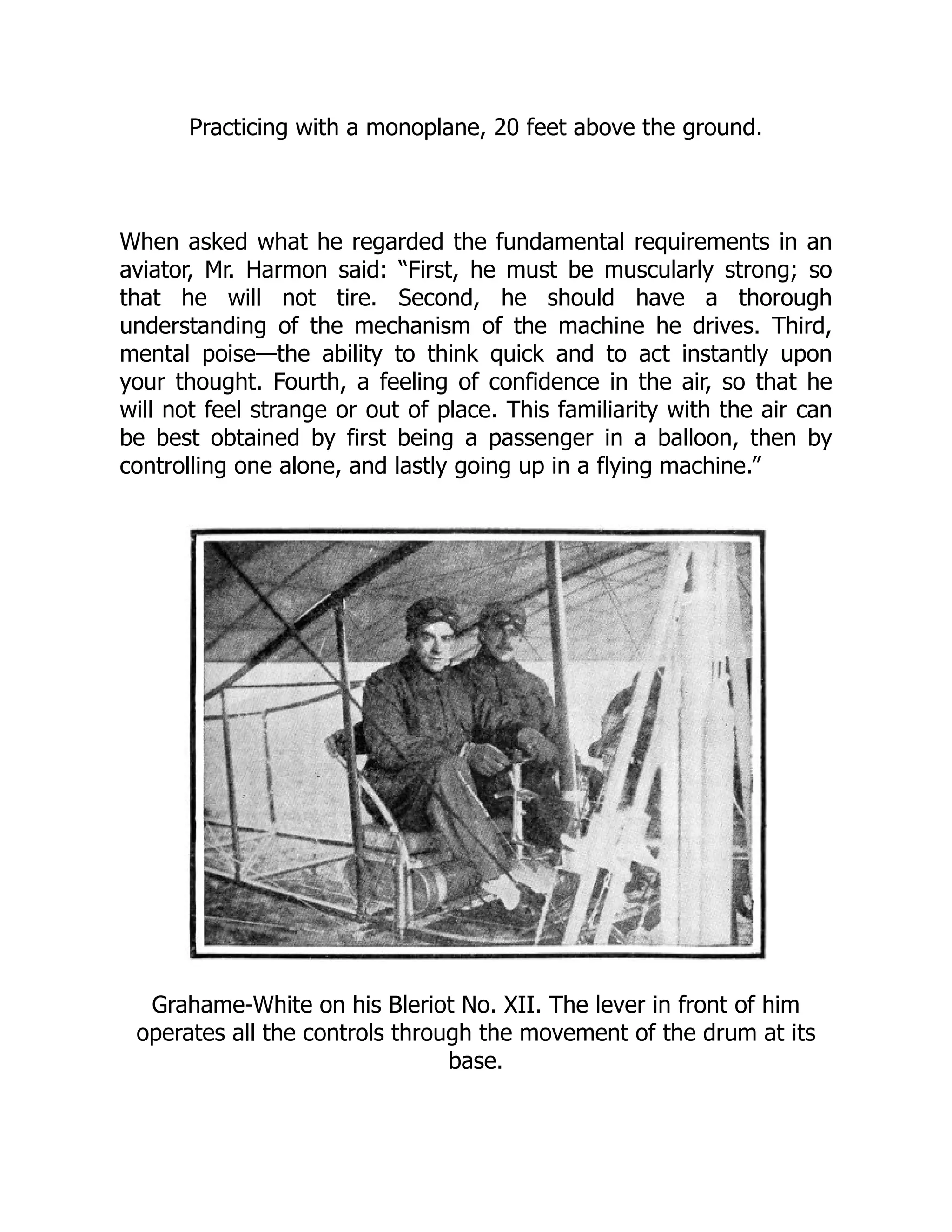
Grahame-White on his Bleriot No. XII. The lever in front of him
operates all the controls through the movement of the drum at its
base.
36.
Mr. Claude Grahame-White,the noted English aviator, has this to say
of his first experience with his big “No. XII.” Bleriot monoplane—
which differs in many important features from the “No. XI.” machine
in which M. Bleriot crossed the English Channel: “After several
disappointments, I eventually obtained the delivery of my machine in
working order.... As I had gathered a good deal of information from
watching the antics and profiting by the errors made by other
beginners on Bleriot monoplanes, I had a good idea of what not to
do when the engine was started up and we were ready for our first
trial.... It was a cold morning, but the engine started up at the first
quarter turn. After many warnings from M. Bleriot’s foreman not on
any account to accelerate my engine too much, I mounted the
machine along with my friend as passenger, and immediately gave
the word to let go, and we were soon speeding along the ground at
a good sixty kilometers (about 37 miles) per hour.... Being very
anxious to see whether the machine would lift off the ground, I gave
a slight jerk to the elevating plane, and soon felt the machine rise
into the air; but remembering the warnings of the foreman, and
being anxious not to risk breaking the machine, I closed the throttle
and contented myself with running around on the ground to
familiarize myself with the handling of the machine.... The next day
we got down to Issy about five o’clock in the morning, some two
hours before the Bleriot mechanics turned up. However, we got the
machine out, and tied it to some railings, and then I had my first
experience of starting an engine, which to a novice at first sight
appears a most hazardous undertaking; for unless the machine is
either firmly held by several men, or is strongly tied up, it has a
tendency to immediately leap forward. We successfully started the
engine, and then rigged up a leash, and when we had mounted the
machine, we let go; and before eight o’clock we had accomplished
several very successful flights, both with and against the wind.
These experiences we continued throughout the day, and by
nightfall I felt quite capable of an extended flight, if only the ground
had been large enough.... The following day M. Bleriot returned, and
he sent for me and strongly urged me not to use the aeroplane any
37.
more at Issy,as he said the ground was far too small for such a
powerful machine.”
Diagram of Bleriot monoplane, showing controlling lever L and
bell-shaped drum C, to which all controlling wires are
attached. When the bell is rocked back and forward the
elevator tips on the rear plane are moved; rocking from
side to side moves the stabilizing tips of the main plane.
Turning the bell around moves the rudder.
38.
The Marmonier gyroscopic
pendulum,devised to secure
automatic stability of aeroplanes.
The wheels are driven by the
aeroplane motor at high speed.
The pendulum rod is extended
upward above the axis and
carries a vane which is engaged
by any gust of wind from either
side of the aeroplane, tending to
tilt the pendulum, and bringing its
gyroscopic resistance into play to
warp the wings, or operate
ailerons.
The caution shown by these experienced aviators cannot be too
closely followed by a novice. These men do not say that their
assiduous practice on the ground was the fruit of timidity. On the
contrary, although they are long past the preliminary stages, their
advice to beginners is uniformly in the line of caution and thorough
practice.
39.
When the aeroplaneis steered to the left, the pendulum swings
to the right and depresses the right side of the plane, as in
(c). The reaction of the air raises the right side of the plane
until both surfaces are perpendicular to the inclined
pendulum, as in (d).
Diagrams showing action of Marmonier gyroscopic pendulum.
Even after one has become an expert, the battle is not won, by any
means. While flying in calm weather is extremely pleasurable, a
protracted flight is very fatiguing; and when it is necessary to
wrestle with gusts of high wind and fickle air currents, the strain
40.
upon the strongestnerve is a serious source of danger in that the
aviator is liable to be suddenly overcome by weariness when he
most needs to be on the alert.
In that inclined position the aeroplane makes the turn, and
when the course again becomes straight, both the
gyroscopic and centrifugal forces cease, and the pendulum
under the influence of gravity becomes vertical. In this
position it is inclined to the left with respect to the planes,
on which its effect is to depress the left wing and so right
the aeroplane, as in (e).
Diagram showing action of Marmonier gyroscopic pendulum.
Engine troubles are much fewer than they used to be, and a more
dependable form of motor relieves the mind of the aviator from such
mental disturbance. Some device in the line of a wind-shield would
be a real boon, for even in the best weather there is the ceaseless
rush of air into one’s face at 45 to 50 miles an hour. The endurance
of this for hours is of itself a tax upon the most vigorous physique.
41.
With the passingof the present spectacular stage of the art of flying
there will doubtless come a more reliable form of machine, with
corresponding relief to the operator. Automatic mechanism will
supplant the intense and continual mental attention now demanded;
and as this demand decreases, the joys of flying will be considerably
enhanced.
If, when pursuing a straight course, the aeroplane is tilted by a
sideways wind (b), the action of the pendulum as described
above restores it to an even keel, as in (a).
Diagrams showing action of Marmonier gyroscopic pendulum.
43.
W
Chapter IX.
FLYING MACHINES:HOW TO BUILD.
Santos-Dumont’s gift—La Demoiselle—Mechanical skill required
—Preparatory practice—General dimensions—The frame—
The motor—The main planes—The rudder-tail—The
propeller—Shaping the blades—Maxim’s experience—The
running gear—The controls—Scrupulous workmanship.
HEN Santos-Dumont in 1909 gave to the world the
unrestricted privilege of building monoplanes after the plans
of his famous No. 20—afterward named La Demoiselle—he gave not
only the best he knew, but as much as any one knows about the
building of flying machines. Santos-Dumont has chosen the
monoplane for himself because his long experience commends it
above others, and La Demoiselle was the crowning achievement of
years spent in the construction and operation of airships of all types.
In view of Santos-Dumont’s notable successes in his chosen field of
activity, no one will go astray in following his advice.
Of course, the possession of plans and specifications for an
aeroplane does not make any man a skilled mechanic. It is well to
understand at the start that a certain degree of mechanical ability is
required in building a machine which will be entirely safe. Nor does
the possession of a successful machine make one an aeronaut. As in
the case of bicycling, there is no substitute for actual experience,
while in the airship the art of balancing is of even greater
importance than on the bicycle.
44.
The would-be aviatoris therefore advised to put himself through a
course of training of mind and body.
Intelligent experimenting with some one of the models described in
Chapter XI. will teach much of the action of aeroplanes in calms and
when winds are blowing; and practice with an easily constructed
glider (see Chapter XII.) will give experience in balancing which will
be of the greatest value when one launches into the air for the first
time with a power-driven machine. An expert acquaintance with
gasoline motors and magnetos is a prime necessity. In short, every
bit of information on the subject of flying machines and their
operation cannot fail to be useful in some degree.
The dimensions of the various parts of the Santos-Dumont
monoplane are given on the original plans according to the metric
system. In reducing these to “long measure” inches, all
measurements have been given to the nearest eighth of an inch.
In general, we may note some of the peculiarities of La Demoiselle.
The spread of the plane is 18 feet from tip to tip, and it is 20 feet
over all from bow to stern. In height, it is about 4 feet 2 inches
when the propeller blades are in a horizontal position. The total
weight of the machine is 265 lbs., of which the engine weighs about
66 lbs. The area of the plane is 115 square feet, so that the total
weight supported by each square foot with Santos-Dumont
(weighing 110 lbs.) on board is a trifle over 3 lbs.
The frame of the body of the monoplane is largely of bamboo, the
three main poles being 2 inches in diameter at the front, and
tapering to about 1 inch at the rear. They are jointed with brass
sockets just back of the plane, for convenience of taking apart for
transportation. Two of these poles extend from the axle of the
wheels backward and slightly upward to the rudder-post. The third
extends from the middle of the plane between the wings, backward
and downward to the rudder-post. In cross-section the three form a
triangle with the apex at the top. These bamboo poles are braced
45.
about every 2feet with struts of steel tubing of oval section, and the
panels so formed are tied by diagonals of piano wire fitted with turn-
buckles to draw them taut.
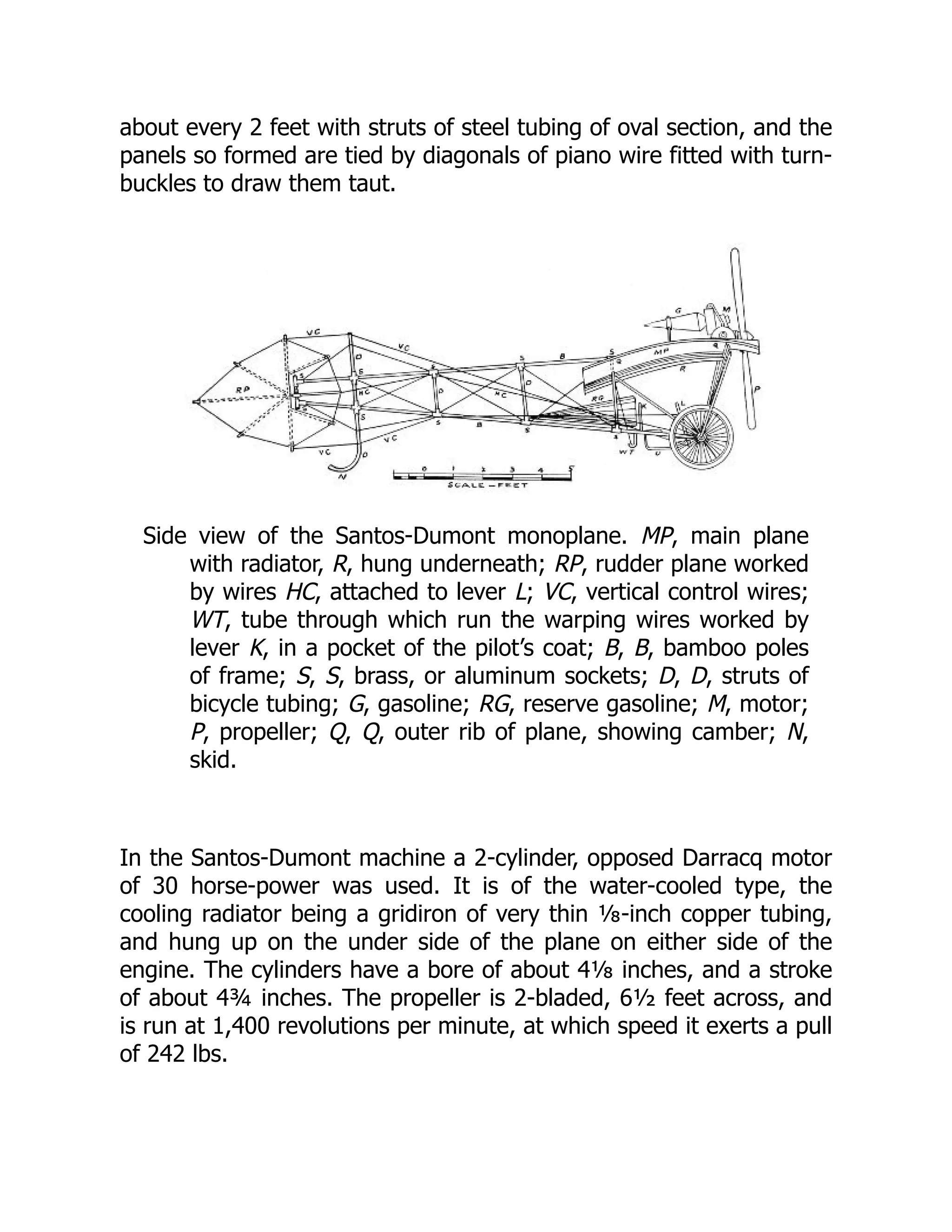
Side view of the Santos-Dumont monoplane. MP, main plane
with radiator, R, hung underneath; RP, rudder plane worked
by wires HC, attached to lever L; VC, vertical control wires;
WT, tube through which run the warping wires worked by
lever K, in a pocket of the pilot’s coat; B, B, bamboo poles
of frame; S, S, brass, or aluminum sockets; D, D, struts of
bicycle tubing; G, gasoline; RG, reserve gasoline; M, motor;
P, propeller; Q, Q, outer rib of plane, showing camber; N,
skid.
In the Santos-Dumont machine a 2-cylinder, opposed Darracq motor
of 30 horse-power was used. It is of the water-cooled type, the
cooling radiator being a gridiron of very thin ⅛-inch copper tubing,
and hung up on the under side of the plane on either side of the
engine. The cylinders have a bore of about 4⅛ inches, and a stroke
of about 4¾ inches. The propeller is 2-bladed, 6½ feet across, and
is run at 1,400 revolutions per minute, at which speed it exerts a pull
of 242 lbs.
46.
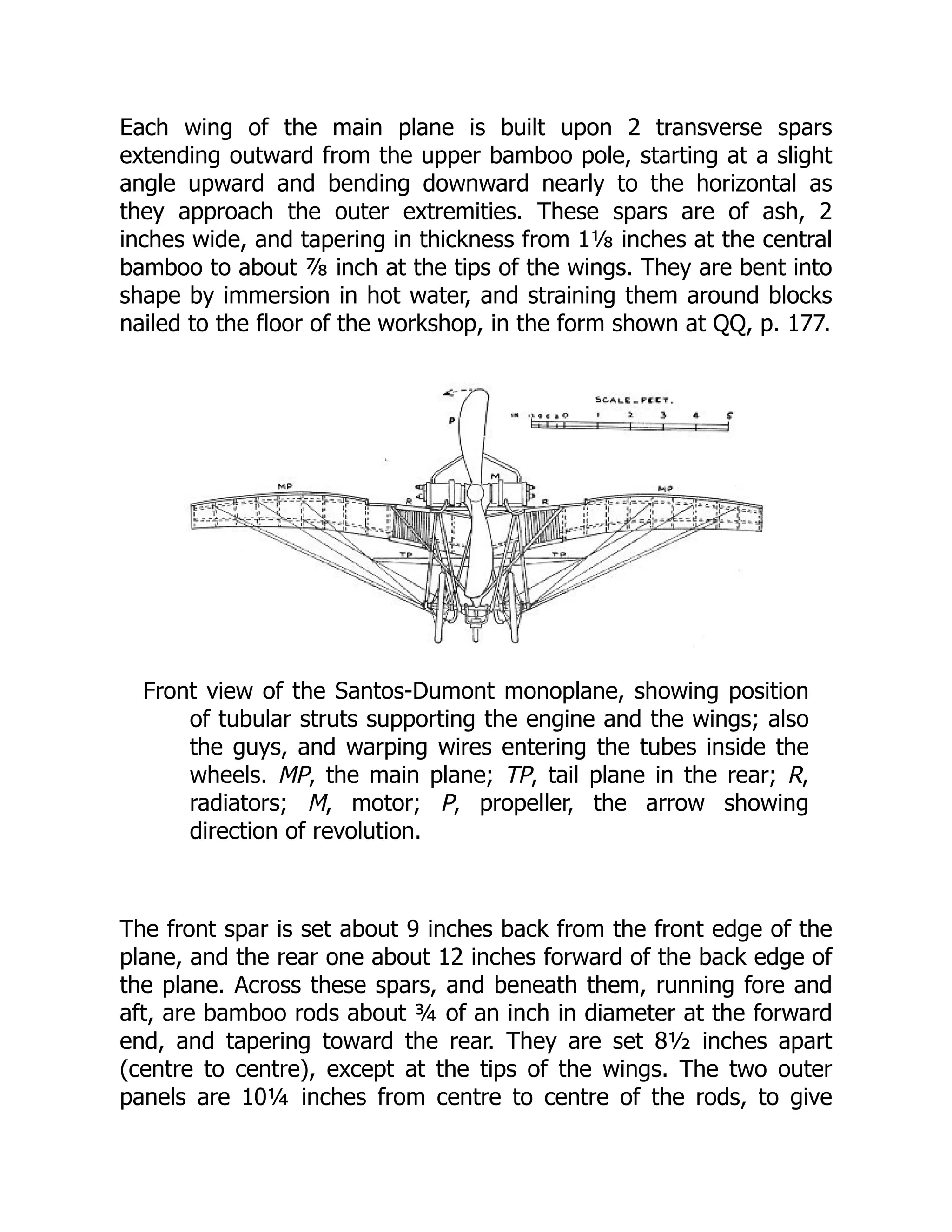
Each wing ofthe main plane is built upon 2 transverse spars
extending outward from the upper bamboo pole, starting at a slight
angle upward and bending downward nearly to the horizontal as
they approach the outer extremities. These spars are of ash, 2
inches wide, and tapering in thickness from 1⅛ inches at the central
bamboo to about ⅞ inch at the tips of the wings. They are bent into
shape by immersion in hot water, and straining them around blocks
nailed to the floor of the workshop, in the form shown at QQ, p. 177.
Front view of the Santos-Dumont monoplane, showing position
of tubular struts supporting the engine and the wings; also
the guys, and warping wires entering the tubes inside the
wheels. MP, the main plane; TP, tail plane in the rear; R,
radiators; M, motor; P, propeller, the arrow showing
direction of revolution.
The front spar is set about 9 inches back from the front edge of the
plane, and the rear one about 12 inches forward of the back edge of
the plane. Across these spars, and beneath them, running fore and
aft, are bamboo rods about ¾ of an inch in diameter at the forward
end, and tapering toward the rear. They are set 8½ inches apart
(centre to centre), except at the tips of the wings. The two outer
panels are 10¼ inches from centre to centre of the rods, to give
47.
greater elasticity inwarping. These fore-and-aft rods are 6 feet 5
inches long, except directly back of the propeller, where they are 5
feet 8 inches long; they are bound to the spars with brass wire No.
25, at the intersections. They also are bent to a curved form, as
shown in the plans, by the aid of the hot-water bath. Diagonal guys
of piano wire are used to truss the frame in two panels in each wing.
Around the outer free ends of the rods runs a piano wire No. 20,
which is let into the tips of the rods in a slot ⅜ inch deep. To
prevent the splitting of the bamboo, a turn or two of the brass wire
may be made around the rod just back of the slot; but it is much
better to provide thin brass caps for the ends of the rods, and to cut
the slots in the metal as well as in the rods. Instead of caps, ferrules
will do. When the slots are cut, let the tongue formed in the cutting
be bent down across the bamboo to form the floor to the slot, upon
which the piano wire may rest. The difference in weight and cost is
very little, and the damage that may result from a split rod may be
serious.
Plan and details of construction of La Demoiselle.
48.
After the frameof the plane is completed it is to be covered with
cloth on both sides, so as entirely to enclose the frame, except only
the tips of the rods, as shown in the plans. In the Santos-Dumont
monoplane the cloth used is of closely woven silk, but a strong,
unbleached muslin will do—the kind made especially for aeroplanes
is best.
Both upper and lower surfaces must be stretched taut, the edges
front and back being turned over the piano wire, and the wire
hemmed in. The upper and lower surfaces are then sewed together
—“through and through,” as a seamstress would say—along both
sides of each rod, so that the rods are practically in “pockets.”
Nothing must be slighted, if safety in flying is to be assured.
Sectional diagram of 2-cylinder Darracq opposed motor.
49.
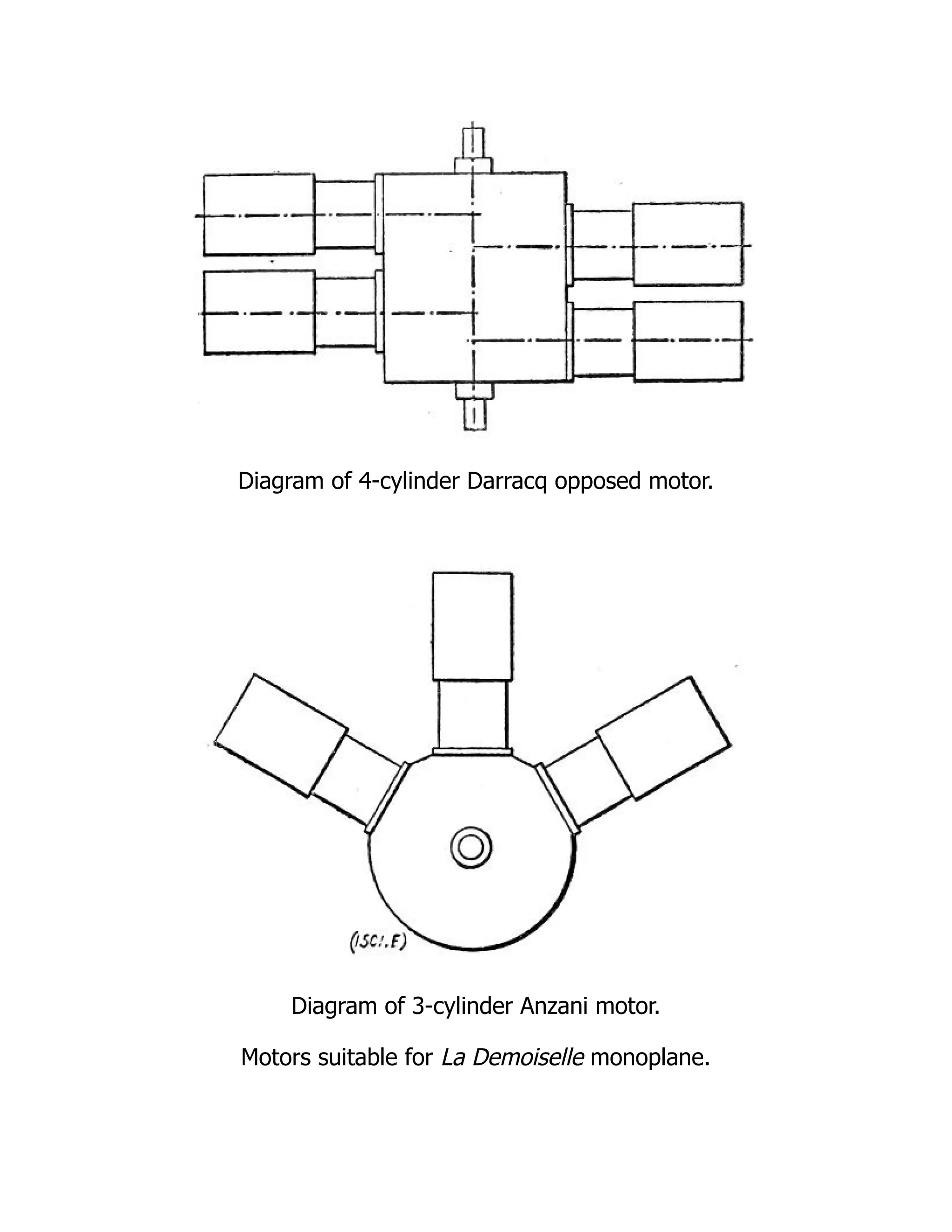
Diagram of 4-cylinderDarracq opposed motor.
Diagram of 3-cylinder Anzani motor.
Motors suitable for La Demoiselle monoplane.
50.
The tail ofthe monoplane is a rigid combination of two planes
intersecting each other at right angles along a central bamboo pole
which extends back 3 feet 5½ inches from the rudder-post, to which
it is attached by a double joint, permitting it to move upon either the
vertical or the horizontal axis.
Although this tail, or rudder, may seem at first glance somewhat
complicated in the plans, it will not be found so if the frame of the
upright or vertical plane be first constructed, and that of the level or
horizontal plane afterward built fast to it at right angles.
As with the main plane, the tail is to be covered on both sides with
cloth, the vertical part first; the horizontal halves on either side so
covered that the cloth of the latter may be sewed above and below
the central pole. All of the ribs in the tail are to be stitched in with
“pockets,” as directed for the rods of the main plane.
The construction of the motor is possible to an expert machinist
only, and the aeroplane builder will save time and money by buying
his engine from a reliable maker. It is not necessary to send to
France for a Darracq motor. Any good gasoline engine of equal
power, and about the same weight, will serve the purpose.
The making of the propeller is practicable for a careful workman.
The illustrations will give a better idea than words of how it should
be done. It should be remembered, however, that the safety of the
aviator depends as much upon the propeller as upon any other part
of the machine. The splitting of the blades when in motion has been
the cause of serious accidents. The utmost care, therefore, should
be exercised in the selection of the wood, and in the glueing of the
several sections into one solid mass, allowing the work to dry
thoroughly under heavy pressure.
51.
Diagram showing howthe layers of wood are placed for
glueing: A, at the hub; B, half way to the tip of the blade;
C, at the tip. The dotted lines show the form of the blade at
these points.
The forming of the blades requires a good deal of skill, and some
careful preliminary study. It is apparent that the speed of a point at
the tip of a revolving blade is much greater than that of a point near
the hub, for it traverses a larger circle in the same period of time.
But if the propeller is to do effective work without unequal strain,
the twist in the blade must be such that each point in the length of
the blade is exerting an equal pull on the air. It is necessary,
therefore, that the slower-moving part of the blade, near the hub, or
axis, shall cut “deeper” into the air than the more swiftly moving tip
of the blade. Consequently the blade becomes continually “flatter”
(approaching the plane in which it revolves) as we work from the
hub outward toward the tip. This “flattening” is well shown in the
nearly finished blade clamped to the bench at the right of the
illustration—which shows a four-bladed propeller, instead of the two-
bladed type needed for the monoplane.
The propeller used for propulsion in air differs from the propeller-
wheel used for ships in water, in that the blades are curved laterally;
the forward face of the blade being convex, and the rearward face
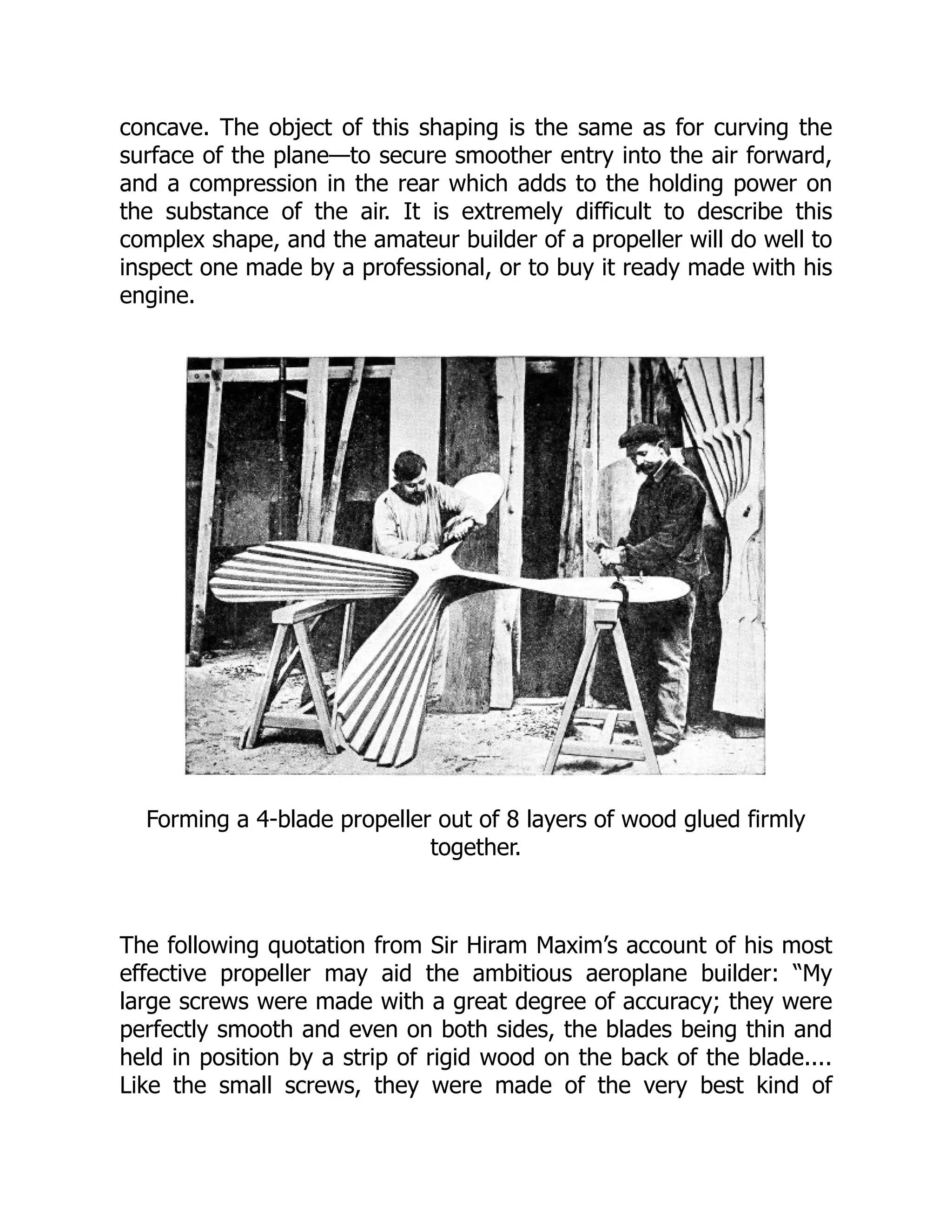
52.
concave. The objectof this shaping is the same as for curving the
surface of the plane—to secure smoother entry into the air forward,
and a compression in the rear which adds to the holding power on
the substance of the air. It is extremely difficult to describe this
complex shape, and the amateur builder of a propeller will do well to
inspect one made by a professional, or to buy it ready made with his
engine.
Forming a 4-blade propeller out of 8 layers of wood glued firmly
together.
The following quotation from Sir Hiram Maxim’s account of his most
effective propeller may aid the ambitious aeroplane builder: “My
large screws were made with a great degree of accuracy; they were
perfectly smooth and even on both sides, the blades being thin and
held in position by a strip of rigid wood on the back of the blade....
Like the small screws, they were made of the very best kind of
53.
seasoned American whitepine, and when finished were varnished on
both sides with hot glue. When this was thoroughly dry, they were
sand-papered again, and made perfectly smooth and even. The
blades were then covered with strong Irish linen fabric of the
smoothest and best make. Glue was used for attaching the fabric,
and when dry another coat of glue was applied, the surface rubbed
down again, and then painted with zinc white in the ordinary way
and varnished. These screws worked exceedingly well.”
The covering of the blades with linen glued fast commends itself to
the careful workman as affording precaution against the splintering
of the blades when in rapid motion. Some propellers have their
wooden blades encased with thin sheet aluminum to accomplish the
same purpose, but for the amateur builder linen is far easier to
apply.
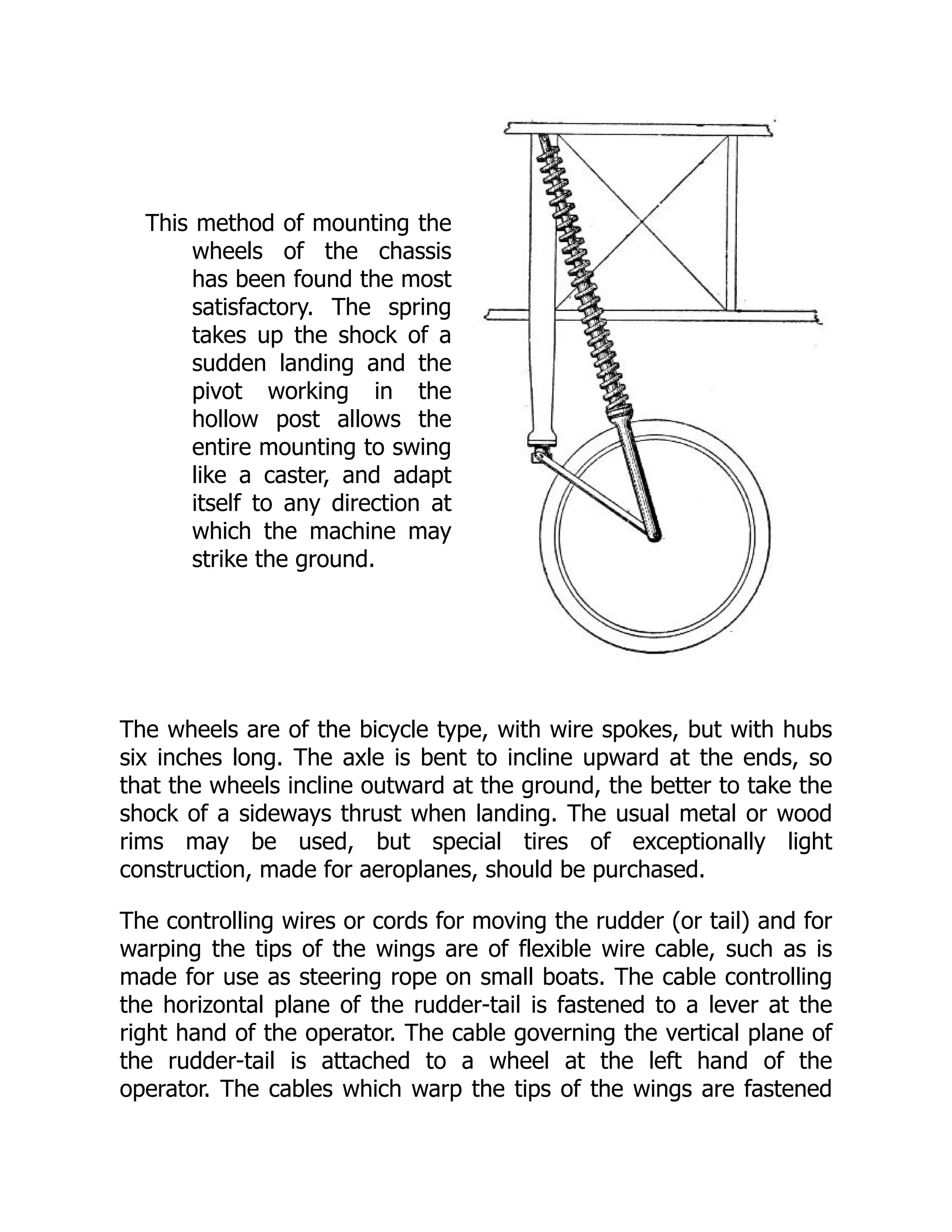
54.
This method ofmounting the
wheels of the chassis
has been found the most
satisfactory. The spring
takes up the shock of a
sudden landing and the
pivot working in the
hollow post allows the
entire mounting to swing
like a caster, and adapt
itself to any direction at
which the machine may
strike the ground.
The wheels are of the bicycle type, with wire spokes, but with hubs
six inches long. The axle is bent to incline upward at the ends, so
that the wheels incline outward at the ground, the better to take the
shock of a sideways thrust when landing. The usual metal or wood
rims may be used, but special tires of exceptionally light
construction, made for aeroplanes, should be purchased.
The controlling wires or cords for moving the rudder (or tail) and for
warping the tips of the wings are of flexible wire cable, such as is
made for use as steering rope on small boats. The cable controlling
the horizontal plane of the rudder-tail is fastened to a lever at the
right hand of the operator. The cable governing the vertical plane of
the rudder-tail is attached to a wheel at the left hand of the
operator. The cables which warp the tips of the wings are fastened
55.
to a leverwhich projects upward just back of the operator’s seat,
and which is slipped into a long pocket sewed to the back of his
coat, so that the swaying of his body in response to the fling of the
tipping machine tends to restore it to an even keel. Springs are
attached to all of these controlling wires, strong enough to bring
them back to a normal position when the operator removes his
hands from the steering apparatus.
The brass sockets used in connecting the tubular struts to the main
bamboos and the rudder-post, and in fastening the axle of the
wheels to the lower bamboos and elsewhere, should be thoroughly
made and brazed by a good mechanic, for no one should risk the
chance of a faulty joint at a critical spot, when an accident may
mean the loss of life.
56.
Welcome to ourwebsite – the ideal destination for book lovers and
knowledge seekers. With a mission to inspire endlessly, we offer a
vast collection of books, ranging from classic literary works to
specialized publications, self-development books, and children's
literature. Each book is a new journey of discovery, expanding
knowledge and enriching the soul of the reade
Our website is not just a platform for buying books, but a bridge
connecting readers to the timeless values of culture and wisdom. With
an elegant, user-friendly interface and an intelligent search system,
we are committed to providing a quick and convenient shopping
experience. Additionally, our special promotions and home delivery
services ensure that you save time and fully enjoy the joy of reading.
Let us accompany you on the journey of exploring knowledge and
personal growth!
ebookultra.com