

Arcan, Jeanlyn
  Forcadilla, Andrea Lyn
      Macalino, Mitch
       Salaysay, Lara
II - 23 BSE Social Science
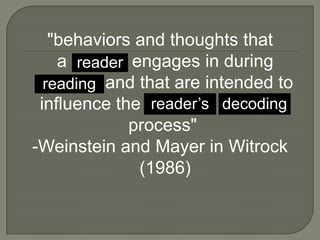
"behaviors and thoughts that
     a learner engages in during
        reader
 learning and that are intended to
   reading
                  reader’s decoding
  influence the learner's encoding
               process"
-Weinstein and Mayer in Witrock
                (1986)
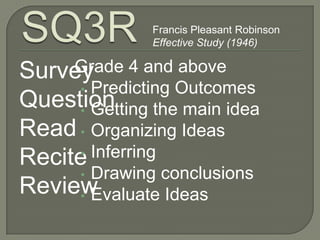
Francis Pleasant Robinson
               Effective Study (1946)

     Grade 4 and above
Survey
     • Predicting Outcomes
Question
     • Getting the main idea
Read • Organizing Ideas
     • Inferring
Recite
     • Drawing conclusions
Review
     • Evaluate Ideas
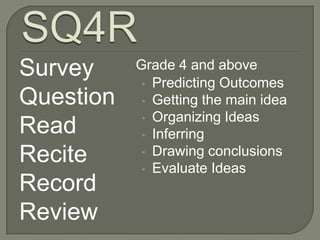
Survey     Grade 4 and above
            • Predicting Outcomes
Question    • Getting the main idea
            • Organizing Ideas
Read        • Inferring

Recite      • Drawing conclusions
            • Evaluate Ideas
Record
Review
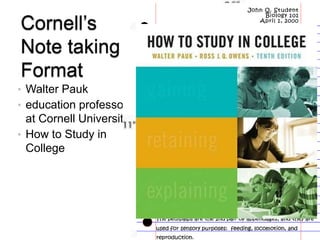
• Walter Pauk
• education professor
  at Cornell University
• How to Study in
  College
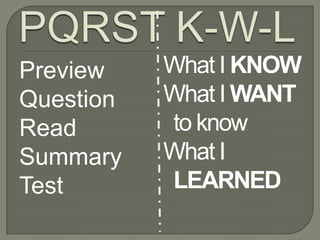
Preview    What I KNOW
Question   What I WANT
Read       to know
Summary    What I
Test       LEARNED
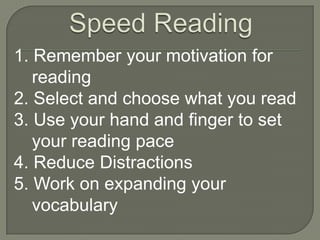
1. Remember your motivation for
   reading
2. Select and choose what you read
3. Use your hand and finger to set
   your reading pace
4. Reduce Distractions
5. Work on expanding your
   vocabulary
6. Read alone
7. Highlight and underline only
   important words
8. Write down your thoughts as your
   are reading
9. Take breaks when necessary

       http://goo.gl/Oh98J
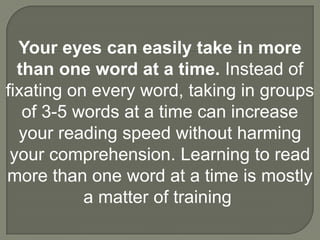
Your eyes can easily take in more
  than one word at a time. Instead of
fixating on every word, taking in groups
   of 3-5 words at a time can increase
  your reading speed without harming
 your comprehension. Learning to read
more than one word at a time is mostly
           a matter of training
Your eyes can        reading speed
easily take in       without harming
more than one        your
word      at     a   comprehension.
time. Instead of     Learning to read
fixating on every    more than one
word, taking in      word at a time is
groups    of   3-5   mostly a matter
words at a time      of training
can increase your
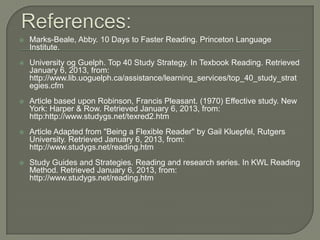
   Marks-Beale, Abby. 10 Days to Faster Reading. Princeton Language
    Institute.
   University og Guelph. Top 40 Study Strategy. In Texbook Reading. Retrieved
    January 6, 2013, from:
    http://www.lib.uoguelph.ca/assistance/learning_services/top_40_study_strat
    egies.cfm
   Article based upon Robinson, Francis Pleasant. (1970) Effective study. New
    York: Harper & Row. Retrieved January 6, 2013, from:
    http:http://www.studygs.net/texred2.htm
   Article Adapted from "Being a Flexible Reader" by Gail Kluepfel, Rutgers
    University. Retrieved January 6, 2013, from:
    http://www.studygs.net/reading.htm
   Study Guides and Strategies. Reading and research series. In KWL Reading
    Method. Retrieved January 6, 2013, from:
    http://www.studygs.net/reading.htm

Study Strategies

  • 1.
    Arcan, Jeanlyn Forcadilla, Andrea Lyn Macalino, Mitch Salaysay, Lara II - 23 BSE Social Science
  • 2.
    "behaviors and thoughtsthat a learner engages in during reader learning and that are intended to reading reader’s decoding influence the learner's encoding process" -Weinstein and Mayer in Witrock (1986)
  • 3.
    Francis Pleasant Robinson Effective Study (1946) Grade 4 and above Survey • Predicting Outcomes Question • Getting the main idea Read • Organizing Ideas • Inferring Recite • Drawing conclusions Review • Evaluate Ideas
  • 5.
    Survey Grade 4 and above • Predicting Outcomes Question • Getting the main idea • Organizing Ideas Read • Inferring Recite • Drawing conclusions • Evaluate Ideas Record Review
  • 6.
    • Walter Pauk •education professor at Cornell University • How to Study in College
  • 7.
    Preview What I KNOW Question What I WANT Read to know Summary What I Test LEARNED
  • 8.
    1. Remember yourmotivation for reading 2. Select and choose what you read 3. Use your hand and finger to set your reading pace 4. Reduce Distractions 5. Work on expanding your vocabulary
  • 9.
    6. Read alone 7.Highlight and underline only important words 8. Write down your thoughts as your are reading 9. Take breaks when necessary http://goo.gl/Oh98J
  • 10.
    Your eyes caneasily take in more than one word at a time. Instead of fixating on every word, taking in groups of 3-5 words at a time can increase your reading speed without harming your comprehension. Learning to read more than one word at a time is mostly a matter of training
  • 11.
    Your eyes can reading speed easily take in without harming more than one your word at a comprehension. time. Instead of Learning to read fixating on every more than one word, taking in word at a time is groups of 3-5 mostly a matter words at a time of training can increase your
  • 13.
    Marks-Beale, Abby. 10 Days to Faster Reading. Princeton Language Institute.  University og Guelph. Top 40 Study Strategy. In Texbook Reading. Retrieved January 6, 2013, from: http://www.lib.uoguelph.ca/assistance/learning_services/top_40_study_strat egies.cfm  Article based upon Robinson, Francis Pleasant. (1970) Effective study. New York: Harper & Row. Retrieved January 6, 2013, from: http:http://www.studygs.net/texred2.htm  Article Adapted from "Being a Flexible Reader" by Gail Kluepfel, Rutgers University. Retrieved January 6, 2013, from: http://www.studygs.net/reading.htm  Study Guides and Strategies. Reading and research series. In KWL Reading Method. Retrieved January 6, 2013, from: http://www.studygs.net/reading.htm