International Research Journal of Engineering and Technology (IRJET) e-ISSN: 2395-0056
Volume: 04 Issue: 10 | Oct -2017 www.irjet.net p-ISSN: 2395-0072
© 2017, IRJET | Impact Factor value: 6.171 | ISO 9001:2008 Certified Journal | Page 949
STUDY ON DYNAMIC BEHAVIOUR OF HIGH RISER DUAL SYSTEM WITH
IN-PLANE DISCONTINUITY IN VERTICAL ELEMENTS RESISTING
LATERAL LOADS
Manasa B R1, M R Suresh2
1Post Graduate student in Structural Engineering, Dr. AIT, Bengaluru, 560056, Karnataka, India.
2 Associate Professor, Dept. of Civil Engineering, Dr. AIT, Bengaluru, 560056, Karnataka, India.
---------------------------------------------------------------------***---------------------------------------------------------------------
Abstract - The purpose of the existent examination is to
conduct Equivalent Static analysis and Time history Analysis
(THA) of vertically irregular RC building frames and to
conduct the seismic analysis that relates to Equivalent static
analysis and Time history analysis. Five categories of
irregularities namely mass irregularity, stiffness irregularity,
vertical geometry irregularity. In-Plane Discontinuity in
Vertical Elements Resisting Lateral Force andDiscontinuityin
Capacity were contemplated.
1. INTRODUCTION
In the course of seismic tremors, failure of structure evolves
at factors of weak point. This weak spot arises due to
discontinuity in mass, stiffness, and geometry of the
structure. the systems having this discontinuity are termed
as irregular structures. Irregular systems make a
contribution to a huge part of city infrastructure. Vertical
irregularities are one of the major reasons of disasters of
structures in the course of earthquakes. For example
systems with soft storey had been the maximum exquisite
structures which collapsed. So, the effect of vertical
irregularities inside the seismic overall performance of
structures will become definitely important. Height-wise
adjustments in stiffness and mass render the dynamic
characteristics of these buildings distinct from the normal
building. When such structures are builtinexcessiveseismic
zones, the evaluation and design turns into extra
complicated.IS 1893 defines vertical anomalies.
1.1 INPLANE DISCONTINUITY
In an in-plane discontinuity ,in-plane offset of the lateral
force resisting elements will be greater than the length of
those elements.
1.2 DUAL SYSTEM
A dual system is a structural system in actual fact whole
frame delivers sustenance for gravity loads, and conflicts
lateral loads afforded by a particularly detailed moment-
resisting frame and shear walls or bracedframes.Bothshear
walls and frames play a part in resisting the lateral loads
ensuing from earthquakes or wind or storms, and the
portion of the forces resisted by each one be contingent on
its rigidity, modulus of elasticity and its ductility, and the
prospect to develop plastic hinges in its parts. The moment-
resisting frame may be either steel or concrete, but concrete
intermediate frames cannot be used in seismic zones 3 or 4.
1.3 OBJECTIVES
1 To study the consequence of in-plane discontinuity of
vertical components resisting lateral loads, shear walls
are reflected as vertical elements.
2. In-plane discontinuity are well thought-out as per the
provisions given in IS 1893-2002, norms for seismic
resistant design of structure foralteredheightsforzone
5.
3. Shear walls in ground floor and upper floors consists of
in-plane discontinuity, and influence of this in-plane
discontinuity on conduct of high rise RC structure is
studied in assessment with regular RC frame without
in-plane discontinuity.
4. Equivalent Static and time historyanalysisisconducted
to find out the responses using ETABS Software
1.4 METHODOLOGY
1. RCC building with square planoftotal measurement
of 40 m × 40 m ,is studied currently.
2. Three forms of RCC structures are considered. One
regular RC frame, second shear wall frame and
third shear wall with in-plane discontinuity.
3. The above 3 structure aremodeledandanalyzedfor
three diverse heights of 20, 40 and 60 storey, each
storey being 3 m in height.
4. Lateral loads as per IS 1893- 2016arewell-thought-
out, consigned and responses are tabulated,graphs
are plotted.
5. Dynamic time history outcomes are tabulated.
6. Lastly, inferences are made.
International Research Journal of Engineering and Technology (IRJET) e-ISSN: 2395-0056
Volume: 04 Issue: 10 | Oct -2017 www.irjet.net p-ISSN: 2395-0072
© 2017, IRJET | Impact Factor value: 6.171 | ISO 9001:2008 Certified Journal | Page 950
2. MODELLING AND ANALYSIS
The common method of modeling the regular structure is
illustrated. The same modeling practice employed to model
the different other configurations, to study the seismic
performance of various structural configurationofstructure.
 Model 1: Regular building. – 20 storey
 Model 2: Regular building with Shear wall – 20
storey
 Model 3: Regular building with Shear wall and in
plane discontinuity – 20 storey.
 Model 4: Regular building – 40 storey.
 Model 5: Regular building with Shear wall – 40
storey.
 Model 6: Regular building with Shear wall and in
plane discontinuity – 40 storey.
 Model 7: Regular building. – 60 storey.
 Model 8: Regular building with Shear wall – 60
storey.
 Model 9: Regular building with Shear wall and in
plane discontinuity – 60 storey.
2.1 MATERIAL PROPERTIES
 Grade of reinforcing steel: FE 500
 Characteristic strength of concrete, fck= 40 MPa
 Ultimate strain in bending, Ƹcu =l0.0035
2.2 MODEL GEOMETRY
 Number of storeys = 20.
 Number of bays along X Direction = 8 Bays,
Y Direction = 8 Bays,
 Storey height = 3.0 meters at Ground Floor,
Remaining Floors.
 Bay width along X Direction = 5 m,
Y Direction = 5 m.
 Similar procedure is used to model with different
storey height, that is building with 40 and 60
storey.
2.3 PLAN AND VIEW OF BUILDING
Fig-1: Plan View of Building type-1
Fig- 2: 3D View of Type –1
International Research Journal of Engineering and Technology (IRJET) e-ISSN: 2395-0056
Volume: 04 Issue: 10 | Oct -2017 www.irjet.net p-ISSN: 2395-0072
© 2017, IRJET | Impact Factor value: 6.171 | ISO 9001:2008 Certified Journal | Page 951
Fig-3: Plan View of Building type-2
Fig- 4: 3D View of Type –2
Fig-5: Plan View of Building type -3
Fig-6: 3D View of Type –3
3. RESULTS
3.1 MODAL ANALYSIS
Chart -1: Mode v/s time period 20 storey
Chart -2: Mode v/s time period 40 storey
International Research Journal of Engineering and Technology (IRJET) e-ISSN: 2395-0056
Volume: 04 Issue: 10 | Oct -2017 www.irjet.net p-ISSN: 2395-0072
© 2017, IRJET | Impact Factor value: 6.171 | ISO 9001:2008 Certified Journal | Page 952
Chart-3: Mode V/s Time period 60 Storey
3.2 EQUIVALENT STATIC ANALYSIS
3.2.1 STOREY SHEAR
Chart-4: Storey shear– 20 Storey
Chart-5: Storey shear– 40 Storey
Chart-6: Storey shear– 60 Storey
3.3 STOREY DISPLACEMENTS
Chart-7: Storey v/s Displacements – 20 Storey
Chart-8: Storey v/s Displacements – 40 Storey
International Research Journal of Engineering and Technology (IRJET) e-ISSN: 2395-0056
Volume: 04 Issue: 10 | Oct -2017 www.irjet.net p-ISSN: 2395-0072
© 2017, IRJET | Impact Factor value: 6.171 | ISO 9001:2008 Certified Journal | Page 953
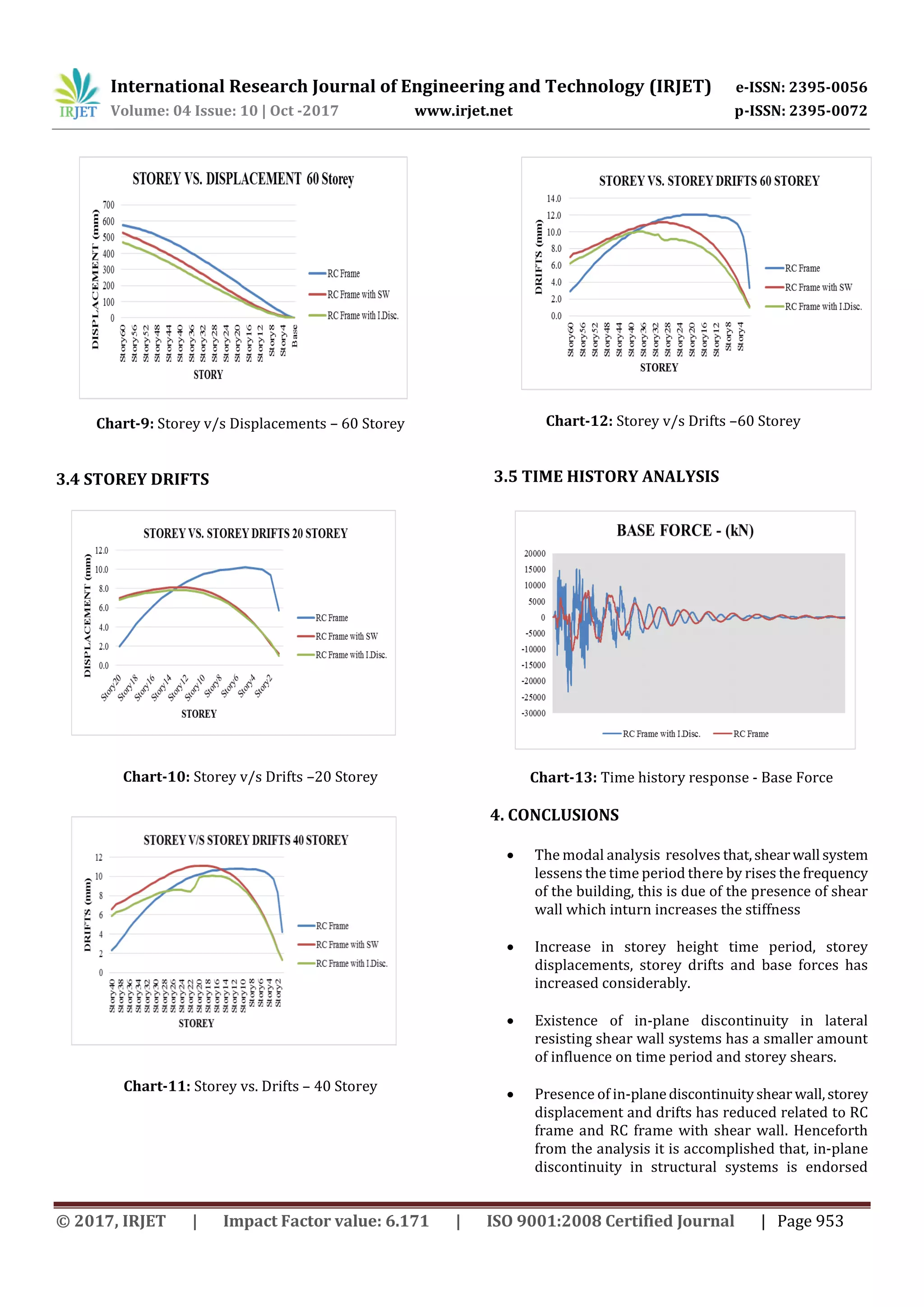
Chart-9: Storey v/s Displacements – 60 Storey
3.4 STOREY DRIFTS
Chart-10: Storey v/s Drifts –20 Storey
Chart-11: Storey vs. Drifts – 40 Storey
Chart-12: Storey v/s Drifts –60 Storey
3.5 TIME HISTORY ANALYSIS
 The modal analysis resolves that,shearwall system
lessens the time period there by rises the frequency
of the building, this is due of the presence of shear
wall which inturn increases the stiffness
 Increase in storey height time period, storey
displacements, storey drifts and base forces has
increased considerably.
 Existence of in-plane discontinuity in lateral
resisting shear wall systems has a smaller amount
of influence on time period and storey shears.
 Presence of in-planediscontinuityshear wall,storey
displacement and drifts has reduced related to RC
frame and RC frame with shear wall. Henceforth
from the analysis it is accomplished that, in-plane
discontinuity in structural systems is endorsed
Chart-13: Time history response - Base Force
4. CONCLUSIONS
International Research Journal of Engineering and Technology (IRJET) e-ISSN: 2395-0056
Volume: 04 Issue: 10 | Oct -2017 www.irjet.net p-ISSN: 2395-0072
© 2017, IRJET | Impact Factor value: 6.171 | ISO 9001:2008 Certified Journal | Page 954
where shear wall cannot be arranged for from the
foundation level.
 Considerable increase in columnandbeamforcesin
shear wall and in-plane discontinuity structures.
 The time history analysis results infers that,
Reinforced concrete frame with in-plane
discontinuity structure displays enhanced
performance in decreasing the peak displacement
up to 40 storey, above 40 storey RC frame with
shear wall systems improved performanceinfalling
the peak displacements. Hereafter it can be
determined that, above 40 storey, in-plane
discontinuity structure will have a lesser amountof
stability compared to shear wall structures.
5. REFERENCES
[1]. Sarkar P, Prasad A Meher, Menon Devdas, “Vertical
geometric irregularity in stepped building frames ”,
,Engineering Structures 32, (2010) , page no.2175–2182.
[2]. Karavallis, Bazeos and Beskos, “Estimation of seismic
inelastic deformation demands in plane steel MRF with
vertical mass irregularities ”,Engineering Structures 30,
(2008), page no. 3265–3275.
[3]. ChintanapakdeeC.andChopra A.K.,“Seismic Responseof
Vertically Irregular Frames: Response History and Modal
Pushover Analyses”, Journal of Structural Engineering,
ASCE, Vol. 130, (2004), issue 8, page no. 1177-1185.
4]. Das, S. and Nau, J.M, “Seismic Design Aspects of Vertically
Irregular Reinforced Concrete Buildings”,Earthquake
Spectra, Vol. 19, (2003), No. 3, page no. 455-477.
[5].Fragiadakis, M., Vamvatsikos, D. and Papadrakakis, M,
“Evaluation of the Influence of Vertical Irregularities on the
Seismic Performance of a Nine-Storey Steel Frame”,
Earthquake Engineering & Structural Dynamics, Vol. 35,
(2006) ,No. 12, page no. 1489-1509.
[6].Ruiz, S.E. and Diederich, R, “The Mexico Earthquake of
September 19, 1985 – The Seismic PerformanceofBuildings
with Weak First Storey”, Earthquake Spectra, Vol. 5, (1989),
No. 1, page no. 89-102.

Study on Dynamic Behaviour of High Riser Dual System with In-Plane Discontinuity in Vertical Elements Resisting Lateral Loads

  • 1.
    International Research Journalof Engineering and Technology (IRJET) e-ISSN: 2395-0056 Volume: 04 Issue: 10 | Oct -2017 www.irjet.net p-ISSN: 2395-0072 © 2017, IRJET | Impact Factor value: 6.171 | ISO 9001:2008 Certified Journal | Page 949 STUDY ON DYNAMIC BEHAVIOUR OF HIGH RISER DUAL SYSTEM WITH IN-PLANE DISCONTINUITY IN VERTICAL ELEMENTS RESISTING LATERAL LOADS Manasa B R1, M R Suresh2 1Post Graduate student in Structural Engineering, Dr. AIT, Bengaluru, 560056, Karnataka, India. 2 Associate Professor, Dept. of Civil Engineering, Dr. AIT, Bengaluru, 560056, Karnataka, India. ---------------------------------------------------------------------***--------------------------------------------------------------------- Abstract - The purpose of the existent examination is to conduct Equivalent Static analysis and Time history Analysis (THA) of vertically irregular RC building frames and to conduct the seismic analysis that relates to Equivalent static analysis and Time history analysis. Five categories of irregularities namely mass irregularity, stiffness irregularity, vertical geometry irregularity. In-Plane Discontinuity in Vertical Elements Resisting Lateral Force andDiscontinuityin Capacity were contemplated. 1. INTRODUCTION In the course of seismic tremors, failure of structure evolves at factors of weak point. This weak spot arises due to discontinuity in mass, stiffness, and geometry of the structure. the systems having this discontinuity are termed as irregular structures. Irregular systems make a contribution to a huge part of city infrastructure. Vertical irregularities are one of the major reasons of disasters of structures in the course of earthquakes. For example systems with soft storey had been the maximum exquisite structures which collapsed. So, the effect of vertical irregularities inside the seismic overall performance of structures will become definitely important. Height-wise adjustments in stiffness and mass render the dynamic characteristics of these buildings distinct from the normal building. When such structures are builtinexcessiveseismic zones, the evaluation and design turns into extra complicated.IS 1893 defines vertical anomalies. 1.1 INPLANE DISCONTINUITY In an in-plane discontinuity ,in-plane offset of the lateral force resisting elements will be greater than the length of those elements. 1.2 DUAL SYSTEM A dual system is a structural system in actual fact whole frame delivers sustenance for gravity loads, and conflicts lateral loads afforded by a particularly detailed moment- resisting frame and shear walls or bracedframes.Bothshear walls and frames play a part in resisting the lateral loads ensuing from earthquakes or wind or storms, and the portion of the forces resisted by each one be contingent on its rigidity, modulus of elasticity and its ductility, and the prospect to develop plastic hinges in its parts. The moment- resisting frame may be either steel or concrete, but concrete intermediate frames cannot be used in seismic zones 3 or 4. 1.3 OBJECTIVES 1 To study the consequence of in-plane discontinuity of vertical components resisting lateral loads, shear walls are reflected as vertical elements. 2. In-plane discontinuity are well thought-out as per the provisions given in IS 1893-2002, norms for seismic resistant design of structure foralteredheightsforzone 5. 3. Shear walls in ground floor and upper floors consists of in-plane discontinuity, and influence of this in-plane discontinuity on conduct of high rise RC structure is studied in assessment with regular RC frame without in-plane discontinuity. 4. Equivalent Static and time historyanalysisisconducted to find out the responses using ETABS Software 1.4 METHODOLOGY 1. RCC building with square planoftotal measurement of 40 m × 40 m ,is studied currently. 2. Three forms of RCC structures are considered. One regular RC frame, second shear wall frame and third shear wall with in-plane discontinuity. 3. The above 3 structure aremodeledandanalyzedfor three diverse heights of 20, 40 and 60 storey, each storey being 3 m in height. 4. Lateral loads as per IS 1893- 2016arewell-thought- out, consigned and responses are tabulated,graphs are plotted. 5. Dynamic time history outcomes are tabulated. 6. Lastly, inferences are made.
  • 2.
    International Research Journalof Engineering and Technology (IRJET) e-ISSN: 2395-0056 Volume: 04 Issue: 10 | Oct -2017 www.irjet.net p-ISSN: 2395-0072 © 2017, IRJET | Impact Factor value: 6.171 | ISO 9001:2008 Certified Journal | Page 950 2. MODELLING AND ANALYSIS The common method of modeling the regular structure is illustrated. The same modeling practice employed to model the different other configurations, to study the seismic performance of various structural configurationofstructure.  Model 1: Regular building. – 20 storey  Model 2: Regular building with Shear wall – 20 storey  Model 3: Regular building with Shear wall and in plane discontinuity – 20 storey.  Model 4: Regular building – 40 storey.  Model 5: Regular building with Shear wall – 40 storey.  Model 6: Regular building with Shear wall and in plane discontinuity – 40 storey.  Model 7: Regular building. – 60 storey.  Model 8: Regular building with Shear wall – 60 storey.  Model 9: Regular building with Shear wall and in plane discontinuity – 60 storey. 2.1 MATERIAL PROPERTIES  Grade of reinforcing steel: FE 500  Characteristic strength of concrete, fck= 40 MPa  Ultimate strain in bending, Ƹcu =l0.0035 2.2 MODEL GEOMETRY  Number of storeys = 20.  Number of bays along X Direction = 8 Bays, Y Direction = 8 Bays,  Storey height = 3.0 meters at Ground Floor, Remaining Floors.  Bay width along X Direction = 5 m, Y Direction = 5 m.  Similar procedure is used to model with different storey height, that is building with 40 and 60 storey. 2.3 PLAN AND VIEW OF BUILDING Fig-1: Plan View of Building type-1 Fig- 2: 3D View of Type –1
  • 3.
    International Research Journalof Engineering and Technology (IRJET) e-ISSN: 2395-0056 Volume: 04 Issue: 10 | Oct -2017 www.irjet.net p-ISSN: 2395-0072 © 2017, IRJET | Impact Factor value: 6.171 | ISO 9001:2008 Certified Journal | Page 951 Fig-3: Plan View of Building type-2 Fig- 4: 3D View of Type –2 Fig-5: Plan View of Building type -3 Fig-6: 3D View of Type –3 3. RESULTS 3.1 MODAL ANALYSIS Chart -1: Mode v/s time period 20 storey Chart -2: Mode v/s time period 40 storey
  • 4.
    International Research Journalof Engineering and Technology (IRJET) e-ISSN: 2395-0056 Volume: 04 Issue: 10 | Oct -2017 www.irjet.net p-ISSN: 2395-0072 © 2017, IRJET | Impact Factor value: 6.171 | ISO 9001:2008 Certified Journal | Page 952 Chart-3: Mode V/s Time period 60 Storey 3.2 EQUIVALENT STATIC ANALYSIS 3.2.1 STOREY SHEAR Chart-4: Storey shear– 20 Storey Chart-5: Storey shear– 40 Storey Chart-6: Storey shear– 60 Storey 3.3 STOREY DISPLACEMENTS Chart-7: Storey v/s Displacements – 20 Storey Chart-8: Storey v/s Displacements – 40 Storey
  • 5.
    International Research Journalof Engineering and Technology (IRJET) e-ISSN: 2395-0056 Volume: 04 Issue: 10 | Oct -2017 www.irjet.net p-ISSN: 2395-0072 © 2017, IRJET | Impact Factor value: 6.171 | ISO 9001:2008 Certified Journal | Page 953 Chart-9: Storey v/s Displacements – 60 Storey 3.4 STOREY DRIFTS Chart-10: Storey v/s Drifts –20 Storey Chart-11: Storey vs. Drifts – 40 Storey Chart-12: Storey v/s Drifts –60 Storey 3.5 TIME HISTORY ANALYSIS  The modal analysis resolves that,shearwall system lessens the time period there by rises the frequency of the building, this is due of the presence of shear wall which inturn increases the stiffness  Increase in storey height time period, storey displacements, storey drifts and base forces has increased considerably.  Existence of in-plane discontinuity in lateral resisting shear wall systems has a smaller amount of influence on time period and storey shears.  Presence of in-planediscontinuityshear wall,storey displacement and drifts has reduced related to RC frame and RC frame with shear wall. Henceforth from the analysis it is accomplished that, in-plane discontinuity in structural systems is endorsed Chart-13: Time history response - Base Force 4. CONCLUSIONS
  • 6.
    International Research Journalof Engineering and Technology (IRJET) e-ISSN: 2395-0056 Volume: 04 Issue: 10 | Oct -2017 www.irjet.net p-ISSN: 2395-0072 © 2017, IRJET | Impact Factor value: 6.171 | ISO 9001:2008 Certified Journal | Page 954 where shear wall cannot be arranged for from the foundation level.  Considerable increase in columnandbeamforcesin shear wall and in-plane discontinuity structures.  The time history analysis results infers that, Reinforced concrete frame with in-plane discontinuity structure displays enhanced performance in decreasing the peak displacement up to 40 storey, above 40 storey RC frame with shear wall systems improved performanceinfalling the peak displacements. Hereafter it can be determined that, above 40 storey, in-plane discontinuity structure will have a lesser amountof stability compared to shear wall structures. 5. REFERENCES [1]. Sarkar P, Prasad A Meher, Menon Devdas, “Vertical geometric irregularity in stepped building frames ”, ,Engineering Structures 32, (2010) , page no.2175–2182. [2]. Karavallis, Bazeos and Beskos, “Estimation of seismic inelastic deformation demands in plane steel MRF with vertical mass irregularities ”,Engineering Structures 30, (2008), page no. 3265–3275. [3]. ChintanapakdeeC.andChopra A.K.,“Seismic Responseof Vertically Irregular Frames: Response History and Modal Pushover Analyses”, Journal of Structural Engineering, ASCE, Vol. 130, (2004), issue 8, page no. 1177-1185. 4]. Das, S. and Nau, J.M, “Seismic Design Aspects of Vertically Irregular Reinforced Concrete Buildings”,Earthquake Spectra, Vol. 19, (2003), No. 3, page no. 455-477. [5].Fragiadakis, M., Vamvatsikos, D. and Papadrakakis, M, “Evaluation of the Influence of Vertical Irregularities on the Seismic Performance of a Nine-Storey Steel Frame”, Earthquake Engineering & Structural Dynamics, Vol. 35, (2006) ,No. 12, page no. 1489-1509. [6].Ruiz, S.E. and Diederich, R, “The Mexico Earthquake of September 19, 1985 – The Seismic PerformanceofBuildings with Weak First Storey”, Earthquake Spectra, Vol. 5, (1989), No. 1, page no. 89-102.