A Comparative study
Of the tribes of
Egypt, Columbia and
North east India.
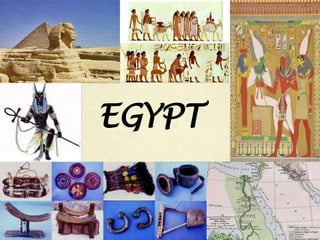
EGYPT
Bedouin Tribe
The Bedouin are the heart of the Arab peoples. Forged
from the desert, the Bedouin have adapted to the harsh
conditions before them and thrived to become one of the
most well known and most respected cultural peoples in
the world. They are the force behind so many
achievements in the Middle East. They are world
renowned for their honour, courage and hospitality, which
are very dominant in all Bedouin.
Food
One thing you will encouter while you stay here is Bedouin
food: an important part of every culture is what people eat.
Of course, this is also true for the us. Over the centuries,
typical dishes and special ways to prepare them have been
developed - secrets we are willing to pass on to our guests.
Some things you might want to know can be found on this
page, but for the real experience, you just have to come and
taste it!
Bedouin food is always cooked in the open fire, which
adds a special taste to even the simplest dish. Usually, a
meal is a social occassion, enjoyed with family or friends.
We eat with our hands: for example, rice is rolled into a
small ball and dipped into the sauce.
Traditional Dress
Bedouin clothing is adapted for desert life. They wear loose flowing
clothing that covers the skin so as to prevent heat stroke and sun
burn, but allowing air to still flow around the body so that it can be
cooled in the heat. The Keffiyeh is a large square coth folded in half
so that it forms a triangle. This is then placed on the head and held
in place with a woven cord called an Agal. This is a iconic symbol
of the Bedouin, as it helps shade them from the sun, allows air to
flow freely around the head, but also shades the face, and can be
wrapped around the nose and mouth in case of a dust storm. They
are usually coloured red and white, black and white, or just plain
white. The Bedouin women generally wear the family’s wealth on
them.
Religion
Religious Beliefs. Although a few Bedouin societies in Jordan
have remained Christian since the early Islamic period, the vast
majority of Bedouin are Sunni Muslims. The Five Pillars of
Islam are the declaration of faith, the five daily ritual prayers,
almsgiving, fasting, and the pilgrimage to Mecca. Most Bedouin
societies observe the fast of Ramadan, perform the obligatory
prayers, and celebrate the two major Islamic holidays—ʿIid al-
Fitr and ʿIid al-Adhha. Some groups endeavor to make the hajj
(the pilgrimage to Mecca) more than once in a lifetime, and
individual piety is sometimes reflected in the number of
pilgrimages an individual manages to undertake.
Columbia
Kogi people
The Kogi are descendants of the Tairona culture, which
flourished before the times of the Spanish conquest. The
Tairona were an advanced civilization which built many stone
structures and pathways in the jungles. They made many gold
objects which they would hang from trees and around their
necks. They lived not much differently from modern day Kogi.
Before the Spanish conquistadors arrived, the Tairona were
forced to move into the highlands when the Caribs invaded
around 1000 CE. The decision to flee to the mountains proved
beneficial and strategic by the time the Spanish entered
modern-day Colombia in the 15th century.
Spiritual Beliefs
The Kogi base their lifestyles on their belief in "Aluna" or "The
Great Mother," their creator figure, whom they believe is the
force behind nature. The Kogi understand the Earth to be a living
being, and see humanity as its "children." They say that our
actions of exploitation, devastation, and plundering for resources
is weakening "The Great Mother" and leading to our destruction.
Like many other indigenous tribes, the Kogi people honor a holy
mountain which they call "Gonawindua," otherwise known as
Pico Cristóbal Colón. They believe that this mountain is "The
Heart of the World" and they are the "Elder Brothers" who care
for it.[5] They also say that the outside civilization is the
"Younger Brothers" who where sent away from The Heart of the
World long ago.
Traditions
The Kogi have many characteristics that define their culture.
For example, all Kogi men receive a "poporo" when they
come of age. The "poporo" is a small, hollow gourd that is
filled with "lima," a type of powder that is made by heating
and crushing shells to produce lime. The men also
continuously chew coca leaves, a tradition followed by many
indigenous tribes to connect them to the natural world. As
they chew the coca leaves, they suck on the lime powder in
their poporos, which they extract with a stick, and rub the
mixture on the gourd with the stick to form a hardened layer
or crust. The size of this layer depends on the maturity and
the age of the Kogi man.
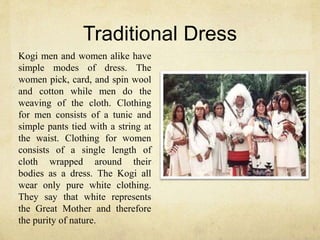
Traditional Dress
Kogi men and women alike have
simple modes of dress. The
women pick, card, and spin wool
and cotton while men do the
weaving of the cloth. Clothing
for men consists of a tunic and
simple pants tied with a string at
the waist. Clothing for women
consists of a single length of
cloth wrapped around their
bodies as a dress. The Kogi all
wear only pure white clothing.
They say that white represents
the Great Mother and therefore
the purity of nature.
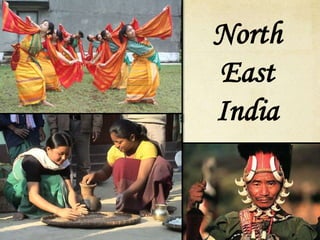
North
East
India
Bodo People
The Bodos of Assam is a branch of the great Bodo group of Indo-
Mongoloid family. The Bodos are basically an agrarian people;
still using traditional means to irrigate their land. Their chief
produce is classified into the ‘Ahu' and the ‘Sali' crops. Bodo
villages are situated in the plains of the valleys of Assam, and
hence they are categorized into what is known as the ‘Plains tribe'.
The Bodo people are expert in bamboo and cane craft; hence one
would usually come across houses fashioned out of bamboo and
wood in places where they live in majority. With the changing
times, the Bodos have taken in large numbers to the services,
business and other non-agricultural modes of livelihood.
Traditional Dress
Bodos have quite exquisite
dresses which are
exhilirating the beauty and
glamours of women. Dokna
is the dress worn by Bodo
women which they
themselves knit on their own
hands. Shawls form the
major fashion among Bodos
and thus loom is the most
important thing used in the
courtyard of the Bodo House
Food
Bodo have favoritism and taste buds for some of the
mouthwatering dishes. They are very much fond of
conventional drink called Zu Mai, Zu means wine and
Mai means rice. Rice is the main staple food but are
savored with a non vegetarian dish like fish or pork.
They now usually prefer non-vegetarian dishes. The
main dishes are Oma Bedor, Onla and Narzi
Culture
The Bodo people, akin to most tribal peoples, are a
festival loving people. The three main categories of
festivals are ‘seasonal', ‘religious', ritualistic and
ceremonial'. The seasonal festivals are (i) Baisagu, (ii)
Domashi, and (iii) Katrigacha. These three festivals are
parallel to the Bihu. Among the religious festivals of
the Bodos, the ‘Kherai' is the most famous; usually
understood to be the ‘national festival' of the Bodos.
Thank
You

Study

  • 1.
    A Comparative study Ofthe tribes of Egypt, Columbia and North east India.
  • 2.
  • 3.
    Bedouin Tribe The Bedouinare the heart of the Arab peoples. Forged from the desert, the Bedouin have adapted to the harsh conditions before them and thrived to become one of the most well known and most respected cultural peoples in the world. They are the force behind so many achievements in the Middle East. They are world renowned for their honour, courage and hospitality, which are very dominant in all Bedouin.
  • 4.
    Food One thing youwill encouter while you stay here is Bedouin food: an important part of every culture is what people eat. Of course, this is also true for the us. Over the centuries, typical dishes and special ways to prepare them have been developed - secrets we are willing to pass on to our guests. Some things you might want to know can be found on this page, but for the real experience, you just have to come and taste it! Bedouin food is always cooked in the open fire, which adds a special taste to even the simplest dish. Usually, a meal is a social occassion, enjoyed with family or friends. We eat with our hands: for example, rice is rolled into a small ball and dipped into the sauce.
  • 5.
    Traditional Dress Bedouin clothingis adapted for desert life. They wear loose flowing clothing that covers the skin so as to prevent heat stroke and sun burn, but allowing air to still flow around the body so that it can be cooled in the heat. The Keffiyeh is a large square coth folded in half so that it forms a triangle. This is then placed on the head and held in place with a woven cord called an Agal. This is a iconic symbol of the Bedouin, as it helps shade them from the sun, allows air to flow freely around the head, but also shades the face, and can be wrapped around the nose and mouth in case of a dust storm. They are usually coloured red and white, black and white, or just plain white. The Bedouin women generally wear the family’s wealth on them.
  • 6.
    Religion Religious Beliefs. Althougha few Bedouin societies in Jordan have remained Christian since the early Islamic period, the vast majority of Bedouin are Sunni Muslims. The Five Pillars of Islam are the declaration of faith, the five daily ritual prayers, almsgiving, fasting, and the pilgrimage to Mecca. Most Bedouin societies observe the fast of Ramadan, perform the obligatory prayers, and celebrate the two major Islamic holidays—ʿIid al- Fitr and ʿIid al-Adhha. Some groups endeavor to make the hajj (the pilgrimage to Mecca) more than once in a lifetime, and individual piety is sometimes reflected in the number of pilgrimages an individual manages to undertake.
  • 7.
  • 8.
    Kogi people The Kogiare descendants of the Tairona culture, which flourished before the times of the Spanish conquest. The Tairona were an advanced civilization which built many stone structures and pathways in the jungles. They made many gold objects which they would hang from trees and around their necks. They lived not much differently from modern day Kogi. Before the Spanish conquistadors arrived, the Tairona were forced to move into the highlands when the Caribs invaded around 1000 CE. The decision to flee to the mountains proved beneficial and strategic by the time the Spanish entered modern-day Colombia in the 15th century.
  • 9.
    Spiritual Beliefs The Kogibase their lifestyles on their belief in "Aluna" or "The Great Mother," their creator figure, whom they believe is the force behind nature. The Kogi understand the Earth to be a living being, and see humanity as its "children." They say that our actions of exploitation, devastation, and plundering for resources is weakening "The Great Mother" and leading to our destruction. Like many other indigenous tribes, the Kogi people honor a holy mountain which they call "Gonawindua," otherwise known as Pico Cristóbal Colón. They believe that this mountain is "The Heart of the World" and they are the "Elder Brothers" who care for it.[5] They also say that the outside civilization is the "Younger Brothers" who where sent away from The Heart of the World long ago.
  • 10.
    Traditions The Kogi havemany characteristics that define their culture. For example, all Kogi men receive a "poporo" when they come of age. The "poporo" is a small, hollow gourd that is filled with "lima," a type of powder that is made by heating and crushing shells to produce lime. The men also continuously chew coca leaves, a tradition followed by many indigenous tribes to connect them to the natural world. As they chew the coca leaves, they suck on the lime powder in their poporos, which they extract with a stick, and rub the mixture on the gourd with the stick to form a hardened layer or crust. The size of this layer depends on the maturity and the age of the Kogi man.
  • 11.
    Traditional Dress Kogi menand women alike have simple modes of dress. The women pick, card, and spin wool and cotton while men do the weaving of the cloth. Clothing for men consists of a tunic and simple pants tied with a string at the waist. Clothing for women consists of a single length of cloth wrapped around their bodies as a dress. The Kogi all wear only pure white clothing. They say that white represents the Great Mother and therefore the purity of nature.
  • 12.
  • 13.
    Bodo People The Bodosof Assam is a branch of the great Bodo group of Indo- Mongoloid family. The Bodos are basically an agrarian people; still using traditional means to irrigate their land. Their chief produce is classified into the ‘Ahu' and the ‘Sali' crops. Bodo villages are situated in the plains of the valleys of Assam, and hence they are categorized into what is known as the ‘Plains tribe'. The Bodo people are expert in bamboo and cane craft; hence one would usually come across houses fashioned out of bamboo and wood in places where they live in majority. With the changing times, the Bodos have taken in large numbers to the services, business and other non-agricultural modes of livelihood.
  • 14.
    Traditional Dress Bodos havequite exquisite dresses which are exhilirating the beauty and glamours of women. Dokna is the dress worn by Bodo women which they themselves knit on their own hands. Shawls form the major fashion among Bodos and thus loom is the most important thing used in the courtyard of the Bodo House
  • 15.
    Food Bodo have favoritismand taste buds for some of the mouthwatering dishes. They are very much fond of conventional drink called Zu Mai, Zu means wine and Mai means rice. Rice is the main staple food but are savored with a non vegetarian dish like fish or pork. They now usually prefer non-vegetarian dishes. The main dishes are Oma Bedor, Onla and Narzi
  • 16.
    Culture The Bodo people,akin to most tribal peoples, are a festival loving people. The three main categories of festivals are ‘seasonal', ‘religious', ritualistic and ceremonial'. The seasonal festivals are (i) Baisagu, (ii) Domashi, and (iii) Katrigacha. These three festivals are parallel to the Bihu. Among the religious festivals of the Bodos, the ‘Kherai' is the most famous; usually understood to be the ‘national festival' of the Bodos.
  • 17.