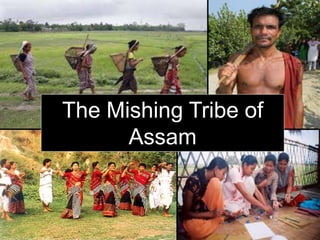
The Mishing Tribe of
Assam
Introduction
The Mishings, are the second largest schedule tribe of Assam.
Mostly they are based on riverine areas like Lakhimpur,
Dibrugarh, Sibsagar, Jorhat and Sonitpur.
The Mishing family is generally a joint family. The eldest
member of the family is highly respected. Inheritance in the
family is a patrilineal one, and the social structure - patriarchal.
After the father's death, the property is equally divided among
the sons. Daughters have no right over the property. Basically
they are peace loving and fun loving. There is no caste system
or ideas of slavery in the Mishing society.
Culture
‘Porag' is the social festival observed by the villagers after
harvesting the ‘Ahu' rice. Neighboring villagers are invited
for celebrations that go on through the night, with a lot of
singing and dancing. A great feast is arranged on the event.
The ‘Amrok' is the festival observed when food from the
harvested crop is offered. A large quantity of pork meat and
chicken is also offered along with apong, and the ‘Paskso-
Monam' dances are performed by the youth.
The ‘Ali-Ai-Ligang' is the most well-known and
widely observed festival of the Mishings. The
most important feature of the festival is the
traditional dancing and singing with Dhol or
drum, Pempa, Siphung, and Gagana. This
community festival is celebrated for a full five
days.
Religion
The traditional religious beliefs of the mishing are animistic.
They believe in different, usually invisible, supernatural beings
that haunt the earth and to which they offer sacrificial offerings,
usually chickens. Although nature worship as such is not a
common practice they do on occasion make appeasement to the
god of thunder and claim to be “children of nature”. The
mishing consider themselves to be descendants of the sun and
moon. They regard polo (moon) as their father and donyi (sun)
as their mother and always honour them first before holding a
ceremony, embarking on a business venture or making any
major decision in their life.
Language
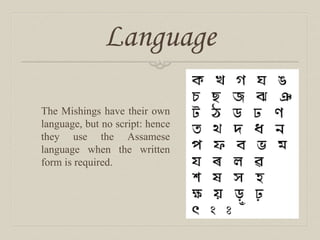
The Mishings have their own
language, but no script: hence
they use the Assamese
language when the written
form is required.
Food
Rice (apin) is the staple food of the villagers. The people
have three meals in a day. One is taken in morning, one in
mid-day and another in the evening. Though, the villagers
now-a-days know various processes of cooking, yet boiled
food is still popular among them. Along with rice, boiled
edible leaves (e.g. dermi, ombe, pakkam, takuk etc.), meat
(adin) and fish (ango) are some of the popular food items of
the villagers. Dried meat and fish are very popular.
In comparison to other food items made of rice, apong (rice
beer) is a much popular drink among the villagers. It is of
two types, viz. Nagin apong and poro apong. Out of these
two types, any one is always taken at the time of meal.
Traditional Dress
The Mishing women are expert
weavers. They produce all the cloth
necessary for the family. The women
wear the ‘sampan' around the waist; the
married women wear an additional
piece of cloth around the hip.
On the upper body, they wear the
‘Galuk'; and adorn their heads with the
‘hura'. Among other garments, the
‘Yamboo' are the ‘riwi gachang' are
notable for the women; the ‘mibu
goluk', the ‘tongali', and the ‘gonroo'
are used by the menfolk.
Current Relevance
In 2009 an armed mishing organisation under the banner of
LIBERAL DEMOCRATIC COUNCIL OF MISHING LAND
(LDCML) was formed for a separate homeland for the
mishings. Now every mishing youths have the sentiment for
their own homeland while the older generation don't seem to be
much interested while keeping their demand only for sixth
schedule. There is a wave of awareness and nationalistic pride
among the younger guns of the tribes with a serious mindset
forming various pages groups in social networking sites.
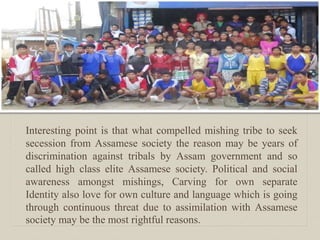
Interesting point is that what compelled mishing tribe to seek
secession from Assamese society the reason may be years of
discrimination against tribals by Assam government and so
called high class elite Assamese society. Political and social
awareness amongst mishings, Carving for own separate
Identity also love for own culture and language which is going
through continuous threat due to assimilation with Assamese
society may be the most rightful reasons.

A study of the local tribes of Assam - Mishing under ISA by the students of SBGJ

  • 1.
  • 2.
    Introduction The Mishings, arethe second largest schedule tribe of Assam. Mostly they are based on riverine areas like Lakhimpur, Dibrugarh, Sibsagar, Jorhat and Sonitpur. The Mishing family is generally a joint family. The eldest member of the family is highly respected. Inheritance in the family is a patrilineal one, and the social structure - patriarchal. After the father's death, the property is equally divided among the sons. Daughters have no right over the property. Basically they are peace loving and fun loving. There is no caste system or ideas of slavery in the Mishing society.
  • 3.
    Culture ‘Porag' is thesocial festival observed by the villagers after harvesting the ‘Ahu' rice. Neighboring villagers are invited for celebrations that go on through the night, with a lot of singing and dancing. A great feast is arranged on the event. The ‘Amrok' is the festival observed when food from the harvested crop is offered. A large quantity of pork meat and chicken is also offered along with apong, and the ‘Paskso- Monam' dances are performed by the youth.
  • 4.
    The ‘Ali-Ai-Ligang' isthe most well-known and widely observed festival of the Mishings. The most important feature of the festival is the traditional dancing and singing with Dhol or drum, Pempa, Siphung, and Gagana. This community festival is celebrated for a full five days.
  • 5.
    Religion The traditional religiousbeliefs of the mishing are animistic. They believe in different, usually invisible, supernatural beings that haunt the earth and to which they offer sacrificial offerings, usually chickens. Although nature worship as such is not a common practice they do on occasion make appeasement to the god of thunder and claim to be “children of nature”. The mishing consider themselves to be descendants of the sun and moon. They regard polo (moon) as their father and donyi (sun) as their mother and always honour them first before holding a ceremony, embarking on a business venture or making any major decision in their life.
  • 6.
    Language The Mishings havetheir own language, but no script: hence they use the Assamese language when the written form is required.
  • 7.
    Food Rice (apin) isthe staple food of the villagers. The people have three meals in a day. One is taken in morning, one in mid-day and another in the evening. Though, the villagers now-a-days know various processes of cooking, yet boiled food is still popular among them. Along with rice, boiled edible leaves (e.g. dermi, ombe, pakkam, takuk etc.), meat (adin) and fish (ango) are some of the popular food items of the villagers. Dried meat and fish are very popular. In comparison to other food items made of rice, apong (rice beer) is a much popular drink among the villagers. It is of two types, viz. Nagin apong and poro apong. Out of these two types, any one is always taken at the time of meal.
  • 8.
    Traditional Dress The Mishingwomen are expert weavers. They produce all the cloth necessary for the family. The women wear the ‘sampan' around the waist; the married women wear an additional piece of cloth around the hip. On the upper body, they wear the ‘Galuk'; and adorn their heads with the ‘hura'. Among other garments, the ‘Yamboo' are the ‘riwi gachang' are notable for the women; the ‘mibu goluk', the ‘tongali', and the ‘gonroo' are used by the menfolk.
  • 9.
    Current Relevance In 2009an armed mishing organisation under the banner of LIBERAL DEMOCRATIC COUNCIL OF MISHING LAND (LDCML) was formed for a separate homeland for the mishings. Now every mishing youths have the sentiment for their own homeland while the older generation don't seem to be much interested while keeping their demand only for sixth schedule. There is a wave of awareness and nationalistic pride among the younger guns of the tribes with a serious mindset forming various pages groups in social networking sites.
  • 10.
    Interesting point isthat what compelled mishing tribe to seek secession from Assamese society the reason may be years of discrimination against tribals by Assam government and so called high class elite Assamese society. Political and social awareness amongst mishings, Carving for own separate Identity also love for own culture and language which is going through continuous threat due to assimilation with Assamese society may be the most rightful reasons.