By: Katie
Introduction


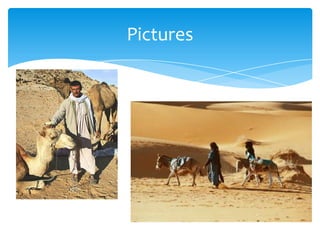
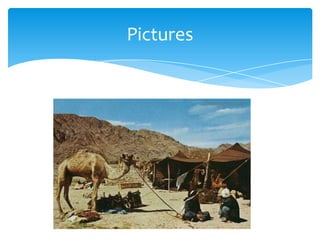
The Bedu (or Bedouin for the plural name) are nomadic
desert herders, who roam around the desert with their
families and herds of goats, camels, donkeys, and
sometimes sheep. Their money is the guinea, worth
$1.50. But the Bedu are changing, becoming more and
more modern by the day, leaving their nomadic life
styles behind very slowly.
Introduction


While some people want to live by a river or the
ocean for water and an easier life, the Beduprefer the
harsh, desert land. They are out in the desert, riding
about. But still, the Bedu love and want water and
green trees, they don’t like the dry, empty desert
land. Their language is Arabic.
As Lawrence of Arabia once said to Lord Feisal, “The
desert is an ocean, in which no oar is dipped, and on
this ocean the Bedugo where they please, and strike
where they please.”
Location


The Bedu are nomads of the Middle East. They can be
found all over the deserts of mainly Saudi
Arabia, Egypt, Israel, Jordan, Iraq, the United Arab
Emirates, Yemen, Syria, Lebanon, Kuwait, Oman, Bahrai
n, and Qatar.
Population


The exact number of Bedouins is unknown, but it
ranges from about 4 to 5 million, but that’s only about
2 or 3 people every square mile (less than 1 person
every square kilometer). About 10% of the population
are still purely Bedu, while the other 90% are more
modern.
Clothing


The traditional and typical clothing for the Bedu men
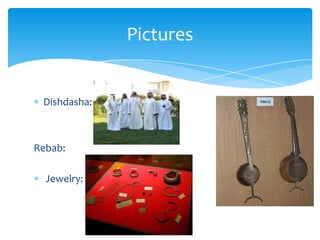
and women is the dishdasha, a long, dress-like article of
clothing worn by lots of Arabs that goes down to the
ankle. The men wear baggy pant-type clothes called
sirwal underneath the dishdasha, but the modern Bedu
men wear sweatpants. Men also have a head cloth, but
it varies from tribe to tribe. Also, both men and women
wear kuhl (kohl).
Clothing For Women


The women wear the dishdasha as an under-
dress, beneath a large, looser dress called a
thob, which is almost always colored black. But the
female Bedualso wear the baggy pants, but they’re
tight around the ankles and embroidered, under their
dishdasha. Some tribes require women to wear a
cloth wrapped around the hair and face so only the
eyes are visible.
Food


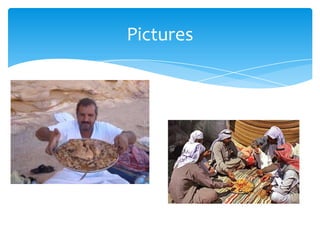
The Bedu traditionally live off a diet mainly consisting of
camel milk (cold or hot), which is usually boiled with
bread or cooked with rice. The main luxury is
meat, usually goat meat. Some Bedu, while around
coastal areas, eat fish. The Bedu also sometimes hunt
for their meat.
Hunting


Traditionally, they capture falcons in the fall, train
them, and then let them out in the spring to hunt
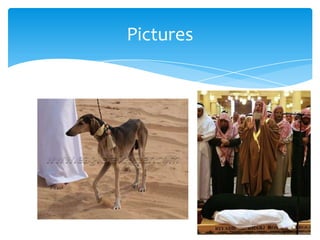
rabbits, foxes or migrating birds. Many Beduhave a
hunting dog called a Saluki, a dog similar to the
greyhound, and these are treated with great love and
affection and even sleep with their masters in the
tent. Ordinary, non-hunting dogs are filthy and not
allowed to enter the tents.
Jewelry


The Bedu women really like and love jewelry, and it’s
their custom to wear lots of it. Some Bedu women
even wear their families’ wealth in jewelry, but there
is no problem with someone trying to steal
it, because Bedu women can’t be touched by
someone not in the family (according to the code of
honor, or sharaf).
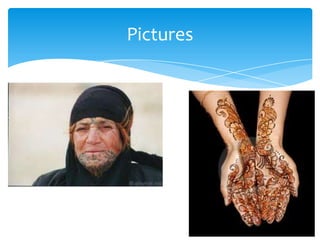
Some older women have tattoos, which back then
when they got them, they were believed to enhance
their beauty, but that has nearly died out and you will
rarely ever see a younger women with the tattoos.
Superstitions


Some Beduare superstitious, getting and buying lots
of special amulets and stones and lucky numbers
(usually odd). Kids, mainly boys, are protected with
special charms hung around their necks and ankles.
They also have special earrings that have what they
call magic stones. Some older men still have holes in
their ears from these ear studs.
Religion


The Bedu don’t all have the same religion, but they
are mainly Muslim, followers of Islam. At one time
there were Jewish and Christian tribes, but those all
died out and no longer exist. The Bedu don’t follow
the rules very well. they can’t fully practice their
religion because of their environment. They can’t do
their ritual dry washings because they don’t have the
right water. The hajj is a very important ritual and is
practiced daily, beginning at the ages of 7-8. The
prayers at noon and morning are most important.
Seasons


 The Bedu have about 5 seasons in total, but they don’t
always have 5 seasons every year, sometimes just 4. The
Bedu seasons are determined by how much rain there is.
In a rainy year, spring could be 6 weeks in February and
March, but in dry years, without lots of rain, there could
be no spring at all, going straight from winter to summer.
Music and Dance


 The traditional Bedu instrument is the rebab, also
known as the robab or rubab, and is a woodwind type
of instrument, similar to a guitar.
The Bedu don’t do many dances, though there is a
dance where the dancers get in a circle around one
main dancer and sing. If a girl is in the center, it’s a
love song, if a boy is in the center, it’s about their god.
Death


When a Bedu dies, they are buried within 24 hours of
the death. The body is prepared by washing the body
clean. The body is also shaved, especially men. The
body is finally shrouded in white cloth called kafan.
The body is buried at the cemetery nearest death.
Many ask if final words are said at the Haram. The
cemeteries are very simple, the graves aren’t
labeled, but the women aren’t allowed to enter. The
day after the burial, a 3 day mourning goes into
effect.
Marriage


Marriage isn’t always about love. Usually the bride
and groom are first cousins. Women get married
between the ages 16-22, but men get married
between the ages 18-30. The wedding is just mainly
negotiations, once the bride is escorted to the
groom’s tent. It’s also really easy to divorce, too.
Either the man states he wants one in front of a
witness, or the women could just move back to her
parents’ tent and refuse to go back.
Sports and Recreation


Being camel herders and all, they don’t really have
time for sports and recreation, or fun. But they do like
to have camel races, though. Most train their camels
to trot (picking up one foot at a time instead of going
left-right with 2 feet at a time), as this makes them go
faster. Hunting is only done for sport by rich
Bedu, although poor families need to.
At night, around a campfire, they tell stories to one
another, and sometimes the women sing songs to the
men in an informal preformance, and this is called
summejr.
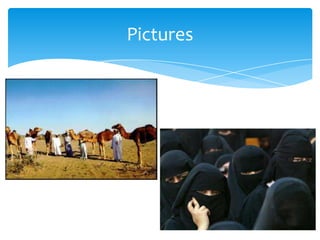
Pictures


 Dishdasha:


Rebab:

  Jewelry:
Pictures
Pictures
Pictures
Pictures

S
a
l
e
Pictures
Pictures
Lawrence of Arabia


This is a link to a website with a video from the movie:
                    ‘Lawrence of Arabia’
       http://youtube.com/watch?v=4ZD4153IubY
Questions?

Katie the bedu

  • 1.
  • 2.
    Introduction The Bedu (orBedouin for the plural name) are nomadic desert herders, who roam around the desert with their families and herds of goats, camels, donkeys, and sometimes sheep. Their money is the guinea, worth $1.50. But the Bedu are changing, becoming more and more modern by the day, leaving their nomadic life styles behind very slowly.
  • 3.
    Introduction While some peoplewant to live by a river or the ocean for water and an easier life, the Beduprefer the harsh, desert land. They are out in the desert, riding about. But still, the Bedu love and want water and green trees, they don’t like the dry, empty desert land. Their language is Arabic. As Lawrence of Arabia once said to Lord Feisal, “The desert is an ocean, in which no oar is dipped, and on this ocean the Bedugo where they please, and strike where they please.”
  • 4.
    Location The Bedu arenomads of the Middle East. They can be found all over the deserts of mainly Saudi Arabia, Egypt, Israel, Jordan, Iraq, the United Arab Emirates, Yemen, Syria, Lebanon, Kuwait, Oman, Bahrai n, and Qatar.
  • 5.
    Population The exact numberof Bedouins is unknown, but it ranges from about 4 to 5 million, but that’s only about 2 or 3 people every square mile (less than 1 person every square kilometer). About 10% of the population are still purely Bedu, while the other 90% are more modern.
  • 6.
    Clothing The traditional andtypical clothing for the Bedu men and women is the dishdasha, a long, dress-like article of clothing worn by lots of Arabs that goes down to the ankle. The men wear baggy pant-type clothes called sirwal underneath the dishdasha, but the modern Bedu men wear sweatpants. Men also have a head cloth, but it varies from tribe to tribe. Also, both men and women wear kuhl (kohl).
  • 7.
    Clothing For Women Thewomen wear the dishdasha as an under- dress, beneath a large, looser dress called a thob, which is almost always colored black. But the female Bedualso wear the baggy pants, but they’re tight around the ankles and embroidered, under their dishdasha. Some tribes require women to wear a cloth wrapped around the hair and face so only the eyes are visible.
  • 8.
    Food The Bedu traditionallylive off a diet mainly consisting of camel milk (cold or hot), which is usually boiled with bread or cooked with rice. The main luxury is meat, usually goat meat. Some Bedu, while around coastal areas, eat fish. The Bedu also sometimes hunt for their meat.
  • 9.
    Hunting Traditionally, they capturefalcons in the fall, train them, and then let them out in the spring to hunt rabbits, foxes or migrating birds. Many Beduhave a hunting dog called a Saluki, a dog similar to the greyhound, and these are treated with great love and affection and even sleep with their masters in the tent. Ordinary, non-hunting dogs are filthy and not allowed to enter the tents.
  • 10.
    Jewelry The Bedu womenreally like and love jewelry, and it’s their custom to wear lots of it. Some Bedu women even wear their families’ wealth in jewelry, but there is no problem with someone trying to steal it, because Bedu women can’t be touched by someone not in the family (according to the code of honor, or sharaf). Some older women have tattoos, which back then when they got them, they were believed to enhance their beauty, but that has nearly died out and you will rarely ever see a younger women with the tattoos.
  • 11.
    Superstitions Some Beduare superstitious,getting and buying lots of special amulets and stones and lucky numbers (usually odd). Kids, mainly boys, are protected with special charms hung around their necks and ankles. They also have special earrings that have what they call magic stones. Some older men still have holes in their ears from these ear studs.
  • 12.
    Religion The Bedu don’tall have the same religion, but they are mainly Muslim, followers of Islam. At one time there were Jewish and Christian tribes, but those all died out and no longer exist. The Bedu don’t follow the rules very well. they can’t fully practice their religion because of their environment. They can’t do their ritual dry washings because they don’t have the right water. The hajj is a very important ritual and is practiced daily, beginning at the ages of 7-8. The prayers at noon and morning are most important.
  • 13.
    Seasons The Beduhave about 5 seasons in total, but they don’t always have 5 seasons every year, sometimes just 4. The Bedu seasons are determined by how much rain there is. In a rainy year, spring could be 6 weeks in February and March, but in dry years, without lots of rain, there could be no spring at all, going straight from winter to summer.
  • 14.
    Music and Dance The traditional Bedu instrument is the rebab, also known as the robab or rubab, and is a woodwind type of instrument, similar to a guitar. The Bedu don’t do many dances, though there is a dance where the dancers get in a circle around one main dancer and sing. If a girl is in the center, it’s a love song, if a boy is in the center, it’s about their god.
  • 15.
    Death When a Bedudies, they are buried within 24 hours of the death. The body is prepared by washing the body clean. The body is also shaved, especially men. The body is finally shrouded in white cloth called kafan. The body is buried at the cemetery nearest death. Many ask if final words are said at the Haram. The cemeteries are very simple, the graves aren’t labeled, but the women aren’t allowed to enter. The day after the burial, a 3 day mourning goes into effect.
  • 16.
    Marriage Marriage isn’t alwaysabout love. Usually the bride and groom are first cousins. Women get married between the ages 16-22, but men get married between the ages 18-30. The wedding is just mainly negotiations, once the bride is escorted to the groom’s tent. It’s also really easy to divorce, too. Either the man states he wants one in front of a witness, or the women could just move back to her parents’ tent and refuse to go back.
  • 17.
    Sports and Recreation Beingcamel herders and all, they don’t really have time for sports and recreation, or fun. But they do like to have camel races, though. Most train their camels to trot (picking up one foot at a time instead of going left-right with 2 feet at a time), as this makes them go faster. Hunting is only done for sport by rich Bedu, although poor families need to. At night, around a campfire, they tell stories to one another, and sometimes the women sing songs to the men in an informal preformance, and this is called summejr.
  • 18.
  • 19.
  • 20.
  • 21.
  • 22.
  • 23.
  • 24.
  • 25.
    Lawrence of Arabia Thisis a link to a website with a video from the movie: ‘Lawrence of Arabia’ http://youtube.com/watch?v=4ZD4153IubY
  • 26.